Lifestyle
How long can Taylor Swift dominate the album chart?

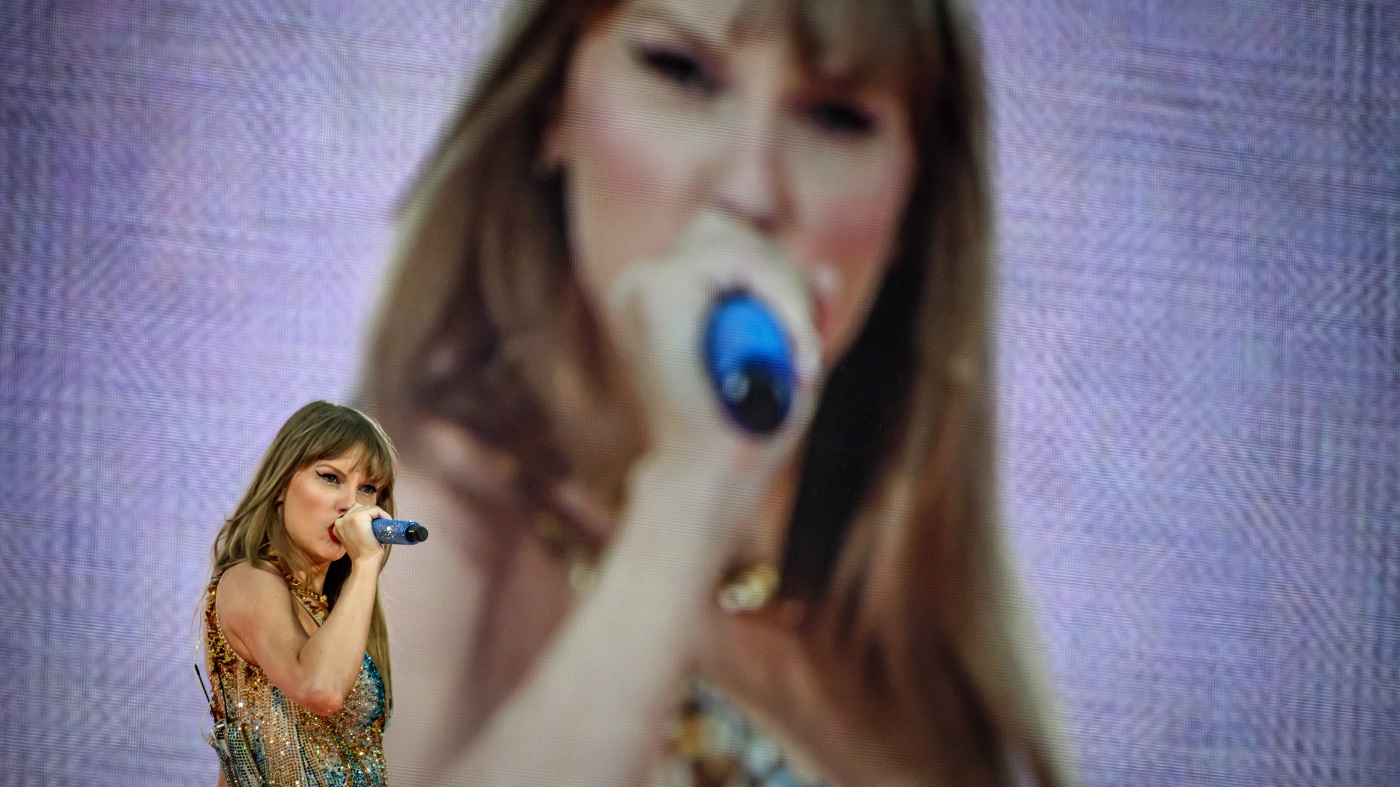
Taylor Swift performs in France during the European leg of her record-breaking Eras Tour on June 2.
Jeff Pachoud/Getty Images
hide caption
toggle caption
Jeff Pachoud/Getty Images
As summertime gets into full swing, the charts of the country’s most popular songs and albums are still being dominated by two very familiar names: Post Malone and Taylor Swift. Given that summertime is usually ruled by individual (and often ephemeral) bangers rather thanfull albums, we might be seeing a full Swiftie season ahead on the albums chart. The Billboard Hot 100 songs chart, on the other hand, is less steady, especially in recent years, when we’ve seen the meteoric rise of newbies’ hits springing out of social media (“Rich Men North of Richmond,” anyone?), so that’s where we might see more movement in the weeks to come.
TOP SONGS
Most of this week’s top five on Billboard’s Hot 100 looks remarkably like last week’s: Post Malone’s “I Had Some Help” featuring Morgan Wallen is at No. 1 for the third week in a row, trailed by Kendrick Lamar’s “Not Like Us,” Tommy Richman’s “Million Dollar Baby” and Shaboozey’s “Tipsy (A Bar Song).”

There’s one newcomer among their ranks: former Disney star-turned-singer Sabrina Carpenter, whose disco-inflected pop confection “Espresso” climbed one spot from No. 6 to No. 5. And right behind her, there’s still another indication that 2024 will indeed be the Summer of Country: Zach Bryan’s weeper “Pink Skies” makes its chart debut at No. 6.
This week also marks the annual return of (yet) another Billboard chart: Songs of the Summer, which the magazine introduced in 2010. This chart looks at songs’ cumulative performance throughout the summer (which Billboard begins with this week’s chart and ends the week of Labor Day). This early in the season, this chart is a snooze — all 20 positions are an exact replica of the top 20 spaces on the Billboard 100 chart — but it will be worth keeping an eye on in the months to come.
TOP ALBUMS
In news that is most likely a surprise to no one, Taylor Swift’s The Tortured Poets Department is spending a sixth week in the No. 1 slot on the Billboard 200 albums chart. What may be slightly more startling information: following a bump after she released many deluxe and special issues of Tortured Poets, Swift is starting to experience a downturn in sales and streaming — and she’s not the only one.
Last week, Swift moved (to borrow a reviled music industry term) 378,000 equivalent album units (I promise, that’s the end of the jargon — at least for now). This week, she only had 175,000 units, per Luminate, the company that compiles the data that make up the Billboard charts. That’s a nearly 54% drop in just seven days — and many psychic worlds away from the first week of Tortured Poets, when Swift earned 2.61 million equivalent album sales a mere month and a half ago.
But Swift may not the only artist starting to sing the summertime blues. Although Bilie Eilish’s album Hit Me Hard and Soft is right behind Swift in the No. 2 spot for a second week in a row, she too has experienced a big drop with 145,000 units, down from last week’s 339,000 — which was a career high for Eilish.
While we’re not at the doldrums of the early 2010s, this is a trend to watch.
WORTH NOTING
One of the not-so-hidden industry secrets of the Billboard 200 chart is that generally, a rather bountiful proportion of its membership is comprised of so-called “catalog” titles: albums that have been commercially available for at least 18 months and sometimes for far, far longer than that.
This week’s chart is a textbook case in point: By my cursory estimate, about 57% of this week’s entries are deep catalog titles, with even more just approaching the 18-month mark. For example, Fleetwood Mac’s Rumours, which was originally released in 1977, is currently at No. 31, having now racked up 583 weeks on this chart; the Bob Marley & the Wailers’ perennially beloved greatest hits collection, Legend (issued in 1984), sits at No. 35, 837 weeks strong and counting. Other nearly eternally charting artists include Journey, Creedence Clearwater Revival, Eminem, Bruno Mars and Guns N’ Roses.
All that is a reminder of just how hard it can be for current — and especially emerging — stars to break through all those longtime favorites, even at the more modest chart positions. If anyone is going to challenge Taylor Swift’s hegemony on the Billboard 200 this summer, perhaps it will be one of these elders.


Alan Greenspan and Ayn Rand are pictured in the Oval Office on Sept. 4, 1974, after Greenspan’s swearing in as Chairman of the Council of Economic Advisors.
David Hume Kennerly/Getty Images/Hulton Archive
hide caption
toggle caption
David Hume Kennerly/Getty Images/Hulton Archive
One of the most important intellectual relationships in the life of Alan Greenspan, the prominent former central banker who died Monday, was with author Ayn Rand, whose 1957 novel Atlas Shrugged has become a perennial favorite among conservatives and which the Library of Congress named as one of the books that has shaped America.
The two first met when he was in his mid-twenties and she was in her forties, and already well-established via her 1943 novel The Fountainhead, which had been a best-seller. They were introduced through Greenspan’s then-wife, the Canadian art historian Joan Mitchell. Mitchell was a close friend of the wife of Nathaniel Branden. Branden was Rand’s protege and longtime lover.
Greenspan and Mitchell wed in 1952, but divorced within a year. By contrast, Greenspan’s relationship with Rand was far more lasting: they remained friends until her death in 1982.

Through the Branden connection, Greenspan joined Rand’s “Collective,” a small group of friends and thinkers who would gather regularly at Rand’s midtown Manhattan apartment to discuss politics, world events and ideas. He became a Collective regular.
According to Greenspan’s 2007 memoir, The Age of Turbulence: Adventures in a New World, Rand nicknamed Greenspan “the undertaker” early on in their friendship, thanks to his penchant for dark suits and his sober demeanor.
His dour reputation was at odds with his early artistic pursuits. He was a talented musician. Before pursuing an economics degree at New York University, he enrolled at Juilliard to study clarinet, and as a teenager played in a swing band alongside jazz legend-to-be Stan Getz. His musical tastes were just as conservative as his politics, however: in his memoir, he dismissed almost every form of post-big band popular music as “on the edge of noise.”

Greenspan wrote for Rand’s magazine, The Objectivist, including contributing an influential essay on the gold standard in 1966 that was later reprinted in her book Capitalism: The Unknown Ideal. When he was sworn in as chairman of the Council of Economic Advisers during the Ford administration, it was Rand who stood with him, along with Rand’s husband, Frank O’Connor, and Greenspan’s mother Rose Goldsmith.
“Ayn Rand became a stabilizing force in my life,” he wrote in his memoir. “She was a wholly original thinker, sharply analytical, strong-willed, highly principled, and very insistent on rationality as the highest value. In that regard, our values were congruent – we agreed on the importance of mathematics and intellectual rigor.”


Laverne Cox says that even from a young age, there was “always music in my head.” Her new memoir is called Transcendent. She’s shown above in New York in April 2026.
Dimitrios Kambouris/Getty Images
hide caption
toggle caption
Dimitrios Kambouris/Getty Images
For more than a decade, Laverne Cox has been one of the most visible trans women in America. But the Orange Is the New Black star says she spent most of her childhood in Mobile, Ala., keeping herself hidden.
A turning point came when she was in third grade, on a church field trip to Six Flags. She bought a paper fan to cool herself, and caught the attention of her teacher.
“I was having a Scarlett O’Hara moment, fanning myself,” Cox says. “And then later that day, my mother comes in and tells me she had gotten a call from the school … and [my teacher] said that I would end up in New Orleans wearing a dress if we didn’t get me into therapy right away.”

When she was 8 or 9, Cox was sent to conversion therapy, where, she says, a therapist suggested injecting her with testosterone. “The idea was that that was supposed to make me more masculine,” she says. “My mother, thank God, said no to that.” But Cox knew she needed to leave Mobile.
In her new memoir, Transcendent, Cox writes about her journey from Mobile to show business. She remembers being bullied mercilessly by other children at school — a situation made worse by her mother’s reaction: “My mother … instead of having an impulse to protect me or care for me or ask if I was OK, she made it my fault,” she says.
In the 1990s, she moved to New York City and began auditioning for roles, first as a dancer and then as an actor. She also started experimenting with gender norms; she began her medical transition in 1998, at the age of 26.

For Cox, writing her memoir is an act of resistance and healing: “After 2023, it became very clear to me that we, that trans people had lost the culture,” she says. “I knew this was the beginning of a disaster in terms of policy. … The dehumanization was so clear to me, and so I think I also thought maybe one more human story out there can help.”
Interview highlights

On the anger she still feels about being bullied as a child
As an adult, I’m angry at the boys. I am angry at my mother. I want to protect that little child. I’m just so angry. I’m so hurt. … There’s also like the anger [about] all the kids that I’ve met who are trans or queer who are still experiencing this, and the anger of knowing that in states that have passed anti-trans laws that the percentage of bullying has skyrocketed in those states. … There’s the rhetorical piece that happens in the media that is dehumanizing and stigmatizing trans people. And it creates a permission structure. If, like your governor and your state legislators are doing [it], if your teachers and pundits on TV are doing it, then of course kids are emboldened to do it. And that makes me so angry.
On beginning to wear skirts and dresses in college
I had internalized so much transphobia. Like, ending up “in New Orleans wearing a dress” was presented to me as the absolute worst thing that could happen to me. In my young mind I imagined I would be on the street and I would be homeless and a person who needed to like do unfortunate things to survive. So it just was presented as something that was the absolute opposite of the straight A student that I was, the human being that I was, who was determined to be successful. So I didn’t wear skirts and dresses until college … but I did start wearing girls’ clothes that I would purchase from the thrift stores in Mobile and in Birmingham. And it was such a fun, wonderful exploration. … In high school I read about Oscar Wilde. He talked about creating yourself as a work of art, and I loved that as a concept.
On being drawn to show business

There was always music in my head, which is such a wonderful gift. From the second I was walking, I was dancing, and I danced everywhere. And it just took me away. … [It was] like a character. There was a person that I could play. So I was in a character and then I was in a new setting. And so all the times we would be at the supermarket in the grocery store, I just loved pushing the grocery cart and then dancing with the grocery cart as if it was like a partner. … Finally in third grade, I got to start studying dance. And that really, that was the best thing ever for me.
On growing up with a twin brother

There’s a closeness now. It’s healthier now than it’s ever been with my brother. But … we were not a touchy feely family. We weren’t a family that said, “I love you.” We weren’t a family that hugged. There was no affection. So my brother and I, so we didn’t do that. … But we bonded most around music, art. There were periods when I would be in dance class and he would come and watch and critique and he’d give me his notes.
On her twin brother playing her pre-transition character in Orange Is the New Black
It was my character’s back story. And the initial idea was that they needed to hire another actor to play me pre-transition. … [And I] asked my brother if he’d be open to it. And he said, “How much does it pay?” And then he ended up going in for the audition, but he had an advantage because he kind of looks a little bit like me. … So he booked it and did it and he had regrets about it for a while because he has his own work and his own life and he wants to be defined by his work and not mine.
Ann Marie Baldonado and Susan Nyakundi produced and edited this interview for broadcast. Bridget Bentz, Molly Seavy-Nesper and Beth Novey adapted it for the web.


-

 Cleveland, OH2 minutes ago
Cleveland man dies after fatal shooting at gas station
-

 Austin, TX9 minutes ago
Adobro’s Filipino-Fiesta-meets-Texas-Dancehall “Right Here, Right Now” Album Release Party
-
 Alabama17 minutes ago
Alabama hires former college offensive lineman as assistant tight ends coach
-
 Alaska19 minutes ago
Starry fire picks up, wrapped with hose
-

 Arizona25 minutes ago
Backyard blaze erupts after Arizona monsoon lightning strike
-
Arkansas32 minutes ago
Arkansas Lottery Powerball, Cash 3 winning numbers for June 22, 2026
-

 California34 minutes ago
Shooting at a Northern California library kills 2, and a suspect is in custody
-

 Colorado40 minutes ago
The Colorado River is vanishing — and the fixes are getting weird

