Lifestyle
How a forgotten California border town became a hip hideaway — with hot springs and music


The first two surprises, as you roll up Old Highway 80 into this dry and silent Sonoran Desert town, might be the steam and the music.
The steam rises from two pools at the recently reborn Jacumba Hot Springs Hotel. The music seeps from a bathhouse ruin where the hotel stages weekend performances.
On this night it’s a torch song from long ago, sung by an acoustic duo for a small, rapt, eclectic audience — hipsters in their 30s, retirees in their 70s, desert rats and spa seekers, all sitting under the open sky as night falls on the roofless building, a few million surrounding boulders and a long, tall fence that runs into the hills.
These are features that California daydreams are made of, and this emergent scene is luring visitors to an outpost 70 miles southeast of downtown San Diego.
Bar patio area of the Jacumba Hot Springs Hotel.
(Pia Riverola)
“It’s a refuge from the stressors of the city. Things seem to wash away here,” co-owner Melissa Strukel said recently.
Now, a few more surprises: The town of Jacumba Hot Springs has been down on its luck for decades. That long fence, 2,100 feet south of the hotel, is the Mexican border, where undocumented migrants pass regularly and a crisis flared last year. And the hotel’s owners are new to town and the business.
“Everything is the first time,” Strukel said.
It was four years ago, early in the COVID shutdown, that Strukel, a veteran San Diego designer and special-event rental entrepreneur, decided to take a drive.
She wound up in a town she’d never noticed before, standing outside a bedraggled old motel, smitten.

Siren Suite 11at the Jacumba Hot Springs Hotel.
(Mikael Kennedy)
So smitten, in fact, that she climbed over a wall to get a better look.
“I just knew right away that I belonged here,” Strukel said.
Soon she learned that the motel was for sale — with a catch. The owner wanted to sell it in a 150-acre package deal with most of the commercial property in town: a gas station (without gas), several homes and storefronts, a ruined bathhouse and a littered mess that was once a man-made lake.
Undeterred, Strukel enlisted her business partner Corbin Winters and they formed a plan.
They would recruit their friend Jeff Osborne, a former client and real estate business veteran. They would make the 24-room motel and restaurant into a resort with 18 rooms, two suites, restaurant, bar and global desert vibe, drawing on influences from Mexico to Marfa to Morocco.
They would replumb the hot springs to take advantage of the alkaline water’s “silky texture,” refill the lake, recruit a veteran general manager for the hotel and use the houses as vacation rentals, including two with their own soaking tubs.

Jacumba Lake is a recently revived reservoir fed by the same springs that feed the Jacumba Hot Springs Hotel. The hotel’s owners worked to refill the lake and plant the shoreline with palm trees.
(Christopher Reynolds/Los Angeles Times)
They would build a new sense of community in Jacumba Hot Springs, where the population is 540, the median age around 62, and the median income and property values are some of the lowest in the county. The nearest full-fledged grocery store is 45 minutes away; the nearest public school, several miles down the road; the nearest legal border crossing, an hour away in Tecate.
“At first I was like, ‘ah, no way,’” Osborne recalled.
But Osborne, 38, whose experience includes several years of house-flipping and short-term rental management, thought on it some more. He drove into town, spent a night in a tent by the lake and changed his mind.
By October 2020 a deal was done. Doing business as We Are Human Kind Inc., the trio paid more than $1.6 million — but less than $3.9 million, Osborne said, declining to be more specific.
Unlike many hotel owners, all three moved to town, taking on major roles in a community short on resources and long on characters.
“This community was the end of the line for a long time,” said Sam Schultz, 69, who lives east of town at the Desert View Tower with eight dogs and at least 12 cats.

Desert View Tower was built as a tourist attraction in the 1920s.
(Christopher Reynolds/Los Angeles Times)
On any day, migrants might be illegally crossing the border nearby, breaching a fence that starts, stops and varies in height, a product of shifting politics and stony slopes.
Yet most of the time, border-crossers are quickly met and taken away by the Border Patrol agents who steadily cruise the dirt roads and highway.
“I haven’t seen one person [crossing] for a couple of weeks now,” said Osborne, who lives in a stone house on a knoll known as Snob Hill. “I live less than a thousand feet from the border … and I don’t lock my doors.”
During my two days in town, I didn’t see anyone crossing, either. But I met plenty of the neighbors.
In the Exotic Desert Hideaway — a.k.a. the hotel bar — you might bump into Roman Wrosz, a 68-year-old inventor and longtime local who flies gliders at the otherwise lonely Jacumba airport.
Along the highway east of town, you will probably encounter Coyote, a 67-year-old junkyard proprietor with a booming baritone voice and a truck that says “UFO retrieval and repairs.”

Exotic Desert Hideaway bar at the Jacumba Hot Springs Hotel.
(Mikael Kennedy)

The Jacumba Hot Springs hotel includes a dark bar decorated with paintings of nudes.
(Christopher Reynolds/Los Angeles Times)
If you see a bearded man in a wheelchair working the register at Sunday breakfast in the town’s community center, that’s probably Eldon Caldwell, 75, who lives in one of the little houses the newcomers purchased.
“They inherited me as tenant,” Caldwell said. “They haven’t raised my rent. They put a shower in for me.”
While Caldwell works the register at those Sunday community center breakfasts, Winters volunteers every other week as a server — again, not standard hotelier behavior. Osborne has signed on as the center’s board president.
“It’s magnificent, what they’ve done,” said Kirk Gilliam, a 69-year-old artist/electrician who builds robot sculptures in a gallery two doors down from the Mountain Sage market on Old Highway 80.
If the new hotel team has its way, more neighbors will arrive soon to fill open hotel jobs and take over storefront vacancies.
“This is not a flip,” said Strukel.


Bathroom scene at the Jacumba Hot Springs Hotel. (Mikael Kennedy; Pia Riverola)
It is, however, one of biggest changes in town since 1919. That’s when a San Diego magnate named John Spreckels opened his “impossible railroad,” running tracks through Jacumba on the boulder-filled hill-and-valley path from San Diego to Yuma.
Next came Highway 80 and speculator Bert Vaughn, who built a four-story hotel, bathhouse and a desert view tower to lure San Diego-Arizona drivers off the road. By the 1950s, a motel and man-made lake had been added.
At the town’s peak, Osborne said, “they say there were 5,000 people here on the weekends.”
But the rail line fell idle. Interstate 8 (two miles north of town) stole most of the passing traffic in the 1970s. The bathhouse and four-story hotel burned.
For a while it seemed the town’s saviors might be a pair of nudists: In the 1990s, David and Helen Landman bought an RV park outside town, converted it into a clothing-optional resort and moved in. Then in 2012, the Landmans bought and made improvements on most of downtown. But as the pandemic began, the couple’s patience ran out. They sold the hotel and most of downtown to Strukel, Winters and Osborne, then peddled the clothing-optional resort, DeAnza Springs, to other buyers in early 2021.
By early last year, the team was deep into redesign and reconstruction, and it was clear that making over the hotel and downtown Jacumba Hot Springs would cost more than buying them did.

The Solstice Pool at the Jacumba Hot Springs Hotel.
(Kate Berry)
To bring back the lake, the three hired workers to spend months scraping with a tractor, consulted with the nonprofit group Indigenous Regeneration, then added about 70 California-native palm trees, which line a sandy shore.
Then the world intervened. In the space of a few spring days, hundreds of immigrants surged over and around the border fence.
Most had come from far beyond Mexico, speaking Chinese, Portuguese and other languages, apparently drawn by the expiration of Title 42, a pandemic-era public health measure that allowed authorities to turn away asylum-seekers more easily. A U.S. Customs and Border Protection spokesman said the migrants had been “callously placed [in the area] by for-profit smuggling organizations.”
Once across, the migrants gathered in three encampments and built campfires in the hills south of Old Highway 80, eager to be seen and considered for asylum, most of them without food, water or protection from the elements.
“It was two weeks of bad,” Strukel said.
While the Border Patrol decided how to respond, Jacumba locals spread the news. The hotel team set up a collection site and began to gather and distribute supplies with help from Border Kindness, a Mexicali-based nonprofit, and other groups.
“There were locals who brought out food and supplies, and there were others who hated them for that,” said Gilliam.

The co-owners of the Jacumba Hot Springs Hotel, seen in the old gas station that serves as their office, are (from left) Corbin Winters, Melissa Strukel and Jeff Osborne.
(Christopher Reynolds/Los Angeles Times)
The hoteliers “weren’t even open and they were using the kitchen as a place for people to bring supplies,” said Kelly Overton, executive director of Border Kindness. “There was no foreseeable benefit to them. They chose to do what they thought was the right thing. … Not everybody makes that decision when it comes to their business and their money.”
As the flow continued into 2024, the Border Patrol imposed more order and sent more buses. Then Mexico boosted its immigration law enforcement near the border and the Biden administration tightened asylum restrictions. Now, Border Patrol officials and locals agree that numbers are down again.
At the hotel, Strukel, Winters and Osborne began a gradual opening in late 2023, launching into daily operation in February, inviting newcomers to explore “an unexpected escape on the dusty edge of everything.”
Its workforce has grown to about 75 people, including general manager Natalie Richards from San Diego, chef Leo Ceja from Los Angeles and director of special programming and hospitality Juan Miron, originally from Tijuana.
I arrived on a Friday, ducking into a rustic-chic trailer that houses the front desk.

The Jacumba Hot Springs Hotel, built as a motel and dramatically reborn in 2024 as a boutique hotel, includes Moroccan design details, multiple pools, record players and curated paperbacks in guest rooms.
(Mikael Kennedy)
Beyond the Moroccan entry gate and wind chimes from Arcosanti in Arizona, every guest room features stylish tiling, a turntable and an adventurously curated selection of books and albums. (Mine included two Louis L’Amour paperbacks and albums by country crooner Charley Crockett and Ethiopian sax player Getatchew Mekuriar.)
Most guests so far have come from San Diego County, “a lot of creative professionals,” Osborne said, and “people that like things off the beaten path, that like going down dirt roads.” Rates typically start at $180 on weekdays, $360 on weekends. (The only other lodging option within five miles of town is the rustic DeAnza Springs Resort.)
That afternoon, guests lounged around the Solstice Pool and Ritual Pool (where sometimes movies are screened) or stepped inside to the warmer soaking tub in the Echo Room.
The Exotic Desert Hideaway Bar — as dim as the desert day is bright— features kitschy nudes on the walls, DJs on weekends, $5 beer during happy hour and a $78 cocktail situation known as “The Fortune Teller.” (It comes flaming in a cauldron, includes tequila and serves six.)
Down the block, Kirk Gilliam usually has his gallery open on weekends. Next to the gallery, David Lampley sells vintage clothes at the Impossible Railroad Trading Post and serves as director of auditory and visual experiences for the hotel. (If you’d like to make a mono recording on a 1938 record-cutting machine, he can help with that too.)
Out at the born-again lake, Coyote the junk dealer has contributed three kayaks and a canoe for anyone who feels like paddling. There’s no fishing, but wildlife sightings are common, including a very large cat — a black jaguar? — at water’s edge in early October.
Though the old bathhouse down the street remains in ruins, it’s busy almost every Saturday night. That’s when the hotel team dresses the roofless structure up with bistro lights and candles and invites an eclectic mix of musicians to play under the stars. Besides torch songs, sea shanties, Latino roots and rockabilly tunes have been heard.

The Jacumba Hot Springs Hotel’s amenities include an old bathhouse, now without water or roof, where the hotel stages weekly candlelight concerts. The performers are Tiny and Mary, a sibling duo.
(Christopher Reynolds/Los Angeles Times)
“I’ve been coming out here since I was a teenager, and I never told anyone about it,” singer-songerwriter Mary Simich, 31, told me. “I was afraid people would ruin it.”
Now Simich, who lives in Orange County, is trying to buy a house in town.
The border remains a wild card (especially with new presidents in office or coming soon on both sides of the border). But this dusty little town is already in transition.
Strukel, Winters and Osborne say occupancy at the Jacumba Hot Springs Hotel is now running above 90%. Entrepreneur Max Daily, semi-famous in San Diego for running the pop-up Oslo Sardine Bar, has announced plans to open an eatery on Old Highway 80 with a stage for live music. Possible name: the Jacumba Yacht Club.
Meanwhile at DeAnza Springs — the former clothing-optional resort north of town — new owners Luke Wasyliu and Kevin Cho have made clothing mandatory, upgraded infrastructure and boosted a focus on wellness, glamping and weekend music festivals, including Youtopia, an October gathering aimed at devotees of Burning Man.
“It’s gentrification,” neighbor Sam Schultz said recently, sitting near the entrance of the Desert View Tower. “And a certain amount of gentrification is good for us around here.”
What to do, see and eat in and near Jacumba
Jacumba Hot Springs Hotel, 44500 Old Highway 80, Jacumba Hot Springs; (760) 766-4333. Room rates start at $180 on weekdays, $360 on weekends.
DeAnza Springs Resort, 1951 Carrizo Gorge Road, Jacumba Hot Springs; (619) 766-4301. The campground has 311 RV sites and about two dozen rental travel trailers, tiny homes, tent sites and motel rooms, two pools and a restaurant. Neighbored on three sides by Anza-Borrego Desert State Park, it also has many trails, including the scenic 1.1-mile Temple Peak Loop Trail. Hikers pay $5 each for trail access, a good bargain. Often hosts weekend music festivals.
Desert View Tower, In-Ko-Pah Road, Jacumba; (619) 971-2845. The view from this 70-foot tower is OK. The best part of the property is the neighboring trail among boulders, where someone long ago carved and painted all sort of faces and creatures. Adult admission $9.50.
Pacific Southwest Railway Museum, 750 Depot St., Campo. Open Saturday and Sunday, 9 a.m.-5 p.m. Admission $10 for adults. The museum is a place for hard-core train people, unless you’re going on a train ride (about 10.5 miles round-trip). Those are offered on Saturdays at 10:30 a.m., 1 p.m. and 2:30 p.m., at varying prices. The museum also has a location in La Mesa.
Gaskill Brothers Stone Store Museum, Forest Gate Road and Historic Highway 94, Campo; (619) 980-2013. Includes a timeline on local history. The upstairs of the stone story museum is mostly about the Buffalo Soldiers. Open Saturdays and Sundays, 11 a.m.–4 p.m.
Camp Lockett Event & Equestrian Facility, 799 Forest Gate Rd., Campo; (619) 369-9399. Including a Buffalo Soldier Museum, horse facilities and camping area. The camp, built in 1941 and closed in 1946, was the last base of operations for Black “Buffalo Soldiers” before the U.S. Army integrated and disbanded cavalry units. The Buffalo Soldiers guarded the U.S.’ southern border and Italian prisoners of war. Museum opens Saturday 9 a.m.- 5p.m., closed in December.



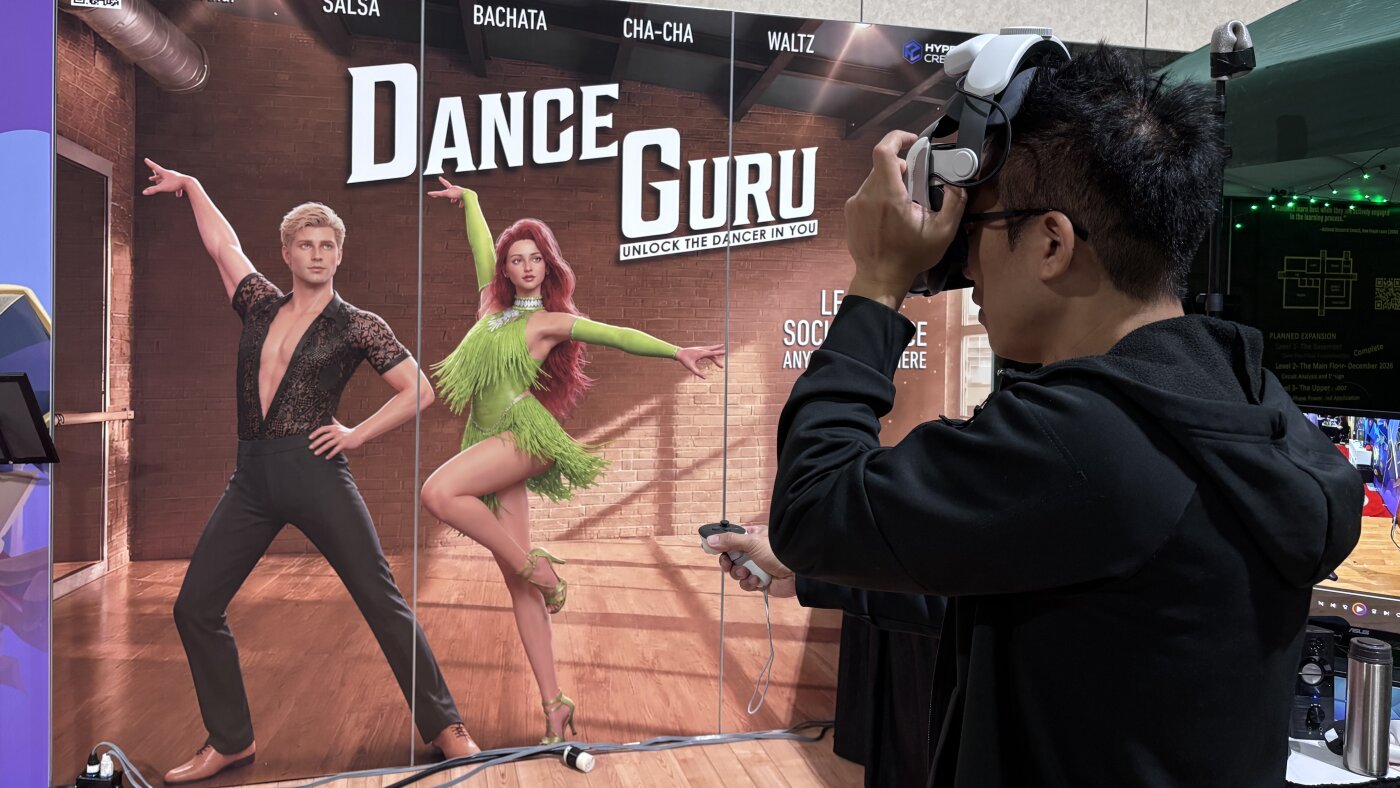
Entrepreneur David Huang tests out a VR headset while conducting demonstrations of the social dance lesson app Dance Guru at the Augmented World Expo in Long Beach, Calif., June 17, 2026.
Chloe Veltman/NPR
hide caption
toggle caption
Chloe Veltman/NPR
Wedding season is in full swing, bringing with it a familiar sense of dread for anyone who fears the dance floor.
But relief may finally be at hand with the help of a new app, Dance Guru, and a virtual reality (VR) headset.
The social dance instruction app transports users to a spacious, digital dance studio. Waiting inside is a computer-generated coach: a handsome, male avatar wearing a shirt open to his navel. He speaks with a slightly gravelly English accent.
“Watch me now,” he instructs at the start of a waltz lesson — which NPR tried out at the Augmented World Expo in Long Beach, Calif., an annual conference showcasing the latest developments in virtual and augmented reality.
The avatar then demonstrates a basic box step.
From there, the lesson becomes interactive. The coach tells the user to hold his hand while an electric pinging sound tracks the student’s foot placement.
“One, two, three, four, five, six,” the virtual teacher counts down.
When the user stumbles, he remains remarkably patient. “Do not worry, foundations take time. Let’s try that again. Work on grounding your steps more intentionally.”
Solving the beginner’s dilemma
Dance Guru creator David Huang said he came up with the idea for the app a couple of years ago out of frustration.
“I always wanted to learn to dance and I was always terrible at it,” Huang said. “And I always ended up stopping midway through the lessons.”
He soon realized that many beginners hit the exact same roadblocks.

“Private lessons are too expensive, and you feel like you’re always forgetting the dance steps,” Huang said. “You cannot find a partner to dance with. So I figured maybe I can create something like this.”
The Dance Guru platform currently offers tutorials in salsa, bachata, waltz, and cha-cha, in both lead and follow modes. To make the digital instruction feel authentic, Huang used motion-capture technology to record the movements of real-life dance teachers — with their permission.
Building on the legacy of online tutorials and video games
Dance Guru belongs to a small but growing wave of apps using VR to demystify social dance. At a nearby booth, conference attendee Victor Chen is testing out a competing app called Trip the Light. It currently offers salsa lessons, as well as freestyle options, where a user can dance with a partner without having to learn specific steps.

Trip the Light’s booth at the Augmented World Expo included posters of the app’s virtual instructors. Real-life performers, who gave Trip the Light permission to motion capture their movements, were used as a basis for these avatars.
Chloe Veltman/NPR
hide caption
toggle caption
Chloe Veltman/NPR
“A lot of times when you’re trying to learn a choreography, it’s watching a YouTube video and you have to pause it, rewind, and play it,” Chen said. “If you were to have a virtual avatar dancing in front of you and correcting for any parts that you missed, it might be a lot easier.”
Interactive video games like Dance Dance Revolution and Just Dance, and YouTube tutorials have been helping people improve their skills in private for years. But those games are mostly aimed at solo players. Unlike the new generation of immersive VR apps, they cannot simulate the mechanics or confidence required for partner dancing on a live dance floor.
The reality check
But this kind of app won’t work for every dancer.
“Everyone learns a little bit differently. And so unless you have a game that has lots of different ways of teaching, you’re going to have things that work for some people and don’t work for others,” said Ariana Katana, a trained contemporary dancer and dance content creator who’s active on YouTube, Twitch and other platforms. “Also, it’s hard to dance with a headset on.”
And then there’s the issue of not being able to physically feel a virtual partner’s hand or shoulder while dancing with them. Patrick Ascolese, the creator of Trip the Light, said the experience could become more tactile in the future. “Haptic suits and wearables will be coming, but I think we’re a little away from that,” he said.
Ascolese said even with their limitations, immersive tools like Trip the Light have immense potential as judgment-free training grounds — giving reluctant dancers the baseline confidence they need to eventually step onto the dance floor with real partners in the real world, including at weddings.
“Just like anything else, practice makes perfect,” said Ascolese. “So the more time you spend in VR with a virtual partner, it works towards helping you get over that social hurdle. We are teaching you the moves that you have to do in order to go out and have fun.”
Jennifer Vanasco edited the broadcast and digital versions of this story. Chloee Weiner mixed the audio.



For half a century, Deidre Hall has taken on every kind of disaster in the drama-packed town of Salem, Ill., as a star of “Days of Our Lives.”
There was the time — actually, it happened twice — when her character, Dr. Marlena Evans, was famously possessed by the devil and even levitated.
In Sunday Funday, L.A. people give us a play-by-play of their ideal Sunday around town. Find ideas and inspiration on where to go, what to eat and how to enjoy life on the weekends.
Or the time a serial killer, who was actually Marlena under hypnosis, seemed to kill several beloved characters. The long-running show’s storylines have become legendary, and in March, while promoting “Hail Mary,” actor Ryan Gosling even gave Hall a shout-out, admitting he was a fan, praising the hard work of soap opera actors and calling her an “OG acting inspiration.”
But Hall’s real life in Santa Monica is much quieter than her character’s, and she likes it that way.
“When I bought my house in Santa Monica, I didn’t realize how great it would be to live near Montana Avenue,” says Hall, 78, about the popular shopping spot. Every day, she walks to the main street with her golden retriever, Riley, and enjoys Pilates, art and good food along the way. “The owners of the Farms Market even keep dog biscuits, so guess where the dog wants to go every time we walk — the Farms, of course,” she says, laughing.
When she isn’t filming the daily soap opera, which airs on Peacock, Hall enjoys raising monarch butterflies, exploring the shops and restaurants on Montana, and hosting movie nights at home with her two sons.
Here’s what a perfect day in L.A. looks like for her.
This interview has been lightly edited and condensed for length and clarity.

7 a.m.: Breakfast and dog walk
I usually kick off my day with a protein shake, feed our golden retriever and take her out for a walk. She’s a phenomenal girl. When we adopted her, her name was Riley, but I did think about naming her after Mrs. Hughes from “Downton Abbey.”

10 a.m.: Church and garden time
After I walk the dog and go to church, I like to spend some time in my yard. I’m not a natural gardener, but I really enjoy it. I started raising monarch butterflies because my identical twin sister, who played my twin on the show, planted a butterfly garden. Monarchs are amazing because they are transitional. Every year, they travel from Mexico to southern New England, but it’s getting harder for them. Their numbers have dropped by about 80%. To help, I plant milkweed, which is what they need to survive. I buy my milkweed from the Staghorn Garden on Wilshire Boulevard in Santa Monica. Julie, who owns the nursery, is delightful and has a wide variety of milkweed. The monarchs always seem to find my garden. Julie was raising some caterpillars too, and she cared a lot about them. We talked about how important it is to help the butterflies. That’s why I do this. Sometimes I get milkweed with eggs already on it, and Julie knows her butterflies are going to a good home.

1 p.m.: Walk to Montana Avenue for some lunch
I live near Montana and love taking long walks, going to Pilates and trying out the great restaurants nearby, like R+D Kitchen and La La Land. I’m a big fan of the waffles at the Courtyard Kitchen. Just a few days ago, I had a chicken salad on raisin bread with an Arnold Palmer, and it was delicious. It is right on Montana and has a nice outdoor seating area. It’s one of my favorite spots. La La Land always has a long line in the morning, which is perfect if you want coffee. They serve coffee, doughnuts, croissants and avocado toast. There’s plenty of outdoor seating, and you can even bring your dog.

2 p.m.: Peek inside a clock shop
There’s a small clock shop on Montana Avenue that’s closed on Sundays, but if you walk by, you’ll see all kinds of clocks — standing, table and wall clocks. The owner is great at fixing them. Once, I bought a wall clock from MacKenzie-Childs, but it didn’t work. And I was really upset because it matched everything else on my countertop. I brought it to the owner and said, “I love this, but I can’t make it work.” He fixed it right away. His name is John, but I call him Geppetto. And we all know why. He really does have a magic touch.

2:30 p.m.: Visit a neighborhood art gallery
Ten Women Gallery is run by 10 artists, all of whom show their work there. I was drawn to some watercolors there, bought a few cards and spoke with one of the artists. She told me, “You seem to love watercolors,” and mentioned that the artist who painted them, Pamela Harnois, lives in Los Angeles and teaches nearby. I got Pamela’s name and found out she taught at the Brentwood Art School. I was so inspired by her gift that I started taking private lessons with her on Saturdays. That gallery is where I discovered my love for watercolor painting.

3 p.m.: Grab some ice cream at Rori’s
The other day, my longtime girlfriend wanted to get ice cream and told me, “We are walking to Rori’s Artisanal Creamery.” It’s a small shop on Montana near Lincoln. They make everything themselves, using local ingredients from grass-fed cows with no added hormones. The place is family-owned and probably has the healthiest ice cream you’ll find. They switch up their flavors often, but my favorite is the salted caramel.

6 p.m.: Family dinner and movie night at home
R+D Kitchen is always packed, so my sons, who are 31 and 33, do the cooking. They come over, and together we make salads and cook dinner. There’s a neighborhood grocery store called the Farms, off Montana, a small family-run place that has everything we need. Everyone knows each other there, and people bring their dogs. We try to have movie night every Sunday. Sometimes the day changes, but we always make sure to have one night a week where we cook a meal and sit down as a family. Keeping that tradition has become really important to us. My sons are great cooks, which is funny because they definitely didn’t get that from me. [Laughs]
9 p.m.: Take Riley for one last walk and visit neighbors
After dinner, I take my dog for a walk. It’s a great way to meet neighbors. We always go around the same block. We’ve met so many people, and since she’s a golden retriever, she loves meeting everyone.

10 p.m.: News, knitting and bedtime
I am a news junkie, so I usually watch whatever is on the news before I go to bed. I have a long-standing passion for knitting. Lately, though, the news would make me drop a stitch.
For Iris van Herpen, couture is a laboratory as much as a runway. Our chief fashion critic, Vanessa Friedman, takes us inside this Dutch designer’s latest Paris show — from sci-fi-inspired gowns to an audacious attempt at a dress made of charged plasma.
-

 Washington1 minute ago
Chisholm’s homer keys 3-run 9th as the Yankees rally past Washington 5-3 – WTOP News
-

 Wisconsin4 minutes ago
Quiotepec en Wisconsin brings Oaxacan basketball fever to the Midwest
-

 West Virginia9 minutes ago
West Virginia DEP seeks details on Peoples Cartage fire cleanup, lawsuit filed on behalf of residents
-

 Wyoming16 minutes ago
Residents celebrate Wyoming Statehood Day by revealing their favorite thing about the Cowboy State
-
Crypto19 minutes ago
Trump’s crypto grift spins into its own industry
-

 Finance31 minutes ago
New changes to financial aid will be minor for UND students, bigger for loan borrowers in repayment
-

 Fitness34 minutes ago
The NHS has reignited the hybrid working debate – but WFH isn’t the health risk, this is
-

 Movie Reviews46 minutes ago
‘Only Beautiful Things to Look At’ Review: A Handsome but Muffled Portrait of State-Sanctioned Cruelty

