Lifestyle
Highlighting Indigenous stories from across NPR’s network


Good morning. You’re reading the Up First newsletter. Subscribe here to get it delivered to your inbox, and listen to the Up First podcast for all the news you need to start your day.
Uplifting Indigenous stories
For Indigenous Peoples’ Day, the Up First newsletter is recognizing the work NPR’s member stations do to uplift Indigenous voices. NPR network member stations are independent and locally operated. They determine their own schedules and base their reporting on the needs and interests of their communities, many of which feature large Indigenous populations.
Karen Little Thunder and her cousin Phil Little Thunder greet attendees of a memorial ceremony in Nebraska’s Ash Hollow State Historical Park Sept. 6.
Jessica Wade / Nebraska Public Media
hide caption
toggle caption
Jessica Wade / Nebraska Public Media
Lily Hope, a Lingít master weaver, is using the popular Labubu dolls to raise awareness of Chilkat and Ravenstail weaving. She has dedicated her life to reviving this craft. So far, Hope has assisted hundreds of Alaska Native individuals in establishing their own weaving practices. (via KTOO)
For her senior thesis, Natalie Zenk researched a Native American statue that had been in Cornell College’s art collection for more than a century. But her project quickly shifted when she discovered its origins were from the Etowah Indian Mounds, a Mississippian burial site in Georgia, hundreds of miles from where the college is located in Iowa. (via Iowa Public Radio)
One hundred and seventy years ago, the U.S. Army massacred a Lakota village near Lewellen, Neb., and soldiers took dozens of the Lakota people’s belongings. The historic possessions were later donated to the Smithsonian Institution. After serious negotiations, these items have now been returned to the descendants of the tribe. (via Nebraska Public Media)
Andre StrongBearHeart Gaines-Roberson Jr. is a Nipmuc cultural steward who teaches traditional Indigenous arts and advocates for Indigenous communities to have access to and manage conservation land. His efforts have brought attention to the declining supply of Atlantic white cedar trees in Nipmuc territory. These cedar saplings are essential for constructing the traditional dwellings of Eastern Woodlands tribes. (via WBUR)
President Trump’s recent Pentagon DEI directive has resulted in the erasure of some Native American war heroes’ legacies from military history records. Although some previously removed photos and stories have been restored, this three-part series by KJZZ’s Gabriel Pietrorazio focuses on the impact of the administration’s actions on the families and descendants of Arizona icons Ira Hayes, Lori Piestewa, and the Navajo Code Talkers.
Have five minutes of your time to spare? Our Living Lands is a weekly radio segment that examines how climate change affects the health, culture, and environment of Indigenous communities. It is led by a three-person Indigenous team, in collaboration with the Mountain West News Bureau, Koahnic Broadcast Corporation and Native Public Media.
Indigenous Peoples’ Day Listens

Journalist Rebecca Nagle poses next to her new book, By the Fire We Carry: The Generations-Long Fight for Justice on Native Land
Photo credit: Brittany Bendabout
hide caption
toggle caption
Photo credit: Brittany Bendabout

Journalist Rebecca Nagle poses next to her new book, By the Fire We Carry: The Generations-Long Fight for Justice on Native Land
Photo credit: Brittany Bendabout
Common Land: Delves into the history, science and politics behind the creation of one particular patch of protected common land.
- 🎧 Show producer Matt Podolsky attempts to hike the Appalachian Trail with his 65-year-old mom, Candy. The two face extreme weather, illness and injury as they trek 2,200 miles from Georgia to Maine. Along the way, Podolsky shares stories of remarkable people, intriguing history, and the modern challenges facing the Appalachian Trail — all as the iconic footpath marks its 100th anniversary.
The Evergreen: Listen to this audio portrait of the Pacific Northwest that showcases stories of the people, places, communities and cultures that make up the region.
- 🎧 Central Oregon’s High Desert Museum’s exhibit, “Sensing Sasquatch,” is interactive, multidimensional and includes larger-than-life installations. Visitors are encouraged to interact with the artwork through touch and smell. The exhibit showcases Native American interpretations of the being known as Sasquatch, Bigfoot or “the big guy.” In this episode, hear from three of the artists — Charlene Moody, Frank Buffalo Hyde and Philip Cash Cash — who co-curated the exhibit.
Curious City: This WBEZ podcast answers listeners’ questions about the Chicagoland region. Including the public in the storytelling makes the journalism more transparent and interconnected.
Code Switch: The podcast explores how race affects every part of society — from politics and pop culture to history, food and everything in between. This podcast makes all of us part of the conversation — because we’re all part of the story.
- 🎧 On this episode, Native journalist Rebecca Nagle discusses her book, By the Fire We Carry: The Generations-Long Fight for Justice on Native Land. The book alternates between the history of Native displacement in the U.S. and a Supreme Court decision that rectifies some of its sins.
Throughline: Each episode travels beyond the headlines to answer the question, “How did we get here?” Sound and stories bring history to life and put you in the middle. From ancient civilizations to forgotten figures, hosts Rund Abdelfatah and Ramtin Arablouei take you directly to the moments that shaped our world.
- 🎧 The word “reservation” implies the land is “reserved” specifically for Native Americans. But most reservation land actually isn’t owned by tribes. Instead, it’s mixed into private farmland, federal forests, summer camps and even resorts. That’s evident for the Leech Lake Band of Ojibwe in northern Minnesota. The tribe owns only a small portion of its reservation land. But just northwest of Leech Lake is Red Lake, one of the only reservations in the country where the tribe owns all of its land. In this episode, a road trip through Leech Lake and Red Lake to tell a tale of two tribal nations, the moments of choice that led them down very different paths, and what the future looks like from where they are now.
The Internet Says it’s True: Forgotten history, bizarre tales and facts that seem too strange to be true: Host Michael Kent asks listeners to tell him something strange, bizarre or surprising that they’ve recently learned, and he gets to the bottom of it. Every episode ends with a game show-style quiz game with a celebrity guest.
- 🎧 In 1957, an amazing discovery was made: a Viking Penny dating back to 11th century Norway. The find itself was rare but not unheard of. What made it so remarkable? The penny was unearthed on the eastern shore of Maine in the U.S. Hear about the founder’s incredible story.
This newsletter was edited by Suzanne Nuyen.


Once rivals on the tennis court, Martina Navratilova, left, and Chris Evert have become close friends in retirement. They are pictured above at the French Open in 1986.
Trevor Jones/Getty Images Europe
hide caption
toggle caption
Trevor Jones/Getty Images Europe
Chris Evert and Martina Navratilova were the most successful women’s tennis champions of their generation. Both were 18-time Grand Slam tournament winners — and each other’s greatest rivals.
Evert, a Florida native, became a tennis star in her teens. Navratilova was born in communist Czechoslovakia, and emerged as a player after Evert was established. They first faced off during a match in Akron, Ohio, in 1973, when Evert was 18, and Navratilova was 16. Evert won, but Navratilova left an impression.
“I remember thinking to myself, holy cow, when this young girl gets into better shape, she is going to be a force to be reckoned with,” Evert says. “She had so much talent. Her hands were quick, she had a big first serve, she had a big forehand, and she just was so powerful.”

Two years later, on the day she lost a semifinals match to Evert at the U.S. Open, Navratilova defected to the U.S. In the years that followed, her tennis game improved. Though she and Evert had initially been friendly, the friendship cooled as their rivalry heated up.
“Playing Chris was difficult because how can you not like Chris? What’s not to admire?” Navratilova says. “She was like the epitome of cool.”
The new Netflix documentary Chris & Martina: The Final Set tells the story of how Evert and Navratilova re-established their friendship and how they both faced cancer in retirement. Evert was diagnosed with ovarian cancer in 2021; Navratilova was diagnosed with throat and breast cancer in 2022.
“I can’t get away from her,” Evert jokes. “We had a 15-year career, and then we got cancer at the same time. It really is freaky, but I always say: If I want someone to be in the trenches with me, it’s Martina because she has been so supportive and so understanding.”

Navratilova agrees: “We have such a level of trust that we know whatever we say to each other, it stays there. We give each other the best advice we know how to. And there is no ulterior motive, no playing games.”
At the time that this interview was taped, Evert and Navratilova were both in remission from cancer. But late last week, Evert disclosed she’d recently been diagnosed with a recurrence of ovarian cancer.

“We know whatever we say to each other, it stays there,” Martina Navratilova says of her friendship with Chris Evert.
Netflix
hide caption
toggle caption
Netflix
Interview highlights
On supporting each other through cancer
Evert: There are a lot of phone calls between us. … I don’t cook, but Martina would bake bread for me, and her wife Julia would cook, make some chicken soup. … I got a lot of food from Martina. She got a necklace from me.
Navratilova: I get jewelry from Chris, she gets food from me.
Evert: Martina’s and my relationship — because we’ve had one for 50 years — is not the type where we have to talk to each other every day to maintain the closeness. I always knew she was there. She always knew I was there if we needed to talk, and that was that.
On the weakness they experienced with cancer
Navratilova: Chris’ diagnosis and treatment was much more life-threatening than mine, percentage wise, but my treatment was more difficult physically. … I was in New York for seven weeks and I literally sat on a yoga mat, maybe half an hour of the seven weeks, and did some stretching. I couldn’t even do the down dog pose because I would have fallen down. I had absolutely zero strength left.
Evert: The chemo kicked my butt, let’s put it that way. … It left me very weak, very, very weak. After chemo I would have three or four days of intense nausea and I just would feel tingling in my body and it just wasn’t nice. I didn’t have the energy. To walk six blocks was a big deal for me. And it was foreign. You know, it felt like it wasn’t my body, for sure.
On watching the old footage of their matches together for the documentary
Navratilova: For me, it was fun watching with Chris, because we had different reactions to what happened on the court. But what impressed me is how well we played with those wooden rackets. Because you know what? Those rackets are not easy to play with. But you try to put yourself in there physically, what it was like, mentally, what it is like. And it’s like, “Oh, I should have gone down the line,” or, “I can’t believe I missed that shot.” Or “Chris, you had such a great pass.” It was amazing. So it was impressive. … I wish I could still have that six-pack, but anyhow.

Evert: I remember feeling genuinely happy for her. I remember it was her first Wimbledon. That’s always been her dream since she defected. Her family couldn’t be there to watch her. She was all alone. And I just was happy for it. And I knew that this was gonna be one of many for her to win.
On defecting to the U.S. in 1975 when she was 18 years old
Navratilova: I was thrilled to be in the States. I always loved American cars. And when you ordered a ham sandwich, you got, like, two inches of ham and two slices of bread. Whereas growing up, you had thick bread and one slice of ham. So I thought I was in heaven. And it was $2.30 for that sandwich. I still remember it. I couldn’t believe how much ham I was getting.
Lauren Krenzel and Nico Gonzalez Wisler produced and edited this interview for broadcast. Bridget Bentz, Molly Seavy-Nesper and Beth Novey adapted it for the web.


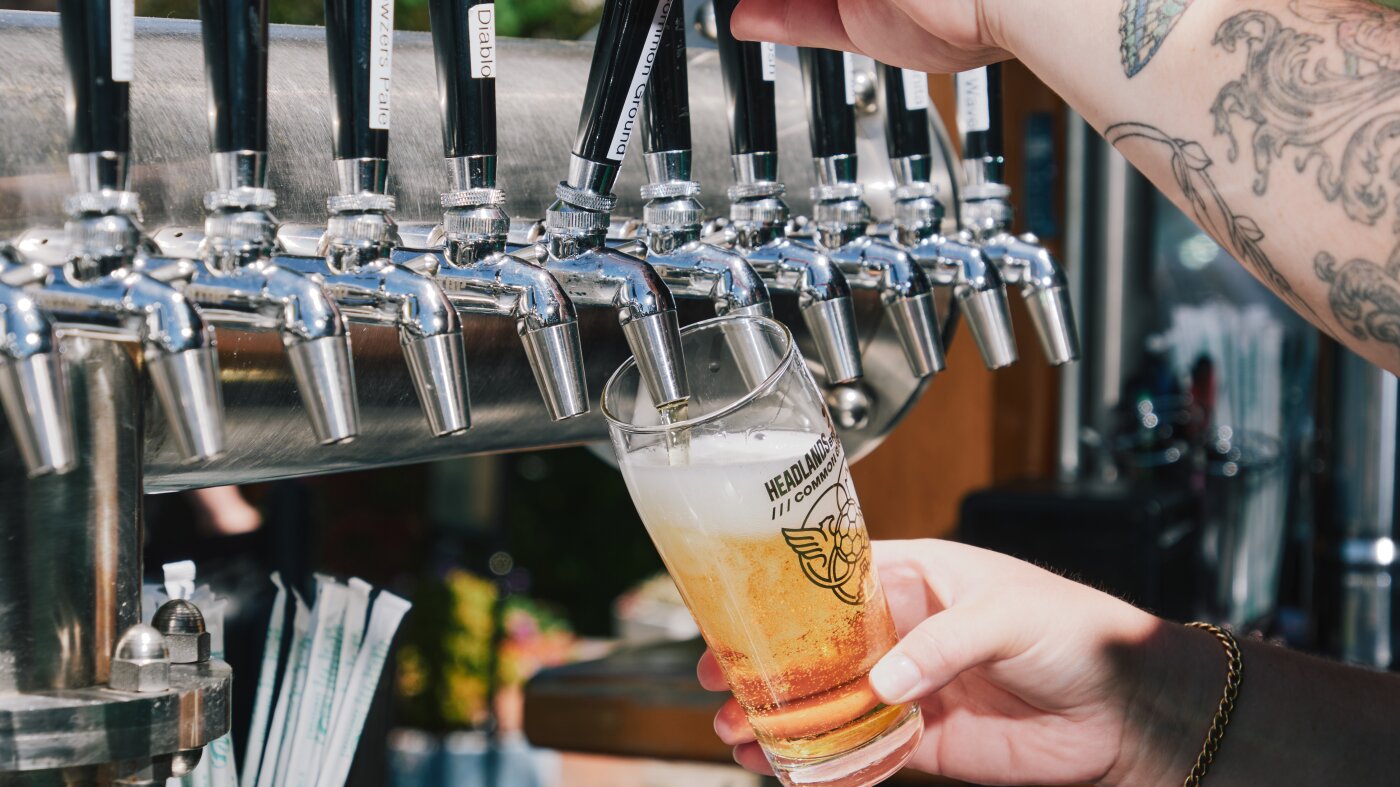
Headlands Brewing launched its World Cup-themed beer Common Ground ahead of the first World Cup game in June.
Justin Gellerson for NPR
hide caption
toggle caption
Justin Gellerson for NPR
The British betting company William Hill predicts that soccer fans will throw back more than 5 million pints of beer in stadiums and fan zones during this year’s World Cup. And that number doesn’t even account for the millions of pints being poured in bars as fans tune in to the global soccer event.
But while international soccer crowds are focusing on goals and penalties, a trio of craft breweries from the tournament’s three host nations are using the tournament to brew something increasingly rare: cross-border solidarity.

A shared recipe with local spin
The collaboration began months ago over a flurry of video chats and emails. The beermakers at Rey Árbol Brewing Co. in Mexico, Headlands Brewing in the United States, and Cabin Brewing Co. in Canada set out to design a single, unified recipe representing the brewing traditions of all three nations.
“It’s a Mexican lager,” said Alejandro Gomez, founder of Rey Árbol.
“That’s like a West Coast IPA,” said Ryan Frank, chief operating officer and brewmaster for Headlands.
“And up in Canada, most of our beers are hop driven,” said Haydon Dewes, co-founder of Cabin. “So we thought, let’s go for a dry-hopped Mexican lager.”
While all three breweries share the exact same recipe, each is giving the final product a distinct local spin, including unique, regionally designed labels. A four-pack of the U.S version costs $15.99. Frank said Headlands has produced about 130 cases of the limited-run brew.
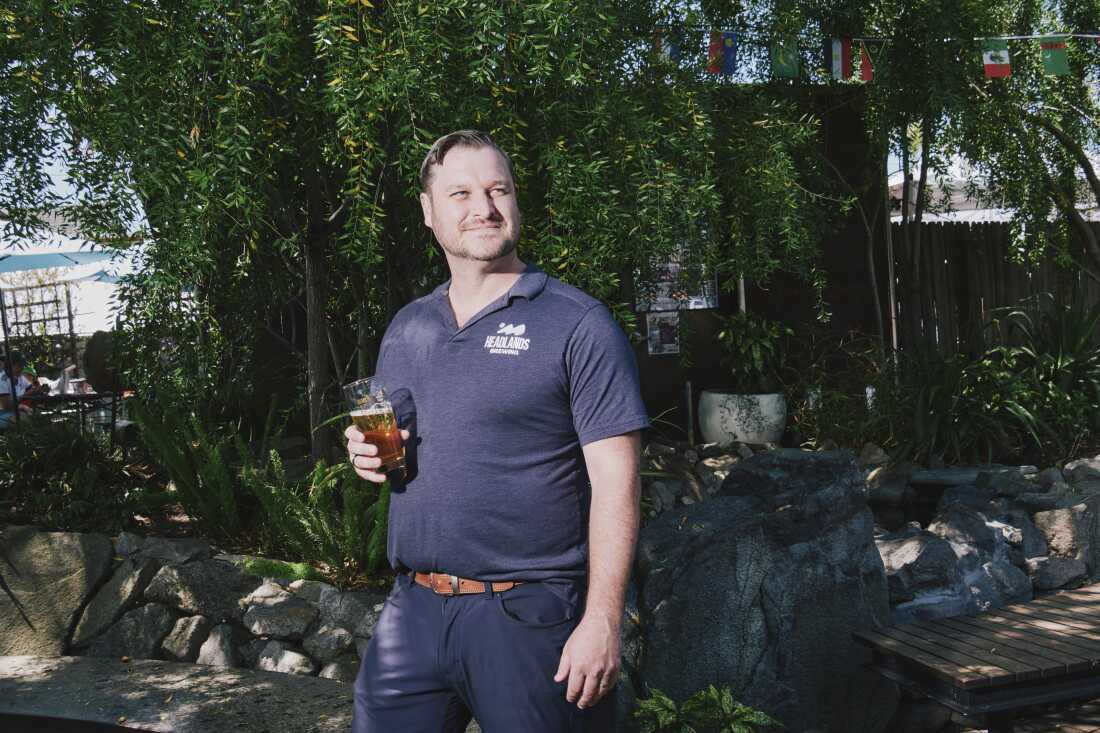
Headlands Brewing COO and brewmaster Ryan Frank drinks a Common Ground beer in Berkeley, Calif., on June 11.
Justin Gellerson for NPR
hide caption
toggle caption
Justin Gellerson for NPR
For the brewers, however, the project is less about marketing and more about connection: They named the multinational beer “Common Ground.”
“When I go to California or Canada, they will treat me like family,” Gomez said.
“It makes the world feel so much smaller,” said Dewes.
“It’s about building bridges and knowing what’s important in life,” said Frank. “And for us, that’s soccer and beer.”
Geopolitical friction in the taproom
The official rhetoric surrounding World Cup 2026 mirrors the brewers’ optimism, with promotional materials promising a tournament where billions are “united as individuals, united as billions.”
Yet this idealistic messaging stands in sharp contrast to a prickly geopolitical reality. Tensions between the U.S., Mexico and Canada have mounted over trade tariffs and auto manufacturing standards as the three nations renegotiate long-standing trade agreements.
The independent brewers behind Common Ground are feeling that friction firsthand through the rising costs of aluminum cans and raw ingredients.
“There are 15% tariffs slapped on any European-grown hops, which are really critical to some of our core brands,” Frank said.

Headlands Brewing brewmaster Ryan Frank and CEO Austin Sharp share a Common Ground beer in Berkeley, Calif., ahead of the first World Cup game on June 11.
Justin Gellerson for NPR
hide caption
toggle caption
Justin Gellerson for NPR
The political discord hasn’t just been confined to trade boards.
When signing an executive order to establish a White House Task Force for the World Cup in March 2025, President Trump suggested that cross-border hostilities might actually benefit the tournament. “Oh, I think it’s gonna make it more exciting,” the president said.
A bittersweet reminder
Tension on the soccer field is one thing; between nations, it’s another.
“It’s true that when it comes to the actual soccer, we’ve developed a very healthy, vibrant rivalry between the three countries,” said Andrés Martinez, the author of The Great Game: A Tale of Two Footballs and America’s Quest to Conquer Global Sport and co-director of Arizona State University’s Great Game Lab, which studies the intersection of sports, media and geopolitics. “But we’re also linked together in this very symbiotic relationship.”
Martinez said that when the U.S., Canada and Mexico initially launched their collaborative bid to host the World Cup back in 2017, the political climate was warmer.
“It was meant to showcase these tight bonds that had developed between the three countries,” Martinez said.

The makers of Common Ground used a shared recipe, but all created their own distinct packaging for the beer: Canada’s Cabin Brewing Co.; Mexico’s Rey Árbol Brewing Co.; the United States’ Headlands Brewing.
Cabin Brewing Company, Rey Árbol Brewing Company, Headlands Brewing
hide caption
toggle caption
Cabin Brewing Company, Rey Árbol Brewing Company, Headlands Brewing
But relations have soured since then, making cross-border business collaborations like Common Ground an anomaly rather than the norm for this tournament.
“To see craft beers across the three countries coming together like this, it’s a bittersweet reminder of what we were hoping to see a lot more of,” Martinez said.
Finding the real common ground
If trade wars and political posturing are looming large in Washington, D.C., Ottawa and Mexico City, they feel a world away at Headlands Brewing’s busy North Berkeley location.
As fans gathered to watch a crucial match between Mexico and South Africa at the start of the tournament, the sunny patio erupted into cheers and shrieks of “Goal!” when Mexico found the back of the net.

Headlands Brewing hosts a screening of the first World Cup game on June 11 in Berkeley, Calif.
Justin Gellerson for NPR
hide caption
toggle caption
Justin Gellerson for NPR
Hovering over a pint of the collaborative brew, soccer fan Roberto Mandujano reflected on the cross-border experiment.
“Three different ways, three different taste buds come together to make something cool,” he said.
When asked about the underlying political tensions between the host nations, Mandujano shrugged off the discord.
“We live in a world where everyone wants to make everything political,” Mandujano said. “But I think we’re all here for soccer. So I guess that’s the common ground.”
-

 Delaware4 minutes ago
Rutgers Basketball Adds St. Peter’s and Delaware State to 2026-27 Non-Conference Schedule
-

 Florida11 minutes ago
50 tons of South Florida aid headed to Venezuela following earthquakes
-

 Georgia14 minutes ago
MLB's No. 39 Draft prospect Daniel Jackson of Georgia wins 2026 Golden Spikes Award
-

 Hawaii19 minutes ago
Historic Hawaiian Kukui Tree Cut Down After Nearly 30 Years at Disney’s Polynesian Village Resort – WDWNT
-

 Idaho26 minutes ago
Distemper found in raccoon population in Pocatello and Chubbuck – East Idaho News
-

 Illinois29 minutes ago
HSHS St. John’s, RMHC open Ronald McDonald House Family Room
-

 Indiana34 minutes ago
Local hardware store sees surge in sales of cooling items amid Indiana heat wave
-

 Iowa41 minutes ago
Iowa City braces for hundreds of thousands of visitors this weekend

