Lifestyle
First look: Disneyland's original Haunted Mansion returns with a heartbreaking new scene


When Disneyland’s Haunted Mansion reopens Saturday in its classic, non-holiday form it will essentially mark the completion of a nearly yearlong refurbishment project, one that added significant backstory and lore to one of the resort’s most famed and mysterious attractions.
A fixture at the park since its 1969 opening, the Haunted Mansion has been the subject of regular tinkering, its illusions evolving and changing as technology — and culture — advances.
This update will be no different. One of the Mansion’s signature scenes has been remade, and now has a much more somber story to tell.
Walt Disney Imagineering, the secretive arm of the company devoted to theme park experiences, has once again revisited the ride’s trademark attic scene, long home to a tortured bride. There’s still a bride, but she’s never quite looked or acted like this.
It’s not the only major change to an attraction developed during the Walt Disney era. An expanded queue has added narrative-focused gardens and a greenhouse to where guests will wait in line, while a new gift shop adjacent to the ride’s exit expands on the storyline of Mademe Leota, seen in the attraction as a disembodied floating head in a séance scene. Imagery at ride’s end, in which a “ghost will follow you home,” has also been updated.

Walt Disney Imagineering has unveiled a new version of the Haunted Mansion bride, this one appearing to float while holding a candelabra. A beating red heart is seen in her chest, a nod to earlier versions of the figure.
(Richard Harbaugh / Disneyland Resort)
As for the would-be honeymooner in the attic, she’s now utilizing the latest in projection technology, appearing to float before guests as she holds a three-pronged physical candelabra, giving corporeal depth to her ethereal glow, which hovers away from a shattered window of a wall. Her blindingly red heart, in a nod to the park’s original vision of the bride, still beats in time to an elongated, gloomy rendition of Richard Wagner’s “Bridal Chorus.”
Disneyland’s Haunted Mansion has for about 55 years stood as a love letter to humanity’s most hedonistic tendencies. Gluttony, greed, sloth, lust and even murder have been on display in its cryptic halls. We’re all going to bite it in the end, the Mansion seems to tell us, so let’s live it up. There are no gilded gates here, but there is one heck of a party, complete with serenading busts, ballroom dancers, excitable opera singers, drunken buffoonery and portraits locked in an endless duel.
And now there’s heartbreak.

The new bride in the Haunted Mansion appears to float, and she is surrounded by pictures of past loves. The men gradually disappear in each portrait, creating a sense of constant loss.
(Richard Harbaugh / Disneyland Resort)
In an exclusive preview of the revamped scene on Tuesday morning at Disneyland, where operations have not been interrupted by the L.A. area fires, I stood across from the new bride for a number of minutes. I marveled at how the hidden-in-the-floor projections allow the ghost to levitate, but also increasingly felt a sense of mourning. Like many locals, my emotions are heightened at the moment, but I was also struck at how much more clearly defined the bride’s face is now, appearing grief-stricken and lovesick. I tell Kim Irvine, the longtime creative director with Imagineering at Disneyland, that unlike the previous bridal scene, here I’m feeling a sense of sorrow.
That’s intentional, Irvine says, noting the team wanted to heighten the “sadness in her face.”
“We thought, what if we change the story back a little bit to the original story that the Imagineers had about a lost bride in the attic mourning the loss of her husbands,” she says. “It was a sad thing. It was a story about lost love.”
The last time the attic received a major overhaul was in the mid-2000s, and that figure, known as the “black widow bride,” had more aggressive, sinister story to tell. Holding an axe, she was portrayed as a murderous, wealth-seeking seductress who had beheaded her husbands, evident by their heads disappearing from the wedding portraits scattered around the attic. Those pictures are still present, only now the full bodies of the men vanish — leaving their departure up to the imagination.
Irvine says the attic scene was redone, in part, because the projection technology on the prior figure had become so outdated as to necessitate regular maintenance. But rather than update what was there, Irvine saw an opportunity to add a greater contrast with the more festive waltz in the prior room as well as to embellish the Mansion’s tale.
The candelabra, for instance, that the character is holding is identical to the one visible floating in an earlier hall scene, now implying the bride is broodingly wandering the Mansion. Additionally, the candelabra will appear a third time, materializing in a cemetery crypt in the ride’s final act.

The expanded Haunted Mansion grounds are filled with an abundance of details and new fixtures — some slightly spooky, others more mystical.
(Richard Harbaugh / Disneyland Resort)
“The bride that used to be in there was an axe murderer, and in this day and age we have to be really careful about the sensitivities of people,” Irvine says. “We were celebrating someone chopping off her husband’s heads, and it was a weird story. I know the fans — some will like it and some will say, ‘Oh, you changed something again.’ That’s our job. That’s what we’re here for.”
Irvine knows the vast Disneyland fanbase will be paying close attention. As one of Disneyland’s most celebrated attractions, and one created by a cadre of Walt’s original Imagineers, fan attachment to the Haunted Mansion is strong.

The expanded grounds of the Haunted Mansion are dedicated to various characters found inside the attraction, including a section of the gardens inspired by Madame Leota.
(Richard Harbaugh / Disneyland Resort)
And the Disney faithful are especially protective of the Haunted Mansion. To wit: an online controversy erupted earlier this winter when it was discovered that the new shop adjacent to the ride contained a piece of art that was created by artificial intelligence. The presence of AI art felt particularly egregious knowing the value Imagineering places on authentic, hand-crafted work.
The moment clearly weighed on Irvine. “How they can find one thing out of all this cool stuff,” Irvine says of the fan outcry, trailing off as she stood in the shop full of artfully created oddities and references to tarot and mysticism. She stresses that the AI art was a temporary placeholder, noting there are many objects coming to the shop — more paintings and tapestries among them — that are in the process of being fireproofed before final install.
“They felt like it would be appropriate for a short time until they could put something else in,” Irvine says of the ill-fated art. “They never intended to do anything bad, and it is gone now. We’re going to bring something back in that is hand-painted, like all of these other pieces are.”
Irvine’s connection to the Mansion runs deep, and is extremely personal. A veteran with Imagineering for nearly 55 years, Irvine just may be the only living creative at the company who worked with and was mentored by Walt’s initial team of designers, including that of her mother, Leota Toombs, one of the first women to work for Imagineering and the inspiration for Madame Leota.

A painting of Madame Leota, inspired by the late, real-life Imagineer Leota Toombs, hangs in the Haunted Mansion’s gift shop. Toombs was the mother of Kim Irvine, the Imagineer who oversaw recent additions to the Mansion and its grounds.
(Richard Harbaugh / Disneyland Resort)
In the shop, officially designated as Madame Leota’s Somewhere Beyond, hangs a portrait of Toombs in her Haunted Mansion guise. The painting was inspired by one of Irvine’s photos of her mother, and if you look closely you’ll spot Kim’s face in the crystal ball that Leota is holding. “That’s what she was seeing into the future,” Irvine says.
Such hidden details abound — instruments that appear to hover, a chair in the shape of the Mansion’s “Doombuggy” ride vehicle and nods to Leota’s spiritual connection to cats. The low-hanging chandelier one spies when first entering the shop used to dangle inside the Mansion itself, having to be removed when more illusions were added.
“We made this in the early ’80s to go over the crystal ball before it floated,” Irvine says. At the time, Imagineering wanted to update a relatively “common” chandelier with a spookier, spider web-inspired look.

A chandelier that hangs in the Haunted Mansion gift shop was once found inside the attraction itself.
(Richard Harbaugh / Disneyland Resort)
The shop, Irvine says, has been in the works for about a decade. It’s designed as a carriage house, and the story is Madame Leota has taken it over as a live-in space. Irvine says it’s created to rhyme with the Mansion, particularly in its color scheme, utilizing the same tones of green and white, only with different places of emphasis. If the design is less ornate, Irvine notes that’s purposeful, pointing out Antebellum carriage houses were “a little bit knocked down.”
Its size was a challenge. “To shoehorn anything into tiny Disneyland is really hard,” Irvine says, adding, “a lot of people in merchandising would have preferred it was bigger.”
The changes to the queue were driven, in part, by other forces as well, namely to ensure the winding line was up to modern ADA standards and to better handle bottlenecks for Disneyland’s current crowds. Here, too, Irvine looked to expand on the Mansion’s narrative, creating multiple sections with different tones — an ever-so-slightly purple-hued garden is Madame Leota’s space, and a more contemplative area is dedicated to the master of the house, a former sea captain whose narrative has shifted over the years.
A sense of sadness permeates that part of the garden — mermaids drape their hair over the light fixtures, and contrasting female statuaries — one prideful and one sorrowful — are meant to nod to his less than ideal romantic relationships. “His love, his life, his lady, was the sea,” Irvine says.

An area of the expanded Haunted Mansion queue is dedicated to the master of the house, who, according to the attraction’s lore, is said to have been a sea captain. The space is one built for reflection.
(Richard Harbaugh / Disneyland Resort)
Leota’s spot is more irreverent. Of particular interest is a not-so-hidden conduit that runs up the side of the centerpiece tree. Here, Irvine created a tribute to late Imagineer Rolly Crump, known for his whimsical art and one of the first artists to work on the Mansion. “Rolly Crump used to do a thing he called the ‘Egyptian eye,’” Irvine says. “A lot of his drawings for the Mansion have that, so I hand-painted it on the conduit to make it look like a snake and put his initials on the top.”
The gardens are a mix of original and found objects. Irvine stops to point out some Imagineering crafted grates, which hide utilities with astrological flourishes, and says she scoured antique shops from “Pasadena to Temecula” looking for items that would fit. She’s happy to share where she collected a piece. A pair of sleeping lions, for instance, Irvine found in the back pages of a catalog for a Chicago statue company, and two iron griffins were hiding in the corner of an Alhambra marble shop.
Irvine says she isn’t bothered when fans discover where an item was procured. “It would be impossible for us to make everything,” Irvine says.
As Irvine walks the ground, pointing out various weeping trees and plants, she also spots areas to continue to tinker. She wonders if a grassy nook in front the Mansion is too pristine as she laments the fact that a fountain relocated from nearby New Orleans Square is no longer pumping water, noting such complex construction wasn’t in the budget. She points to an iron horse on an utility box, quickly adding the direction of the face and handle may someday need to be changed.
And there may still be more work to do inside the Mansion. When Imagineering last made updates to the attraction in 2021, Irvine’s team spoke of potentially removing the hanging corpse in the stretching room, noting such an image could be triggering for some guests. “We’re still looking at that,” Irvine says. “That one is complicated, structurally … One thing at a time.”
For a palace dedicated to the dead, the Haunted Mansion remains a living entity.


Lifestyle
L.A. Affairs: It’s hot when a man drives to me. But would this new guy make the trek from the Valley?
I met Dan on Hinge.
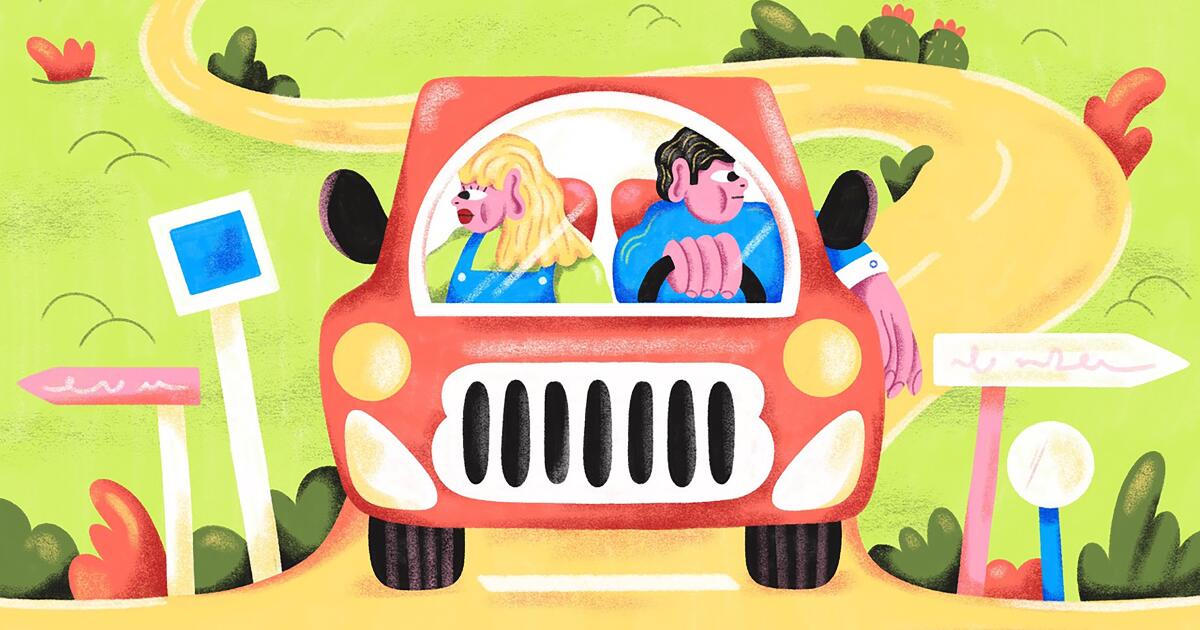
He lives in Woodland Hills, and I live in Venice. In Los Angeles, this is considered a long-distance relationship. In another city it might be nothing. Here, it’s a factor.
But I believe that with the right person, you can make anything work, so I stay open. I’m a native New Yorker, and if I were living in Brooklyn and a guy lived on the Upper West Side, that would be a 45-minute subway ride, which is truly nothing in New York. So with that same logic, I try to have flexibility with men in L.A.
When we started planning our first date, Dan suggested three options: a hike on mushrooms, a wine tasting or a walk on the beach.
A hike on mushrooms is something I’d only do with someone I already trust, not someone I just met online. I don’t do first-date hikes because I don’t like feeling trapped if the guy’s a dud. So I chose the wine tasting.
Then I learned the wine tasting was in West Hills.
On a Friday night, driving there from Venice would be insane. So I said I didn’t want to meet there because of the traffic. He suggested Malibu. That was also not ideal on a Friday.
I was getting annoyed — this was a pink flag because in my dating world, the guy is supposed to come to the woman’s neighborhood in the early days. I’ve gone out with plenty of men from the Valley who effortlessly suggested they come to me. It’s not rare or impossible.
I suggested he come to the Westside. I didn’t specifically say Venice, and in hindsight, I probably should have. He landed on Brentwood, which was manageable for both of us. On our first date, we met at an Irish pub on Wilshire Boulevard. He was cuter and more interesting than I had expected, and with the Guinness flowing, we had fun.
When I got home, he texted me: “Well, I like you 🙂 Less the tik tok and the lack of rock music in your life, but it’s not a deal breaker — there are other qualities 🙂 What are your thoughts?”
I noticed the slight negativity but was mostly dazzled that a man texted immediately after the date to say he liked me. In the modern dating economy, this felt rare.
The next day, both of our evening plans fell through, so we made a last-minute date. The wine tasting he originally suggested still sounded like fun, and although it meant me driving to the Valley, I was up for it now that we’d met.
We sipped flights at Malibu Wines & Beer Garden in its airy, romantic courtyard and played a flirty version of Truth or Dare. Halfway through, he dared me to kiss him.
We ended with sushi on Ventura Boulevard and a short make-out session in his car. He invited me to Thanksgiving at his uncle’s, which felt too soon, but also sweet.
After the second date, he texted and said he had his kids that week and was also hosting an event on Thursday, so his only day to meet was Wednesday. I said great.
On Tuesday night, he checked if we were still on, and I said yes.
Then he texted: “I’m flexible on time but not on location. I have a big event on Thursday, hopefully you can come to me again.”
My stomach tightened. This again?
So I texted back: “I drove to you last time, which was a bit of an exception for me especially in the early days, but the wine tasting location sounded special. Usually guys come to my area. How about we switch it up this time?”
He replied: “I appreciate the effort! Because of my event, I’d rather be close to a computer just if needed … Here is what i offer:
— I’ll come to your area anytime next week/end
— Lunch/dinner on me
I want to continue where we stopped last time 😉 No pressure of course, but let’s snuggle”
I responded: “Ok let’s meet next week. Snuggles sound nice … let’s see what happens …”
Then he wrote: “So I won’t see you tomorrow?”
I replied: “Unless you wanna come to me and bring your laptop along, let’s rain check until you have more flexibility.”
He said: “Dang, you are hard. I’ll let you know tomorrow around midday if it’s ok.”
And then — surprise — he decided to come.
He drove to Venice for a 5 p.m. date. He said his ETA was 5 p.m., and it ended up being 5:25 p.m., typical 405 Freeway.
When he showed up, he was in a cranky mood. On our way to KazuNori in Marina del Rey, I thanked him for picking me up and told him I think it’s hot when the guy comes to the girl.
“You’re just saying that because you want me to come to you more,” he said, not playfully, but aggressively.
That was basically the end for me. But there I was, in his car, heading to dinner. So I stayed pleasant and tried to make the best of it.
I shared that in the early stages of dating, I find it’s good etiquette for the guy to come to the woman’s neighborhood. He immediately disagreed and started ranting about how dating rules are ridiculous and how they swing in women’s favor. He resented paying for dates and declared he wasn’t looking to “sponsor a woman’s life.”
“If women want equality and equal rights,” he said, “then it should apply all across the board, including dating, and the man shouldn’t have to pay.”
I said women don’t actually have equal rights because we get paid less than men and often receive lower salaries than men in the same position.
I tried to change the subject and reset the mood, but he insisted we keep hashing it out.
I tried to explain masculine/feminine dynamics: providing and protecting, giving and receiving.
“What does the man get out of this arrangement?” he asked.
It was like watching someone’s personality warp into Mr. Hyde. Then he brought up another point: He’s a single dad of two kids, so he gets tired; and because I don’t have kids, that should factor into who drives where.
At this point, I was barely engaging and focused on eating my hand rolls, and I couldn’t wait to get home.
The check came, and I happily split it, wanting nothing further from him.
In the car back to my place, he remarked: “It’s obvious we’re never gonna see each other again.”
Obvious, but did it need to be stated?
Then he showed me a Spotify playlist he’d made for me of his favorite electronic music, because he knows I like EDM.
“Oh, that’s sweet,” I said.
“Yeah, that’s how I show interest. Through things like this, not who drives to who,” he replied.
When I got out of the car, we wished each other luck, and I headed inside and shut the door.
Two hours later, he sent me the playlist. I’ve yet to listen to it.
It wasn’t the distance that ruined it. It was the resentment. I’m not looking for a man who feels burdened by the effort. I’m looking for a man who sees the value of courting a woman in the first place.
The author is a writer, comedian and former psychologist who lives in Venice. She is the creator of the new vertical series “Manfari.” She’s on Instagram: @solange_neue and @manfari.show.
L.A. Affairs chronicles the search for romantic love in all its glorious expressions in the L.A. area, and we want to hear your true story. We pay $400 for a published essay. Email LAAffairs@latimes.com. You can find submission guidelines here. You can find past columns here.

Lonnie Bunch III is the 14th Secretary of the Smithsonian. He’s pictured above in September 2017.
J. Scott Applewhite/AP
hide caption
toggle caption
J. Scott Applewhite/AP
In a memo addressed to staffers sent Tuesday, the secretary of the Smithsonian, Lonnie G. Bunch III, defended the institution after the White House issued a 162-page report that characterizes the National Museum of American History as a place which has become “subject to institutional capture by a radical, activist ideology that is fundamentally opposed to telling the noble, honest story of the great country we know and love.”
In his email, which NPR has obtained, Bunch wrote in part: “While there will always be room for improvement, this report is not a fair characterization of the work and totality of the National Museum of American History. At the Smithsonian, our work is driven by scholarship, accuracy and an uncompromising commitment to tell the fullness of America’s story. As public servants and the keepers of this institution, we are charged with helping a nation find understanding, hope and clarity and as part of that duty, we are dedicated to excellence, reflection and growth.”

He continued: “We remain focused on what grounds us: a steadfast commitment to scholarship, nonpartisanship, independence, accuracy and integrity. For nearly 180 years, the Smithsonian has worked alongside partners across government — from the White House to Congress to our governing Board of Regents — guided by our enduring mission to increase and diffuse knowledge. That purpose remains: to pursue knowledge with rigor and to serve the American public with clarity and care.”
The White House report was issued on July 4 by the Domestic Policy Council under the title “Saving America’s Story: How Ideological Capture at the Smithsonian Institution’s National Museum of American History Erases Our Heritage.”

The council faults the National Museum of American History on a multitude of fronts, saying it underemphasized the Founding Fathers and early colonial and Revolutionary history; was not sufficiently celebratory of the country’s 250th anniversary; and that it engaged in “anti-white,” “illegal alien” and transgender activism.
It also accuses the museum of trying to “indoctrinate” teachers and students through its exhibitions, programming and teaching resources.
In the report, the council also specifically criticizes museum director Anthea Hartig, who has led the National Museum of American History since 2019 and is concurrently the president of the Organization of American Historians, calling her “an activist advancing an ideological agenda contradictory to the museum’s founding purpose of fostering patriotism.”
The Trump administration has made the Smithsonian museums one of its primary targets in its efforts to reshape cultural narratives to align with its viewpoints. In August 2025, the White House requested a “comprehensive internal review” of eight Smithsonian museums, including the National Museum of American History, following an executive order issued by President Trump in March 2025 in which he called for the removal of “improper ideology” from the Smithsonian’s offerings.
According to the Smithsonian’s charter, all of its 21 museums, 14 education and research centers, and the National Zoo are meant to be run independently of the federal government. The Smithsonian is overseen by Bunch and a board of regents, which includes Vice President Vance, Supreme Court Chief Justice John Roberts and other members appointed by Congress.
In an interview with NBC’s Meet the Press on Sunday, Bunch spoke about the Smithsonian’s 250th anniversary special exhibition at the Smithsonian Castle, which is called “American Aspirations.”
He told NBC: “It’s really important for people to understand that America is much an ideal as it is a place, that it’s a series of aspirations that have really shaped who this country is. And so for me, what is so powerful is to say, ‘Let us honor the words of Thomas Jefferson and the founders, but let us use those to challenge us to be better.’”
Jennifer Vanasco edited this story.

-

 Virginia7 minutes ago
Rabid cat, bat, raccoons and skunks reported in these 4 Virginia counties
-

 Wisconsin15 minutes ago
Shipwreck Coast sanctuary council to meet July 16 in Sheboygan
-

 West Virginia22 minutes ago
Helicopter crashes in Pocahontas County
-

 Wyoming25 minutes ago
Wyoming officials say Meta’s 715,000-square-foot data center is responsible for contaminating its water system with a rare bacterium | Fortune
-

 Crypto30 minutes ago
What Are KOLs Discussing About the Cryptocurrency Market Today?
-

 Finance37 minutes ago
From Love Island to Precious Metals, Prediction Markets Are Changing Finance | PYMNTS.com
-

 Fitness40 minutes ago
80-year-old fitness icon Joan MacDonald reveals her simple exercise for a stronger, more stable core
-

 Movie Reviews52 minutes ago
‘Gail Daughtry and the Celebrity Sex Pass’ Review: We’re Off to Hump the Wizard

