Lifestyle
'By Natives, for Natives': This new L.A. hub is drawing in the young, artsy and Indigenous

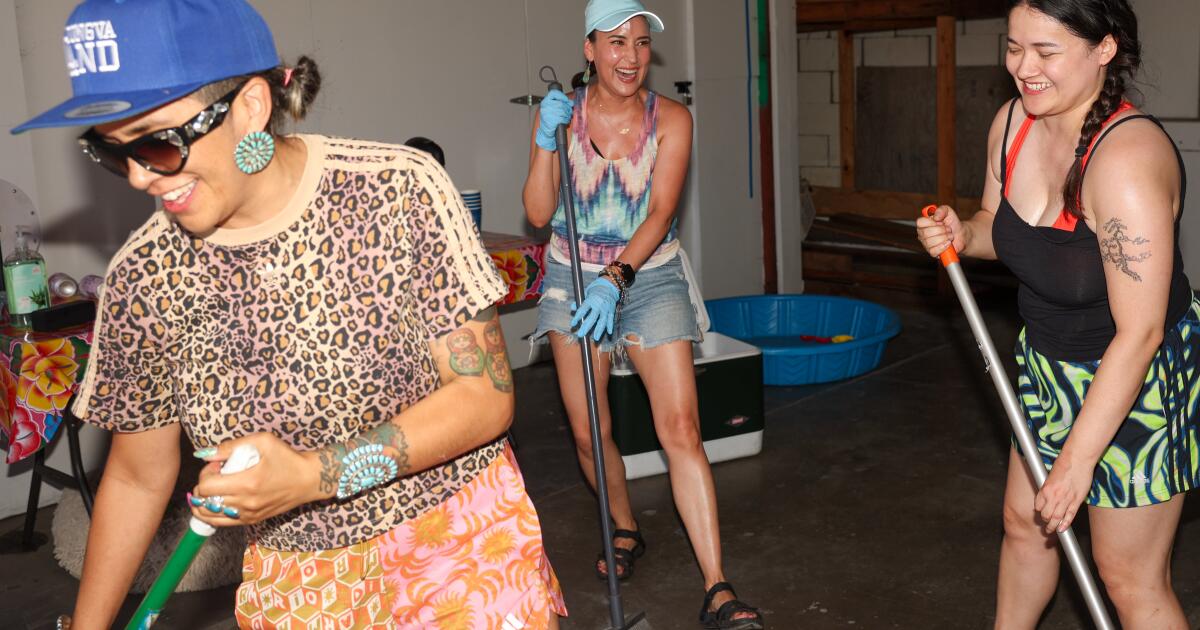
On a sweltering July afternoon in Echo Park, Miranda Due approached a table topped with a trio of flavored syrups and a spread of toppings: diced pickles, Kool-aid powder and gummy bears. Behind it, Dria Yellowhair pulled a pre-filled cup of crushed ice from a cooler, and asked Due what flavor she wanted. Upon requesting blueberry, Yellowhair doused the ice with fluorescent blue syrup and loaded the treat with a generous serving of each fixing.
Piccadilly — an icy, sweet treat that includes pickles, gummy bears and topping of Kool-Aid powder — served at a recent Chapter House event in Echo Park.
(Katie Janss)
This was Due’s first piccadilly, a delicacy whose origins are debated, but can be traced to either the Navajo, the Tohono O’odham Reservation, or the Hopi village Moenkopi. Wherever they came from, they exploded in popularity on the Navajo reservation around 2018. Yellowhair, who is Diné — the word Navajo people use to identify themselves — grew up in Downey, but has family on the reservation and visits frequently. She was introducing the sweet treat to visitors at a new Indigenous community center and exhibition space called the Chapter House.
After taking a bite, Due contemplated the flavor.
“It’s sweet, and a little bit sour, and salty from the pickles,” she said. “It’s a nice combination of all the flavors. It’s fantastic.”
Due, 31, is Cherokee and a member of the Pawnee Nation of Oklahoma. The nonprofit worker, who lived in Los Angeles for five years before moving to Tulsa, couldn’t miss an opportunity to check out the Chapter House on her latest visit to California.
The teal building is located on a noisy stretch of Glendale Boulevard just off the 2 Freeway. In its front room you can find the center’s summer art exhibition, “Diary of a Native Femme(nist)” by artist Kimberly Robertson. But it’s the building’s tranquil, shaded outdoor space out back where most community gatherings take place. The day I visited, about a dozen Indigenous Angelenos compared the colors of their tongues, newly dyed blue and red from their piccadilly syrup, as music from native bands like Redbone and The Halluci Nation drowned out the cityscape. A gaggle of small children waved bubble wands and ran circles around a kid-sized, Barbie-pink Cybertruck.
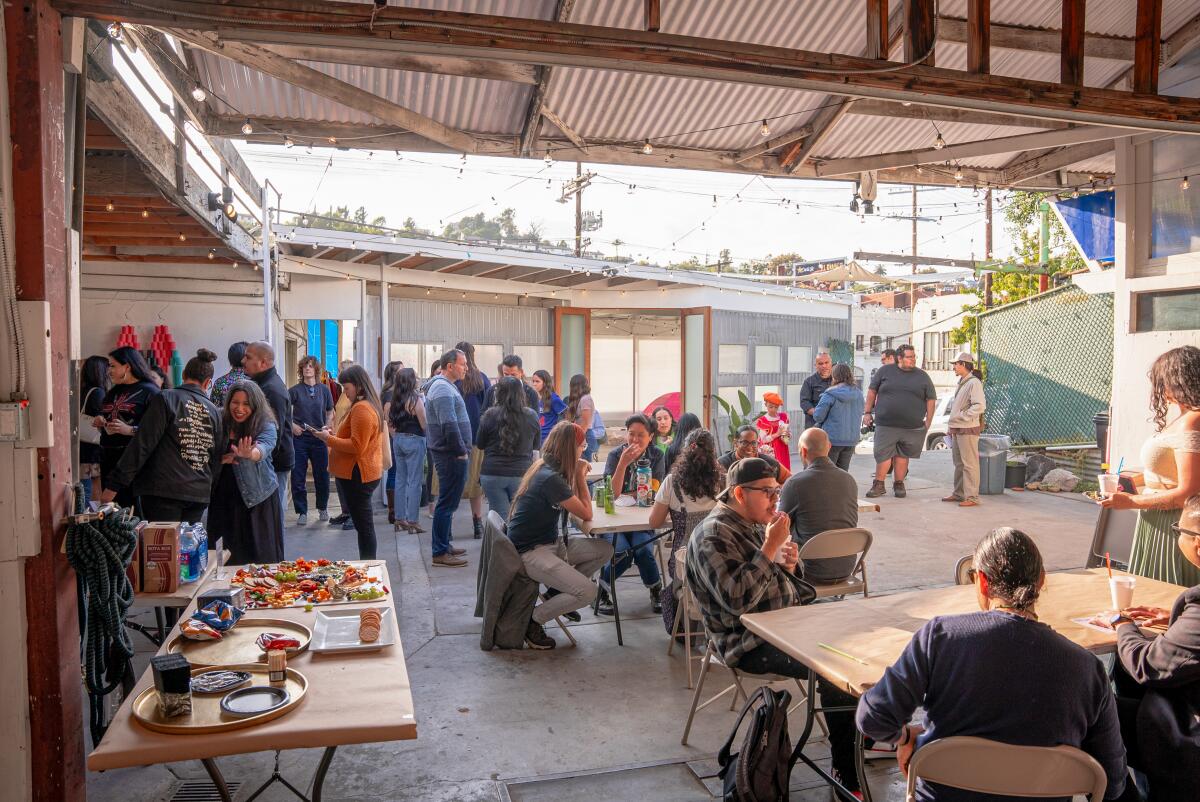
A May 6 exhibition opening at the Chapter House. The building’s tranquil, shaded back outdoor space is where most community gatherings take place.
(Anthony Chase In Winter)
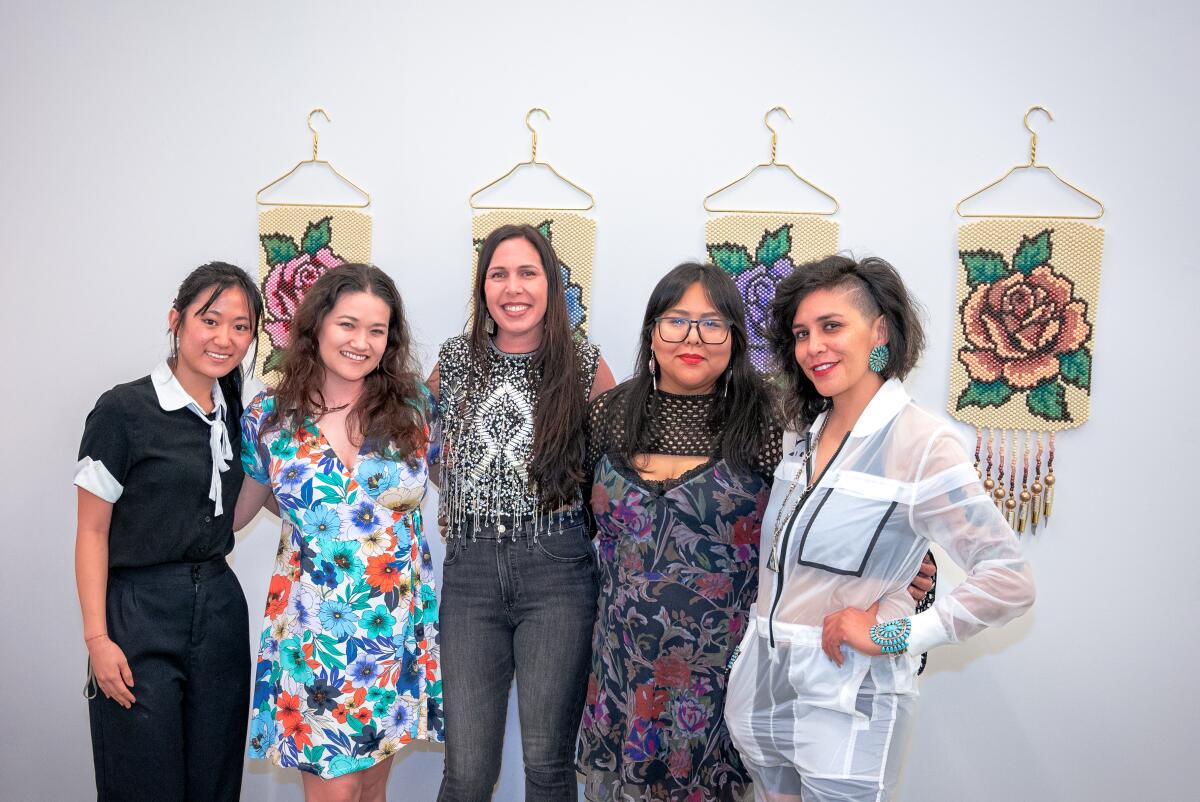
A group photo from the opening of the Chapter House’s most recent art exhibition, “Diary of a Native Femme(nist),” including artist Kimberly Robertson, center, and Chapter House founder Emma Robbins (Diné), right.
(Anthony Chase In Winter)
“I went to school out here for a while, and I was always hoping for more community,” Due said. “I think it really came to life once I left town.”
Nearly 400,000 people in Los Angeles County identify as partly American Indian or Alaskan Native, according to the 2020 census. That makes it one of the largest urban Indigenous populations in the nation.
“We’re all unique, and we’re all from different tribes, different nations, but we all were craving the space to come together, recharge and heal.”
— Emma Robbins, Chapter House founder
Despite this, Chapter House founder Emma Robbins (Diné) says there are very few places for the Indigenous to gather socially in the city. The Gabrielino/Tongva people, the original people of Los Angeles, are not yet a federally recognized tribe, and therefore do not have a reservation nearby that could function as a centralized hub.
Before the Chapter House opened, Indigenous Angelenos would see each other at a handful of annual events at the Autry Museum of the American West, like the powwow hosted by the nonprofit United American Indian Involvement. UAII also provides social services for the urban native population, and community members would sometimes bump into acquaintances while waiting for a doctor’s appointment at the clinic. But the events at the Autry were too infrequent to nurture a sense of belonging. And other Indigenous L.A. residents interviewed for this story said that they found it too awkward to connect in the UAII’s waiting room..
For the record:
11:49 a.m. Sept. 9, 2024The sentiment that it was awkward to connect in the USII’s waiting room was incorrectly attributed to Emma Robbins. Other Indigenous L.A. residents, including Joey Clift, shared this view.
Though UAII also offers community programming for families, youth and elders, there aren’t as many events geared towards young, creative natives. To fill this gap, Robbins sought to create a casual, artistic community space with year-round programming.
The Chapter House was founded virtually in 2020 by Robbins, who grew up on the Navajo Reservation, which sprawls across Arizona, New Mexico and Utah. There, the center of social life takes place at so-called chapter houses, community centers unique to the Navajo nation. They are where people distribute food and water, facilitate town halls, see art, experience cultural celebrations, throw parties and hold funerals. 110 chapter houses are distributed across the reservation, and Robbins jokes that the Los Angeles Chapter House, which opened its physical space in the fall of 2023, is the 111th.
“Navajo rez is what I know,” Robbins said. “But I think working with California natives — specifically Tongva and Chumash folks from the area — is really important because, although we are Navajo or Diné-led, it’s important to be inclusive of all Natives.”
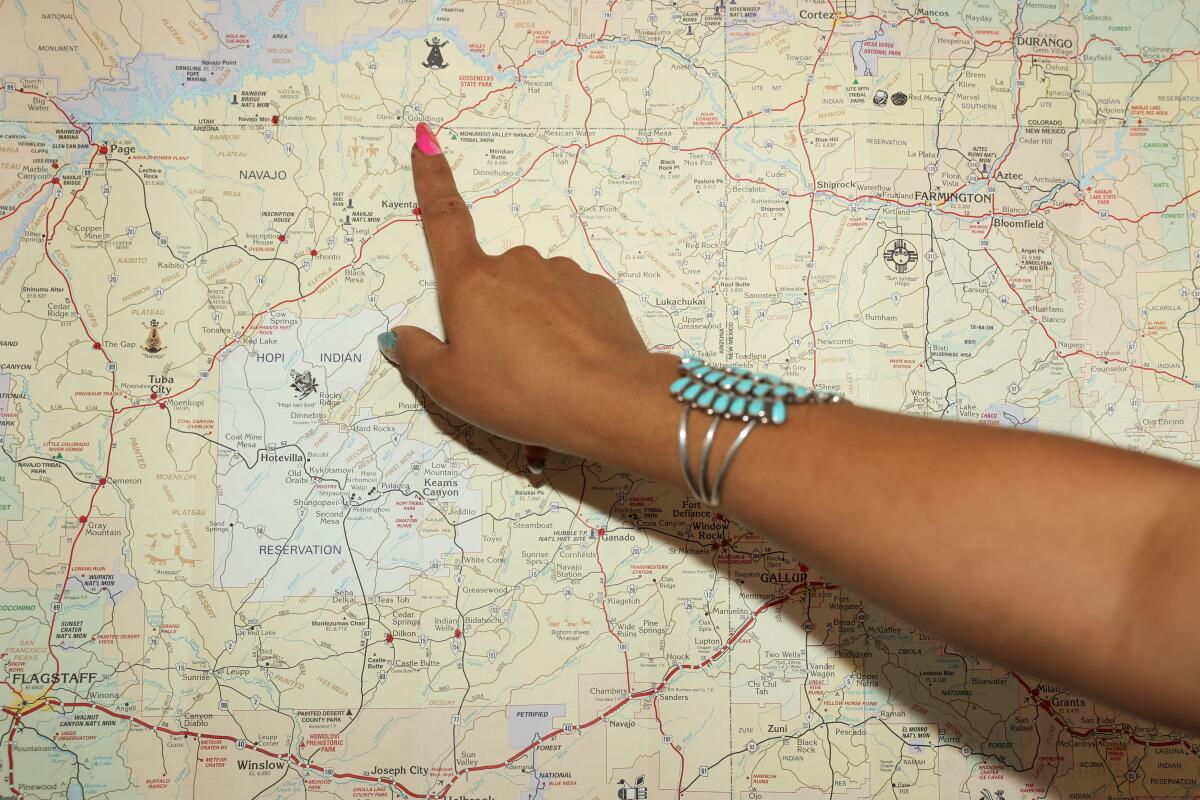
Emma Robbins points to a town on the Navajo Nation map during community “Refresh Day” to help touch up the space.
(Michael Blackshire / Los Angeles Times)
“We’re all unique, and we’re all from different tribes, different nations, but we all were craving the space to come together, recharge and heal,” Robbins said. “We also bring things to our community that we might not historically have had access to, like art shows, or yoga classes or even just good Wi-Fi,” Robbins said.
Robbins founded the Chapter House on four pillars: wellness, community, art and nature. In addition to the frequent piccadilly socials, they’ve held events like a Métis (Michif) finger weaving lesson, plant medicine workshops, screenings of the new seasons of Netflix’s Indigenous-forward animated children’s show “Spirit Rangers” and drag story hour with Landa Lakes (Chickasaw) and Lady Shug (Diné.)
Joey Clift, a Cowlitz comedian and television writer, first discovered the Chapter House in July 2023 through a bolo tie-making workshop, which helped him transform a hand-beaded Garfield medallion, made by Cree beadworker Sweet Grass by Heather, into something he could wear.
I feel like I don’t have to try to be something that I’m not. We all uplift each other, and inspire each other, and help each other.
— Burgandi Trejo Phoenix, Yaqui actress and Chapter House visitor
He said the Chapter House reminded him of a bygone era of 1930s Hollywood that he had read about, in which the Indian American Art Shop, located across the street from the Grauman’s Chinese Theatre, was the unofficial hang out spot for Native American actors like Jim Thorpe, member of the Sac and Fox Nation, and a gold medalist Olympian turned Western star. Until Clift found the Chapter House, he could only dream of these spaces from the past. Clift would go on to join the community center’s board, with hopes to reignite the young Indigenous creative scene.
“I think that there are a lot of really great spaces for elders in Los Angeles to participate in and practice culture,” Clift, 40, said. “But I don’t feel like there are a lot of spaces for Native millennials and zoomers. That’s something that really excited me about the Chapter House. It’s for all ages, but it really does feel like it’s on the pulse of the really great artistic gains that Native folks are doing now.”
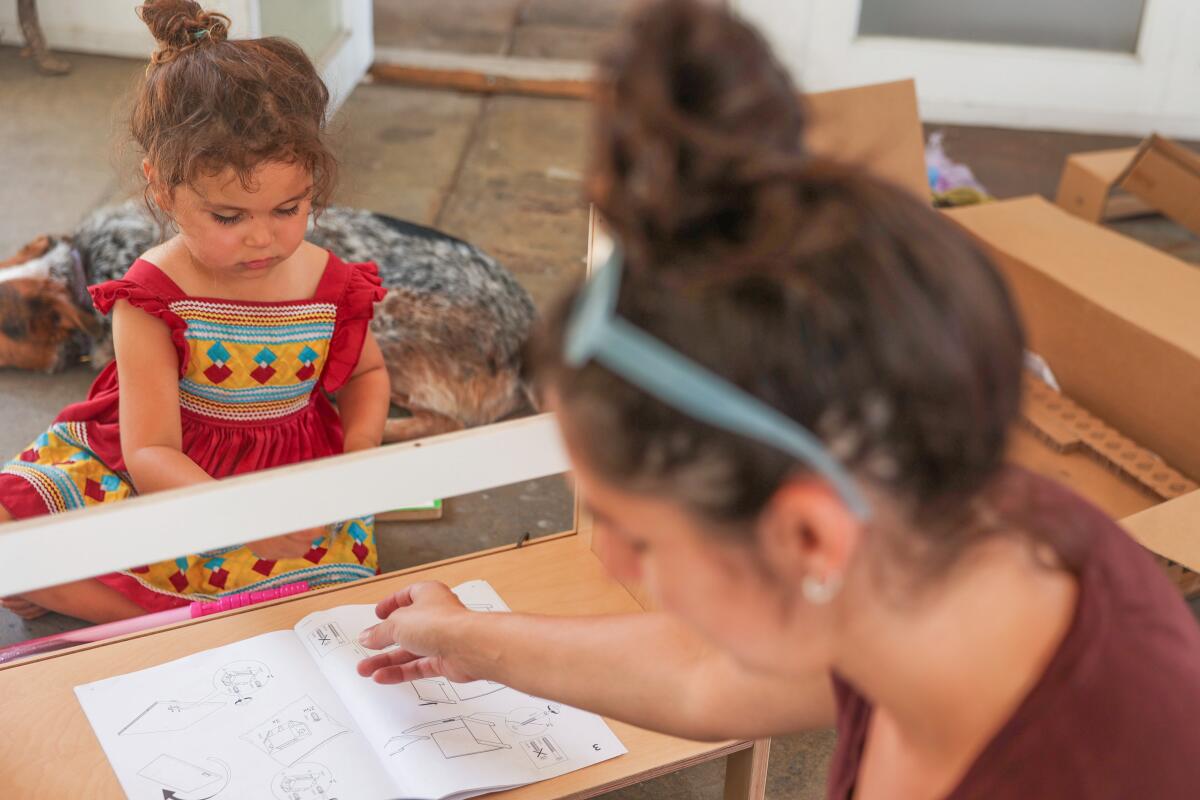
Alyssa Musket, right, looks through directions to build a cabinet as she receives help from Piñon “Pinny” Robbins, left, during community “Refresh Day.”
(Michael Blackshire / Los Angeles Times)
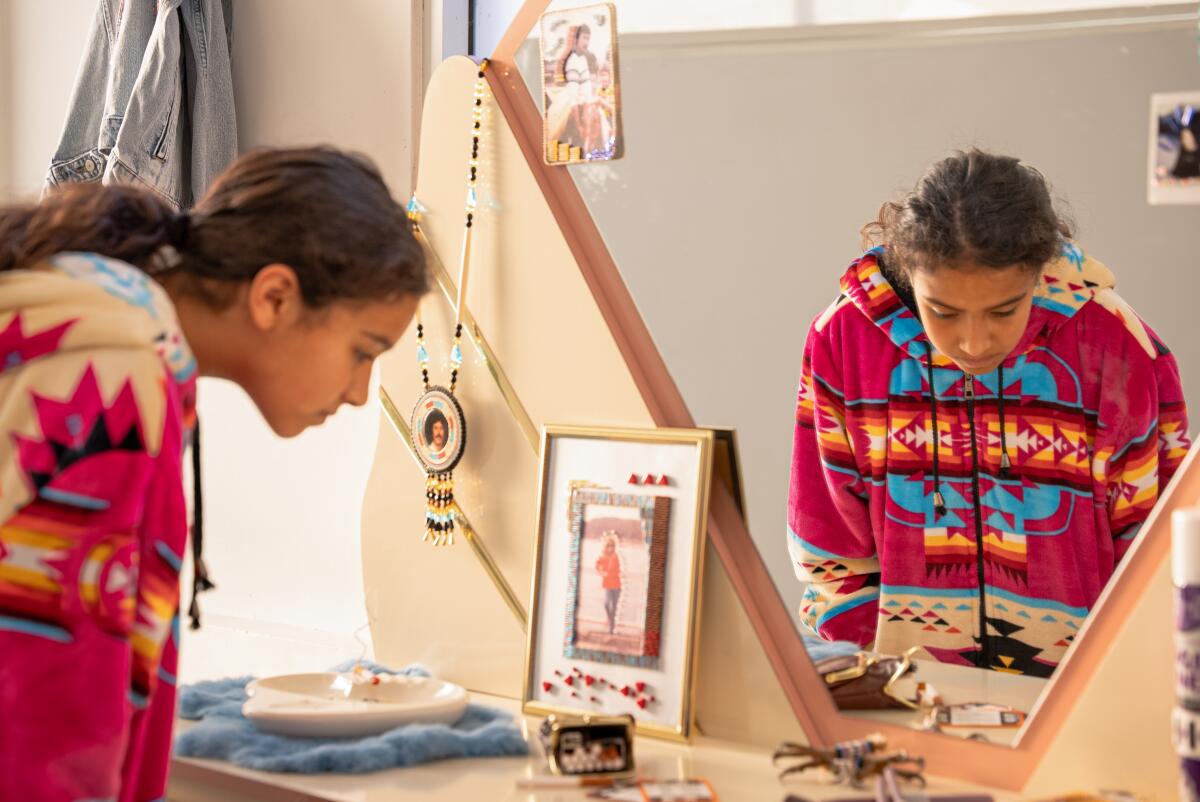
A visitor views “Diary of a Native Femme(nist),” an art exhibition by Kimberly Robertson that opened at the Chapter House on May 4th.
(Anthony Chase In Winter)
The space also is helping young Indigenous people connect to their culture for the first time. Burgandi Trejo Phoenix, an Yaqui actress who voices a character named Squash in “Spirit Rangers,” first connected with the Chapter House when it screened the Season 4 finale of the kids show in April. She immediately felt embraced by the community, even though she wasn’t brought up with her Yaqui traditions.
“I feel like I don’t have to try to be something that I’m not,” Phoenix said. “We all uplift each other, and inspire each other, and help each other.”
Through promoting events at UAII, on Instagram and through word of mouth, Chapter House is building a loyal following. Their events, which are always free and open to the public, regularly attract around 20 to 25 people — but 200 packed the house for the La La Land Back Tour drag show they co-hosted last November. While most people who come identify as Indigenous, Robbins emphasizes that the Chapter House is welcoming of allies, too.
“This is definitely a Native space by Natives for Natives,” Robbins said, “We want people to come, learn, and experience what it’s like when we come together and build this beautiful Indigenous future.”




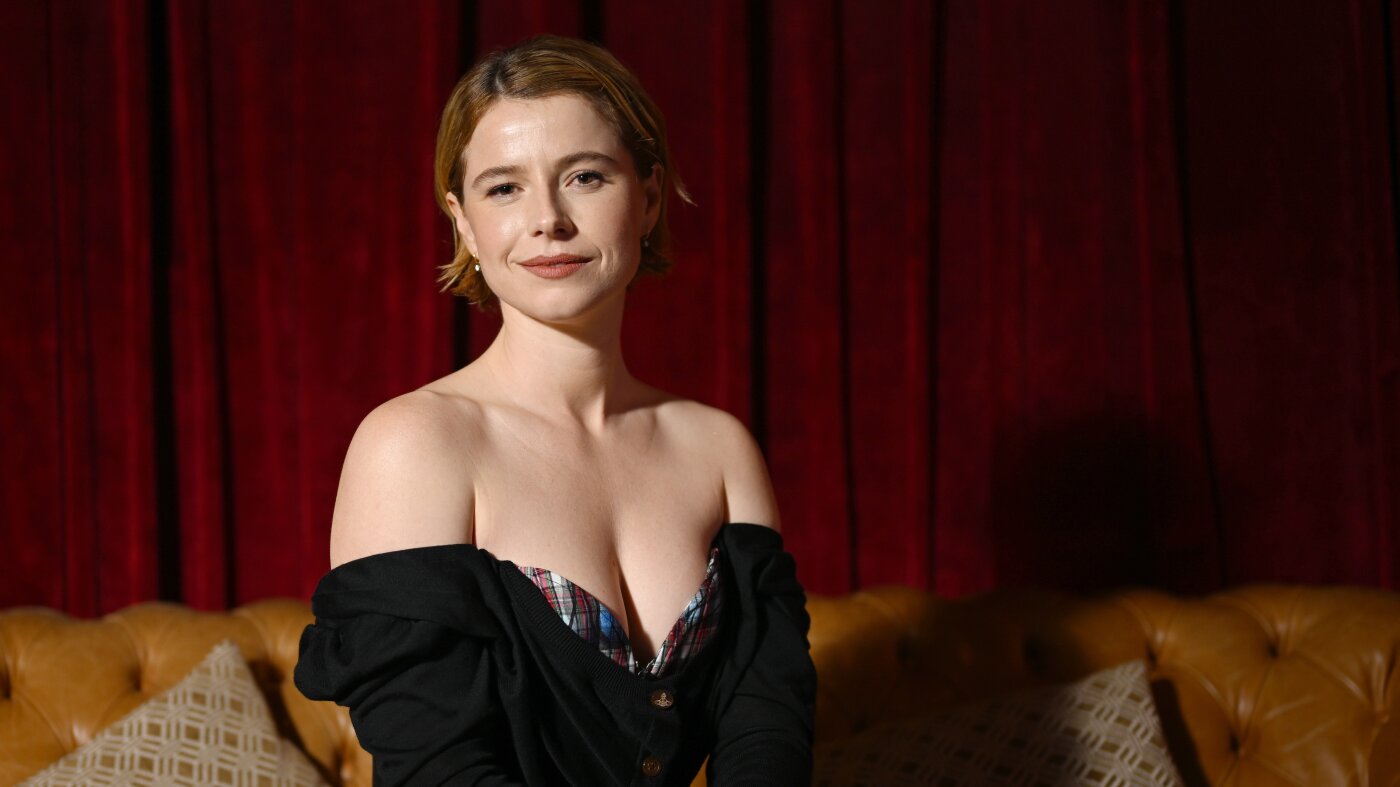
Jessie Buckley has been nominated for an Academy Award for best actress for her portrayal of William Shakespeare’s wife in Hamnet.
Kate Green/Getty Images
hide caption
toggle caption
Kate Green/Getty Images
Actor Jessie Buckley says she’s always been drawn to the “shadowy bits” of her characters — aspects that are disobedient, or “too much.” Perhaps that’s what led her to play Agnes, the wife of William Shakespeare, in Hamnet.
Buckley says the film, which is based on Maggie O’Farrell’s 2020 novel, offered a chance to counter a common narrative about the playwright’s wife: that she “had kept him back from his genius,” Buckley says.

But, she adds, “What Maggie O’Farrell so brilliantly did, not just with Agnes and Shakespeare’s wife, but also with Hamnet, their son, was to bring these people … and give them status beside this great man. … [And] give the full landscape of what it is to be a woman.”
The film is nominated for eight Academy Awards, including best actress for Buckley. In it, she plays a woman deeply connected to nature, who faces conflicts in her marriage, as well as the death of their son Hamnet.
Buckley found out she was pregnant a week after the film wrapped. She’s since given birth to her first child, a daughter.

“The thing that this story offered me, that brought me into this next chapter of my life as a mother was tenderness,” she says. “A mother’s tenderness is ferocious. To love, to birth is no joke. To be born is no joke. And the minute something’s born into the world, you’re always in the precipice of life and death. That’s our path. … I wanted to be a mother so much that that overrode the thought of being afraid of it.”

Jessie Buckley stars as Agnes and Joe Alwyn plays her brother Bartholomew in Hamnet.
Courtesy of Focus Features/Courtesy of Focus Features
hide caption
toggle caption
Courtesy of Focus Features/Courtesy of Focus Features
Interview highlights
On filming the scene where she howls in grief when her son dies
I didn’t know that that was going to happen or come out, it wasn’t in the script. I think really [director] Chloé [Zhao] asked all of us to dare to be as present as possible. Of course, leading up to it, you’re aware this scene is coming, but that scene doesn’t stand on its own. By the time I’d met that scene, I had developed such a deep bond with Jacobi Jupe, who plays Hamnet, and [co-stars] Paul [Mescal] and Emily Watson, and all the children and we really were a family. And Jacobi Jupe who plays Hamnet is such an incredible little actor and an incredible soul, and we really were a team. …

The death of a child is unfathomable. I don’t know where it begins and ends. Out of utter respect, I tried to touch an imaginary truth of it in our story as best I could, but there’s no way to define that kind of grief. I’m sure it’s different for so many people. And in that moment, all I had was my imagination but also this relationship that was right in front of me with this little boy and that’s what came out of that.
On what inspired her to pursue singing growing up
I grew up around a lot of music. My mom is a harpist and a singer and my dad has always been passionate about music, so it was always something in our house and always something that was encouraged. … Early on, I have very strong memories of seeing and hearing my mom sing in church and this quite intense mercurial conversation that would happen between her, the story and the people that would listen to her. And at the end of it, something had been cracked between them and these strangers would come up with tears in their eyes. And I guess I saw the power of storytelling through my mom’s singing at a very young age, and that was definitely something that made me think I want to do that.
On her first big break performing as a teen on the BBC singing competition I’d Do Anything — and being criticized by judges about her physical appearance
I was raw. I hadn’t trained. I had a lot to learn and to grow in. I was only 17. I think there was part of their criticism which I think was destructive and unfair when it became about my awkwardness, or they would say I was masculine and send me to kind of a femininity school. … They sent me to [the musical production of] Chicago to put heels on and a leotard and learn how to walk in high heels, which was pretty humiliating, to be honest, and I’m sad about that because I think I was discovering myself as a young woman in the world and wasn’t fully formed. … I was different. I was wild, I had a lot of feeling inside me. I could hardly keep my hands beside myself and I think to kind of criticize a body of a young woman at that time and to make her feel conscious of that was lazy and, I think, boring.
On filming parts of the 2026 film The Bride! while pregnant
I really loved working when I was pregnant. I thought it was a pretty wild experience, especially because I was playing Mary Shelley and I was talking about [this] monstrosity, and here I was with two heartbeats inside me. Becoming a mom and being pregnant did something, I think, for me. My experience of it, it’s so real that it really focuses [me to be] allergic to fake or to disconnection.
Since my daughter has come and I know what that connection is and the real feeling of being in a relationship with somebody … as an actress, it’s very exciting to recognize that in yourself and really take ownership of yourself.
I’m excited to go back and work on this other side of becoming a mother in so many ways, because I’ve shed 10 layers of skin by loving more and experiencing life in such a new way with my daughter. I’m also scared to work again because it’s hard to be a mother and to work. That’s like a constant tug because I love what I do and I’m passionate and I want to continue to grow and learn and fill those spaces that are yet to be filled — and also be a mother. And I think every mother can recognize that tug.
On the possibility of bringing her daughter to travel with her as she works
I haven’t filmed for nearly a year and I cannot wait. I’m hungry to create again. And my daughter will come with me. She’s seven months, so at the moment she can travel with us and it’s a beautiful life. And she meets all these amazing people and I have a feeling that she loves life and that’s a great thing to see in a child. And I hope that’s something that I’ve imparted to her in the short time that she’s been on this earth is that life is beautiful and great and complex and alive and there’s no part of you that needs to be less in your life. You might have to work it out, but it’s worth it.
Lauren Krenzel and Susan Nyakundi produced and edited this interview for broadcast. Bridget Bentz, Molly Seavy-Nesper and Beth Novey adapted it for the web.

Bruce Campbell
I’m Battling Cancer
Published
Bruce Campbell has revealed he has cancer, but says it’s a type that’s treatable, though not curable.
“The Evil Dead” actor shared the news Monday in a message to fans, writing, “Hi folks, these days, when someone is having a health issue, it’s referred to as an ‘opportunity,’ so let’s go with that — I’m having one of those.” He continued, “It’s also called a type of cancer that’s ‘treatable’ not ‘curable.’ I apologize if that’s a shock — it was to me too.”

Campbell said he wouldn’t go into further detail about his diagnosis, but explained his work schedule will be changing. “Appearances and cons and work in general need to take back seat to treatment,” he wrote, adding he plans to focus on getting “as well as I possibly can over the summer.”
As a result, Campbell says he has to cancel several convention appearances this summer, noting, “Treatment needs and professional obligations don’t always go hand-in-hand.”
He says his plan is to tour this fall in support of his new film, “Ernie & Emma,” which he stars in and directs.
Ending on a determined note, Campbell told fans, “I am a tough old son-of-a-bitch … and I expect to be around a while.”

Neve Campbell in Scream 7.
Paramount Pictures
hide caption
toggle caption
Paramount Pictures
The OG Scream Queen Neve Campbell returns. Scream 7 re-centers the franchise back on Sidney Prescott. She has a new life, a family, and lots of baggage. You know the drill: Someone dressing up as the masked slasher Ghostface comes for her, her family and friends. There’s lots of stabbing and murder and so many red herrings it’s practically a smorgasbord.
Follow Pop Culture Happy Hour on Letterboxd at letterboxd.com/nprpopculture

Fearing GOP win, California’s Democratic leader urges unviable party candidates for governor to drop out

Mobile clinic brings mammograms to women on Skid Row

Commentary: Will Klein isn’t surprised he saved the Dodgers’ World Series dynasty

Is Iran expanding attacks to target energy and civilian sites in the Gulf?

Trump claims US stockpiles mean wars can be fought ‘forever’; Kristi Noem testifies before Congress – US politics live

Florida High School Football Rankings: Top 25 teams – Oct. 21

Cleary's 21 help Le Moyne down Central Connecticut State 69-64 in OT

How old is Bo Nix? What to know about Oregon quarterback ahead of 2024 NFL Draft

99th annual Pony Swim held in Virginia

Indiana Members Credit Union announced as new anchor tenant at Bottleworks District
Is Iran expanding attacks to target energy and civilian sites in the Gulf?
Trump claims US stockpiles mean wars can be fought ‘forever’; Kristi Noem testifies before Congress – US politics live

War in the Middle East: Iran’s broad retaliation in the Gulf • FRANCE 24 English

Trump sends official notification to Congress on strikes against Iran

Unexpected birth brings hope to near-extinct Amazon tribe
-

 World5 days ago
Exclusive: DeepSeek withholds latest AI model from US chipmakers including Nvidia, sources say
-

 Massachusetts6 days ago
Mother and daughter injured in Taunton house explosion
-

 Denver, CO6 days ago
10 acres charred, 5 injured in Thornton grass fire, evacuation orders lifted
-

 Louisiana1 week ago
Wildfire near Gum Swamp Road in Livingston Parish now under control; more than 200 acres burned
-

 Oregon4 days ago
2026 OSAA Oregon Wrestling State Championship Results And Brackets – FloWrestling
-

 Technology1 week ago
Arturia’s FX Collection 6 adds two new effects and a $99 intro version
-

 News1 week ago
Video: How Lunar New Year Traditions Take Root Across America
-

 Florida2 days ago
Florida man rescued after being stuck in shoulder-deep mud for days