Lifestyle
Artist, scientist, polymath — a new documentary uncovers the real Leonardo da Vinci


People watch a hologram called “Studio di uomo barbuto” (study of bearded man) during a Leonardo da Vinci multimedia installation in Milan in 2019.
Miguel Medina/AFP via Getty Images
hide caption
toggle caption
Miguel Medina/AFP via Getty Images
More than half a millennium after his death, Leonardo da Vinci is still one of the most well-known artists in the world. The rare artist who, when you name some of his most iconic paintings, most people will immediately picture the artwork in their minds: the Mona Lisa, The Last Supper, his Vitruvian Man notebook sketches.
We have a lot of labels for da Vinci — artist, scientist, polymath — but a new documentary seeks to understand da Vinci as a person.

Documentary filmmakers Ken Burns, his daughter Sarah Burns, and her husband, David McMahon, are the co-directors of a new two-part miniseries called Leonardo da Vinci.
Ken and Sarah Burns sat down with All Things Considered host Scott Detrow to talk about what they learned about the human experience from studying da Vinci.
The trailer for the new PBS documentary, “Leonardo da Vinci.”
YouTube
This interview has been lightly edited for length and clarity.
Interview highlights
Scott Detrow: Ken, I want to start with you. You have made a career out of telling American stories. What was it about Leonardo da Vinci that made you want to step outside that lane that you have carved so well?
Ken Burns: Sarah and Dave. I was an old dog that needed to be reminded that I could still learn a new trick. I’d had this sort of sense that I only did American topics. I think the rest sort of plows from that. They moved to Italy for a year to work on this, and sort of realize that this person is one of the most extraordinary gifts to humanity that we’ve ever had, arguably the person of the last millennium. And lots of people could make a run for that statement, but Leonardo is a hugely inspirational figure.

(From left) David McMahon, Sarah Burns and Ken Burns arrive at the New York Film Critics Circle awards dinner in January 2013 after co-directing the documentary “The Central Park Five.”
Evan Agostini/AP
hide caption
toggle caption
Evan Agostini/AP
Scott Detrow: There are so many different elements of da Vinci that I think fascinate us 500-plus years later. What to you is his most remarkable aspect? What to you is the draw that makes you go, like, “I can’t I can’t believe he did that”?
Sarah Burns: I think it’s really his curiosity, and that’s what leads him to want to explore everything. He’s obsessed with nature and knowing everything there is to know about it, and that’s what leads him down all of these different paths that, to him, are entirely connected. He does not see boundaries between these disciplines that today we would say, “Art is over here and science is over here.” It’s all part of this grand experiment to try to understand the world. And so for him, it’s all process. And that’s the amazing thing about him is that he is looking at all of these things, and in each case, pushing it further, wanting to know more, asking more questions, rejecting authority in many cases on a subject, in order to figure out what the reality, the truth of this thing. And it’s extraordinary to see that.

Ken Burns: I think Sarah is right that this focus on nature and relentlessly questioning everything, it makes him see that it was necessary to know everything about the human body, the circulatory system, the skeletal system — the everything — in order to paint the Mona Lisa, and vice versa for these other things. So what happens is that what Leonardo leads you to is the essential essence of the human project. What is the nature of this universe? Why are we here? Why am I here? What is my purpose? Where am I going? These are essential questions that our daily life distracts us from. I mean, left us no kind of diaries of what he felt, but he left us thousands of pages of what he thought.

The Virgin of the Rocks at the National Gallery in London in 2019.
Tolga Akmen/AFP via Getty Images
hide caption
toggle caption
Tolga Akmen/AFP via Getty Images
Scott Detrow: One of the most interesting things about da Vinci is the fact the guy was kind of a procrastinator. So many of these great paintings weren’t finished. So many of these commissions took a very long time. What do you make of that aspect of it?
Ken Burns: I think procrastination isn’t quite the right word. I think it’s really this relentless questioning of the universe, as Guillermo del Toro, the Mexican filmmaker, says in our film. So you see in a great painting like the Adoration of the Magi — that is an abandoned work — that perhaps the questions that he is asking have not been answered or won’t be answered by this particular project, and he’s moved away. So he’s not in the business of art. He has to survive, he has to get commissions, he has to live — but he’s about these higher pursuits. So he’ll walk away because he’s either satisfied or he’s not satisfied and needs to turn his attention to something else; to study water dynamics or to study the flight of birds, or to understand things about gravity or anatomy, or all of these things that he’s constantly pursuing. And he didn’t invent the helicopter or the submarine or these things, but he, in his drawings, prefigured our own pursuits later on. And that makes him incredibly modern.

Documentarian Ken Burns conducts a question and answer session in June in College Park.
John McDonnell/AP
hide caption
toggle caption
John McDonnell/AP
Scott Detrow: I want to pause from the Renaissance for a moment and talk about current events. Because, Ken, we talked about the fact that this is a non-American subject that you tackle, but you have been telling the story of America throughout your career. And I have to ask, a week after this presidential election, what do you think the story of America over the past decade is? What is the story that’s happening right now, in the middle of the moment, at least? How are you thinking about the currents that we’re seeing and the choices the American people are making?
Ken Burns: The first thing is that you want to make sure that you don’t superimpose a story. You don’t want to tell people what it is. You have to let the story emerge. The other thing is that human nature never changes. So these are not unfamiliar events. Historians are, for the most part, happy because we know that there is existing precedent, and we know that people get through things and that there are challenging times and there’s unexpected parts. This is why documentary, to me, is so much more fruitful than making stuff up. And so I have to wait and give some distance. And so I think that what you have to do is exhale a little bit, and we cannot look away. We have to dedicate ourselves to telling complicated stories. And when you do that, then you’ve got the tools. I mean, there’s no greater teacher than the history you don’t know, and that allows you to meet a moment with a little bit more courage and a little bit more purpose and determination.

Scott Detrow: Let’s end on Renaissance Italy. And I want to end this interview by asking what your favorite work of art by Leonardo is, and why? Now this project is done and about to be shown to everybody, what are you still thinking about?
Sarah Burns: The one that moved me the most, I think just standing in front of it, was his Virgin and Child with Saint Anne. It’s larger than I had realized, and it’s been restored within the last decade or so, and so the colors are vibrant in a way that we unfortunately don’t always get with these paintings. I was stunned standing there. And we were lucky to get to go there and film overnight at the Louvre when it was empty, and sort of just experience it on our own, which was a really moving thing to be sort of up close and personal with that one.

A visitor takes a picture of The Virgin and Child with Saint Anne in the Louvre in 2012.
Philippe Huguen/AFP via Getty Images
hide caption
toggle caption
Philippe Huguen/AFP via Getty Images
Ken Burns: For me, I have an experience where I was scouting in advance of Sarah’s filming in 2019 and in an empty Louvre with the paintings going up, and I passed by this thing called the Virgin of the Rocks. And, you know, I read the thing, I went, “Huh.” You know, “Another great background and whatever.” And then, in our film, through an interview that Sarah and Dave did with Monsignor Timothy Verdon, a Catholic priest but also an art historian, he narrates a version of this painting that is new to me. And it woke me up from the person who saw it, that basically this woman who knows through all time that she is to bear the son of God who must die. Her maternal instincts in this painting, she’s trying to restrain John the Baptist. She’s trying to reach her son, but an angel isn’t there. And so you have, as he says, this larger purpose of drawing. You’re seeing a mother with the natural maternal instincts. And not just the people in three dimensions, but the intentions of their mind — what they’re feeling, what they’re thinking. And that, to me, is just what we’re all here about, all of us.


Azar Nafisi on the set of Eran Riklis’ Reading Lolita in Tehran
Marie Gioanni/Greenwich Entertainment
hide caption
toggle caption
Marie Gioanni/Greenwich Entertainment
A new film version of Azar Nafisi’s critically-praised, worldwide bestselling memoir, Reading Lolita in Tehran, is now in theatres.
The film shows a group of women meeting clandestinely in Nafisi’s home in the mid-1990s, to read forbidden books. They read classics of the West, like Madame Bovary, The Great Gatsby, Pride and Prejudice, and Lolita.
Education had become dangerous and even deadly during the Islamic Revolution, and reading forbidden books was Nafisi’s way to fight back.
The film, directed by Eran Riklis, begins with Nafisi as a university professor and ends with her exiled from her homeland. Nafisi told Scott Simon about the experience of seeing herself and her story depicted on the big screen, “I feel towards it the way I feel towards my children.”
The film is directed by Eran Riklis and won the the Audience Award and a special jury prize at the 2024 Rome Film Festival.
It stars Iranian actors Goldshifteh Farahani, Zar Amir Ebrahimi, and Mina Kavani. Like the author, some of the actors are exiled from Iran.

Actor Golshifteh Farahani stars as Azar Nafisi in Eran Riklis’ Reading Lolita in Tehran.
Greenwich Entertainment
hide caption
toggle caption
Greenwich Entertainment
“These girls were very different, one from the other,” Nafisi said of the students who studied with her in Tehran. Remembering them now, and seeing them depicted on the screen, Nafisi saw anew the power of great literature.
“Outside the classroom, they probably wouldn’t talk to one another. But in that class, they learned to communicate and to connect,” she said.
Through the stories in the books, Nafisi said each woman could find more and become more herself. “It reached a sort of magic,” she said.
The magic was brutally broken by a government that was desperate to quiet the voices of dissenters. Nafisi’s homeland changed quickly into a place she barely recognized
“This wasn’t my land,” she told Simon. “This was a country ruled by a regime that stoned people to death.”
When the religious hardliners in the government banned women from appearing in public without a headscarf, the film shows Nafisi, played by Goldshifteh Farahani, agonizing in front of a mirror with a black headscarf.
“The expression on her face is fear, because by and by, she disappears into this garment,” Nafisi said. For some, the headscarf was a symbol of the place of women in society, but for Nafisi the stakes were even higher.
“This is not a political fight. This is an existential one,” she said. “Our identity as human beings, as women, has been taken away from us.”
When fighting against covering her hair became too dangerous, Nafisi found small ways to rebel. “I never wore my scarf properly. I would always show a few strands out of the scarf to tell them, ‘You don’t own me.’”
Nafisi’s book about fighting the Iranian Revolution through the simple act of reading was an international bestseller, won numerous literary awards, and was named as one of the “100 Best Books of the Decade” by The Times (London).
Nafisi now lives in Washington, D.C., and continues to make a passionate case for the role of artists and writers in society.
She shared with Simon an illustrative story from the beginning of Islamic Revolution. The new leaders tore down the statues of the king and the royal family and changed the names of streets. But when they tried to bring down the statue of Persian poet Abul-Qâsem Ferdowsi, and erase his place of honor within the culture, the people opposed it.
“I thought how fantastic that they can bring down the statue of the Shah, but they can’t touch the poet,” she said.
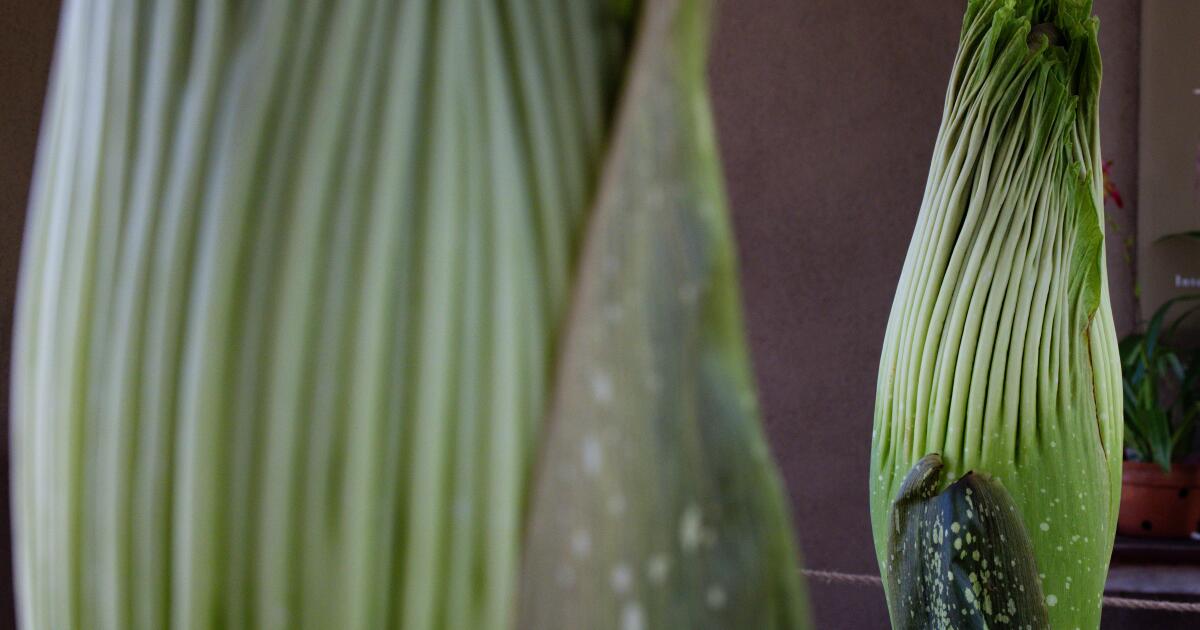
Get ready to catch a whiff of stink. Not one, but two rare corpse flowers are set to bloom at the Huntington in the coming days, with one of them making its first-ever public bloom.
If both plants unfurl on the same day, it would be just the second time a double bloom has ever occurred at the Huntington.
For those unfamiliar with these funky flora, be warned. Corpse flowers bloom for just 24 to 48 hours, and once opened, they reek of gym socks, rotten eggs and decaying flesh … or, well, a corpse.
Brandon Tam, associate curator of orchids for the Huntington, speaks to reporters in front of two corpse flowers as they prepare to bloom.
(Kayla Bartkowski / Los Angeles Times)
Couple that with their tropical native climate of Sumatra, Indonesia, and you’re in for a sweaty, stinky viewing experience.
The stench is important for pollination, said Brandon Tam, the Huntington’s associate curator of orchids. It attracts carrion beetles and flesh flies, which lay their eggs on rotting animal carcasses.
At the Huntington, pollinators aren’t the only thing it entices. Since the garden exhibited its first corpse flower in 1999, thousands of people flock to its conservatory every summer, just to smell these putrid plants.

-
Share via
It smells like rotting flesh, but thousands of people will be lining up to catch a whiff.
“The kids that first came in 1999 are now bringing their kids — their own kids — to experience this over 20 years later,” Tam said. “It’s amazing, this plant, the impact that it has had over many generations.”
Glendale resident Trinity Shi, 42, witnessed three blooms at the Huntington in 2022 and 2023 and compared the smell to rotten fish: pungent, but not unbearable. She was excited to feature such an unusual specimen on her Instagram plant blog, @cubehousejungle, and hopes to make it to this year’s bloom too.
“It feels really prehistoric to look at this plant, because it is so giant,” Shi said of the corpse flower, which can grow over 12 feet tall. “It’s become kind of like a mascot for the Huntington.”
Thanks to cultivation techniques, the Huntington coaxes the plants to bloom every two to three years, not four to six like they do in their natural habitat, where they’re endangered.
Still, the blooms are notoriously unpredictable, Tam said. He guessed one of the plants will bloom in the coming days.
This upcoming bloom spotlights a plant nicknamed Odora, who last opened in 2024, and Odorysseus, a rookie public bloomer. Visitors offered name suggestions for Odorysseus on the Huntington’s Instagram page, where contenders included Stinkerbell, Gagatha and Count Flatula, among others.
It’s not unusual for the Huntington to have multiple soon-to-be bloomers on display. But only once, in 2018, did two plants actually unfurl on the same day.

A detailed view of a corpse flower as it prepares to bloom.
(Kayla Bartkowski / Los Angeles Times)
For Odora and Odorysseus, siblings from a 2002 pollination, a double bloom is unlikely, Tam said. The plants are inclined to bloom out of sequence, “because they want to pollinate another plant that’s in the vicinity.” That can’t happen if they bloom simultaneously.
Though many refer to these plants as “flowers,” they are actually an “inflorescence,” a flowering structure containing hundreds of smaller blooms inside.
When it’s almost time for the plant to open, the spadix — a conic protrusion from inside the plant — emerges and accelerates in growth, climbing up to six inches per day. After a few days, its growth slows down.
“When it gets to about the one-inch range, we’ll know it’s about to bloom for us fairly soon,” Tam said.
When it does bloom, the spathe — leaflike structures encasing the plant — unfurl around 3 or 4 p.m., reaching maximum size in the early hours of the morning. The odor comes from the spadix, which heats up to about 98 degrees to strengthen the smell.

Brandon Tam, associate curator of orchids at the Huntington, walks past the corpse flowers as they prepare to bloom.
(Kayla Bartkowski / Los Angeles Times)
From there, visitors have until about 3 to 5 p.m. to smell the plant before it closes back up and collapses, losing its odor. Eventually, the plant returns as a leaf or a flower, photosynthesizing energy in preparation for its next bloom.
Today, the Huntington houses 43 corpse flowers, making it one of the largest corpse flower collections in North America. The Huntington cultivates them on-site and has distributed many to botanic gardens and zoos across the country.
“It’s important when it comes to conservation that we make plants accessible,” Tam said. “If we’re able to share these plants with other organizations and other hobbyists, we’re able to decrease the amount of plant theft that occurs in the wild, where a lot of conservation work is much needed.”
Eager sniffers can visit the Huntington from 10 a.m. to 5 p.m. Wednesday to Monday. Be sure to stay hydrated, cool and patient, as it’s humid inside the conservatory and lines can be long. For those who want to track the blooms’ progress from afar, catch the Huntington’s online livestream.
Library, art museum, botanical garden
The Huntington
Address: 1151 Oxford Road, San Marino
Admission: $13-34; children 3 and under, free; “Museums for All” (SNAP EBT) program, $5.
Info: huntington.org
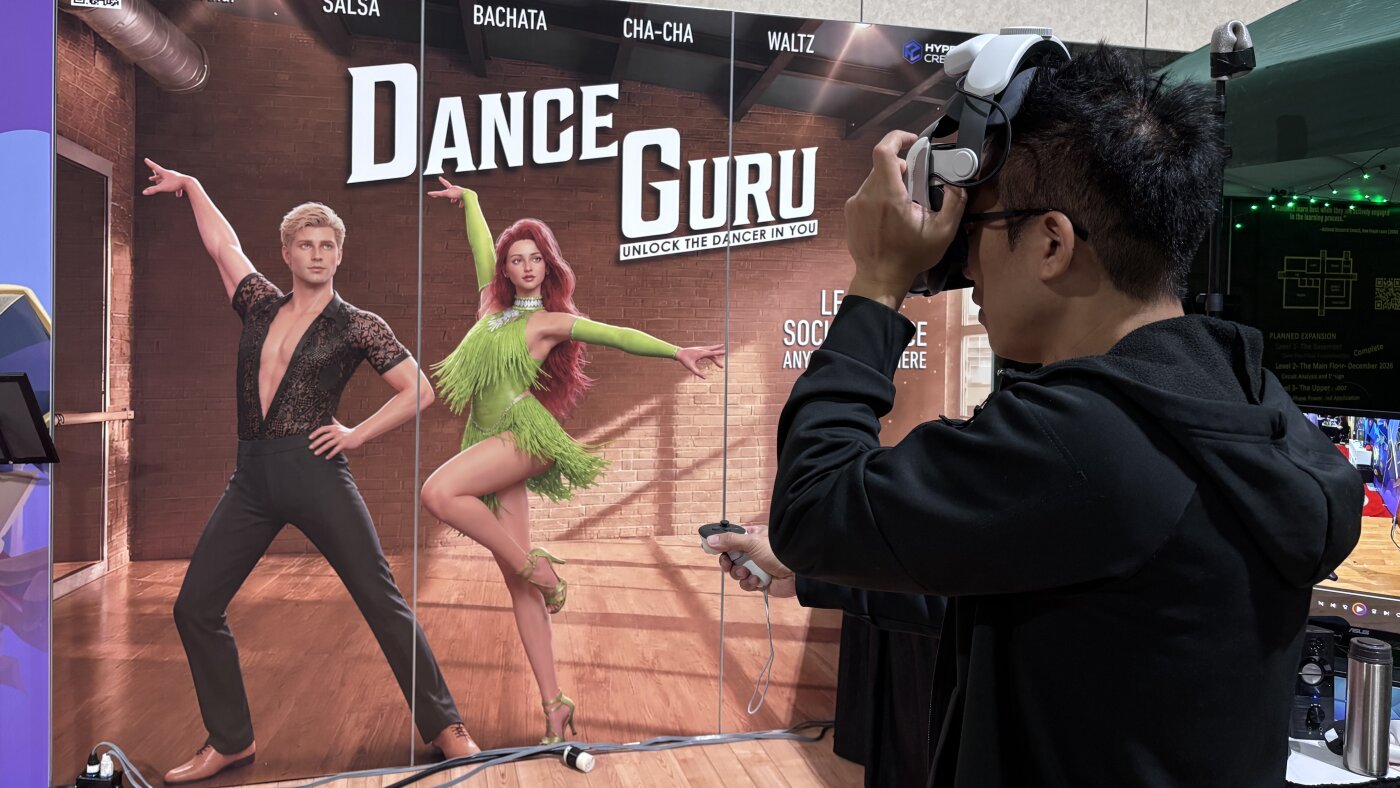
Entrepreneur David Huang tests out a VR headset while conducting demonstrations of the social dance lesson app Dance Guru at the Augmented World Expo in Long Beach, Calif., June 17, 2026.
Chloe Veltman/NPR
hide caption
toggle caption
Chloe Veltman/NPR
Wedding season is in full swing, bringing with it a familiar sense of dread for anyone who fears the dance floor.
But relief may finally be at hand with the help of a new app, Dance Guru, and a virtual reality (VR) headset.
The social dance instruction app transports users to a spacious, digital dance studio. Waiting inside is a computer-generated coach: a handsome, male avatar wearing a shirt open to his navel. He speaks with a slightly gravelly English accent.
“Watch me now,” he instructs at the start of a waltz lesson — which NPR tried out at the Augmented World Expo in Long Beach, Calif., an annual conference showcasing the latest developments in virtual and augmented reality.
The avatar then demonstrates a basic box step.
From there, the lesson becomes interactive. The coach tells the user to hold his hand while an electric pinging sound tracks the student’s foot placement.
“One, two, three, four, five, six,” the virtual teacher counts down.
When the user stumbles, he remains remarkably patient. “Do not worry, foundations take time. Let’s try that again. Work on grounding your steps more intentionally.”
Solving the beginner’s dilemma
Dance Guru creator David Huang said he came up with the idea for the app a couple of years ago out of frustration.
“I always wanted to learn to dance and I was always terrible at it,” Huang said. “And I always ended up stopping midway through the lessons.”
He soon realized that many beginners hit the exact same roadblocks.

“Private lessons are too expensive, and you feel like you’re always forgetting the dance steps,” Huang said. “You cannot find a partner to dance with. So I figured maybe I can create something like this.”
The Dance Guru platform currently offers tutorials in salsa, bachata, waltz, and cha-cha, in both lead and follow modes. To make the digital instruction feel authentic, Huang used motion-capture technology to record the movements of real-life dance teachers — with their permission.
Building on the legacy of online tutorials and video games
Dance Guru belongs to a small but growing wave of apps using VR to demystify social dance. At a nearby booth, conference attendee Victor Chen is testing out a competing app called Trip the Light. It currently offers salsa lessons, as well as freestyle options, where a user can dance with a partner without having to learn specific steps.

Trip the Light’s booth at the Augmented World Expo included posters of the app’s virtual instructors. Real-life performers, who gave Trip the Light permission to motion capture their movements, were used as a basis for these avatars.
Chloe Veltman/NPR
hide caption
toggle caption
Chloe Veltman/NPR
“A lot of times when you’re trying to learn a choreography, it’s watching a YouTube video and you have to pause it, rewind, and play it,” Chen said. “If you were to have a virtual avatar dancing in front of you and correcting for any parts that you missed, it might be a lot easier.”
Interactive video games like Dance Dance Revolution and Just Dance, and YouTube tutorials have been helping people improve their skills in private for years. But those games are mostly aimed at solo players. Unlike the new generation of immersive VR apps, they cannot simulate the mechanics or confidence required for partner dancing on a live dance floor.
The reality check
But this kind of app won’t work for every dancer.
“Everyone learns a little bit differently. And so unless you have a game that has lots of different ways of teaching, you’re going to have things that work for some people and don’t work for others,” said Ariana Katana, a trained contemporary dancer and dance content creator who’s active on YouTube, Twitch and other platforms. “Also, it’s hard to dance with a headset on.”
And then there’s the issue of not being able to physically feel a virtual partner’s hand or shoulder while dancing with them. Patrick Ascolese, the creator of Trip the Light, said the experience could become more tactile in the future. “Haptic suits and wearables will be coming, but I think we’re a little away from that,” he said.
Ascolese said even with their limitations, immersive tools like Trip the Light have immense potential as judgment-free training grounds — giving reluctant dancers the baseline confidence they need to eventually step onto the dance floor with real partners in the real world, including at weddings.
“Just like anything else, practice makes perfect,” said Ascolese. “So the more time you spend in VR with a virtual partner, it works towards helping you get over that social hurdle. We are teaching you the moves that you have to do in order to go out and have fun.”
Jennifer Vanasco edited the broadcast and digital versions of this story. Chloee Weiner mixed the audio.



-

 Austin, TX2 minutes ago
Man shot and killed by police after pointing gun at people in Austin, Texas
-

 Alabama9 minutes ago
Alabama has Talent returns with local connection
-

 Alaska12 minutes ago
Alaska Sports Scoreboard: July 11, 2026
-

 Arizona17 minutes ago
Cardinals Mailbag: Latest on Jacoby Brissett, Carson Beck, and Arizona’s QB Future
-

 Arkansas24 minutes ago
Arkansas tips its hat to blues pioneer Larry “Totsie” Davis in England dedication
-

 California27 minutes ago
‘Explosive diarrhea’ parasite surfaces in California as health officials fear statewide surge
-

 Colorado32 minutes ago
This Quiet Colorado Town Is An Underrated Gem For Nature Lovers
-

 Connecticut39 minutes ago
Car catches fire in Trumbull

