Lifestyle
Altadena’s Christmas Tree Lane survives. Volunteers hope to turn the lights on again

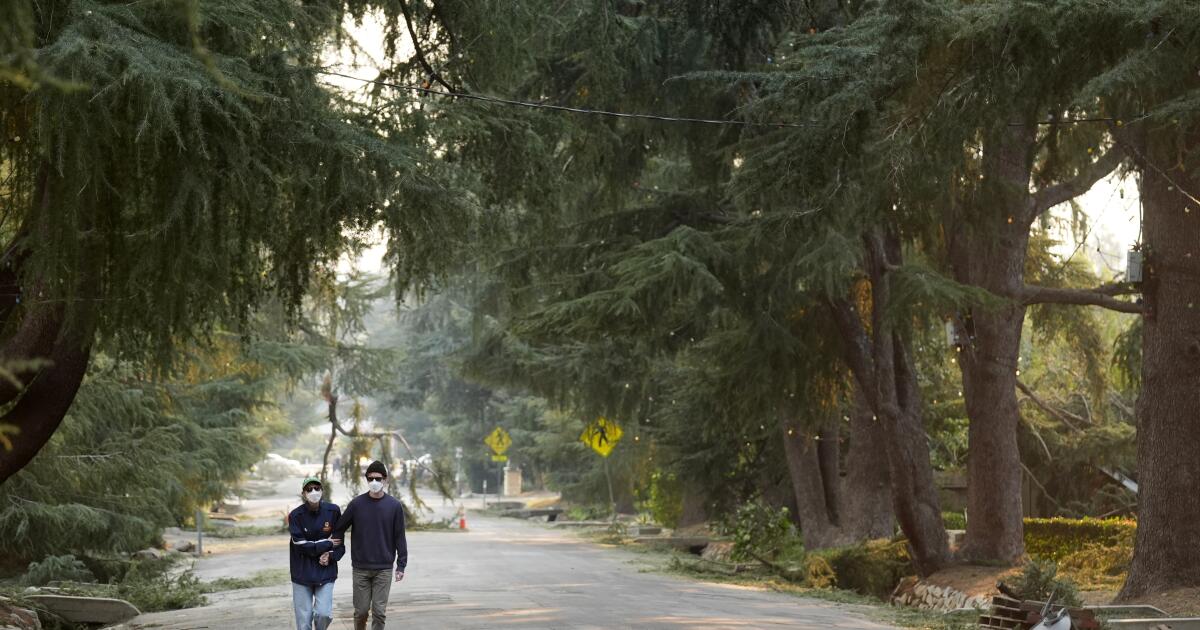
• Altadena’s 104-year holiday lighting tradition known as Christmas Tree Lane escaped damage from the fire despite a torrent of embers coming down on its historic deodar cedars.
• Fierce Santa Ana winds did break branches from some of the trees, but most on Santa Rosa Avenue — the real name of the street — appear unscathed.
• The lights are usually taken down every February, but the head of the volunteer association hopes they can be turned on again “to show we’re still here.”
The people who tend Altadena’s venerable deodar cedars have suffered incomprehensible community losses this week, but Santa Rosa Avenue, a.k.a. Christmas Tree Lane, is a tiny bright spot among the wreckage wrought by the Eaton fire.
Despite what residents described as a fiery rain of embers propelled by hurricane force winds, the street’s 135 cedars seemed unfazed by the fire. The raging Santa Ana winds have broken a few branches, but overall, the massive trees with their graceful drapey limbs seem fine, which means the community’s 104-year holiday light tradition can continue.
Tony Ward and his wife, Maureen, longtime residents of Santa Rosa Avenue and past presidents of the Christmas Tree Lane Assn., went out for dinner in Hastings Ranch on Jan. 7, after the power went out at their home.
Thousands of people turn out every year to drive under a nearly mile-long canopy of sparkly lights strung on 135 deodar cedars on Santa Rosa Avenue in Altadena, a 104-year, volunteer-led tradition known as Christmas Tree Lane.
(Los Angeles Times)
The wind was intense when they left “but there wasn’t any discussion on the media about a fire,” Ward said.
Their dinner outing was short. Before their meal was served, Ward said, “the waiter came up and apologized. He said, ‘We have to give you the meal to go because we have an evacuation order.’ ”
The Wards’ home of nearly 50 years is at the southern end of Santa Rosa Avenue, near Woodbury Road, about six miles west of Hastings Ranch. As the couple returned home and looked to the north, “we could see Eaton Canyon was totally involved in fire, from top to bottom, and we were flabbergasted. It happened so fast,” Ward said.
Once they got home, they began packing “all the things we could think of, photos and business records, into our car and van,” in case they had to evacuate, Ward said. “The wind was intense, and the smoke was just heavy, heavy, heavy.”

The gusting Santa Ana winds blew fiery embers throughout Altadena, including on Woodlyn Road, on Jan. 8 during the Eaton fire.
(Gina Ferazzi / Los Angeles Times)
The Wards have lived in their home for 50 years and never experienced this kind of fire event. Between the constant roar of the wind and the advancing flames, sleep was impossible that night.
They joined their neighbor standing watch outside “to see if anything flared up so we could run and stamp it out,” Ward said.
By 2:30 a.m. last Wednesday, “we noticed embers flying all the way down from way up in the [Angeles National] forest. They would strike the trees [the deodar cedars] and burst into little sparklers. And most of the embers went out, but this was something we’d never experienced before,” he said.
“And in addition to the wind roaring, there were very loud reports we could hear in the background, which we surmised to be exploding canisters of fuel for barbecues and outdoor space heater,” he added. “It was pretty scary because the wind was so intense, and the dust and ashes, everything was right in your eyes. And who thinks of wearing safety goggles? We had no idea that anything like this could happen so far away from the canyons and the national forest.”
When the evacuation order came at 5 a.m., the Wards finally left. They were able to return briefly last Thursday and found their home still standing. It turns out that most of the houses on Santa Rosa Avenue south of Mariposa Street escaped fire damage, although houses on adjoining streets were burned.
And the cedars, most of which were planted in the late 1880s, seemed fine.

A large broken branch from a deodar cedar hangs precariously from a string of lights on Santa Rosa Avenue the day after massive winds and the Eaton fire tore through Altadena.
(Jeanette Marantos / Los Angeles Times)
However, there is wind damage. A few large branches broken in the heavy winds dragged strings of lights with them to the street. But the trees didn’t burn, and it’s not clear why.
“They are pretty lusciously green,” said Cristhian Mace, a natural areas biologist for Los Angeles County Parks and Recreation, “which makes me think they were well irrigated, and that’s probably one of the factors that saved them. They weren’t dry and brittle, and when you look at cedar bark, it’s thick and somewhat fire resistant. … I don’t know how else to account for their resiliency.”
The trees are well tended by the Christmas Tree Lane Assn., but they are largely cared for by the homeowners on whose property the trees reside, said Assn. President Scott Wardlaw. During drought years, the association has taken steps to give the trees extra water, but usually, Wardlaw said, it has to warn homeowners against overwatering the deodar cedars. Too much water can lead to Armillaria root disease, a deadly form of root rot.
Preserving the trees is critical, because without the cedars, there is no Christmas Tree Lane.

In November 2024, volunteers use ropes and pulleys to hang long strings of holiday lights on Christmas Tree Lane’s deodar cedars. Casty Fortich, far left, and Temple City High School student Patience Cam, pull as Scott Wardlaw, president of the Altadena Christmas Tree Lane Assn., and Feli Hernandez, right, look on.
(Genaro Molina / Los Angeles Times)
It takes 10 weekends and more than a 100 volunteers to string those lights every year; volunteers begin their work in September to be ready for Altadena’s free winter festival and tree lighting event in early December. The same volunteers usually start taking the lights down for the year in February to avoid winter rains.
The festival is traditionally held in the parking area of the Altadena Public Library at the corner of Mariposa Street and Santa Rosa Avenue. Last week, several buildings at the intersection burned, including the Altadena Senior Center next door, but the library was saved.
The area lighting event that began in 1920 still has a small-town, old-fashioned feel, with booths and hot chocolate, local leaders making speeches and attendees walking the route once the lights are turned on. The Christmas Tree Lane display itself is pretty low-tech, with no music or special effects. But it still draws thousands of people every year for the simple pleasure of driving slowly for a near mile under a canopy of sparkly lights.
Wardlaw said at least 13 of the Christmas Tree Lane volunteers lost homes in the fire. Also, the local school that had let the association park its truck and store its container of equipment for free was destroyed in the fire.
Now the association is grappling with where it will store its truck and equipment, which didn’t burn in the fire.
The trick will be finding a new storage place the cash-strapped nonprofit can afford. “The cheapest storage units charge around $5 a day for a truck, nearly $1,900 a year, which we can’t afford for just parking,” Wardlaw said.
The association relies on annual $35 memberships and sponsors to cover its expenses, and several of its sponsors, including Altadena Hardware, St. Mark’s School, Pasadena Waldorf School and Western Fence Co., lost buildings in the fire.
Those losses have weighed heavy on Wardlaw, who, like most displaced Altadena residents, is chafing to get into the burned areas, presently closed to the public, to see what has been lost, and what, if anything, can be saved. The broken tree branches on the street will have to be cleared away, he said, and the strings of lights, many of which are likely broken, will have to be repaired or replaced.
The work will require volunteers, many of whom will be preoccupied by their own losses, Wardlaw acknowledged, but he sees the work ahead as a tiny act of defiance against all the fire’s terrible destruction.
“Something I want to do, if it’s feasible, is turn the lights on again as soon as possible,” he said, “Just so we can say, ‘We’re still here.’ ”



By day, you’d be forgiven for walking past the newest theater in downtown L.A.
It isn’t hidden in an alley or obscured via a nameless door. No, this performance space is essentially a theater in disguise, as it’s designed to look like an electrical box — a fabrication so real that when artist S.C. Mero was installing it in the Arts District, police stopped her, concerned she was ripping out its copper wire. (There is no copper wire inside this wooden nook.)
Open the door to the theater, and discover a place of urban enchantment, where a red velvet door and crimson wallpaper beckon guests to come closer and sit inside. That is, if they can fit.
With a mirror on its side and a clock in its back, Mero’s creation, about 6 feet tall and 3 feet deep yet smaller on its interior, looks something akin to an intimate, private boudoir — the sort of dressing room that wouldn’t be out of place in one of Broadway’s historic downtown theaters. That’s by design, says Mero, who cites the ornately romanticized vibe and color palette of the Los Angeles Theatre as prime inspiration. Mero, a longtime street artist whose guerrilla art regularly dots the downtown landscape, likes to inject whimsy into her work: a drainage pipe that gives birth, a ball pit for rats or the transformation of a dilapidated building into a “castle.” But there’s just as often some hidden social commentary.
With her Electrical Box Theatre, situated across from the historic American Hotel and sausage restaurant and bar Wurstküche, Mero set out to create an impromptu performance space for the sort of experimental artists who no longer have an outlet in downtown’s galleries or more refined stages. The American Hotel, for instance, subject of 2018 documentary “Tales of the American” and once home to the anything-goes punk rock ethos of Al’s Bar, still stands, but it isn’t lost on Mero that most of the neighborhood’s artist platforms today are softer around the edges.
Ethan Marks inside S.C. Mero’s theater inside a fake electrical box. The guerrilla art piece is near the American Hotel.
(Kayla Bartkowski / Los Angeles Times)
“A lot of galleries are for what can sell,” Mero says. “Usually that’s paintings and wall art.”
She dreamed, however, of an anti-establishment place that could feel inviting and erase boundaries between audience and perfomer. “People may be intimidated to get up on a stage or at a coffee shop, but here it’s right on street level.”
It’s already working as intended, says Mero. I visited the box early last week when Mero invited a pair of experimental musicians to perform. Shortly after trumpeter Ethan Marks took to the sidewalk, one of the American Hotel’s current residents leaned out his window and began vocally and jovially mimicking the fragmented and angular notes coming from the instrument. In this moment, “the box,” as Mero casually refers to it, became a true communal stage, a participatory call-and-response pulpit for the neighborhood.

Clown Lars Adams, 38, peers out of S.C. Mero’s theater inside a fake electrical box. Mero modeled the space off of Broadway’s historic theaters.
(Kayla Bartkowski / Los Angeles Times)
A few days prior, a rideshare driver noticed a crowd and pulled over to read his poetry. He told Mero it was his first time. The unscripted occurrence, she says, was “one of the best moments I’ve ever experienced in making art.”
“That’s literally what this space is,” Mero says. “It’s for people to try something new or to experiment.”
Marks jumped at the chance to perform for free inside the theater, his brassy freewheeling equally complementing and contrasting the sounds of the intersection. “I was delighted,” he says, when Mero told him about the stage. “There’s so much unexpectedness to it that as an improviser, it really keeps you in the moment.”
A downtown resident for more than a decade, Mero has become something of an advocate for the neighborhood. The area arguably hasn’t returned to its pre-pandemic heights, as many office floors sit empty and a string of high-profile restaurant closures struck the community. Mero’s own gallery at the corner of Spring and Seventh streets shuttered in 2024. Downtown also saw its perception take a hit last year when ICE descended on the city center and national media incorrectly portrayed the hood as a hub of chaos.

Artist S.C. Mero looks into her latest project, a fake electrical box in the Arts District. Mero has long been associated with street art in the neighborhood.
(Kayla Bartkowski / Los Angeles Times)
“A lot has changed in the 13 years when I first got down here,” Mero says. “Everybody felt like it was magic, like we were going to be part of this renaissance and L.A. was going to have this epicenter again. Then it descended. A lot of my friends left. But I still see the same beauty in it. The architecture. The history. Downtown is the most populous neighborhood in all of L.A. because it belongs to everybody. It’s everybody’s downtown, whether they love it or not. And I feel we are part of history.”
Art today in downtown ranges from high-end galleries such as Hauser & Wirth to the graffiti-covered towers of Oceanwide Plaza. Gritty spaces, such as Superchief Gallery, have been vocal about struggles to stay afloat. Mero’s art, meanwhile, remains a source of optimism throughout downtown’s streets.
At Pershing Square, for instance, sits her “Spike Cafe,” a mini tropical hideaway atop a parking garage sign where umbrellas and finger food props have become a prettier nesting spot for pigeons. Seen potentially as a vision for beautification, a contrast, for instance, from the nature intrusive barbs that aim to deter wildlife, “Spike Cafe” has become a statement of harmony.
Elsewhere, on the corner of Broadway and Fourth streets, Mero has commandeered a once historic building that’s been burned and left to rot. Mero, in collaboration with fellow street artist Wild Life, has turned the blighted space into a fantastical haven with a knight, a dragon and more — a decaying castle from a bygone era.
“A lot of times people are like, ‘I can’t believe you get away with that!’ But most people haven’t tried to do it, you know?” Mero says. “It can be moved easily. It’s not impeding on anyone. I don’t feel I do anything bad. Not having a permit is just a technicality. I believe what I’m doing is right.”

Musician Jeonghyeon Joo, 31, plays the haegeum outside of S.C. Mero’s latest art project, a theater in a faux electrical box.
(Kayla Bartkowski / Los Angeles Times)
After initially posting her electrical box on her social media, Mero says she almost instantly received more than 20 requests to perform at the venue. Two combination locks keep it closed, and Mero will give out the code to those she trusts. “Some people want to come and play their accordion. Another is a tour guide,” Mero says.
Ultimately, it’s an idea, she says, that she’s had for about a decade. “Everything has to come together, right? You have to have enough funds to buy the supplies, and then the skills to to have it come together.”
And while it isn’t designed to be forever, it is bolted to the sidewalk. As for why now was the right time to unleash it, Mero is direct: “I needed the space,” she says.
There are concerns. Perhaps, Mero speculates, someone will change the lock combination, knocking her out of her own creation. And the more attention brought to the box via media interviews means more scrutiny may be placed on it, risking its confiscation by city authorities.
As a street artist, however, Mero has had to embrace impermanence, although she acknowledges it can be a bummer when a piece disappears in a day or two. And unlike a gallerist, she feels an obligation to tweak her work once it’s out in the world. Though her “Spike Cafe” is about a year old, she says she has to “continue to babysit it,” as pigeons aren’t exactly known for their tidiness.
But Mero hopes the box has a life of its own, and considers it a conversation between her, local artists and downtown itself. “I still think we’re part of something special,” Mero says of living and working downtown.
And, at least for now, it’s the neighborhood with arguably the city’s most unique performance venue.
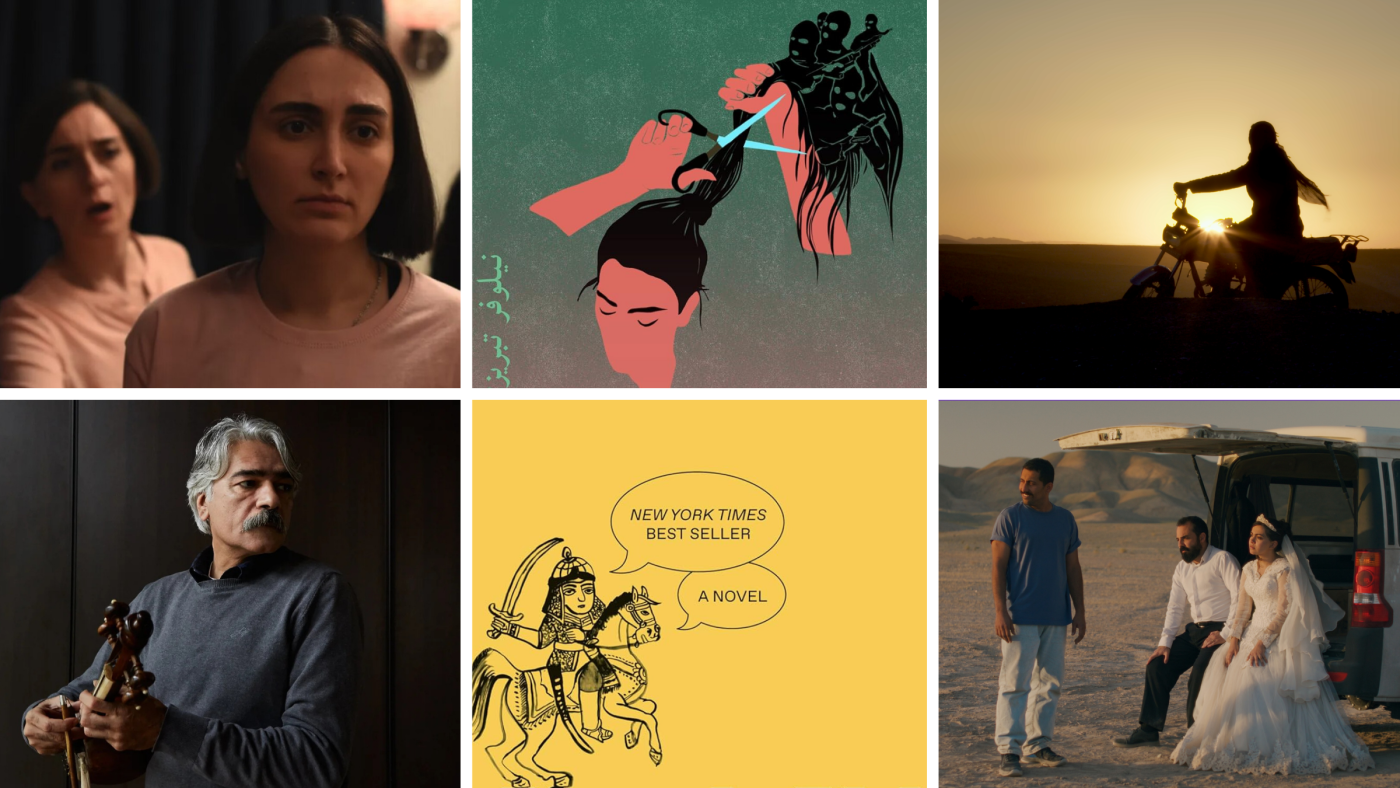
Understanding one of the world’s oldest civilizations can’t be achieved through a single film or book. But recent works of literature, journalism, music and film by Iranians are a powerful starting point. Clockwise from top left: The Seed of the Sacred Fig, For The Sun After Long Nights, Cutting Through Rocks, It Was Just an Accident, Martyr!, and Kayhan Kalhor.
NEON; Pantheon; Gandom Films Production; NEON; Vintage; Julia Gunther for NPR
hide caption
toggle caption
NEON; Pantheon; Gandom Films Production; NEON; Vintage; Julia Gunther for NPR
Few Americans have had the opportunity to visit or explore Iran, an ethnically diverse nation of over 90 million people which has been effectively shut off from the United States since the Iranian revolution of 1979. Now, with a U.S. and Israeli-led war on Iran underway, the ideas, feelings and opinions of Iranians may feel less accessible. However, some recent books, films and music made by artists and journalists in Iran and from the Iranian diaspora can help illuminate this ancient culture and its contemporary politics.
These suggestions are just a starting point, of course — with an emphasis on recent works made by Iranians themselves, rather than by outsiders looking in.
Books
For the Sun After Long Nights: The Story of Iran’s Women-Led Uprising, by Fatemeh Jamalpour and Nilo Tabrizy
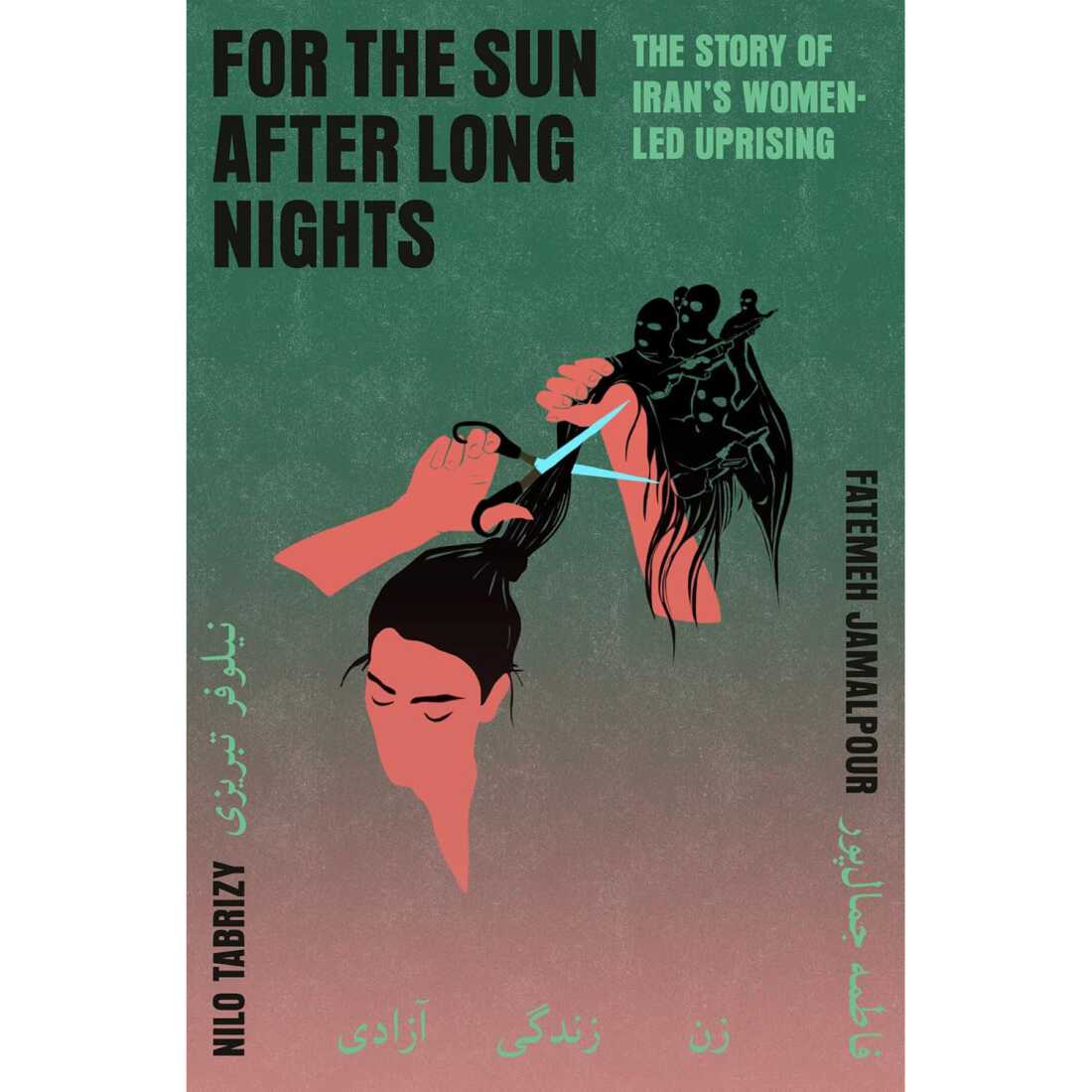
There are quite a few excellent titles that deconstruct the history of Iran from ancient times through the rule of the Pahlavi Dynasty to the Iranian Revolution. But there are far fewer books that help us understand the Iran of 2026 and the people who live there now. One standout is the National Book Award-nominated For the Sun After Long Nights: The Story of Iran’s Women-Led Uprising by journalists Fatemeh Jamalpour and Nilo Tabrizy, which chronicles — almost in real time — the Woman, Life, Freedom movement that began in 2022, during which Jamalpour was working secretly as a journalist in Tehran. In 2024-25, Jamalpour (who is now living in exile in the U.S.) and I spent a year together at the University of Michigan’s Knight-Wallace fellowship for journalists; her insights into contemporary Iran are among the best.
Gold, by Rumi, translated by Haleh Liza Gafori

If Americans are familiar with Persian poetry at all, it may well be through popular “translations” of the 13th-century Sufi poet Jalaluddin Rumi done by the late American poet Coleman Barks, who neither read nor spoke the Persian language and detached the works of Molana (“our master”), as Iranians call him, of references to Islam. (Instead, Barks “interpreted” preexisting English translations.)
In 2022, Iranian-American poet, performance artist and singer Haleh Liza Gafori offered the first volume of a corrective, in the form of fresh Rumi translations that are at once accessible, deeply contemplative and immediate. A second volume, Water, followed last year.
Martyr!: A Novel, by Kaveh Akbar
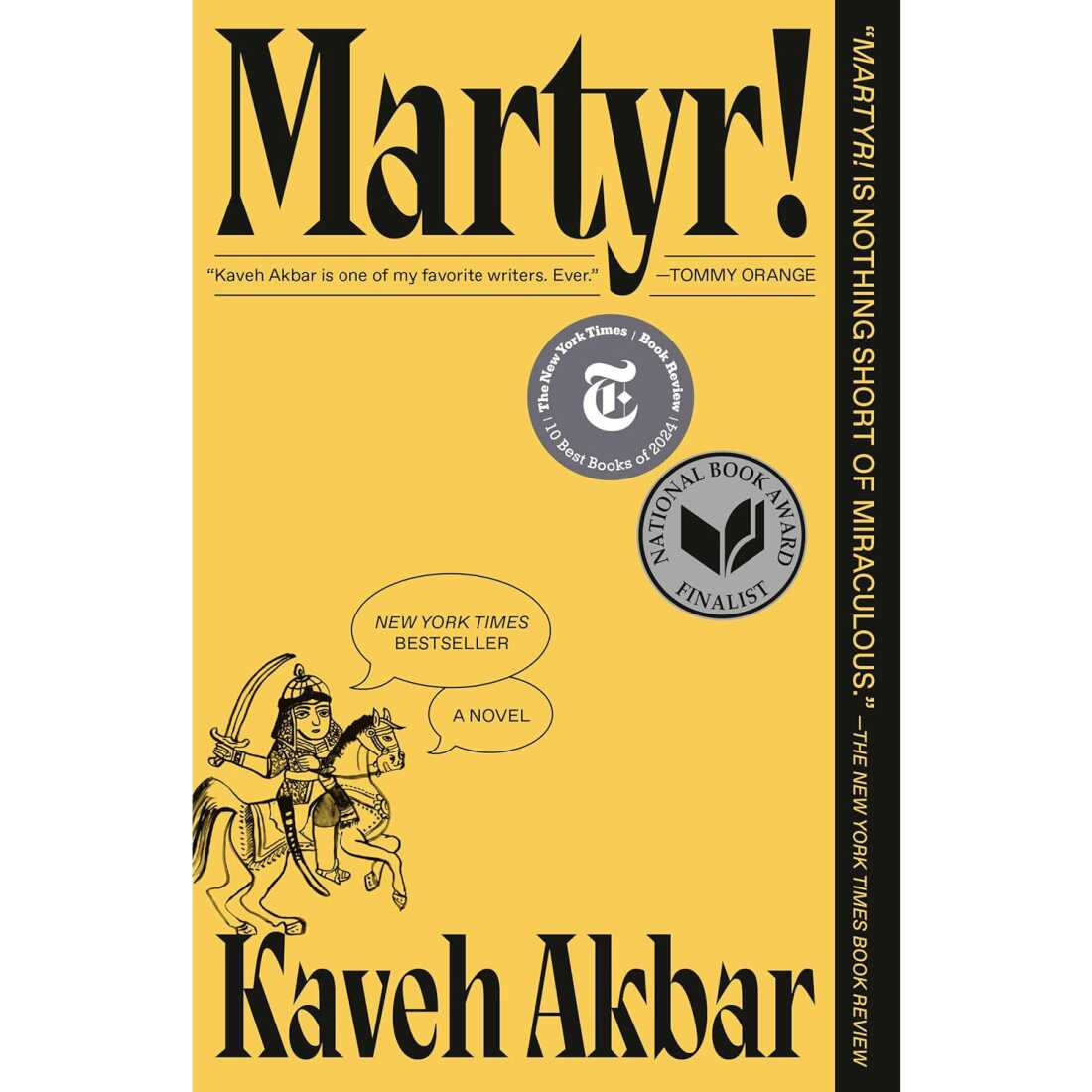
This 2024 debut novel by Kaveh Akbar, the poetry editor at The Nation, is an unflinching tour-de-force bursting with wit and insight into the complications of diaspora, the nature of identity in a post-War on Terror world and the inter-generational impact of the 1979 Revolution on Iranians. The protagonist, the Iran-born but American-raised Cyrus Shams, has struggled with addiction, depression and insomnia his whole life, and is trying his best to make sense of a world at the “intersection of Iranian-ness and Midwestern-ness.” As with so many other of the titles here, fiction and fact are woven together: the story centers around the true story of the U.S. downing an Iranian passenger plane in 1988 during the Iran-Iraq war.
The Stationery Shop: A Novel, by Marjan Kamali

Marjan Kamali’s 2019 love story is the wistful tale of a young woman named Roya and an idealistic activist named Bahman, who meet cute in a Tehran store in the 1950s, but whose planned marriage falls apart due to turmoil both familial and political, as Iran’s democratically elected government falls in a U.S.-British lead coup that ends with the installation of the Shah. Roya flees to the U.S. for a fresh start, but the two reunite in 2013, wondering: what if life had spun out in a different direction?
Movies
Coup 53
This 2019 documentary directed by Iranian film maker Taghi Amirani and co-written by Walter Murch recounts Operation Ajax, in which the CIA and Britain’s MI6 engineered the removal of Mohammad Mossadegh, Iran’s democratically elected prime minister, and installed a friendly ruler, Shah Mohammad Reza Pahlavi, in his place. (The Shah was ousted in the 1979 revolution.) As Fresh Air critic John Powers noted in his review, “What emerges first is the backstory of the coup, which like so much in the modern Middle East is predicated on oil. Shortly after the black gold was discovered in early 20th century Iran, a British oil company now known as BP locked up a sweetheart deal for its exploitation. Iran not only got a mere 16% of the oil money before British taxes, but the books were kept by the British — and the Iranians weren’t allowed to see them.”
YouTube
Cutting Through Rocks
Sara Khaki and Mohammadreza Eyni’s film Cutting Through Rocks is up for an Oscar this season after premiering at the 2025 Sundance Film Festival. This inspiring documentary follows Sara Shahverdi — a divorced, childless motorcyclist — as she campaigns to become the first woman elected to the city council of her remote village, and who dreams of teaching girls to ride and to end child marriage.
YouTube
It Was Just an Accident
The latest film from acclaimed director Jafar Panahi — who has officially been banned from making films in Iran — is 2025’s It Was Just an Accident. Panahi, who has been jailed multiple times for his work and was recently sentenced again in absentia, has said in interviews that his inspiration for this brutal – and shockingly funny – thriller was people he met while in prison: an auto mechanic named Vahid finds himself face-to-face with the man who he is fairly certain was his torturer in jail, and eventually assembles other victims to try to confirm his suspicions. Fresh Air critic Justin Chang called It Was Just an Accident “a blast of pure anti-authoritarian rage.”
YouTube
The Seed of the Sacred Fig
This 2024 thriller — shot in secret by director Mohammad Rasoulof — centers on a family whose father, Iman, is appointed as an investigating judge in Tehran. But it soon becomes clear that his job has nothing to do with actually investigating. Iman, his wife, and two daughters come to suspect each other in our age of mass surveillance, as the city streets below erupt into the real-life Woman, Life, Freedom protests.
YouTube
Music
Kayhan Kalhor
One of the primary ambassadors of Persian classical music has been the composer and kamancheh (an Iranian bowed-instrument) virtuoso Kayhan Kalhor. Although music, like poetry, has been central to Iranian culture for centuries, all kinds of music were initially banned after the 1979 revolution. Since then, however, Iranian classical musicians have ridden many looping cycles of official condemnation, grudging tolerance, censorship and attempts at co-option by the regime.
Despite those difficulties, Kalhor has built a thriving career both inside Iran and abroad, including winning a Grammy Award as part of the Silkroad Ensemble and earning three nominations as a solo artist. Back in 2012, I invited him to our Tiny Desk to perform solo. “Didn’t know I could have goosebumps for 12 minutes straight,” a YouTube commenter recently wrote; I couldn’t put it any better.
YouTube
Saeid Shanbehzadeh
Among Iran’s 92 million people, about 40% of come from various ethnic minorities, including Azeris, Kurds and Armenians among many others. One of the most fascinating communities is the Afro-Iranians in the Iranian south, many of whose ancestors were brought to Iran as enslaved people from east Africa. Multi-instrumentalist and dancer Saeid Shanbehzadeh, who traces his ancestry to Zanzibar, celebrates that heritage with his band, and specializes in the Iranian bagpipe and percussion.
YouTube
The underground metal scene
Despite ongoing restrictions on music — including the continued ban on female singers performing in mixed-gender public settings — Iran is home to a thriving underground scene for metal and punk. Though it’s fictional, Farbod Ardebelli’s 2020 short drama Forbidden to See Us Scream in Tehran — which was secretly filmed in Tehran, with the director giving instructions remotely from the U.S. via WhatsApp — gives a flavor of that real-life scene and the dangers those artists face.
YouTube

Sen. Tillis To Kristi Noem
ICE Killings Are Like Dog You Killed
Published
Fireworks on Capitol Hill … Sen. Thom Tillis ripped into DHS Secretary Kristi Noem during a congressional hearing … comparing American citizens killed by immigration agents to a dog she killed.
Check out the video … the Republican Senator from North Carolina says Noem has shown terrible leadership and decision-making as Trump‘s DHS Secretary.
AP

Tillis says the killings of Renee Good and Alex Pretti in Minneapolis by ICE and Border Patrol remind him of a passage from Noem’s book … where she recalls killing a dog she brought on a hunting trip.
Noem said the 14-month-old dog, Cricket, was misbehaving … so she led the dog to a gravel pit and shot her.
X/@DHSgov
Sen. Tillis told her straight up … “Those are bad decisions made in the heat of the moment. Not unlike what happened up in Minneapolis. We’re an exceptional nation, and one of the reasons we’re exceptional is we expect exceptional leadership. And you’ve demonstrated anything but that.”

Aging process could accelerate due to ‘forever chemicals’ exposure, study finds

ESPN analyst Paul Finebaum questions Trump’s college sports reform meeting as potential ‘circus’

Stop the insanity 2.0: ’90s icon Susan Powter’s tech comeback

Startup Varda Space Industries snags former Mattel plant in El Segundo

Meet the Mexican American talent behind ‘KPop Demon Hunters’

Florida High School Football Rankings: Top 25 teams – Oct. 21

Cleary's 21 help Le Moyne down Central Connecticut State 69-64 in OT

How old is Bo Nix? What to know about Oregon quarterback ahead of 2024 NFL Draft

99th annual Pony Swim held in Virginia

Indiana Members Credit Union announced as new anchor tenant at Bottleworks District

Which oil and gas facilities in the Gulf have been attacked?

Mojtaba Khamenei, son of former supreme leader, tipped to become Iran’s next head of state

Video: Senators Question Kristi Noem on ICE Immigration Tactics

Combustible Republican Senate primary in Texas heading into overtime

Hungarian veto proves EU needs less unanimity, says new Dutch PM
-

 World7 days ago
Exclusive: DeepSeek withholds latest AI model from US chipmakers including Nvidia, sources say
-

 Massachusetts7 days ago
Mother and daughter injured in Taunton house explosion
-

 Denver, CO7 days ago
10 acres charred, 5 injured in Thornton grass fire, evacuation orders lifted
-

 Louisiana1 week ago
Wildfire near Gum Swamp Road in Livingston Parish now under control; more than 200 acres burned
-

 Oregon5 days ago
2026 OSAA Oregon Wrestling State Championship Results And Brackets – FloWrestling
-

 Florida3 days ago
Florida man rescued after being stuck in shoulder-deep mud for days
-

 Maryland3 days ago
AM showers Sunday in Maryland
-

 Wisconsin2 days ago
Setting sail on iceboats across a frozen lake in Wisconsin