Lifestyle
A costume designer on the art of building characters for film and TV

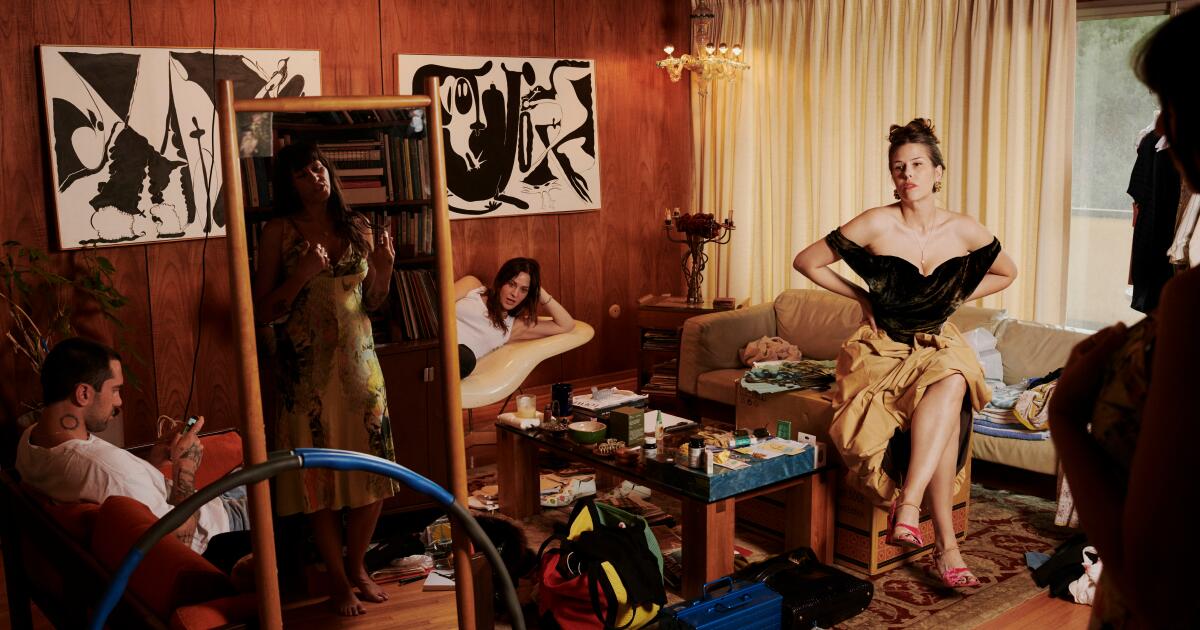
How do you know how to dress someone when that person technically doesn’t exist? This inane yet genuine question burned in my mind when I sat down to interview Natasha Newman-Thomas, an award-winning costume designer. Newman-Thomas is the sartorial mastermind behind TV shows including HBO’s “The Idol” and Childish Gambino’s iconic “This Is America” music video (which garnered her a Costume Designers Guild award). Known for her character-driven approach and highly distinctive, vintage-inflected eye, Newman-Thomas explains to me that costume design requires not only a deep understanding, passion, and technical proficiency for clothing design and fashion styling: it also requires an ability to conjure and then investigate a fictionalized character’s psychological makeup. The answer to my question, in short, is that you have to believe in an illusion in order to make it a believable reality.
When you see an actor or musician in a costume designed by Newman-Thomas, the outfit looks authentic in a way that is almost unnoticeable — and this is the point. The selection and styling of the clothes appear so natural and unique to the character that it seems as though they showed up to set wearing it. Her latest subjects are Keanu Reeves and Cameron Diaz in the upcoming film “Outcome,” directed by Jonah Hill. While Newman-Thomas couldn’t get into the details of those characters yet, she shared the peculiar and fascinating details of her art with me and made the case for why flying helicopters is more interesting than sitting through a group critique in art school.
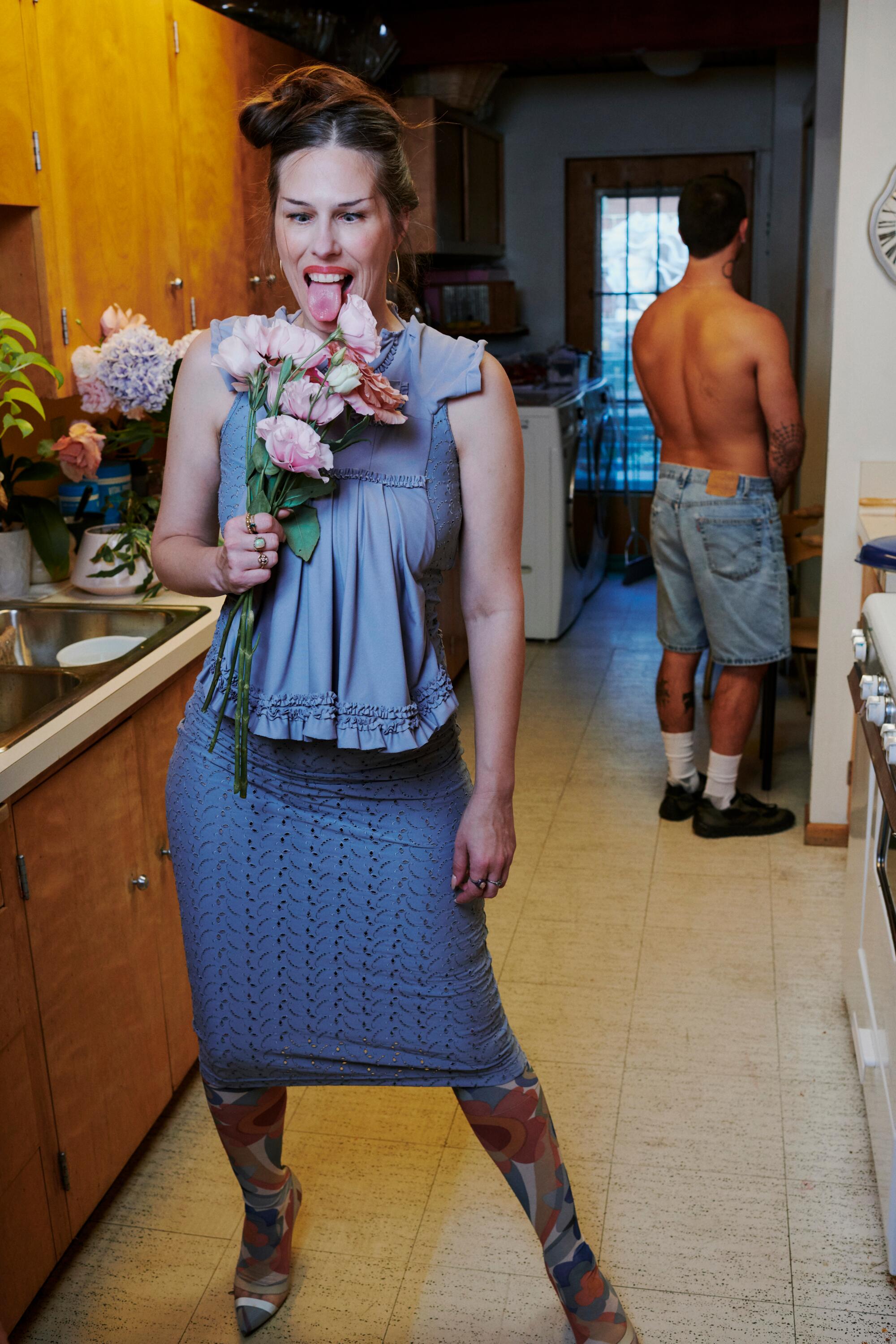
Natasha wears Comme des Garçons Autumn/Winter 2007 dress courtesy of Aralda Vintage, Fendi boots, Gabriella Kiss earrings.
Costumes are the first place where you get to begin storytelling without actually knowing someone.
— Natasha Newman-Thomas
Eugenie Dalland: My Gen-Z cousin had never seen “The Matrix” before, so I recently watched it with her. I realized how crucial all those latex and black leather costumes were to the tone of the film. Why are costumes so important?
Natasha Newman-Thomas: Costumes are the first place where you get to begin storytelling without actually knowing someone. It’s crucial on screen because you want to know as much about a character as you can, instantly, in order to get the viewer involved and on board. If you’re in a dystopian future like “The Matrix,” the costumes pull you in and make you believe in that world and in the story on a surface level.
ED: I’m curious about the nuts and bolts of creating these characters, what you’ve called the “sociological exploration” involved in building them. Who is involved in this process?
NNT: It depends on the project. Sometimes I have one initial conversation with the director, and then they turn the whole thing over to me and let me do my thing. Other times, the director is super involved and we get into the nitty-gritty about every character. And then I’ve been on projects where I do that with the actors, which I like doing because it’s part of the character development for them. It’s super informative for both of us to have those conversations and figure out why a character behaves a certain way, the things that inform who they are, their pathologies.
ED: Shopping is a big part of costume design. What kind of mindset are you in when you’re buying clothes for a character? I imagine it’s sort of meditative.
NNT: It’s definitely meditative! I’m almost trying to put myself in their mental state, and then imagine how they would acquire clothing. Where would they shop? Or would their character only wear hand-me-downs? If so, where would those come from? Someone from their church, a sibling?
ED: I feel like this psychological approach is why your costumes always feel so personalized and unique. It makes the characters more believable as actual individuals. You’re not throwing them into whatever is trendy.
NNT: There’s totally something to be said for capturing a moment in history with [trendy costumes], but typically I strive to make something timeless. I try to make things as unique to the characters as possible.
ED: I’ve always wanted to ask you about the outfit Childish Gambino wears for the “This Is America” music video, which you costumed. It’s very minimal — vintage pants, no shirt, gold chains — but he looks so f—ing cool and moreover, totally natural, authentic. I almost wondered if he showed up to set wearing that look.
NNT: It’s funny you say he looks really natural and embodies the outfit well, because up until 20 minutes before the shoot, Donald [Glover] and I were going back and forth about it. He was like, “I’m not comfortable in that, it inhibits my performance, I just want to wear sweats.” I was like, “no way, sweats are a completely different message, it’s really crucial that these are the pants you wear. If it’s inhibiting your movement, I’ll sew in a gusset.” I was literally sewing a gusset into those pants up until 30 seconds before we shot! I just did another project with Donald a few months ago and he was like, “by the way, you were right about the pants.”
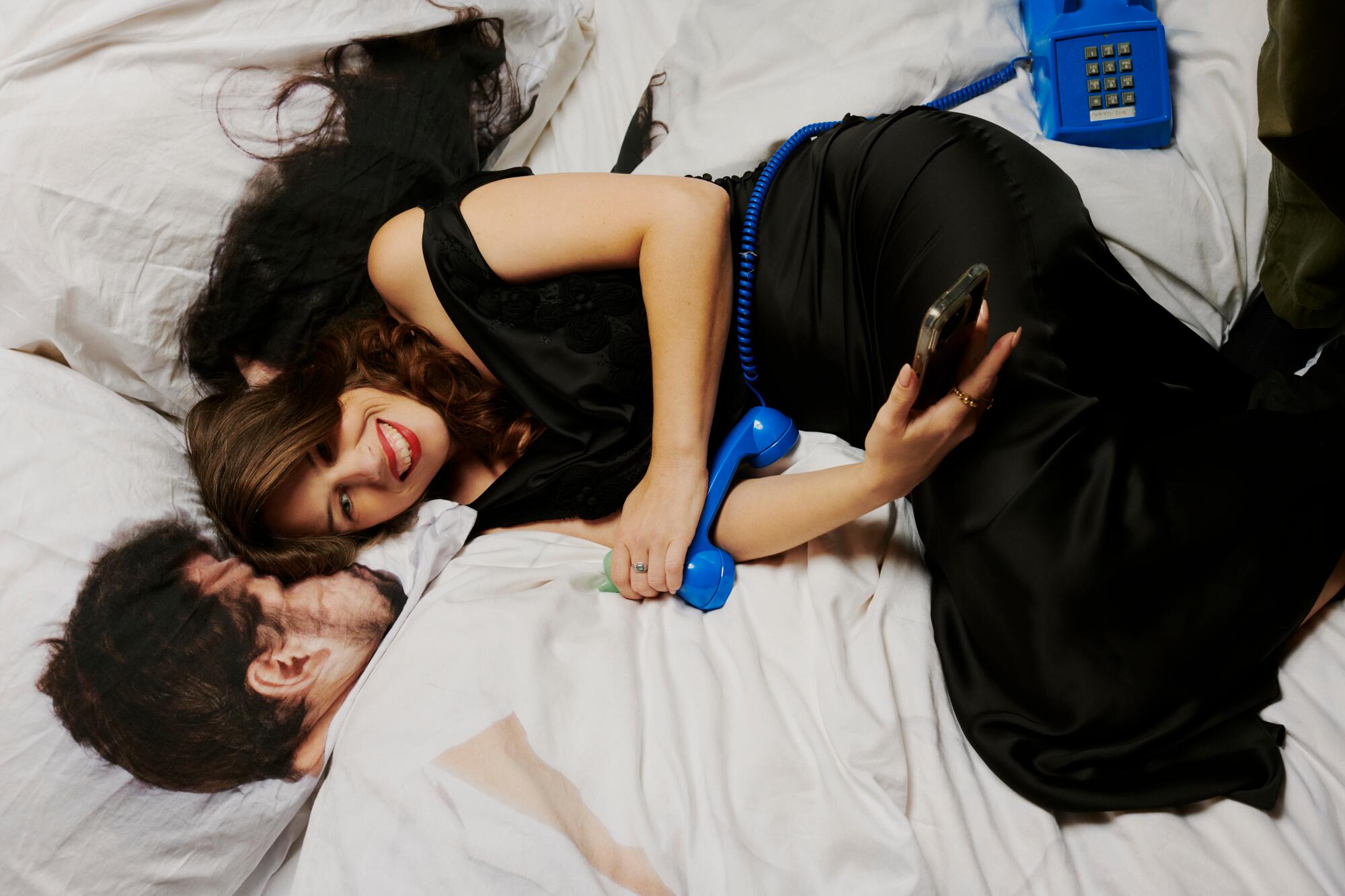
Natasha wears vintage John Galliano 2008 runway dress courtesy of Aralda Vintage. Opposite page: Natasha wears Christian Lacroix jacket, Wolford tights, KNWLS shoes Vivienne Westwood necklace, Gabriella Kiss earrings.

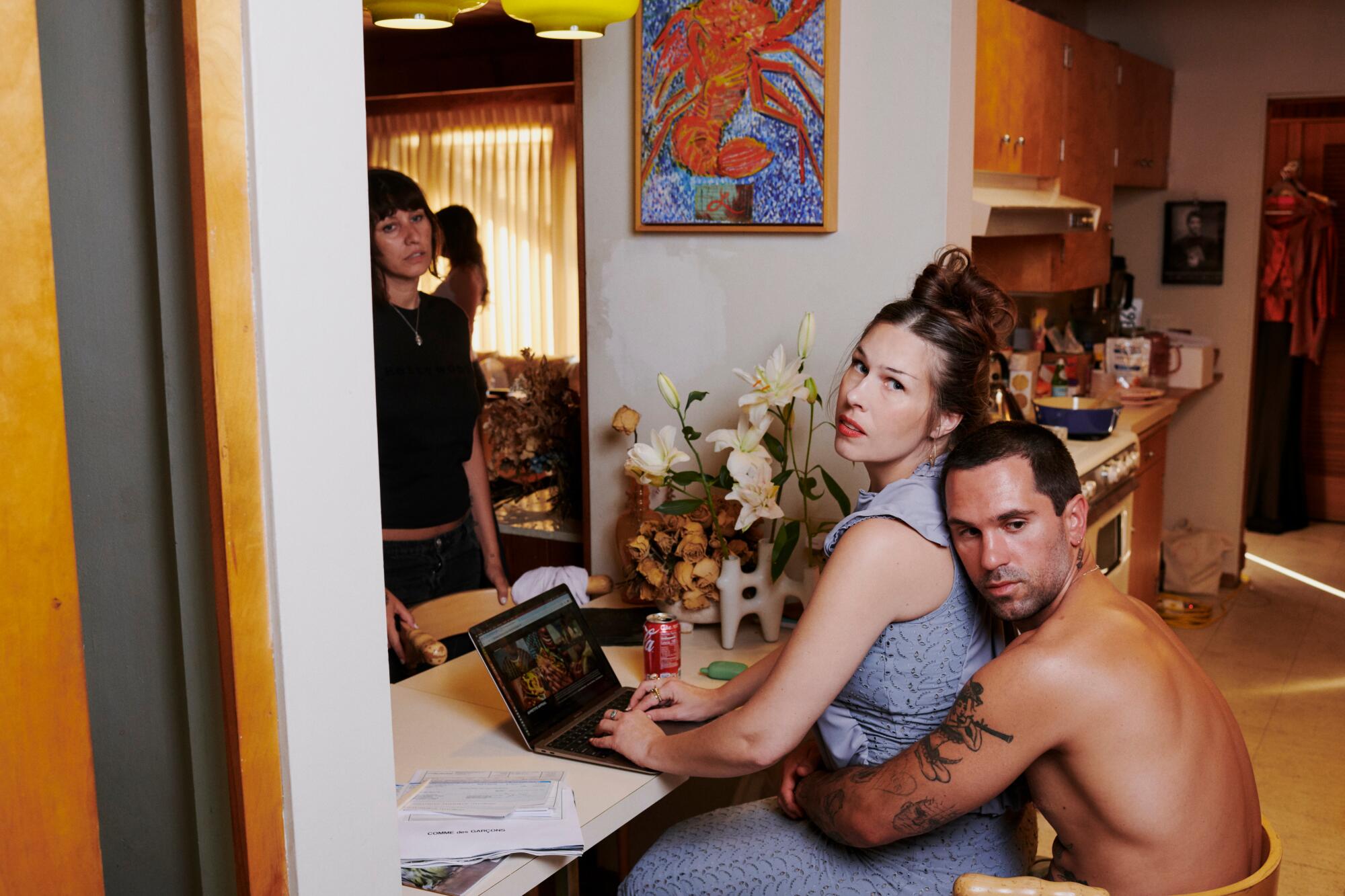
Natasha wears Helmut Lang suit, vintage Frank Zappa shirt from Zappa’s personal collection, Rejina Pyo shoes, Bottega Veneta earrings, Mondo Mondo ring.
ED: What were you aiming for with his costume?
NNT: We referenced some Fela Kuti images, but also the idea of someone who acquires clothes and then really makes them their own. Someone who finds a pair of pants and makes them look sick by styling them in a specific way. That was so important because we didn’t want it to look or feel new, typical, or trendy.
ED: How did you get into costume design?
NNT: I went to the School of the Art Institute of Chicago because they didn’t make you choose between fashion and fine art, you could do both, which is what I wanted. But eventually I had the rude awakening that you really couldn’t do both. I took every fashion class I could without committing to being in the fashion design program there. A few years in, I realized I didn’t want to sit through a critique and hear people bulls— about “juxtaposition” ever again. I decided to drop out and move back to L.A. and go to helicopter school to be a pilot.
ED: Wait, what?
NNT: There’s a nonprofit program at the Compton Airport. It’s amazing. I’d love to go back and finish my flight hours and get my license. Anyway, while I was there, an old professor friend of mine from the Art Institute called and said, “I’m moving to L.A. to do costumes on this show, I’d love for you to try assisting me.” My first day on set I was like, “this is literally made for me, it combines all my interests.” The pacing, the creative problem solving, the clothes, the character development, all of it. That was it. Day One. I feel very blessed that I found a job where I can make money and do what I love.
ED: What are some movies that made a strong impression on you in terms of costume design?
NNT: There’s so many. I actually just did a symposium about [Jean Paul] Gaultier’s costumes for “The Fifth Element.” I also love his work on “The Cook, the Thief, His Wife & Her Lover.” The costume design really blends with the production design, it’s so artful.
ED: What’s an unexpected shopping tip you tell people?
NNT: This is so cheesy: Be clothes minded, not closed minded. [laughter] I love to go into a shopping experience with the idea that you can really style anything to make it interesting. A game I’ll play with my best friend is we’ll send each other pictures of things and ask, “how would you make this cool?” Like “how would you make a pair of Toms cool?” I love a good challenge.
ED: How do you make a pair of Toms cool?
NNT: The way I would do it is to cast a Toms shoe in a block of resin, and then put another Toms shoe on top of it. So it’s a platform shoe with the Toms inside the platform and then the other one on top.
ED: Please make this shoe.
NNT: Our first question when we start anything is what’s not cool right now, what is no one doing, and how can we use that to our advantage? We did an Yves Tumor music video and I was like, “no one is doing indie sleaze right now, I’m going to cover a pair of jeans in the Strokes patches, that’ll be so weird!” Two years later, the Strokes were playing the Celine show. It’s fun to try to get ahead of the cycle. It’s getting harder to do because with the internet, everything moves so much faster now, people just gobble up trends. But it’s creating an interesting position for designers to be forced to come up with new things that no one’s seen before, that aren’t referential. I think it could be really exciting. Fingers crossed.
Hair & Makeup Paige Wishart
Lighting Director David Lopez
Styling Assistants Margaux Solano, Tommy Petroni
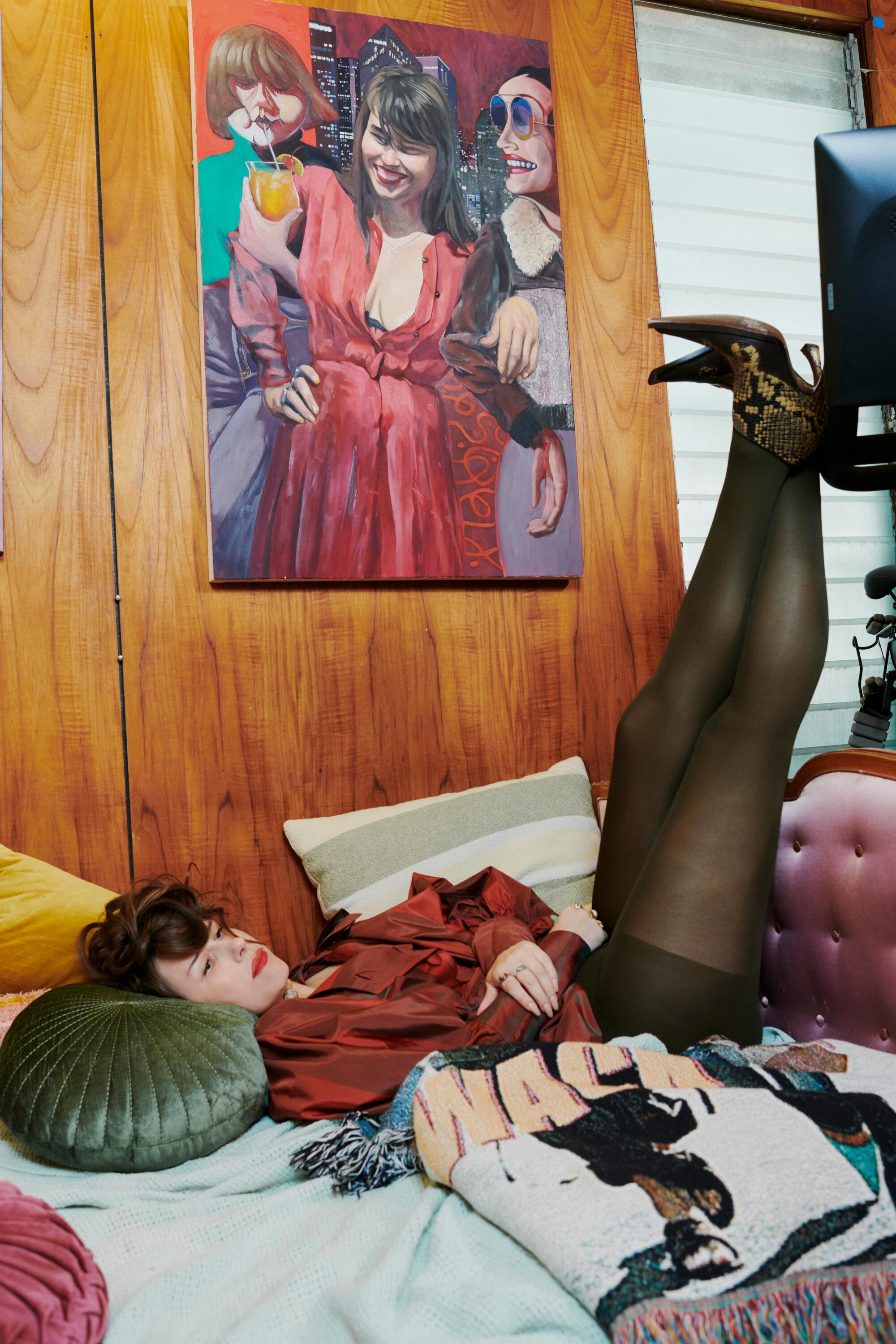
Natasha wears Christian Lacroix jacket, Wolford tights, KNWLS shoes Vivienne Westwood necklace, Gabriella Kiss earrings.
Eugenie Dalland is a writer based in New York. Her essays, profiles and reviews have appeared in the Los Angeles Review of Books, Hyperallergic, BOMB, Cultured Magazine, the Brooklyn Rail and elsewhere. She publishes the arts and culture magazine Riot of Perfume.



The scoreboard shows the results of the women’s singles final match between Iga Swiatek of Poland and Amanda Anisimova of the U.S. at the Wimbledon Tennis Championships in London, Saturday, July 12, 2025.
Kirsty Wigglesworth/AP
hide caption
toggle caption
Kirsty Wigglesworth/AP
Fifteen points in tennis? Nice. Thirty, 40 — even better. Advantage — that sounds good. “Love” — that also must be great, right? Well, not quite.
As the French Open rolls on and Serena Williams has announced her return to the sport, maybe you’ve been paying a little more attention to tennis. The sport’s scoring system is notably distinct, and can sometimes be hard to grasp for newcomers. But even tennis aficionados might not know why, or how, “love” became the unmistakable callout for zero points. For this installment of NPR’s Word of the Week, we’re exploring how a word that signifies trailing behind got such a sweet name.
“Love” comes from the heart — or an egg?
It’s hard to pinpoint when the first tennis ball went over the net. Tennis is a derivative of lots of other sports, such as “jeu de paume,” a handball game played in France, said JT Buzanga, the collections manager at the International Tennis Hall of Fame museum.

But tennis became a patented, official sport in 1874, said Steve Flink, a journalist whose tennis coverage got him inducted into the International Tennis Hall of Fame. It has retained its unique, mysterious scoring system ever since.
“By and large, the original system has held up almost entirely,” Flink said.
The use of “love” goes back to the late 18th century, said Jesse Sheidlower, a lexicographer. But it was used earlier than that in card games such as whist and bridge. Before the term made its way to tennis, the sport favored plain old “nothing,” or “nil,” he said.
Why love in the first place, though? Historians don’t really know for sure, but there are a few theories.
The French could have something to do with it. Some historians believe “love” derives from “l’oeuf,” which means “the egg” in French. Because eggs are shaped like zeros, terms such as “goose egg” and “duck’s egg” have been used in other contexts to mean zero, Sheidlower said.
It’s also possible English speakers mispronounced l’oeuf as “love.” But Sheidlower isn’t convinced that’s the answer.
“It’s the French equivalent of an English expression. But since that expression doesn’t appear in French, the French word wouldn’t have been used,” he said.
To be sure, France has had a lot of influence on tennis culture, Buzanga said. For example, “deuce” or a game tied at 40 points, comes from the French word for “two”: “deux.” But he prefers another prominent theory: that “love” comes from the idiom “for the love of the game.” Even if a player hasn’t scored, it doesn’t matter, because their heart is in it. It’s the theory Sheidlower said is the most plausible, because the idiom was used by the English before tennis was popularized.

Another variation of the “love of the game” theory is that the word could have come from the Dutch “lof,” or “honor” — or the Latin “amare,” meaning “to love,” Flink said.
But if tennis’ “love” doesn’t come from a French word, the theory at least has a French sensibility.
“I think the ‘for the love of the game’ is kind of romantic,” Buzanga said.
“Love” probably isn’t going anywhere
Tennis used to be a sport of leisure. The style of play has changed a lot over the years; players are more athletic and competitive, for instance, Flink said. But the rules of the sport are more steadfast, he said.
“There’s this incredible, enduring respect for tradition in tennis,” he said. “Changes are not made easily.”
There has been one major change in modern history: the tie-break. Matches can go on and on because players have to score two consecutive points to break a deuce, or by two games to break a tied set. But the onset of television meant matches would have to get shorter if the sport wanted to capture a larger audience, Flink said.

Change even came for “love.” An alternative sprouted up in the 1970s, and is still used today: “bagel,” named for its zero shape, Sheidlower said. Novices may say “zero,” and insiders will understand what they mean, but they “will needle them about it,” Flink said.
But “love” still prevails.
“People kind of like it,” Flink said. “It’s different. Why say zero when you can say love?”

On a 75-mile cliff-hugging stretch of highway in California, traffic is way up, despite soaring gas prices. And locals expect the busiest summer in years.
The road is Highway 1 in Big Sur, which reopened in January after three years of repair and reconstruction following a pair of landslides. Drivers can once again embark on the state’s most famous road trip, covering the 100 miles between Cambria to the south and Carmel to the north without leaving the two-lane coastal highway. And they’re heading out in big numbers.
Caltrans estimates that as of May, Big Sur restaurant and retailer guest counts are up 40% from last year, and that northbound traffic at Ragged Point, the southern gateway to Big Sur, has risen 900% year-over-year.
People pose for photos near Bixby Bridge. Monterey County’s Board of Supervisors voted to explore a 12-month ban on parking around the bridge.

Safety cones prevent parking along Coast Road near the Bixby Bridge.
“Take your time,” said Kirk Gafill, co-owner of the popular Nepenthe restaurant and president of the Big Sur Chamber of Commerce, offering advice to travelers. “You’re going to be sharing the road with a number of people.”
As travelers rediscover the road, the cost of driving has been shooting skyward. California’s average gas price ($6.11 per gallon as of May 26) is up 26% from the year before. In early April, rates hit $9.99 at the isolated gas station in the Big Sur community of Gorda.
For spring and summer travelers, these numbers would seem to pose a stark question: Stay home and save money, or head for the coast because the road is finally open and it’s still cheaper than flying?
So far, the latter answer is winning big.

Fog lingers off the coast of Highway 1.
“We are definitely seeing a huge uptick in our reservations,” said Megan Handy, assistant general manager at the upscale Treebones resort. She estimated that bookings are 30% or more ahead of last year, and rates are unchanged since then. But “it’s still not feeling super crowded, which is nice. Everything still feels kind of calm.”
But added traffic has raised some anxiety. On May 19, Monterey County’s Board of Supervisors voted to explore a 12-month ban on parking at Bixby Bridge, one of the region’s top photo spots.
Over the years, the number of cars parking near the bridge — often illegally, sometimes impeding emergency vehicles — has risen. The proposed parking moratorium won’t take effect until the supervisors discuss it further.

-
Share via
Busy as things are, several business owners pointed out that many international travelers have not yet returned — perhaps because most make their plans more than six months ahead, perhaps because of global politics, perhaps a little of each.
The biggest challenge for businesses during this resurgence? “Restaffing and retaining,” said Handy at Treetops.
At Nepenthe, Gafill said his business has seen a 45% boost in guest volume since the road’s reopening. Gafill said he would have expected a 35% pickup, “simply by virtue of reopening the highway.” The additional 10%, he said, might be “all that pent-up demand,” aided by “a very beautiful and very dry winter,” followed by a mild spring.

A lunch crowd dines at popular restaurant Nepenthe.
Another possible factor: Nobody can be sure how long the road will remain open.
To cope with the influx of people, Gafill said, “everybody is trying to recruit and retain their existing staff.”
At the Ragged Point Inn, where rates dropped as low as $149 nightly last fall, rates are back over $200 and staffers are suggesting that customers book at least six months ahead. The inn has reopened its snack bar for the first time since early 2023, and management is investing in capital upgrades and staging live music on weekends throughout the summer.
Business “is up over 100%,” said Diane Ramey, whose family owns the inn. “I know not all of our neighbors are having the same lift, but everybody is doing better.”
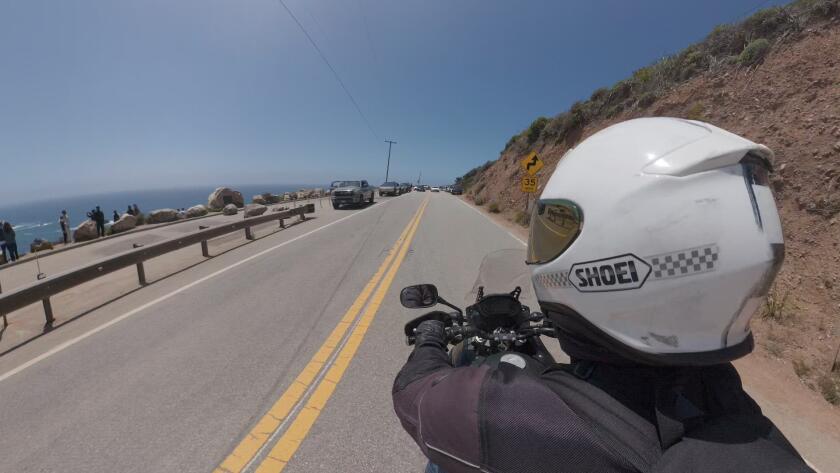
Traffic approaching Bixby Bridge.

A visitor poses in an oversized chair at Big Sur River Inn.
Even at the New Camaldoli Hermitage, a Benedictine monastery above Lucia, the road’s reopening and coming summer season have made a difference. Bookings are up an estimated 30% at the hermitage, which rent rooms and cottages (for two nights or more) to visitors who agree to its requirement of silence.
Big Sur business owners advise visitors to travel on weekdays for less traffic and the best hotel rates, and to get on the road as early as possible.
Since its opening in 1937, the highway has been vulnerable to landslides and shifting ground, operating on a longstanding cycle of landslide, closure, repair, reopening and then another landslide, or sometimes a fire. The U.S. Geological Survey has identified the Big Sur coastline as one of the most landslide-prone areas in the western United States. The 2023-2026 closure was the longest in the highway’s history.
Over time, road crews have used increasingly sophisticated strategies. In the most recent efforts, Caltrans said, it used drones to help survey the slopes and remotely operated bulldozers and excavators to reduce risks to workers.
During the closure, no traffic was allowed on 6.8-mile span from just north of Lucia until about a mile south of the Esalen Institute. Drivers detoured inland by way of U.S. 101.
-

 Technology2 minutes ago
Cyberdecks used to look like little laptops, but now they’re getting more personal
-

 World5 minutes ago
Pete Hegseth warns narco-terrorists as U.S. backs Bolivia’s government amid coup warnings
-

 Politics10 minutes ago
Democrats split over Tlaib’s Lebanon measure as Republicans seize on Hezbollah omission
-

 Health17 minutes ago
Popular weight-loss diet shows surprising impact on serious mental health condition
-

 Sports20 minutes ago
NBA bans two fans for life after court invasion during Knicks-Spurs Game 1
-

 Technology25 minutes ago
Charter breach warning: What customers should know
-
 Business32 minutes ago
Trump announces new coal export terminal in Oakland
-
 Entertainment35 minutes ago
Kathy Hilton won’t be WeHo Pride’s grand marshal after backlash from community

