Lifestyle
A completely subjective ranking of Los Angeles neighborhoods by walkability


Admit it, you’re here because you want to see how walkable your favorite (or least favorite, I suppose) L.A. neighborhood is. You want bragging rights, you want your biases confirmed, you want a totally unscientific, more than a little opinionated ranking of Los Angeles neighborhoods by walkability. And we’re here to give it to you.
L.A. really is a walking city.
Explore our ground-level guide to the people and places keeping our sidewalks alive.
Why unscientific? For starters because those kinds of number-crunching rankings already exist in urban planning master’s degree projects and on apartment-rental websites such as walkscore.com. And let’s face it, while data tells a story, it doesn’t tell the whole story.
That’s why I put together this list: to highlight the things that make walking in a neighborhood, and in our dear city, especially unique. Those include celebrity adjacency (Will I see someone famous?), L.A.-ness (Is there an instantly-recognizable palm-tree dotted backdrop?), pedestrian density (If I saw someone walking here, would I immediately suspect something’s amok?). I also consulted many a friend and colleague — folks who’ve actually lived in these neighborhoods.
Finally, as an Angeleno who’s lived here for 27 years and likes to explore the city on foot after a few drinks (or a puff or two of the herb), I took a few — how shall I put it? — personal liberties. In short, this is my highly particular list. Perhaps you have one of your own?
Be forewarned: This is not an exhaustive overview (L.A. is big! And many neighborhoods are mostly residential.) but one that touches on the four least- and most-walkable neighborhoods (at the top and bottom of the list, respectively), along with some handpicked in-betweens you’re probably familiar with.


(Al Seib / Los Angeles Times)
18. Bel-Air
It’s a fact: L.A.’s wealthiest neighborhoods are, for the most part, the least pedestrian-friendly, more concerned with privacy hedges than the safe passage of foot traffic. Exhibit A: this sidewalk-free enclave where people once, presumably, moved about without vehicular assistance, but no longer seem to. I’ve never once seen a pedestrian here. Nor have I met anyone who has. Are there celebrities to be found on these icy manicured streets? Undoubtedly, but chances are you won’t have the opportunity to lay eyes on the likes of Rupert Murdoch (who recently tied the knot at his winery here), Joni Mitchell or Jennifer Lopez. Unless, that is, you’re a paparazzo who’s specifically called on to do so. Oh, and don’t bother looking for the original “Fresh Prince” house either. That’s actually in Brentwood.

(Brian van der Brug / Los Angeles Times)
17. Pacific Palisades
No one walks to — or from — anywhere in the Palisades. And, if anybody looks like they’re walking, it’s probably because they’ve just parked the car or are popping from one store to the next at Rick Caruso’s Palisades Village. I walked here — just once — and felt like I was sporting the scarlet letter (“P” for pedestrian, naturally) the entire time. And what good is a stretch of coastline if you can’t walk there without taking your life in your hands? Even so, the neighborhood has plenty of idyllic, Californian backdrops and its fair share of celebrity residents. You could easily find yourself next to a soup-slurping Cheech Marin at Casa Nostra Ristorante or crossing paths with Tom Hanks and Rita Wilson, who have a house here.

(Brian van der Brug / Los Angeles Times)
16. Hollywood Hills
A rabbit warren of steep, narrow, twisty streets and near-total lack of sidewalks make foot traffic in most of this hilly neighborhood not just challenging but downright dangerous. And, since it’s overwhelmingly residential, places — other than hillside homes — to walk to and from are all but nonexistent. While plenty of celebs call the hills home, your best bet at laying eyes on a star is to find a spot where you can gaze out at the Hollywood sign on nearby Mt. Lee in Beachwood Canyon. (P.S.: No one likes to admit it, but there’s also a serious rat problem in them there hills. And the last thing I want to worry about if I’m trying to outrun a rapacious rodent is dodging traffic.)

(Myung J. Chun / Los Angeles Times)
15. Elysian Park
Notably home to two things: Dodger Stadium — itself so inaccessible on foot that there has been a years-long effort to build a gondola to ferry people there from Union Station — as well as the neighborhood’s namesake 600-acre park, which may put it toward the top of a strollability index. But as far as access to shopping and dining options, not so much (the seasonal Dodger Dog notwithstanding).

(Al Seib / Los Angeles Times)
14. Beverly Hills
A dense concentration of high-profile places to go and things to do in the Golden Triangle certainly make this swanky slice of Greater L.A. seem walkable. Which it is — up to a point. But most of Beverly Hills is, well, hills. North of Sunset Boulevard and the part known as “the flats” are mostly residential, so neither really lend themselves to robust pedestrian traffic. The only thing that keeps it from ranking worse on the list is that you’d be hard-pressed to find a better backdrop for the socials than the shops of Rodeo Drive. Case in point: I recently watched a a young influencer-type stick her smartphone to the front window of the Gucci boutique— literally, using some sort of suction cup phone case — so she could step back and beam her whereabouts to TikTok.

(Shelby Moore / For The Times)
13. Larchmont/Hancock Park
It pains me to give one of my favorite neighborhoods in the entire city a sub-par rank but the delightful meander that is two bustling blocks of Larchmont Boulevard isn’t enough to offset the quick transition into full residential territory just a block in either direction. But if you are strolling that one lovely thoroughfare, be on the lookout for Kiernan Shipka, who likes to grab her coffee at Go Get Em Tiger, or Emma Roberts, who stocks up on periodicals at the newstand there. The farmers market, held on Wednesdays and Sundays, isn’t bad either.

(Myung J. Chun / Los Angeles Times)
12. Downtown L.A.
I have a theory: Downtown L.A. ranks near the top of a lot of walkability rankings because it’s just expected that a dense urban core that serves as a major transit hub would, by default, be a great place for people to live their best car-free lives. But here we’re grading on a curve — and factoring in the reality that the same place where we can easily dash out on foot to grab a French dip sandwich or take in the symphony is also a place filled with enough dark alleys, vacant storefronts and litter-strewn sidewalks to make the on-foot feel on guard after dark.

(Brian van der Brug / Los Angeles Times)
11. Koreatown
This is a neighborhood that ticks all the boxes for walkability — it’s densely packed with shopping and dining options (like a lot of delicious dining options), it’s easily navigable on foot, and parking is so scarce, having a car is more a liability than an asset. But it’s densely populated too, and that combination of pedestrian traffic and the cars zooming along the main arteries of Wilshire and Olympic boulevards and Third Street, take a little bloom off the rose.

(Allen J. Schaben / Los Angeles Times)
10. Beverly Grove/Fairfax
The Grove shopping center, the Original Farmers Market, LACMA and the Academy Museum combine to give this part of Mid-City a solid score. The biggest hurdle here — literally in some cases — are the handful of root-busted, near impassable sidewalks. The only thing more quintessentially L.A. than posing for a photo in front of Chris Burden’s “Urban Light” installation (in front of LACMA) is doing it in a room full of Oscar statuettes at the Academy Museum next door. This is also where you’ll be able to amble through the grassy greenspace around the La Brea Tar Pits (super fun when you’re a little baked, BTW) where gooey asphalt can be seen bubbling up and oozing out of the ground, thick and smelling like a freshly resurfaced roadway. An alluring, distinctly Angeleno perfume, if I’ve ever smelled one.

(Allen J. Schaben / Los Angeles Times)
9. Hollywood
Out of necessity — and opportunity — there’s a direct correlation between tourist popularity and walkability in L.A. neighborhoods. That puts Hollywood in the top half of this list — but just barely. It’s pedestrian-heavy and mass-transit-accessible with something to eat, buy or take a photo of at nearly every turn. Though A-list celebs are usually in short supply (but for the occasional movie premiere or awards show), there are legions of spider-folk, Jack Sparrows and other costumed characters along Hollywood Boulevard who will gladly play the part (for a “donation,” of course). And, no matter how skilled a driver you are, you’ll never be able to explore the Hollywood Walk of Fame from behind the wheel.
Unfortunately, the same draws that make it a walkable gawk for touristas of every stripe makes it a frustrating exercise in perambulation for locals — kind of like New York’s Times Square with balmier weather. A lot of the shops traffic in tacky souvenirs and most of the eateries are of the soggy pizza sort (beloved old-school Musso & Frank’s the rare exception). And, statistically, when you get that many people prowling the sidewalks, the chances for shenanigans are high. That’s how I found myself (in a somewhat altered state, I’ll admit) being screamed at — and I mean screamed at — by a ghoulish-looking clown in full face paint as we passed each other in a Hollywood Boulevard crosswalk.

(Christina House / Los Angeles Times)
8. Culver City
If you don’t immediately think of Culver City as walkable, it’s probably because you’ve only driven through it on the way to somewhere else. In addition to myriad dining and shopping options that are thickest where Washington, Culver and Venice boulevards intersect, there are also a few pieces of walk-by Hollywood history. One is the wedge-shaped Culver Hotel — where the actors who played the Munchkins stayed during the filming of “The Wizard of Oz,” and the Washington Boulevard entrance to Culver Studios, which can be seen in the opening titles of “Gone With the Wind.” A cliché photo op? Perhaps. But frankly, I don’t give a damn.
(Mariah Tauger / Los Angeles Times)
7. Highland Park
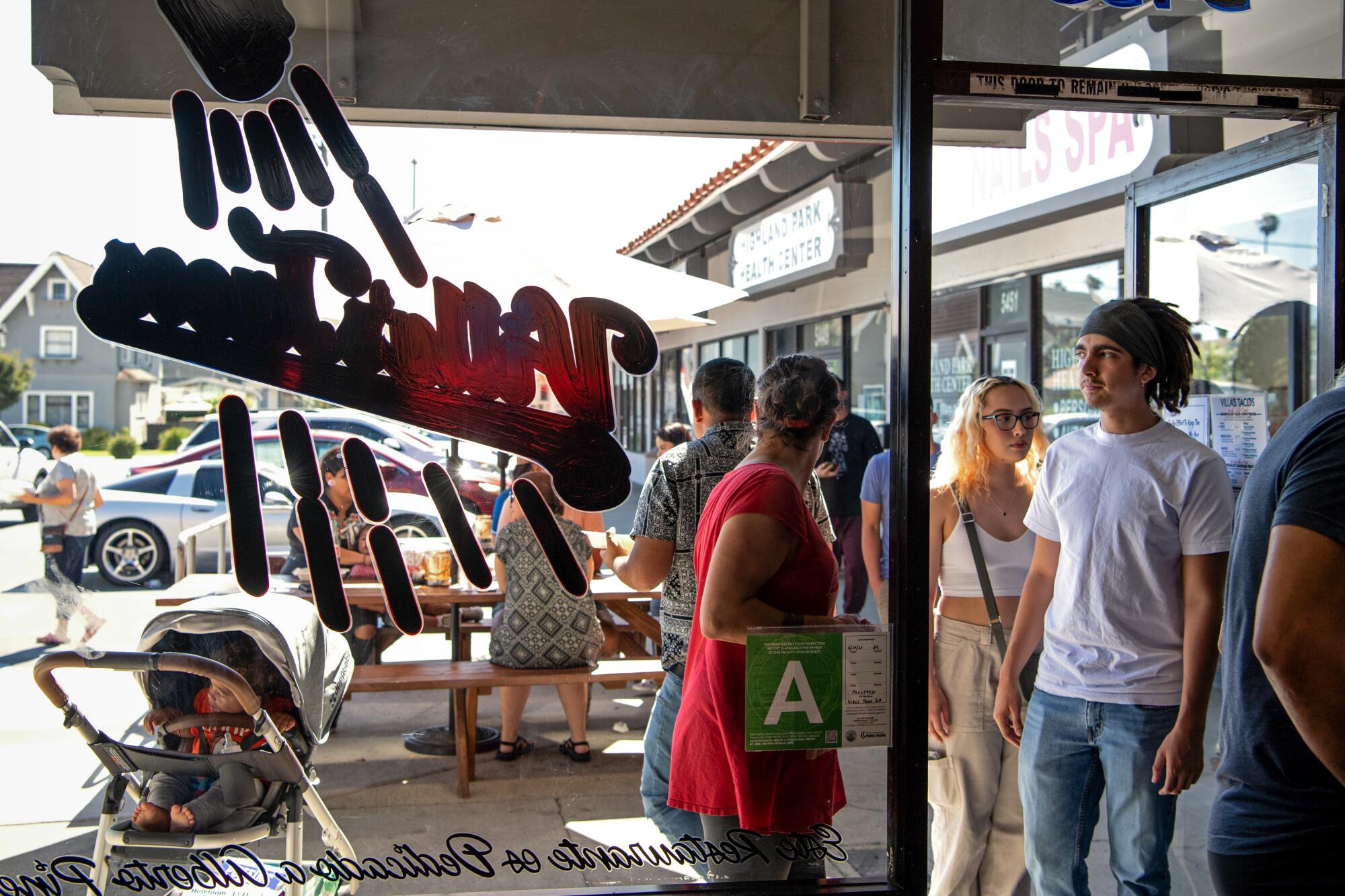
There’s a reason why L.A.’s legendary Bob Baker’s Marionette Theater decamped to Highland Park in 2019. Not only does it sit on York Street across from a children’s playground with a rattlesnake slide, but it’s also on the edge of a bustling commercial stretch where you can find gourmet bagels, lengua tacos at low prices and delightful trinkets for nearly every person in your life. The flow of pedestrian traffic is strong day and night both here and on Figueroa Street (where you can also access the Metro A Line). If you hang around enough, you might even pass by an NELA-dwelling celebrity or two (my colleagues have spotted the likes of John C. Reilly and Eric Warheim in these parts).

(Dania Maxwell / Los Angeles Times)
6. Echo Park
The crown jewel of this neighborhood — and the big pedestrian draw — is Echo Park Lake, where walking one loop will get you about a mile closer to your step goal (and it’s especially beautiful during lotus season). But that’s not all that makes this a good place to forgo your four-wheeled transportation; there’s also the vibrant, explorable bend in Sunset Boulevard that runs from Taix to to Quarter Sheets (past El Prado and the Time Travel Mart) and the stretch of Echo Park Avenue just north of Sunset (look for the mural-covered buildings at the corner) that takes you toward the Echo Park outpost of Jon & Vinny’s Cookbook market.
You might think that bordering the not-so-walkable Elysian Park (see above) would negatively impact Echo Park’s walkability, but several of my colleagues assure me it’s actually the opposite — using it as a kind of pedestrian base camp for a 20-minute walk to Dodger Stadium (gondola plans be damned). The one thing that does cut into the walkability (or at least some of the enjoyment of walking) around these parts are the steepness of some of the streets as they rise toward the hills north of Sunset.

(Myung J. Chun / Los Angeles Times)
5. Silver Lake
The meat in Silver Lake’s walkabilty sandwich is Sunset Junction, where Santa Monica and Sunset boulevards converge and there’s plenty for pedestrians to peruse, including Mohawk General Store and Taiwanese noodle shop Pine & Crane, a twice-weekly farmers market and one of the best Erewhons to people-watch in. Bonus: There’s also the Silver Lake Reservoir — for that kind of walking — and some serious cardio-elevating staircases in the mix, including the historic Music Box Steps, made famous by the silent-film comedy duo Laurel and Hardy in the 1930s.

(Glenn Koenig / Los Angeles Times)
4. Los Feliz
What gives this neighborhood the walkability edge over its seemingly similar neighbors? Two retail- and restaurant-heavy streets for starters — Hillhurst and Vermont Avenues, home to a pedestrian-pleasing assortment of restaurants, (Little Dom’s), bars (Ye Rustic for some of the best chicken wings in the city, the so-hip-it-hurts Dresden Room bar and lounge for martinis and some live music) and shops (Skylight Books for the printed word). Keep your eyes peeled because you could easily find yourself downward dogging next to Sandra Oh in a Pilates class or bump into Aaron Paul at Albertsons. This urban walker’s paradise also gets extra points because of its location — right at the base of Griffith Park — making it a gateway, nay a biped’s launchpad, into one of the largest urban parks in North America.

(Jason Armond / Los Angeles Times)
3. Santa Monica
Thank the 10 million tourists that trek to the pier here for helping make the city — particularly the stretch along Ocean Avenue and the three car-free blocks of the Third Street Promenade — among the Southland’s most walkable. It gets extra points for the pedestrian bridges over the bustling Pacific Coast Highway that help folks get safely from the shops-and-restaurants part of town to the beach. Pro tip: Leave the pier and its immediate surroundings to the out-of-towners and channel your pedestrian energy on the less-trafficked, local parts of town. (There are plenty — Wilshire and Pico boulevards east of Lincoln Boulevard and stretches of Montana Avenue for starters.) Grab dinner at nearby old-school haunt Chez Jay or head a little farther afield for a knee-wobbling mai tai at the Galley. When you leave you’ll be happy you arrived on foot.

(Luis Sinco / Los Angeles Times)
2. Venice
Another tourist-heavy, pedestrian-friendly part of town — with a view of the Pacific Ocean thrown in for good measure. You might need to get here by car, but the sooner you ditch it in a (probably overpriced) parking spot the better. That frees you up to dip into the human soup of the boardwalk for people-watching at its finest: pigeon-training, python-handling carnies, vendors who can write your name on a grain of rice or balance your chakras. (During one visit, I spent the better part of a half-hour doing nothing but watching a guy dressed like an escapee from a “Where’s Waldo?” book — bold-red-and-white-striped shirt, black knit cap, skinny-leg jeans — popping in and out of shops.) Who knows, you might even glimpse Arnold Schwarzenegger or Owen Wilson pedal past you on a bike.
From the strand it’s a win-win for the walking class no matter the direction, thanks to a wide swath of sandy beach and the mighty Pacific on one side and quaint, artsy neighborhoods with mural-covered walls and funky yarn art trees on the other. Another short stroll to the Venice Canals can transport you seemingly worlds away to a network of European-style canals and past a magical, people-powered carousel for kids — neither of which are accessible by car.


(Mel Melcon / Los Angeles Times)
1. West Hollywood
I’ll admit it — I’m wildly biased about WeHo’s walkability for a couple of reasons. It was the the first place I lived when I moved to town more than a quarter-century ago and it was here — in a liquor store at the corner of Sunset Boulevard and Larrabee Street — that I had my very first celebrity sighting (“Goodfellas” actor Paul Sorvino eating a powdered donut). That felt like peak walkability — the original Spago, Tower Records, the Viper Room and Whiskey a Go Go all within walking (and occasionally stumbling) distance of each other. And the assortment of walkable wonderment has only increased in the years since. In addition to the dense concentration of places to eat and drink (heavily clustered along Sunset and Santa Monica boulevards) that make this a pedestrian-friendly destination any time of day and late into the night, this compact neighborhood/city , is home to five of the county’s six open cannabis consumption lounges — most clustered along a two-mile stretch of Santa Monica Boulevard. Being able to light up a joint at a place like the leafy jungle oasis that is the Woods (the dispensary and weed lounge co-owned by Woody Harrelson) or grab dinner and a bong hit at the sex-shop-adjacent PleasureMed and not have to climb behind the wheel makes West Hollywood the unbeatable holy grail of L.A. neighborhood walkability — and the recipient of the most vaunted honor of this unscientific endeavor: a pair of golden sneakers.



For half a century, Deidre Hall has taken on every kind of disaster in the drama-packed town of Salem, Ill., as a star of “Days of Our Lives.”
There was the time — actually, it happened twice — when her character, Dr. Marlena Evans, was famously possessed by the devil and even levitated.

In Sunday Funday, L.A. people give us a play-by-play of their ideal Sunday around town. Find ideas and inspiration on where to go, what to eat and how to enjoy life on the weekends.
Or the time a serial killer, who was actually Marlena under hypnosis, seemed to kill several beloved characters. The long-running show’s storylines have become legendary, and in March, while promoting “Hail Mary,” actor Ryan Gosling even gave Hall a shout-out, admitting he was a fan, praising the hard work of soap opera actors and calling her an “OG acting inspiration.”
But Hall’s real life in Santa Monica is much quieter than her character’s, and she likes it that way.
“When I bought my house in Santa Monica, I didn’t realize how great it would be to live near Montana Avenue,” says Hall, 78, about the popular shopping spot. Every day, she walks to the main street with her golden retriever, Riley, and enjoys Pilates, art and good food along the way. “The owners of the Farms Market even keep dog biscuits, so guess where the dog wants to go every time we walk — the Farms, of course,” she says, laughing.
When she isn’t filming the daily soap opera, which airs on Peacock, Hall enjoys raising monarch butterflies, exploring the shops and restaurants on Montana, and hosting movie nights at home with her two sons.
Here’s what a perfect day in L.A. looks like for her.
This interview has been lightly edited and condensed for length and clarity.

7 a.m.: Breakfast and dog walk
I usually kick off my day with a protein shake, feed our golden retriever and take her out for a walk. She’s a phenomenal girl. When we adopted her, her name was Riley, but I did think about naming her after Mrs. Hughes from “Downton Abbey.”

10 a.m.: Church and garden time
After I walk the dog and go to church, I like to spend some time in my yard. I’m not a natural gardener, but I really enjoy it. I started raising monarch butterflies because my identical twin sister, who played my twin on the show, planted a butterfly garden. Monarchs are amazing because they are transitional. Every year, they travel from Mexico to southern New England, but it’s getting harder for them. Their numbers have dropped by about 80%. To help, I plant milkweed, which is what they need to survive. I buy my milkweed from the Staghorn Garden on Wilshire Boulevard in Santa Monica. Julie, who owns the nursery, is delightful and has a wide variety of milkweed. The monarchs always seem to find my garden. Julie was raising some caterpillars too, and she cared a lot about them. We talked about how important it is to help the butterflies. That’s why I do this. Sometimes I get milkweed with eggs already on it, and Julie knows her butterflies are going to a good home.

1 p.m.: Walk to Montana Avenue for some lunch
I live near Montana and love taking long walks, going to Pilates and trying out the great restaurants nearby, like R+D Kitchen and La La Land. I’m a big fan of the waffles at the Courtyard Kitchen. Just a few days ago, I had a chicken salad on raisin bread with an Arnold Palmer, and it was delicious. It is right on Montana and has a nice outdoor seating area. It’s one of my favorite spots. La La Land always has a long line in the morning, which is perfect if you want coffee. They serve coffee, doughnuts, croissants and avocado toast. There’s plenty of outdoor seating, and you can even bring your dog.

2 p.m.: Peek inside a clock shop
There’s a small clock shop on Montana Avenue that’s closed on Sundays, but if you walk by, you’ll see all kinds of clocks — standing, table and wall clocks. The owner is great at fixing them. Once, I bought a wall clock from MacKenzie-Childs, but it didn’t work. And I was really upset because it matched everything else on my countertop. I brought it to the owner and said, “I love this, but I can’t make it work.” He fixed it right away. His name is John, but I call him Geppetto. And we all know why. He really does have a magic touch.

2:30 p.m.: Visit a neighborhood art gallery
Ten Women Gallery is run by 10 artists, all of whom show their work there. I was drawn to some watercolors there, bought a few cards and spoke with one of the artists. She told me, “You seem to love watercolors,” and mentioned that the artist who painted them, Pamela Harnois, lives in Los Angeles and teaches nearby. I got Pamela’s name and found out she taught at the Brentwood Art School. I was so inspired by her gift that I started taking private lessons with her on Saturdays. That gallery is where I discovered my love for watercolor painting.

3 p.m.: Grab some ice cream at Rori’s
The other day, my longtime girlfriend wanted to get ice cream and told me, “We are walking to Rori’s Artisanal Creamery.” It’s a small shop on Montana near Lincoln. They make everything themselves, using local ingredients from grass-fed cows with no added hormones. The place is family-owned and probably has the healthiest ice cream you’ll find. They switch up their flavors often, but my favorite is the salted caramel.

6 p.m.: Family dinner and movie night at home
R+D Kitchen is always packed, so my sons, who are 31 and 33, do the cooking. They come over, and together we make salads and cook dinner. There’s a neighborhood grocery store called the Farms, off Montana, a small family-run place that has everything we need. Everyone knows each other there, and people bring their dogs. We try to have movie night every Sunday. Sometimes the day changes, but we always make sure to have one night a week where we cook a meal and sit down as a family. Keeping that tradition has become really important to us. My sons are great cooks, which is funny because they definitely didn’t get that from me. [Laughs]
9 p.m.: Take Riley for one last walk and visit neighbors
After dinner, I take my dog for a walk. It’s a great way to meet neighbors. We always go around the same block. We’ve met so many people, and since she’s a golden retriever, she loves meeting everyone.

10 p.m.: News, knitting and bedtime
I am a news junkie, so I usually watch whatever is on the news before I go to bed. I have a long-standing passion for knitting. Lately, though, the news would make me drop a stitch.
For Iris van Herpen, couture is a laboratory as much as a runway. Our chief fashion critic, Vanessa Friedman, takes us inside this Dutch designer’s latest Paris show — from sci-fi-inspired gowns to an audacious attempt at a dress made of charged plasma.
Lifestyle
The BoF Podcast | Decoding Paris Haute Couture: Wonder, Restraint and the Call of the Void

-

 Technology11 minutes ago
Are you filthy enough for a $700 portable shower?
-

 World13 minutes ago
Former British MP and reality TV star Ann Widdecombe found dead; man arrested for murder
-

 Politics19 minutes ago
Trump takes unusual step, lets bipartisan housing bill become law unsigned amid SAVE pressure campaign
-

 Health26 minutes ago
Eating common dairy food every day may slow biological aging, study suggests
-

 Sports29 minutes ago
CM Punk to defend Undisputed WWE Championship against Cody Rhodes at SummerSlam
-

 Technology34 minutes ago
Would you pay $8,000 for a robot to fold laundry?
-
 Business41 minutes ago
Legendary Television City may be be sold in further blow to Hollywood
-
 Entertainment44 minutes ago
‘Foreign Tongues’ is the funniest Rolling Stones album in decades

