Lifestyle
40 years after 'Purple Rain,' Prince’s band remembers how the movie came together


Prince on the custom motorcycle featured in Purple Rain.
Cinematic/Alamy
hide caption
toggle caption
Cinematic/Alamy
Wendy Melvoin, guitarist for Prince’s genre bending band The Revolution, remembers one of their most iconic songs started with an idea — and a challenge — from the boss himself.
Prince broached the topic during a band rehearsal. “He came to the table with this beautiful idea … most of the songs [on the album] had already been done,” says Melvoin, “He said ‘I have this idea and sounds a little like this…whattaya you guys got?’”
What Wendy had was an idea for a mournful cascade of guitar chords that proved the perfect starting point.
“I came up with that intro and that chord progression to get us into the song,” she adds. “And it ended up being one of the most iconic intros to a pop ballad ever.”
The song Purple Rain would become the surprising, anthemic climax for a film of the same name that emerged as one of the most successful and influential musical films in history. The movie hit theaters 40 years ago, breaking barriers in the music world while signaling the ascendancy of Prince as a pop music superstar.
Putting Purple Rain on the silver screen
Filmed around the band’s Minneapolis hometown, Purple Rain had a simple story. Prince’s character — known only as The Kid – is rocked by his dad constantly beating his mother at home, struggling to connect with his bandmembers and a new romantic interest, a beautiful singer named Apollonia.
Drummer Bobby Rivkin, known onstage as Bobby Z, says the idea of showcasing Prince’s songs and The Revolution in a film was inspired by the success of MTV and its focus on music videos.
“Prince was always someone who took a step bigger than the cultural [stuff] that was happening at the times,” he adds. “Once MTV started playing his videos, I think he just gravitated to something bigger and said ‘I’ll just take it to the next level.’’”
Melvoin says she and The Revolution — including Rivkin, keyboardists Lisa Coleman and Matt Fink and bassist Brown Mark — found out they would be working on a movie when Prince announced it in a matter-of-fact way at a rehearsal. But she wasn’t worried about whether she could act or how the band would look onscreen.
“I guess if I had any concern back then, it was just literally, ‘was the story going to be any good?’” she says, laughing. “I didn’t have any doubt the music sequences would be fantastic. But I didn’t have a good sense of whether the narrative of the film was going to work.”

Turns out, it all worked pretty well. Purple Rain was a hit, with the film and its soundtrack earning an Oscar, two Grammy awards and status as a groundbreaking musical film.
It also introduced a film audience to Prince’s scorching performance style, his unerring ability to craft hit tunes, and his distinctive fashion sense. Prince’s network of bands and performers also got some attention – including the girl-fronted group Apollonia 6 and the funk band The Time.
The Time lead singer Morris Day and his onstage foil Jerome Benton became the film’s comic center, with the two riffing on a version of Abbott and Costello’s classic routine “Who’s on First?”.
“Honestly, we weren’t trying to be funny … we always clowned around at the time because we were young,” Day says, responding to questions via email. He noted, even though the cast took acting and dance classes in preparation for filming, “we were just being ourselves. If anything, I was more conscious of being cool than funny.”

Morris Day of The Time performs in Chicago in 1983, before Purple Rain came out.
Raymond Boyd/Getty Images
hide caption
toggle caption
Raymond Boyd/Getty Images
He’s not surprised people are still talking about the film four decades after its initial release.
“The film was groundbreaking on so many levels … it was the first of its kind,” adds Day, who says he’s only watched the film in its entirety one time, at its Hollywood premiere on July 26, 1984. “It somehow reminds people of a special period in their lives during the ‘80s, which is a period we all at times wish we could reclaim.”
Building the drama in Purple Rain
Fans know the film tells a more combative story behind the genesis of the song Purple Rain.
Onscreen, Melvoin and her then-girlfriend, keyboardist Lisa Coleman write the song, fighting a reluctant Prince – known only as The Kid in the movie – to let The Revolution play it onstage.
“Everytime we give you a song, you say you’re going to use it, but you never do,” Melvoin shouts at Prince during the scene, delivering some of the best acting from the musicians who mostly fill out the cast. “You think we’re doing something behind your back…you’re just being paranoid as usual.”
When Prince finally agrees to play Purple Rain onstage at the Minneapolis club First Avenue – launching into an emotional rendition topped by one of the best guitar solos in pop music – he wows the crowd and saves the band. But Melvoin says now that the friction they acted out was “movie magic” conjured to build a story; in real life, she, Lisa and Prince were very close collaborators.

Prince, alongside Wendy Melvoin (left) and Lisa Coleman (right) accepts Purple Rain‘s Oscar for best original score in 1985.
HARMS/AFP via Getty
hide caption
toggle caption
HARMS/AFP via Getty
Powered by hits like the title track and the percolating dance jam I Would Die 4 U, Purple Rain burst like a lavender-tinged explosion across the pop culture landscape – launching Prince’s growing fame into the stratosphere.
The innovative dance hit When Doves Cry, recorded by Prince with no bass guitar, became his first Number One single on Billboard’s Hot 100 singles list. That was followed by his second Number One single, the rock and soul classic Let’s Go Crazy, which showcased his guitar skills at a time when rock guitar wasn’t heard often on R&B records.
Giving fans a peek behind the mystique
Prince had developed a mystique by rarely talking to the press. So, in the days before YouTube and Tik Tok, Purple Rain offered a sustained – if fictionalized – look at the inner workings of the band and his origin story for fans eager to know more.
And it centered a group of performers who were a mix of identities and ethnicities in the Midwest, making music that crossed all kinds of cultural barriers, at a time when people like that were rarely seen on the silver screen.
“That film was Prince’s version of social media,” Melvoin says. “This is funk rock and nobody’s seen a movie based on this kind of life. It [was] a trip for people to see.”
But there were also criticisms. Many of the film’s performers were amateurs, which showed in their performances. And female characters were often treated badly on screen: in one scene, Jerome Benton gets rid of a hostile woman confronting Day by tossing her into a dumpster.
“Given today’s culture, I’m certain there are moments in the film that ruffle a few feathers,” Day says. “Overall, I would like to think we did something great. And based on the overwhelming majority [of public reaction], I believe we did.”
The film ultimately proved the perfect showcase for Prince’s expansive creativity – from his ruffled shirts and big shouldered clothes to his mix of religion and sexuality in lyrics, innovative ways of recording and his seemingly endless supply of high-quality songs.

Bobby Rivkin, otherwise known as Bobby Z, during a recording session in 1989.
Jim Steinfeldt/Michael Ochs Archives/Getty Images
hide caption
toggle caption
Jim Steinfeldt/Michael Ochs Archives/Getty Images
“MTV opened the door a little bit — just a teeny crack of light — and he would kick it open,” Rivkin adds. “He was innovative in fashion and culture. And it was a remarkable time for him. From humble beginnings to control [of] black culture, crossover culture … rock, funk, pop … He was on fire for quite a while.”
Continuing on without the boss
A couple of years and albums later, Prince disbanded The Revolution. But the group has reunited a few times – notably for a benefit concert after Rivkin had his first heart attack in 2010 – and after Prince died in 2016, at age 57 from an accidental fentanyl overdose. More recently, the group came together last month to perform during a five-day event in Minneapolis celebrating Purple Rain’s 40th anniversary.
Both Melvoin and Rivkin say they hope The Revolution can play more shows commemorating Purple Rain’s anniversary over the next year. But they also admit it can be challenging performing without their dynamic leader and frontman, even as playing together helps them process the loss.
“After he passed, it’s the only thing that we could think of to do — to be together and grieve,” Melvoin says.
And what would The Kid himself think about the legacy of his blockbuster film and album? Day says he’s not sure.
“[Prince] never liked staying in the past,” the singer adds. “He was always evolving. Once Purple Rain was done, he was on to the next. But now that I’m thinking about it, he might have thrown a big celebration at Paisley Park for the fans. Probably would have been one hell of a jam session.”



Kevin Kline plays actor Richard Bean, and Laura Linney is his sister-in-law Kristen, in American Classic.
David Giesbrecht/MGM+
hide caption
toggle caption
David Giesbrecht/MGM+
American Classic is a hidden gem, in more ways than one. It’s hidden because it’s on MGM+, a stand-alone streaming service that, let’s face it, most people don’t have. But MGM+ is available without subscription for a seven-day free trial, on its website or through Prime Video and Roku. And you should find and watch American Classic, because it’s an absolutely charming and wonderful TV jewel.
Charming, in the way it brings small towns and ordinary people to life, as in Northern Exposure. Wonderful, in the way it reflects the joys of local theater productions, as in Slings & Arrows, and the American Playhouse production of Kurt Vonnegut’s Who Am I This Time?
The creators of American Classic are Michael Hoffman and Bob Martin. Martin co-wrote and co-created Slings & Arrows, so that comparison comes easily. And back in the early 1980s, Who Am I This Time? was about people who transformed onstage from ordinary citizens into extraordinary performers. It’s a conceit that works only if you have brilliant actors to bring it to life convincingly. That American Playhouse production had two young actors — Christopher Walken and Susan Sarandon — so yes, it worked. And American Classic, with its mix of veteran and young actors, does, too.

American Classic begins with Kevin Kline, as Shakespearean actor Richard Bean, confronting a New York Times drama critic about his negative opening-night review of Richard’s King Lear. The next day, Richard’s agent, played by Tony Shalhoub, calls Richard in to tell him his tantrum was captured by cellphone and went viral, and that he has to lay low for a while.
Richard returns home to the small town of Millersburg, Pa., where his parents ran a local theater. Almost everyone we meet is a treasure. His father, who has bouts of dementia, is played by Len Cariou, who starred on Broadway in Sweeney Todd. Richard’s brother, Jon, is played by Jon Tenney of The Closer, and his wife, Kristen, is played by the great Laura Linney, from Ozark and John Adams.
Things get even more complicated because the old theater is now a dinner theater, filling its schedule with performances by touring regional companies. Its survival is at risk, so Richard decides to save the theater by mounting a new production of Thornton Wilder’s Our Town, casting the local small-town residents to play … local small-town residents.
Miranda, Richard’s college-bound niece, continues the family theatrical tradition — and Nell Verlaque, the young actress who plays her, has a breakout role here. She’s terrific — funny, touching, totally natural. And when she takes the stage as Emily in Our Town, she’s heart-wrenching. Playwright Wilder is served magnificently here — and so is William Shakespeare, whose works and words Kline tackles in more than one inspirational scene in this series.
I don’t want to reveal too much about the conflicts, and surprises, in American Classic, but please trust me: The more episodes you watch, the better it gets. The characters evolve, and go in unexpected directions and pairings. Kline’s Richard starts out thinking about only himself, but ends up just the opposite. And if, as Shakespeare wrote, the play’s the thing, the thing here is, the plays we see, and the soliloquies we hear, are spellbinding.
And there’s plenty of fun to be had outside the classics in American Classic. The table reads are the most delightful since the ones in Only Murders in the Building. The dinner-table arguments are the most explosive since the ones in The Bear. Some scenes are take-your-breath-away dramatic. Others are infectiously silly, as when Richard works with a cast member forced upon him by the angel of this new Our Town production.
Take the effort to find, and watch, American Classic. It’ll remind you why, when it’s this good, it’s easy to love the theater. And television.


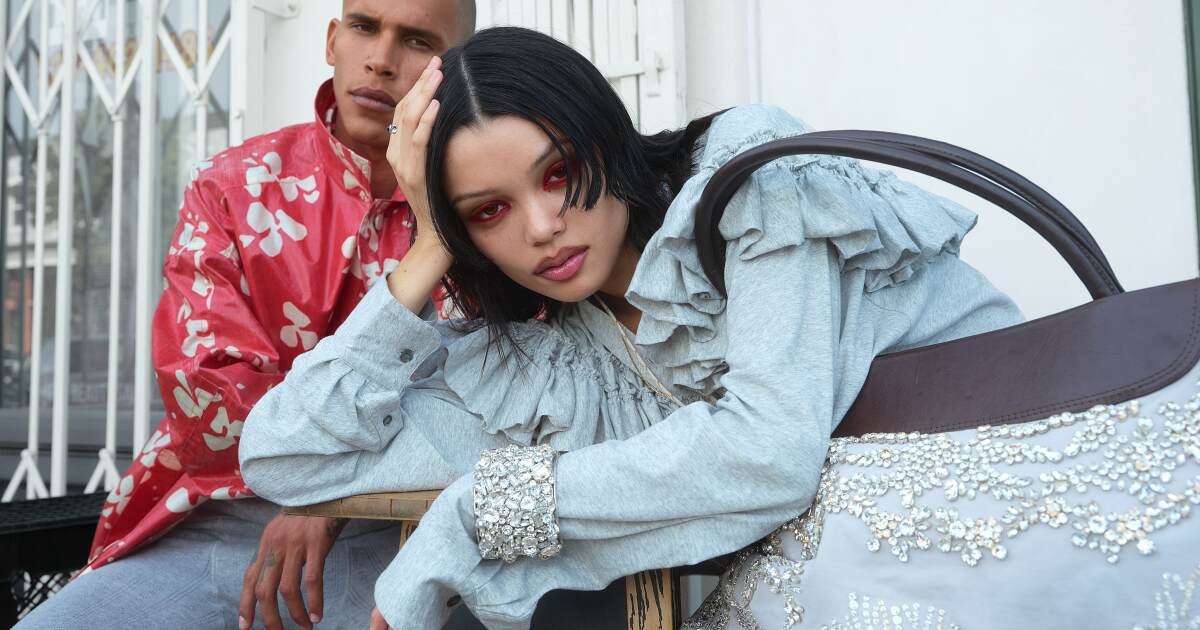
The ritual of meeting up and hanging out at a coffee shop in L.A. is a showcase of style filled with a subtle site-specific tension. Don’t you see it? Comfort battles formality fighting to break free. Hiding out chafes against being perceived. In the end, we make ourselves at home at all costs — and pull a look while doing it.
It’s the morning after a night out. Two friends meet up at Chainsaw in Melrose Hill, the cafe with the flan lattes, crispy arepas and sorbet-colored wall everybody and their mom has been talking about.
Miraculously, the line of people that usually snakes down Melrose yearning for a slice of chef Karla Subero Pittol’s passion lime fruit icebox pie is nonexistent today. Thank God, because the party was sick last night — the DJ mixed Nelly Furtado’s “Promiscuous” into Peaches’ “F— the Pain Away” and the walls were sweating — so making it to the cafe’s front door alone is like wading through viscous, knee-high water. Senses dull and blunt in that special way where it feels like your brain is wearing a weighted vest. The sun, an oppressor. Caffeine needed via IV drip.
The mood: “Don’t look at me,” as they look around furtively, still waking up. “But wait, do. I’m wearing the new Dries Van Noten from head to toe.”

Daniel, left, wears Dries Van Noten mac, henley, pants, oxford shoes, necklace and socks. Sirena wears Dries Van Noten blouse, micro shorts, sneakers, shell charm necklace, cuff and bag and Los Angeles Apparel socks.


If a fit is fire and no one is around to see it, does it make a sound? A certain kind of L.A. coffee shop is (blessedly) one of the few everyday runways we have, followed up by the Los Feliz post office and the Alvarado Car Wash in Echo Park. We come to a coffee shop like Chainsaw for strawberry matchas the color of emeralds and rubies and crackling papas fritas that come with a tamarind barbecue sauce so good it may as well be categorized as a Schedule 1. But we stay for something else.
There is a game we play at the L.A. coffee shop. We’re all in on it — the deniers especially. It can best be summed up by that mood: “Don’t look at me. But wait, do.” Do. Do. Do. Do. We go to a coffee shop to see each other, to be seen. And we pretend we’re not doing it. How cute. Yes, I’m peering at you from behind my hoodie and my sunglasses but the hoodie is a niche L.A. brand and the glasses are vintage designer. I wore them just for you. One time I was sitting at what is to me amazing and to some an insufferable coffee shop in the Arts District where a regular was wearing a headpiece made entirely of plastic sunglasses that covered every inch of his face — at least a foot long in all directions — jangling with every movement he made. Respect, I thought.
Dries Van Noten’s spring/summer 2026 collection feels so right in a place like this. The women’s show, titled “Wavelength,” is about “balancing hard and soft, stiff and fluid, casual and refined, simple and complex,” writes designer Julian Klausner in the show notes. While for the men’s show, titled “A Perfect Day,” Klausner contextualizes: “A man in love, on a stroll at the beach at dawn, after a party. Shirt unbuttoned, sleeves rolled up, the silhouette takes on a new life. I asked myself: What is formal? What is casual? How do these feel?” What is formal or casual? How do you balance hard and soft? The L.A. coffee shop is a container for this spectrum. A dynamic that works because of the tension. A master class in this beautiful dance. There is no more fitting place to wear the SS26 Dries beige tuxedo jacket with heather gray capri sweats and pink satin boxing boots, no better audience for the floor-length striped sheer gown worn with satin sneakers — because even though no one will bat an eye, you trust that your contribution has been clocked and appreciated.

Daniel wears Dries Van Noten coat, shorts, sneakers and socks. Sirena wears Dries Van Noten jacket, micro shorts and sneakers.


Back at Chainsaw the friends drink their iced lattes, they eat their beautiful chocolate milk tres leches in a coupe. They’re revived — buzzing, even; at the glorious point in the caffeinated beverage where everything is beautiful, nothing hurts and at least one of them feels like a creative genius. The longer they stay, the more their style reveals itself. Before they were flexing in a secret way. Now they’re just flexing. Looking back at you looking at them, the contract understood. Doing it for the show. Wait, when did they change? How long have they been here? It doesn’t matter. They have all day. Time ceases to exist in a place like this.


Daniel wears Dries Van Noten tuxedo coat, pants, scarf, sneakers and necklace and Hanes tank top. Sirena wears Dries Van Noten jacket, micro shorts, sneakers and socks.


Creative direction Julissa James
Photography and video direction Alejandra Washington
Styling Keyla Marquez
Hair and makeup Jaime Diaz
Cinematographer Joshua D. Pankiw
1st AC Ruben Plascencia
Gaffer Luis Angel Herrera
Production Mere Studios
Styling assistant Ronben
Production assistant Benjamin Turner
Models Sirena Warren, Daniel Aguilera
Location Chainsaw
Special thanks Kevin Silva and Miguel Maldonado from Next Management
Lifestyle
Nature needs a little help in the inventive Pixar movie ‘Hoppers’ : Pop Culture Happy Hour

Piper Curda as Mabel in Hoppers.
Disney
hide caption
toggle caption
Disney
In Disney and Pixar’s delightful new film Hoppers, a young woman (Piper Curda) learns a beloved glade is under threat from the town’s slimy mayor (Jon Hamm). But luckily, she discovers that her college professor has developed technology that can let her live as one of the critters she loves – by allowing her mind to “hop” into an animatronic beaver. And it just might just allow her to help save the glade from serious risk of destruction.
Follow Pop Culture Happy Hour on Letterboxd at letterboxd.com/nprpopculture
Subscribe to Pop Culture Happy Hour Plus at plus.npr.org/happyhour

Severe weather threat increasing for Oklahoma tonight

Oregon gas prices highest since Sept. 2025 as oil surges on Hormuz disruptions

Fire crews try moving burning barge to shallow water in Delaware Bay

Thousands drop public health insurance coverage in RI after premiums spike

Source: Lamont Paris returning to South Carolina next season

Florida High School Football Rankings: Top 25 teams – Oct. 21

How old is Bo Nix? What to know about Oregon quarterback ahead of 2024 NFL Draft

Cleary's 21 help Le Moyne down Central Connecticut State 69-64 in OT

99th annual Pony Swim held in Virginia

Indiana Members Credit Union announced as new anchor tenant at Bottleworks District

Map: 2.3-Magnitude Earthquake Reported North of New York City

Trump stirs GOP primary drama with visit to Massie’s Kentucky home turf

Israeli air strike targets building in south Lebanon

Ed Martin, outspoken Justice Department lawyer, is formally accused of ethical violations | CNN Politics

Trump reveals top issues GOP should focus on to secure midterms victory: ‘I’ve never been more confident’
-

 Wisconsin1 week ago
Setting sail on iceboats across a frozen lake in Wisconsin
-

 Massachusetts1 week ago
Massachusetts man awaits word from family in Iran after attacks
-

 Maryland1 week ago
AM showers Sunday in Maryland
-

 Pennsylvania5 days ago
Pa. man found guilty of raping teen girl who he took to Mexico
-

 Florida1 week ago
Florida man rescued after being stuck in shoulder-deep mud for days
-

 Sports6 days ago
Keith Olbermann under fire for calling Lou Holtz a ‘scumbag’ after legendary coach’s death
-

 Virginia6 days ago
Giants will hold 2026 training camp in West Virginia
-

 Detroit, MI4 days ago
U.S. Postal Service could run out of money within a year