Lifestyle
2024 brings the Year of the Dragon. Are we in for a lucky, powerful year?

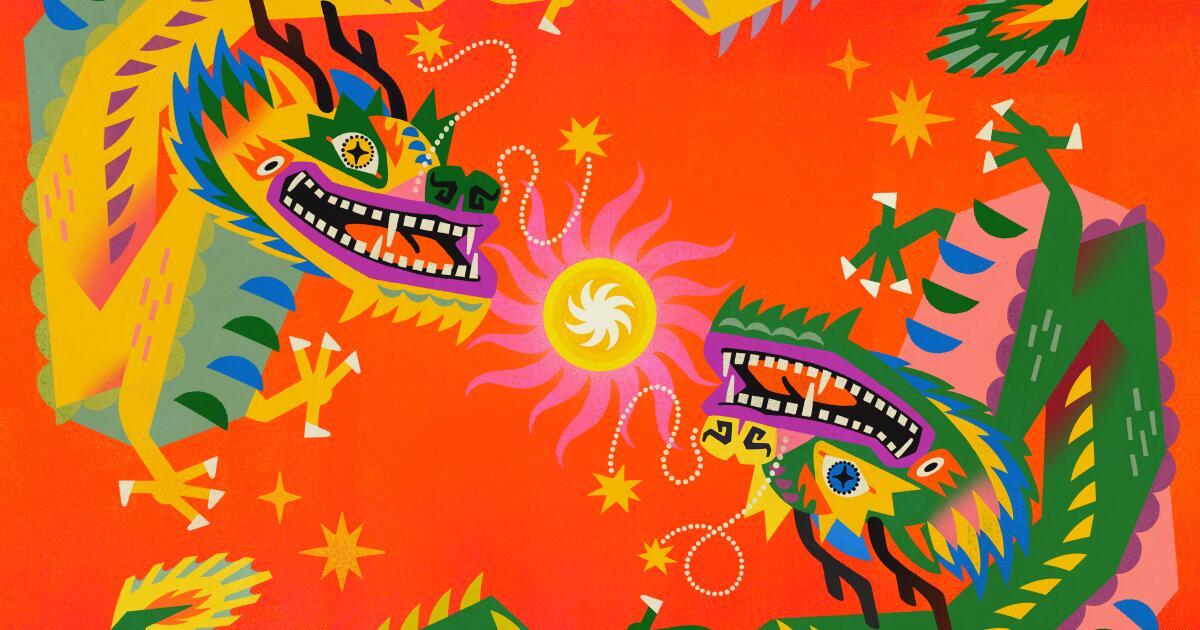
My dad was born in 1952, the Year of the Dragon. He’s an immigrant from Taiwan who came to the U.S. for graduate school at San Jose State University, and he worked as an engineer until his retirement.
In some ways, he’s the reason I never took Chinese horoscopes that seriously. The other members in my family have signs with character traits that seem to suit them. Sure, she’s loyal and honest like a Dog, and yes, he’s smart and charming like a Rat.
But my dad is very introverted and soft-spoken. He’s always smiling — the only time I remember him getting mad at me was when my brother and I were jumping on the bed as kids and wouldn’t go to sleep.
With my limited understanding of the zodiac animals and their characteristics, I’d think, “Is this the ferocious dragon breathing fire?”
The upcoming Lunar New Year brings the Year of the Dragon, fifth in the 12-animal Chinese zodiac cycle. Dragons were born in the years 2024, 2012, 2000, 1988, 1976, 1964, 1952 and so on — but after the Lunar New Year, which falls on Feb. 10 this year.
(Yunyi Dai / For The Times)
Since 2022, I’ve consulted with Laura Lau, co-author of “The Handbook of Chinese Horoscopes,” annually prior to Lunar New Year, on what we should expect.
Lau’s late mother, Theodora, wrote the first edition of the horoscope guide in 1979. At the time, she had been giving informal consultations in Hong Kong and realized none of the English-language horoscope books were written by authors of Chinese descent. So she wrote her own.
When Lau talks about horoscopes, she frequently mentions her mother, who saw Chinese horoscopes less as a crystal ball that foretold the future and more as an entry point in understanding people who are different from you. The idea is that if you take the time to consider where people are coming from, you can make more thoughtful decisions for yourself.
According to superstition, each year takes on the traits of that year’s animal. The tiger, in 2022, brought passion and rebelliousness. The rabbit in 2023 was supposed to bring us some peace.
So what about the dragon?
The dragon is the only animal on the Chinese zodiac that is a mythical creature. In Chinese culture, dragons symbolize good luck, strength and power. They control the weather and water. (Also, they don’t breathe fire. They breathe clouds.)
Those who believe in the superstitions even go so far as to try to have babies in the Year of the Dragon because they believe dragons are destined for greatness and good fortune.
Characteristics of the dragon, according to Lau, include creativity, power and charisma. They’re confident, so they have an ego. They’re also energetic and impulsive by nature.
What does this mean for the upcoming year?
First it’s important to understand that we’re coming off the Year of the Rabbit, who is the diplomat and the peacemaker.
“The rabbit is about making things nice,” Lau told The Times last year. “That doesn’t mean that the rabbit year doesn’t have drama underneath, but it’s kind of like, ‘Let’s be polite. Let’s maintain etiquette. Let’s move forward. Let’s have more productivity.’”
Some people like the calm. Others find rabbits frustrating. “Often you don’t know what’s going on … so you still end up feeling bad,” Lau said.
You know where you stand with a dragon. They’re an open book. They’re swift. They’re not going to drag anything on for too long.
Dragons, in contrast, are very straightforward and clear. You know where you stand with a dragon, Lau said. They’re an open book. They’re swift. They’re not going to drag anything on for too long.
Each year also has an element, and this year is the wood dragon. The wood tempers the dragon and makes it more introspective, Lau said. Wood also is associated with morality and ethics, and the dragon is an animal that likes to have a sense of purpose and duty.
Lau added that people tend to respect dragons. But they can be individualistic, so sometimes those who are more community-minded will butt heads with the dragon.
It’s an election year. What might the Year of the Dragon bring in that sense?
The fact that 2024’s Year of the Wood Dragon also is an election year is extra fascinating to Lau, because dragons are competitive. If they win, they want it to be a decisive win. If they lose, they’re resilient, so they will move on.
One more tidbit about Chinese horoscopes: Each animal has its animal enemies, the ones directly across from it on the zodiac wheel, along with its animal friends, a trio formed from the animals four spaces away in either direction that makes up a triangle of affinity.
(Yunyi Dai / For The Times)
This year, the goat will have a particularly hard time with the dragon, compared with the dragon’s friends, the monkey and the rat.
Lau said her mother liked to look at each country’s day of independence to analyze the country’s animals. The U.S. — born 1776 — is a monkey. Her mother would always say that America is like a monkey: We’re very creative, we like to do things our own way and we’re innovative.
Lau hopes that because the U.S., as a monkey, is compatible with the Year of the Dragon, the elections will go more smoothly and there will be a clear and decisive result.
What signs should we look out for?
Whatever type of year it’ll be, we’ll know very quickly, she said. One of the superstitions tied to those who are born in the Year of the Dragon is that the weather on their day of birth — whether it is stormy or calm — impacts the type of life that person is going to lead.
Lau is going to be paying close attention to the weather on Feb. 10. Having bad weather on that day doesn’t mean we’ll have a bad year, she said. But the year might be a bit more unpredictable.
I ran Lau’s analysis by my dad and asked if he believed any of it. He shrugged. He thinks his generation of Taiwanese American immigrants, who pursued a Western education and have now lived in the U.S. for most of their lives, are less likely to believe in Eastern mythology.
But it turns out my late grandfather — a small-business owner from Taichung, Taiwan, who sold mushroom spawn in jars and bags — was also a Dragon. He was born in 1928.
My grandfather was a believer in feng shui and fortune-telling, and he had my dad’s reading done at birth. My father found the prediction in a notebook when he was browsing his father’s bookshelf as a young adult.
“If I had a iPhone back then, I would have taken a picture of it,” my dad said. “But now, I only remember one line: 不富而貴 bù fù ér guì.” That means “not rich but noble.”
Nobility is another characteristic of a dragon.
He laughs. “I mean, I’m an engineer, so not quite ‘noble’ like a king. But not bad.”


Xie Miao and Yang Enyou in The Furious.
Norachai Kajchapanont/Lionsgate
hide caption
toggle caption
Norachai Kajchapanont/Lionsgate
There have been some fantastic movies released this year, and we know you can’t see them all. So we’re recommending four recent movies we missed that you should add to your watchlist: The Furious, Tuner, She’s The He, and Heresy.
If you need a few more fun film recommendations, check out these episodes:
Fun movies you may have missed
Our favorite movies on Tubi
We debate the best movies to watch on an airplane
Connect with Pop Culture Happy Hour:
Letterboxd / Facebook
Our weekly newsletter
Support Pop Culture Happy Hour+

A tarp covers the facade of the John F. Kennedy Memorial Center for the Performing Arts in Washington, D.C., on June 13. A federal judge has asked the arts complex’s leadership to explain the purpose of the tarp and the surrounding scaffolding.
Alex Wroblewski/AFP via Getty Images
hide caption
toggle caption
Alex Wroblewski/AFP via Getty Images
On Wednesday, the federal judge overseeing the Kennedy Center lawsuit ordered the center to give him a status report on the center’s operation and programming within the next few weeks. Judge Christopher R. Cooper also said that the Kennedy Center must explain the purpose and status of the tarp and scaffolding that have been placed over the front of the arts complex, where until recently both President Trump and President John F. Kennedy’s names were both displayed.
In a directive issued last Tuesday, Judge Cooper had given Kennedy Center administrators three days to update him on the arts complex’s immediate plans regarding construction, programming and public access. Trump, who now serves as the center’s chairman, had announced July 5 as the date the venue would close for major renovations.

Last Friday, on Cooper’s due date, lawyers for the Kennedy Center filed a request asking for an extension. In that filing, Matt Floca, who was promoted as the center’s president and CEO in March, said that the Kennedy Center’s current management intends to present its board with “an array of options” for trustees to vote on at their next meeting on an unspecified date in mid-July.
According to Floca, the options are a complete closure for extensive renovations; a partial closure “enabling some continued public access and limited programming” while some renovations are undertaken; and “a highly limited series of phased closures to address only the center’s most serious infrastructure needs while scheduling and maintaining a full slate of programming.”
In his newest order, Cooper denied Floca’s request for an extension. And he mandated that the center file a status report within seven days of the center’s July board meeting or by July 31, whichever date is earliest. He also ruled that the report must “indicate the purpose for and status of the tarp and scaffolding,” which were erected by workers over the center’s front signage in the early morning hours of June 13.
When asked for comment Wednesday, the Kennedy Center pointed back to the documents its legal team submitted to the court.
The tarp and scaffolding on the center’s front portico went up after the Kennedy Center’s administration slow-walked the court-mandated removal of President Trump’s name from the front of the center and from all digital materials, which was supposed to happen no later than June 12. Workers removed the lettering overnight into the following morning, hours after the federal court’s original deadline, and covered the center’s sign with a tarpaulin.
As of Monday, the sign remains hidden from the public.

Trump’s name was scrubbed from all of the Kennedy Center’s digital content on June 4, the same day an email order to do so was issued by the complex’s legal team; NPR obtained this memo the day it was sent out to Kennedy Center staff.
These court orders are part of the ongoing lawsuit filed by Rep. Joyce Beatty, D-Ohio, against President Trump and the board of the Kennedy Center. Earlier this year, Cooper ruled that Beatty, an ex-officio member of the Kennedy Center board, must be allowed to participate in board meetings. NPR has asked Beatty if she plans to vote at the July board meeting, but did not receive an immediate response.
It would be very difficult for the Kennedy Center to revive a thriving programming lineup for the months ahead. Over the past year, many prominent artists canceled their planned appearances, citing the politicization of the venue. Most of the center’s programming staff have departed, either via layoffs or resignations. Unlike top administrators at other major performing arts venues around the country, Matt Floca has no experience in artistic direction, fundraising or arts administration; formerly, he was the center’s head of facilities, and he holds a bachelor’s degree in construction management.
Established artists who typically perform at the Kennedy Center generally have their touring schedules set at least a year in advance, if not multiple years ahead. In years past, the center has publicly announced its upcoming season in mid-spring for performances beginning in September and running through the following summer.

Currently, only a handful of outdoor free movie screenings of nostalgic favorites like The Princess Diaries and Clue appear on the center’s calendar of events, along with some participatory workshops for kids. In the past, the Kennedy Center presented over 2,000 arts and education events each year.
The center also recently became ensnarled in litigation with one of its longtime tenants and artistic partners. On June 12, the Washington National Opera, a company formerly in residence at the Kennedy Center, sued the complex for $17 million. It claims that the Kennedy Center had withheld “years’ worth of donor gifts, bequests and endowment funds” that had been intended specifically for the WNO.

Denis Novikov/Getty Images
I tend to romanticize summer. The movies and TV shows I grew up with made me think that the season was about adventure and big-time transformation.
I imagined myself building a tight-knit friend group and getting out of a pickle together, like in The Sandlot or Camp Nowhere. Or traveling across the world, say, to Greece, like Lena Kaligaris, a character in The Sisterhood of the Traveling Pants, having a whirlwind summer romance and returning an entirely different person.
I’ve never actually had a summer like that.
Even when your expectations are more modest than mine, “so often, the summer just flies by, and we haven’t taken the picnics or gone for the day trip or whatever it was that we thought we were gonna do,” says happiness expert Gretchen Rubin.
Rubin, author of The Happiness Project and host of the podcast Happier With Gretchen Rubin, has been sharing ideas on social media about how to make the season more memorable and satisfying.
She walks through four exercises to help you get what you want — and more — out of the season. Print out our worksheet here, fill it out and stick it on your fridge to keep you accountable. Or take a screenshot and post it to Instagram (don’t forget to tag @NPRLifeKit!).
🍑 Give your summer a theme
Pick a single word or phrase that you want to embrace this season — something that captures the feeling you want to have over the next few months.
“My theme for the summer is ‘ketchup,’” Rubin says. “It has a kind of a summer feeling, because you think of putting ketchup on your burger.”
“It’s a metaphor,” she says. It means to look for “whatever I could add [this season] to make something elevated and more fun.”
Meanwhile, my theme word this summer is “juice.” I no longer think that I need to travel far or completely transform to have a delicious summer. I just need to take advantage of the abundance that the season offers: ripe peaches and tomatoes, juicy softball pitches and the opportunity to feel juicy in my body when I wear a bathing suit.

Print out our worksheet here, fill it out and stick it on your fridge to keep you accountable. Or take a screenshot and post it to Instagram (don’t forget to tag @NPRLifeKit!).
Malaka Gharib/NPR
hide caption
toggle caption
Malaka Gharib/NPR
🪣 Create a summer bucket list
What do you want to do this summer? On my bucket list: ride the Ferris wheel at a summer fair, have more barbecues at my parents’ house and see the sunrise at least once.
There might even be something you don’t necessarily want to do but have been trying to accomplish for a long time — like cleaning out the garage or learning how to swim.
“Some people love a long list with a lot of easy things to cross off,” Rubin says. “I’m a fan of that approach myself.”
But some people like a list with fewer goals that are more ambitious. If you take this path, just make those items realistic, she says. “It’s easy to get discouraged if you set the bar too high.”
🏁 Set a fun challenge
It could be fun to gamify a few of the items on your bucket list — or to come up with an entirely different kind of dare for yourself.
You might try 10 new taco joints this summer or read five romance novels. Or you might come up with a theme, like “Freaky Flavor Friday,” Rubin says. Every Friday, you go to a different ice cream shop and try a new and ambitious flavor.
A good challenge can make your summer feel more memorable, she says. “If you did ‘Freaky Flavor Friday’ all summer long, that would stand out in your mind. Years later, you’d be like, ‘That’s the summer I discovered creamed corn ice cream.’”
Two challenges I’m considering: taking a swim class and rewatching all the best Pixar movies.
🖼️ Take a “five-senses portrait”
Experience the summer through your five senses — then reflect on each one. What does summer look like, smell like, taste like, sound like and feel like?
“It’s one thing to look at photographs, but that’s very flat,” Rubin says. “A ‘five-senses portrait’ puts you back into that experience. It’s a creative, fun way to look back on summer and capture the memories that you’ve created.”
Do this exercise either for your whole summer or for a specific summer adventure, she says. Do it with yourself or with a group. You can journal about it, make a collage, draw a picture or simply have a conversation.
When I think of summer, here’s what comes to mind: the smell of smoke from a crackling outdoor fire and the taste of toasted marshmallows on a stick.
More summer-worthy goals from Life Kit
Learn how to swim. Knowing how to swim can help you have fun at the pool or beach this summer. But it could also save your life. Here are some tips to start swimming at any age.
Focus on rest and relaxation. In Dr. Saundra Dalton-Smith’s book Sacred Rest, she outlines different kinds of rest you may be craving. From the mental to the physical, Dalton-Smith shares how to identify what kind of respite you need and how to embrace rest.
Get into running. Ready to kick-start a new running habit? Coach Martinus Evans breaks down a common misconception to get you into the mindset and offers quick tips on pace, form and more.
Declutter your home. Got piles of stuff you just can’t seem to get rid of? Professional organizer Star Hansen explains how to let go of unnecessary items and keep your home neat and tidy.
This episode was produced by Clare Marie Schneider. The story was edited by Meghan Keane. The visual editor is CJ Riculan. We’d love to hear from you. Leave us a voicemail at 202-216-9823, or email us at LifeKit@npr.org.
Listen to Life Kit on Apple Podcasts and Spotify, and sign up for our newsletter. Follow us on Instagram: @nprlifekit.
-

 Los Angeles, Ca8 minutes ago
Boyle Heights warehouse cleanup begins as crews face 85 million pounds of spoiled food
-

 Detroit, MI28 minutes ago
Would Detroit Lions Salary Cap Be Wrecked If Terrion Arnold Gets Cut?
-

 San Francisco, CA38 minutes ago
Two more Presidio Heights homes reach $10M range as luxury supply dwindles
-

 Dallas, TX43 minutes ago
One Dallas Cowboys Contract That Will Age Poorly in 2026
-

 Miami, FL50 minutes ago
Live updates: Today’s South Florida News
-
 Boston, MA53 minutes ago
A federal judge in Boston has blocked parts of Trump’s order to limit voting by mail
-
 Denver, CO58 minutes ago
Denver Transplant Games sets Guinness World Record for most living donors, recipients in one place at one time
-

 Seattle, WA1 hour ago
17-year-old boy shot in High Point, multiple suspects seen running from crashed car

