Lifestyle
165 feet of ribbon, 13 hours of embroidery. The allure of a handmade Prada dress

As a young aspiring ballerina, I was transfixed by ribbons. Attached just so, winding up the ankle like a vine, tied expertly on the inside of the leg — to me, nothing completed a ballet slipper like a ribbon. I anticipated receiving my ribbons — normally achieved when a dancer reaches Grade 3 in the Royal Academy of Dance syllabus — more than graduating to pointe shoes. When I was finally old enough to accessorize my slippers, I took great care in my ribbon ritual. The ribbons were bubblegum pink when brand new, and I stayed up late, carefully dyeing them in a bath of boiling tea until they reached the correct shade to match my slippers and tights, before sewing them on by hand at the perfect, ergonomic angle. I reveled in the task of learning to tie my ribbons; it felt like an arrival. I was one step closer to looking and feeling like a real ballerina.
In today’s fashion ecosystem, the versatility of a bow is on full display.
Ribbons are easy to romanticize, especially as we exit Brat Summer, where Charli XCX’s “Everything Is Romantic” has served as the sonic partner to the resurgence of ballet flats, puffy skirts and, yes, ribbons. The way a ribbon is styled communicates very different things — for example, not all ribbons are bows, yet a bow transforms a ribbon. In today’s fashion ecosystem, the versatility of a bow is on full display. London-based designer Simone Rocha’s bow earrings have become a staple. Fine and weightless, they finish any outfit. The Shanghai label Shushu/Tong employs bow maximalism, with every piece incorporating at least one bow, resulting in garments that are playful yet restrained. New York designer Sandy Liang’s summer collaboration with Salomon uses ribbons and bows for a refreshing twist on the gorp standard. And style influencers have been democratically tying bows on everything from over-ear headphones to bag straps to headbands.
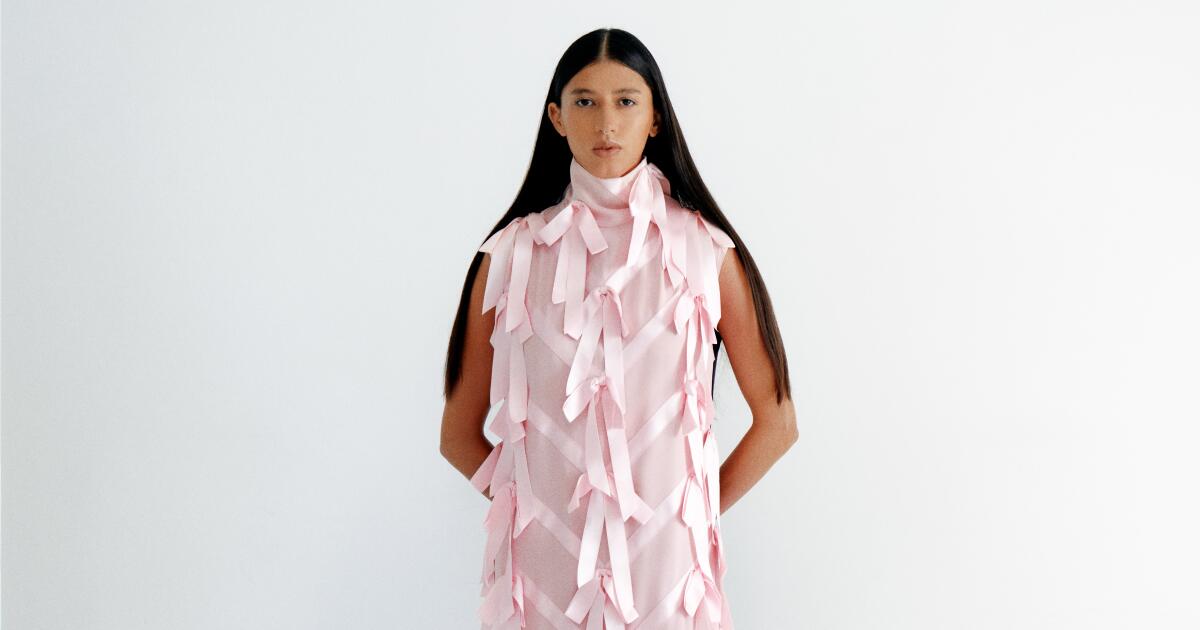
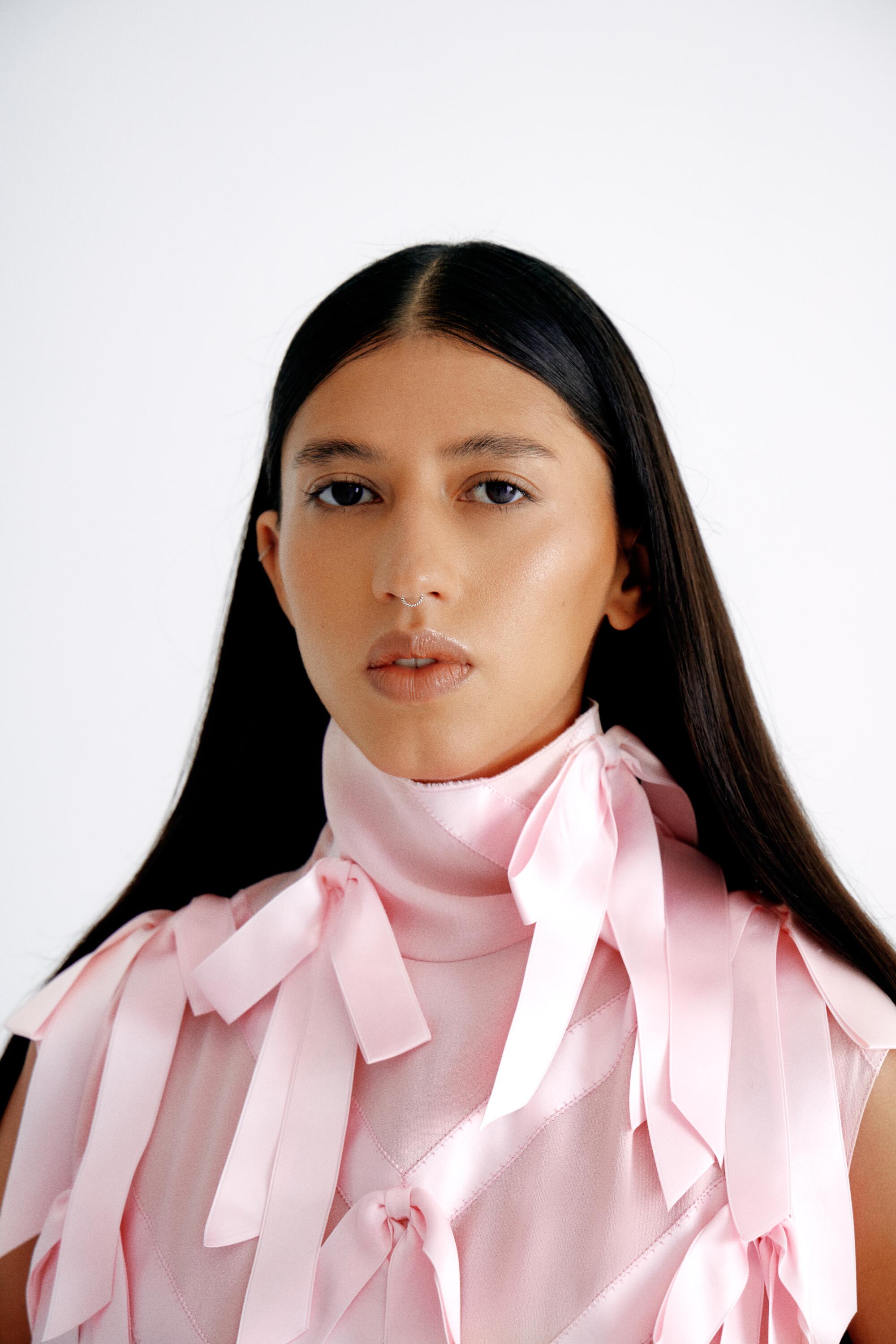
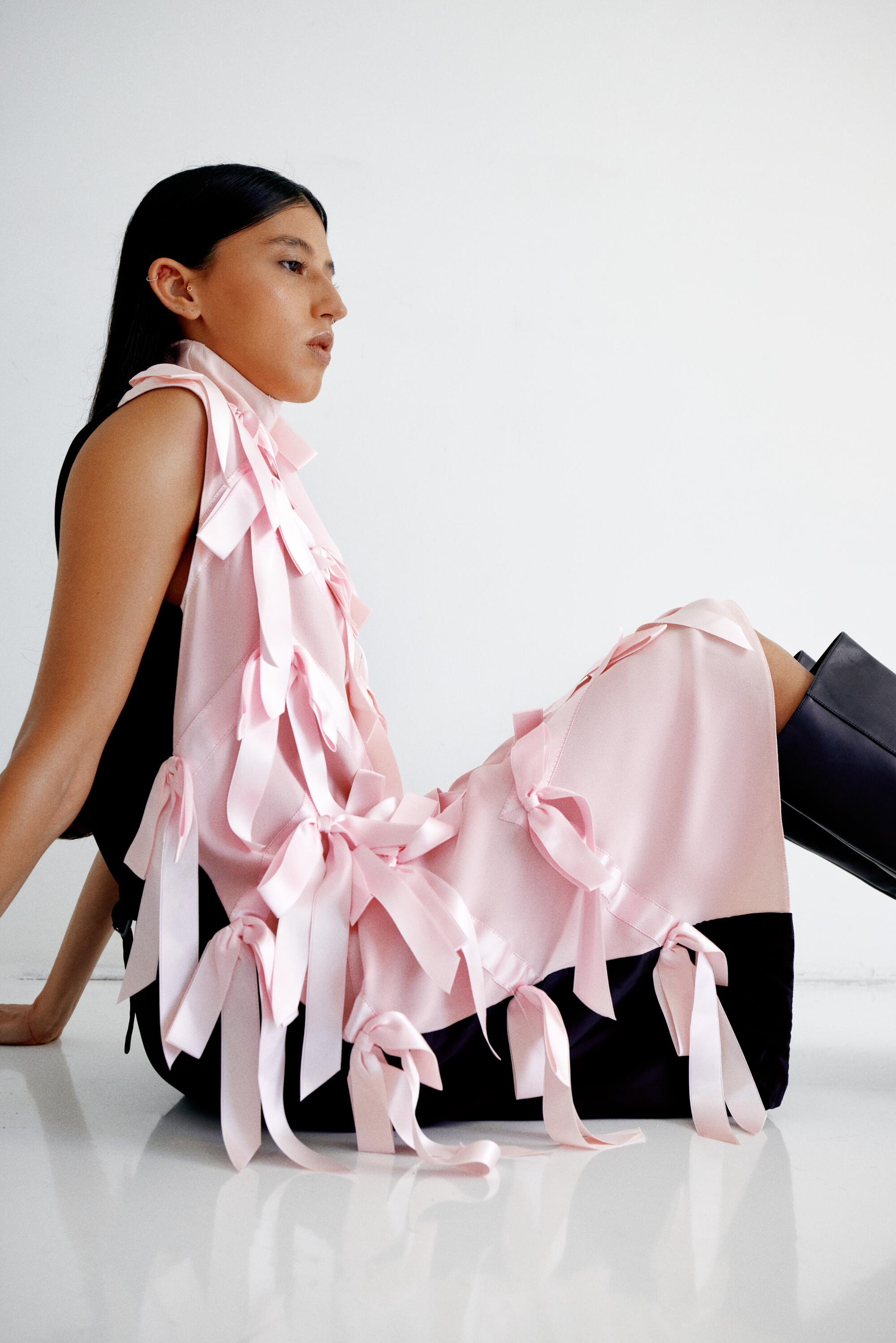
In all its serene defiance, the Prada embroidered ribbon dress is also about a bow. In the brand’s autumn/winter 2024 women’s collection — aptly titled “Instinctive Romance” — designers Miuccia Prada and Raf Simons play with hard and soft, black and pink, tailored and relaxed, to propose fall’s most poetic take on romantic fashion, culminating with an embroidered ribbon dress, a sleeveless shift made of 35 hand-cut, -tied and -embroidered bows cascading from neck to knee. The bows danced as the models walked down the runway during the collection’s show at the Prada Foundation in Milan in tone-on-tone aubergine and baby pink iterations styled with black knee-high boots. The back of the dress featured an unexpected panel of black silk, minimal and bowless. When the models turned to march backstage, their ribbon tails confidently reached around from the front in buoyant embrace. (Chioma Nnadi, editor in chief of British Vogue, described the dress as the “bowment” of the season.)
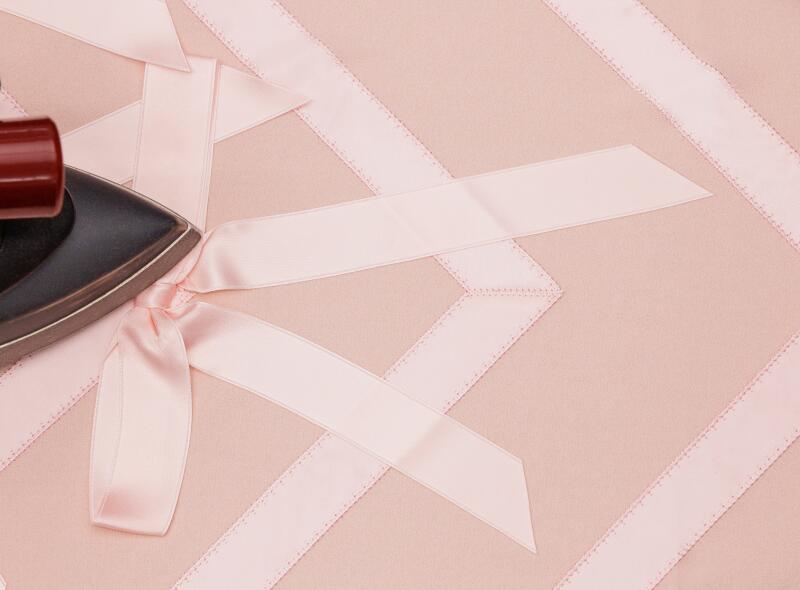
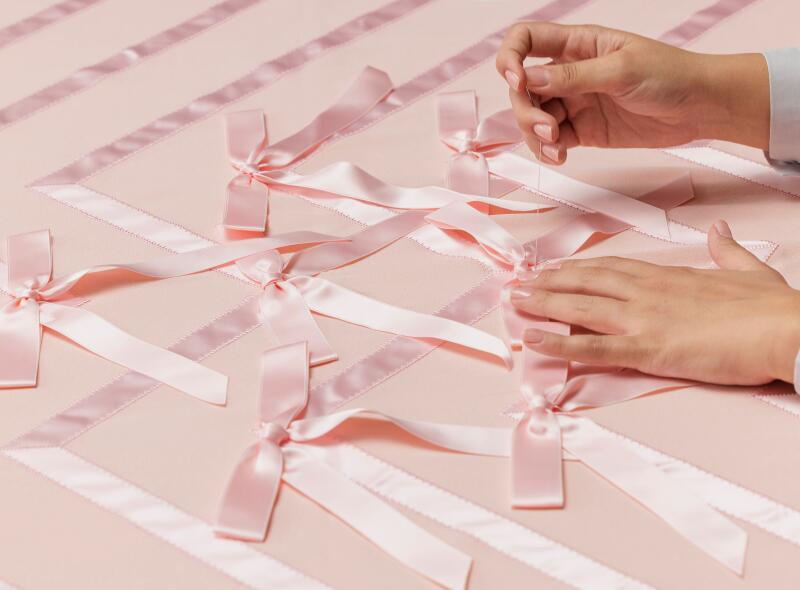
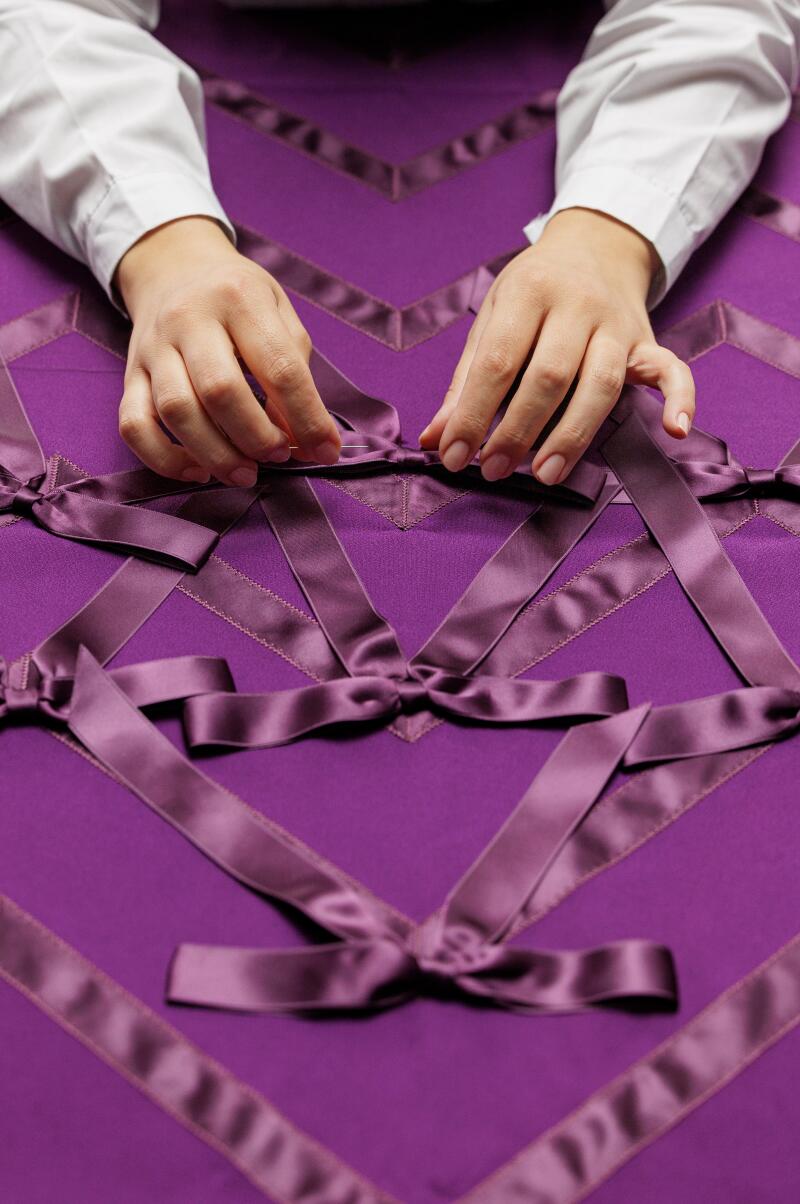
“Made in Prada — Fragments of Romance” (Courtesy of Prada)
Wholly intentional, Prada’s design team used complex techniques to animate each bow. The first step involved positioning the ribbon embroidery in a classic chevron pattern. The embroiderer then cut the satin ribbons at precise angles to correspond with the pattern and secured the ribbons onto the fabric by hand. The preparation of 35 bows was next; they were shaped and ironed one by one before they were sewn at the specified points along the chevron pattern created by the ribbons. The next step involved attaching the embroidered fabric to the contrasting black silk lining, then a second pressing, followed by additional bows being sewn at the hips and around the neck. After 165 feet of ribbon and 13 hours of embroidery, a dress was complete.
Brought to life by craftsmanship that can be executed only by hand, the ribbons on this dress are alive. They speak, surely, but they don’t shout. Miuccia Prada’s long-standing love for ribbon is well documented at her other brand, Miu Miu, where inventive references to ballet and femininity are often the undercurrent of each collection. The Prada embroidered ribbon dress is the posh auntie’s version of Miu Miu’s preeminent and forever young buckle ballet flats. Both items prove that cute and tough can coincide in a way that only Prada can do.
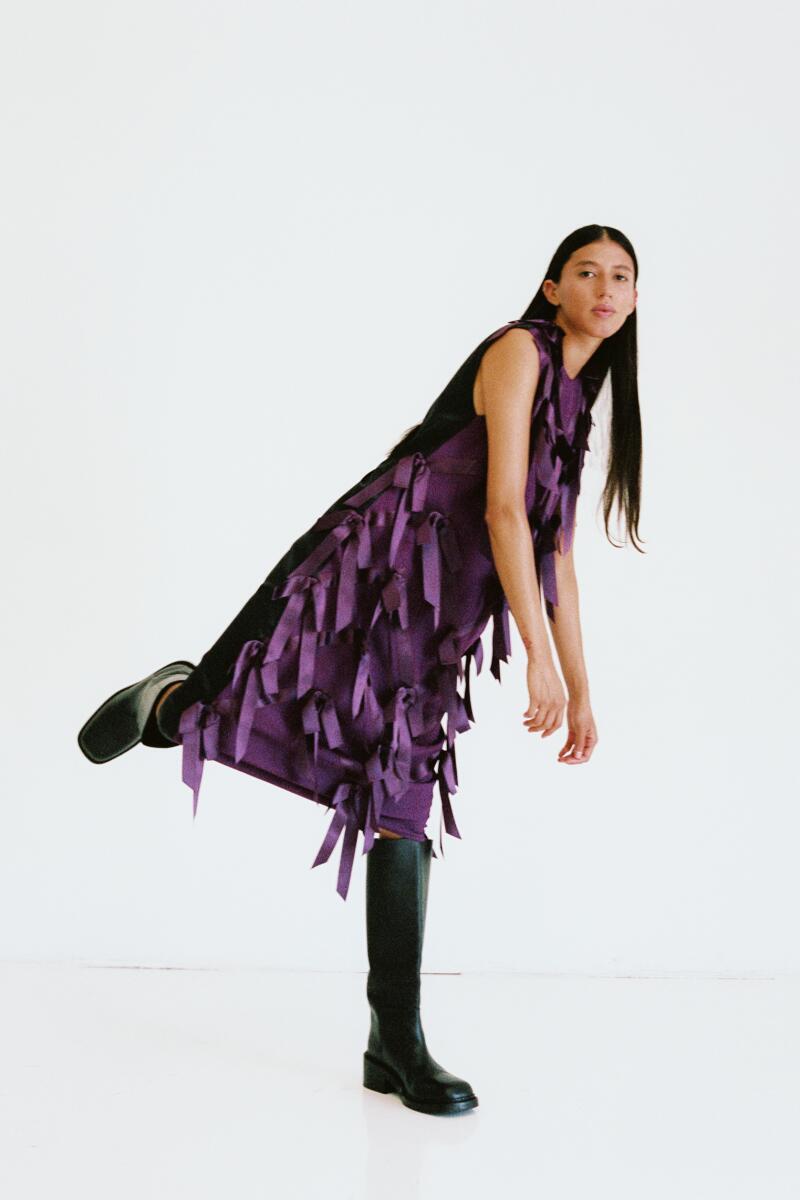
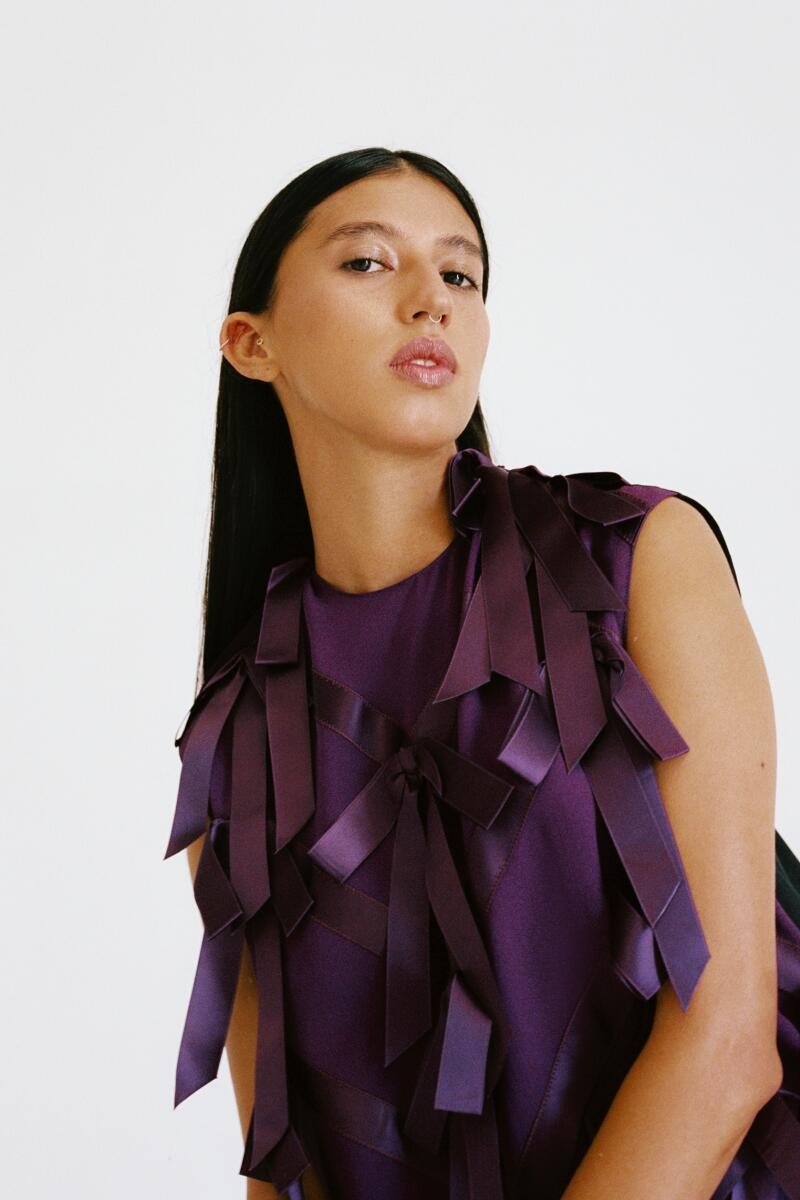
Fernanda wears embroidered dresses from “Instinctive Romance” Fall/Winter 2024 Prada collection.
Long categorized as clichés of femininity, ribbons and bows have been reduced to stereotypes, rather than the compelling and versatile tool they are. Maybe the current resurgence of bows in fashion stems from the desire to reclaim this narrative while simultaneously romanticizing our lives in turbulent times. What could be less romantic than an election year? A bow is a hit of sweet to overpower the sour, but it’s also confident and fluid in its dimensions, expressing much more than it’s given credit for.
In rhythmic gymnastics, ribbons become an extension of the dancer’s body and punctuate every movement with equal parts control and abandon. Stevie Wonder used ribbons as a metaphor for endless love. From awareness ribbons to gift giving, ribbons are used to show compassion and care too. In many communities, ribbons and bows play a significant cultural role, from intricate hair braiding traditions in Guatemala to sacred ribbon skirts in Indigenous tribes across North America. What is a ribbon, then, but a vessel for deep connection and communication? A bow, however saccharine, is symbolic and powerful. A reclamation of cute and a potent, universal tool for self-expression. Call it the bow attitude.
Model Fernanda Álvarez
Hair and makeup Carla Perez
Styling assistant Deirdre Marcial

Romany Williams is a writer, editor and stylist based on Vancouver Island, Canada. Her collaborators include SSENSE, Atmos, L.A. Times Image and more.


Students walk on the Stanford University campus on March 14, 2019, in Stanford, Calif.
Ben Margot/AP
hide caption
toggle caption
Ben Margot/AP
When Theo Baker arrived at Stanford University a few years ago, he joined the student newspaper, following the path of his journalist parents, Peter Baker, a White House correspondent for The New York Times, and Susan Glasser, a writer for The New Yorker.
Through his reporting as a student journalist, he eventually broke a story about manipulated data in Stanford President Marc Tessier-Lavigne’s neuroscience research that helped lead to the university president’s resignation.
Theo Baker’s book, How to Rule the World: An Education in Power at Stanford University was released May 19. In it, Baker describes Stanford as a place where proximity to Silicon Valley gives rise to a parallel system of influence, recruitment and money, with investors looking to identify promising students almost as soon as they arrive on campus.
He told Morning Edition host Steve Inskeep there was “a sort of Stanford inside Stanford,” where elite students are drawn into an “alternate reality” of excess and access to cut corners.
In the interview, he discusses how Stanford is not just a university but also a pipeline where status and power can matter as much as ideas.
We reached out to Stanford University for comment and have not heard back.
Listen to the interview by clicking play on the blue box above.


The scoreboard shows the results of the women’s singles final match between Iga Swiatek of Poland and Amanda Anisimova of the U.S. at the Wimbledon Tennis Championships in London, Saturday, July 12, 2025.
Kirsty Wigglesworth/AP
hide caption
toggle caption
Kirsty Wigglesworth/AP
Fifteen points in tennis? Nice. Thirty, 40 — even better. Advantage — that sounds good. “Love” — that also must be great, right? Well, not quite.
As the French Open rolls on and Serena Williams has announced her return to the sport, maybe you’ve been paying a little more attention to tennis. The sport’s scoring system is notably distinct, and can sometimes be hard to grasp for newcomers. But even tennis aficionados might not know why, or how, “love” became the unmistakable callout for zero points. For this installment of NPR’s Word of the Week, we’re exploring how a word that signifies trailing behind got such a sweet name.
“Love” comes from the heart — or an egg?
It’s hard to pinpoint when the first tennis ball went over the net. Tennis is a derivative of lots of other sports, such as “jeu de paume,” a handball game played in France, said JT Buzanga, the collections manager at the International Tennis Hall of Fame museum.
But tennis became a patented, official sport in 1874, said Steve Flink, a journalist whose tennis coverage got him inducted into the International Tennis Hall of Fame. It has retained its unique, mysterious scoring system ever since.
“By and large, the original system has held up almost entirely,” Flink said.
The use of “love” goes back to the late 18th century, said Jesse Sheidlower, a lexicographer. But it was used earlier than that in card games such as whist and bridge. Before the term made its way to tennis, the sport favored plain old “nothing,” or “nil,” he said.
Why love in the first place, though? Historians don’t really know for sure, but there are a few theories.
The French could have something to do with it. Some historians believe “love” derives from “l’oeuf,” which means “the egg” in French. Because eggs are shaped like zeros, terms such as “goose egg” and “duck’s egg” have been used in other contexts to mean zero, Sheidlower said.
It’s also possible English speakers mispronounced l’oeuf as “love.” But Sheidlower isn’t convinced that’s the answer.
“It’s the French equivalent of an English expression. But since that expression doesn’t appear in French, the French word wouldn’t have been used,” he said.
To be sure, France has had a lot of influence on tennis culture, Buzanga said. For example, “deuce” or a game tied at 40 points, comes from the French word for “two”: “deux.” But he prefers another prominent theory: that “love” comes from the idiom “for the love of the game.” Even if a player hasn’t scored, it doesn’t matter, because their heart is in it. It’s the theory Sheidlower said is the most plausible, because the idiom was used by the English before tennis was popularized.

Another variation of the “love of the game” theory is that the word could have come from the Dutch “lof,” or “honor” — or the Latin “amare,” meaning “to love,” Flink said.
But if tennis’ “love” doesn’t come from a French word, the theory at least has a French sensibility.
“I think the ‘for the love of the game’ is kind of romantic,” Buzanga said.
“Love” probably isn’t going anywhere
Tennis used to be a sport of leisure. The style of play has changed a lot over the years; players are more athletic and competitive, for instance, Flink said. But the rules of the sport are more steadfast, he said.
“There’s this incredible, enduring respect for tradition in tennis,” he said. “Changes are not made easily.”
There has been one major change in modern history: the tie-break. Matches can go on and on because players have to score two consecutive points to break a deuce, or by two games to break a tied set. But the onset of television meant matches would have to get shorter if the sport wanted to capture a larger audience, Flink said.

Change even came for “love.” An alternative sprouted up in the 1970s, and is still used today: “bagel,” named for its zero shape, Sheidlower said. Novices may say “zero,” and insiders will understand what they mean, but they “will needle them about it,” Flink said.
But “love” still prevails.
“People kind of like it,” Flink said. “It’s different. Why say zero when you can say love?”
-

 Politics8 minutes ago
Video: Jan. 6 Rioter Hired by Pentagon
-
Lifestyle38 minutes ago
‘How to Rule the World’ explores education and power at Stanford University
-

 Technology50 minutes ago
Cyberdecks used to look like little laptops, but now they’re getting more personal
-

 World53 minutes ago
Pete Hegseth warns narco-terrorists as U.S. backs Bolivia’s government amid coup warnings
-

 Politics58 minutes ago
Democrats split over Tlaib’s Lebanon measure as Republicans seize on Hezbollah omission
-

 Health1 hour ago
Popular weight-loss diet shows surprising impact on serious mental health condition
-

 Sports1 hour ago
NBA bans two fans for life after court invasion during Knicks-Spurs Game 1
-

 Technology1 hour ago
Charter breach warning: What customers should know

