Lifestyle
10 lively walking clubs to help you tour L.A. by foot — and make friends while doing it


Walking is considered one of the healthiest ways to exercise, but let’s be honest: Unless you have a dog dragging you to the door or a friend pulling your arm, it’s easy to find reasons to stay on the couch. Especially in a place like L.A., where cars typically take us from point A to point B.
L.A. really is a walking city.
Explore our ground-level guide to the people and places keeping our sidewalks alive.
These 10 walking clubs won’t help you get a dog, but they can give you a compelling reason to get up and out. They’re as much about exercise as they are about socializing and exploring.
Here in L.A. there are groups for almost every interest and skill level, and almost all the clubs are free. Some, like the SoCal Stair Climbers, average a brisk 2.5 miles an hour as they explore L.A.’s myriad stair walks. Others, like the Slow Walkers Club, let the slowest participant set the pace, and sometimes help them finish a route. Achilles International Los Angeles provides guides to help people with disabilities get moving, while L.A. Leggers is focused on training walkers and runners for the L.A. Marathon.
All the groups share a similar, overarching goal: to help people make connections while moving.
“It’s easier to get out when you’re in a setting of like-minded individuals,” said Laura Murillo, founder of SoCal LGBTQ+ Explorers. “Our little catchphrase is: ‘Making friends as an adult is hard, exploring SoCal is easy!’”
Achilles International Los Angeles| Culver City EverWalk Walking Club | Hot Girl Walk | Long Beach Walking Club| Los Angeles Hiking Group | L.A. Girls Who Walk | L.A. Leggers | Slow Walkers Club | SoCal LGBTQ+ Explorers | SoCal Stair Climbers

Achilles International Los Angeles

Achilles International was established in 1983 “to transform the lives of people with disabilities through athletic programs and social connection,” according to its website. Today it has programs in 18 countries, including the United States. Its Los Angeles chapter creates opportunities for people with physical and mental disabilities to participate in running, walking and other athletic events with the help of nondisabled volunteers, or “guides.”
Achilles International Los Angeles
Athletes range from “people with autism and no physical disabilities to people who are blind or amputees — we have a lot of veterans who lost their legs,” said Christina Swanson, who was inspired to run the L.A. Marathon after watching a blind woman guided by volunteers complete the race in 2019. Swanson became a volunteer guide herself that year and in 2020 became the Los Angeles chapter’s president.
The L.A. chapter hosts walks the first Sunday of every month at 10 a.m. at Dorothy Green Park in Santa Monica and is starting a second monthly walk in the South Bay area, with times and days to be announced.
The chapter had only a few athletes and guides when Swanson first got involved, but today about 50 people — athletes and guides — show up for walks every month, she said. (Swanson said several of her friends have signed up as guides since she got involved.)
After training and a background check, volunteer guides are paired with athletes. Typically, a walk involves warm-up stretches before people tackle the three-mile trail starting at Dorothy Green Park, although some athletes may walk longer routes. What the guides do also varies: “Some blind athletes just need someone to be their eyes and keep them from walking off the path; others might need two guides to make sure they stay safe,” Swanson said.
Guides are encouraged to converse as much as possible with their athletes and, if possible, train with them on additional days at locations that are convenient to them both. “A lot of our blind athletes can’t drive, so it’s sometimes a big lift for them to get to Santa Monica or the South Bay,” she said. “If our volunteers can meet with them someplace else, it helps them out.” — Jeanette Marantos

Culver City EverWalk Walking Club

When, in 2016, long-distance swimmer Diana Nyad and her friend and coach Bonnie Stoll organized the first EverWalk event — a 135-mile trek from Santa Monica to San Diego over seven days — Culver City resident Laura Petersen “signed up and completed the walk (much to my surprise!),” she said in an email. “That’s when I seriously caught the walking bug!” And when Nyad and Stoll called on volunteers to lead walks in their communities, Petersen stepped up once again, starting the Culver City EverWalk Walking Club in 2018.
Culver City EverWalk Walking Club
Since then, except for about a year during the COVID-19 pandemic, she has led walks once a month, following different routes of about three miles. When she resumed the walks in 2021, she decided to always start at Coombs Park in Culver City, usually the first Saturday of every month from 9 to 10 a.m., “to make it something people could count on.” Her co-leader and husband, Peter, joins the walks each month to help ensure everyone is included.
“We cater to all kinds of walkers, which is sometimes tricky if we have some people walking faster or slower than others,” Petersen wrote. “Peter’s taller and faster, so he’s usually up front, whereas I usually stay with the slower walkers, kind of like a mother hen, to make sure I can see all my chicks ahead of me.”
Membership is free, and while the focus of EverWalk is to get people moving, these walks are also a great way to make new friends. “It’s so much easier to chat with people you’ve just met when you’re on the move, walking side by side,” she said. “I love when we get to the end of a walk and I hear people say, ‘The time just flew by!’” — Jeanette Marantos

Hot Girl Walk

Mia Lind was a 22-year-old communications major and sorority president at USC trying to combat the stress and anxiety in her life when her motivational post about “hot girl walks” went viral on TikTok in January 2021. The idea is that women should stop obsessing about intense workouts to get skinny and instead take daily mindful walks focusing on gratitude, goals and their self-worth, because those are the things that really make you hot.
“When I walk, I think about how grateful I am for the people who love me, and how proud I am about what I’ve achieved and all my new goals. … And that’s how I get to how hot I am,” Lind, 25, said laughing. The idea resonated with her sorority sisters, who urged her to post it online. It met with enough interest (and sponsors) worldwide that Lind quit her day job in September 2023, and now travels the country and the world promoting healthy living and self-worth through walking. (Her pop-up walk in London on Oct. 19 drew 400 people.)
She’s trademarked the name Hot Girl Walk and has started groups that meet regularly in Los Angeles, New York and Miami as well as pop-up walks in other cities, such as one in Boston that drew 800 people in July. There are no membership rules or fees; anyone is welcome to join the monthly Hot Girl Walk in L.A., she said, although “Hot Girl Walkers” are predominantly female. The ultimate goal: Encourage people to start walking, have fun and stop stressing. — Jeanette Marantos

Long Beach Walking Club

Long Beach native Evelyn Avila was looking for a safe way to meet and make friends with other women when she started the Long Beach Walking Club in April 2023. “I started my fitness journey around the same time. I didn’t know how to work out or lift weights, so I just started walking,” she said. “I saw walking clubs popping up everywhere, and I thought Long Beach would be amazing because it’s such a diverse environment.” The idea struck a chord: The group now has 18,000 followers on Instagram and 2,000 “engaged” followers who regularly sign up for events.
Avila, a 31-year-old social media manager, lived downtown at the time, so having walking buddies provided some safety in numbers too, she said. “I love walking to the beach and the shoreline, but it’s not the safest option to walk alone.”
The club offers easy walks at least once a week, along with other activities, such as recent classes about mental health and self-defense. There are also social gatherings at local restaurants or parks and community service opportunities such as food drives and toy drives. Club walks last about an hour and are designed to be easy, Avila said, adding: “These are leisurely, flat, paved walks that are more about socializing.”
Membership is free, and members are encouraged to network and set up extra walks with others in the club. Avila did all the work herself for the first nine months but now has nine “ambassadors” who help with organizing, and the club is currently applying for nonprofit status. Avila is excited about all the ways the group is building community just 18 months after it began. “This is my passion, my hobby,” she said. “Our members are glad to have this space just for women, because [spaces exclusively for women] really don’t exist. This club really helps me help them.” — Jeanette Marantos

Los Angeles Hiking Group

Back in 2007, friends Barry Craine and Lee Zebold started an L.A.-based group with a simple winning formula: Encourage Angelenos to have fun outdoors with others. Some 17 years later, the free, nonprofit Los Angeles Hiking Group has more than 43,000 members on Meetup and multiple opportunities every month for people to join free urban walks or group hikes organized by one of the group’s nearly 70 leaders.
“If you don’t want to travel far, an urban walk is an ideal activity for someone living in a city,” said Mike Cheng, who joined the group in 2011 and is now its president. “I’ve had the best times of my life hiking or walking. And of course it’s a great way to meet people. If you like to walk, and you meet a person who clearly enjoys what you’re doing, you have something in common right away compared to meeting someone in a bar.”
Cheng leads hikes for small groups in places such as Bishop Lake, but he also gets involved in the many urban walks. This time of year, he said, there are several nighttime excursions to admire holiday decorations. Walk leaders do a lot of research to find the best locations, he said, and it doesn’t cost anything to get involved, beyond taking the time to join. And while the membership is huge, individual walks are typically much smaller, no more than 35 people, Cheng said, out of consideration for the neighborhoods where they’re walking. “If you’re hiking in the wilderness, you can accommodate more people, but can you imagine a group of 60 people walking through a neighborhood? Anything over 35 is just too much.” — Jeanette Marantos

L.A. Girls Who Walk

(Francine Orr / Los Angeles Times)
When Monica Figueroa was sent to work in New York City for a few months, she struggled to make friends in the bustling city. After getting flaked on multiple times by people she met on Bumble BFF (an app for people seeking friendships), the San Diego native invited a woman she connected with on the app to attend a walking event with her hosted by City Girls Who Walk. Figueroa and the woman attended several walks together and bonded with two other women, whom they added to their friend group.
But when Figueroa received a promotion that moved her to Los Angeles, she was back at square one making new mates, so she decided to start her own walking clubs. She launched L.A. Girls Who Walk in June 2023, along with another chapter in her hometown, San Diego, where she has volunteers leading walks and occasionally returns to host them herself.
Walking is “a very low-budget, accessible and healthy activity to do when you’re being social, and there really aren’t that many of those things to do [in L.A.],” said 30-year-old Figueroa. “Everything either costs money, [or] causes you to be up late at night, which is not good for your health. It just seems like everything comes with a price, and [walking] really is one of the few things that doesn’t.”
L.A. Girls Who Walk holds one or two walks per month, usually on the Westside at Palisades Park Rose Garden in Santa Monica. Figueroa hopes to host walks in the San Fernando Valley later this year. L.A. members also often get together for smaller neighborhood walks or for social gatherings like bar-hopping. The group even sells merch, including crewnecks and baseball caps. — Kailyn Brown

L.A. Leggers

Back in December 1988, KNX radio reporter Bob Scott ran the Los Angeles Marathon equipped with a radio and microphone to conduct interviews along the way. Scott was alarmed by the number of participants he encountered on the 26.2-mile route who had no training or even awareness of what the marathon entailed, so he helped start a training club that gets people into shape for the annual marathon. Thus L.A. Leggers was born.
Today, the group has more than 600 members and an annual entry fee of $85 that helps cover the expense of T-shirts and other swag, plus discounts for running events, running equipment and, most important, social events. Members start training weekly in August until the marathon in March, and then the group takes a hiatus until the next August. (It’s too late to join the group now, but sign-ups for the next training session, which begins in August 2025, should start in April.)
The marathon includes walkers as well as runners, and about 100 of the club’s 600 members are walkers, said Vice President William Sweat. Participants are put into pace groups based on how fast they can walk or run a mile, and they increase their miles every week, going up to 20 miles per session. Members are expected to work out at least three times a week — twice with other members of their pace group and once during the weekly events; the group meets on Saturdays to work out on various routes in Santa Monica, Venice or Pacific Palisades.
Lest you worry this sounds too intense, Sweat said socializing is a key part of the training. “The mantra when you’re running or walking with the club is you should not walk until you’re winded,” he said. “You should be able to hold a conversation when you’re training, so you should be talking.” — Jeanette Marantos

Slow Walkers Club

Lisa Moore likes to walk, despite “very bad knees,” but when she joined a few walking clubs, she got tired of being left in the dust. “I just couldn’t keep up with the people on those walks. People would tear out and leave me behind, so I was just walking alone.” Moore started her own group in February with a name that made her intent very clear: the Slow Walkers Club.
More than 300 people have signed up since then, but her monthly walks usually involve small groups, “and the only rule is we let the slowest person set the pace,” Moore said. “When we did the Silver Lake Reservoir walk, one woman had very bad ankle pain and there was one steep hill, so we just basically helped her get up that hill. It was hard for her, but she did it. That’s the kind of stuff I like doing, making sure everybody is included to go as far as they can go.”
Moore lives in Hollywood, but she tries to schedule walks of three miles or less all over Los Angeles, including at Descanso Gardens, the Santa Monica Pier and even the giant Ikea store in Burbank. “You can easily get 4,000 steps there,” she said. “It’s a great place to walk if it’s raining or really hot. You just follow the arrows.”
At the end of a walk, the group tries to find a place to eat and do a little more socializing. Moore said she’d like to offer more frequent walks, and hopes other members will suggest places to go. “We try to keep it fun and scenic, but the conversation and making friends is as important as the walking,” she said. “We all need to be included and not left behind. I don’t like that feeling, and I don’t think anybody else does either.” — Jeanette Marantos

SoCal LGBTQ+ Explorers

Angeleno Laura Murillo and a friend joined a walking group in Orange County in 2021, intent on doing some exploring while meeting new people. They made several new friends, she said, but every time they invited them to visit their home in East Hollywood, “We couldn’t get anyone willing to make the drive to L.A.,” she said, laughing. So in March 2022, the two decided to start a walking group closer to home, dedicated to helping others in L.A.’s LGBTQ+ community meet new people and make friends while exploring the Greater L.A. area.
The SoCal LGBTQ+ Explorers is open to everyone in the LGBTQ+ community, including allies. Most of the events center around weekly or monthly urban walks in Griffith Park and Pasadena, but there are other activities, such as walks that include picking up trash in Fullerton’s Coyote Hills, kayaking trips, museum visits and dinner or lunch after certain walks. “It’s easier to meet people when you’re in a setting of like-minded individuals,” Murillo said. “It’s not a dating thing; there’s no pressure. It’s just people getting together to go for a walk and make friends in the LGBTQ community.” — Jeanette Marantos

SoCal Stair Climbers

Dan Gutierrez spent years biking and mountain hiking until he found out about stair walks, a practice advocated by authors Dan Koeppel and Bob Inman. His first stair walk — on the 265-step Esther’s Steps in Silver Lake (also known as the Landa Street Stairs) — was a revelation. “I was in pretty good shape and kind of jogged up the first 92 steps, until I got to the top and realized, ‘Oh no, there’s more!’ That stairway beat the crap out of me. But I also realized that stairways are great interval training.”
Since then, Gutierrez, a satellite systems engineer, has made it his mission to catalog every stairway in the Greater Los Angeles area, including those near his home in Long Beach. He has kept a record of every walk he has done since his first excursion on Dec. 14, 2013, when the group began.
The Stair Climbers is a free group that now features multiple walks every month. One of his most popular is his Painted Stairways Tour, which involves 14 painted stairways over 6.4 miles around the Silver Lake area. The shorter excursions are after-work walks of five to six miles on Tuesdays and Thursdays led by Gutierrez in the Long Beach area, or Thursdays in Santa Monica’s Rustic Canyon, led by members Dave and Kristy Moorman.
Gutierrez also organizes longer walks of eight to 15 miles on weekends, and at least once a year offers the 305-mile, 808-stairway L.A. Loop, which he breaks up into 15 segments over many weekends. On the longer walks, Gutierrez insists that participants take an hour break midway to rest and eat a meal. “I’ve found that if you rest a bit and have something to eat, you’ll not feel as wiped out.” He designs the stops to be near places that offer several restaurant options, he said. “That’s one of the virtues of urban walks — you don’t have to carry all your food.”
Gutierrez likes to keep his walking “brisk,” averaging 2.5 miles a hour, but he also stops frequently to offer mini lessons in history and architecture, which is how he gives people a chance to catch their breath. The motto of the club, after all, is “Enjoyment, Exercise and Exploration,” so Gutierrez has found a balance. “I’ve found if you walk faster and then rest, it helps people become faster walkers, so I’m kind of training them in a gentle, hidden way.” — Jeanette Marantos




Entrepreneur David Huang tests out a VR headset while conducting demonstrations of the social dance lesson app Dance Guru at the Augmented World Expo in Long Beach, Calif., June 17, 2026.
Chloe Veltman/NPR
hide caption
toggle caption
Chloe Veltman/NPR
Wedding season is in full swing, bringing with it a familiar sense of dread for anyone who fears the dance floor.
But relief may finally be at hand with the help of a new app, Dance Guru, and a virtual reality (VR) headset.
The social dance instruction app transports users to a spacious, digital dance studio. Waiting inside is a computer-generated coach: a handsome, male avatar wearing a shirt open to his navel. He speaks with a slightly gravelly English accent.
“Watch me now,” he instructs at the start of a waltz lesson — which NPR tried out at the Augmented World Expo in Long Beach, Calif., an annual conference showcasing the latest developments in virtual and augmented reality.
The avatar then demonstrates a basic box step.
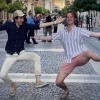
From there, the lesson becomes interactive. The coach tells the user to hold his hand while an electric pinging sound tracks the student’s foot placement.
“One, two, three, four, five, six,” the virtual teacher counts down.
When the user stumbles, he remains remarkably patient. “Do not worry, foundations take time. Let’s try that again. Work on grounding your steps more intentionally.”
Solving the beginner’s dilemma
Dance Guru creator David Huang said he came up with the idea for the app a couple of years ago out of frustration.
“I always wanted to learn to dance and I was always terrible at it,” Huang said. “And I always ended up stopping midway through the lessons.”
He soon realized that many beginners hit the exact same roadblocks.

“Private lessons are too expensive, and you feel like you’re always forgetting the dance steps,” Huang said. “You cannot find a partner to dance with. So I figured maybe I can create something like this.”
The Dance Guru platform currently offers tutorials in salsa, bachata, waltz, and cha-cha, in both lead and follow modes. To make the digital instruction feel authentic, Huang used motion-capture technology to record the movements of real-life dance teachers — with their permission.
Building on the legacy of online tutorials and video games
Dance Guru belongs to a small but growing wave of apps using VR to demystify social dance. At a nearby booth, conference attendee Victor Chen is testing out a competing app called Trip the Light. It currently offers salsa lessons, as well as freestyle options, where a user can dance with a partner without having to learn specific steps.

Trip the Light’s booth at the Augmented World Expo included posters of the app’s virtual instructors. Real-life performers, who gave Trip the Light permission to motion capture their movements, were used as a basis for these avatars.
Chloe Veltman/NPR
hide caption
toggle caption
Chloe Veltman/NPR
“A lot of times when you’re trying to learn a choreography, it’s watching a YouTube video and you have to pause it, rewind, and play it,” Chen said. “If you were to have a virtual avatar dancing in front of you and correcting for any parts that you missed, it might be a lot easier.”
Interactive video games like Dance Dance Revolution and Just Dance, and YouTube tutorials have been helping people improve their skills in private for years. But those games are mostly aimed at solo players. Unlike the new generation of immersive VR apps, they cannot simulate the mechanics or confidence required for partner dancing on a live dance floor.
The reality check
But this kind of app won’t work for every dancer.
“Everyone learns a little bit differently. And so unless you have a game that has lots of different ways of teaching, you’re going to have things that work for some people and don’t work for others,” said Ariana Katana, a trained contemporary dancer and dance content creator who’s active on YouTube, Twitch and other platforms. “Also, it’s hard to dance with a headset on.”
And then there’s the issue of not being able to physically feel a virtual partner’s hand or shoulder while dancing with them. Patrick Ascolese, the creator of Trip the Light, said the experience could become more tactile in the future. “Haptic suits and wearables will be coming, but I think we’re a little away from that,” he said.
Ascolese said even with their limitations, immersive tools like Trip the Light have immense potential as judgment-free training grounds — giving reluctant dancers the baseline confidence they need to eventually step onto the dance floor with real partners in the real world, including at weddings.
“Just like anything else, practice makes perfect,” said Ascolese. “So the more time you spend in VR with a virtual partner, it works towards helping you get over that social hurdle. We are teaching you the moves that you have to do in order to go out and have fun.”
Jennifer Vanasco edited the broadcast and digital versions of this story. Chloee Weiner mixed the audio.

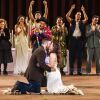


For half a century, Deidre Hall has taken on every kind of disaster in the drama-packed town of Salem, Ill., as a star of “Days of Our Lives.”
There was the time — actually, it happened twice — when her character, Dr. Marlena Evans, was famously possessed by the devil and even levitated.

In Sunday Funday, L.A. people give us a play-by-play of their ideal Sunday around town. Find ideas and inspiration on where to go, what to eat and how to enjoy life on the weekends.
Or the time a serial killer, who was actually Marlena under hypnosis, seemed to kill several beloved characters. The long-running show’s storylines have become legendary, and in March, while promoting “Hail Mary,” actor Ryan Gosling even gave Hall a shout-out, admitting he was a fan, praising the hard work of soap opera actors and calling her an “OG acting inspiration.”
But Hall’s real life in Santa Monica is much quieter than her character’s, and she likes it that way.
“When I bought my house in Santa Monica, I didn’t realize how great it would be to live near Montana Avenue,” says Hall, 78, about the popular shopping spot. Every day, she walks to the main street with her golden retriever, Riley, and enjoys Pilates, art and good food along the way. “The owners of the Farms Market even keep dog biscuits, so guess where the dog wants to go every time we walk — the Farms, of course,” she says, laughing.
When she isn’t filming the daily soap opera, which airs on Peacock, Hall enjoys raising monarch butterflies, exploring the shops and restaurants on Montana, and hosting movie nights at home with her two sons.
Here’s what a perfect day in L.A. looks like for her.
This interview has been lightly edited and condensed for length and clarity.

7 a.m.: Breakfast and dog walk
I usually kick off my day with a protein shake, feed our golden retriever and take her out for a walk. She’s a phenomenal girl. When we adopted her, her name was Riley, but I did think about naming her after Mrs. Hughes from “Downton Abbey.”

10 a.m.: Church and garden time
After I walk the dog and go to church, I like to spend some time in my yard. I’m not a natural gardener, but I really enjoy it. I started raising monarch butterflies because my identical twin sister, who played my twin on the show, planted a butterfly garden. Monarchs are amazing because they are transitional. Every year, they travel from Mexico to southern New England, but it’s getting harder for them. Their numbers have dropped by about 80%. To help, I plant milkweed, which is what they need to survive. I buy my milkweed from the Staghorn Garden on Wilshire Boulevard in Santa Monica. Julie, who owns the nursery, is delightful and has a wide variety of milkweed. The monarchs always seem to find my garden. Julie was raising some caterpillars too, and she cared a lot about them. We talked about how important it is to help the butterflies. That’s why I do this. Sometimes I get milkweed with eggs already on it, and Julie knows her butterflies are going to a good home.

1 p.m.: Walk to Montana Avenue for some lunch
I live near Montana and love taking long walks, going to Pilates and trying out the great restaurants nearby, like R+D Kitchen and La La Land. I’m a big fan of the waffles at the Courtyard Kitchen. Just a few days ago, I had a chicken salad on raisin bread with an Arnold Palmer, and it was delicious. It is right on Montana and has a nice outdoor seating area. It’s one of my favorite spots. La La Land always has a long line in the morning, which is perfect if you want coffee. They serve coffee, doughnuts, croissants and avocado toast. There’s plenty of outdoor seating, and you can even bring your dog.

2 p.m.: Peek inside a clock shop
There’s a small clock shop on Montana Avenue that’s closed on Sundays, but if you walk by, you’ll see all kinds of clocks — standing, table and wall clocks. The owner is great at fixing them. Once, I bought a wall clock from MacKenzie-Childs, but it didn’t work. And I was really upset because it matched everything else on my countertop. I brought it to the owner and said, “I love this, but I can’t make it work.” He fixed it right away. His name is John, but I call him Geppetto. And we all know why. He really does have a magic touch.

2:30 p.m.: Visit a neighborhood art gallery
Ten Women Gallery is run by 10 artists, all of whom show their work there. I was drawn to some watercolors there, bought a few cards and spoke with one of the artists. She told me, “You seem to love watercolors,” and mentioned that the artist who painted them, Pamela Harnois, lives in Los Angeles and teaches nearby. I got Pamela’s name and found out she taught at the Brentwood Art School. I was so inspired by her gift that I started taking private lessons with her on Saturdays. That gallery is where I discovered my love for watercolor painting.

3 p.m.: Grab some ice cream at Rori’s
The other day, my longtime girlfriend wanted to get ice cream and told me, “We are walking to Rori’s Artisanal Creamery.” It’s a small shop on Montana near Lincoln. They make everything themselves, using local ingredients from grass-fed cows with no added hormones. The place is family-owned and probably has the healthiest ice cream you’ll find. They switch up their flavors often, but my favorite is the salted caramel.

6 p.m.: Family dinner and movie night at home
R+D Kitchen is always packed, so my sons, who are 31 and 33, do the cooking. They come over, and together we make salads and cook dinner. There’s a neighborhood grocery store called the Farms, off Montana, a small family-run place that has everything we need. Everyone knows each other there, and people bring their dogs. We try to have movie night every Sunday. Sometimes the day changes, but we always make sure to have one night a week where we cook a meal and sit down as a family. Keeping that tradition has become really important to us. My sons are great cooks, which is funny because they definitely didn’t get that from me. [Laughs]
9 p.m.: Take Riley for one last walk and visit neighbors
After dinner, I take my dog for a walk. It’s a great way to meet neighbors. We always go around the same block. We’ve met so many people, and since she’s a golden retriever, she loves meeting everyone.

10 p.m.: News, knitting and bedtime
I am a news junkie, so I usually watch whatever is on the news before I go to bed. I have a long-standing passion for knitting. Lately, though, the news would make me drop a stitch.
For Iris van Herpen, couture is a laboratory as much as a runway. Our chief fashion critic, Vanessa Friedman, takes us inside this Dutch designer’s latest Paris show — from sci-fi-inspired gowns to an audacious attempt at a dress made of charged plasma.
-

 Washington17 seconds ago
Chisholm’s homer keys 3-run 9th as the Yankees rally past Washington 5-3 – WTOP News
-

 Wisconsin3 minutes ago
Quiotepec en Wisconsin brings Oaxacan basketball fever to the Midwest
-

 West Virginia8 minutes ago
West Virginia DEP seeks details on Peoples Cartage fire cleanup, lawsuit filed on behalf of residents
-

 Wyoming15 minutes ago
Residents celebrate Wyoming Statehood Day by revealing their favorite thing about the Cowboy State
-
Crypto18 minutes ago
Trump’s crypto grift spins into its own industry
-

 Finance30 minutes ago
New changes to financial aid will be minor for UND students, bigger for loan borrowers in repayment
-

 Fitness33 minutes ago
The NHS has reignited the hybrid working debate – but WFH isn’t the health risk, this is
-

 Movie Reviews45 minutes ago
‘Only Beautiful Things to Look At’ Review: A Handsome but Muffled Portrait of State-Sanctioned Cruelty

