


There’s a reason why some of the most effective exercises tend to mirror movements in real life. It’s not because personal trainers and coaches lack imagination, but because the body doesn’t care how creative your programming is — it cares whether you can climb a flight of stairs without grabbing the banister, for example, or if you can catch yourself from a stumble.
These are just a few of the benchmarks that matter in later life, and for elite performance coach David Higgins — who has trained everyone from Margot Robbie and Scarlett Johansson to Samuel L. Jackson, David Harbour, Game of Thrones’ Richard Madden and the entire cast of The Batman, among many others — one exercise sits at the top of the list for anyone over 50: the step-up. Here’s why.
Lower-body power matters so much after 50
Most people understand that strength declines with age. What they underestimate, however, is how quickly it begins to matter in practical terms, despite not being able to be measured on the best smartwatches’ fitness age metrics.

“Lower body power becomes critical after 50 because we naturally lose muscle mass, reaction speed and balance as we age,” says Higgins. “The glutes, quads and calves are what keep you upright, stable and independent.”
If you can’t generate force through the floor, he says, “everyday movements like climbing stairs, getting out of a chair or catching yourself from a fall become harder.” The step-up addresses all of this in a single movement: “it trains strength, balance and coordination all at once and mirrors real life better than most gym exercises.” It’s slightly similar to the farmer’s carry, an application of a real-life movement.
It’s also the reason Higgins places it above more popular alternatives. Walking is excellent, of course, but doesn’t load the body enough to preserve muscle. Squats are bilateral — they share the work equally between both legs, which means they don’t expose or address the kind of side-to-side imbalances that tend to develop quietly over decades. Step-ups, however, are unilateral, as each leg works independently, building the stability and gait mechanics that bilateral training misses.
“If I could only choose one lower-body movement after 50,” says Higgins, “step-ups would be near the top because they combine strength, stability, balance, gait mechanics and unilateral control in one movement; they bridge the gap between rehab and performance.”
Watch the tutorial video below for advice on how to do a step up:
The mistake most older adults make
Before thinking about adding height, load or additional reps, Higgins is more concerned with something more fundamental: the quality of the movement itself. “The biggest mistake older adults make is chasing fatigue instead of quality movement,” he says. “Rushing through reps, leaning through the hips, or pushing through the stronger side of the body.” Your nervous system, he says, “has to trust the movement before your body can own it.”
Rushing through step-ups doesn’t just reduce the benefit — it reinforces the compensations you’re trying to correct. If you’re relying on the trailing leg to push you up, or leaning forward as you step, you’re not actually building the unilateral strength and hip control the exercise is there to develop.
Instead, Higgins’ coaching cue is worth memorising: “push the floor away and finish tall through the glutes.” Most people pull themselves up through the knee, instead of driving through the hip. It’s a subtle distinction, but makes an enormous difference to where the effort is actually made.
How to get started — and when to progress
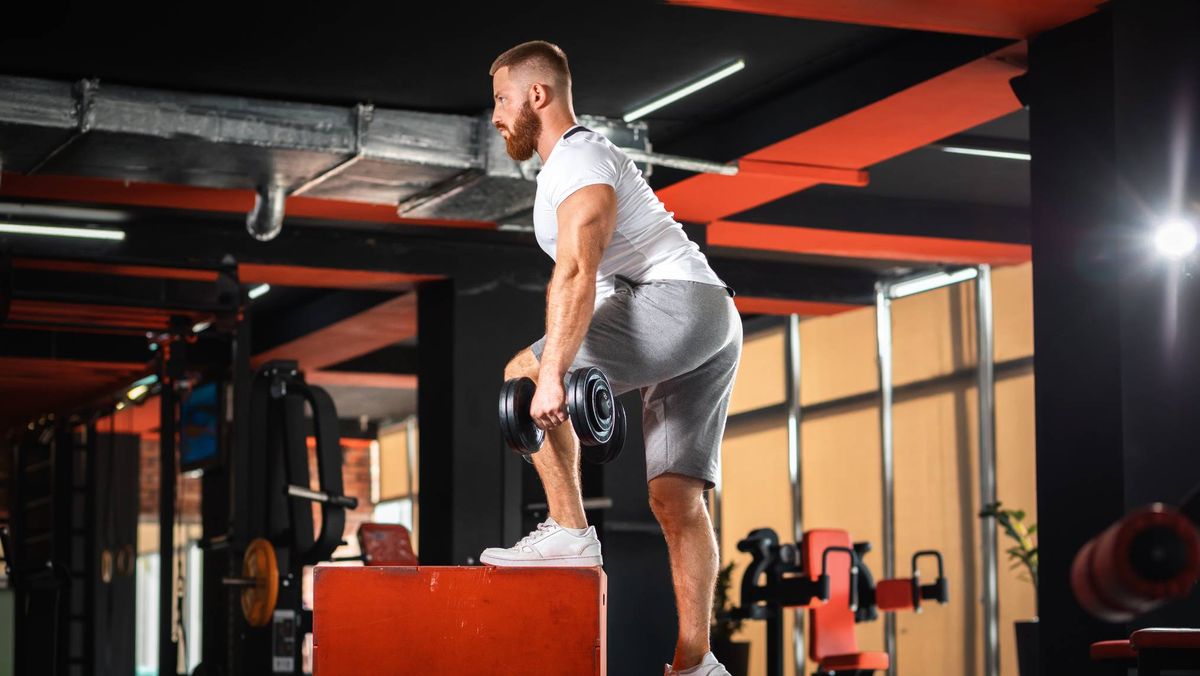
To perform the step-up, stand facing a sturdy bench, box, or step. Place one foot fully on the platform, then drive through that heel to lift your body up until both feet are on the step. Step back down with control and repeat for the desired reps before switching legs. Keep your chest up and avoid pushing off excessively with the trailing leg.
For step height, beginners should start with a low box, roughly ankle to mid-shin height. “You want control, not compensation,” he says. Fitter adults with solid mobility, balance and hip control can work up to knee height.
As for volume, Higgins prescribes 2–3 sets of 8–12 controlled reps per leg. “Tempo matters more than volume,” he says. Drive through the whole foot, stand tall at the top and lower slowly under control.
Higgins confirms that just your bodyweight is sufficient resistance to begin with and, for many people over 50, it’s exactly where they should stay — probably for longer than they’d expect. “Most people over 50 need to relearn movement patterns before adding load,” he says. “Once control, balance and posture improve, adding dumbbells or a weighted vest is a brilliant progression.” The dumbbells can wait. As for frequency? Two to three sessions a week is enough to see real benefit, Higgins says. “Consistency beats intensity every time.”
Precautions
Step-ups are accessible to most people, but Higgins flags a few situations worth considering. Anyone with severe knee osteoarthritis, significant balance issues or acute hip pain should approach the exercise carefully and ideally with professional guidance. “Often it’s not that the exercise is wrong,” he says, “it’s that the height is too ambitious or the body isn’t controlling the movement properly yet.” Low and slow is always the right answer.
What leg-day moves are your go-tos in the gym? Have you tried the step-up yet? Let us know below.

Follow TechRadar on Google News and add us as a preferred source to get our expert news, reviews, and opinion in your feeds.


