Fitness
People Swear by ‘Exercise Stacking’ on Weekends: 'I Feel So Validated by This'


Being a “weekend warrior,” or practicing “exercise stacking” on weekends, comes with its benefits. According to recent research published in Obesity, leaving your workouts solely for the weekend—and exercising hard—can be just as effective as exercising throughout the week when it comes to burning fat and achieving your fitness goals.
We spoke with Tyler Read, BSc, CPT, the founder of PTPioneer.com and a personal trainer who has been involved in the health and fitness world for the past 15 years, who breaks down everything you need to know about exercise stacking, along with how it can speed up your progress. Keep reading to learn more, and when you’re finished, check out the 6 ‘Power Foods’ That Helped This Woman Lose 100 Pounds.
What is exercise stacking all about?
“Stacking exercises refers to the practice of cramming essentially an entire week’s worth of workouts and exercise into just a few back-to-back days, such as on the weekend,” explains Read. And research backs up the benefits.
TikTok user Kevin Gendreau, a board-certified obesity medicine doctor, posted a video with the caption, “I’m a weekend warrior—are you?” He mentioned a 2022 “weekend warrior” study published in JAMA Internal Medicine, which revealed that you can lower your risk of all-cause mortality by squeezing all of your exercise for the week into the weekend.
“So, for example, you can work out for 75 minutes Saturday and 75 minutes Sunday and still get the same all-cause mortality benefit as if you were to disperse your workouts through the week,” Gendreau explains. “This was a game-changer, and it means that people with super busy schedules throughout the week can actually push off their workouts to the weekend. And whether you work out through the week or you just work out really intensely Saturday and Sunday, you still have a benefit of decreased myocardial infarction or heart attack, decreased risk of stroke, decreased risk of heart failure, and even atrial fibrillation.”
TikTokers were quick to comment, with one user writing, “I feel so validated by this,” and another commenting, “Love this!”
How can exercise stacking help you progress?
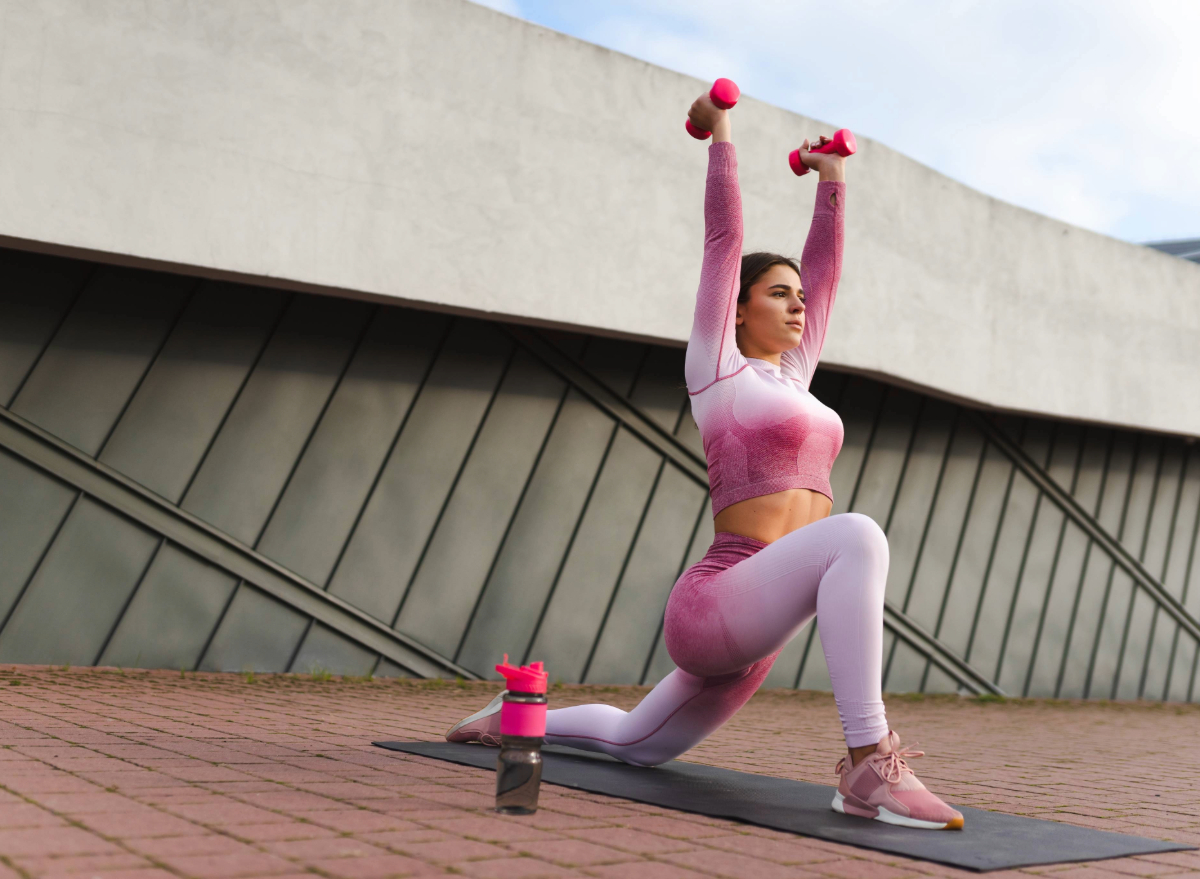
If you lead a hectic, jam-packed lifestyle during the week, exercise stacking can help you be productive with your fitness goals over just a couple of days. “Research suggests that stacking may be as effective as spread-out exercise for general health benefits,” Read tells us. This doesn’t come without a caveat, though.
“Based on my knowledge of strength and conditioning for serious performance goals, the lack of recovery between the stacked workouts followed by the extended period without exercise may be detrimental,” Read stresses. “However, for general fitness and making ‘some gains’ compared to ‘no gains,’ stacking is far better than nothing.”
What are examples of exercise stacking?

When it comes to aerobic training, Read suggests stacking various forms of exercise like swimming, cycling, or running to add variety to your program and help steer clear of overuse injuries.
If you’re working with weights, Read recommends performing total-body workouts with superset aspects, like push-pull, and incorporating several sites of a wide range of exercises. “Make sure you don’t only focus on a single body part; instead, spread the love across all the muscles in your body to make sure they each get the work they need,” says Read.

Sign up for our newsletter!
Alexa Mellardo



Athletes need to think about stamina and endurance all the time. Whether you’re a runner, a basketball player or a swimmer, your ability to push hard and keep going often determines who wins and who comes out on top.
Advertisement
Cleveland Clinic is a non-profit academic medical center. Advertising on our site helps support our mission. We do not endorse non-Cleveland Clinic products or services. Policy
But endurance and stamina aren’t just important for athletes. They can also affect how easily you tackle everyday activities, like yardwork or helping a friend move.
Exercise physiologist Christopher Travers, MS, explains what sets stamina and endurance apart and how to build up both with a variety of workouts.
How stamina and endurance work together
Stamina and endurance often go hand in hand — but they’re different.
Think of stamina as how hard you can push yourself, and endurance as how long you can maintain that effort.
In car terms, stamina reflects how hard you push on the gas pedal for a quick jump in speed. Endurance reflects how far you can go before running out of fuel.
Together, they help you reach your destination and achieve milestones in your physical performance.
Let’s dig a little bit more into what makes each unique.
What is stamina?
Stamina describes your mental and physical ability to sustain high-intensity effort over a shorter period of time. It’s that quick burst at the starting line, the second-wind sprint you get during the last push of a marathon and the fast acceleration that carries you uphill.
“With stamina, you’re trying to push through at a higher heart rate,” says Travers. “It’s your power, your speed and your repeated burst of effort.”
What is endurance?
Endurance describes your body’s ability to sustain low-to-moderate-intensity activity over very long periods of time. It’s the ability to endure a marathon, miles of cycling and long workout sessions without stopping or decreasing intensity.
“With endurance, you’re learning how to maintain a certain level of intensity for the longest period of time,” says Travers. “You’re focused on your breathing, keeping a steady pace and sticking to correct form so you can go longer without running out of energy.”
How to increase endurance and stamina
Building stamina and endurance involves different approaches to physical fitness. Stamina relies on quick bouts of high-intensity exercises, while endurance is less intense but for longer periods of time.
Working on both simultaneously can improve your performance and make a significant impact on your overall health. Let’s now focus on each one individually.
How to increase stamina
Circuit training is a great way to build stamina because it combines strength and cardio exercises with limited rest. A circuit involves moving through a series of exercises that target different muscle groups with little-to-no break between each one. After completing a circuit, you take a longer recovery before repeating the entire circuit.
“The big thing with stamina workouts is your recovery,” notes Travers. “When you finish an entire circuit made up of several quick exercises, you want a longer recovery so you can come back and do the entire circuit over again at the same high intensity.”
High-intensity interval training (HIIT) can also improve stamina. HIIT alternates short bursts of intense exercise with brief recovery periods, training your body to:
- Work hard even when you’re fatigued
- Recover quickly between exercises
- Tolerate higher levels of exertion
- Use oxygen more efficiently
A stamina workout might combine these approaches by using a circuit of high-intensity exercises followed by a longer recovery period before repeating the circuit.
Exercises commonly used in stamina workouts include:
- Hill sprints
- Box jumps
- Stair climbs
- Mountain climbers
- Jump squats
- Burpees
How to build endurance
To build endurance, you’ll need to learn how to maintain a certain level of intensity for longer stretches of time.
“With endurance, we’re going for that longer, steady state and gradually increasing our time and our distances,” explains Travers. “Endurance requires consistency over weeks and even months.”
It helps to focus on workouts that keep your body moving for extended periods. Cardiovascular exercises are especially effective at building endurance. But strength training can be adapted to improve muscular endurance, training your muscles to work longer before they become fatigued.
When working on endurance, you want to increase the amount of time, distance or reps as you progress through your training.
Common exercises for endurance include:
- Cycling
- Running
- Hiking
- Swimming
- Rowing
- Planks
Final note for the miles ahead
Whether your goal is to move faster, exercise longer or simply keep up with the demands of daily life, stamina and endurance can help you get there. Building both takes consistency and practice. But over time, those efforts can pay off in improved performance, better fitness and greater confidence in what your body can do.
“If you train consistently and you’re seeing progress, both your stamina and endurance are improving,” encourages Travers. “It doesn’t happen overnight. It takes time, practice and attention to your overall health.”

GLP-1 medications have reshaped the conversation around weight loss, but fitness experts are quick to point out that the blueprint for a strong, healthy body hasn’t budged. In fact, it’s never mattered more. The fundamentals of healthy living, from strength training and prioritizing protein to staying active, remain essential for preserving muscle, supporting metabolism and creating results that last. Here’s what top trainers want everyone taking a GLP-1 to know.
“Weight changes quickly, but structure doesn’t,” says Tracy Anderson (@tracyandersonmethod), founder of her namesake movement catalog. For anyone relying on GLP-1s without prioritizing movement, she has a clear warning: The body you’re uncovering still needs tending. “The health of your metabolism relies a lot on how you interact with your muscles.” And for Anderson, that means keeping movement varied and consistent. “You want to recruit as much activity as you possibly can in your body. It’s not enough to just say, ‘I’m going to lift; I’m going to build muscle.’ Things atrophy, and you want to keep as much awake and as much alert as you possibly can.”
“When you’re on a GLP-1, as much as 40 percent of the weight you lose may be lean muscle mass,” explains Kira Jones (@kirajones), founder of Cacti Wellness, who adds that the fix for this is non-negotiable. “It’s essential that GLP-1 users actively work to gain and maintain strength and build muscle. Muscle protects your metabolism long-term and provides that toned appearance.” Her advice: Strength train two to three times a week with weight that genuinely challenges you, prioritize protein at every meal and protect your recovery. “Eating well and exercising means nothing if you don’t give your body time to properly digest food, rebuild muscle and release stress.”
Nicole Winhoffer (@nicolewinhoffer), founder of the NW Method, has watched GLP-1s change not only her clients’ bodies, but also their relationship with movement. The risks she highlights are both physical and behavioral, particularly when medication replaces lifestyle habits. “For some individuals, GLP-1s can work best when paired with natural long-term habits around nutrition, movement and overall wellness.” But, she’s also seen something more encouraging: clients who feel better in their bodies showing up differently in the studio. “I would encourage anyone on a GLP-1 to incorporate dance into their routine. Dancing is a great way to improve self-esteem and build confidence in both social settings and personal style.”
-

 Los Angeles, Ca1 hour ago
Ritzy Pasadena hotel settles lawsuit for allegedly price gouging wildfire victims
-

 Detroit, MI1 hour ago
Brother Nature at Night: Jack’s backyard & kayaking the Huron River
-

 San Francisco, CA2 hours ago
Hardin Fire in Napa County burns 55 acres near Pope Valley
-

 Dallas, TX2 hours ago
Former Dallas ISD Superintendent Michael Hinojosa runs for Dallas Mayor
-

 Miami, FL2 hours ago
South Florida mother arrested for leaving daughter chained to fence, police say
-

 Boston, MA2 hours ago
Boston man charged after allegedly assaulting Burger King employee, punching customer
-
 Denver, CO2 hours ago
Denver Country Club caddie earns full-ride Evans Scholarship, becomes first in family to attend college
-

 Seattle, WA2 hours ago
Seattle very much in running for another World Cup

