Entertainment
With 'Everything Must Go,' Hannah Einbinder returns to her first passion: stand-up

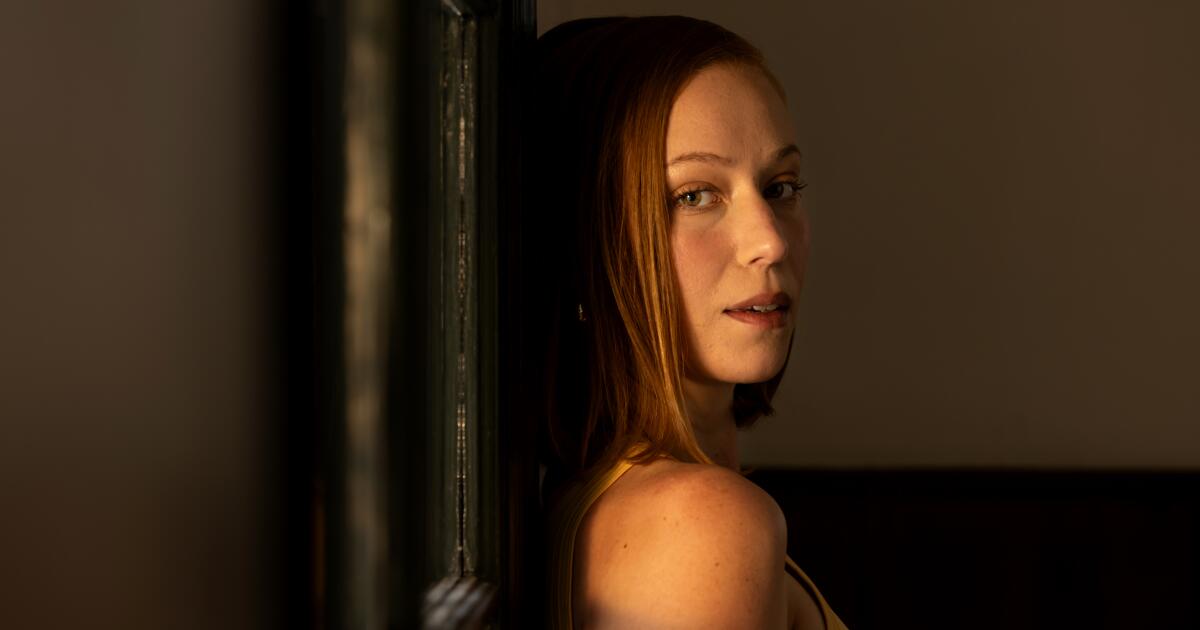
When I told Hannah Einbinder at the start of our interview that I had seen her new comedy special, “Everything Must Go,” a look somewhere between terror and elation crossed her face, which momentarily turned bright red.
“It feels like the most intimate extension of myself, being and soul that I am sharing,” she said when I asked what she was feeling. “So to hear you say that you’ve seen it is the first time I’ve heard someone say that they have seen it. It filled me with joy and excitement and anticipation and a little shock.”
At 29, she described the hour, premiering June 13 on Max, as her “very short” life’s work. “So,” she said, launching into a sarcastic tone, “no presh. It’s casual.”
Einbinder became known to audiences as the overworked comedy writer and underling Ava Daniels on “Hacks,” the Max series starring Jean Smart, which just wrapped up its third and most acclaimed season to date. However, stand-up has long been her main artistic passion and pursuit.
She remembers the exact date of her first open mic in Los Angeles — Jan. 3, 2018, at the Silverlake Lounge — and she considers this special the culmination of her entire time doing stand-up. It’s an hour that’s both deeply personal and couched in a performance style she has carefully crafted. She wears a sleek, all-black look and an expertly cut bob, but she uses her body to both bare her innermost feelings and to become various characters ranging from a witch-like hypnotist to planet Earth embodied as Marisa Tomei in “My Cousin Vinny,” who is angry at humanity for climate change. Einbinder’s “greatest love is the natural world,” she said over Zoom, wearing a sweatshirt with the rolling paper icon the Zig-Zag Man.
Hannah Einbinder in her Max comedy special, “Everything Must Go.”
(Eddy Chen)
If you want to get to know Einbinder, the special, which opens with her birth and ends with her grandmother’s funeral, is a good place to start. It starts with a bit she has done before on camera, notably on “The Late Show With Stephen Colbert” in 2020, when she became the youngest comedian to ever perform on the show. She explains that many comics, when they start their set, begin by telling the audience “a little bit about me.” Her version of that is sultry, with a jazz score, the result of watching a lot of Turner Classic Movies at the time she wrote the gag. Everything she says is true. Her mother, Laraine Newman, one of the original “Saturday Night Live” cast members, had Einbinder when she was 42. Her parents did sperm selection with the hope that they would have a boy. But the way Einbinder delivers the material makes you question just how real it is.
“When I originally wrote that bit, and it is an older bit of mine, I was still at a place where I was trying to create a little bit of distance between myself and the audience,” she said.
Since then, she’s become much more comfortable being honest with the crowd. Sandy Honig, a comedian who directed the special and has toured with Einbinder, has seen her friend and collaborator grow since they first met about six years ago. “Just watching her really come into her own and love herself and be confident, it’s all you really want for someone you love,” Honig said.
The material in “Everything Must Go” covers Einbinder’s bisexuality, her Judaism, her passion for the environment and her period, in addition to different eras of her life, from her stoner days to her time as a competitive cheerleader. She describes the intensity of cheering and how it ruined her body, holding up the microphone to her knee so you can hear it crack like a “gambling addict juggling dice.” The sound is awful.

“Just watching her really come into her own and love herself and be confident, it’s all you really want for someone you love,” said Sandy Honig, Hannah Einbinder’s friend and director of her stand-up special.
(Christina House / Los Angeles Times)
Yes — perhaps surprisingly given her lack of pep — Einbinder was extremely serious about cheerleading, a result of having seen “Bring It On” at an impressionable age.
“It was a huge chunk of my life and it was my first real passion for performance,” she said, speaking in her typically deliberate fashion and explaining that she was a “flyer,” one who is held aloft. “I was very dedicated to perfection. I think my work ethic can be very, obviously to me at least, be attributed to my time as a cheerleader.”
Growing up, Einbinder competed in the sport throughout Los Angeles, including at Beverly Hills High School, which she attended. She still considers the city her home base. “I love being in my car,” she said. “I wish they made a scented candle of the 405, I’d light that s— up every day in my home. I love Los Angeles. It is a huge part of my identity.”
In fact, the beginning of “Everything Must Go” is a tribute to Einbinder’s love of driving and her romantic vision of Los Angeles. She pulls up to the El Rey Theatre in a vintage red Mercedes as a French tune plays in the background.
For this story, the photo shoot was held at beloved West L.A. burger joint the Apple Pan, one of her childhood favorites. I was confused by the location because in the special she identifies as vegan, but she explained that during the taping, she forgot to say the line she added about how she no longer adheres to that diet, a joke about her own hypocrisy. “That is my bad,” she said. “That’s on me.” She does believe in reducing meat consumption, but being vegan is not her choice anymore.
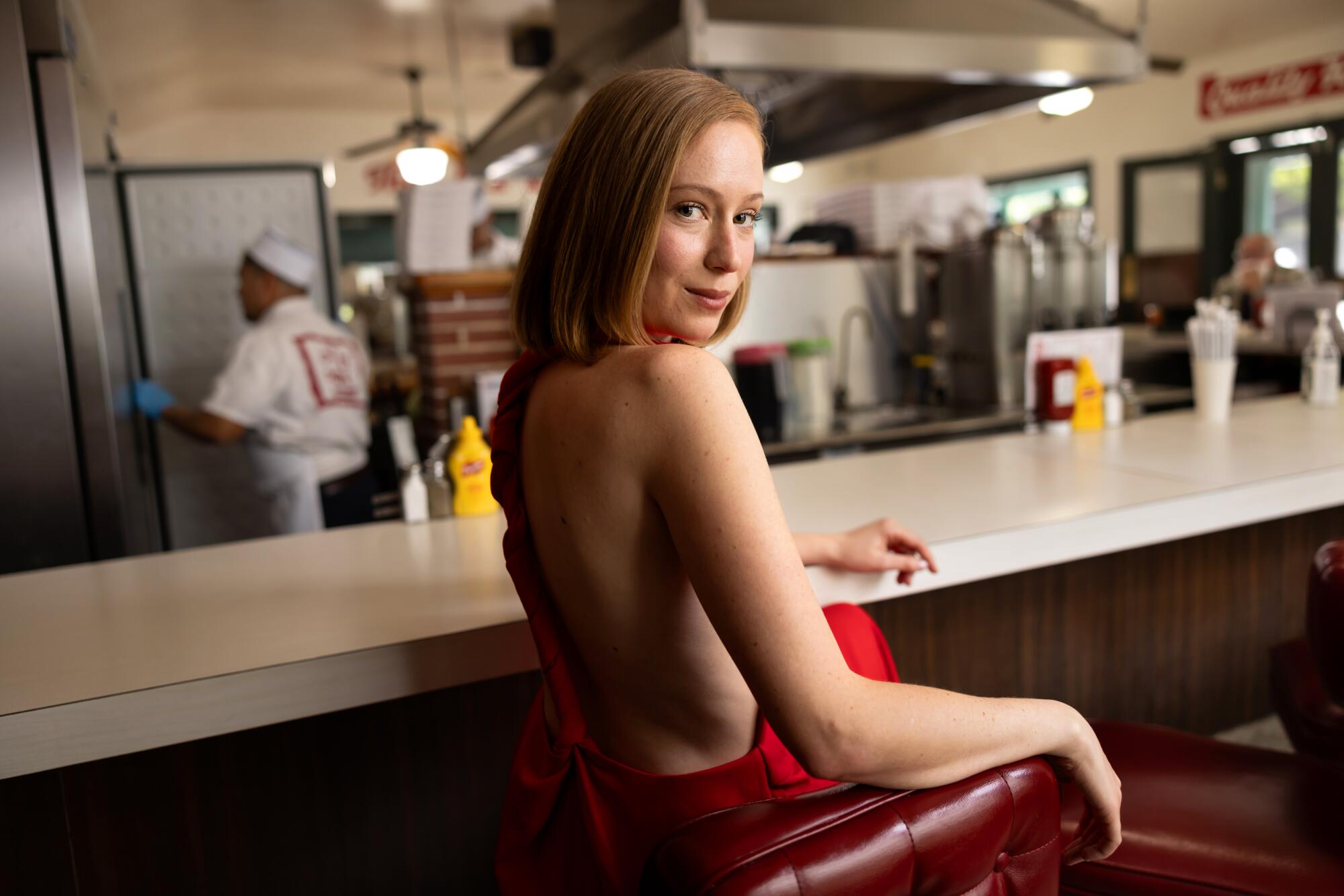
Hannah Einbinder said she considers L.A. her home base: “I love Los Angeles. It is a huge part of my identity.”
(Christina House / Los Angeles Times)
Einbinder grew up in Westwood where she was, in her words, an “ADHD child” who gravitated toward the comedy of Jim Carrey. “I had a lot of energy and I was very hyperactive,” she said. “There are many studies that examine the differences in ADHD between little boys and little girls, and I definitely fall on the little boy ADHD side of the spectrum. I was really rambunctious and really I think Jim Carrey’s physical style spoke to me and I kind of started to mimic him.”
These days, “Hacks” co-creators Jen Statsky, Lucia Aniello and Paul W. Downs compare her to Robin Williams, highlighting her ability to combine acting and character work with intimate revelations about herself in her stand-up.
She first tried stand-up in college at Chapman University, where she initially enrolled in the broadcast journalism program. She was doing improv but didn’t think comedy would be a path until comedian Nicole Byer came to Chapman and was looking for someone to open for her. Einbinder volunteered.
“That was when it became very clear to me,” she said. “I didn’t really view it as, ‘This is my career.’ I just maybe naively viewed it as like, ‘I’m obsessed with this and I’m going to pursue this and I can’t stop doing it.’”
After college she moved in with her mom, worked as a barista at the now-closed Alfred Tea Room on Melrose and started doing open mics. Newman was “brutally honest” in her opinions about her daughter’s chosen field, saying, in Einbinder’s telling, “Good luck, girl. It’s tough out there. Go off, girl, do your thing.”
Getting the role of Ava on “Hacks” not only raised Einbinder’s profile as an actor — it was her first time acting on television — but also boosted her stand-up career, allowing her to pursue it at a pace she wanted. Because of the fame the series brought, she could work out material while touring instead of trying to play the game of internet recognition that so many stand-ups do these days.
“It is never lost on me how fortunate I am and how much being on ‘Hacks’ has made it possible for me to take my time and not have to put my clips up on Instagram or TikTok and to be able to just go right to the road,” she said.

Hannah Einbinder, photographed at the Apple Pan, an L.A. burger joint that was a childhood favorite of hers, says she’s no longer a vegan.
(Christina House / Los Angeles Times)
Einbinder approaches acting with the same studied intensity she approaches stand-up. “She’s always been innately talented and had this thing inside her that is just so raw and you can’t teach it or learn it,” Statsky said. “But she also takes the job of being an actor on the show so seriously and she’s so prepared.”
Downs added that Einbinder has notebooks filled with preparation for her scenes. Still, her seriousness about the job hasn’t stopped her from befriending everyone on set. Downs said that he and his co-creators always joke that she is No. 2 on the call sheet but has the energy of a production assistant.
“She’s the kind of person who immediately makes friends with everybody on the crew and knows everything about everybody and hangs out with them and they’re buds,” her “Hacks” co-star Smart said.
That’s evident in how she brought the “Hacks” community along for her special, using cinematographer Adam Bricker as well as the crew of grips and electricians that worked the series. Smart remembered walking in to watch the taping and being greeted by the grips parked outside. Arranging the work for her “Hacks” co-workers was “textbook Hannah Einbinder,” Smart said.
“She fights for her people so hard in a way that I’ve never encountered with anybody else in this industry,” Honig said. In Honig’s case, it meant that Einbinder advocated for the director to receive a fair fee in order to make a healthcare minimum. Einbinder specifically wanted to “shout out to the artisans,” who quickly learned the lighting cues for her act so she and Honig could turn the set into a cinematic experience, where the stage transforms each time Einbinder takes on a different persona.
The ending of Season 3 of “Hacks” sets up new shades of Ava for Einbinder to play in the fourth season, which Max has already ordered. In the final moments of Season 3, Ava blackmails Smart’s Deborah Vance into letting her be the head writer on her new late-night talk show, after Deborah tells her it’s going to someone else.
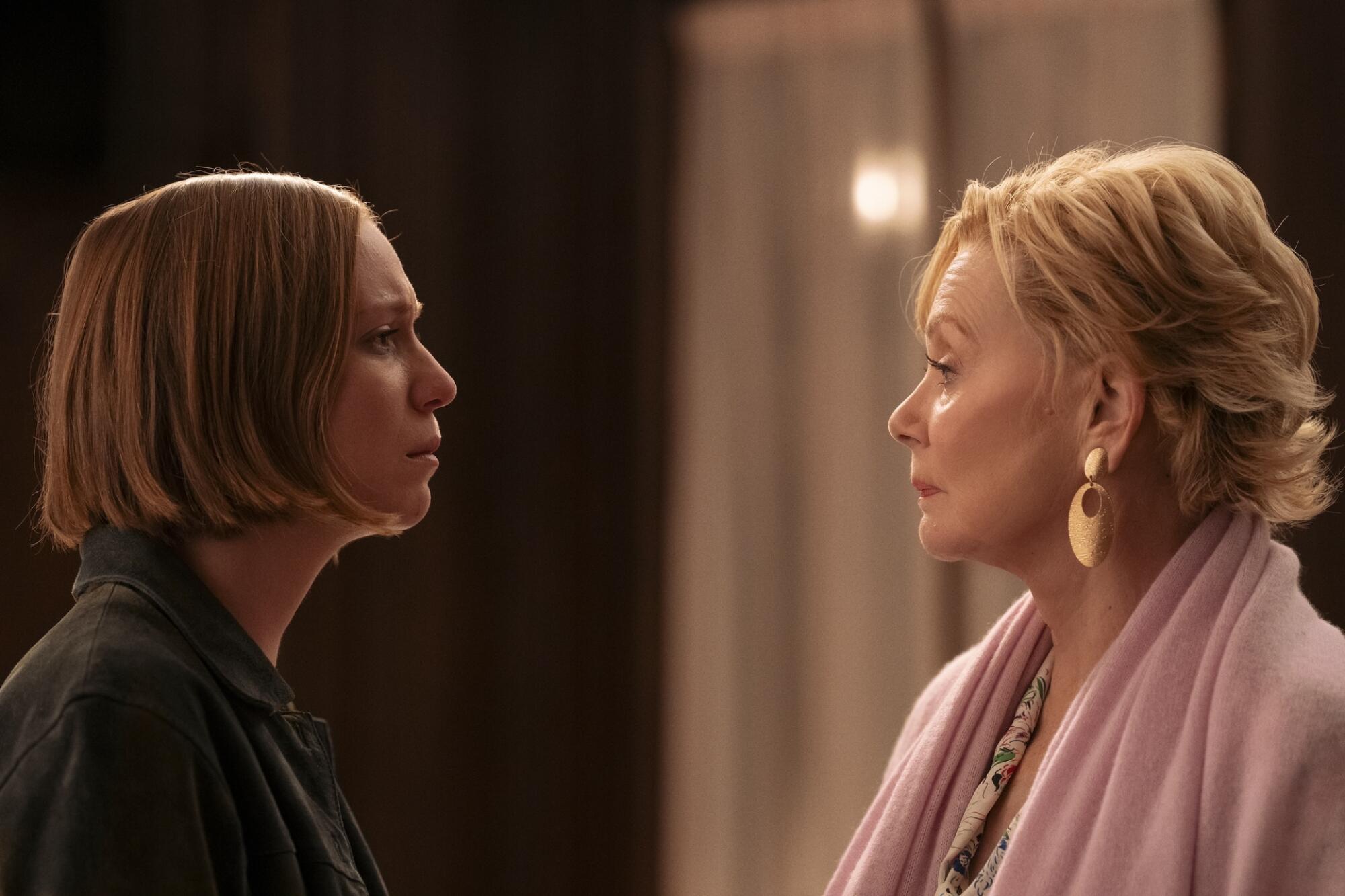
Ava (Hannah Einbinder) and Deborah (Jean Smart) in the Season 3 finale of “Hacks.”
(Jake Giles Netter / Max)
Smart said that Einbinder made her cry while filming one of the season’s most intense scenes — the confrontation between Ava and Deborah, in which Ava reveals her heartbreak over not getting the job.
“She is up for the challenge no matter what it is that we throw at her,” Downs said. “Because she has deepened her understanding of the character and because it’s been three seasons now, we knew that we wanted the character to level up.”
But as for what’s next for Einbinder, she plans to use her privileged position to take her time and choose what’s right. Smart even said that Einbinder turned down a meeting with an unnamed director on a “big, big movie” because of ethical issues with the project.
“I just went crazy when she told me,” Smart said. “But that’s the kind of person she is and I have to respect that. She’s an extraordinarily principled and kind person.”
For her part, Einbinder said she is trying to remove herself from a “capitalist timeline” where artists are required to churn out material when they have a level of heat in their careers. She wants to take her time to workshop new material with an eye toward quality above all else.
“I have been given the incredible gift of being able to make art and to be a part of art for a living and I hope to maintain that level of quality,” she said. “Cut to me in a Shell Oil commercial.” I said I don’t see that happening. She added: “No, just kidding, folks.”

Entertainment
Good night and good luck and goodbye — CBS News Radio signs off after nearly 100 years

As a radio professional who grew up aspiring to work at CBS News Radio, anchor Steve Kathan understood the weight of the words he wrote and recorded Friday on the final broadcast of “World News Roundup.”
“America’s longest running newscast signs off for the last time,” Kathan said in the small dimly lighted studio in the CBS Broadcast Center on Manhattan’s West Side. “It all began on March 13, 1938,” he said, referring to the iconic news program.
Kathan played a recording of Edward R. Murrow, the legendary CBS News journalist who delivered his first report on the debut of the program, saying “the best in radio reporting is yet to be — good night and good luck.”
“And goodbye,” Kathan added, ending the run of around 23,000 editions of the 10-minute signature broadcast, delivered from CBS’ radio network . A final news update was scheduled to run later Friday night.
CBS News Radio and its 26 employees became a victim of budget cuts across parent-company Paramount’s news division announced in March.
“A shift in radio station programming strategies, coupled with challenging economic realities, has made it impossible to continue the service,” the company said.
Privately, longtime insiders at CBS News say the division has struggled for years to find ways to financially turn around its radio business.
The unit was operating at a loss with monthly revenues recently falling as low as $67,000, according to a network executive not authorized to discuss the matter publicly. The service held on because it still had value in promoting CBS News and its journalism, reaching 20 million listeners a week.
Leadership over the years have put off the messy task of winding the radio business down due to its iconic status at the company. CBS News editor-in-chief Bari Weiss was reluctant to make the cuts as well, according to people inside the company familiar with her thinking. But with Paramount taking on substantial debt to acquire Warner Bros. Discovery, considerations of the division’s legacy are likely to matter less in ongoing efforts to reduce costs.
Kathan had heard rumblings about CBS getting out of radio going all the way back to its first ownership change in the 1980s when Larry Tisch acquired the company.
“Even though I’ve been here 39 years, the thought was someone’s going to decide to do it,” he said.
As television dominated the media landscape, CBS News Radio retained its role as what Kathan called “the background track of American history.”
As a child growing up in Connecticut, Kathan recalls watching Douglas Edwards, the “World News Roundup” evening anchor for two decades, doing TV news updates in between the soap operas his mother watched on CBS. After Kathan joined the network in 1987 as a writer and producer, he would see Edwards and other famous names from the division walking through the hallways of the broadcast center before doing his afternoon newscasts.
“Just the fact that you were working with them made you think and realize you had to up your game,” Kathan said. “You wanted the audience to trust you as much as it trusted them.”
“World News Roundup” rose to prominence during World War II, when Murrow and other CBS News correspondents delivered live reports from Europe.
Once TV supplanted radio as a source for scripted entertainment, news and information became the primary mission of CBS’ radio division that began in 1927. In 1967, the company converted its owned AM radio stations — including its Los Angeles outlet KNX — to an all-news format.
While the stations focused on local news, traffic, weather and sports, they also prominently featured CBS News Radio reports at the top of the hour and other features throughout the day.
Longtime listeners became familiar with Edwards, Dallas Townsend, Reid Collins, Richard C. Hottelet, Christopher Glenn and other CBS News veterans who brought national and world stories to listeners throughout the day, introduced by a five-note sounder that simulated a telegraph. Dan Rather and Walter Cronkite were heard daily with analysis.
The radio network developed a major star in Charles Osgood, who joined WCBS in New York as anchor. He went national in 1971 with a twice-daily segment called “The Osgood File.”
Osgood wrote two-minute reports in succinct prose delivered in his mellifluous tones. He occasionally offered commentary in verse, which earned him the title of poet-in-residence at CBS News.
Osgood’s popularity was rivaled only by ABC Radio personality Paul Harvey. CBS News even allowed him to read commercial copy to satisfy eager advertisers who wanted their product messages presented in his comforting voice. When Osgood became a host on the TV side in the 1990s on “CBS News Sunday Morning,” his sign-off remained “I’ll see you on the radio.” He filed his final “Osgood File” report in 2017.
Charles Osgood in the WCBS radio studio in New York on July 25, 1967.
(CBS Photo Archive/CBS)
CBS sold off its radio stations in 2017, but continued to produce and distribute its network programs as the business faced competition from digital media.
Dustin Gervais, technical operations manager for the network, said CBS News Radio struggled as more audio advertisers prefer digital content because of its effectiveness at targeting specific demographic groups. The shift is reflected in radio ad revenue, which dipped about 2% to $14.37 billion, according to media research firm Kagan. But the digital ad revenue portion of that pie continued to grow, topping $1.75 billion.
Charles Forelle, managing editor for CBS News, said the company plans to remain in the audio journalism business through podcasting and not straight newscasts.
“We have a whole bunch of different things in development that are less news reading and more other things,” he told The Times.
Not all of radio’s problems are related to digital.
Michael Socolow, a professor of communication and journalism at the University of Maine, notes that the industry troubles began in 1996 when deregulation loosened the limit on the number of stations a single entity can own. Buying sprees of outlets led to owners who became highly leveraged and less able to invest in programming, which put the squeeze on suppliers such as CBS News Radio.
“Radio was hollowed out by the corporations, before its utility to the American citizen ended,” Socolow said. “You can trace it to the Telecom Act of 1996.”
Some of the 26 employees at CBS News Radio who were severed from the company have found work at Worldwide News Network, a service launched by John Catsimatidis, the owner of New York’s top-rated talk station WABC. The company said the service, which begins Saturday, will deliver “hard news, breaking headlines, and fact-driven reporting to affiliates across the country.”
CBS News Radio’s biggest customer — the all-news stations owned by Audacy, including KNX — have already switched their network service to ABC News Audio.
Movie Reviews
‘The End of It’ Review: Rebecca Hall, Gael García Bernal and Beanie Feldstein in a Compellingly Quirky, if Overstretched, Sci-Fi Exercise

The always eminently watchable Rebecca Hall (The Man I Love, TV’s The Beauty) both anchors and buoys the tonally irregular but consistently thoughtful and compelling sci-fi comedy-drama The End of It, a feature debut for Catalan writer-director Maria Martinez Bayona.
Offering a near future that’s creepily plausible, resonant with recent headlines and nicely underplayed in terms of design, this posits Hall as Claire, a 250-year-old artist who’s kept looking like an elegant 30something thanks to sophisticated blood dialysis techniques and other kinds of high-tech, vaguely defined wizardry, available to a very select few.
The End of It
The Bottom Line Augurs a potentially interesting career.
Venue: Cannes Film Festival (Cannes Premiere)
Cast: Rebecca Hall, Gael Garcia Bernal, Noomi Rapace, Beanie Feldstein
Director/screenwriter: Maria Martinez Bayona
2 hours 22 minutes
However, when Claire grows bored with an effectively immortal life and chooses to die, her husband Diego (Gael García Bernal), 180-year-old daughter Martha (Noomi Rapace), and android personal assistant Sarah (Beanie Feldstein) react in various ways, ranging from supportive to angry. Running an attenuated 142-minutes, this feels slightly flawed by a script that doesn’t quite know how to play out its endgame and erupts with jarring flashes of spongey, overegged satire. Still, the performances and visuals consistently add value, and if this doesn’t sell many tickets IRL, it should haul in clicks as a streaming entity.
Shot mostly in the Canary Islands with the region’s searing, glaring Tropic-of-Cancer-adjacent light, freakishly black, volcanic soil and groovy mid-century-modernist buildings, the film suggests a future where the worst climactic disasters have been avoided. That, or the people we meet here are wealthy enough to have found a cushy little enclave to live forever without a care in the world. It seems they’re part of the select few, members of a vaguely alluded-to world order that provides the means to exist in a state of permanent, hedonistic ennui.
But the only way to get in on this immortality gig, or to be granted permission to have a baby, is for someone else to die. And since no one expires from, say, cancer or other now-curable diseases, and bones and organs can be replaced like car parts with artificial spares, people only pass when involved in freak accidents…or take their own lives.
On the occasion of her 250th birthday (she gets a cake with so many candles she can barely be bothered to blow them out), Claire is in a funk and just not enjoying any of this anymore. Having just replaced her last remaining natural bone, she takes stock. Years ago, she was an acclaimed artist whose work was a bit avant-garde and challenging. Now she designs jewelry, a remunerative but not very intellectually rewarding pursuit. (This plot point is a bit mean to jewelry designers.) Suffering an acute case of anhedonia, she decides that she will no longer have her blood work every day or any other kind of life-extending treatment and instead will just let nature take its course.
As grey hairs appear and other augurs of age become visible, Claire contends with the varied reactions of her small social circle. She couldn’t care less about the assorted colorful acquaintances who attended her birthday party, a cohort clad in an assortment of semi-minimalist clothes with funky little details and interestingly textured textiles, as if dressed in a mix of Comme des Garçons and Cos. (Costume designer Pau Auli’s work throughout is both witty and oddly covetable with its precise tailoring and subtle color palette.)
But it is more upsetting that Diego, her husband of many years, doesn’t get her reasoning at all, or even sees this as a personal rejection. Sarah, Claire’s relentlessly perky robot sidekick, similarly cannot compute why Claire would wish to undermine Sarah’s prime directive, to keep Claire alive. But she’ll do whatever it takes to keep her mistress happy, like some kind of humanoid golden retriever.
Only her daughter Martha, who shows up suddenly, having not seen her mother in 50 years, seems at peace with Claire’s decision. That turns out to be because she thinks this may be her chance to take Claire’s place as a breeding female in their society and has brought along an android baby to practice on, like some kind of 23rd century Tamagotchi that can be switched off and recharged whenever necessary.
Prone to wearing clothes that suggest an overgrown pre-teen herself, all frills, flounces and bright colors, Martha doesn’t look like great maternal material to Claire, although this judgmental attitude may be evidence of her own maternal deficiencies. The peevish sparring between the two of them gets a comic push from the fact that the two actors are very close in age (Hall is three years younger than Rapace), but like so many parents and children they remain stuck in a dynamic that formed sometime in adolescence and has never been outgrown.
The digs at the pretensions of artists, channeled through Claire’s decision to make her death a public spectacle in order to secure some future fame, are less amusing here because the blows never seem to quite connect with their targets. Also, one begins to suspect that a small budget prohibited the filmmakers from showing a wider view of this society, which also dampens any parodic purpose. Claire’s elective death therefore remains a problematic choice for some viewers, an act of vainglorious selfishness from a woman who was never terribly nice to begin with.
It’s lucky she’s played by Hall, who endows Claire with a spiky sort of wit and charisma, while her performance in the film’s final minutes packs a considerable emotional wallop and pathos to spare. The impact of that shocking final scene is sufficient to send viewers out feeling enervated after what’s been a pretty desultory final act. But even with these flaws, The End of It looks like it marks the beginning of an interesting career for its young writer-director, a talent with a strong visual sensibility and skills with actors.

After a nearly seven-year absence from theaters, Star Wars proved it still has the Force, as the latest installment, “The Mandalorian and Grogu,” is on track to earn an estimated $102 million in the U.S. and Canada for the Memorial Day weekend.
The movie, which is a continuation of “The Mandalorian” streaming show that debuted on Disney+ in 2019, met studio expectations for its opening weekend results.
Globally, the film was on track to pull in $165 million for the four-day holiday weekend.
Director Jon Favreau’s “The Mandalorian and Grogu” now ranks as the year’s third-highest grossing domestic opening, based on its Friday-Sunday ticket sales of $82 million, according to ticket tracker Comscore.
The results are likely a relief to Walt Disney Co.-owned Lucasfilm, which had not released a theatrical Star Wars film since 2019’s “Star Wars: Episode IX — The Rise of Skywalker.”
Since then, the San Francisco-based studio has largely focused on its Star Wars streaming shows, which have included both live-action and animated series. Some of those shows received mixed reviews, though “The Mandalorian” and “Rogue One” spin-off “Andor” were breakout hits, praised by critics and largely revered by fans.
The movie — starring Pedro Pascal, Sigourney Weaver and Jeremy Allen White — benefited from positive reviews from moviegoers, but it stopped short of shattering expectations. Its initial financial performance was on par with the disappointing 2018 opening weekend for “Solo: A Star Wars Story.” That film notched $103 million in its opening weekend.
Still, as cinemas struggle to recover from pandemic-era shutdowns, a film that generates more than $100 million in its the opening weekend is typically seen as a success.
Box office revenue for “The Mandalorian and Grogu,” which played in 4,300 theaters, will be just one indicator of the movie’s success.
The Burbank entertainment giant is counting on the film to boost other parts of its business, including views of Star Wars shows on the Disney+ streaming service, its gaming collaboration with Fortnite and its all-important theme parks sector. The main characters are present in the Star Wars: Galaxy’s Edge-themed land, and the Millennium Falcon: Smugglers Run ride has been overlaid with a new “Mandalorian and Grogu” storyline at Disney parks in Anaheim and Orlando.
The weekend ticket sales underscore the enduring appeal of Star Wars, which remains among Disney’s top five franchises, producing more than $1 billion in annual retail sales.
Reception for the film was seen as critical to keeping the franchise fresh in moviegoers’ minds, particularly as Disney prepares for the upcoming 50th anniversary of Star Wars and a new movie starring Ryan Gosling set for next year.
Locally, “The Mandalorian and Grogu” is the first Star Wars movie to be made entirely in Los Angeles.
The film received a state tax credit to film in the Golden State, Favreau said at the premiere last week.
“The Mandalorian and Grogu” faced little new competition at the box office this Memorial Day weekend. Rival studios largely stayed on the sidelines, with no other potential blockbuster debuting at the same time.
Focus Films’ horror hit “Obsession” came in second at the box office with $22.4 million for its three-day total, according to Comscore.
Lionsgate’s blockbuster Michael Jackson documentary, “Michael,” snared $20 million, bringing its total to $314 million. “The Devil Wears Prada 2” came in fourth with $12.6 million, bringing its purse to $196 million since it opened earlier this month.
Amazon’s MGM studio’s “The Sheep Detectives” rounded out the top five with nearly $9 million.
-

 Politics4 minutes ago
‘After your boy’: Hasan Piker lashes out over fed probe into Cuba trip
-

 Health10 minutes ago
5 common walking mistakes that could hurt your progress, according to an expert
-

 Sports16 minutes ago
Victor Wembanyama scores 33 as Spurs dominate Thunder in Game 4 to even Western Conference Finals
-

 Technology22 minutes ago
Fake CAPTCHA scam can hack your computer
-
 Business28 minutes ago
Newsom blames Chevron for California’s gas-price problem
-
Entertainment34 minutes ago
Good night and good luck and goodbye — CBS News Radio signs off after nearly 100 years
-
 Lifestyle40 minutes ago
L.A. Times Concierge: ‘Where can I buy the best celebration cake for a dear friend?’
-
 Politics46 minutes ago
As influencers rise in politics, some call for tighter regulations on payments

