A documentary on his life, “You Can Call Me Bill,” directed by Alexandre O. Philippe (“Lynch/Oz”), is scheduled to roll out in theaters March 22 to coincide with his 93rd birthday. He continues to host and narrate the puzzling-phenomena History series “The UnXplained With William Shatner.” A 2022 performance at the Kennedy Center, backed by Ben Folds and the National Symphony Orchestra, is about to be released both as an album, “So Fragile, So Blue,” and a concert film. The title song, says Shatner, “encompasses a lot of my thinking about how we’re savaging the world, and [I’d hope] it’d be a song that people would listen to and perhaps be inspired to do something about global warming.” And on April 8, for 15 minutes before the shadow of an eclipse falls over Bloomington, Ind., Shatner will address “55, 60,000 people” in the Indiana University football stadium. “So what do you say, what do you write, what do you do? I’m going to have to solve those problems.”
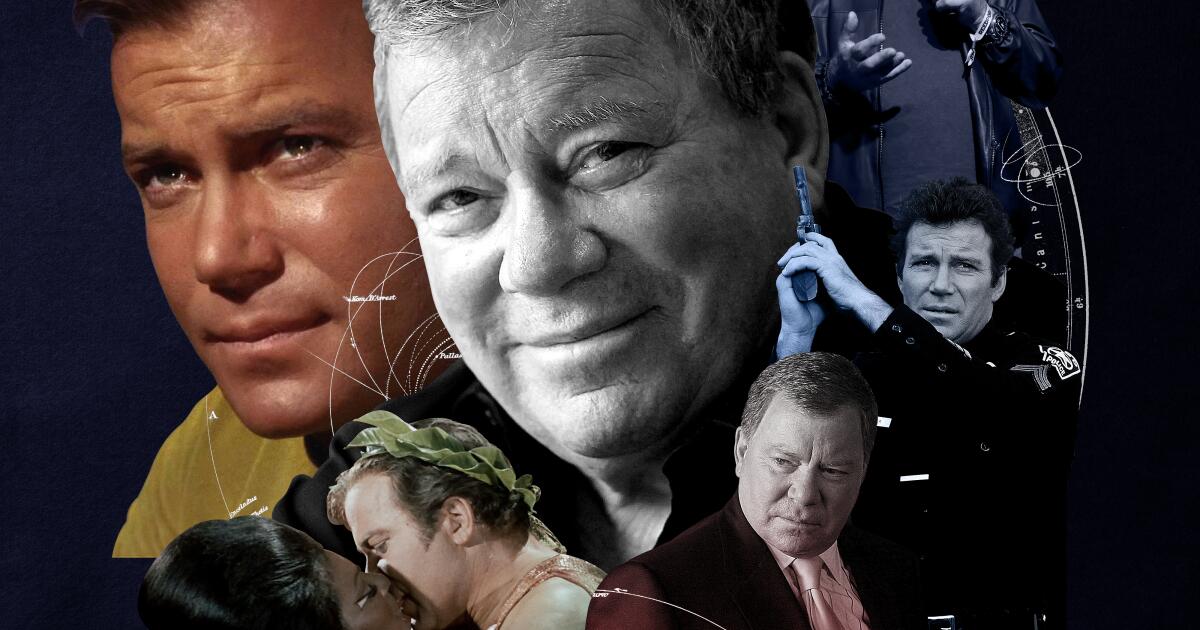
Actor, author, recording artist, equestrian, pitchman, the range of his seven-decade career — from Broadway (he won a Theater World award for “The World of Suzie Wong” in 1958), to Hollywood, Shakespeare to He-Man — has made him more than an actor in the public mind and something of a brand, or perhaps a national monument. If his role as Capt. James T. Kirk on “Star Trek” is the fixed point from which that career extends backward and forward in time, there are things to admire in Early, Middle and Late Period Shatner alike, and the more I’ve explored the farther reaches of his work, the higher I’ve come to rate him.
There is something larger than life and at the same time very human about Shatner that makes him easy to love — and people do, sincerely, even though his singular presence can invite parody. (The word “Shatneresque” fetches back some 40,000 hits on Google.) Nothing one learns about him — that he’s gone into space, that he’s in a horse breeders hall of fame, that he once auctioned a kidney stone for charity — seems at all surprising.
I spoke with Shatner over Zoom recently, regarding his latest performance as the villainous Keldor in the animated Netflix series “Masters of the Universe: Revolution,” and some of those farther reaches.
Advertisement
William Shatner at the premiere of the documentary “You Can Call Me Bill” at the 2023 SXSW festival in Austin, Texas. The film will get a theatrical release March 22.
(Frazer Harrison / Getty Images for SXSW)
How do you keep your voice so young?
Wow. Where to start? I’ve had whatever the qualities of my voice are for a long time. I studied at the Stratford, Ontario, classical company when I graduated from university. And they had voice classes there, which I attended somewhat. But your voice reflects your health. It’s a light. Listening very closely to what your voice is saying, how it’s saying. What are the gifts? I don’t know. I presume I‘m using my vocal mechanism properly from all those years of training.
Advertisement
No regimen or voice exercises?
Used to.
You used to?
Well, I was taking singing lessons, so they’d want you to do what is called solfeggio, to read music, and I wasn’t very good at it.
Reading or singing? You’ve made a lot of recordings, but you never sing.
Advertisement
No. Because I’m of the belief I can’t sing. I don’t know. It must be mental. I love music, I love the lyrics, I love everything about music and song, all its nuances. I love it all. I just can’t do it to my satisfaction, singing. But since I’ve done a lot of classical plays, I’m accustomed to the rhythm of the language, the onomatopoeia of the language. So mechanically I know how the voice operates. Classical theater wants you to do 10 sentences of Shakespeare on one breath. I can’t do that now.
In “Masters of the Universe: Revolution” you play the villain with a sense of fun, as someone who’s enjoying himself.
I think that was there in the writing — I didn’t know what to do about it, an ancient animated character. How do you look for some way to do it in a new fashion, add some character to it? I didn’t know how to make choices so I just sort of intuitively went along.
Any instructions from Robert Lloyd Kevin Smith?
He yelled “Great!” a lot.
Advertisement
In “Masters of the Universe: Revolution,” William Shatner voices Keldor.
(Netflix)
Jumping back to the beginning of your TV career, at 24 you played the title role in a 1955 production of “Billy Budd.”
I did! Canadian live television, which is where I began essentially. After Stratford I moved to Toronto and became part of that contingent. Yeah, “Billy Budd,” a wonderful play!
Advertisement
Basil Rathbone, who played Capt. Vere, was an elegant, distinguished talent. He was an Englishman and he spoke [posh English accent] veddy veddy. That’s the way he did everything, very English. So one evening as we were approaching broadcast, Basil said to me, “Are you aware we’re going to be in front of 30 million people?” I said, “yeah. “[Accented burble], that’s frightening.” And he got on the air and put his foot in a bucket, and the bucket wouldn’t come off. It was like something out of Charlie Chaplin, and we spent the first act with him thumping around on a bucket and all of us trying not to laugh. You had one shot at this thing, one performance and that’s it, goodbye. You try not to laugh, but it was very funny.
Did you ever have any ever fear onstage?
No. The fear onstage is not remembering words. Laurence Olivier apparently retired for five years from the stage because he went through that moment when he couldn’t remember the words and frightened himself to death.
But you’re young, you’re on camera, basically the lead character — that didn’t feel intimidating at all?
No. In those days, I didn’t have a fear of not remembering. But you know you go through life — now, at my age, you forget why you entered the room, or your wife’s name. That’s what’s happened to me. I’m becoming a little forgetful. That can frighten you if you’re in front of a large audience.
Advertisement
You went to New York in the great era of live television.
I was perhaps the most popular actor in live television on a certain year or two; I was in demand the most because I had this classical background; I was young and had some looks and there was nobody in America who had my experience of doing a play a week for two years. That appealed to a lot of people in live television.
That was followed by a period of filmed anthology shows and episodic TV, including “The Twilight Zone,” where you starred in two of its best-remembered episodes, “Nick of Time” and “Nightmare at 20,000 Feet.”
In one year, it went from New York City live television to everybody heading to the West Coast to do film. I’m sure historians will have an answer to why all of a sudden there was this exodus, but it happened. So everybody went west, including me, and these little shows were around; and in order to make a living, you either did a big movie, if you could get into one, that took six months to make, or you did the best you could on shows like the ones I did, in order to wait for something to come along that had more breadth to it.
A scene from 1979’s “Star Trek: The Motion Picture,” in which William Shatner, center, reprised his role as Capt. James T. Kirk.
Advertisement
(Paramount Pictures)
Right before “Star Trek,” you played a New York City prosecutor in “For the People,” an on-location series I like a lot.
I had speeches to make and meaningful words. It wasn’t, “Where do we go to next, who do we arrest?” It was meaningful to the character, which was great fun for the actor. But we came up against “Bonanza,” and we did poorly and they canceled us.
The writers in those days were playwrights. They worked in Broadway. They were tremendously talented. And when they weren’t working in the theater, they were working in live television, which was as exacting as the theater. You had to hit your mark, you had to know your lines — you had to not only know your lines but you had to be able to play with them.
Advertisement
In 1970, you starred as another prosecutor in the Civil War courtroom drama “The Andersonville Trial” for PBS, sort of a jump back to live TV. George C. Scott directed you in the role he’d played on Broadway. What was that experience like?
I’ll sum it up in one moment, and I guess it’s been unforgettable for me. So I’m interrogating a prisoner, and I’m saying, “Why did you do these terrible things? [loud, accusatory] WHY DID YOU DO THESE TERRIBLE THINGS?” So after a couple of rehearsals, George comes to me, he says, “You know, I played this part on Broadway and I played it exactly the way you’re playing it for about six months, and then the second six months I learned to try and soften the role, like it was tearing at his heart.” Saying, [softly] “Why did you do these terrible things?” I thought, “Wow, what a crowning piece of direction that is.” I became his lap dog after that.
Your best-known series were with three very different producers — Gene Roddenberry on “Star Trek,” Aaron Spelling on “T.J. Hooker” and David E. Kelley on “Boston Legal” — each with a distinct approach.
David Kelley is a genius. He won an Emmy for comedy and an Emmy for drama one year [for “Ally McBeal” and “The Practice”], and he’d written all 48, 40 shows, whatever it was. So he would write a script and it was pretty much there when he presented it. He barely ever turned up on the set; I mean, half a dozen times over five years. But he wrote these marvelous, funny scripts. And he’s worthy of worship. He is an icon.
Aaron Spelling was so personable and so charming and had so many shows on the air that I don’t think he even knew which one was on that night or not. But he was very busy. I think his charm resulted in selling a lot of shows to the networks. Gene Roddenberry had the least experience of anybody, but he must have had a fascinating talent for writing, or creating, because how “Star Trek” came up as an idea, the fulfillment of “Star Trek” as a drama, the things that went on in production that you wouldn’t have believed was a lot to do with Gene Roddenberry. Gene was more of an everyday man. He was more the policeman, the airline pilot that he had been prior to being a writer. So there were a lot more shaded areas in Gene than anybody else.
Advertisement
William Shatner, left, with James Spader in “Boston Legal,” the David E. Kelley dramedy that starred the two actors and ran from 2004 to 2008 on ABC.
(Danny Feld / ABC)
When you got the part of Denny Crane in “Boston Legal,” did you expect to have another great role at that point in your career?
I just don’t recognize these miraculous things that happen. Denny Crane, it started off with Kelley writing this character, his having been a great lawyer and now he can’t remember very well — it’s not dissimilar to actors like we were talking about, not going onstage for five years. Fear. “Have I lost my talent?” I kept that in mind all the time. And the other thing that gave me great joy, his constant repetition of his name to me was like lizards flicking their tongue out — we know that their flicking their tongue out is their assessing their surroundings. So it’s a matter of “Who’s out there? What’s out there?” “Denny Crane, Denny Crane, Denny Crane”— flicking his tongue out to see what the reaction was. “Oh, Denny Crane, you were so wonderful!” I mean, I’m home. “Denny Crane, weren’t you the guy caught up in” — uh oh, I’d better leave now.
Advertisement
When did your relationship with horses begin? Was it on a television show?
I’d gone on and off a horse literally within a half hour when I was 12 years old, a rental horse; and my mother said, “Where did you learn to do that?” Because I was doing really well. I came to the mystical conclusion that in our DNA — ‘cause I’ve just been inducted into the [American Road Horse & Pony Assn.] Hall of Fame for breeding, breeders of American Saddlebreeds saddlebreds. You can breed for characteristics, and with some luck in three or four generations you might be able to get that characteristic you’re aiming at, or weed that one out. So I think, obviously, the same thing happens to human beings. We have in our DNA characteristics we’re not aware of. I think one of them for me was horses; somebody in my background dealt with horses a lot and then when I came upon a horse, “Wow, that’s my destiny.” I have lots of horses.
Are there things that you can get from a horse that you can’t get from a human?
You can get kicked. The thing about a horse — I’ve run a charity event for the last 35 years called the Hollywood Charity Horseshow and we draw in about $500,000 a year; over the years many millions of dollars have been put into children and into veterans, who have not dissimilar problems. I saw a thalidomide baby on a horse, no arms, one leg, grasping the reins with her toes, and I decided to do a horse show right then and there, helping kids like that and veterans coming back with [disabilities]. The horses allow the kids to talk when they wouldn’t talk, allowed veterans to move when they wouldn’t move. The horse in its size makes somebody feel better than before they got on the horse. You can move around, you can go where you want, high up. That’s what horses have.
William Shatner, center, with Audrey Powers, left, and Chris Boshuizen, when the actor took a space flight on a Blue Origin rocket in 2021. “I think that’s probably my best characteristic. I’m very curious about people and how events are made,” he says.
Advertisement
(LM Otero / Associated Press)
You hosted a couple of interesting interview shows, “William Shatner’s Raw Nerve” and “William Shatner’s Brown Bag Wine Tasting,” on which your guests included people from ordinary life — a butcher, a cheese monger, a magician, a cosplayer.
Discovery, discovering what they did, discovering their personal life, how they did it, why they did it. I said, I want anybody off the street walking by and let them spend 15, 20 minutes with me. They got me a kid from the streets who sold dope, and we talked about selling dope. I said, “I’ve got a horse show on this Sunday. You want to come?” He said, “Yeah, can I bring my kid”? So there was this young man who was trying to make it in this world bringing his 3-year old, 2-year-old baby to a horse show, and they’d never seen horses.
Is it fair to say you’re a person who’s driven by curiosity?
Advertisement
I think that’s probably my best characteristic. I’m very curious about people and how events are made. I’m designing a watch right now. What is time? We ask yourselves that question. [Quietly] What is time? [More quietly] What is time?
I’m designing a watch — I’ve got a watch out there now that I’ve already designed — and the concept is “Where does time go?” I’ve been looking, and searching my brain — where does time go? And I came across a coin that doesn’t look like a coin, it looks like a 3,500-year-old depiction of the skies. It’s made of blue, I don’t know what it is, azure of some kind, and gold, and that’s going to be the face of the watch. So we’ve got a watch trying to answer the question, “Where does time go?”
In a roundabout way, the fact that I don’t have a strong attachment to The Wizard of Oz as a film (my late mother loved it, so that memory is deeply rooted in me, but the movie itself never did much for me) contributed directly to how amusing I found Gail Daughtry and the Celebrity Sex Pass to be. This comedy spoofs the plot of the classic fantasy movie, though the jokes are largely about Hollywood. The humor is big and broad, with some of the jokes really landing. Others? Not so much. Still, more than enough do to warrant a recommendation.
Gail Daughtry and the Celebrity Sex Pass gets a lot of mileage out of sending up show business, even if the observations, while funny, are not particularly new. Besides the deluge of jokes, there’s also a lot of likably broad characters to spend time with, especially our lead. They make the 90 minutes and change spent together with them go down very easy.
Sony Pictures Classics
For Gail Daughtry (Zoey Deutch), her life as a small town hairdresser is perfect. Engaged to her high school sweetheart Tom (Michael Cassidy), she’s the picture of happiness, at least until a trip to a celebrity book signing. There, Tom meets and ends up sleeping with his “celebrity pass,” a term Gail wasn’t even really previously aware of. Feeling betrayed, Gail impulsively joins her co-worker and friend Otto (Miles Gutierrez-Riley) on a trip to Los Angeles. There, a psychic convinces her that the can save her marriage by sleeping with her own celebrity pass: Jon Hamm (Jon Hamm).
Journeying through Tinseltown in a manner that recalls Dorothy’s adventure in Oz, Gail and Otto won’t have to find Hamm alone. Joining forces with talent agency assistant Caleb (Ben Wang), down on his luck paparazzo Vincent (Ken Marino), and actor John Slattery (John Slattery). As they search for Hamm, some for their own purposes, they meet other celebrities, while also being hunted by a group of Italian assassins after a case of mistaken identity. Eventually, they come across Hamm, and the moment of truth is at hand.
Sony Pictures Classics
Zoey Deutch dives headfirst into a broad comedy like this, absolutely relishing the opportunity to get silly again. She’s able to make Gail a babe in the woods but also someone you laugh with, not at. It’s a wildly enjoyable turn. Deutch started out in comedies and was always a talented comedic actress, so it’s a pleasure to watch her back at it. Miles Gutierrez-Riley and Ben Wang get some very funny moments, while Ken Marino is a reliable comic presence. Jon Hamm and John Slattery are delighted to be sending up themselves, with amusing results. Supporting players here, in addition to Michael Cassidy, also include Kerri Kenney, Richard Kind, Thomas Lennon, Joe Lo Truglio, Fred Melamed, and more, plus some cameos.
Advertisement
Filmmaker David Wain, again co-writing with Ken Marino, continues to make it look easy. Few can make a silly comedy like Marino and Wain, especially as they pack their flicks with extra bits that only subsequent viewings reveal. Is Gail Daughtry and the Celebrity Sex Pass on the same level as Wet Hot American Summer or They Came Together? No, not quite. At the same time, is this, scattershot approach and all, funnier than most other 2026 releases? You bet. Marino and Wain have a hit rate that allows some of the jokes to miss, as you only have seconds to wait before the next one, which probably will hit.
Gail Daughtry and the Celebrity Sex Pass is very amusing, and occasionally hilarious, even if not as many jokes land as you might expect. Zoey Deutch is great in the lead role, David Wain is in his comfort zone, and the laughs come hot and heavy. If you’re a Wain fan, this new movie should be a must see.
Right now in Los Angeles it’s Wes Week, with multiple tributes to the career of filmmaker Wes Anderson, known for his fastidious visual style, melancholy longing and nerd-chic aesthetic.
On Monday night there was a sold-out 30th anniversary screening of Anderson’s debut feature, “Bottle Rocket,” at the Academy Museum with the filmmaker making a rare in-person L.A. appearance. He sat for a warmly endearing Q&A with actor Luke Wilson and director James L. Brooks, an early champion who executive-produced.
Then on Friday, Saturday and Sunday, the Hollywood Bowl will have three nights celebrating the music of Anderson’s films, hosted by the director’s 10-time fixture, Bill Murray. Among those scheduled to perform are Beck, Jenny Lewis, Karen O, Rufus Wainwright and Devo, among many more. Other surprise guests may appear as well, performing songs familiar from Anderson’s music-stuffed movies.
“I was surprised how many things we did have to leave out,” Anderson, 57, tells The Times in a recent interview conducted via voice notes (his personal preference) recorded from Paris, where he has long lived. “There’s so much music over all these movies because I’ve been doing them for so long. We could do a whole other round of this, but let’s see how it goes on this first one.”
Because of his unique use of music, combining left-field vintage pop songs with classical pieces and original scores by favored composers Alexandre Desplat and Devo’s Mark Mothersbaugh, there have been frequent requests over the years for live performances, but Anderson and his longtime music supervisor Randall Poster have always declined — up until now and this ambitious three-night event at the Bowl.
Advertisement
“From the moment that he said yes we’ve been on the phone talking about his vision and how to execute it,” says Johanna Rees, vice president of programming and creative partnerships at the L.A. Phil, during a recent call from San Diego. “It’s about exploring and celebrating so many styles of music. It’s been such a fun adventure.”
Kara Hayward and Jared Gilman in Wes Anderson’s 2012 movie “Moonrise Kingdom.”
(Focus Features)
This will be more than a typical evening at the Bowl, with dedicated Anderson-branded merchandise and uniformed bicycle riders dispensing candy. “The plan is you walk into the Hollywood Bowl and you are immersed in the world of Wes Anderson,” Rees says.
Advertisement
Criterion, which has long put out high-end home video editions of Anderson’s work and recently issued a 20-disc box set, will also have a special presence at the Bowl. Alongside the popular Criterion Mobile Closet making another stop in L.A., there will also be a lounge, a listening booth and a screening room showing Anderson’s movies as well as ones curated by him, including “Yojimbo,” “Amarcord” and “Belle de Jour.”
“Wes is an amazing community-builder as a human being,” said Peter Becker, president of Criterion, in a video call from the Il Cinema Ritrovato Festival in Bologna, Italy. “If you look at his films and the people he’s been working with consistently, we’re not the only ones who’ve been part of the greater Wes Anderson family for the last 25-plus years. How could we not be a part of this?”
From left, Jason Schwartzman, Adrien Brody and Owen Wilson in the movie “The Darjeeling Limited.”
(Fox Searchlight Pictures)
Music supervisor Poster met Anderson in 1996 at L.A.’s Original Farmers Market shortly after “Bottle Rocket” was finished and immediately began to assist in pulling together the soundtrack release. Though the CD at the time could not include some of the key songs from the movie, these Bowl events will finally offer a flexi-disc of the Rolling Stones’ “2000 Man” as well as a limited-edition yellow vinyl 12-inch record with two songs by the band Love.
Advertisement
The two have worked together on all of Anderson’s films since, with a process that is constantly developing.
“Sometimes we’ve been talking about it even before the film takes shape,” says Poster on a recent phone call from New York. “We get to that point where I feel informed to a certain degree, that we’ve identified an element or two, whether it’s a composer, a specific song, a specific band that allows us to sort of start weaving it together. Sometimes we have more details, and sometimes we’re in a little bit more of a process of discovery.”
As impeccably detailed as his movies can be, Anderson acknowledges that his method can still be a bit vague. “I really couldn’t tell you what it’s all about, where it came from or why,” he says. “It’s just totally instinctive.”
One of the most indelible moments in Anderson’s repertoire is Gwyneth Paltrow’s slow-motion exit from a bus in “The Royal Tenenbaums” to the sounds of Nico’s 1967 recording of the song “These Days,” perfectly capturing a tender, delicate rush of emotions.
“That music was part of the inspiration for the entire movie,” Anderson recalls. “There’s a Ravel string quartet in F Major and this song — those two things together, for whatever reason, suggested something to me that slowly became the whole movie. With Gwyneth Paltrow coming off of the bus, we played the music on the set. It was all a bit choreographed to that.”
Advertisement
“Everybody wanted to do ‘These Days,’ ” says Poster of the artists lined up for this weekend’s shows. “But Jackson Brown wrote ‘These Days’ and Jackson Brown is going to perform ‘These Days.’ Nobody could really argue with that one.” (The rest of the song choices and performers are being kept under wraps.)
Ben Stiller, left, Gwyneth Paltrow and Gene Hackman in the 2001 movie “The Royal Tenenbaums.”
(James Hamilton / Touchstone Pictures)
In choosing music for the movies, inspiration can strike from just about anywhere, as with the Johnny Duncan and the Blue Grass Boys’ recording of “Last Train From San Fernando,” memorable from the opening credits of 2023’s “Asteroid City.”
“I knew that song because my daughter used to listen to it,” says Anderson. “She had a CD of western swing from the ’50s and ’40s that she was listening to again and again. So I stole it from her.”
Advertisement
Poster mentions Anderson’s affinity for woodwinds and novelty instruments along with his tremendous sense of rhythm, which is why the music often has a strong percussive feel, from Gene Krupa’s “Drum Boogie” in last year’s “The Phoenician Scheme” to Japanese taiko drums and the work of composer Peter Jarvis.
“I would say that I think the biggest change is that Wes has taught himself how to read music,” says Poster. “He just really gets into the score’s DNA and really has a great insight into how to arrange thematic pieces that I think help make the movies more wholesome, just being a whole thing.”
Poster playfully refers to Anderson as “The Maestro” and remains struck by how fresh the music cues feel in the context of the films.
“When those clips come on — ‘Here Comes My Baby,’ ‘A Quick One, While He’s Away,’ ‘These Days,’ ‘Needle in the Hay,’ ‘Ooh La La’ — I mean, countless, countless, I always get a kick out of it.”
All of which should add up to a special alchemy at the Bowl.
Advertisement
“They won’t happen again,” says Rees of the three nights curated by Anderson. “Not knowing what he’s going to do in the future, but certainly this is a special event, a one-of-a-kind weekend. It won’t be happening like this again.”
For Anderson, putting together the Hollywood Bowl shows has been a reminder of how far his work has evolved.
“When we made ‘Bottle Rocket,’ I didn’t intend to have an original score at all,” he remembers. “We had some Ennio Morricone music. We put Bob Dylan’s ‘Pat Garrett and Billy the Kid’ in the movie originally — and that’s a score from somebody else’s movie. At a certain point everything sort of changed, and Mark Mothersbaugh came and saw the movie and he liked everything we had in there. And so he brought his own voice in, but from the point of view of somebody who was very sympathetic to what was already in place, and that led to more movies together.”
Showing a bit of his own trademark wistfulness, he adds, “It is quite an amazing thing to have Mark and Devo coming up on the stage to do this music that reflects back on all these years — this whole gathering.”
Supergirl Director: Craig Gillespie DC Studios, Troll Court Entertainment, The Sagan Company In theaters: 06.26.2026
I was a pretty big fan of James Gunn’s Superman. Building up to the release of the film, I relapsed into my comic book obsession, which I had laid to rest many years prior. I read whatever you get recommended when you look up “Superman comic recommendations:” For All Seasons, All Star, Birthright — whatever, you don’t care. David Corenswet’sportrayal of Big Blue was loving, thorough and unbelievably human, which is what Superman is (he’s not Jesus). He is the best of us. He is what we aspire to be.
Supergirl was announced, and I picked up the comic it was based on: Supergirl: Woman of Tomorrow. The questionable morals and talent of author Tom King aside, the book is good! The fantastic art by Bilquis Evely makes King’s (sometimes preachy) prose this beautiful and somber story about trauma and war. It appears that I’m ahead of director Craig Gillespie, who reportedly didn’t read the book and, boy, does it show.
Advertisement
During a bender, Superman’s cousin Kara (Milly Alcock, House of The Dragon)meets Ruthye (Eve Ridley), a child whose family is murdered by Krem (Matthias Schoenaerts, Amsterdam, The Old Guard), the leader of a raider group. She enlists Kara to hunt and kill him, and on their way, they confront their traumas.Kara faces Krem, the films antagonist, retold as an all-powerful kryptonite wielding brute. Photo courtesy: DC Studios.
Every change made from the original comic was for the worse. Most notably, this film simplifies the depth of the comic’s characters. Kara is reduced to a loud, charming alcoholic, which is fine, but in the comic, she’s somber and reflective, making an effort to teach Ruthye how the greater universe works. The antagonist, Krem, is sort of a loser in the comic. He’s a coward who spends his time running away, while in the film he’s a tattooed, pierced, menacing psychopath who appears in almost every major action sequence. He’s almost indistinguishable from The Joker — this all boils down to shame. While they’re becoming increasingly popular, comics are still for losers. Hinting at depth with characters who fly and shoot lasers from their eyes in brightly colored underpants isn’t something that a general audience will accept. They will accept a comic film so long as it constantly flogs itself for being comic-inspired.
Another bastardization is the look of this film. Everly’s amazing use of color in the comic makes the story so engaging. How is this translated? Brown. Just brown. When characters clash, it looks like someone’s wiping their finger across their dirt-covered lens, which is a total departure from Gunn’s fantastic color palette in Superman. The visual effects appear to be rushed and often look horrible — laughably horrible, as a matter of fact. How do you spot a bad action director? Look at the editing. If they have to hide poor action choreography and bad visual effects behind dizzying amounts of cuts, they’re bad. Gillespie is a bad action director. James Gunn promised that the DCU would prioritize artist voice over universal coherence, but if these are the artists he’s hiring, I’m not sure how long this could last.
Performances here are whatever. Alcock could have been good if the script and direction were right, but they’re not. I couldn’t get into Krem due to character assassination, but even if I wasn’t into the comic, I would find his performance as a crazy guy to be a standard for bad superhero movies. Ridley is good, especially for a debut in feature films, but the standout is Jason Momoa (Aquaman, A Minecraft Movie) as Lobo. He is loving the character, absolutely chewing up the scene with thick cigars. He’s a little cheesy-edgy, but that’s just what he is in the comics, so I won’t knock him for it.
While I was watching the film, I was suffering from a discrepancy. Supergirl is as powerful as Superman, but throughout this film, she doesn’t use her powers to their full potential. Something I actually loved about Superman is how much he got his ass kicked. Gunn was out to prove that Superman fights can have stakes — that he’s not just undefeatable and therefore boring as everyone says. Gunn’s ability to create ways to kill the Man of Steel without Kryptonite is amazing! Kara, in this film, is fighting space pirates and constantly forgets to finish the fight. It’s frustrating because the remedy to this in the comic is that they don’t see Krem until the last couple of issues, but in this film, Krem keeps showing up to menace Supergirl, and most of the time she has her powers.
Advertisement
I could ramble about how bad the dialogue can be, how derivative and uninspired it is or whatever lame comic thing I can talk about, but I’ll spare you. Here’s the moral of all this: Comic books are a valid storytelling medium. I recall recommending Alan Moore’sWatchmen to someone and being told that they have more important things to read. Watchmen is one of my favorite works of fiction. I did end up falling out of love with comics because I was told they were childish and I had grown bored of having costumes thrust into my peripherals all the time, but I’m back now, and I love them so much more than ever. I loved Superman because, above all else, it was earnest. There wasn’t a self-deprecatory tone toward its own plot. It didn’t try to bog its drama down with one-liners. It was just proud to be a comic book movie, and I think more movies should.
If you want to see Supergirl, go ahead, but I’d advise you to just read the comic, which is more dramatic, more meaningful and more impactful. —B. Allan Johnson
Read more reviews from B. Allan Johnson below: Film Review: The Bride! Film Review: Backrooms
Advertisement
Do you enjoy SLUG’s film reviews? Consider becoming one of our donors!




 Sony Pictures Classics
 Sony Pictures Classics


