Entertainment
'Wicked' and 'Gladiator II' jolt the box office with a combined $170 million

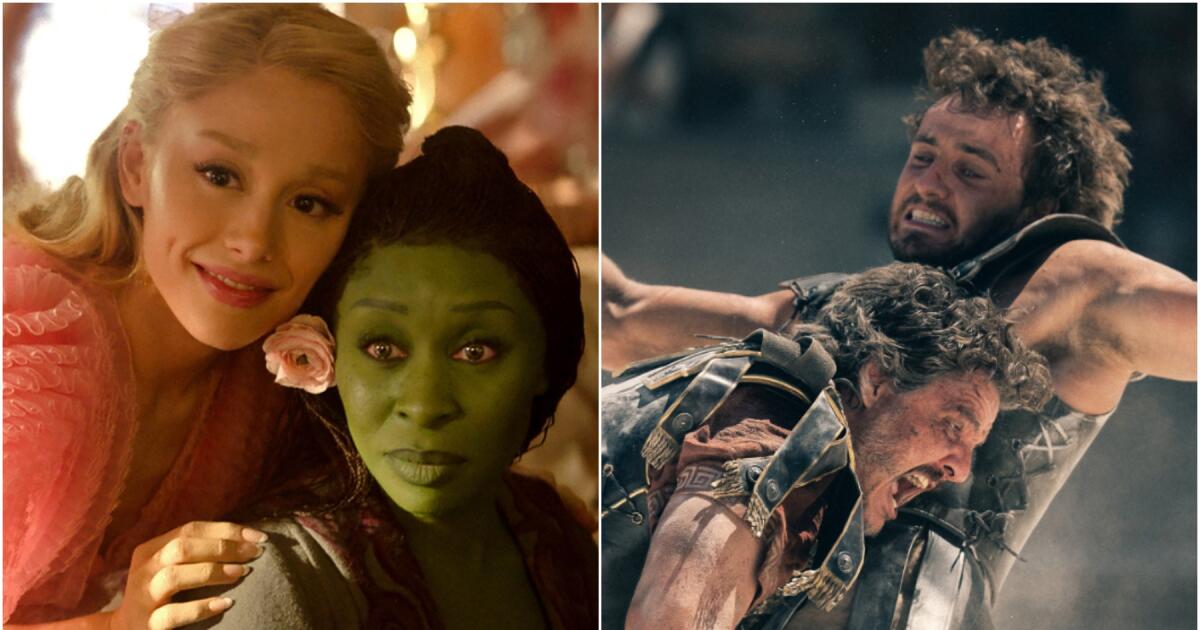
Universal Pictures’ “Wicked” needed no lessons in how to be popular at the domestic box office this weekend, opening at No. 1 to the tune of $114 million, according to studio estimates.
That’s the highest opening ever for a film based on a Broadway musical, way ahead of 2014’s “Into the Woods” ($31 million). “Wicked” smashed the same record globally, bringing in a total of $164.2 million and surpassing 2012’s “Les Misérables” ($103 million).
In second place this weekend was Paramount Pictures’ “Gladiator II,” which launched at $55.5 million in the United States and Canada — the biggest domestic opening ever for an R-rated film released in November, not adjusted for inflation.
Jon M. Chu’s adaptation of the first act of Winnie Holzman and Stephen Schwartz’s hit Broadway musical fell slightly short of recent analyst expectations in the $120-million to $140-million range, falling closer to the studio’s more modest pre-release projection of $110 million.
“Wicked” cost an estimated $150 million to make, not counting marketing.
Meanwhile, the legacy sequel to Ridley Scott’s early-aughts best picture winner came in lower than both analyst and studio projections, which ranged from $60 million to $75 million. The film had a pre-marketing budget of $250 million.
Still, the solid performances of both movies are an early, much-needed holiday gift to the movie theater industry, which has suffered a disappointing autumn thanks to critical and commercial flops such as Warner Bros.’ “Joker: Folie à Deux” and Amazon MGM Studios’ “Red One.”
“It couldn’t have come at a better time,” said Paul Dergarabedian, senior media analyst at Comscore.
“What’s happening right now is the perfect recipe for success for movie theaters heading into 2025,” he added. “It’s how you finish the race, right?”
Rounding out the top five at the domestic box office this weekend were “Red One,” which grossed $13.28 million in its sophomore weekend for a North American total of $52.91 million; Angel Studios’ “Bonhoeffer: Pastor. Spy. Assassin,” which debuted at $5.12 million; and Sony Pictures’ “Venom: The Last Dance,” which devoured $4 million in its fifth outing for a total of $133.83 million, according to estimates from measurement firm Comscore.
“On behalf of the people who operate movie theatres around the world, congratulations to our studio partners and the creative community for one of the most successful November weekends ever at the box office,” said Michael O’Leary, president of the National Assn. of Theatre Owners, in a statement.
“This is a tremendous catalyst for a strong box office going into December and the new year,” he said.
Arriving 21 years after its source material took Broadway by storm, “Wicked” stars Ariana Grande as Glinda, the Good Witch of the North, and Cynthia Erivo as Elphaba, the Wicked Witch of the West, before Dorothy and friends followed the yellow brick road to the Emerald City. The highly anticipated reframing of “The Wizard of Oz” also counts Jeff Goldblum, Jonathan Bailey, Marissa Bode and Michelle Yeoh among its principal cast.
The movie’s ubiquitous rollout was fueled by an aggressive marketing campaign that saw Universal partner with 400 brands worldwide — including Starbucks, Ulta Beauty, Bloomingdales and Target — to paint the shelves Glinda pink and Elphaba green.
“Wicked” also benefited from mostly positive reviews hyping the performances of its leading sorceresses. The film received a 90% rating on review aggregation site Rotten Tomatoes, and a A grade from audiences polled by CinemaScore. The audience skewed heavily female. Women accounted for 72% of the domestic opening weekend box office.
Jim Orr, head of domestic distribution at Universal Pictures, was particularly glad that “Wicked” seems to be playing pretty evenly across the country — not just over-performing in coastal regions that tend to see more traffic.
“To see certain markets like Nashville and Salt Lake City over-index like they are is very gratifying,” Orr said.
“Very encouraging to a long, healthy run at the domestic box office.”
It’s a big win for Universal and its leader Donna Langley, who was recently elevated to chair of NBCUniversal Entertainment & Studios. The Comcast-owned studio has often bet big on the musical movie genre — sometimes to great success (“Mamma Mia!” and “Les Misérables”) and other times to disastrous results (“Cats,” “Dear Evan Hansen”).
“The history of box office is littered with musicals that failed,” Dergarabedian said.
In an effort to evade the curse of the movie musical, some studios have recently concealed the show tunes when promoting titles such as Paramount’s “Mean Girls” or Warner Bros.’ “Wonka.” But this strategy has been known to backfire, and “Wicked” took the opposite approach.
“The marketing team [behind ‘Wicked’] did a fantastic job of embracing wholeheartedly — as they should — the musical aspects of this,” Dergarabedian added.
“This is a huge result for the genre and sets the bar really high.”
“Wicked Part Two,” covering the second act of the stage production, is scheduled to bow next year.
Also new to domestic theaters this weekend was “Gladiator II,” which stars Paul Mescal, Pedro Pascal and Denzel Washington as dueling warriors and emperors of ancient Rome. Rounding out the main cast of the bloody historical drama are Joseph Quinn and Connie Nielsen.
The long-awaited “Gladiator” follow-up drew mixed-to-positive reviews, receiving a 71% rating on Rotten Tomatoes and a B grade from audiences polled by CinemaScore.
“The fact that we were 52% under [the age of] 35 shows that we tapped into a new audience for the film, and not just in service of the legacy audience,” said Chris Aronson, head of domestic distribution at Paramount Pictures.
“That’s very heartening … of the film itself, of our marketing efforts and of its playability.”
The next major studio entry is Disney’s “Moana 2,” which opens in wide release the Wednesday before Thanksgiving.



Movie Reviews
‘Greenland 2: Migration’ Review: Gerard Butler in a Post-Apocalyptic Sequel That’s Exactly What You Expect

Desperate migrants are forced to leave Greenland after a malevolent force makes their island uninhabitable. No, it’s not tomorrow’s headline about Donald Trump, but rather the sequel to Ric Roman Waugh’s 2020 post-apocalyptic survival thriller. That film starring Gerard Butler and Morena Baccarin had the misfortune of opening during the pandemic and going straight to VOD. Greenland 2: Migration (now there’s a catchy title) has the benefit of opening in theaters, but it truly feels like an unnecessary follow-up. After all, how many travails can one poor family take?
That family consists of John Garrity (Butler), whose structural engineering skills designated him a governmental candidate for survival in the wake of an interstellar comet dubbed “Clarke” wreaking worldwide destruction; his wife Allison (Baccarin); and their son Nathan (now played by Roman Griffin Davis). At the end of the first film, the clan had endured numerous life-threatening crises as they made their way to the underground bunker in Greenland where survivors will attempt to make a new life.
Greenland 2: Migration
The Bottom Line It’s the end of the world as we know it…again.
Release date: Friday, January 9
Cast: Gerard Butler, Morena Baccarin, Roman Griffin Davis, Amber Rose Revah, Sophie Thompson, Trond Fausa Aurvag, William Abadie
Director: Ric Roman Waugh
Screenwriters: Mitchell LaFortune, Chris Sparling
Rated PG-13,
1 hour 38 minutes
Five years later, things aren’t going so well. Fragments of the comet continue to rain down on the planet, causing catastrophic destruction. The contaminated air prevents people from going outside, and resources are becoming increasingly scarce. But there are some plus sides, such as the bunker’s inhabitants still being able to dance to yacht rock.
When their safe haven in Greenland is destroyed, the Garritys, along with a few other survivors, are forced to flee. Their destination is France, where there are rumors of an oasis at the comet’s original crash site. And at the very least, the food is bound to be better.
It’s a perilous journey, but anyone who saw the first film knows what to expect. The Garritys, along with the bunker’s Dr. Casey (Amber Rose Revah), run into some very bad people, undergoing a series of life-threatening trials and tribulations.
Unfortunately, while the thriller mechanics are reasonably well orchestrated by director Waugh (Angel Has Fallen, Kandahar) in his fourth collaboration with Butler, Greenland 2: Migration feels as redundant as its title. While the first film featured a relatively original premise and some genuine emotional dynamics in its suspenseful situations, this one just feels rote. And while it’s made clear that the crisis has resulted in people resorting to cutthroat, deadly means to ensure their survival, the Garritys have it relatively easy. All John has to do is adopt a puppy-dog look, put a pleading tone in his voice, beg for his family’s help, and people inevitably comply.
To be fair, the film contains some genuinely arresting scenes, including one set in a practically submerged Liverpool and another in a dried-up English Channel. The latter provides the opportunity for a harrowing sequence in which the family is forced to cross a giant ravine on a treacherously fragile rope ladder.
Butler remains a sturdy screen presence, his Everyman quality lending gravitas to his character. Baccarin, whose character serves as the story’s moral conscience (early in the proceedings she spearheads a fight to open the shelter to more refugees despite the lack of resources, delivering a not-so-subtle message), more than matches his impact. William Abadie (of Emily in Paris) also makes a strong impression as a Frenchman who briefly takes the family in and begs them to take his daughter Camille (Nelia Valery de Costa) along with them.
Resembling the sort of B-movie fantasy adventure, with serviceable but unremarkable special effects, that used to populate multiplexes in the early ‘70s, Greenland 2: Migration is adequate January filler programming. The only thing it’s missing is dinosaurs.
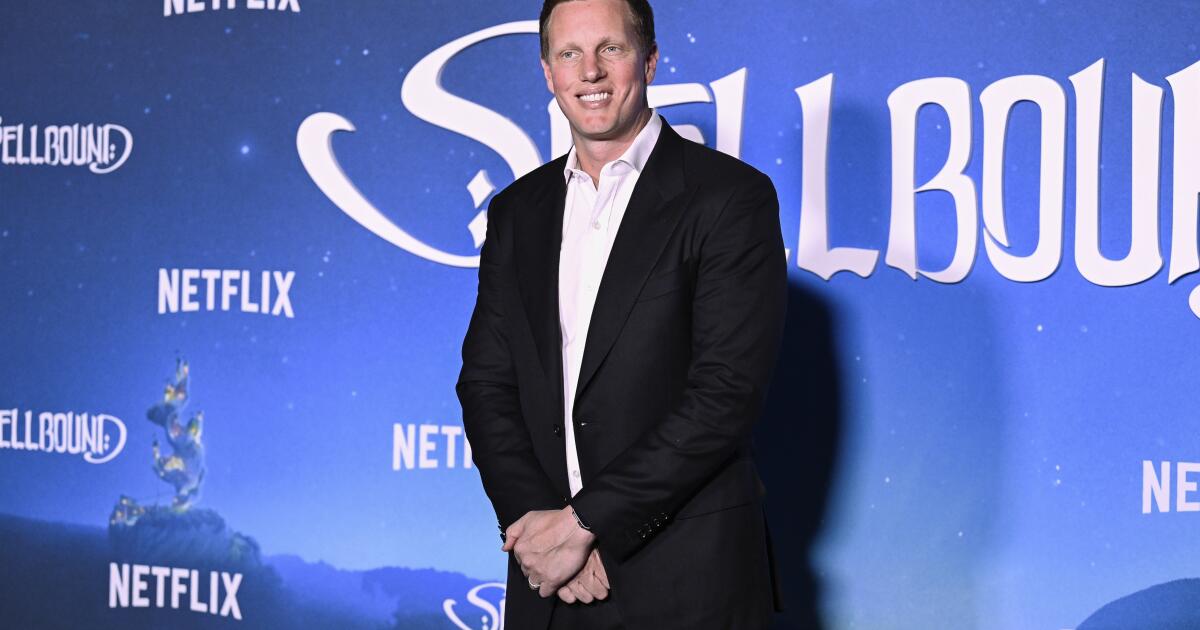
Paramount is staying the course on its $30-a-share bid for Warner Bros. Discovery, again appealing directly to shareholders.
The move comes after Warner Bros. Discovery’s board voted unanimously this week to reject Paramount’s revised bid, in which billionaire Larry Ellison agreed to personally guarantee the equity portion of his son’s firm’s financing package.
Paramount Skydance, in a Thursday statement, sidestepped Warner’s latest complaints about the enormous debt load that Paramount would need to pull off a takeover. Paramount instead said the appeal of its bid should be obvious: $30 a share in cash for all of Warner Bros. Discovery, including its large portfolio of cable channels, including CNN, HGTV, TBS and Animal Planet.
Warner board members have countered that Netflix’s $27.75 cash and stock bid for much of the company is superior because Netflix is a stronger company. Warner also has complained that it would have to incur billions in costs, including a $2.8-billion break-up fee, if it were to abandon the deal it signed with Netflix on Dec. 4.
The streaming giant has agreed to buy HBO, HBO Max and the Warner Bros. film and television studios, leaving Warner to spin off its basic cable channels into a separate company later this year.
The murky value of Warner’s cable channel portfolio has become a bone of contention in the company’s sale.
“Our offer clearly provides WBD investors greater value and a more certain, expedited path to completion,” Paramount Chief Executive David Ellison said in Thursday’s statement. Paramount said it had resolved all the concerns that Warner had raised last month, “most notably by providing an irrevocable personal guarantee by Larry Ellison for the equity portion of the financing.”
Paramount is gambling that Warner investors will evaluate the two offers and sell their shares to Paramount. Stockholders have until Jan. 21 to tender their Warner shares, although Paramount could extend that deadline.
The Netflix transaction offers Warner shareholders $23.25 in cash, $4.50 in Netflix stock and shares in the new cable channel company, Discovery Global, which Warner hopes to create this summer.
Comcast spun off most of its NBCUniversal cable channels this month, including CNBC and MS NOW, creating a new company called Versant. The result hasn’t been pretty. Versant shares have plunged about 25% from Monday’s $45.17 opening price. On Thursday, Versant shares were selling for about $32.50. (Versant has said it expected volatility earlyon as large index funds sold shares to rebalance their portfolios).
Paramount has argued that fluctuations in Netflix’s stock also reduces the value of the Netflix offer.
“Throughout this process, we have worked hard for WBD shareholders and remain committed to engaging with them on the merits of our superior bid and advancing our ongoing regulatory review process,” Ellison said.
Paramount is relying on equity backing from three Middle Eastern sovereign wealth funds, including Saudi Arabia. It turned to Apollo Global for much of its debt financing. Warner said this week that Paramount’s proposed $94 billion debt and equity financing package would make its proposed takeover of Warner the largest leveraged buyout ever.
Amid the stalemate, Paramount and Warner stock held steady. Paramount was trading around $12.36, while Warner shares are hovering around $28.50 on Thursday.
Movie Reviews
Movie Review: A real-life ’70s hostage drama crackles in Gus Van Sant’s ‘Dead Man’s Wire’

It plays a little loose with facts but the righteous rage of “Dog Day Afternoon” is present enough in Gus Van Sant’s “Dead Man’s Wire,” a based-on-a-true-tale hostage thriller that’s as deeply 1970s as it is contemporary.
In February 1977, Tony Kiritsis walked into the Meridian Mortgage Company in downtown Indianapolis and took one of its executives, Dick Hall, hostage. Kiritsis held a sawed-off shotgun to the back of Hall’s head and draped a wire around his neck that connected to the gun. If he moved too much, he would die.
The subsequent standoff moved to Kiritsis’ apartment and eventually concluded in a live televised news conference. The whole ordeal received some renewed attention in a 2022 podcast dramatization starring Jon Hamm.
But in “Dead Man’s Wire,” starring Bill Skarsgård as Kiritsis, these events are vividly brought to life by Van Sant. It’s been seven years since Van Sant directed, following 2018’s “Don’t Worry, He Won’t Get Far on Foot,” and one of the prevailing takeaways of his new film is that that’s too long of a break for a filmmaker of Van Sant’s caliber.
Working from a script by Austin Kolodney, the filmmaker of “My Own Private Idaho” and “Good Will Hunting” turns “Dead Man’s Wire” into not a period-piece time capsule but a bracingly relevant drama of outrage and inequality. Tony feels aggrieved by his mortgage company over a land deal the bank, he claims, blocked. We’re never given many specifics, but at the same time, there’s little doubt in “Dead Man’s Wire” that Tony’s cause is just. His means might be desperate and abhorrent, but the movie is very definitely on his side.
That’s owed significantly to Skarsgård, who gives one of his finest and least adorned performances. While best known for films like “It,” “The Crow” and “Nosferatu,” here Skarsgård has little more than some green polyester and a very ’70s mustache to alter his looks. The straightforward, jittery intensity of his performance propels “Dead Man’s Wire.”
Yet Van Sant’s film aspires to be a larger ensemble drama, which it only partially succeeds at. Tony’s plight is far from a solitary one, as numerous threads suggest in Kolodney’s fast-paced script. First and foremost is Colman Domingo as a local DJ named Fred Temple. (If ever there were an actor suited, with a smooth baritone, to play a ’70s radio DJ, it’s Domingo.) Tony, a fan, calls Fred to air his demands. But it’s not just a media outlet for him. Fred touts himself as “the voice of the people.”
Something similar could be said of Tony, who rapidly emerges as a kind of folk hero. As much as he tortures his hostage (a very good Dacre Montgomery), he’s kind to the police officers surrounding him. And as he and Dick spend more time together, Dick emerges as a kind of victim, himself. It’s his father’s bank, and when Tony gets M.L. Hall (Al Pacino) on the phone, he sounds painfully insensitive, sooner ready to sacrifice his son than acknowledge any wrongdoing.
Pacino’s presence in “Dead Man’s Wire” is a nod to “Dog Day Afternoon,” a movie that may be far better — but, then again, that’s true of most films in comparison to Sidney Lumet’s unsurpassed 1975 classic. Still, Van Sant’s film bears some of the same rage and disillusionment with the meatgrinder of capitalism as “Dog Day.”
There’s also a telling, if not entirely successful subplot of a local TV news reporter (Myha’la) struggling against stereotypes. Even when she gets the goods on the unspooling news story, the way her producer says to “chop it up” and put it on air makes it clear: Whatever Tony is rebelling against, it’s him, not his plight, that will be served up on a prime-time plate.
It doesn’t take recent similar cases of national fascination, such as Luigi Mangione, charged with killing a healthcare executive, to see contemporary echoes of Kiritsis’ tale. The real story is more complicated and less metaphor-ready, of course, than the movie, which detracts some from the film’s gritty sense of verisimilitude. Staying closer to the truth might have produced a more dynamic movie.
But “Dead Man’s Wire” still works. In the film, Tony’s demands are $5 million and an apology. It’s clear the latter means more to him than the money. The tragedy in “Dead Man’s Wire” is just how elusive “I’m sorry” can be.
“Dead Man’s Wire,” a Row K Entertainment release, is rated R for language throughout. Running time: 105 minutes. Three stars out of four.

Tarik Skubal, Tigers can’t agree on 2026 salary. Here’s what happens

San Francisco celebrates drop in traffic deaths

Anti-ICE protest outside Dallas City Hall follows deadly shooting in Minneapolis

Ole Miss S Nick Cull’s targeting call reversed vs Miami in Peach Bowl

Boston nightclub where woman suffered medical emergency and died has license reinstated

Florida High School Football Rankings: Top 25 teams – Oct. 21

Cleary's 21 help Le Moyne down Central Connecticut State 69-64 in OT

How old is Bo Nix? What to know about Oregon quarterback ahead of 2024 NFL Draft

99th annual Pony Swim held in Virginia

Video: ‘It Didn’t Have to Happen This Way:’ U.Va. Faculty Call for Review of Police Response to Protests

Video: What Trump Told Us About the ICE Shooting

Trump calls for $1.5T defense budget to build ‘dream military’
Belgium open to housing foreign prisoners in other countries, minister says

Community reacts to ICE shooting in Minnesota. And, RFK Jr. unveils new food pyramid

Video: Minnesota Governor Condemns ICE Shooting
-

 Detroit, MI5 days ago
2 hospitalized after shooting on Lodge Freeway in Detroit
-

 Technology2 days ago
Power bank feature creep is out of control
-

 Dallas, TX4 days ago
Defensive coordinator candidates who could improve Cowboys’ brutal secondary in 2026
-

 Health4 days ago
Viral New Year reset routine is helping people adopt healthier habits
-

 Nebraska2 days ago
Oregon State LB transfer Dexter Foster commits to Nebraska
-

 Iowa2 days ago
Pat McAfee praises Audi Crooks, plays hype song for Iowa State star
-
 Nebraska2 days ago
Nebraska-based pizza chain Godfather’s Pizza is set to open a new location in Queen Creek
-
 Entertainment1 day ago
Spotify digs in on podcasts with new Hollywood studios