Entertainment
Video game actors are on strike. Here's what that means

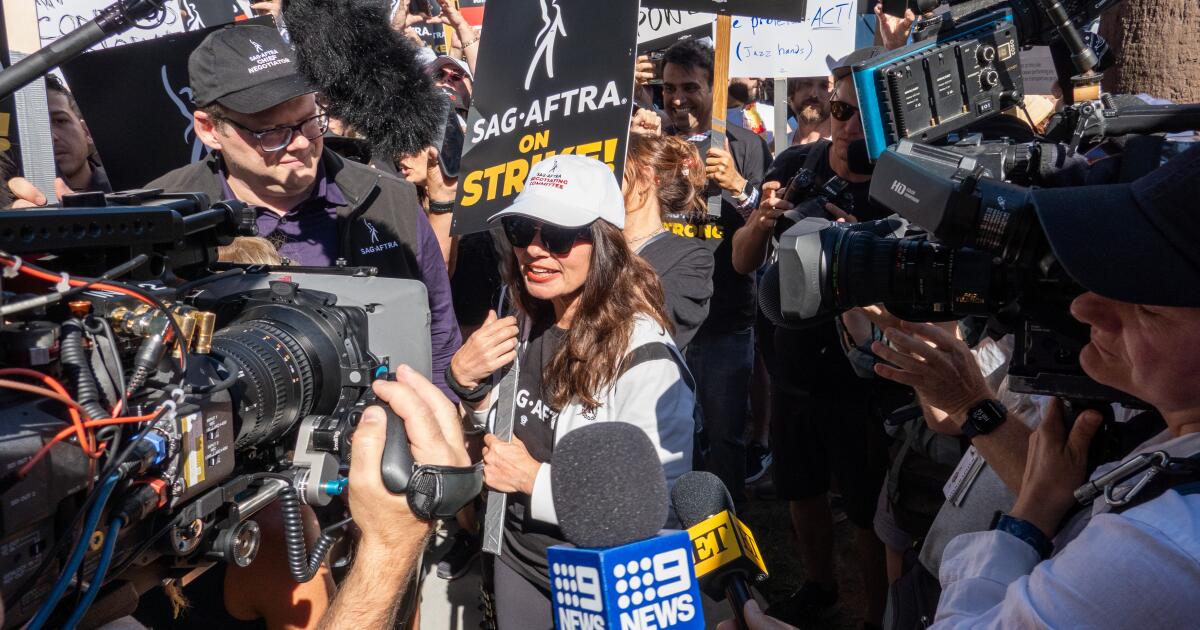
Video game performers are officially on strike.
The Screen Actors Guild-American Federation of Television and Radio Artists called a walkout this week on behalf of roughly 2,600 actors doing voice-over, motion-capture and other work in the gaming industry.
Union leaders took the step after they could not reach an agreement on artificial intelligence terms while bargaining for a new contract with the top video game companies, including Activision, Electronic Arts, Insomniac and Blindlight.
“We’re not going to consent to a contract that allows companies to abuse AI to the detriment of our members,” SAG-AFTRA President Fran Drescher said in a statement Thursday. “Enough is enough.”
Audrey Cooling, a spokesperson for the video game producers, said in a statement: “We are disappointed the union has chosen to walk away when we are so close to a deal, and we remain prepared to resume negotiations.”
How did we get here?
The union has been in contract negotiations with the video game companies since 2022, and the Interactive Media Agreement expired that November.
Video game performers are seeking a new agreement that will require video game producers to obtain their consent and compensate them when using AI to replicate their voices or likenesses. They are also demanding wage increases to keep up with inflation, more rest time and set medics for hazardous jobs.
Tensions escalated in September 2023, when union members voted 98% in favor of authorizing a strike.
Duncan Crabtree-Ireland, chief negotiator and national executive director of SAG-AFTRA, said at the time that the companies were not “willing to meaningfully engage on the critical issues,” including compensation, AI and safety.
The companies vowed to “negotiate in good faith to reach an agreement that reflects the important contributions” of game performers.
On July 20, the union’s national board of directors granted Crabtree-Ireland the authority to call a strike, citing a lingering dispute over AI.
How will this affect the video game companies?
Much like last year’s Hollywood writers’ and actors’ strikes against the film and TV studios and streaming services, this one could potentially lead to longer-term production lulls, particularly for games scheduled for release in 2025 or 2026.
Production is expensive and on a tight schedule, a reality that doesn’t give video game companies a lot of margin to “sit this out,” said Joost van Dreunen, an adjunct assistant professor at NYU Stern School of Business and author of “One Up: Creativity, Competition, and the Global Business of Video Games.”
For instance, companies can’t afford to miss out on the all-important holiday spending season. November and December traditionally account for about half of annual game sales, he said.
“If you don’t get things across the line, if you can’t finish your work and release it on time, you’re going to miss a very, very important window, and that’s going to hurt you financially,” Van Dreunen said.
But not all games are covered by the strike. According to contract provisions, games that were in production when the union provided the company with notice of its termination are not subject to the strike order, according to a SAG-AFTRA spokesperson.
What’s next?
As of Friday, SAG-AFTRA video game actors are barred from lending their services to any struck games.
Those services may include acting, singing, dancing, stunts, motion capture, auditions, camera tests, rehearsals, authorizing the use of one’s voice or likeness, background and stand-in work.
Covered performers are also prohibited from promoting struck games via social media, interviews, conventions, festivals, award shows, podcast appearances or any other platform. (The ongoing San Diego Comic-Con has been exempt from this rule due to its proximity to the strike announcement.)
The union has indicated that it will also hold pickets as part of the walkout.
Only time will tell how long it will take the union and the companies to reach a tentative agreement and end the work stoppage.
The last strike by video game actors stretched on for nearly a year, from October 2016 to September 2017. Back then, AI had yet to become a major concern and performers were pushing for residual-like payments based on video game sales — similar to how film and TV actors are compensated for their work.
Van Dreunen said companies would likely try to resolve the contract negotiations by September, but at the latest, by the end of the year, before answering to investors during their next earnings calls.



I’ve been watching Renny Harlin’s three-film reboot of “The Strangers” for several years, because that’s how it was foisted upon us, and now that it’s finally over, I’m willing to give it some credit. It was an ambitious idea to turn a classic home invasion thriller into a gigantic pre-planned slasher trilogy. The filmmakers could have phoned the whole thing in and nobody would have blamed them. Heck, given how it all turned out, phoning it in might have been the better plan. But instead they tried something and they deserve an “A” for effort. And a “D” for everything else.
If you’re just now joining us, the original “The Strangers” was an efficient, tightly-edited home invasion thriller about a young couple attacked by three masked murderers. Why? Because they were home. The ambiguity was the point. It was a horror movie where the horror could happen to anyone, for any reason, at any time, and it was scary as hell. There was an excellent sequel called “The Strangers: Prey at Night,” but when that didn’t set the box office on fire, the studio rebooted the franchise with an inefficient, extremely padded trilogy that revealed everything about the killers and ruined their mystique. They say “If it ain’t broke don’t fix it,” and they didn’t. They just broke it, seemingly on purpose.
Madelaine Petsch stars as Maya. She was attacked in “Chapter 1,” she ran from the killers in “Chapter 2,” and it sounds like there should be more to her story after two films but there really isn’t. When we catch up to Maya in “The Strangers — Chapter 3” she’s celebrating her first proper victory, having finally killed Pin-Up Girl, one of the three title murderers (she wore the “Pin-Up Girl” mask, try to keep up). Unfortunately for Maya, the leader of the slasher cabal had a romantic thing going with Pin-Up Girl, so now Scarecrow (the one in the scarecrow mask) has weird desires for Maya. He doesn’t want to kill her anymore. He wants her to be the new Pin-Up Girl, which means he has to turn her into a serial killer and make her fall in love with him.
That’s a creepy idea. Horror protagonists have been losing their sanity since the dawn of the genre, and several slasher series already tried to get away with a seemingly stalwart hero turning to the dark side, or at least feeling tempted. “Halloween” tried it a couple times. The “Scream” movies feinted in that direction. Heck, “Saw” made it their whole gimmick after a while. The trick is to put the hero through so much hell that hell becomes their new normal. When their sense of identity shatters they could glom onto anything, even evil, just to make sense of it all. I’m not sure that’s good psychology but it’s an unsettling notion, at any rate.
But if that story was going to work we’d have to believe it, and that’s where “The Strangers — Chapter 3” falls flat. Madelaine Petsch barely had a character to play in the first place, and three films later there’s still very little evidence that she’s playing a real human being. Heck, it was hard to believe she was even scared until the second film. It doesn’t help that everyone else in the cast plays arch, unconvincing archetypes, and it really doesn’t help that the villains’ backstories are perfunctory and shallow.
You can’t shatter the audience’s reality, let alone the hero’s, without establishing reality in the first place, and Harlin’s trilogy is too phony to qualify. A character-driven storyline only works if the characters have character, and a plot-driven storyline doesn’t work if you can’t sell the plot. There’s a scene in “The Strangers — Chapter 3” where Scarecrow finally takes his mask off and an audience member gasped, as if it was a big reveal. But there was already a whole, long scene earlier in the movie where that guy talked about being the killer. The scene had such vague dialogue and monotonous acting and generic filmmaking that the plot point didn’t register the first time.

In my review of “The Strangers — Chapter 1” I talked about how the original film’s title referred not just to the murderers, but also the protagonists, who thought they knew each other but didn’t. (In my review of “Chapter 2” I talked about food poisoning. These movies really wore me down.) As we finally, finally put this whole whoopsie-daisy to bed I find myself wondering who “The Strangers” really were in this reboot trilogy. They can’t be the masked killers. We got to know them too well. And “The Strangers” can’t be the victims, because the victims aren’t complicated enough to be unknowable.
So I’m forced to conclude, in the end, that the strangers in Renny Harlin’s “The Strangers” are the people who thought this was a good idea. They watched one of the scariest movies of the 21st century, made an itemized list of everything that made it work, then ignored those lessons. It’s genuinely hard to fathom. They didn’t even go in a wild new direction. They just tried to do the same schtick, but longer and worse, and let’s face it, “longer and worse” is only the goal if you’re trying to torture somebody.
Wait, was that the point this whole time? Was this supposed to be torture? Mission accomplished, I guess. What a strange mission.


One question has bothered Martin Ludlow in his decades as a concert and event promoter in Los Angeles. In a city packed with excellent jazz musicians, and a century of history with the genre, why is there no local equivalent of the massive festivals that cities like Montreal, New Orleans or Montreux, Switzerland, have built? One where the music transforms clubs, restaurants and parks across the city for nights on end?
This summer’s inaugural LA Jazz Festival in August will be the biggest push in a generation to build that here. Ludlow’s event — which melds his passion for jazz with the logistics muscle of his former life as a city councilman and labor leader — hopes to draw 250,000 fans across the city for a month of concerts culminating in a stadium-sized show on Dockweiler Beach. It will be one of the largest such events in the world, and the biggest Black-owned fest of its kind.
“This festival is intended to lift up our ancestors that came to this country in bondage, terrorized, brutalized,” Ludlow said outside City Hall on Wednesday. “It’s also about celebrating the end to those last bastions of Jim Crow racism, the days we were denied access to public drinking fountains, public swimming pools and public beaches. From the beginning of this journey, we’ve been very intentional about telling the narrative of that human rights struggle called Jazz.”
Flanked by Mayor Karen Bass, City Council members Heather Hutt, Traci Park and Tim McOsker, and jazz figures including Ray Charles Jr. and Pete Escovedo, Ludlow promised a galvanizing occasion for L.A.’s local jazz scene and the city’s wobbly tourism economy. That jazz scene has welcomed new investments like Blue Note L.A., and lamented beloved clubs like ETA closing.
This festival, however, hopes to be more on a scale with forthcoming mega-events such as the World Cup and the Olympics. The 25-day event in August will sprawl all over the region, with free park concerts in all 15 council districts, and 150 late-night shows at clubs and restaurants across the city. A Caribbean street fair highlighting the African and Latin roots of jazz will hit El Segundo, along with guided tours of historic Black coastal sites like Bruce’s Beach and Inkwell beach.
The fest culminates in a two-day concert on Dockweiler Beach that hopes to draw 40,000 fans a night. While a lineup is still in progress, the scope of Ludlow’s ambition is formidable — the fest will ban fossil fuels from its footprint, and earned a strong vouch from the California Coastal Commission. For decades, the Playboy Jazz Festival (now the Hollywood Bowl Jazz Festival) was the defining event for the music in Los Angeles; this could eclipse it several times over.
“Martin, I’ve been on this 15-year journey with you. Through all of the ups and downs, I’m so excited this is the year,” Mayor Bass said at Wednesday’s event at City Hall debuting the festival. “This is the Los Angeles that will welcome the world. One of the best things we have to offer is all of our culture.”
Ludlow is a colorful figure in Los Angeles politics, a former council member and L.A. County Federation of Labor executive who pleaded guilty to misappropriating funds in 2006. He’s since delved deep into community activism and embarked on a successful third act as a concert and event promoter, throwing socially-conscious events with his firm Bridge Street, which has produced shows for Stevie Wonder, The Revolution, Sheila E and Snoop Dogg along with civic events like the ceremony renaming Obama Boulevard in Los Angeles.
“During this journey, you can only imagine there’s a lot of highs and a lot of lows,” Ludlow said. “When you have those lows, you want a friend that really can lift you up.” He had plenty of them onstage with him Wednesday announcing what could be a new flagship event for jazz in Los Angeles.

Jimpa, 2025.
Written and Directed by Sophie Hyde.
Starring Olivia Colman, John Lithgow, Aud Mason-Hyde, Daniel Henshall, Kate Box, Eamon Farren, Hans Kesting, Zoë Love Smith, Romana Vrede, Deborah Kennedy, Jean Janssens, Frank Sanders, Cody Fern, Tilda Cobham-Hervey, Bryn Chapman, Parish Len, Leo Vincent, and Julian Cruiming.
SYNOPSIS:
Hannah and her non-binary teenager Frances visit her gay grandfather Jimpa in Amsterdam. Frances expresses a desire to stay with their grandfather for a year, challenging Hannah’s parenting beliefs and forcing her to confront past issues.

Both gay activist/somewhat estranged grandfather Jim (certainly a bold performance from John Lithgow that plays to his charismatic strengths) and his non-binary teenager grandchild Frances (Aud Mason-Hyde, the child of writer/director Sophie Hyde, who is evidently telling a personal story here) are complex characters in Jimpa (a combination of the name and grandpa, which fittingly reflects two very distinct ways in which Frances perceives him, perhaps first and foremost as a gay rights fighter more than a family member).
As Frances and parents, Hannah (Olivia Colman) and Harry (Daniel Henshall), visit Jim in Amsterdam, where Frances, much to their chagrin, is thinking about staying for a year with Jimpa to enjoy his enigmatic company and study abroad in a more progressive community, the more frustrating, problematic sides to him become more pronounced. It’s a side of Frances’ parents they warned has always been there, but even after a stroke, the openly flamboyant, provocative, no-filter man can control and captivate an entire room effortlessly.

Jim has had many lovers and has no doubt been an instrumental force in fighting for gay rights. He has also slipped into conservatism and lost sight of the greater picture, insistent that there is no such thing as bisexuality, which, to him, as an idea, negates everything he has fought for. Naturally, Frances very existence as a non-binary individual sexually attracted to women or non-cis men is a challenge to that worldview. Much of that frustration with Jimpa’s stubbornness is reflected in a tremendously nuanced performance from Aud Mason-Hyde, a natural at playing what is unquestionably a multilayered and complicated role, given the circumstances.
There is also an aspect that sees Hannah, a filmmaker clearly standing in for Sophie Hyde here, looking to channel a family history in which Jim came out as gay and left the family when she was 13, into conflict-free art, something that creative collaborators over Zoom advise her isn’t possible. At times, it feels as if Sophie Hyde is executing this film similarly, which isn’t as interested in some of the above clashes as one might be led to believe. Instead, the third act involves a bit of tragedy and some extended wrapping-up that doesn’t seem to address much of what comes before.

The film also primarily wants to be about Frances and their rocky relationship with their Jimpa, but also individual experiences such as discovering aspects of their sexuality, experiencing intimacy for the first time (in numerous unconventional and casual ways that some might deem inappropriate, but then again, it is Europe…), and how living in Amsterdam could provide a more fulfilling and welcoming upbringing. Throughout all of this are vague montage-like flashback glimpses to these characters, replaced by younger actors in a stylistic choice that is substantially empty.
The longer Jimpa goes on, the more it feels overstuffed with plot concepts and thematic ideas that are either discarded or never cohere into anything profound, especially since the focus is scattered all over the place. It’s a film that might have worked better by sticking with the perspective of one of its major characters, rather than ambitiously piling everything into a family affair that doesn’t necessarily resolve, but instead transitions into about 30 minutes of sentimentality.

In some ways, it isn’t tightly coiled enough to prioritize both Frances and Jimpa, shortchanging both of them as complex people. By the time Hannah is having filmmaking epiphanies about how to tell this story, one is likely confounded by this family’s dynamics and has checked out. Jimpa is a story of fascinatingly messy, contradictory LGBTQ stances and character relationships that is far more interesting than it is rewarding.
Flickering Myth Rating – Film: ★ ★ ★ / Movie: ★ ★
Robert Kojder
https://www.youtube.com/watch?v=embed/playlist

Ex-con KOs state police K-9 in Detroit street brawl, feds allege

Teen charged with murder in SF triple shooting that left girl, 15 dead

Ownership of The National skyscraper reverts to lender in foreclosure sale

Miami Legend Clinton Portis built quite a resume coaching Running Backs at Delaware State, and with the position wide open at The U could throw his name in the hat

Boston Police Blotter: East Boston drug bust, loaded gun seized in Dorchester

Florida High School Football Rankings: Top 25 teams – Oct. 21

Cleary's 21 help Le Moyne down Central Connecticut State 69-64 in OT

How old is Bo Nix? What to know about Oregon quarterback ahead of 2024 NFL Draft

99th annual Pony Swim held in Virginia

Indiana Members Credit Union announced as new anchor tenant at Bottleworks District

Video: Investigators Say Doorbell Camera Was Disconnected Before Nancy Guthrie’s Kidnapping

White House says murder rate plummeted to lowest level since 1900 under Trump administration
Council of Europe chief calls for political and financial backing of Ukraine Special Tribunal

Republicans pan Democrats’ demands for ICE reform in DHS funding, with little time to reach deal

LIVE: White House press briefing
-

 Indiana4 days ago
13-year-old rider dies following incident at northwest Indiana BMX park
-

 Massachusetts5 days ago
TV star fisherman, crew all presumed dead after boat sinks off Massachusetts coast
-

 Tennessee6 days ago
UPDATE: Ohio woman charged in shooting death of West TN deputy
-

 Movie Reviews1 week ago
Vikram Prabhu’s Sirai Telugu Dubbed OTT Movie Review and Rating
-

 Indiana4 days ago
13-year-old boy dies in BMX accident, officials, Steel Wheels BMX says
-

 Politics1 week ago
Virginia Democrats seek dozens of new tax hikes, including on dog walking and dry cleaning
-
Austin, TX7 days ago
TEA is on board with almost all of Austin ISD’s turnaround plans
-

 Texas5 days ago
Live results: Texas state Senate runoff

