Entertainment
Travis and Taylor have arrived at Super Bowl LVIII. Follow our columnist as she covers all things Swelce

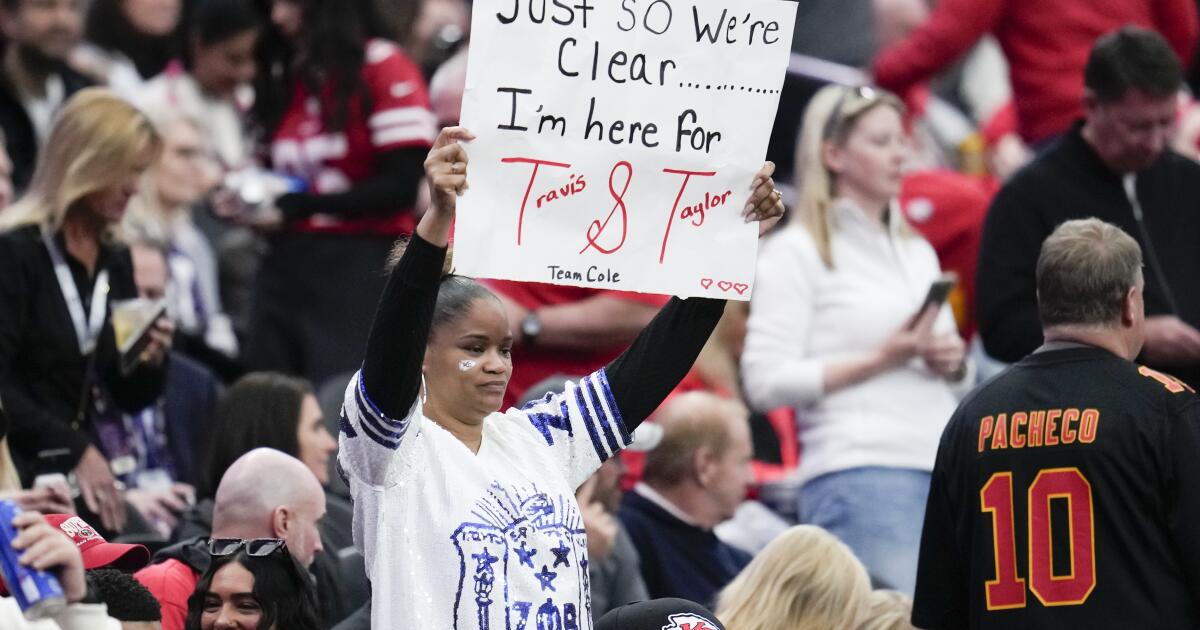
The big day is finally here: This Swiftie has made it to the Super Bowl.
I’ve spent the week in Las Vegas tracking all things Travis Kelce and Taylor Swift. I asked him a non-football question at a press conference filled with sports journalists, went to the NFL’s version of the Oscars and even went to a strip club that offered the couple a $1-million package to stop by on Sunday.
But today is different. Today we may actually gain proximity to Swift herself. I have dozens of friendship bracelets, a comfortable pair of sneakers and my eagle eye. Follow along as I bring you all the Swelce news I can find.
9:30 a.m: The earliest media buses depart Mandalay Bay at 10:30 a.m.; my colleagues and I decide to arrive as early as possible just in case. As luck would have it, the driver decides to leave an hour early, getting us on the road to Allegiant Stadium with plenty of time to spare.
The drive to the stadium isn’t long — five minutes, tops. We could walk, but there are so many security barricades that the best course of action is to go the official route. It’s so early that there’s still not a lot of action on the streets outside the stadium — no one has set up makeshift T-shirt stands or food carts yet.
9:35 a.m: Aaaaand we’re here. The only other people in the line to have their bags checked are stadium workers, decked out in official jackets.
Allegiant Stadium opened in 2020 and it’s still got that shiny and bright sheen to it. The second-most expensive stadium in the world, ($1.9 billion), it crouches around its 65,000 seats, reflecting the growing swarm around it. I’ve heard some compare it to the Death Star, but I’m into it. I’ve never been to a non-college football game before (I know. Life is unfair.) Still, the tunnels look familiar to me — not only because I’ve been to concerts in other stadiums but because, obviously, these are exactly the kind of halls we’ve seen Swift walking down this season on her way to her seats.
10 a.m.: My credential gives me access to the service level, which is where a lot of the action seems to take place. There are boxes of doughnuts and huge bags of popcorn ready to be rolled to the concession stands. Big red bags with Kansas City Chiefs logos are stacked outside of the locker room. And at the end of a long walkway is a huge open-air garage, where the buses dropping off the players are set to arrive. I decide to post up here, hoping to catch a glimpse of Kelce in his pre-game fit.
11:37 a.m.: The NFL camera crew starts shifting their gear onto their shoulders, indicating something might be happening soon. It’s been colder than I expected in Vegas this week — today’s high is predicted to be 54 degrees — and it’s at least 15 degrees cooler on this dark, windy garage. So I’m really hoping Kelce steps off the bus. Alas, while a handful of KC players arrive — including Patrick Mahomes, in his trademark suit — Kelce isn’t among them.
11:58 a.m.: We have our first celebrity garage-sighting: Post Malone, who is singing “America the Beautiful” before the game today. He walks by leisurely, only to emerge with his posse a few times again shortly later, his guitar strapped around his neck. Reba McEntire, who is decked out in a fur coat I wish I was wearing, also arrives in time to get ready to sing the national anthem.
12:40 a.m: With less than thee hours until kickoff, Kelce has arrived — and he walks right past me. He’s looking remarkably shiny, dressed in what Vogue says is a sequin suit he had custom made for the occasion by Amiri. He’s wearing sunglasses and betrays no emotion as he struts in. “All right, Trav,” a woman next to me shouts. “Alright nah,” he responds, using his signature catchphrase from the “New Heights” podcast.
1 p.m.: A kind security guard has told me that all “friends and family” will be coming through this entrance, and I’m hoping that includes Swift. But my phone is at 15%, and I don’t want it to die before she comes, so I decide to chance it and book it up to the press box to grab my charger.
1:17 p.m.: A fellow reporter downstairs texts me that he sees some commotion coming from the side where the 49ers entered the stadium. (I’ve been on the Chiefs side.) I rush downstairs, until a slew of texts arrive on my phone: She’s here. And I missed her. How could this happen to me?
My colleague, Sam Farmer, caught some of the action and says she came in with Blake Lively, Ice Spice and her mother, Andrea.
The only thing that makes me feel slightly better is that she came in across the parking garage, far from my eye-line, and those close to her were apparently instructed by security to keep their phones down. That’s probably because the only ones who ended up getting a clear shot of her were the NFL cameras.
I missed this chance, but I will not give up. I have at least five hours left under the same roof as T.Swift.
1:30 p.m.: Back out in the sunshine, fans have started to trickle in. I spot a telltale sign of a Swiftie: A pink glittering heart painted around her eye, just like Swift rocked on her “Lover” album. It’s Sloan Moyer, 11, a Kansas City resident who found out last week her dad had surprised her and her family with tickets to the game. They’re big fans of the Chiefs and go to all the home games, but Sloan loves Swift the most. She’s been to three home concerts and supports her idol’s new romance.“I think it’s a good idea. I hope it moves on,” she said giddily. “I just love supporting her. I would, like, probably start crying or something if I saw her.”
Sloan, 11, came from Kansas City with her family to cheer on the Chiefs — and Taylor Swift. She’s rocking a “Lover”-themed heart around her eye.
(Amy Kaufman/Los Angeles Times)
1:45 p.m.: There are a handful of booths surrounding the stadium, selling standard Super Bowl merch and overpriced sodas. But Hunt Auctions catches my eye because they have a bunch of unique-looking memorabilia. I immediately ask Gary Reibsane, who is putting out the gear, to point out the Kelce items. He’s got six helmets signed by #87 on display ($925 to $1150) plus his jersey ($975) and a photo signed by both Mahomes and Kelce ($2,850.) How do they get the stuff signed? “We buy it in bulk from the autograph sellers,” Reibsane says. I ask if he thinks he’ll sell out of all of the Kelce items today. “Oh, this isn’t everything out there — there’s back-stock,” he grins.
A jersey signed by Kelce is going for $975 at a booth outside Allegiant Stadium.
(Amy Kaufman/Los Angeles Times)
Hunt Auctions is selling a variety of autographed Kelce helmets outside the stadium. This one goes for $925.
(Amy Kaufman / Los Angeles Times)
2:20 p.m.: It’s nearing game time, and I’ve yet to head to the press box. I head up to find my two colleagues from the sports section, Gary Klein and Sam Farmer, ready with binoculars for me to borrow. As it turns out, Swift is posted in a box directly across the stadium from us, and we can see her if we just use the special lenses.
It’s weird to be trying to catch a glimpse of her this way instead of anxiously waiting for the TV to pan to her during a telecast at home. But knowing she’s 150 yards or so away from me is a different feeling altogether. My co-workers and I try to calculate when might be best to try to head over and catch a glimpse of her IRL instead of through the binoculars. I don’t feel comfortable revealing my strategy here, but let’s say I will not be remaining in the press box for this entire game.
4 p.m.: With the first quarter over, I decided to see if I could get closer to Swift’s suite. (Also, the food in the press box included “Jackpot dogs” that I was warned had an “explosive payout,” so I wanted to peruse the offerings outside.) Less than five minutes later, I was in the area that houses the nicest boxes. Most had at least one security guard posted outside, but outside one door three men wearing blazers stood stoically taking in the scene. Nearby two young women — one in an 87 jersey — were staring at the door, alongside a man with a long-lens camera and another wearing a USA Today press pass. This had to be it, though there are bathrooms in the suites, meaning she wouldn’t have to exit until she was leaving the stadium.
I asked the young women in the jerseys if they were Swifties, gave them my card and explained my mission: that I, too, was here for Taylor and Travis. We started to chat until their mom interjected: “Do not talk to her,” she warned.


Perhaps there’s a certain irony in a story about a fireworks factory mostly keeping away from explosive drama. Yoshitoshi Shinomiya‘s lowkey feature directorial debut A New Dawn is at the very least visually captivating, comprised of lush and rather hypnotic production design. The story is small scale focusing on a trio of friends who try to save a fireworks factory in their hometown, but the imagery feels expansive and lush. A New Dawn begins with a beautiful and vaguely familiar display of this beauty: the flowing, painterly imagery of its opening sequence recalls Shinomiya’s work on the flashback sequence in Makoto Shinkai‘s your name., immediately showing that the film’s visuals might transcend its small town drama.
A background artist himself on films by Makoto Shinkai as well as the similarly resplendent Pompo: The Cinéphile, it makes sense that this history would be felt in the background works of A New Dawn. They’re dense with detail, rich with almost luminous color and illustrative texture. Shinomiya, who also wrote and storyboarded the film, veers away from the photorealism associated with someone like Shinkai through some impressionist touches – like the splotches of green paint which represent treelines – which sometimes turns into outright abstraction like when a character begins to run through the space. Sometimes there are swaying, morphing textures in the background as splotches of paint subtly shift around. On a more intimate level, the cluttered and characterful interior spaces tell a story too. This is a long-winded way of saying A New Dawn looks really, really good.
It’s not just in the tableaux of its countryside habitats and ramshackle living spaces carved out of abandoned warehouses, but there’s a sense of invention permeating through A New Dawn‘s various experiments with visual languages of animation. The most prominent is an incredibly charming stop motion animated sequence using a cardboard diorama and real human hands invading the shot in a creative reflection of a drunken character’s perspective. Even though it broadly still looks “anime” through its character design, there are also smaller details which work to set A New Dawn apart from its contemporaries, touches like its occasional lineless artwork or the way rain is defined through smudged black brushstrokes.
It’s in the screenwriting where A New Dawn begins to feel more run of the mill. Its story about the constant chasing of the majesty of a fabled firework “Shuhari” feels both familiar in its premise but also a little bit alienating in its structure. The importance of the firework itself never feels clear – the moment its mystery is unravelled hardly feels like a revelation as a result, something amplified by how the writing often obfuscates what anyone is talking about. The whole story feels a little distancing, and despite the allure of the background art and design of the spaces the characters inhabit, the people themselves feel constantly at arms length.
It almost pulls things back with its climax – the detonation of the “Shuhari” goes a long way in justifying the circular conversations about its nature and origins – a painted streak of light launches into the sky before turning into something otherworldly, suddenly tripling down on the film’s captivating exaggerations.
Entertainment
Review: They’re finally too old for it in the middling clip reel ‘Jackass: Best and Last’

The best weapon in the “Jackass’” arsenal isn’t the taser, the beehive or the booby-trapped latrine. It’s the explosion of relief when a prank ends, often in humiliation, always with hoots and claps. The first film, 2002’s “Jackass: The Movie” was slow to discover that carnage without camaraderie is painful; several injuries limped off-screen in horrified silence. Laughter heals, except for the brain hemorrhage that Johnny Knoxville suffered in 2022’s “Jackass Forever” when, dissatisfied by the clobbering he took from a bull, requested a second ramming that knocked him out cold.
Hence “Jackass: Best and Last,” the goon squad’s alleged final film, is underwhelmingly tame. Shot quickly by stalwart director Jeff Tremaine this spring, half of it is a clip reel of past hits, like the time fan favorite Steve-O slingshotted into the sky in a port-a-potty. The rest is scraps of hastily assembled chaos, the most elaborate of which is a puppet show in which veterans Ehren McGhehey, Dave England and Jason “Wee Man” Acuña dangle helplessly from strings, trying to recite cue cards while being pummeled by tropical fruit. “A pineapple!” Wee Man moans.
I’m no sadist. They’ve suffered plenty for our amusement. Still, it’s a shame that for the first time in two and a half decades of cringe comedy, the guffaws feel forced.
Acknowledging the Jackasses’ age, if not maturity, are a couple skits about prostate and rectal checkups. (The gnarliest involves clear pants, colonoscopy prep liquid and a game of Twister.) Modern technology enters the arena with a nimble-fingered robot. If the team had invested any actual energy into brainstorming this entry, they’d have played paintball with a sniper drone. At least for the sake of torch-passing, someone should have thought of something for the newish members introduced in “Jackass Forever” to do besides stand around and applaud.
These fresher faces — Jasper Dolphin, Rachel Wolfson, Zach Holmes — prove brave and resilient when allowed to participate. Only one of them, Sean “Poopies” McInerney, a surf bro so gullible that I’m not sure he’s capable of informed legal consent, fits into “Best and Last” like a well-worn punching bag. (When Poopies yelps that “my mind is getting to me” while wearing a shock collar around a sensitive area, people snort because, as sweet as he seems, the only thing rattling inside his cranium is a moth.) Early on, Poopies gets swollen lip injections that, someone claims, will last the whole movie. You expect his trophy wife pout to be a running sight gag. But his disfigurement never even gets another closeup.
“Jackass” started with a bang. In January of 1998, Knoxville, then a 26-year-old aspiring actor, strapped on a cheap bulletproof vest padded with a stack of “Hustler” magazines and fired a gun point-blank into his chest. His dumb derring-do went viral on VHS tapes, earning him an MTV show and five feature films. Watching that Rosetta Stone-cold stupid footage here, you’re struck not only by his audacity, but by the scene’s excruciating comic pacing. As there’s only one bullet in the pistol, empty chambers click multiple times before the bullet finally fires. Logically, you know Knoxville will live long enough for his hair to turn fright-wig white. Yet the lizard brain making you gawk is shrieking.
Do not attempt any of the stunts you’re about to see, the prefatory caution blares. Absolutely. The thing is, no one else could. “Best and Last’s” flashbacks are a walloping reminder that Knoxville is inimitable: a telegenic and extroverted entertainer with a charisma he wields like a skunk aims its stink. Upset him at your own risk. Like Buster Keaton before him, Knoxville has an uncanny awareness of how his death-defying escapades appear on camera. Even in that near-suicidal early segment, note how Knoxville stays on his feet, enduring agony with a magician’s “Ta-da!” He might have given himself a bruise the size of a baseball but he’s focused on the audience’s delight.
Over the years, the visuals dramatically improve, from snuff film aesthetics to confidently silly splendor. “Jackass Number Two,” released in 2006, expended major energy on a musical homage to Old Hollywood that nodded to Keaton and bathing beauty Esther Williams who, in MGM’s “Million Dollar Mermaid,” plunged 50 feet into a pool and broke her neck. By 2010’s “Jackass 3D,” which riffed on classic cartoons with Knoxville strapping himself onto an Acme-style red rocket, one could admit they went to see a Jackass movie for the cinematography with even more sincerity than if Knoxville claimed he bought “Hustler” for its life-saving properties.
The new movie doesn’t have any artistic ambition. The charitable excuse for its reliance on old material is that the gang wanted one more film that summed up their entire legacy — from the impact of seeing them age to the opportunity to include departed colleagues Ryan Dunn, who died in 2011, and Bam Margera, fired in 2020. The other explanation is it’s a cash grab made for pennies. Still, Steve-O strives for memorable moments, gathering the gang in a generic office building corridor to watch him take off his pants and pop out a ping-pong ball. There’s a lot of nudity but the setting feels half-assed.
“Best and Last’s” intro splat-tacular, typically a highlight of each film, hinges on the posse standing still on a moving floor. But the monochrome staging — white walls, white ground — looks almost like CGI, the antithesis of their appeal, and it takes us a minute to understand what’s actually going on. Worst, it lacks both suspense and surprise, that no-they-aren’t–oh-god-they-are drama that once elevated the franchise to the peak of pure cinema.
There is — and I mean this — existentialism in witnessing a person embrace shame and terror. Actors have won Oscars without achieving the transcendence of, say, misery glutton McGhehey in “Jackass Forever,” bound to a chair and coated in salmon and honey, realizing that his friends have released a bear into the room. Meryl Streep could never do that (and wouldn’t have to). McGhehey’s sole path to stardom is that he did.
Not everything in a “Jackass” movie needs to be that sublime. One of my few genuine howls in “Best and Last” came in a three-second rehash of someone stepping on a rake; another was the percussion Chris Pontius makes with his swinging nethers before attempting a naked Fosbury flop. There’s a great accidental gag in a cut bit from the original MTV pilot when a deputy pulls up to arrest Knoxville and forgets to put her car in park. Yet the snippet I keep thinking about is a throwaway beat in a new skit when McGhehey willingly gets into the wrong chair again and, once freed, attacks Knoxville who coolly knees him in the nuts. Everyone chuckles.
Once, in anthropology class, my professor lectured on an insular island tribe that cackled whenever someone got hurt. Schadenfreude was the community’s way to vent tension. I thought of that village throughout “Best and Last,” especially during Knoxville’s nonchalant disarmament of his pal. Team Jackass has stayed united even while at each other’s throats. In bad times, they’ve borne each other’s struggles with sobriety and mental health. In good, they’ve seen the inequality of success that’s left Knoxville in a better financial position to retire than the rest.
While “Best and Last” is a whiff, I can forgive this band of bozos’ urge to make it. No one seems happy to still be zapping themselves with electrodes. They just want to rally together for the final time to choke out one last laugh.
‘Jackass: Best and Last’
Rated: R, for extremely dangerous stunts and crude material throughout, graphic nudity, pervasive language and sexual material
Running time: 1 hour, 32 minutes
Playing: Opening Friday, June 26 in wide release
Movie Reviews
Hollywood Pariah Kevin Spacey Opens in a Straight to Video Movie with 25 Producers, 1 Review, No Theaters, No Press – Showbiz411

As we know, Kevin Spacey is a pariah in Hollywood.
He’s in a rare club with Mel Gibson, Armie Hammer, Nate Parker, Jonathan Majors, and James Franco.
Spacey has managed to avoid jail time by reaching settlements with various accusers of sexual malfeasance, all men.
His film career — which included two Oscars and a Tony Award — has been destroyed.
Spacey has been reduced to appearing in straight to video films, made for whatever reason the various producers involved know only to themselves.
On Friday, a new Spacey movie surfaced against its will, but not in theaters. It also went straight to video. “1780” is a period piece set during the Revolutionary War. Spacey plays a toothless Pennsylvania country trapper.
There is no rating on Rotten Tomatoes, largely because there is only one review. The review by Alan Ng of Film Threat is positive. Ng recently reviewed “World War Bigfoot,” which he also liked. He seems to specialize in reviewing films no one has heard of.
“1780” does boast 25 producers who will probably not see a return on their investment. But they can say they made a movie with Kevin Spacey.
Donate to Showbiz411.com
Showbiz411 is now in its 13th year of providing breaking and exclusive entertainment news. This is an independent site, unlike the many Hollywood trades that are owned by one company. To continue providing news that takes a fresh look at what’s going on in movies, music, theater, etc, advertising is our basis. Reader donations would be greatly appreciated, too. They are just another facet of keeping fact based journalism alive.
Thank you
-

 Maryland4 minutes ago
STEM Exploration Zone during SAIL250 MD provides hands-on activities for families
-

 Michigan11 minutes ago
Inside a 168-year-old Michigan estate frozen in time listed at $1.49M
-

 Massachusetts14 minutes ago
8 Picture-Perfect Main Streets In Massachusetts
-

 Minnesota19 minutes ago
Cold Spring man fatally stabbed, suspect in custody, police say
-

 Mississippi26 minutes ago
Could Texas Be Facing Another Trap Game vs. Mississippi State in 2026?
-

 Missouri29 minutes ago
UPDATE: Well-known mid-Missouri attorney charged after sting expected to request home detention | 93.9 The Eagle
-
 Montana34 minutes ago
Montana nurse and Guard member earns national Air Force recognition
-

 Nebraska41 minutes ago
Former OSU, Nebraska wrestler AJ Ferrari arrested after police pursuit in Nebraska

