Entertainment
This is what Billie Eilish talks about when she's not promoting ‘Barbie, Barbie, Barbie'

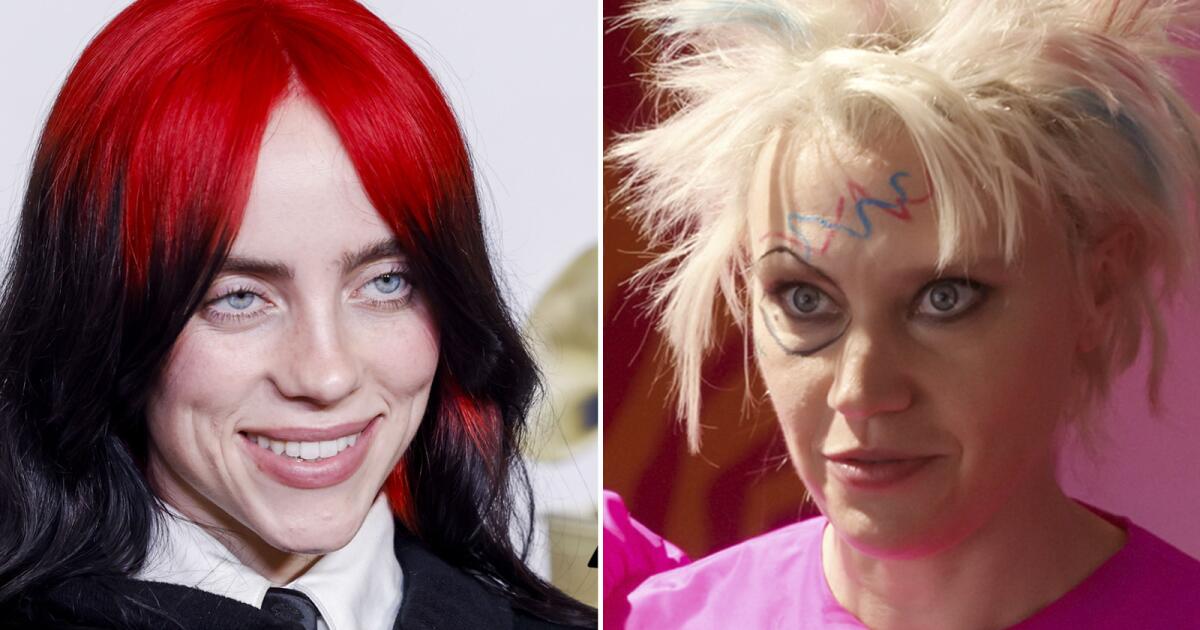
Billie Eilish is so sick of talking about her Oscar-winning “Barbie” song.
The singer, who co-wrote “What Was I Made For?” with brother-collaborator Finneas for Greta Gerwig’s movie, finally has time to talk about how tiring it was to promote the song and attend all those awards ceremonies.
“Bro, nobody can get enough of me,” she told Rolling Stone. “Every second of every day is Barbie, Barbie, Barbie, Barbie, Barbie, which is great, but as soon as the Oscars are over and I lose, I’m going the f— away. I’m literally gone.”
She did not, in fact, lose the Academy Award for original song, and she and Finneas became the youngest two-time winners in Oscars history. The duo also picked up a Golden Globe and a Grammy for the hit.
Eilish told the magazine — in what she said was her first non-”Barbie” interview in more than a year — that the song became a bigger hit than she was anticipating.
The 22-year-old hitmaker is set to release her third album, “Hit Me Hard and Soft,” on May 17. Though she is exploring different sounds and more mature themes than in her previous work, she and Finneas, who was also interviewed for the profile, revealed that the opening track mirrors “What Was I Made For?”
She and Finneas had writer’s block when they were creating the “Barbie” track, and they ended up writing this new song first, she said.
The tune, with its yet-to-be-revealed title, became the catalyst for the emotional and delicate “Barbie” hit, sharing its whispered sound and a similarly graceful melody. It explores the myth that losing weight means gaining happiness — another emotional theme that, like the one in “What Was I Made For?,” often plagues girls and women as they grow up.
Eilish, 22, said she felt like she had been making music and working nonstop since she hit the A-list as a teenager.
“I had this moment of like, ‘Oh, my God, I haven’t had fun in seven years.’ Truly. I had this illusion that I had, because who experiences going to the Grammys at basically 17 and winning five?” she said. “But in life, I realized I had really not experienced that much. I didn’t go outside for five years. How was I supposed to have any experiences?”
Since 2019, the singer has put out two albums, written and performed songs for “No Time to Die” and “Barbie” (winning Oscars for both), headlined at Coachella and picked up more than a few Grammys. After the lengthy and very pink “Barbie” promotional tour, she said she was relieved to catch a break.
That is, until her next album kicks off a whole new cycle.


Enter your email and we’ll send a secure one-click link to sign in.
WKRN is provided by Nexstar Media Inc., and uses the My Nexstar sign-in, which works across our media network.
Nexstar Media Inc. is a leading, diversified media company that produces and distributes engaging local and national news, sports, and entertainment content across its television and digital platforms. The My Nexstar sign-in works across the Nexstar network—including The CW, NewsNation, The Hill, and more. Learn more at nexstar.tv/privacy-policy.
On the Shelf
Come Undone: A Novel
By Eddie Huang
One World: 240 pages, $29
If you buy books linked on our site, The Times may earn a commission from Bookshop.org, whose fees support independent bookstores.
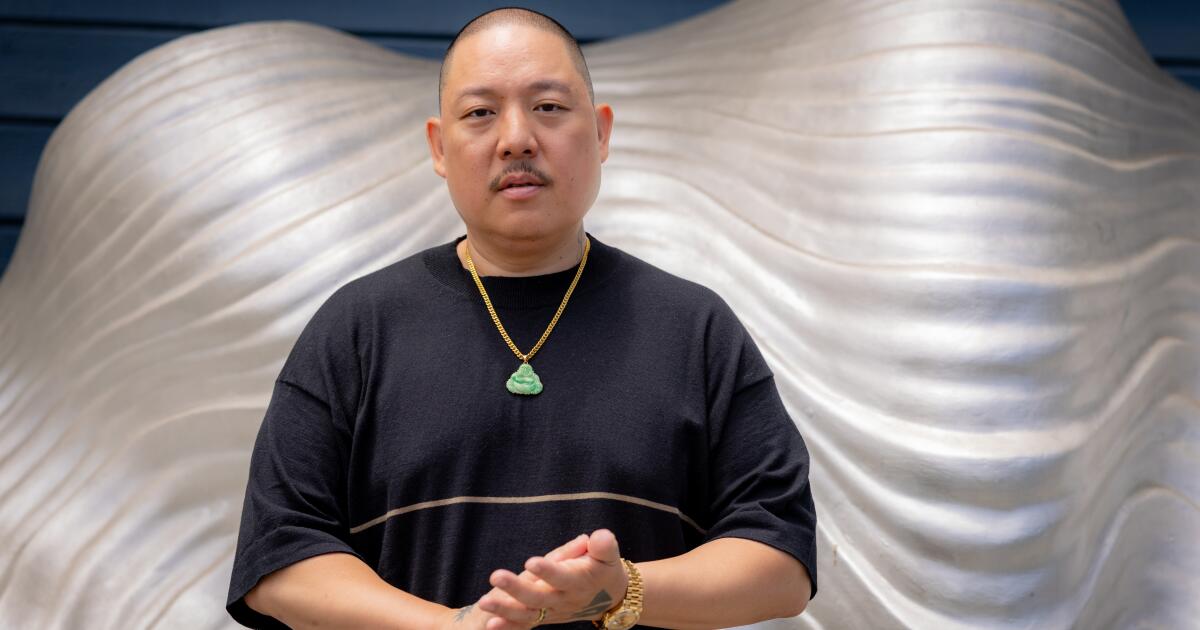
Eddie Huang has never felt lighter. Last month, after his debut novel, “Come Undone,” finally released, something shifted.
“I have a family. I feel healed,” he said over coffee and short ribs in Santa Monica hours ahead of a live talk with Ottessa Moshfegh, the bestselling, critically acclaimed author of Huang’s favorite book, “My Year of Rest and Relaxation.”
“People always write me off as a personality or a multi-hyphenate,” he said. “It’s a nice way of saying I’m not really good at anything. But I didn’t have any of that this time.” He leaned forward, serious. “I have to be honest. I do think the Knicks are a big, big part of it.”
His beloved Knicks winning the championship, he said, kept him from spiraling over the book. In person, Huang subdues his ironic braggadocio with polite eye contact and rolling belly laughs at his own jokes. For years, audiences have watched Huang resist whatever box you put him in. His particular brand of cultural fluency — a rapid-fire mix of food, fashion, basketball, politics and pop culture — is what made the “Gua Bao Bad Boy” impossible to categorize.
For most of his career, Huang has seemed constitutionally incapable of standing still. Chef. Memoirist. TV host. Filmmaker. Lawyer. Comic. Podcaster. His first book, “Fresh Off the Boat,” became the longest-running network sitcom centered on an Asian American family, even as Huang publicly distanced himself from the show. Since leaving post-fires L.A. for New York, he’s reopened Baohaus — returning to the kitchen that built his career. Waiting for him at home after the book tour is his wife, Natashia Perrotti, and their 2-year-old son.
Now there’s “Come Undone,” fiction that Huang called his most honest — and vulnerable — work to date.
“It’s sort of this next-gen auto fiction type thing that is creating its own rules,” Moshfegh said ahead of their Q-and-A. “It made me think about my own appreciation for the experience of male heterosexuality and how much it’s been commodified.”
The book follows Hubie, a globe-trotting food-show host drifting through Chateau Marmont, Madeo, Nobu and other “dirtbag L.A” (as Huang coins) spots. He meets Janine, his equal in appetite and id, sending him into a tailspin of yearning and loops of Sky Ferreira’s “Everything Is Embarrassing” on sadboi walks. The “two walking red flags” decide to try to make it work.
Huang called the novel an “autofictional riddle.” The puzzle isn’t especially difficult if you’ve followed his relationship with Perrotti, who co-hosts their podcast, “Canal Street Dreams.” Marrying a writer, she’s learned, often means finding out what he feels by reading it. “We’ll get into a fight,” she said, “and I’ll wake up to a Substack article about it.”
It’s also part of the private life she’s since conceded. “It’s annoying,” she added. “But now I can read it, and maybe understand him a little bit better. He’s trying to communicate through the writing, like sending somebody a song and saying, ‘I want you to listen to these lyrics.’”
The novel goes further, drawing from experiences the couple has never discussed publicly. In the novel, Hubie and Janine’s relationship pivots after an ectopic pregnancy ends in loss. Perrotti said the scene is fictionalized but mirrors a similar experience they had early in their own relationship.
“It brought us closer together,” she said. “It was the catalyst for us realizing we were serious.”
Before Huang could finish the book, the life he was writing about had to fall apart. “This book was very much about breaking up with your family to start your own,” he said. “There was a lot of anger in the book that had not been resolved.”
By the end of 2024, Huang had stopped speaking to his mother. The break followed what he described as a blowup at a Cheesecake Factory. It also unlocked the ending he’d been chasing.

Eddie Huang.
(Jason Armond / Los Angeles Times)
Looking back, Huang thinks the earlier versions failed because he was still arguing with her. He’s still trying, in some way, to communicate with her through his writing. “If there’s one person I wish would read the book,” he said, “it would be my mom.”
There were other chapters he had to close the book on, mainly Hollywood. His foray into fiction coincided with the writers’ strike, drying up all his income and future projects. That same year, he became a father. “I had to accept and realize that my value was not in making money,” he said. “Because for three years, I couldn’t.”
He recalled a particular low point researching life insurance policies. “I had to rebuild my whole self. Really love myself despite not being able to offer anybody anything.”
That new certainty didn’t make Huang any less willing to pick fights. Last year, as his documentary “Vice Is Broke” — an autopsy of the media company behind “Huang’s World” and its eventual bankruptcy — awaited release, Huang said distributor Mubi shelved the film after he boycotted the company over Sequoia Capital’s investment in an Israeli defense technology startup. (Mubi denied this and said it still planned to distribute the film.)
The ghost of Vice still lingers in today’s media ecosystem in what he called our “era of cartel journalism:” creators navigating a world of blurred incentives and corporate interests. He traced this instinct to challenge those systems back to Socrates’ “gadfly” — the person whose job was to annoy power. “As a writer, you should be challenging people,” he said. “If your memoir can be turned into a sitcom, it probably wasn’t challenging.”

Eddie Huang.
(Jason Armond / Los Angeles Times)
After the 2025 L.A. fires drove his new family back to New York, Huang went back to cooking. He worked pop-ups, reopened Baohaus and found himself alongside line cooks half his age. In March 2025, he rewrote the novel in five days. That same month “was the first month I didn’t overdraft my credit card,” he said, with the majority of his income today coming from the restaurant. It’s allowed him to make films, write books and walk away from deals he doesn’t believe in. “Being a chef is the anchor that allows me to maintain my artistic integrity.”
For years, comparisons to Anthony Bourdain followed Huang everywhere. The two eventually became friends.
“He was one of the few people who was as advertised,” Huang said. “Nicer and more generous in person. And wounded.”
Bourdain is the only real person who appears in “Come Undone” under his own name.
When Huang mentions him, he stops talking. He covers his face. Tears come.
“I don’t believe in God,” he said, “but I asked the universe why for many, many years.”
Bourdain’s suicide, he said, was one of the reasons he walked away from “Huang’s World” in 2018. At the time, few people understood why. “It was Tony. It was family. It was everything.”

Eddie Huang.
(Jason Armond / Los Angeles Times)
Now, looking back, Huang thinks he was writing “Come Undone” toward a different ending than the one he’d imagined.
“This book is a guy saying, ‘I don’t want to be like my biological father,’” he said. “And, in the most respectful, loving way, I don’t want to go out like Tony.”
He paused. “I needed to name the sadness in me. I needed to allow myself to be loved.”
Huang is already writing another memoir about getting back into the kitchen. Still, he said, these days, he’d rather write fiction.
Rudi, an L.A. native, is a freelance art and culture writer. She’s at work on her debut novel about a stuttering student journalist.

So I took my Dad to go and see the new Supergirl movie – and we both loved it;
Kara Zor-El, aka Supergirl, joins forces with an unlikely companion on an interstellar journey of vengeance and justice when an unexpected adversary strikes too close to home.
And when we left the cinema, I broke the News to him that critics had absolutely panned it and predicted it was on its way to being a box office flop;
And my Dad joined me in being totally and utterly baffled by this response, and wondering if we’d just seen a totally different film to the seeming majority of reviewers!?
Oddly enough, a few reviewers banged the same drum asking if Supergirl had come out just as audiences were putting away childish things, like Superheroes;
To that last point; sure Scorsese hates superhero movies, but he also endorses the use of AI in filmmaking calling it “creatively freeing” – so I dunno, if a douche canoe declares superhero movies aren’t “real cinema” but seems totally fine letting broligarchy robots become filmmakers using stolen artwork, does anyone care? No. No we do not.
And mind you too – everyone is excited for the new Spider-Man: Brand New Day (including me, and my Dad) and not decrying it’s come out just as Superheroes are dying. So once again; this seems an odd argument to make.
And then lots also took the opinion that it missed the feminist mark;
I mean … sigh – there’s no real valid points to them, and when Coleman Spilde decries the “infantilisation” of Superigrl in one paragraph (WHAT?!) and then – with a straight-face – writes;
As always, I return to a perfect example: 2004’s “Catwoman.” That film was ingeniously enterprising, weird, stylish, sexy, and most importantly, totally singular. Moreover, it was entirely separate from the character’s source comics, with no mention of Batman to be found. Although “Catwoman” didn’t quite recoup its budget in theaters and was largely reviled among audiences and critics, it looks and feels a hell of a lot more thrilling 22 years on than anything DC Studios has cooked up in the time since.
I’m sorry but I can’t take you seriously. Sit down.
ALSO: the reviewers pointing to a slumped box office as proof that Supergirl is dud are being disingenuous, but few are willing to admit it;
Waner Bros. and DC’s “Supergirl” did the best of the newcomers on Friday, landing in second place with $18 million domestically from 3,602 theaters. Through the weekend, it should collect about $50 million. For context, James Gunn’s “Superman,” which cost $225 million, debuted to $125 million last summer and ended its run with $618 million. “Supergirl” was a bit cheaper to produce at $170 million, but will still need to stick around in theaters to justify the pricetag.
So here’s the truth; Supergirl has a fairly gritty storyline – we follow newcomer, young girl Ruth (Eve Ridley) who witnesses the murder of her parents and sibling at the hands of patriarchal space pirates – the Brigands – and specifically their leader Krem (Matthias Schoenaerts) who struck the killing blows against her kin. Her father was a master sword-maker, so when Ruth is the only one left alive she vows to take her father’s last remaining sword and use it to seek vengeance and kill Krem. She goes seeking a champion to help her in this goal.

But what Ruth stumbles across in the Red Sun galaxy is a bar-hopping Supergirl (played brilliantly by Aussie Milly Alcock) – who is seeking the neutralisation of the red sun to allow her to exist in a boozey state of forgetting … she has her canine companion Crypto, her cousin Kal-El back on the rejuvenating yellow-sunned earth (who she is avoiding) but not much else until Ruth and her problems stumble into her life.
When Crypto’s life is endangered by one and the same Krem, Supergirl reluctantly joins the fight – and along the way discovers that the Brigands trade in kidnapped girls from across the galaxy, to continue populating their all-male line.
Ah.
Suddenly the throughly disinterested Supergirl is drawn into a Shakespearean web of Ruth’s revenge plot, her own desperate three-day bid to save Crypto, and breaking up an inter-galactic slave trade smuggling ring.
It’s definitely got darkness at its centre. And decent enough story-echoes to two more films from established franchises that put female leads front-and-centre in their new outings, and saw great success. Namely; Rogue One which has the avenge-my-family subplot similar to Ruth’s, and Mad Max; Fury Road for the rescued brides of pirate psychopaths plot.

Along the way Supergirl and Ruth bump into Lobo (Jason Momoa) who is seeking his own bounty from one of the heads of the Brigands. He’s not so interested in helping Ruth and Supergirl in their loftier ambitions, but proves a useful hammer when their fights align;
![Film/TV] New LOBO Character Poster for SUPERGIRL : r/DCcomics](https://i0.wp.com/substackcdn.com/image/fetch/$s_!vAcc!,w_1456,c_limit,f_auto,q_auto:good,fl_progressive:steep/https%3A%2F%2Fsubstack-post-media.s3.amazonaws.com%2Fpublic%2Fimages%2F39e348f6-fa86-46af-a788-9f7299e9b9be_1080x1440.jpeg?ssl=1 "Film/TV] New LOBO Character Poster for SUPERGIRL : r/DCcomics")
Overall I found the plot to be quite moving and decently big enough in scope. It’s hard to watch and not see connections to the here and now – that no matter the planet or galaxy, women and girls are traded and abused at the hands of men;
Why shouldn’t Supergirl but a version of this story front and centre?
James Gunn’s 2025 Superman raised similar lines of enquiry about the echoes to modern conflicts to be found in its fiction;
That last one undoubtedly hits closest to the truth – but it’s still an interesting practice on how Art is Indeed Political, and amazingly when you give audiences colonial war-mongers as villains they’re going to see parallels to real-world apartheid and genocidal states, whether studios wanted them to or not.
I am not the biggest Superman fan, truth be told. But I did really enjoy David Corenswet’s 2025 take (and far more than all of the Zack Snyder’s poorly written nonsense … I mean; MARTHA!! – really? Dud).
Superman has always been a little too cheery and optimistic for me. I far more gravitate to Batman (millionaire he may be, eat them!) and Chris Nolan’s films remain the definitive superhero franchise for me – especially because they lean into violence and a more Jekyll-Hyde struggle.
I am probably also more of a Marvel gal (X-Men and Kitty Pryde being my definitive favourites of all time!) and again – I think there’s more complexity and shades of light and dark to be found there, that I am more drawn to. I am a millennial child raised on the X-Men cartoon and The Dark Phoenix Saga in particular, really shaped my comic-book/superhero arc outlook.
So I was pleasantly surprised to find more grit and dark in this 2026 Supergirl, and new dimensions to the character whom I’d last encountered in the squeakier CW universe (which only tangentially touched on domestic violence against women, when its star –Melissa Benoist – admitted to her own experiences in an abusive relationship, with a fellow actor on the CW show).
Superman is a tale of immigration, and always has been – Superman is a refugee;
Critically though; Superman migrated to America and found asylum with the Kent family, as a baby. He has little to no memory of Krypton, only the acquired memories of his parent’s imperfect messages in his Fortress of Solitude.
Supergirl is not the same – as she explains in the film; “Krypton did not die in a day, the Gods are not that kind.” She was born eight years after Krypton’s core could not sustain the planet anymore. Her uncle and Kal-El’s father sent Superman away immediately as the planet started to disintegrate, but Supergirl’s own father was instrumental in creating a forcefield around the city to sustain it while the rest of the planet fell away. Supergirl was born in a domed and doomed piece of the Krypton planet, and it was only in her teenage years when her father admitted this bandaid-on-a-bullet-wound was unsustainable, that he sent her away to Earth, to follow her cousin to safety and a new life. In this, there’s of course allusions to climate catastrophe that any viewer can – and should – relate to, living on a similarly dying planet.
Supergirl did not want to leave though, because that dying planet was all she had ever known. It was home. Imperfect as it was.

She is the embodiment of a different refugee and migration story. She is closer to the Warsan Shire poem;
you have to understand,
that no one puts their children in a boat
unless the water is safer than the land
That’s Supergirl’s experience.
She does not integrate into Earth as seamlessly as Kal-El. She is not the perfect refugee, desperate to assimilate.
How interesting, that we’re having these ridiculous conversations in Australian politics – prompted by that feckless and cruel bootlicker, Pauline Hanson – about migrants assimilating. A deadening and dulling of their culture to a ‘mono’ smooth-brained nothingness of acquiescence to an ill-defined “Australian” identity.

I found Supergirl’s struggles refreshing, in this light. She is not the perfect immigrant – there is no such thing. She struggles with Superman’s goodness and wholesome Kansas-boy persona, his Clark Kent assimilation that she cannot relate to or emulate. She carries the death and destruction she witnessed on Krypton with her, the grief for what she left behind – all that she had ever known. It has shaped her in a way that Superman wasn’t similarly moulded, and so she feels alone and lonely. One of two surviving Kryptonians and one of them has no memory of what they even survived.
This is fascinating to me, and brilliantly wrought in the film.
Especially for how Supergirl sees in Ruth a similar yearning for a place that no longer exists, and she can never go back to … a place before her family was murdered. Ruth is hellbent on vengeance to try and cure her of her grief, but Supergirl knows all too well that nothing can change the past.
I loved it.
My Dad loved it.
Milly Alcock was brilliant – snarky and ragged, but a girl willing to go to great lengths for her dog (hard relate).
Maybe the character of Krem was rendered in costume and design a little too Mad Max, and lost some of the comic-book commentary around him just being an ordinary-looking guy bordering on dastardly dashing pirate; maybe keeping him looking so norm-core would’ve added to commentary on bad men looking completely ordinary as opposed to the villainous ball-bearings-embedded-in-his-forehead version of the film? But I’m honestly not that mad at it.
I thought it was suitably dark in places, funny in others, with tough but necassary commentary on the safety of women in every galaxy. A film for young girls to come to and appreciate, but equally millennial me and my younger boomer dad also got a lot out of it.
5/5, frankly – and now I am keen for a Superman and Supergirl pair-up movie, as these two refugees swap light and dark and learn to live in the imperfect complexity of their migrant stories.
-

 Detroit, MI13 minutes ago
5 Potential Landing Spots For Former Detroit Lions CB Terrion Arnold
-

 San Francisco, CA23 minutes ago
May 17 officially declared
-

 Dallas, TX28 minutes ago
Dallas City Hall named to World Monuments Fund’s ‘Irreplaceable America’ list – Lake Highlands
-

 Miami, FL35 minutes ago
Ex-con lists $138M in luxury penthouses, including Miami trophy condo
-

 Boston, MA38 minutes ago
Celtics reportedly trading Jaylen Brown to 76ers for Paul George, picks
-

 Denver, CO43 minutes ago
LeBron James to the Nuggets? Latest reports and betting odds
-

 Seattle, WA50 minutes ago
Residents and activists clash over plan to curb SEPA appeals at Seattle hearing
-

 San Diego, CA53 minutes ago
San Diego family celebrates UCSD graduation amid ICE fears

