Entertainment
‘The biggest mistake of my life’: 6 actors on typecasting, comedy idols and more

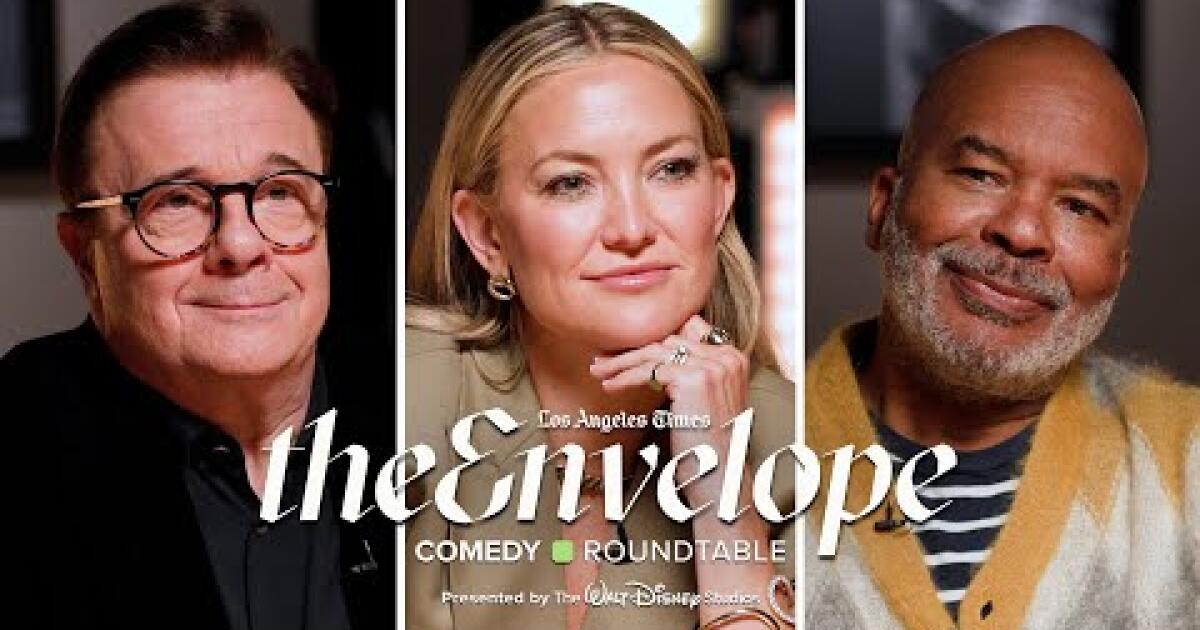
Hailing from some of today’s funniest TV series, six actors gathered recently for an uninhibited conversation about what it takes to make people laugh at The Envelope’s Emmy Roundtable for comedy actors.
In Netflix’s “Running Point,” Kate Hudson plays Isla, a woman who becomes pro basketball’s first girl boss when she takes over the family franchise. In ABC’s “Abbott Elementary,” Lisa Ann Walter portrays Melissa Schemmenti, a tough grade school teacher in Philly’s underfunded public education system. With Hulu’s “Mid-Century Modern,” Nathan Lane takes on the role of Bunny, an aging gay man who brings together a chosen family when he invites two friends to reside in his Palm Springs home. “Hacks” co-creator Paul W. Downs does double duty as Jimmy, the manager to legendary comedian Deborah Vance (Jean Smart) in the Max series. Bridget Everett, creator of HBO’s “Somebody Somewhere,” plays Sam, a cabaret singer who moves back to her family’s sleepy Kansas town to take care of her dying sister. And David Alan Grier stars as Dr. Ron, a devoted physician and cranky veteran who’s seen it all in the overrun ER of a small-town hospital in NBC’s “St. Denis Medical.”
The talented group spoke with The Times about their respective shows, typecasting and the risks one takes to make great comedy. Read on for excerpts from our discussion — and watch video of the roundtable above.
The 2025 Emmy Comedy Roundtable: Kate Hudson, left, Paul W. Downs, Bridget Everett, Nathan Lane, Lisa Ann Walter and David Alan Grier.
The best comedy pushes boundaries, which means it can also skirt the edge of offensive. How do you know if you’ve gone too far, or haven’t pushed it enough?
Downs: In the “Hacks” pilot, Jean Smart’s character, Deborah Vance, says there is no line. I think there’s nothing off limits, because it’s really about execution and thoughtfulness. The thing that makes edgy comedy not funny is when it causes harm, when it’s something that’s punching down, when it’s not something that can bring people together. That, to me, isn’t worth it. But there’s nothing that’s too taboo, because that’s what comedy is for. It’s to examine things, explore things, get close to the edge.
Everett: I think that comedy is about making people feel good. I want to make people feel joy. So as long as I’m not hurting anybody’s feelings, I think everything’s on the table.
Grier: I don’t think you know the edge and that’s why it’s dangerous. I’ve done things where I thought, “This is too much,” and things where I thought, “We didn’t go far enough.” So you have to play that game. My intention is never to anger and offend, but you do have to put yourself in that position and take a chance, especially with comedy. You can prescreen it, but who are you prescreening it to? Sixty-year-old white women? High school kids? You have to take a chance.

Kate Hudson of “Running Point.”
Hudson: I’m not a stand-up [comedian], so it’s fun to watch people walk that line. It’s exciting. What are they going to say? Is it going to be offensive? Is it not? Is it going to be brilliant? That’s part of what’s fun about being an audience of adult comedy. But I don’t like mean comedy. It’s really hard for me to see. I’ve been asked to do roasts a million times, and I just can’t do it. It just doesn’t move me in any way.
Lane: I was asked. This was the biggest mistake of my life. … A Friars [Club] Roast that was going to happen. [Jerry Lewis] was going to be roasted. And Richard Belzer said to me, “Oh, Nathan, would you be a part of it? Would you do it? It would mean a lot to Jerry.” And I’m like, “Oh, yeah, sure. I’ll do the roast.” And then I’m suddenly there and I’m sitting next to Paul Shaffer and Jeff Ross, who apologized in advance for what he might say. And I realized then that, “Oh, you’re not getting up and just roasting this person. You’re attacked. You’re on the dais.” So I thought, “Oh, what have I gotten into?” And I had asked them, “Please let me go first.” And I had worked out jokes. I had a couple of writers help me, and there was an initial joke, which was, “The only reason I agreed to do this was because I thought by the time it happened, Jerry would be dead.”
Walter: I’m on a show that’s got a lot of kids, and families can watch it together, which was Lorraine Ali Quinta Brunson’s intention. But there are things that the kids won’t get and that adults get. Melissa Schemmenti gets bleeped out regularly because she curses. She’s South Philly! As a comic, I only am interested in edge, that’s where I want to live … It’s easier to make a point and get ears when you’re making people laugh. And we do that on the show quite frequently. They’ll do a storyline about the school-to-prison pipeline, but it’s not ham-fisted, it’s not preachy. It’s edgy and it’s all within jokes. Anytime you’re making people laugh, I think you can say whatever you want.
What’s the strangest or most difficult skill you’ve had to learn for a role?
Hudson: In “Almost Famous,” [director] Cameron [Crowe] wanted me to learn how to roll cigarettes fast with one hand. And so I was learning how to roll, and I got really good at it really fast. And then when we were doing camera tests, I was doing it and I was smoking. And he was like, “No.” And I was like, “What? I just spent months trying to learn how to do that!” Then I started rolling my own cigarettes and got into a really bad habit and then spent years trying to quit.

Paul W. Downs of “Hacks.”
Downs: On “Broad City,” I had to learn and do parkour. It’s high skill level and high risk. You know, when you jump off buildings and roll around … [leap] off chairs and over fire hydrants. I did it, but not a lot of it ended up onscreen. Just the most comedic moments. I jumped between buildings and they didn’t even put it in!
Lane: When I did “Only Murders in the Building,” they said, “So you have a deaf son and you’re going to have scenes with him in ASL [American Sign Language].” It was challenging. I had a coach and I would work with him. And the wonderful young actor, James Caverly, who is Deaf … he was very supportive. If I had to become fluent, it would’ve taken six months to a year to do it well. But I had an advantage; they said, “Oh, your character is embarrassed by having a deaf son, so he didn’t learn it until later in life. So he’s not that good at it.” But it was a great thing to learn. I loved it.
Grier: I did an episode of a sitcom in which it was assumed, unbeknownst to me, that I was very proficient playing an upright bass. This is not true. I played cello as a child. I had to play this upright bass and as a jazz musician. It was horrible. Your fingers swell and blister and bleed. Of course, I went along with it because that’s what we’re all supposed to do. But by Day 4, my fingers were in great pain. I never mastered it. But I did want to ask them, “Who told you I could play?”
Everett: I did a little trapeze work, but since the knee thing, I can’t anymore … [Laughs]
Lane: This was the independent film about the Wallendas, right?
Everett: The truth is I’ve never had to do anything. Really. I had to rollerblade once in a Moby video, but that doesn’t seem like it’s going to stack up against all this, so maybe we should just move on to the next person. I would do trapeze, though. I’ll do anything. Well, not anything. Can we just edit this part out in post?
Hudson: I’m in love with you.
Walter: In a movie I did where I started out as the nosy neighbor, I found out that I was going to be a cougar assassin and I had to stunt drive a Mustang and shoot a Glock. It was a surprise. Literally. When I got to set, I saw my wardrobe and went, “I think I’m playing a different character than what I auditioned for.” … They put the car on a chain and I got T-boned. I was terrified, but then I was like, “Let’s go again!” That was the most dangerous thing until I had to do a South Philly accent as Melissa, and do it good enough so that South Philly wouldn’t kill me. That was probably more dangerous.

David Alan Grier of “St. Denis Medical.”
Let’s talk about typecasting. What are the types of roles that frequently come to you, where you’re like “Oh, my God, not again!”
Lane: Oh, not another mysterious drifter.
Hudson: Rom-coms. If I can’t get a job doing anything else, I can get a job doing a romantic comedy. When you have major success in something, you realize the business is just so excited [that] they want you in them all the time. It really has nothing to do with anything other than that. It’s something that I’m very grateful for, but you’re constantly having to fight to do different things. I’d be bored if I was constantly doing the same thing over and over again. But it’s just how the business works. Once you’re in that machine, they just want to keep going until they go to somebody else.
Walter: I can’t tell you how bored I am with being the gorgeous object of men’s desire. I named my first production company Fat Funny Friend … But as a mother of four in Los Angeles, I didn’t really have the luxury of saying, “I want to branch out.” But I did say, “Can I play someone smart?” My father was a NASA physicist. My mother was brilliant. I was over doing things I could do in my sleep, always getting the part of the woman who sticks her head out of the trailer door and goes, “I didn’t kill him, but I ain’t sorry he’s dead!” … It’s like, “Can I play someone who has a college education?” And I did, finally, but it took Quinta to do it.
Grier: I’ve found that the older I’ve gotten, the roles I’m offered have broadened. And I’ve played a variety of really challenging great roles because I’m old now. That’s been a real joy because I didn’t really expect that. I just thought I’d be retired. I did. So it’s been awesome.

Nathan Lane of “Mid-Century Modern.”
Lane: There was an article written about me, it was sort of a career-assessment article. It was a very nice piece, but it referred to me as the greatest stage entertainer of the last decade. And as flattering as it was, I can find a dark cloud in any silver lining. I felt, “Oh, that’s how they see me?” As an “entertainer” because of musicals and things [I did] like “The Birdcage” or “The Lion King.” I’d been an actor for 35 years and I thought, “I have more to offer.” So I wound up doing “The Iceman Cometh” in Chicago … and that would change everything. It was the beginning of a process where I lucked out and got some serious roles in television, and that led to other things. But it was a concerted effort over a period of 10, 15 years, and difficult because everybody wants to put you in a box.
Is it difficult in the industry to make the move between drama and comedy?
Walter: It’s a lifelong consternation to me that there is an idea that if you are known comedically, that’s what you do. We are quite capable of playing all of the things.
Grier: I remember seeing Jackie Gleason in “The Hustler.” I loved it. He was so great. Robin Williams also did serious. I think it’s actually harder when you see serious actors try to be comedians.
As a mother of four in Los Angeles, I didn’t really have the luxury of saying, ‘I want to branch out.’ But I did say, ‘Can I play someone smart?’ My father was a NASA physicist. My mother was brilliant. I was over doing things I could do in my sleep, always getting the part of the woman who sticks her head out of the trailer door and goes, ‘I didn’t kill him, but I ain’t sorry he’s dead!’
— “Abbott Elementary” actor Lisa Ann Walter on being typecast
Downs: One of the things about making “Hacks” is we wanted to do something that was mixed tone, that it was funny and comedic but also let actors like myself, like Jean, all of these people, have moments. Because to us, the most funny things are right next to the most tragic things.
Hudson: And usually the most classic. When you think about the movies that people know generation after generation, they’re usually the ones that walk the line. And they’re the ones that you just want to go back and watch over and over and over again.

Bridget Everett of “Somebody Somewhere.”
Everett: I haven’t had a lot of experience with being typecast because I’ve been in the clubs for a long time doing cabaret. But on my show, Tim Bagley, who plays Brad … he’s been doing the same characters for I don’t know for how long. So we wrote this part for him, and one of the most rewarding things for me on this show was sitting behind the monitor and watching him get to have the moment he deserved … It’s one of the greatest gifts to me as a creator to have been part of that. It’s a whole thing in my show. We’re all getting this break together. We’ve all struggled to pay our rent well into our 40s. I waited tables into my 40s, but you don’t give up because you love doing it.
I’m sure many of you are recognized in public, but what about being mistaken for somebody else who’s famous?
Grier: I went to a performance of a David Mamet show on Broadway. I went backstage, and this particular day, it was when Broadway was raising money to benefit AIDS. There was a Midwestern couple there with their young son and they saw me, and the house manager said, “This couple, they’re going to give us an extra $1,000 if you take a picture with them. Would you mind?” I’m like, “Yeah, cool.” So I’m posing and the dad goes, “It is our honor to take a picture with you, Mr. LeVar Burton.” Now in that moment, I thought if I say no, people will die. So I looked at them and I went, “You liked me in ‘Roots?’” He said, “We loved you.” Click, we took the picture. I’m not going to be like, “How dare you?!”
Walter: Peg Bundy I got a couple of times. But as soon as I open my mouth, they know who I am. I can hide my hair, but as soon as I talk, I’m made.
Hudson: I’ve had a lot of Drew Barrymore. And then every other Kate. Kate Winslet, Katie Holmes … I’ve gotten all of them.
Walter: Do you correct them?
Hudson: Never. I just say yes and sign it “Cate Blanchett.”

Lisa Ann Walter of “Abbott Elementary.”
I’d love to know who everybody’s comedic inspiration was growing up.
Walter: My dad used to let me stay up and watch “The Smothers Brothers Comedy Hour” and “Laugh-In.” I got to see Ruth Buzzi, rest in peace, and Goldie Hawn and Lily Tomlin. Jo Anne Worley. All these funny women. That’s what made me think, “You can get a job doing this, the thing that I get in trouble for at school?!”
Grier: My comedy hero was Richard Pryor. I was this Black little boy in Detroit, and George Jessel would come on “The Mike Douglas Show” and he might as well have been speaking Russian. I’m like, “How can this be comedy?” Then I saw Richard Pryor, and he was the first comic who I just went, “Well, this guy’s hilarious.”
Downs: I remember one of the first comedies that my dad showed me was “Young Frankenstein.” I remember Teri Garr, Cloris Leachman and Madeline Kahn. All of these women. I was always like, “They’re the funniest ones.”
Hudson: My era growing up was Steve Martin, Martin Short, Albert Brooks, Mel Brooks. But women were, for me, the classics. Lucille Ball.
Walter: There was a time when I was growing up where women really dominated comedy. They were your mom [nods at Hudson, Hawn’s daughter], Whoopi [Goldberg], Bette Midler. The biggest stars of the biggest comedies were women, and then that all went away for a really long time. I think it found its way back with Judd Apatow and then he made “Bridesmaids.”
Hudson: I tried really hard to make edgy comedy and studios wouldn’t do it. They wouldn’t. It took Judd to convince the studio system that women are ready. That we can handle rated-R. In the ’70s and ’80s, there was a ton of rated-R comedy with women. But for some reason, it just all of a sudden became like, “Oh, there’s only 1½ demographics for women in comedy.” I always felt like it was an uphill battle trying to get them made. Then I remember when Jenji [Kohan] came in with “Orange Is the New Black.” That was really awesome.
Lane: Above all, it was always Jackie Gleason for me. He was such an influence. He was hilarious, and of course, very broadly funny, but then there was something so sad. It was such pathos with him. … He was this wonderful, serious actor, as well as being Ralph Kramden.
Everett: There’s nobody that taught me more about how to be funny than my mom. She just had this way of being that I have used in my live shows. It’s led to where I am now. She used to wet her pants [laughing] so she had to put towels down on all the chairs in the house. She just didn’t care. That shows you to not care, to go out there. I live in fear, but not when I feel like she’s with me.
Grier: That’s the edge. You’re either going to weep or you’re going to [laugh] until you urinate.



I am a sucker for all those straight-to-video slasher movies from the 90’s; there was just a certain point where you knew the acting was terrible, however, it made you fall in love. I can definitely remember scanning the video store sections for all the different horror movies I could. All those movies had laughable names and boom mics accidentally getting in the frame. Trucker seems like a child of all those old dreams, because it is.
Let’s get into the review.
Synopsis
When a group of reckless teens cause an accident swroe to never speak of it. The father is reescued by a strange man. from the wreckage and nursed back to health by a mysterious old man. When the group agrees to visit the accident scene, they meet their match from a strange masked trucker and all his toys with revenge on his mind.
Roll on 18 Wheleer
Trucker is what you would imagine: a movie about a psychotic trucker chasing you. We have seen it many, many times. What makes the film so different is its homage to bad movies but good ideas. I don’t mean in a negative way. When you think of a slasher movie, it’s not very complicated; as a matter of fact, it takes five minutes to piece the film together. This is so simple and childlike, and I absolutely love it. Trucker gave us something a little different, not too gory, bad CGI fire, I mean, this is all we old schlock horror fans want. Trucker is the type of film that you expect from a Tubi Original, on speed. However, I would take this over any Tubi Original.
I found some parts that were definitely a shout-out to the slasher humor from all those movies. Another good point that made the film shine was the sets. I guess what I can say is the film is everything Joy Ride should have been. While most modern slashers are trying to recreate the 1980s, the film stands out with its love for those unloved 1990’s horror films. While most see Joyride, you are extremely mistaken, my friend; you will enjoy this film much more.

In The End
In the end, I enjoyed the entire film. At first, I saw it listed as an action thriller; I was pleasantly surprised, and Trucker pulled at my heart strings, enveloping me in its comfort from a long-forgotten time in horror. It’s a nostalgic blast for me, thinking back to that time, my friends, my youth, and finding my new home. Horror fans are split down the middle: from serial-killer clowns (my side) to elevated horror, where an artist paints a forty-thousand-year-old demon that chases them around an upper-class studio apartment. I say that a lot, but it’s the best way to describe some things.
The entire movie had me cheering while all the people I hated suffered dire consequences for their actions. It’s the same old story done in a way that we rabid fans could drool over, and it worked. In all the bad in the world today, and my only hope for the future is the soon-to-end Terrifier franchise. However, the direction was a recipe to succeed with 40+ year old horror fans like me. I see the film as a hope for tomorrow, leading us into a new era.
Trucker is set to release on March 10th, 2026
Entertainment
Review: In ‘American Classic,’ Kevin Kline and Laura Linney deliver a love letter to theater

The lovely, funny “American Classic,” premiering Sunday on MGM+, is a love letter to theater, community and community theater. Kevin Kline plays Richard Bean, a narcissistic stage actor. He’s famous enough to be opening on Broadway in “King Lear,” but he has to be pushed onstage and is forgetting lines. After he drunkenly assails a hostile New York Times critic — caught on video, of course — he’s suspended from the play, and his agent (Tony Shalhoub) advises him to get out of town and lay low until the heat’s off, as they used to say in the gangster movies.
Learning that his mother (Jane Alexander, acting royalty, in film clips) has died, Richard heads back to his small Pennsylvania hometown, where his family — all actors, like the Barrymores, but no longer acting — owns a once-celebrated theater. To Richard’s horror, it has, for want of income, become a dinner theater, hosting touring productions of “Nunsense” and “Forever Plaid” instead of the great stage works on which he cut his teeth.
Brother Jon (Jon Tenney), running the kitchen at the theater, is married to Kristen (Laura Linney), Richard’s onetime acting partner, who dated him before her marriage; now she’s the mayor. Their teenage daughter, Miranda (Nell Verlaque) — a name from Shakespeare — does want to act and move to New York, as her mother had before her, but is afraid to tell her parents. Richard’s father, Linus (Len Cariou), is suffering from dementia, though not to the point he won’t actively contribute to the action; every day he comes out again as gay.
Across the eight-episode series, things move from the ridiculous to the sublime. Richard’s attempt to stage his mother’s funeral, with her coffin being lowered from the ceiling, while “Also sprach Zarathustra” plays and smoke billows toward the audience, fortunately comes to naught; but he announces at the ceremony that he’ll direct a production of Thornton Wilder’s 1938 play “Our Town” at the theater, to “restore the soul of this town.” (His big idea is to ignore Wilder’s stage directions, which ask for no curtain, no set and few props, with a “realistic version,” featuring a working soda fountain, rain effects and a horse.) Fate will have other plans for this, and not to give away what in any case should be obvious, the title of the play will also become its ethos, with a cast of amateurs, including Miranda’s jealous boyfriend, Randall (Ajay Friese), and ordinary people standing in for the ordinary people of Wilder’s Grover’s Corners.
The series has a comfortable, cushiony feeling; it’s the sort of show that could have been made as a film in the 1990s, and in which Kline could have starred as easily in his 40s as in his 70s; it has the same relation to reality as “Dave,” in which he played a good-hearted ordinary Joe who takes the place of a lookalike U.S. president. The town is essentially a sunny place, full of mostly sunny people, to all appearances, a typical comedy hamlet. But we’re told it’s distressed, and Mayor Kristen is in transactional cahoots with developer Connor Boyle (Billy Carter), who wants clearance to build a casino on the site of a landmark hotel. (Much of the plot is driven by money — needing it, trading for it, leaving it, losing it.) He also wants his heavily accented, bombshell Russian girlfriend, Nadia (Elise Kibler), to have a part in “Our Town.”
As in the great Canadian comedy “Slings & Arrows,” set at a Shakespeare Festival outside of Toronto, themes and moments and speeches from the play being performed are echoed in the lives of the performers, while the viewer experiences the double magic of watching a fine actor playing an actor playing a part. Kline, of course, is himself an American classic, with a long stage and screen career that encompasses classical drama, romantic and musical comedy and cartoon voiceovers; the series makes room for Richard to perform soliloquies from “Hamlet” and “Henry V,” parts Klein has played onstage. He brings out the sweetness latent in Richard. Linney, who played against her sweetheart image in “Ozark,” is happily back on less deadly ground (though she’s tense and drinks a little). Tenney, who was sweet and funny on “The Closer,” and who we don’t see enough of these days, is sweeter and funnier here, and gets to sing. (All the Beans will sing, except for Linus.)
As a comedy, it is often predicable — you know that things will work out, and some major plot points are as good as inevitable — but it’s the good sort of predictability, where you get what you came for, where you hear the words you want to hear, ones you could never have written yourself. “American Classic” is not out to challenge your world view in any way but wants only to confirm your feelings and in doing so amplify them. Shock effects are fine in their place — and to be sure there are major twists in the plot — but there is a certain release when the thing you’re ready to have happen, happens, whether it brings laughter or tears. Either is welcome.
Movie Reviews
‘Scream 7’ Review: Ghostface Trades His Metallic Knife for Plastic in Bloody Embarrassing Slasher Sequel

It’s funny how this film is marketed as the first Scream movie in IMAX, yet it’s their sloppiest work to date. Williamson accomplishes two decent kills. My praise goes to the prosthetic team and gore above anything else. The filmmaking is amateurish, lacking any of the tension build and innovation in set pieces like the Radio Silence or Craven entries. Many slasher sequences consist of terribly spliced editing and incomprehensible camera movement. There was a person at my screening asking if one of the Ghostfaces was killed. I responded, “Yeah, they were shot in the head; you just couldn’t see it because the filmmaking is so damn unintelligible.”
Really, Spyglass? This is the best you can do to “damage control” your series that was perfectly fine?
I’m getting comments from morons right now telling me that I’m biased for speaking “politically” about this movie. Fuck you! This poorly made, bland, and franchise-worst entry is a byproduct of political cowardice.
The production company was so adamant about silencing their outspoken star, who simply stated that she’s against the killing of Palestinian people by an evil totalitarian regime, that they deliberately fired her, conflating her comments to “anti-semintism,” when, and if you read what she said exactly, it wasn’t. Only to reconstruct the buildup made in her arc and settle on a nonsensical, manufactured, nostalgia-based slop fest to appeal to fans who lack genuine film taste in big 2026. To add insult to injury, this movie actively takes potshots at those predecessors, perhaps out of pettiness that Williamson didn’t pen them or a mean-spirited middle finger to the star the studio fired. Truly, fuck you. Take the Barrera aspect out of this, which is still impossible, and Scream 7 is a lazy, sloppy, ill-conceived, no-vision, enshittification of Scream and a bloody embarrassment to the franchise. It took a real, morally upright actress to make Ghostface’s knife go from metal to plastic.
FINAL STATEMENT
You either die a Scream or live long enough to see yourself become a Stab.

Arkansas Bested by Mizzou on Sunday

More SoCal rallies for and against military action in Iran expected on Sunday and Monday

Colorado lawmakers duel over data centers: Grant millions in tax breaks or regulate them without incentives?

Two people shot in New Haven restaurant Saturday evening

When will Delaware warm up? After snow, ice Tuesday, temps will rise

Florida High School Football Rankings: Top 25 teams – Oct. 21

Cleary's 21 help Le Moyne down Central Connecticut State 69-64 in OT

How old is Bo Nix? What to know about Oregon quarterback ahead of 2024 NFL Draft

99th annual Pony Swim held in Virginia

Indiana Members Credit Union announced as new anchor tenant at Bottleworks District

Video: What the Texas Primary Battle Means for the Midterms

Dems’ potential 2028 hopefuls come out against US strikes on Iran

At least nine killed after Iranian strike on Israel’s Beit Shemesh

Mass shooting at Austin, Texas bar leaves at least 3 dead, 14 wounded, authorities say

Mamdani’s response to Trump’s Iran strike sparks conservative backlash: ‘Rooting for the ayatollah’
-

 World4 days ago
Exclusive: DeepSeek withholds latest AI model from US chipmakers including Nvidia, sources say
-

 Massachusetts4 days ago
Mother and daughter injured in Taunton house explosion
-

 Montana1 week ago
2026 MHSA Montana Wrestling State Championship Brackets And Results – FloWrestling
-

 Denver, CO4 days ago
10 acres charred, 5 injured in Thornton grass fire, evacuation orders lifted
-

 Louisiana7 days ago
Wildfire near Gum Swamp Road in Livingston Parish now under control; more than 200 acres burned
-

 Technology1 week ago
YouTube TV billing scam emails are hitting inboxes
-

 Technology1 week ago
Stellantis is in a crisis of its own making
-

 Politics1 week ago
OpenAI didn’t contact police despite employees flagging mass shooter’s concerning chatbot interactions: REPORT