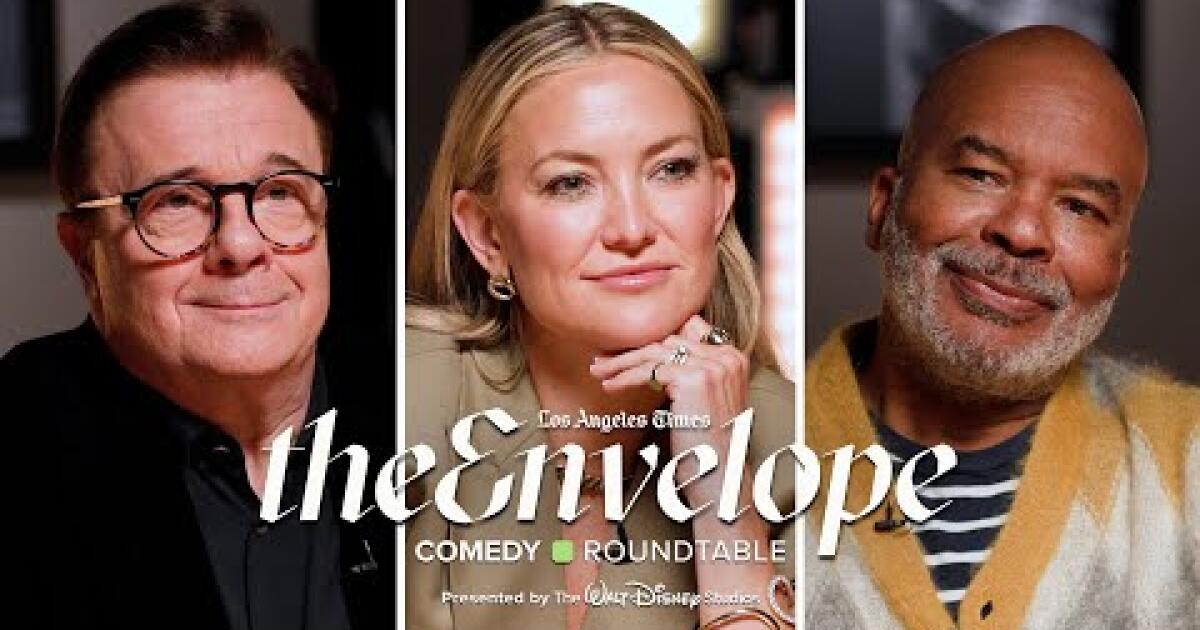
Hailing from some of today’s funniest TV series, six actors gathered recently for an uninhibited conversation about what it takes to make people laugh at The Envelope’s Emmy Roundtable for comedy actors.
In Netflix’s “Running Point,” Kate Hudson plays Isla, a woman who becomes pro basketball’s first girl boss when she takes over the family franchise. In ABC’s “Abbott Elementary,” Lisa Ann Walter portrays Melissa Schemmenti, a tough grade school teacher in Philly’s underfunded public education system. With Hulu’s “Mid-Century Modern,” Nathan Lane takes on the role of Bunny, an aging gay man who brings together a chosen family when he invites two friends to reside in his Palm Springs home. “Hacks” co-creator Paul W. Downs does double duty as Jimmy, the manager to legendary comedian Deborah Vance (Jean Smart) in the Max series. Bridget Everett, creator of HBO’s “Somebody Somewhere,” plays Sam, a cabaret singer who moves back to her family’s sleepy Kansas town to take care of her dying sister. And David Alan Grier stars as Dr. Ron, a devoted physician and cranky veteran who’s seen it all in the overrun ER of a small-town hospital in NBC’s “St. Denis Medical.”
The talented group spoke with The Times about their respective shows, typecasting and the risks one takes to make great comedy. Read on for excerpts from our discussion — and watch video of the roundtable above.
The 2025 Emmy Comedy Roundtable: Kate Hudson, left, Paul W. Downs, Bridget Everett, Nathan Lane, Lisa Ann Walter and David Alan Grier.
Advertisement
The best comedy pushes boundaries, which means it can also skirt the edge of offensive. How do you know if you’ve gone too far, or haven’t pushed it enough?
Downs: In the “Hacks” pilot, Jean Smart’s character, Deborah Vance, says there is no line. I think there’s nothing off limits, because it’s really about execution and thoughtfulness. The thing that makes edgy comedy not funny is when it causes harm, when it’s something that’s punching down, when it’s not something that can bring people together. That, to me, isn’t worth it. But there’s nothing that’s too taboo, because that’s what comedy is for. It’s to examine things, explore things, get close to the edge.
Everett: I think that comedy is about making people feel good. I want to make people feel joy. So as long as I’m not hurting anybody’s feelings, I think everything’s on the table.
Grier: I don’t think you know the edge and that’s why it’s dangerous. I’ve done things where I thought, “This is too much,” and things where I thought, “We didn’t go far enough.” So you have to play that game. My intention is never to anger and offend, but you do have to put yourself in that position and take a chance, especially with comedy. You can prescreen it, but who are you prescreening it to? Sixty-year-old white women? High school kids? You have to take a chance.
Kate Hudson of “Running Point.”
Advertisement
Hudson: I’m not a stand-up [comedian], so it’s fun to watch people walk that line. It’s exciting. What are they going to say? Is it going to be offensive? Is it not? Is it going to be brilliant? That’s part of what’s fun about being an audience of adult comedy. But I don’t like mean comedy. It’s really hard for me to see. I’ve been asked to do roasts a million times, and I just can’t do it. It just doesn’t move me in any way.
Lane: I was asked. This was the biggest mistake of my life. … A Friars [Club] Roast that was going to happen. [Jerry Lewis] was going to be roasted. And Richard Belzer said to me, “Oh, Nathan, would you be a part of it? Would you do it? It would mean a lot to Jerry.” And I’m like, “Oh, yeah, sure. I’ll do the roast.” And then I’m suddenly there and I’m sitting next to Paul Shaffer and Jeff Ross, who apologized in advance for what he might say. And I realized then that, “Oh, you’re not getting up and just roasting this person. You’re attacked. You’re on the dais.” So I thought, “Oh, what have I gotten into?” And I had asked them, “Please let me go first.” And I had worked out jokes. I had a couple of writers help me, and there was an initial joke, which was, “The only reason I agreed to do this was because I thought by the time it happened, Jerry would be dead.”
Walter: I’m on a show that’s got a lot of kids, and families can watch it together, which was Lorraine Ali Quinta Brunson’s intention. But there are things that the kids won’t get and that adults get. Melissa Schemmenti gets bleeped out regularly because she curses. She’s South Philly! As a comic, I only am interested in edge, that’s where I want to live … It’s easier to make a point and get ears when you’re making people laugh. And we do that on the show quite frequently. They’ll do a storyline about the school-to-prison pipeline, but it’s not ham-fisted, it’s not preachy. It’s edgy and it’s all within jokes. Anytime you’re making people laugh, I think you can say whatever you want.
What’s the strangest or most difficult skill you’ve had to learn for a role?
Hudson: In “Almost Famous,” [director] Cameron [Crowe] wanted me to learn how to roll cigarettes fast with one hand. And so I was learning how to roll, and I got really good at it really fast. And then when we were doing camera tests, I was doing it and I was smoking. And he was like, “No.” And I was like, “What? I just spent months trying to learn how to do that!” Then I started rolling my own cigarettes and got into a really bad habit and then spent years trying to quit.
Advertisement
Paul W. Downs of “Hacks.”
Downs: On “Broad City,” I had to learn and do parkour. It’s high skill level and high risk. You know, when you jump off buildings and roll around … [leap] off chairs and over fire hydrants. I did it, but not a lot of it ended up onscreen. Just the most comedic moments. I jumped between buildings and they didn’t even put it in!
Lane: When I did “Only Murders in the Building,” they said, “So you have a deaf son and you’re going to have scenes with him in ASL [American Sign Language].” It was challenging. I had a coach and I would work with him. And the wonderful young actor, James Caverly, who is Deaf … he was very supportive. If I had to become fluent, it would’ve taken six months to a year to do it well. But I had an advantage; they said, “Oh, your character is embarrassed by having a deaf son, so he didn’t learn it until later in life. So he’s not that good at it.” But it was a great thing to learn. I loved it.
Grier: I did an episode of a sitcom in which it was assumed, unbeknownst to me, that I was very proficient playing an upright bass. This is not true. I played cello as a child. I had to play this upright bass and as a jazz musician. It was horrible. Your fingers swell and blister and bleed. Of course, I went along with it because that’s what we’re all supposed to do. But by Day 4, my fingers were in great pain. I never mastered it. But I did want to ask them, “Who told you I could play?”
Everett: I did a little trapeze work, but since the knee thing, I can’t anymore … [Laughs]
Advertisement
Lane: This was the independent film about the Wallendas, right?
Everett: The truth is I’ve never had to do anything. Really. I had to rollerblade once in a Moby video, but that doesn’t seem like it’s going to stack up against all this, so maybe we should just move on to the next person. I would do trapeze, though. I’ll do anything. Well, not anything. Can we just edit this part out in post?
Hudson: I’m in love with you.
Walter: In a movie I did where I started out as the nosy neighbor, I found out that I was going to be a cougar assassin and I had to stunt drive a Mustang and shoot a Glock. It was a surprise. Literally. When I got to set, I saw my wardrobe and went, “I think I’m playing a different character than what I auditioned for.” … They put the car on a chain and I got T-boned. I was terrified, but then I was like, “Let’s go again!” That was the most dangerous thing until I had to do a South Philly accent as Melissa, and do it good enough so that South Philly wouldn’t kill me. That was probably more dangerous.
David Alan Grier of “St. Denis Medical.”
Advertisement
Let’s talk about typecasting. What are the types of roles that frequently come to you, where you’re like “Oh, my God, not again!”
Lane: Oh, not another mysterious drifter.
Hudson: Rom-coms. If I can’t get a job doing anything else, I can get a job doing a romantic comedy. When you have major success in something, you realize the business is just so excited [that] they want you in them all the time. It really has nothing to do with anything other than that. It’s something that I’m very grateful for, but you’re constantly having to fight to do different things. I’d be bored if I was constantly doing the same thing over and over again. But it’s just how the business works. Once you’re in that machine, they just want to keep going until they go to somebody else.
Walter: I can’t tell you how bored I am with being the gorgeous object of men’s desire. I named my first production company Fat Funny Friend … But as a mother of four in Los Angeles, I didn’t really have the luxury of saying, “I want to branch out.” But I did say, “Can I play someone smart?” My father was a NASA physicist. My mother was brilliant. I was over doing things I could do in my sleep, always getting the part of the woman who sticks her head out of the trailer door and goes, “I didn’t kill him, but I ain’t sorry he’s dead!” … It’s like, “Can I play someone who has a college education?” And I did, finally, but it took Quinta to do it.
Grier: I’ve found that the older I’ve gotten, the roles I’m offered have broadened. And I’ve played a variety of really challenging great roles because I’m old now. That’s been a real joy because I didn’t really expect that. I just thought I’d be retired. I did. So it’s been awesome.
Advertisement
Nathan Lane of “Mid-Century Modern.”
Lane: There was an article written about me, it was sort of a career-assessment article. It was a very nice piece, but it referred to me as the greatest stage entertainer of the last decade. And as flattering as it was, I can find a dark cloud in any silver lining. I felt, “Oh, that’s how they see me?” As an “entertainer” because of musicals and things [I did] like “The Birdcage” or “The Lion King.” I’d been an actor for 35 years and I thought, “I have more to offer.” So I wound up doing “The Iceman Cometh” in Chicago … and that would change everything. It was the beginning of a process where I lucked out and got some serious roles in television, and that led to other things. But it was a concerted effort over a period of 10, 15 years, and difficult because everybody wants to put you in a box.
Is it difficult in the industry to make the move between drama and comedy?
Walter: It’s a lifelong consternation to me that there is an idea that if you are known comedically, that’s what you do. We are quite capable of playing all of the things.
Grier: I remember seeing Jackie Gleason in “The Hustler.” I loved it. He was so great. Robin Williams also did serious. I think it’s actually harder when you see serious actors try to be comedians.
Advertisement
As a mother of four in Los Angeles, I didn’t really have the luxury of saying, ‘I want to branch out.’ But I did say, ‘Can I play someone smart?’ My father was a NASA physicist. My mother was brilliant. I was over doing things I could do in my sleep, always getting the part of the woman who sticks her head out of the trailer door and goes, ‘I didn’t kill him, but I ain’t sorry he’s dead!’
— “Abbott Elementary” actor Lisa Ann Walter on being typecast
Downs: One of the things about making “Hacks” is we wanted to do something that was mixed tone, that it was funny and comedic but also let actors like myself, like Jean, all of these people, have moments. Because to us, the most funny things are right next to the most tragic things.
Hudson: And usually the most classic. When you think about the movies that people know generation after generation, they’re usually the ones that walk the line. And they’re the ones that you just want to go back and watch over and over and over again.
Advertisement
Bridget Everett of “Somebody Somewhere.”
Everett: I haven’t had a lot of experience with being typecast because I’ve been in the clubs for a long time doing cabaret. But on my show, Tim Bagley, who plays Brad … he’s been doing the same characters for I don’t know for how long. So we wrote this part for him, and one of the most rewarding things for me on this show was sitting behind the monitor and watching him get to have the moment he deserved … It’s one of the greatest gifts to me as a creator to have been part of that. It’s a whole thing in my show. We’re all getting this break together. We’ve all struggled to pay our rent well into our 40s. I waited tables into my 40s, but you don’t give up because you love doing it.
I’m sure many of you are recognized in public, but what about being mistaken for somebody else who’s famous?
Grier: I went to a performance of a David Mamet show on Broadway. I went backstage, and this particular day, it was when Broadway was raising money to benefit AIDS. There was a Midwestern couple there with their young son and they saw me, and the house manager said, “This couple, they’re going to give us an extra $1,000 if you take a picture with them. Would you mind?” I’m like, “Yeah, cool.” So I’m posing and the dad goes, “It is our honor to take a picture with you, Mr. LeVar Burton.” Now in that moment, I thought if I say no, people will die. So I looked at them and I went, “You liked me in ‘Roots?’” He said, “We loved you.” Click, we took the picture. I’m not going to be like, “How dare you?!”
Walter: Peg Bundy I got a couple of times. But as soon as I open my mouth, they know who I am. I can hide my hair, but as soon as I talk, I’m made.
Advertisement
Hudson: I’ve had a lot of Drew Barrymore. And then every other Kate. Kate Winslet, Katie Holmes … I’ve gotten all of them.
Walter: Do you correct them?
Hudson: Never. I just say yes and sign it “Cate Blanchett.”
Lisa Ann Walter of “Abbott Elementary.”
I’d love to know who everybody’s comedic inspiration was growing up.
Advertisement
Walter: My dad used to let me stay up and watch “The Smothers Brothers Comedy Hour” and “Laugh-In.” I got to see Ruth Buzzi, rest in peace, and Goldie Hawn and Lily Tomlin. Jo Anne Worley. All these funny women. That’s what made me think, “You can get a job doing this, the thing that I get in trouble for at school?!”
Grier: My comedy hero was Richard Pryor. I was this Black little boy in Detroit, and George Jessel would come on “The Mike Douglas Show” and he might as well have been speaking Russian. I’m like, “How can this be comedy?” Then I saw Richard Pryor, and he was the first comic who I just went, “Well, this guy’s hilarious.”
Downs: I remember one of the first comedies that my dad showed me was “Young Frankenstein.” I remember Teri Garr, Cloris Leachman and Madeline Kahn. All of these women. I was always like, “They’re the funniest ones.”
Hudson: My era growing up was Steve Martin, Martin Short, Albert Brooks, Mel Brooks. But women were, for me, the classics. Lucille Ball.
Walter: There was a time when I was growing up where women really dominated comedy. They were your mom [nods at Hudson, Hawn’s daughter], Whoopi [Goldberg], Bette Midler. The biggest stars of the biggest comedies were women, and then that all went away for a really long time. I think it found its way back with Judd Apatow and then he made “Bridesmaids.”
Advertisement
Hudson: I tried really hard to make edgy comedy and studios wouldn’t do it. They wouldn’t. It took Judd to convince the studio system that women are ready. That we can handle rated-R. In the ’70s and ’80s, there was a ton of rated-R comedy with women. But for some reason, it just all of a sudden became like, “Oh, there’s only 1½ demographics for women in comedy.” I always felt like it was an uphill battle trying to get them made. Then I remember when Jenji [Kohan] came in with “Orange Is the New Black.” That was really awesome.
Lane: Above all, it was always Jackie Gleason for me. He was such an influence. He was hilarious, and of course, very broadly funny, but then there was something so sad. It was such pathos with him. … He was this wonderful, serious actor, as well as being Ralph Kramden.
Everett: There’s nobody that taught me more about how to be funny than my mom. She just had this way of being that I have used in my live shows. It’s led to where I am now. She used to wet her pants [laughing] so she had to put towels down on all the chairs in the house. She just didn’t care. That shows you to not care, to go out there. I live in fear, but not when I feel like she’s with me.
Grier: That’s the edge. You’re either going to weep or you’re going to [laugh] until you urinate.
A family and friends gather for a naming-day ceremony at a Danish seaside hotel, but an unexpected appearance by one uninvited attendee (Trine Dyrholm) ruptures the veil of bland, happy-clappy familial unity in director Mads Mengel’s gutsy, well-wrought debut feature, The Guest.
The most audacious move here may be Mengel and co-screenwriter Christian Bengtson’s choice to write something that will inevitably invite comparisons with Festen (The Celebration), arguably the most notorious Danish-language film of the last 30 years, which similarly revolved around a bougie gathering disrupted by angry revelations. But there’s a savvy 2026 vibe about the way the film refuses to create florid melodrama out of quotidian crisis, and instead observes with generosity as the characters grope awkwardly toward emotional détente and mutual forgiveness.
The Guest
The Bottom Line
When wetting the baby’s head goes too far.
Advertisement
Venue: Karlovy Vary Film Festival Cast: Simon Bennebjerg, Trine Dyrholm, Josephine Park, Peter Gantzler, Petrine Agger, Mette Klakstein Wiberg, Kristine Kujath Thorp, Buster Lund Luscher Director: Mads Mengel Screenwriter: Christian Bengtson, Mads Mengel
1 hour 40 minutes
Festen-alumnus Dyrholm, having a bit of a career moment with outstanding performances both here and in the recent The Girl With the Needle among others, leads a uniformly excellent cast in a work that deserves celebration on the festival circuit and beyond.
Dyrholm’s Vibeke is technically the first person we meet, although she’s seen only in shadow at first as she smokes and drives while her unattached seatbelt, caught outside by a closed door, clatters on the road. This is the kind of unsafe driving her son Karl (Simon Bennebjerg) so deplores, a point of contention later on in the story when he will steal her car keys in interest of her own safety and that of others.
Advertisement
But well before we get to that flashpoint, the film introduces Karl, effectively the film’s protagonist, as he arrives at the swanky resort with his wife Emilie (Mette Klakstein Wiberg) and their infant son Elliot (Buster Lund Luscher). The young family, who’ve chosen this new, secular tradition instead of a christening to welcome their child to the world, are there a day before the ceremony to meet up with core family members.
As this advance party settles down for dinner, a table that includes Karl’s sister Rikke (Josephine Park) and Emilie’s parents Frank (Peter Gantzler) and Kirsten (Petrine Agger), there’s a surprise: Vibeke is coming, courtesy of Rikke’s invitation. Karl is quietly furious and seems determined to turn her away, even when she shows up minutes later. Poor Frank and Kirsten look on confused, determinedly polite in their insistence that all family members should be welcome.
Bengtson and Mengel’s economical script carefully dripfeeds backstory as the film unfolds to explain that Karl hasn’t spoken to his mother in years, that Rikke has taken over all the daily mom management and that she’s very worn out by it. Even so, she insists Vibeke is regularly taking her medication and isn’t a problem these days, although to Karl every weird anecdote and moment of emotional intensity is an augur of impending chaos. Rikke counters that their mother is just “big, that’s her personality not her condition.”
Interestingly, that specific condition is never named throughout, although armchair diagnosticians might spot many of the signs of bipolar disorder. But the film’s emotional focus on the person and her actions rather than the label is also very contemporary, reflecting a more holistic, inclusive mindset and approach to dealing with mental health issues.
Which is all fine and dandy, until Vibeke duly does skip a dosage and starts getting manic. One of the first signs of chemical imbalance arrives during the ceremony on the beach, when Vibeke carries little Elliot much further away from the shore than anyone wants, creating a panic. From there it just gets worse as Vibeke picks up on the censorious feeling emerging from the other party guests, who had found her so charming the night before when she’d led everyone to the casino to play roulette and diverted a bunch of partying teenagers from the room next to Karl and Emilie so they could get some sleep. When the toasts at the formal dinner begin, Vibeke’s mood darkens much further, and if we’ve all learned one thing from Festen, it’s be very afraid when a Dane gets up to make a toast.
Advertisement
Cinematographer David Bauer’s nimble-footed lensing and use of natural light does indeed hark back considerably to the look of those Dogme 95 movies back in the day, as does the naturalistic editing style deployed by Louis Emil Ramm Seeberg. But there are plenty of sins against the rules of cinematic chastity that marked that movement, such as the ample space made for Lasse Aagaard’s affecting, low-key score that amps up the anxiety as Vibeke starts to spiral.
That said, Mengel keeps things simple in sonic terms when it really counts, letting the musicality of Dyrholm’s deep, sonorous voice ring out on its own in the big monologue scenes. She is, as ever, utterly mesmerizing but the performance is made even more powerful by the muted, expressive reactions of the rest of the cast as they look on, frozen like deer in the headlights of the car crash of pseudo-christening. Moments of levity puncture the gloom, but the final feeling is one of numbed sorrow and pity for all these kind, fallible people, just trying to do their best.
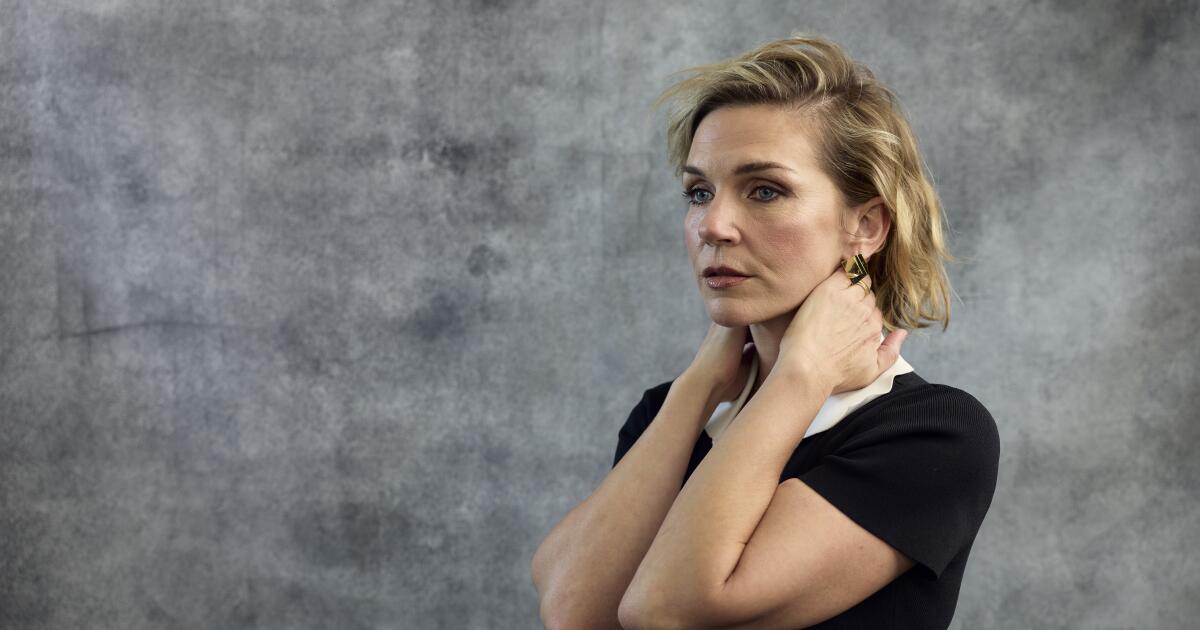
Rhea Seehorn was nervous about whether “Pluribus” would be recognized by Emmy voters Wednesday when nominations were announced. So she was jubilant when she and the surreal sci-series on Apple TV scored 18 nominations, the most for a first-year drama.
“I’m just so grateful,” the actor said in a phone interview. “People were like, ‘Why were you nervous?’ Honestly, you never actually know. I’m just so thrilled for the show, my co-stars, the production design, the editing, the writing, the music, the sound. I haven’t moved from my couch since they first announced everything because I’m still trying to call everybody on the show.”
Seehorn received a nomination for lead actress in a drama series for her portrayal of cynical Carol Sturka, a fantasy romance author who finds herself in a mystifying situation after a virus seems to have wiped out most of Earth’s population. The series was created by Vince Gilligan, who created the acclaimed series “Breaking Bad” and co-created its spinoff “Better Call Saul,” which also featured Seehorn.
The actor compared her experience of being nominated for “Pluribus” to “Better Call Saul,” which earned her two supporting actress nominations: “ ‘Better Call Saul’ was such a family that supported and cheered each other on, and I’m so grateful I have that environment again. People could not be happier for each other, and we get to celebrate the show together.”
She added, “The only part that feels different is that it’s my first nomination as a lead. It’s the process of Vince writing this for me and seeing the mountain which he wanted me to climb and going through that process. The whole thing has been its own journey, so ending up with awards and nominations, and being so well received by critics and fans is not lost on me.”
Advertisement
The series has been applauded for its mix of drama, comedy and strangeness in its portrait of a woman coming to terms to what seems like an impossible dilemma.
“I love the storytelling, how much Vince and I would drill down on making this as authentic as we could in terms of an everyman who has to deal with an insane situation,” Seehorn said. “Most of us are just not heroic or leaping off the couch to go save the world. And Carol is dealing with immense grief and confusion in an utter dystopian crisis. I love the humor and the drama that comes out of us being as realistic as we can with her amidst an unrealistic event.”
Fans of “Pluribus” have been relentlessly curious since the finale in December about when the second season will launch.
“I don’t know anything about that,” Seehorn said. “I don’t have to keep secrets because I’m not great at keeping them, and I know nothing. I don’t know what I’m doing with an atom bomb in the driveway. I can’t wait to find out. The writers want to have the same quality and reward the intelligence of the fans and never phone a single thing in. So their process is their process.”
In a roundabout way, the fact that I don’t have a strong attachment to The Wizard of Oz as a film (my late mother loved it, so that memory is deeply rooted in me, but the movie itself never did much for me) contributed directly to how amusing I found Gail Daughtry and the Celebrity Sex Pass to be. This comedy spoofs the plot of the classic fantasy movie, though the jokes are largely about Hollywood. The humor is big and broad, with some of the jokes really landing. Others? Not so much. Still, more than enough do to warrant a recommendation.
Gail Daughtry and the Celebrity Sex Pass gets a lot of mileage out of sending up show business, even if the observations, while funny, are not particularly new. Besides the deluge of jokes, there’s also a lot of likably broad characters to spend time with, especially our lead. They make the 90 minutes and change spent together with them go down very easy.
Sony Pictures Classics
For Gail Daughtry (Zoey Deutch), her life as a small town hairdresser is perfect. Engaged to her high school sweetheart Tom (Michael Cassidy), she’s the picture of happiness, at least until a trip to a celebrity book signing. There, Tom meets and ends up sleeping with his “celebrity pass,” a term Gail wasn’t even really previously aware of. Feeling betrayed, Gail impulsively joins her co-worker and friend Otto (Miles Gutierrez-Riley) on a trip to Los Angeles. There, a psychic convinces her that the can save her marriage by sleeping with her own celebrity pass: Jon Hamm (Jon Hamm).
Journeying through Tinseltown in a manner that recalls Dorothy’s adventure in Oz, Gail and Otto won’t have to find Hamm alone. Joining forces with talent agency assistant Caleb (Ben Wang), down on his luck paparazzo Vincent (Ken Marino), and actor John Slattery (John Slattery). As they search for Hamm, some for their own purposes, they meet other celebrities, while also being hunted by a group of Italian assassins after a case of mistaken identity. Eventually, they come across Hamm, and the moment of truth is at hand.
Sony Pictures Classics
Zoey Deutch dives headfirst into a broad comedy like this, absolutely relishing the opportunity to get silly again. She’s able to make Gail a babe in the woods but also someone you laugh with, not at. It’s a wildly enjoyable turn. Deutch started out in comedies and was always a talented comedic actress, so it’s a pleasure to watch her back at it. Miles Gutierrez-Riley and Ben Wang get some very funny moments, while Ken Marino is a reliable comic presence. Jon Hamm and John Slattery are delighted to be sending up themselves, with amusing results. Supporting players here, in addition to Michael Cassidy, also include Kerri Kenney, Richard Kind, Thomas Lennon, Joe Lo Truglio, Fred Melamed, and more, plus some cameos.
Advertisement
Filmmaker David Wain, again co-writing with Ken Marino, continues to make it look easy. Few can make a silly comedy like Marino and Wain, especially as they pack their flicks with extra bits that only subsequent viewings reveal. Is Gail Daughtry and the Celebrity Sex Pass on the same level as Wet Hot American Summer or They Came Together? No, not quite. At the same time, is this, scattershot approach and all, funnier than most other 2026 releases? You bet. Marino and Wain have a hit rate that allows some of the jokes to miss, as you only have seconds to wait before the next one, which probably will hit.
Gail Daughtry and the Celebrity Sex Pass is very amusing, and occasionally hilarious, even if not as many jokes land as you might expect. Zoey Deutch is great in the lead role, David Wain is in his comfort zone, and the laughs come hot and heavy. If you’re a Wain fan, this new movie should be a must see.





 Sony Pictures Classics
 Sony Pictures Classics


