Entertainment
The best, worst and weirdest of Stagecoach Day 1 with Eric Church, Jelly Roll and more

After Coachella’s back-to-back weekends, barely any grass remains on the grounds of the Empire Polo Club. But that hasn’t stopped tens of thousands of country fans from venturing here for Stagecoach, which got underway Friday afternoon and runs though Sunday night with headliners Eric Church, Miranda Lambert and Morgan Wallen. The Times’ Mikael Wood and Vanessa Franko are at the festival, notebooks in hand and bandanas in place. Here’s a rundown of the highlights and lowlights of Day 1.
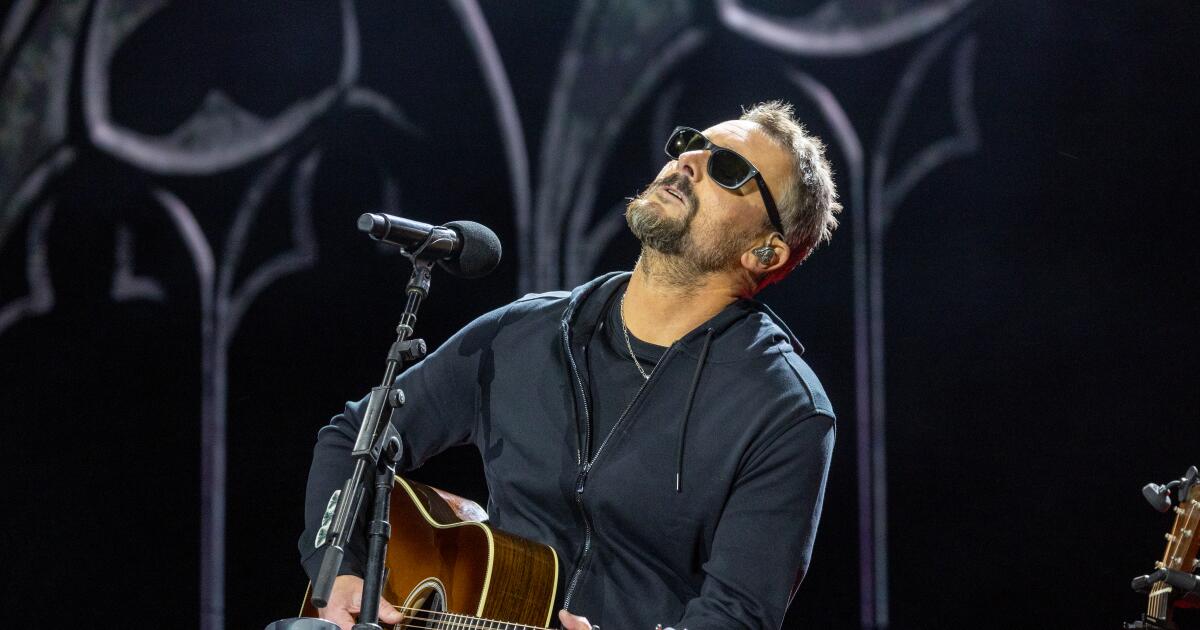
Eric Church performs on the Mane Stage on the first day of Stagecoach Country Music Festival at the Empire Polo Club in Indio.
(Allen J. Schaben / Los Angeles Times)
Eric Church lives up to his name
Church used his fifth headlining appearance at Stagecoach as an opportunity to try something different: Instead of leading his sturdy road band through a set of the hits that have made him a kind of older-brother figure to the likes of Wallen and Luke Combs, Church turned the so-called Mane Stage into an open-air chapel (complete with stained glass) for a stripped-down acoustic performance in which he was backed by a 16-member gospel choir.
The set mixed originals like “Mistress Named Music” and “Like Jesus Does” with far-flung covers: “Amazing Grace,” “I’ll Fly Away,” “Take Me to the River” and “Gin and Juice.” His aim seemed to be to showcase the music that formed him as a kid growing up in small-town North Carolina — and to draw attention, in this year of Beyoncé’s “Cowboy Carter,” to the Black roots of country music. (The performance also shared some DNA with the solo-acoustic residency Church has going at Chief’s, his new bar in Nashville, where Wallen was arrested this month for throwing a chair off the roof.)
Energy-wise, it was a risky choice at the end of a day many spent drinking in the sun: Half an hour or so after Church opened with Leonard Cohen’s “Hallelujah” — probably not a song anyone still needs to keep doing, if we’re being honest — one guy near me yelled, “This is Friday night, not Sunday morning!” As they went along, though, Church and his accompanists picked up a righteous steam. — Mikael Wood
Dwight Yoakam and the fabulous flying fringe
If you’re going to wear a Canadian tuxedo, make it memorable.
While top-and-bottom denim is a perennial look for Yoakam, on Friday the troubadour paired it with his standard cowboy hat and boots, but the standout was the jacket covered in white fringe on the front and back.
Yoakam, whose name was misspelled on the official Stagecoach set-times sign outside of the Palomino stage (as was Nickelback’s), started about 10 minutes after his scheduled start of 7:20 p.m.
Back to the fringe, it was almost hypnotic to watch it bounce and sway as Yoakam shimmied and shuffled across the stage while he and his band (also snazzily dressed with sparkles, no fringe) played songs including “Little Sister,” “Streets of Bakersfield” and a cover of Queen’s “Crazy Little Thing Called Love.”
Since Yoakam didn’t allow press to photograph his set, the best you can get from us is a stick–figure drawing I made — unfortunately art is not my strong suit and I really couldn’t do the fringe justice.
Other than a couple of feedback screeches on the microphone, Yoakam and his band played a tight set. The crowd began filtering out to hike over to the Mane Stage to catch Jelly Roll, which was a shame because Yoakam just kept getting better with “Honky Tonk Man” and “Guitars, Cadillacs” in the back half of the performance. — Vanessa Franko
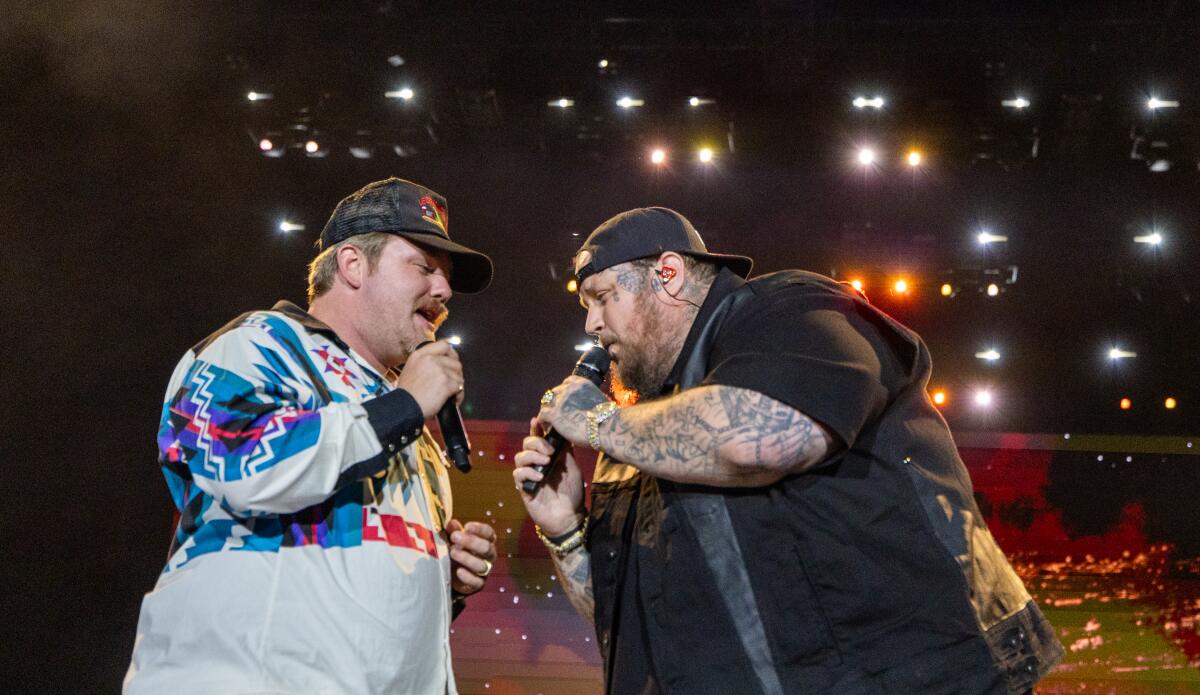
Jelly Roll, right, performs with his special guest Ernest on the Mane Stage on the first day of Stagecoach Country Music Festival at the Empire Polo Club in Indio.
(Allen J. Schaben / Los Angeles Times)
Best multitasker: Jelly Roll
Nobody made more of their time at Stagecoach than Jelly Roll, who, before his set on the Mane Stage, turned up for a cooking demo with Guy Fieri and afterwards schlepped over to the Palomino to join Nickelback for “Rockstar.”
His primary performance was a condensed version of the road show he’s been touring hard over the past couple of years, with bruised yet muscular country hits like “Son of a Sinner” and “Save Me” alongside a medley of the hip-hop classics (including Eminem’s “Lose Yourself” and Biz Markie’s “Just a Friend”) that inspired him to become a rapper before he turned to singing.
He brought out Maddie & Tae to do a new song, “Liar,” that he said he’d put on his next album if the crowd liked it (and wouldn’t if the crowd didn’t); he also brought out T-Pain, who did “All I Do Is Win” and helped Jelly Roll pay tribute to the late Toby Keith with a take on Keith’s “Should’ve Been a Cowboy.”
After “Need a Favor,” Jelly Roll ushered his wife and daughter to the stage — he’d taken his daughter out of school for the day and flown her to California, he happily pointed out — and thanked the audience for changing their trajectory of their lives. Then he did a spiel about proving naysayers wrong that climaxed with his enumerating how many People’s Choice Awards he’s won. Iconic, obviously. — M.W.
Worst surprise guest: the wind
Jelly Roll brought out T-Pain. Mother Nature brought out winds that were so bad that if you drove in to the festival along the 10 Freeway it was difficult to see the mountains because of the dust.
While the worst of the wind was west of the festival site (some gusts reached upwards of 60 and 70 m.p.h. in the Coachella Valley, according to the National Weather Service), the South Coast Air Quality Management District issued a windblown dust advisory through late Friday. And if you were on the grounds, you could feel all of that windblown dust sticking to you.
It did lead to some interesting people-watching, though, as many a cowboy hat was chased across the field. — V.F.
A return visit from a Coachella headliner
A week after she headlined Coachella — and with an album on the way called “Lasso” to hype — Lana Del Rey turned up at Stagecoach to trill the Righteous Brothers’ “Unchained Melody” with Paul Cauthen, a hammy up-and-comer with a booming baritone and a televangelist’s fashion sense. No idea what kind of relationship these two might share in real life, but together onstage they brought a touch of slightly creepy glamour to the desert. — M.W.
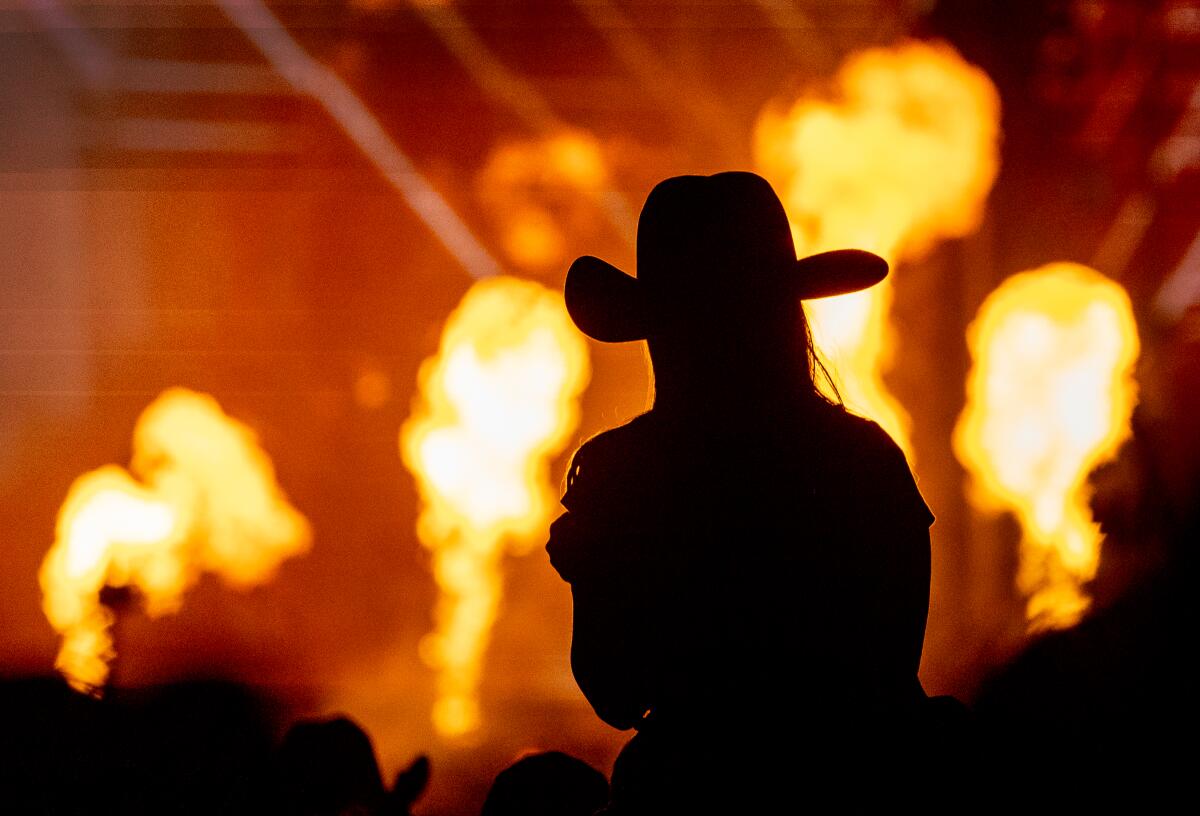
A fan sits up high and is silhouetted against a pyrotechnic display as Jelly Roll performs on the Mane Stage on the first day of Stagecoach Country Music Festival.
(Allen J. Schaben / Los Angeles Times)
Inside the secret spots that make you feel like you’re not at a country festival
Heading into the weekend, George Michael, INXS and the Human League were among the artists I would’ve least expected to hear at Stagecoach.
But if you make your way to the password-protected Sonny’s — the ’80s-tastic speakeasy from Attaboy with a light-up dance floor and tropical print wallpaper that could have been ripped from the bedroom of one of the Golden Girls — it’s less honkytonk and more new wave.
Surrounding Sonny’s is the outdoor tiki-inspired speakeasy Tropicale from PDT, but you still get the same ‘80s tunes pumping from inside Sonny’s. You can find the secret bars near the Golden Road patio heading to Diplo’s Honkytonk.
The third speakeasy, the Basement, is also back for Stagecoach. It still has black-light posters of Cheech & Chong and neon artwork of an alien with dorm-room vibes, but it’s where you’ll hear alt-rock and mainstream hip-hop from the ’90s. When I stopped by I was greeted with a Sublime sing-along from fellow patrons followed by some Cypress Hill and Eminem. You can access it via chef Aaron May’s Porky’s barbecue pop-up near the rainbow Spectra tower. — V.F.
One to watch
Is it too early to anoint the next Zach Bryan? Wyatt Flores, a 22-year-old singer-songwriter from Bryan’s home state of Oklahoma, seemed to be gunning for the job in an impressive set on the Palomino Stage that got the place shouting along at top volume, as folks do with Bryan at his famously rowdy gigs. With a scraped-up voice and a pained-looking expression on his face, Flores sang ragged yet cathartic emo-country songs about bottoming out emotionally; he also added the Fray to the list of 1990s/2000s rock acts shaping the sound of modern Nashville with a punked-up rendition of that band’s “How to Save a Life.” — M.W.

Elle King performs on the Mane Stage on opening day of the Stagecoach Country Music Festival at the Empire Polo Club in Indio.
(Allen J. Schaben / Los Angeles Times)
A difference of opinion
Her dad, comedian Rob Schneider, has lately reoriented his career around railing against what he calls “woke bull—.” But Elle King introduced her cover of Tyler Childers’ “Jersey Giant” with as woke a set of instructions as I heard all day: “Grab someone you know. If not, ask permission.” — M.W.
Best country singer dressed for her performance as a European milkmaid: Hailey Whitters

Hailey Whitters performs Friday on the Mane Stage at Stagecoach.
(Allen J. Schaben / Los Angeles Times)
Real Swiss Miss energy. — M.W.
Most stylish cowboy hat worn by an artist who also played Coachella: Carin León
The rootsy yet polished Mexican singer and songwriter was the first Spanish-language act to play a full set at Stagecoach, a sign of both his popularity and that of the regional Mexican music that also took him (and Mexico’s Peso Pluma) to Coachella this month. — M.W.
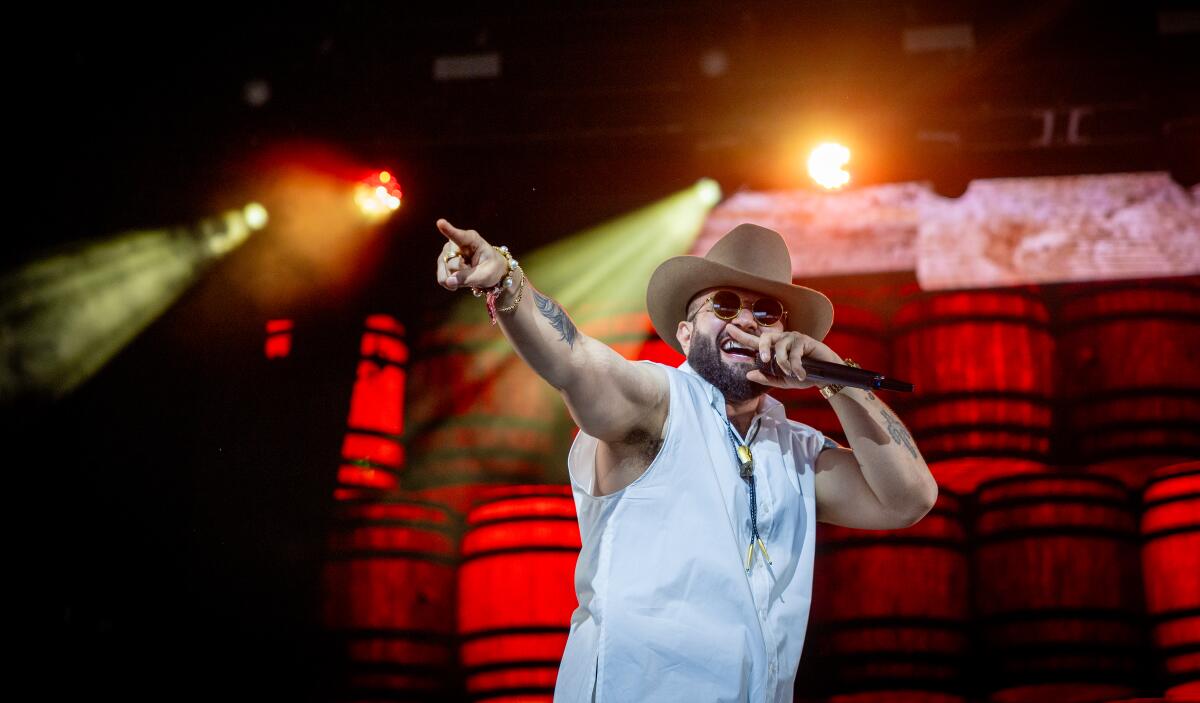
Carin León performs Friday on the Palomino Stage.
(Allen J. Schaben / Los Angeles Times)
Right where they belong
“Very strange to be playing a country festival,” Nickelback frontman Chad Kroeger said not long into the band’s late-night set, but it wasn’t really: Nashville has been absorbing Nickelback’s caveman-rock lessons for years, as Kroeger reminded us when he brought out Hardy (who shares Nickelback’s longtime producer, Joey Moi) to yowl his happily knuckle-dragging “Sold Out.” — M.W.



“What can one person do but two people can’t?”
“Dream.”
I knew the 2025 film “Resurrection” (狂野时代) would be elusive the second I walked out of Amherst Cinema and into the cold air, boots gliding over tanghulu-textured ice. The snow had stopped falling, but I wished it hadn’t so that I could bury myself in my thoughts a little longer. But the wind hit my uncovered face, the oxygen slipped from my lungs, and I realized that I had stopped dreaming.
“Resurrection” is a love letter to the evolution of cinematography, the ephemerality of storytelling, and the raw incoherence of life. Structured like an anthology film and set in a futuristic dreamscape, humanity achieves immortality on one condition: They can’t dream. We follow the last moments before the death of one rebel dreamer, called the “Deliriant” or “迷魂者,” as he travels through four different dream worlds, spanning a century in his mind.
Being Bi Gan’s third film after the 2015 “Kaili Blues” (路边野餐) and the 2018 “Long Day’s Journey Into Night” (地球最后的夜晚), “Resurrection” follows Gan’s directorial style of creating fantastical, atmospheric worlds. Jackson Yee, known for being a member of the boy group TFBoys, stars as the Deliriant and takes on a different identity in each dream, ranging from a conflicted father-figure conman to an untethered young man looking for love to a hunted vessel with a beautiful voice. His acting morphs unhesitatingly into each role, tailored to the genre of each dream. Of which, “Resurrection” leans into, with practice and precision.
Opening with a silent film that mimics those of German expressionist cinema, “Resurrection” takes the opportunity to explore the genres of film noir, Buddhist fable, neorealism, and underworld romance. The Deliriant’s dreams are situated in the years 1900 to 2000, as we follow the evolution of a century of competing cinematic visions. The characters don’t utter a single word of dialogue in the first twenty minutes, as all exposition occurs through paper-like text cards that yellow at the edges. I was worried it would be like this for the whole film, but I stayed in the theater that Tuesday night, the week before midterms, waiting for the first line of spoken dialogue to hit like the first sip of water after a day of fasting.

Through a massive runtime that spans two hours and 39 minutes, this movie makes you earn everything you get. Gan trains the audience’s patience with a firm hold on precision over the dials of the five senses and the mind.
The dreams may move forward in time through the cultures of the twentieth century, but on a smaller temporal scale, the main setting of each dream functions to tell the story of a day in reverse. The first dream, being a film noir, is told on a rainy night. Without giving any more spoilers, the three subsequent dreams take place at twilight, during multiple sunny afternoons, and then at sunrise. “Resurrection” does not grant sunlight so easily; we are given momentary solace after being deprived of direct sunlight for a solid 70 minutes, until it is stripped from us again and we are dropped into the darkness of pre-dawn – not that I am complaining. I love a movie that knows what it wants the audience to feel. I felt a deep-seated ache as I watched the film, scooting closer to the edge of my seat.
“Resurrection” is a movie that is best watched in theaters, but a home speaker system or padded headphones in a dark room can also suffice. Some of its most gripping moments are controlled by sound. Loud, cluttered echoes of the world, whether from people chatting in a parlor or anxiety in a character’s head, are abruptly cut off with ringing silence and a suspended close-up shot. We are forced to reckon with what the character has just done. I knew I was a world away, but I was convinced and terrified at my own culpability and agency. If I were him, would I have done the same? I could only hear my thoughts fade away as we moved onto the next dream.
Beyond sight and sound, the plot also deals intimately with the senses of taste, smell, and touch, but you will have to watch the movie yourself to find that out.
My high school acting teacher once told us that whenever a character tells a story in a play, they are actually referencing the play’s overall narrative. This exact technique of using framed narratives as vessels of information foreshadowing drives coherence in a seemingly ambiguous, metaphorical anthology film. Instead of easy-to-follow tales that mimic the hero’s journey, we are taken through unadulterated, expansive explorations of characters and their aspirations. We never find out all the details of what or why something happens, as the Deliriant moves quickly through ephemeral lifetimes in each dream, literally dying to move onto the next, but we find closure nonetheless through the parallels between elements and the poetry of it all.
That is why I like to think of “Resurrection” as pure art. It is not bound by structure; it osmoses beyond borders. It is creation in the highest form; it is a movie that I will never be able to watch again.
Perhaps because the dream worlds are so intimate and gorgeous, the exposition for the actual futuristic society feels weak in comparison. We learn that there is a woman whose job is to hunt down Deliriants, but we don’t see the rest of the dystopian infrastructure that runs this system. However, I can understand this as a thematic choice to prioritize dreams over reality. Form follows function, and these omissions of detail compel us to forget the outside world.
What it means to “dream” is up for interpretation, and we never learn the specifics of why or how immortality is achieved. Instead, “Resurrection” compares dreaming to fire. We humans are like candles, the movie claims, with wax that could stand forever if never used. But what is the point in being candles if we are never lit?
The greatest reminder of “Resurrection” is our own mortality. Whether we run from the snow-dipped mountaintops to the back alleyways of rain-streaked Chongqing, we can never escape our own consequences. “Resurrection” gives me a great fear of death, but so does it reignite my conviction to live a life of mistakes and keep dreaming anyway.
Dreaming is nothing without death. Immortality is nothing without love. So, I stumbled back to my dorm that Tuesday night, the week before midterms, thinking about what I loved and feared losing. So few films can channel life and let it go with a gentle hand. I only watch movies to fall in love. I am in love, I am in love. I am so afraid.
Entertainment
Spotify once had a reputation for underpaying music artists. It hopes to change that perception

Back in the early 2010s, the music industry was at a low point.
Piracy was rampant. Compact disc sales were on a steady decline. And the then-new audio streaming services, like Spotify, were taking hits from creators for paying low royalty rates.
Today, Spotify has grown into the world’s most popular audio streaming subscription service and the highest-paying retailer globally — paying the music industry over $11 billion last year. The Swedish company said in a recent post that the payouts aren’t strictly going to ultra-popular artists, but that “roughly half of royalties were generated by independent artists and labels.”
“A decade ago, a lot of the questions were really fair. Spotify had to be able to prove out if it could scale as an economic engine. People didn’t know if streaming would scale as a model,” said Sam Duboff, Spotify’s global head of marketing and policy of music business.
Duboff said Spotify’s payouts aren’t “plateauing — we’re still growing that royalty pool on Spotify more than 10% per year.” He credits the streaming platform’s growth to “incentivizing people to be willing to pay for music again” by providing personalized experiences and global accessibility.
The company, founded in 2006, serves more than 751 million users, including 290 million subscribers, in 184 markets.
“The average Spotify premium subscriber listens to 200 artists every month, and nearly half of those artists are discovered for the first time,” Duboff said. “When you build an experience where people can explore and fall in love with music, it inspires them to upgrade to premium and keep paying.”
The platform offers a wide variety of playlists, curated by editors like the up-and-comer-driven Fresh Finds or rap’s latest, RapCaviar. There are also personal playlists generated for users, such as the weekly round-up Discover Weekly and the daily mix of tunes called the “daylist.”
The streamer considers itself the first step toward “an enduring career” for today’s indie artists. Last year, more than a third of artists making $10,000 on the platform in royalties started by self-releasing their music through independent distributors.
“Streaming, fundamentally, is about opportunity and access. It’s artists from all over the world releasing music the way they want to and reaching a global audience from Day One,” Duboff said. He adds that when fans have a choice, they will discover new genres and music cultures that may have otherwise languished in obscurity.
In 2025, nearly 14,000 artists earned $100,000 from Spotify alone. The streamer’s data also show that last year the 100,000th highest-earning artist made $7,300 in Spotify royalties, whereas in 2015, an artist in that same spot earned around $350.
The company, with a large presence in L.A.’s Arts District, emphasizes that the roster of artists on its platform who earn significantly more money — well into the millions — is no longer limited to the few. A decade ago, Spotify’s top artist made around $10 million in royalties. Today, the platform’s top 80 artists generate over $10 million annually. Some of 2025’s top artists globally were Bad Bunny, Taylor Swift and the Weeknd.
Spotify claims those who aren’t household names can earn six figures, with more than 1,500 artists earning $1 million last year.
For some musicians, the outlook is not as clear
Damon Krukowski, a musician and the legislative director for United Musicians & Allied Workers, argues that Spotify’s money isn’t necessarily going to artists — it’s going to their labels.
Those without labels usually upload music through distributors such as DistroKid and CD Baby. These platforms charge a small fee or commission. For example, DistroKid’s lowest-level subscription is $24.99 a year, and the site states users “keep 100% of all your earnings.”
”There are zero payments going directly to recording artists from Spotify,” Krukowski asserts. “Recording artists deserve direct payment from the streaming platforms for use of our work.”
The advocacy group, which has mobilized more than 70,000 musicians and music workers, recently helped draft the Living Wage for Musicians Act to address the streaming industry. The bill, introduced to the U.S. House of Representatives last fall, calls for a new streaming royalty that would directly pay artists a minimum of one penny per stream.
In the Q&A section of Spotify’s Loud and Clear website, the streamer confirms that it “doesn’t pay artists or songwriters directly. We pay rights holders selected by the artist or songwriter, whether that’s a record label, publisher, independent distributor, performance rights organization, or collecting society.”
Instead of following a penny-per-stream model, Spotify pays based on the artist’s share of total streams, called a “streamshare.”
“Streaming doesn’t work like buying songs. Fans pay for unlimited access, not per track they listen to,” wrote the company online. “So a ‘per stream’ rate isn’t actually how anyone gets paid — not on Spotify, or on any major streaming service.”

In contrast to other sci-fi heroes, like Interstellar’s Cooper, who ventures into the unknown for the sake of humanity and discovery, knowing the sacrifice of giving up his family, Grace is externally a cynical coward. With no family to call his own, you’d think he’d have the will to go into space for the sake of the planet’s future. Nope, he’s got no courage because the man is a cowardly dog. However, Goddard’s script feels strikingly reflective of our moment. Grace has the tools to make a difference; the Earth flashbacks center on him working towards a solution to the antimatter issue, replete with occasionally confusing but never alienating dialogue. He initially lacks the conviction, embodying a cynicism and hopelessness that many people fall into today.
The film threads this idea effectively through flashbacks that reveal his reluctance, giving the story a tragic undercurrent. Yet, it also makes his relationship with Rocky, the first living thing he truly learns to care for, ever more beautiful.
When paired with Rocky, Gosling enters the rare “puppet scene partner” hall of fame alongside Michael Caine in The Muppet Christmas Carol, never letting the fact that he’s acting opposite a puppet disrupt the sincerity of his performance. His commitment to building a gradual, affectionate friendship with this animatronic creation feels completely natural, and the chemistry translates beautifully on screen. It stands as one of the stronger performances of his career.
Project Hail Mary is overly long, and while it can be deeply affecting, the film leans on a few emotional fake-outs that become repetitive in the latter half. By the third time it deploys the same sentimental beat, the effect begins to feel cloying, slightly dulling the powerful emotions it built earlier. The constant intercutting between past and present can also feel thematically uneven at times, occasionally undercutting the narrative momentum. At 2 hours and 36 minutes, the film feels like it’s stretching itself to meet a blockbuster runtime when a tighter cut might have served better.
FINAL STATEMENT
Project Hail Mary is a meticulously crafted, hopeful, and dazzling space epic that proves the most moving friendship in film this year might just be between Ryan Gosling and a rock.

New synthetic opioid ‘cychlorphine’ linked to 16 overdose deaths across East Tennessee

Texas man facing execution for fatally stabbing girlfriend and her 8-year-old son

‘It’s really cool’: Utah selected to lead federal pilot program testing electric aircraft
VT Lottery Mega Millions, Gimme 5 results for March 10, 2026

The Good, the Bad and the Ugly from Virginia Tech’s 95-89 Loss to Wake Forest

Florida High School Football Rankings: Top 25 teams – Oct. 21

Cleary's 21 help Le Moyne down Central Connecticut State 69-64 in OT

How old is Bo Nix? What to know about Oregon quarterback ahead of 2024 NFL Draft

99th annual Pony Swim held in Virginia

Indiana Members Credit Union announced as new anchor tenant at Bottleworks District

EXCLUSIVE: ICE says El Paso detention facility will stay open under new contractor after $1.2B deal scrapped

Von der Leyen ‘acting outside of competence,’ Araud tells Euronews

Wheelchair curler Steve Emt’s path from drunk driver to three-time Paralympian

Map: 2.3-Magnitude Earthquake Reported North of New York City

Trump stirs GOP primary drama with visit to Massie’s Kentucky home turf
-

 Wisconsin1 week ago
Setting sail on iceboats across a frozen lake in Wisconsin
-

 Massachusetts1 week ago
Massachusetts man awaits word from family in Iran after attacks
-

 Pennsylvania6 days ago
Pa. man found guilty of raping teen girl who he took to Mexico
-

 Florida1 week ago
Florida man rescued after being stuck in shoulder-deep mud for days
-

 Detroit, MI5 days ago
U.S. Postal Service could run out of money within a year
-

 Miami, FL6 days ago
City of Miami celebrates reopening of Flagler Street as part of beautification project
-

 Sports6 days ago
Keith Olbermann under fire for calling Lou Holtz a ‘scumbag’ after legendary coach’s death
-

 Virginia7 days ago
Giants will hold 2026 training camp in West Virginia