Entertainment
Review: Mark Strong and Lesley Manville power Robert Icke’s sleek remake of ‘Oedipus’ on Broadway

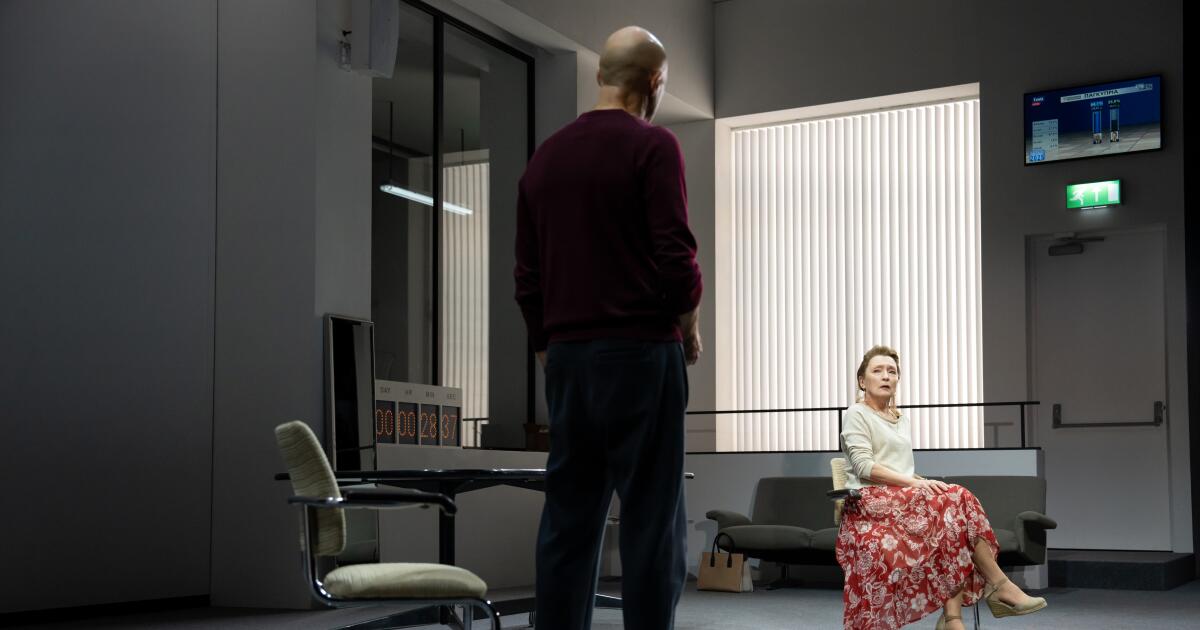
It’s election night in Robert Icke’s “Oedipus,” a modern retelling of Sophocles’ “Oedipus the King” that must be the buzziest, if not the chicest, Broadway offering of the fall season.
The production, a prestigious London import that opened at Studio 54 on Thursday under Icke’s smart and sleek direction, stars a charismatic Mark Strong in the title role. His elegant and urbane Oedipus, a politician on the cusp of a momentous victory, prides himself on not playing by the old rules. A straight talker who has made transparency his calling card, he frequently veers off script in paroxysms of candor, to the chagrin of Creon (John Carroll Lynch), his brother-in-law who has been steering the campaign to what looks like a landslide victory.
But “count no mortal happy till / he has passed the final limit of his life secure from pain,” as the chorus intones at the end of Sophocles’ tragedy. There is no chorus in Icke’s version, but the sentiment holds, as Oedipus unravels the puzzle of his identity with the same relentlessness that has brought him to the brink of electoral triumph.
Anne Reid, left, and Olivia Reis in “Oedipus.”
(Julieta Cervantes)
A birther conspiracy has been raised by his political opponent, and Oedipus, speaking impromptu to reporters on-screen at the start of the play, promises to release his birth certificate and put an end to the controversy. What’s more, he vows to reopen an investigation into the death of Laius, the former leader who died 34 years ago under circumstances that have allowed rumor and innuendo to fester.
Oedipus calls himself Laius’ “successor, the inheritor of his legacy,” and in true Sophoclean fashion he speaks more than he knows. Jocasta (Lesley Manville in top form), Oedipus’ wife, was married to Laius, and so Oedipus is occupying his predecessor’s place in more ways than one.
In Sophocles’ play, Oedipus confronts a plague that has been laying waste to Thebes. In Icke’s drama, which had its premiere in Amsterdam in 2018, the pathogen is political. The civic body has fallen ill. Oedipus sees himself as an answer to the demagogic manipulation that has wrought havoc. The water is poisoned, economic inequality is out of control and immigrants have become an easy target. Sound familiar?
Icke’s Oedipus has an Obama-level of confidence in reason and reasonableness. His direct, pragmatic approach has seduced voters, but has it deluded him into thinking that he has all the answers? Oedipus is an ingenious problem solver. Puzzles entice his keen intellect, but he will have to learn the difference between a paradox and a riddle.

Mark Strong, left, and Samuel Brewer in “Oedipus.”
(Julieta Cervantes)
His daughter, Antigone (Olivia Reis), a scholar who has returned for her father’s big night, ventures to make the distinction: “One’s got a solution — one’s just something you have to live with?” But Oedipus is in no mood for academic hairsplitting.
A countdown clock marks the time until the election results will be announced. That hour, as audiences familiar with the original tragedy already know, is when Oedipus will discover his true identity.
Merope (Anne Reid), Oedipus’ mother, has unexpectedly turned up at campaign headquarters needing to speak to her son. Oedipus fears it has something to do with his dying father, but she tells him she just needs a few minutes alone with him. Thinking he has everything under control, he keeps putting her off, not knowing that she has come to warn him about revealing his birth certificate to the public.
The handling of this plot device, with the canny veteran Reid wandering in and out of the drama like an informational time bomb, is a little clumsy. There’s a prattling aspect to Icke’s delaying tactics. His “Oedipus” is more prose than poetry. The family dynamics are well drawn, though a tad overdone.

Mark Strong and the cast of “Oedipus.”
(Julieta Cervantes)
Reid’s Merope and Reis’ Antigone, ferocious in their different ways, refuse to play second fiddle to Manville’s Jocasta when it comes to Oedipus’ affections. Manville, who won an Olivier Award for her performance in “Oedipus,” delivers a performance as sublimely seething as her Oscar-nominated turn in “Phantom Thread.” Endowed with a formidable hauteur, her Jocasta acts graciously, but with an unmistakable note of condescension. As Oedipus’ wife, she assumes sexual pride of place, which only exacerbates tensions with Merope and Antigone.
Oedipus’ sons, Polyneices (James Wilbraham) and Eteocles (Jordan Scowen) are given personal backstories, but there is only so much domestic conflict that can be encompassed in a production that runs just under two hours without interruption. And Polyneices being gay and Eteocles being something of a philander would be of more interest in an “Oedipus” limited series.
When Sophocles’ tragedy is done right, it should resemble a mass more than a morality tale. Oedipus’ story has a ceremonial quality. The limits of human understanding are probed as a sacrificial figure challenges the inscrutable order of the universe. Icke, who views classics through a modern lens (“Hamlet,” “1984”), is perhaps more alert to the sociology than the metaphysics of the tragedy.
Oedipus’ flaws are writ large in his rash, heated dealings with anyone who stands in his way. Icke transforms Creon into a middle-of-the-road political strategist (embodied by Lynch with a combination of arrogance and long-suffering patience) and blind Teiresias (a stark Samuel Brewer) into a mendicant psychic too pathetic to be a pariah.

Mark Strong and Lesley Manville in “Oedipus.”
(Julieta Cervantes)
But Oedipus’ strengths — the keenness of his mind, his heroic commitment to truth and transparency — mustn’t be overlooked. Strong, who won an Olivier Award for his performance in Ivo van Hove’s revival of Arthur Miller’s “A View From the Bridge,” exposes the boyish vulnerability within the sophisticated politician in his sympathetically beguiling portrayal.
Wojciech Dziedzic’s costumes remake the protagonist into a modern European man. Yet true to his Ancient Greek lineage, this Oedipus is nothing if not paradoxical, suavely enjoying his privilege while brandishing his egalitarian views.
The production takes place on a fishbowl office set, designed by Hildegard Bechtler with a clinical and wholly contemporary austerity. The furnishings are removed as the election night draws to its conclusion, leaving no place for the characters to hide from the unwelcome knowledge that will upend their lives.
What do they discover? That everything they thought they understood about themselves was built on a lie. For all his brilliance, Oedipus was unable to outrun his fate, which in Icke’s version has less to do with the gods and more to do with animal instincts and social forces.
When Oedipus and Jocasta learn who they are to each other, passion rushes in before shame calls them to account. Freud wouldn’t be shocked. But it’s not the psychosexual dimension of Icke’s drama that is most memorable.
The ending, impeded by a retrospective coda, diminishes the full cathartic impact. But what we’re left with is the astute understanding of a special kind of hubris that afflicts the more talented politicians — those who believe they have the answers to society’s problems without recognizing the ignorance that is our common lot.



In contrast to other sci-fi heroes, like Interstellar’s Cooper, who ventures into the unknown for the sake of humanity and discovery, knowing the sacrifice of giving up his family, Grace is externally a cynical coward. With no family to call his own, you’d think he’d have the will to go into space for the sake of the planet’s future. Nope, he’s got no courage because the man is a cowardly dog. However, Goddard’s script feels strikingly reflective of our moment. Grace has the tools to make a difference; the Earth flashbacks center on him working towards a solution to the antimatter issue, replete with occasionally confusing but never alienating dialogue. He initially lacks the conviction, embodying a cynicism and hopelessness that many people fall into today.
The film threads this idea effectively through flashbacks that reveal his reluctance, giving the story a tragic undercurrent. Yet, it also makes his relationship with Rocky, the first living thing he truly learns to care for, ever more beautiful.
When paired with Rocky, Gosling enters the rare “puppet scene partner” hall of fame alongside Michael Caine in The Muppet Christmas Carol, never letting the fact that he’s acting opposite a puppet disrupt the sincerity of his performance. His commitment to building a gradual, affectionate friendship with this animatronic creation feels completely natural, and the chemistry translates beautifully on screen. It stands as one of the stronger performances of his career.
Project Hail Mary is overly long, and while it can be deeply affecting, the film leans on a few emotional fake-outs that become repetitive in the latter half. By the third time it deploys the same sentimental beat, the effect begins to feel cloying, slightly dulling the powerful emotions it built earlier. The constant intercutting between past and present can also feel thematically uneven at times, occasionally undercutting the narrative momentum. At 2 hours and 36 minutes, the film feels like it’s stretching itself to meet a blockbuster runtime when a tighter cut might have served better.
FINAL STATEMENT
Project Hail Mary is a meticulously crafted, hopeful, and dazzling space epic that proves the most moving friendship in film this year might just be between Ryan Gosling and a rock.

Joshua Jackson says he knows he was “really just a footnote” in James Van Der Beek’s life, despite the “amazing” time they spent together as stars of the series “Dawson’s Creek.”
The star of “The Affair” is reflecting publicly for the first time about his former castmate, who died Feb. 11 at age 48 after a battle with colorectal cancer.
The time they shared on set was “formational” for them, Jackson said on “Today.” When the “Dawson’s Creek” pilot aired in January 1998, he was 19 and Van Der Beek was almost 21, playing characters who were 15.
“I know both of us look back on that time with great fondness, but I will also say that I know that I’m really just a footnote in what he actually accomplished in his life.”
Jackson spoke with great respect for his friend, who he said “became what we used to just call a good man, a man of the kind of belief, the kind of faith that allowed him to face the impossible with grace, an unbelievable partner and husband, just a real man who showed up for his family and a beautiful, kind, curious, interested, dedicated father.”
On the one hand, the 47-year-old said, “that’s beautiful.” On the other, “The tragedy of that loss for his family is enormous.”
Since Jackson and Van Der Beek played Pacey Witter and Dawson Leery three decades ago, both men had kids of their own — a 5-year-old daughter for Jackson, born during the pandemic with ex-wife Jodie Turner-Smith, and six kids for Van Der Beek with second wife Kimberly Brook. The latter couple’s children — two boys and four girls, ranging in age from 4 to 15 — were what Van Der Beek said changed everything for him.
“Your life becomes shared, and your joys become shared joys in a really beautiful way that expands your level of circuitry out to other people instead of just keeping it all for your own gratification,” the actor told “Good Morning America” in May 2023. “And the lessons, they keep on coming. It’s the craziest, craziest thing I’ve ever done, and it’s the thing that’s made me happiest.”
Knowing his colleague’s love for his family, Jackson said on “Today” that “for me as a father now, I think the enormity of that tragedy hits me in a very different way than just as a colleague, so I think the processing [of Van Der Beek’s death] is ongoing.”
The “Little Fires Everywhere” actor was on the morning show Tuesday to bring attention to colorectal cancer screenings.
Van Der Beek’s diagnosis, which went public in November 2024, was among the factors prompting Jackson to get involved with drugmaker AstraZeneca’s “Get Body Checked Against Cancer” campaign, which takes a lighter approach to a serious subject — cancer screening — through a partnership with Jackson, the National Hockey League and the Philadelphia Flyers’ furry orange mascot, Gritty.
“It is … true, the earlier you find something,” said “The Mighty Ducks” actor, “the better your possible outcomes are.”

DAN WEBSTER:
It may now seem like ancient history, especially to younger listeners, but it was only 26 years ago when the streets of Seattle were filled with protesters, police and—ultimately—scenes of what ended up looking like pure chaos.
It is those scenes—put together to form a portrait of what would become known as the “Battle of Seattle” —that documentary filmmaker Ian Bell captures in his powerful documentary feature WTO/99.
We’ve seen any number of documentaries over the decades that report on every kind of social and cultural event from rock concerts to war. And the majority of them follow a typical format: archival footage blended with interviews, both with participants and with experts who provide an informational, often intellectual, perspective.
WTO/99 is something different. Like The Perfect Neighbor, a 2026 Oscar-nominated documentary feature, Bell’s film consists of what could be called found footage. What he has done is amass a series of news reports and personal video recordings into an hour-and-42-minute collection of individual scenes, mostly focused on a several-block area of downtown Seattle.
That is where a meeting of the WTO, the World Trade Organization, was set to be held between Nov. 30 and Dec. 3, 1999. Delegates from around the world planned to negotiate trade agreements (what else?) at the Washington State Convention and Trade Center.
Months before the meeting, however, a loose coalition of groups—including NGOs, labor unions, student organizations and various others—began their own series of meetings. Their objective was to form ways to protest not just the WTO but, to some of them, the whole idea of a world order they saw as a threat to the economic independence of individual countries.
Bell’s film doesn’t provide much context for all this. What we mostly see are individuals arguing their points of view as they prepare to stop the delegates from even entering the convention center. Meanwhile, Seattle authorities such as then-Mayor Paul Schell and then-Police Chief Norm Stamper—with brief appearances by Gov. Gary Locke and King County Executive Ron Sims—discuss counter measures, with Schell eventually imposing a curfew.
That decision comes, though, after what Bell’s film shows is a peaceful protest evolving into a street fight between people parading and chanting, others chained together and splinter groups intent on smashing the storefronts of businesses owned by what they see as corporate criminals. One intense scene involves a young woman begging those breaking windows to stop and asking them why they’re resorting to violence. In response a lone voice yells their reasoning: “Self-defense.”
Even more intense, though, are the actions of the Seattle police. We see officers using pepper spray, tear gas, flash grenades and other “non-lethal” means such as firing rubber pellets into the crowd. In one scene, a uniformed guy—not identified as a police officer but definitely part of the security crowd, which included National Guardsmen—is shown kicking a guy in the crotch.
The media, too, can’t avoid criticism. Though we see broadcast reporters trying to capture what was happening—with some affected like everybody else by the tear gas that filled the streets like a winter fog—the reports they air seem sketchy, as if they’re doctors trying to diagnose a serious illness by focusing on individual cells. And the images they capture tend to highlight the violence over the well-meaning actions of the vast majority of protesters.
Reactions to what Bell has put on the screen are bound to vary, based on each viewer’s personal politics. Bell revels his own stance by choosing selectively from among thousands of hours of video coverage to form the narrative he feels best captures what happened those two decades-and-change ago.
If nothing else, WTO/99 does reveal a more comprehensive picture of what happened than we got at the time. And, too, it should prepare us for the future. The way this country is going, we’re bound to see a lot more of the same.
Call it the “Battle for America.”
For Spokane Public Radio, I’m Dan Webster.
——
Movies 101 host Dan Webster is the senior film critic for Spokane Public Radio.

Wisconsin Lawmakers Propose Ranked Choice Voting for All Elections

New laws establish a statewide literacy program

Current price of Bitcoin for March 10, 2026 | Fortune

When should kids start learning about money? Advice from local financial advisor

Exercise Boosts Brain ‘Ripples’ Tied to Learning and Memory

Florida High School Football Rankings: Top 25 teams – Oct. 21

Cleary's 21 help Le Moyne down Central Connecticut State 69-64 in OT

How old is Bo Nix? What to know about Oregon quarterback ahead of 2024 NFL Draft

99th annual Pony Swim held in Virginia

Indiana Members Credit Union announced as new anchor tenant at Bottleworks District

Map: 2.3-Magnitude Earthquake Reported North of New York City

Trump stirs GOP primary drama with visit to Massie’s Kentucky home turf

Israeli air strike targets building in south Lebanon

Ed Martin, outspoken Justice Department lawyer, is formally accused of ethical violations | CNN Politics

Trump reveals top issues GOP should focus on to secure midterms victory: ‘I’ve never been more confident’
-

 Wisconsin1 week ago
Setting sail on iceboats across a frozen lake in Wisconsin
-

 Massachusetts1 week ago
Massachusetts man awaits word from family in Iran after attacks
-

 Maryland1 week ago
AM showers Sunday in Maryland
-

 Pennsylvania5 days ago
Pa. man found guilty of raping teen girl who he took to Mexico
-

 Florida1 week ago
Florida man rescued after being stuck in shoulder-deep mud for days
-

 Sports6 days ago
Keith Olbermann under fire for calling Lou Holtz a ‘scumbag’ after legendary coach’s death
-

 Virginia6 days ago
Giants will hold 2026 training camp in West Virginia
-

 Politics1 week ago
Mamdani’s response to Trump’s Iran strike sparks conservative backlash: ‘Rooting for the ayatollah’