Entertainment
Review: A reinvented Daniel Craig burrows into the heart of a lonely expat in 'Queer'


If director Luca Guadagnino has proven anything during his remarkable 2024, it’s that he is the preeminent depicter of erotic desire on-screen. His sexy spring sensation “Challengers” became a phenomenon with its hot-under-the-collar tennis matches, and he’s assembled the same group of collaborators for the surreal and sweaty “Queer,” an adaptation of the William S. Burroughs novella written in 1952 and published in 1985.
On the surface, “Queer” seems to be miles away from the shiny, sporty thrills of “Challengers,” but in execution, both are pure expressions of cinematic sensuality and the subconscious. But whereas “Challengers” finds its horny friction in repression, control and repetition, “Queer” is a sprawling, sometimes grotesque fever dream of chaos. It is messy and it doesn’t totally cohere (just how those Beat forefathers liked it), but it does stick to a guiding principle of yearning, expressed in achingly poignant, unforgettable moments of sound and image.
Screenwriter Justin Kuritzkes (also of “Challengers”) has adapted “Queer” for the screen and Daniel Craig stars as William Lee, the Burroughs stand-in, a writer of some means killing time and getting drunk in Mexico in the early 1950s among a group of gay American expats (Jason Schwartzman, Drew Droege, Ariel Schulman). One night he spies Eugene (Drew Starkey) in one of the greatest character introductions of all time — strolling in slow motion past a cockfight set to Nirvana’s “Come As You Are” — and becomes instantly obsessed with the mysterious and handsome young man.
“Queer” is about many things, including the consumption of an unholy amount of mind-altering substances, but first and foremost it is about the absolute embarrassment of being stricken with an all-consuming crush. Craig’s performance is fantastic, baring body and soul, but he is specifically great at the fumbling, awkward choices Lee makes in front of Eugene: a jokey little bow that doesn’t go over well, talking too much and too fast, getting drunk and falling down in front of his friends. He is too needy, too touchy, too wanting of Eugene’s attention, which is doled out sparingly.
Starkey, best known for the Netflix teen drama “Outer Banks,” terrifically inhabits this breakout role, playing Eugene as an inherently unknowable object of desire, because that is what he is to Lee. With his background in military intelligence, Eugene is a cipher, allowing people to project whatever they desire onto him. His sexuality is unclear and seemingly opportunistic. In a film about wanting, he leaves Lee in such a state that it haunts the man for the rest of his life.
The pair set off for the Amazon in search of a magical drug known as yagé (or ayahuasca), Lee determined to use it to achieve telepathy. What he wants is to achieve a true, tender connection with Eugene, a channel of clear communication, even if he might be disappointed by what he ultimately hears.
Visually and sonically, “Queer” is a textured, evocative piece about moments of heady anticipation — a high we get to chase as viewers. There is no drug that could equal the intoxicating power in the cling of a white undershirt or the angle of a throat straining for a kiss. There is no high greater than the person you want draping their leg over yours in bed. Lee chases sex, drugs and telepathy, but what he’s chasing isn’t sex itself, but the moments beforehand.
No one captures that better than Guadagnino and his team, including cinematographer Sayombhu Mukdeeprom and editor Marco Costa. Production designer Stefano Baisi has recreated 1950s Mexico (or the memory of it) on Italian soundstages, while Trent Reznor and Atticus Ross contribute a score that keens and wheedles, blending with the anachronistic pop soundtrack and diegetic music.
But it’s Jonathan Anderson’s costume design that takes your breath away. The creative director for the Spanish fashion house Loewe, Anderson outfits the loose-limbed Starkey in appropriately tattered polos and perfectly tailored trousers, Craig in Burroughs’ signature linen suit and spectacles. The costumes are an inherent part of the storytelling, from huarache sandals that Schwartzman turns into a punchline, to flamboyant embellishments on the suits of Droege’s Dumé.
The context of Burroughs writing “Queer” is unspeakably tragic and Guadagnino refers to those real-life details without making the film a biopic. He’s more concerned with the character’s state of mind, which is troubled, addled from drugs and booze, and driven almost mad with yearning.
If the film is too long (and it is), it still achieves something indelible because despite its hallucinatory flights of fancy, it remains rooted in deeply human emotion. Of all the memorable images, none are quite so affecting as those two pairs of legs on a bed. That’s all we really want, right?
Katie Walsh is a Tribune News Service film critic.
‘Queer’
Rated: R, for strong sexual content, graphic nudity, strong drug content, language and brief violence
Running time: 2 hours, 15 minutes
Playing: In limited release Wednesday, Nov. 27



Wainheads will be delighted to see his alums in cameos: Kerri Kenney-Silver, Michael Ian Black, Thomas Lennon, and supporting roles for Zickel and Truglio. A large portion of the cast are his homies. But with Deutch, Gutierrez-Riley, Wang, Slattery, Impacciatore, and yes, Hamm, it’s as if they’re being inducted into a new mad family. Wain and Marino are basically catching Pokémon and hoping they can hold onto the roster (by that logic, yes, Paul Rudd is a legendary Pokémon). The film is anchored by Zoey — everything everywhere all this summer with Voicemails From Isabelle to Minions & Monsters — Deutch in the Dorothy Gale role, exuding a high level of perkiness consistent with the character’s can-do, wide-eyed, midwestern charm and heart.
A major standout, Ben Wang finally gets to show off his comedic abilities, portraying a self-assured, quick-witted agent who makes me laugh every time he reveals his sheltered upbringing in snappy whines at every inconvenience. Sabrina Impacciatore, who has proven to be a comedic juggernaut in The Paper, is having so much fun hamming it up as the mob boss-esque wicked witch counterpart, torturing her henchmen and deliciously chewing up the scenery whenever onscreen. I don’t think they use her to the height of her comedic prowess, but she’s a delight nonetheless. John Slattery is the film’s comedic MVP. The way the writers use his over-the-top character for comedy is downright hilarious every time. They use him as either a punchline or a force of nature, and he’s great. This movie is like Mad Men propaganda, and by God, it works. As someone who’s never seen it, Gail allowed me a better appreciation for Slattery and Hamm.
Man, we don’t deserve Jon Hamm. This is the second time I’ve seen him play a silly, fictionalized version of himself this year (the other being the SXSW crowd-pleasing rom-com Wishful Thinking, which Gail distributor Sony Pictures Classics acquired), and he also voice-acted in his comedic Mayor Jerry role in Hoppers. Maybe working with Wain in 2007’s The Ten was the canon event, but I consider his weird little sex scene with Kristen Wiig in Bridesmaids his awakening. Since then, I’ve only seen him as unserious, and it’s delightful. Oz-like in appearance, he’s funny and befitting the film’s overall light, joyful nature.
LAST STATEMENT
Ultimately, Gail Daughtry and the Celebrity Sex Pass is a campy, delightful romp that succeeds as both a distinctive Hollywood‑centric riff and a Wizard of Oz reimagining, retaining a loving, twisted, demented charm. It’s a weird description, but it’s so high‑spirited and light‑hearted despite being strangely ultraviolent. It might as well be a live‑action episode of Smiling Friends (RIP), yet it’s everything the theatrical market needs today. Ten years ago, this would’ve been a studio production rather than an indie Sundance acquisition, but thank God it exists for the big screen. More absurdist Gail Daughtrys for cinemas (not streaming), please, because this is the most fun to be had in a theater all summer, if not the year thus far.
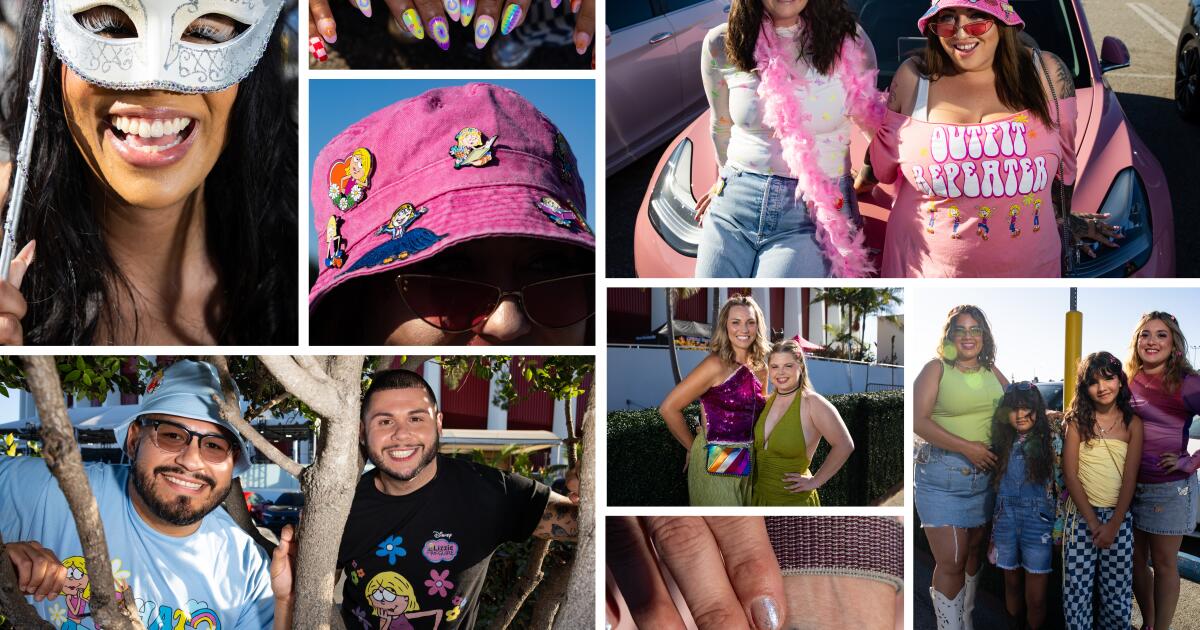
Chunky platform sandals, fitted baby tees, butterfly clips on perfectly crimped hair, brightly patterned skirts and tons of sparkles. Pure Y2K-fueled nostalgia filled the Kia Forum on Wednesday night in celebration of all things Hilary Duff.
-
Share via
Duff graced the stage at the Inglewood venue as part of her Lucky Me tour, her first global headlining tour in nearly two decades. And her fans couldn’t have been more thrilled. The pop singer and actor, who released her sixth studio album “Luck… or Something” in February, performed two back-to-back sold-out shows.
Before the final L.A. show, we caught up with fans to talk about their outfits (many of which were inspired by Duff’s most famous roles such as Sam in “A Cinderella Story” and the title role in “The Lizzie McGuire Movie”), the memories her music brings up for them and why her work still resonates with them. Here’s what they had to say.

(Kayla Bartkowski/Los Angeles Times)
Tristan Hallam, 36, of Chicago
Tell us about your outfit.
This is my wedding dress that I had stuffed in a suitcase. She’s been in a suitcase for 10 years, and I still fit into her, which is nice. People ask me why I keep stuff and this is exactly why: You might get divorced and use it as a costume. My outfit is inspired by “A Cinderella Story.” It’s my favorite Hilary Duff movie. She plays diner girl Cinderella. She disguises herself with a mask and a L.A. Dodgers cap. I did have a tiara, but I didn’t bring it because I didn’t want to be too much. So I figured, you know what, why not buy an apron and a little black crop top, and rep L.A.
I have a tattoo of her signature. It’s a little faded because it’s like 10 years old, maybe older than that now. It was at a book signing at Barnes and Noble at like the Grove or something. I asked her if she would initial my wrist, and I got it tattooed the same night. I literally drove to the tattoo shop on Hollywood Boulevard with my arm out the window because I’m so clumsy and I didn’t want to smudge it. Then the next time I saw her, she asked me, what did your parents say? I said, “My mom asked me how long I kept the Sharpie on so long.”
How long have you been a fan?
I think I was like 8 or 9 years old when I saw “Casper Meets Wendy” for the first time. My grandma took me to like a K-Mart or something, and told me that I could get any movie that I wanted. Then I was into “Lizzie McGuire,” but as soon as Hilary started doing all her like movies and independent work, obviously the music is great. I used to live in L.A., so I went to a bunch of her book signings. I’ve done a lot of meet and greets for her concerts, and right now I’m traveling around. I’m going to 18, technically 19 shows now, and I’m gonna see her in New Zealand, Australia and some other places. I’m actually really excited because one of my friends, I met her in a Hilary Duff fan club chat room in 2005 on MSN Messenger, and we are still friends, so we are going to a ton of shows together.
Why does her work still resonate with you today?
The fact that we’re around the same age, there’s been a lot of relationship similarities. I don’t have any kids, but the struggles with family, with your dad, with your siblings. She’s got some songs that are more mature and relatable for people our age. People who have gone through ups and downs in relationships, struggles with family and figuring out who your real family is, not just by blood but who your chosen family is. I think that’s really important.

(Kayla Bartkowski / Los Angeles Times)
Leilanie Martinez, 30, of South Gate
Tell us about your outfit and the inspiration behind it?
It’s my quinceañera dress. It’s supposedly very traditional to wear a white dress, like young women coming of age. For mine, I wanted to wear something that I didn’t see a lot of people wearing and I was very firm that if I didn’t find the love of my life, I was going to wear a white dress and this was my moment. My quinceañera was such a precious time. It really was a labor of love, and I think it’s one those memories I hold very near and dear. I think it’s an ode to her history, her legacy.
How long have you been a fan?
I remember I was 5 and I was running around in my neighborhood, playing with Barbies and watching “Lizzie McGuire.” I’m here today with my neighborhood and childhood friends. We used to watch it together and now we’re reliving our nostalgia and childhood.
Thinking back on when you first fell in love with her work, why does it still resonate with you today?
There’s a lot of power in her being a woman and she’s going through so many milestones that a lot of people my age are going through like having children and growing her career. Sometimes I think people “wash out” and I think it’s wonderful how she’s combating that narrative in so many ways, and that people are out here supporting her. I think there’s a lot of beauty in being able to be together as young women and relive some of these memories, but also cheer her on as she continues developing further.

(Kayla Bartkowski / Los Angeles Times)
Crystal Chesher, 33, of Mar Vista and Isabella Sanchez, 33, of Culver City
Tell us about your outfit.
Sanchez: We’re channeling “The Lizzie McGuire Movie.” My actual name is Isabella. She gives more Lizzie vibes and I give more Isabella vibes. It’s funny because I’ve literally saved [looks] of Isabella and Lizzie on my Pinterest board and I’ve always wanted to dress up like this. It’s not 100% of what I wanted, but it’s giving what it’s supposed to.
How long have you been a fan?
Chesher: Since I was little. I remember watching “Lizzie McGuire” since the age of 10 at the very least so I’ve been growing up with her movies and shows. She’s definitely my idol.
Sanchez: Same. Growing up, I was bullied so she was a very big part of me being more positive about myself. I can relate to her and she really helped me. It just feels full circle to be able to see her at 33 when I wanted to see her when I was like 10.
Thinking back on when you first fell in love with her work, why does it still resonate with you today?
Chesher: She has a heavy influence in the LGBT community as well especially with the [anti-gay speech campaign]. I loved that. With her movies and her music, it’s all relatable and it resonates with you, the lyrics, the storyline and even her new album that just came out.
Sanchez: She’s just that girl. I’ve never even met her, but I feel like she’s so genuine and real and she’s always stayed consistent with who she is. She’s not like your typical celebrity. She’s just awesome. I’m literally probably going to tear up seeing her on stage.

(Kayla Bartkowski / Los Angeles Times)
Lucca Petrucci, 33, of Santa Monica
Tell us about your outfit.
This is a last-minute choice. It’s very like ’70s or retro. I feel like I’ve seen her wear something like this. I’m wearing wide-legged pants, Doc Martens, platform, new haircut, facial. The inspiration for this fit was elegant pop star like confidence, grounded, a baddie. I’m a baddie who knows my worth and that’s what I wanted to embrace. I feel like she’s like doing that. She has a lyric that’s like ‘I look in the mirror, like I’m a bad b—.”
How long have you been a fan?
Since third grade. I thought she was my crush, but I think I just wanted to be her. So many of my core childhood memories are with her.
Why was tonight a non-negotiable for you?
I wanted to experience with my bestie and her sister. I feel like as a kid I didn’t allow myself to fully embrace it because it would be too girly, too much, too gay. So I feel like as a 33-year-old, I’m reclaiming that experience. I’m so excited just to hear everybody in the Forum sing “So Yesterday” and “Come Clean.” She has always been my number one pop star, to this day, and I’ve never seen her perform.
Why does her work still resonate with you today?
I feel like, especially when she was on “Lizzie McGuire,” she was figuring out who she was, but was open to being her authentic self. So I think that just like hit me when I was like in third and fourth grade, like figuring out myself. I felt so seen by her, and her music just brings back like such good feelings. Younger version of me, life wasn’t always great, but, I don’t know, she made things better.

(Kayla Bartkowski/Los Angeles Times)
Liv Guardado, 8, Priscilla Cruz, 38, Ava Guardado, 10 and Jezelle Velasco of Costa Mesa
Tell us about your outfit.
Cruz: We went thrifting for the first time for this. I’m plus-size, so thrifting is not easy in my size, so we did what we could. We got some overalls from Goodwill. And then we got some cowboy boots because we just wanted to be comfy.
Velasco: I probably stressed the most. I ordered so many pieces and it just kind of came together. I think the nails took the longest. One of my friends did my nails. It took some time but we got it done.
How long have you been a fan?
Velasco: Probably since I was their age. I never got to go to a concert, so this is my first time seeing her live.
Cruz: I definitely got inspired around middle school. I had a friend who was like Lizzie, and I was the best friend, Miranda. People would always say I was Miranda. I was a little older than [my girls], but I definitely have kept tabs on her life, and we love her.
Why does her work still resonate with you today?
Cruz: It definitely feels like memories and home when you think of her music from back then. And now she’s obviously stepped into a different phase of her life, and it matches where we’re at in our phase too so it’s nice.
Velasco: It just brings back the nostalgia from back when we were younger and now being parents, and being able to relate to her and her new music.

(Kayla Bartkowski/Los Angeles Times)
Paige Beard, 34, and Tayler Nelson, 27, of Bakersfield
Tell us about your outfits.
Beard: I was supposed to be wearing purple and she was going to wear green, and we were going to do the Isabella and Lizzie look at the end of “The Lizzie McGuire Movie.” It turned out more pink, but we ran with it.
Nelson: I was all about that performance, so I was like green. Gotta go green. We’ve been planning for a while, like two months.
How long have you been a fan?
Beard: I’ve been a fan for a long, long time, probably since “Casper Meets Wendy.” I was also a really big “Lizzie McGuire” fan, so I got into her acting as well as her music.
Nelson: Same. I was all about the Cinderella movie though, so it’s probably been 10 years for me.
Why does her work still resonate with you today?
Beard: I was telling my sister that I really liked “Lizzie McGuire” because it was one of the first times I saw somebody’s inner dialogue acted out in cartoon form. It showed me that I’m not too much. She’s a little bit older than me and I see her crying on stage and I’m like “OK, it’s OK.”
Nelson: “The Lizzie McGuire Movie” was a big turning point for me. I just loved how she expressed herself with what she wore and how she acted. I feel like I understood her in different ways. I enjoyed the dancing and the singing for sure. She felt free and I’m like, “Dang, I want that.”

(Kayla Bartkowski/Los Angeles Times)
Freddy Lopez, 38, and Raymond Lockwood, 36, of San Bernardino
Tell us about your outfits.
Lopez: Just a ’90s vibe. I guess a little old-school.
Lockwood: The outfits are a little last-minute because we were like we should’ve done diner girl [from “A Cinderella Story”] or one of her other movies, but we chose the little cartoon character from the show.
How long have you been a fan?
Lopez: I’ve been a fan since “Lizzie McGuire” and her movies.
Lockwood: For the past 20 something years. We grew up watching “Lizzie McGuire” and got introduced to Hilary Duff when she started singing.
Why was tonight a non-negotiable for you?
Lopez: We don’t know if she’s going to come back after this, so you’ve gotta take every opportunity. There’s other artists who cannot come back to perform right now. So when she said I’m coming back, we had to.
Lockwood: We’re healing our inner child. As a kid, we didn’t know she was having tours or we couldn’t afford to come out. Now, we’re like we don’t have to ask our mom and dad for anything.
Why does her work still resonate with you today?
Lockwood: For me, it’s being a teenager, watching the “Lizzie McGuire” show and watching the movie and then learning her songs. My favorite song is from the movie, “What Dreams Are Made Of.” It’s just us getting to live back in the past and kind of understanding it a little bit more. As a kid, our dreams are not what they realistically are today. I ended up becoming a nurse. As a kid, I didn’t sit on the couch like “Oh, I’m going to be a nurse,” but that’s what my dream ended up being.
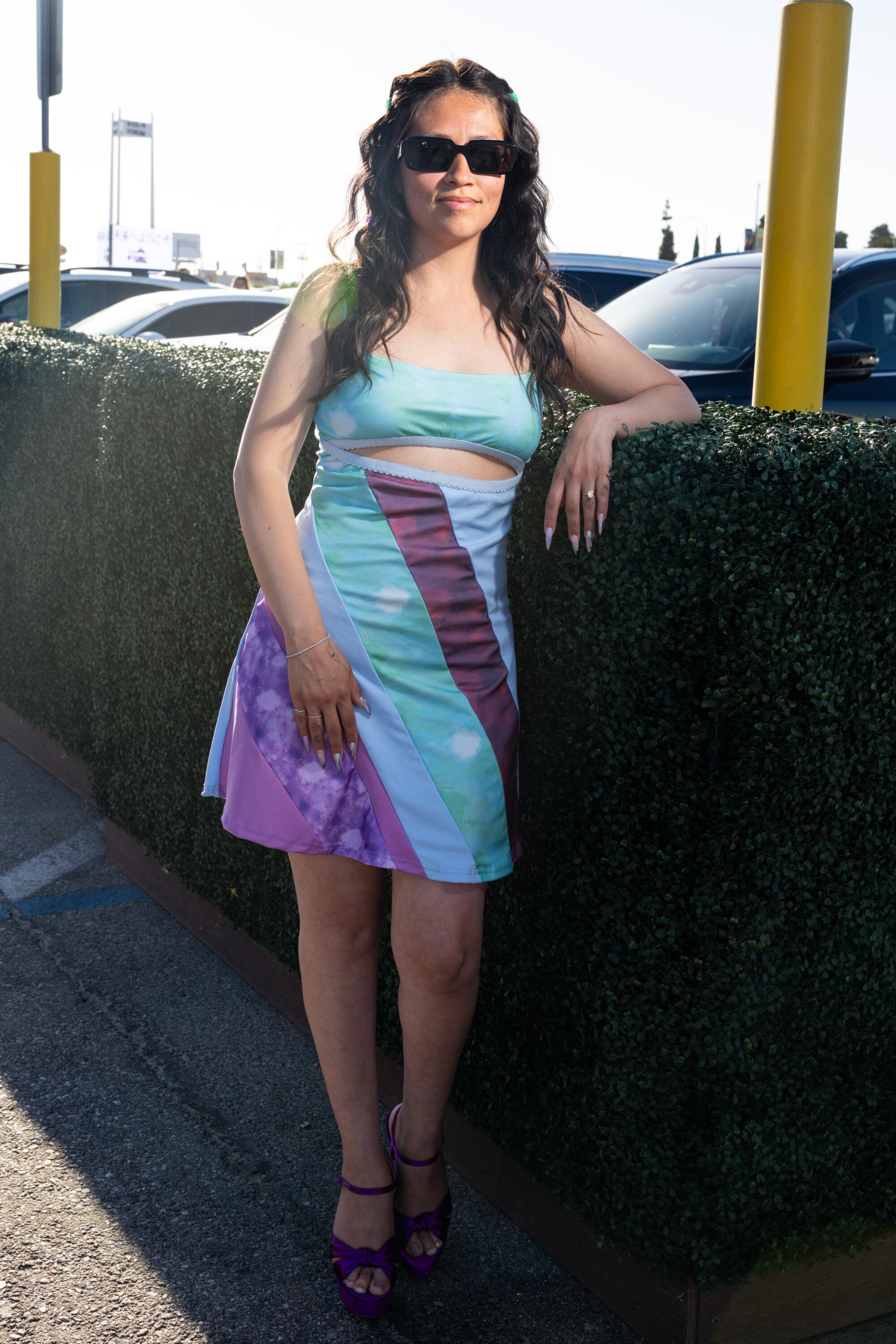
(Kayla Bartkowski/Los Angeles Times)
Stephanie Rodriguez, 32, High Desert
Tell us about your outfit.
If you ask my fiancé, I was hunting for outfits and last-minute I was like, “I’m just gonna order something on Amazon.” When I saw this, I was like, “That’s it.” Total nostalgia with “13 Going on 30.” We went shoe shopping at the South Coast Plaza over the weekend. The metallic is pulling it all together and the butterfly clips.
How long have you been a fan?
Probably since I was like 8 or younger, pretty much very much obsessed. All of my holiday gifts were Hilary Duff. I had her K-Mart home products. Any magazines she was in, I got. Any outfits that I could try and replicate, I would. My first Hilary show was either Wango Tango or a Jingle Ball with KIIS-FM, so it was just a festival with a bunch of different artists but I went specifically for her.
Why does her work still resonate with you today?
I think a lot of us feel like we grew up with Hilary, so all of her music resonated with us then, and now, now that we’re older, through relationships or divorces or motherhood. It’s pretty cool to see just how we’re all kind of growing up together. The first time I think I found out about her was at the Glendale Galleria. I was recently telling my fiancé that my dad had me on his shoulders because she did a meet and greet and the entire mall was packed.

(Kayla Bartkowski/Los Angeles Times)
Kelsie Wagner, 35, of Temecula and Tyler Walsh, 35, of Long Beach
Tell us about your outfit.
Wagner: I’m channeling Lizzie McGuire. My favorite part is the butterfly clips.
Walsh: This is from Company D, which is a discount store for Disneyland. I was like let me get the biggest shirt and make it into a dress, but I’m wearing shorts — it’s still appropriate. I have like six authentic Disney pins here. This is about $200 on my hat. I was like I have to do something that represents. It’s a big hobby, pin trading, that I picked up in 2023. Then I wore my Lisa Franks. I figured I would channel everything from the ’90s and 2000s.
How long have you been a fan?
Wagner: Whenever the “Lizzie McGuire” show came out.
Walsh: I remember going to sleepovers with all of my friends and we would do Lizzie nights. I was on a soccer team and on Saturday nights, we’d go watch the newest episode. It was just so fun because I feel like I had a little clan that loved Lizzie. We went to her concert at the Grove together and it was back when you paid $50 to get in. We were front row and we like smelled her. It was wonderful.
Why does her work still resonate with you today?
Wagner: For me, especially her new album, she talks about marriage, relationships, motherhood, so it’s still relatable in that sense of that stage of life that we’re in.
Walsh: For me, it’s just nostalgia, because I’m not married, I have no kids, like I’m that fun aunt. And I will say, like, because she goes to Disneyland a lot, so I luckily got to meet her too. I asked her for a picture, and she’s like “Yeah, of course, honey.” It’s the most embarrassing photo of me ever though.
Wagner: I told her she should get it printed and wear it to the concert.
Walsh: I should have.

Sam Raimi‘s Evil Dead films and TV series are a fine example of creativity within constraints, playfulness, self-awareness and outright slapstick comedy. The Evil Dead series after Raimi is very, very different. Starting with 2013’s Evil Dead by Fede Álvarez, followed by Evil Dead Rise by Lee Cronin, the new series takes itself more seriously and emphasises pure horror, violence and gore. Some have considered this praiseworthy as it avoids being a mere retread of the old films, but the reception has been mixed.
In Sébastien Vanicek’s Evil Dead Burn, Alice (Souheila Yacoub) loses her abusive husband (George Pullar) to a motor accident. When she goes home to stay with his family, the consequences of the work of their dead grandfather researching the Necronomicon and the Deadites manifest in terrible ways. One by one, the family are turned into the Evil Dead.
Horror is a genre that depends on you relating to the protagonists so you care what happens to them. In the case of Evil Dead Burn, Yacoub does a decent job with the character she’s given, but the gonzo horror elements manifest so early in the film that she may as well be collateral damage in the onslaught, especially as the film’s early point of view is that of her brother-in-law (Hunter Doohan).
Fans of gory violence will get their money’s worth here, but there’s not a lot going on besides that. The film is a descent into madness and carnage that is so resolutely unpleasant that, after some of the early kills, it becomes numbing. It’s hard to gather what the tone is supposed to be, with lots of callbacks to the early films’ style by setting up inevitable kills with Chekhov’s weed trimmer, Chekhov’s fork and every other potentially dangerous prop the camera lingers on. The family are all deeply unpleasant at some level and so their deaths register as meaningless. Yes, the film has the obligatory something to say about how our tendency to ignore domestic abuse creates demons that destroy families, but then absolutely panders to bloodlust by absolutely revelling in some of the most extreme violence imaginable between family members (and a pet). To say this is not a film for the sensitive is to understate things considerably. This is a film that absolutely earns its content guidance warnings.
Is there any comedy? Some, but it feels out of place given the absolute brutality inflicted on the cast. While most of the other films were self-aware about setting up a ludicrously grisly end for a villain as a payoff, in Evil Dead Burn,the kills have very little flair. It’s also hard to know what the rules for getting rid of a Deadite are, as some of them are still upright and chatty after losing most of the contents of their skull and some are dispatched by the repeated application of a blunt object to the head. Towards the end, a McGuffin is added to make the kills final, but before that, who knows?
Should you watch Evil Dead Burn,? It certainly gets vocal reactions from audiences in a cinema, and if you’re a gorehound you’ll be in for a ride. If you’re a horror fan, it’s certainly a horror film, but violent instead of scary. If you’re just a fan of cinema who likes good films whether or not they’re horror films, then this will be an alienating watch. In Evil Dead Rise the decay of the family was more than background noise and factored into the circumstances of the individual deaths, but not here. It has slight pretences of being a film with Themes and Ideas, but in the end it just feels like an excuse to serve up limbs being mutilated, skulls being crushed and any number of stabbings, slicings and gougings rendered with psychopathic visual fidelity. If that’s what you’re after, that’s what it’s got.
-
Washington2 minutes ago
Bengals 2026 Opponent Preview: Washington Commanders
-

 Vermont2 minutes ago
Beau Welling’s Stowe Country Club Revamp Signals New Vermont Golf Era
-

 Virginia9 minutes ago
Rabid cat, bat, raccoons and skunks reported in these 4 Virginia counties
-

 Wisconsin17 minutes ago
Shipwreck Coast sanctuary council to meet July 16 in Sheboygan
-

 West Virginia24 minutes ago
Helicopter crashes in Pocahontas County
-

 Wyoming27 minutes ago
Wyoming officials say Meta’s 715,000-square-foot data center is responsible for contaminating its water system with a rare bacterium | Fortune
-

 Crypto32 minutes ago
What Are KOLs Discussing About the Cryptocurrency Market Today?
-

 Finance39 minutes ago
From Love Island to Precious Metals, Prediction Markets Are Changing Finance | PYMNTS.com

