Entertainment
Review: A new Sondheim biography reveals some shockers — and the dark side of genius


Book Review
Stephen Sondheim: Art Isn’t Easy
By Daniel Okrent
Yale University Press: 320 pages, $35
If you buy books linked on our site, The Times may earn a commission from Bookshop.org, whose fees support independent bookstores.
Stephen Sondheim’s death in 2021, at 91, was a gut punch to musical theater fans. Showered with honors and tributes, he had begun to seem eternal, a cultural constant. Even his gnarliest shows enjoyed successful revivals — more acclaimed, and more profitable, than their original productions. His influence and mentorship shaped a new generation of theatrical composers that included Adam Guettel (“The Light in the Piazza”), Jason Robert Brown (“Parade”), Jeanine Tesori (“Fun Home”), Jonathan Larson (“Rent”) and Lin-Manuel Miranda (“Hamilton”).
The most secular of Jews, Sondheim is now the subject of a biography in Yale University Press’ excellent Jewish Lives series. Its author, Daniel Okrent, was the New York Times’ first public editor and has written acclaimed books on topics such as immigration and Prohibition.
Okrent never met Sondheim, he tells us, but he had some near misses: He sat near the composer in the theater on more than one occasion and was even mistaken for him. For “Stephen Sondheim: Art Isn’t Easy,” Okrent spent three years absorbing the literature, interviewing collaborators and friends, and probing the archives. He cites a particular debt to biographer Meryle Secrest’s extensive taped interviews, from the mid-1990s, with Sondheim and others.
The resulting volume is a brisk, engaging read that avoids hagiography. Okrent highlights the emotional frailties that coexisted with the brilliance and generosity. He seeks to liberate Sondheim’s reputation from the encrustation of myth and to demystify his relationships, while offering a succinct analysis of his achievements. That’s a tall order for a compact book, especially given its subject’s long, complicated life. Okrent’s failings are, unsurprisingly, primarily those of omission.
The general outlines of Sondheim’s story are well known. The precocious only child of two acrimoniously divorced parents, he benefited from the mentorship of his Bucks County, Pa., neighbor, Oscar Hammerstein II. Sondheim enjoyed early success, in the late 1950s, as the lyricist for “West Side Story” and “Gypsy,” but chafed at the limitations of the role. He vastly preferred writing music.
With a variety of collaborators, including Hal Prince, George Furth, John Weidman, Hugh Wheeler and James Lapine, he went on to forge a distinctive legacy as both a composer and lyricist. His shows, including “Company,” “Follies,” “A Little Night Music,” “Sweeney Todd,” “Merrily We Roll Along” and “Into the Woods,” mined the darkness and complexities of human relationships, deployed diverse forms of storytelling, and expanded the possibilities of the Broadway musical.
Okrent’s subtitle, “Art Isn’t Easy,” is a lyric from Sondheim’s “Sunday in the Park with George.” The 1984 musical, inspired by the painter Georges Seurat’s 1886 pointillist masterpiece “A Sunday Afternoon on the Island of La Grande Jatte,” explored the rigors and rewards of the artistic process.
There are some surprises here. While Sondheim spoke about using alcohol as a creative lubricant, Okrent goes further. Quoting Lapine and others, he concludes that Sondheim was an unrepentant alcoholic, as well as a prolific user of marijuana and cocaine. He kept drinking, Okrent says, even after at least two heart attacks.
For years, Sondheim dated men casually, without commitment. Only late in life did he find two serious loves, the songwriter Peter Jones and then the producer Jeff Romley, 50 years his junior, whom he married. That union brought him contentment, Okrent says.
Okrent also takes seriously Sondheim’s “emotionally intimate” relationships with women. Among them were Mary Rodgers, daughter of composer Richard Rodgers, who chronicled her devotion in the memoir “Shy;” the actress Lee Remick, whom Okrent says Sondheim truly loved; and the producer-director Hal Prince’s wife, Judy, an artistic muse with whom he may have talked daily. Her disinclination (along with Romley’s) to cooperate with biographers leaves an unfortunate gap in the record.
One of the myths Okrent tackles involves Sondheim’s supposed rupture with Judy’s husband, whose vision had helped fuel shows such as “Company,” “Follies” and “A Little Night Music.” After the spectacular failure, in 1981, of “Merrily We Roll Along,” Sondheim turned to new collaborators. But, according to Okrent, the friendship remained largely intact. (A final, years-long collaboration with Prince, on the musical “Bounce” — later called “Road Show” — never made it to Broadway.)
Okrent portrays Sondheim as witty and endearing, but also poorly groomed, remote, caustic, quick to anger — and, mostly, quick to forgive. One exception was the case of the prickly Arthur Laurents (librettist for “West Side Story” and “Gypsy”), a longtime friend and sometime foe whose request for a deathbed visit Sondheim spurned. By contrast, Sondheim was consistently accessible and encouraging to younger composers and lyricists even as his own artistic output sputtered.
One of his most embattled relationships was with his mother, known as Foxy. She famously bemoaned his birth in a cruel letter, which Okrent suggests Sondheim may have misquoted. But it was through her machinations that he met Hammerstein, a debt he repaid by supporting her financially through much of her life.
The biography’s brevity is necessarily limiting. While Okrent mentions that the recent Tony Award-winning Broadway revival of “Merrily We Roll Along” fetched high ticket prices, he doesn’t detail the reasons for its success. (Director Maria Friedman re-envisioned the show as a memory play, and cast the supremely likable Jonathan Groff as the corrupt composer Franklin Shepard, ruefully reflecting on his past.)
Okrent touches on Sondheim’s faltering efforts to complete his final musical, with David Ives, “Here We Are.” But he says nothing about its posthumous Off Broadway production, in 2023, which played to packed houses and mixed reviews — not quite the valedictory Sondheim would have wanted.
In Sondheim’s body of work, Okrent searches for the autobiographical resonances that Sondheim himself mostly disdained. He likens the composer to both the emotionally disengaged protagonist, Bobby, of “Company,” who struggles with ambivalence, and (more surprisingly) the vengeful barber Sweeney Todd, whose demons drove him to murder. Sondheim’s were instead tamed by his art, Okrent suggests, which shaped his “textured, contradictory, troubling, and gratifying life.”
Klein is a Philadelphia-based cultural critic and reporter.



Movie Reviews
‘Forbidden Fruits’ Review: The Salesgirls Are Witches in a Depraved Satirical Thriller That’s Like ‘Mean Girls’ Meets ‘The Craft’ Touched with Something Darker

If you see one spicy depraved satirical thriller this year that’s a cross between “Mean Girls” and “The Craft” and something far darker, by all means make that movie “Forbidden Fruits.” It’s an agreeably sharp-witted black-as-midnight comedy about four young women from Texas who work in a clothing-and-knickknack boutique at the Highland Place mall. They aren’t just friends; they’re part of a coven. Does that mean they’re actually witches? Maybe, maybe not.
What we can say for sure is that they’re shopping junkies obsessed with signifiers of their femininity (skimpy chemises, bracelets with charms, designer cupcakes), that their banter is peppered with the kind of slang (gorge, perf, vom) you’d expect from a movie that has Diablo Cody as one of the producers, that at one point they do a willowy dance to an EDM cover of Bryan Adams’ “Heaven,” and that three of them are under the spell of their ringleader, Apple (Lili Reinhart), a cold vixen in long straight red hair and stiletto heels who controls their every move with agendas of her own.
Each of the girls is named for a different fruit. In addition to Apple, there’s Cherry (Victoria Pedretti), who in earlier age would have been the “ditz,” because she’s got a sensual innocence (she spends every Wednesday afternoon boinking a different dude from the food court), but she’s actually as sharp-tongued as the rest of them. There’s Fig (Alexandra Shipp), the most serious and skeptical. And there’s the mysterious newbie, Pumpkin (Lola Tung), who’s working at a candied-pretzel store called Sister Salt’s when Apple taps her to join the coven (though she doesn’t put it quite that way). She leads Pumpkin into the girls’ shared immersion in the ways of fashion and jargon and backbiting, their filtering of life through a scrim of pop, and the way that Apple layers her “sisterly” directives with an academic feminist righteousness. That, in fact, is what makes the film original — its perception that for these girls, progressive anger is now inseparable from fashion.
If they are in fact witches, what’s the witchcraft about? In comedies like “The Craft” or “Practical Magic,” witchcraft has mostly been a free-floating expression of female power. But in “Forbidden Fruits,” Apple, the group’s Regina George, uses her status as head witch to enforce her rules about the way things should be. (You’re only allowed to text a dude using emojis.) Periodically, she’ll send one of her comrades into the dressing room that serves as a “confessional,” where the one you’re confessing to is the spirit of Marilyn Monroe. Why Marilyn? Because Apple considers her the ultimate female martyr, and says “no one could control her, not even the president.” Apple has a JFK assassination theory about Marilyn. According to the theory, Marilyn was murdered — by JFK — precisely because she couldn’t be controlled. In Apple’s eyes, the ghost of Marilyn now hovers over every dance of power between a man and a woman.
Cherry, promiscuous and confused, actually seems to have a bit of Marilyn in her. But what of the others? As Fig pursues a romance, which Apple tries to squelch, we realize that Apple, with her fear and loathing of men, is a witch of the spirit. Yet Lili Reinhart plays her with a diamond-hard smirk and a gleam of perception that lights up the screen. She’s like Parker Posey crossed with Ann-Margret. She has the potential to go far.
At first, cued by everything in “Forbidden Fruits” that’s reminiscent of those earlier films, we think it’s all for fun: a high-camp giggle trip. But the film’s first-time director, Meredith Alloway (who co-wrote the script with Lily Houghton), has a vision that’s less facile and more contemporary than that. She has made a screw-loose comedy of stylized youth attitudes that doesn’t pretend to be “real,” but it’s also a serious movie that asks: What do young women today want? Love or justice or power? Or all three? And is any one of the three more powerful?
The movie takes a turn into suspense when Apple leads the others in putting a hex on someone, and the hex appears to work. What happens is unnerving, at which point the film passes through a looking glass of fear. There’s something new at work — a cultural hairpin turn — in the way that Apple is made out to be a figure of commanding but toxic damage. “Forbidden Fruits” goes over-the-top into shock and violence (which is staged with great wit), but what drives the movie forward is how it tries to pull its characters out from under the influence of someone whose witchery has made men the enemy. The movie says: It’s time to break that spell.

Hulu the “Buffy” reboot slayer?
The Disney-owned streaming platform has pulled the plug on its much-anticipated “Buffy the Vampire” revival, a year after star Sarah Michelle Gellar confirmed the series was officially in the works. A “really sad” Gellar delivered news of the pre-debut cancellation to fans in a brief Instagram video shared Saturday. She was set to executive produce the series, tentatively titled “Buffy: New Sunnydale,” with Oscar-winning filmmaker Chloé Zhao set to direct.
“I never thought I would find myself back in Buffy’s stylish yet affordable boots and thanks to Chloé I was reminded [of] how much I love her and how much she means not only to me but to all of you,” Gellar said. “This doesn’t change any of that.”
She added: “I promise if the apocalypse actually comes you can still beep me.”
Gellar’s bittersweet announcement prompted Los Angeles resident Bren O’Brien to organize a rally on Monday outside Hulu’s headquarters in Santa Monica. O’Brien, a lifelong “Buffy” fan, displayed several posters urging the streamer to reconsider its decision along the sidewalk. One bright red poster read “Bring Buffy Back!!” scrawled in black ink. Another, bearing Gellar’s likeness, asserted, “Canceling Buffy Isn’t smart, the world needs a hero!”
“I’m really sad. This was a moment that I’ve been waiting decades for,” O’Brien said.
Hulu officially began production on the “Buffy” sequel series after years of careful consideration by Gellar. Last year, the cast for the pilot was assembled while Gellar vowed , “We will only make this show if we can do it right.”
The “Buffy” star did not share additional details about the cancellation in her weekend post, but Zhao said at the 2026 Academy Awards red carpet that she was “not surprised” by Hulu’s decision.
“I had an incredible, incredible time with Sarah, with all the cast and crew doing this. We, first and foremost, see ourselves as the guardians of the original show,” the “Hamnet” filmmaker told Variety on Sunday. “Our priority for Sarah and for us has always been to be truthful to the show, to be truthful to our fans. So, things happen for a reason, and we keep our hearts open and we welcome the mystery.”
Actor Ryan Kiera Armstrong, who was set to lead the show as a supernatural slayer opposite Gellar, lamented the cancellation on Instagram. “Your slayer,” she captioned a photo of herself in costume.
“Buffy” premiered in 1997 and aired on the WB until 2001 when it moved to UPN. Though the series ended in 2003 , it spawned the spinoff series “Angel” which aired from 1999 to 2004 on the WB. Other prospective “Buffy” revivals, however, reportedly struggled to make it past development. Additionally, several actors in recent years have accused “Buffy” creator Joss Whedon of misconduct.
After Gellar broke the cancellation news, “Buffy” fans reacted online, with many of them slamming Hulu for its “terrible decision.” A representative for Hulu did not immediately respond to a request for comment on Monday.
O’Brien, among the disappointed fans, said he began posting about the cancellation online, creating posters and promoting his rally. He said he was surprised by Hulu’s decision because “Buffy” is “such a valuable IP to have,” considering its generations of fans.
“It’s just a no-brainer,” he added.
Erin McClory, a fellow “Buffy” fan, joined O’Brien outside of Hulu’s headquarters and held a poster depicting a wooden stake through a broken heart. She said she hopes rallying around the slain “Buffy” series can help persuade Hulu to reconsider its decision or prompt another network to pick up the show.
“It seems crazy for them to not even give it a chance,” she said.
Though both O’Brien and McClory say they’re eager for new “Buffy” material down the line, their support for the show remains steadfast.
“We’ll just keep doing what we’ve been doing and keep sharing Buffy edits [on social media],” O’Brien said, then sighed. “I want new content.”
Movie Reviews
‘The Saviors’ Review: Adam Scott and Danielle Deadwyler in a Timely Comic Thriller With Good Intentions and Clunky Execution

If there is one thing Sean (Adam Scott) would like to make perfectly clear, it’s that he’s only ever had the best intentions. He’s no bigot. He doesn’t buy into far-right propaganda like his parents (Ron Perlman and Colleen Camp) do. And he’s been nothing but hospitable to his new Airbnb guests, Jahan (Nazanin Boniadi) and Amir (Theo Rossi). If it happens that he finds them suspicious, it’s certainly not because they’re Middle Eastern. It’s only because there’s just something off about them, somehow.
As Sean eventually learns the hard way, though, good intentions can only ever count for so much. His movie, too, is proof of that. The premise of The Saviors, a genre-defying thriller written (with Travis Betz) and directed by Kevin Hamedani, is undeniably timely, exploring the way faulty assumptions about some unknown Other might have disastrous, even apocalyptic consequences. But an emphasis on broad ideas over nuanced detail yields a film that’s more interesting in theory than in practice.
The Saviors
The Bottom Line A worthwhile message, flatly conveyed.
Venue: SXSW Film Festival (Narrative Spotlight)
Cast: Adam Scott, Danielle Deadwyler, Theo Rossi, Kate Berlant, Nazanin Boniadi, Greg Kinnear
Director: Kevin Hamedani
Screenwriters: Kevin Hamedani, Travis Betz
1 hour 30 minutes
Sean’s increasing fear of the Razi siblings isn’t the only problem he’s got going on. The only reason the place is being rented to begin with is because he and Kim (Danielle Deadwyler) are preparing to divorce and the mortgage needs paying off. No surprise, then, that Kim is initially skeptical of Sean’s conspiracy theories, assuming her aimless husband to be fixating on trivial nonsense. But as Kim also starts noticing odd things — including a missing journal and an alarming map, to add to the strange electrical equipment and unexplained lights Sean’s been trying to tell her about already — she slowly comes around.
The Saviors pitches its tone somewhere between horror, thriller and comedy, and there are elements of all of those in the slightly unnerving sense that Kim and Sean almost seem to need Amir and Jahan to be up to no good. The excitement of nosing around the siblings’ stuff, comparing notes afterward, hiring a private investigator (Greg Kinnear as Jimmy Clemente, who looks and acts exactly as you’d want a Greg Kinnear character named Jimmy Clemente to look and act) and planning to take their findings to the FBI rejuvenates their relationship like nothing else has. During a bout of make-up sex, Kim even asks for a change of position so they can both keep staking out the backyard while they screw.
But like much else in The Saviors, that almost psychosexual component is an intriguing idea that, once presented, just sits there. It’s not carried to some surprising logical extreme, nor deepened into rich character work. You can see what the film is trying to say about a political climate in which the best unifier is a common enemy, but it’s not expressed with enough finesse or confidence to hit a nerve.
The Saviors does not even tell us much about Sean and Kim, since despite Scott and Deadwyler’s affable chemistry — too affable, maybe, considering they’re about to split — the characters are so vaguely drawn that it’s never clear what brought this couple together in the first place, or what’s pulling them apart now. The real, meta reason for their coupling seems to be that the filmmakers wanted a Black woman to ever so slightly complicate the racial dynamics, calling Sean out for “living in a white bubble” when he fails to comprehend why these visitors might seem skittish in their lily-white town.
That she eventually starts to buy Sean’s thinking is rooted in another shrewd and salient observation, about the contagion of prejudice. The rank bigotry of a neo-Nazi newsletter filters through folks like Sean’s parents and sister (a very funny Kate Berlant) — which is to say conservatives, but mostly amiable ones. That, in turn gets spread to nice white liberals like Sean, then even more left-leaning skeptics like Kim. But once again, The Saviors undermines its own relevance by handling its characters like props being used to make a point, rather than people with their own complex motivations or contradictions.
This extends as well to Amir and Jahan, despite an impressive performance by Rossi that manages to convey the depth of Amir’s emotions long before we understand what’s behind them. The siblings are cryptic and unknowable by design, and Jahan even more so for her silence. (She’s deaf, Amir explains early on, but can lip-read.) The script does a decent job of keeping us guessing as to their true goals, playing on the tension between our desire to see them proven innocent and our gnawing realization that they’re clearly up to something strange.
Once the truth is out, however, and it becomes possible to piece together how the past several days have looked from their perspective, The Saviors just stops. It’s made its point — loudly and bluntly, including in a line of dialogue that might as well have been presented with a flashing neon caption reading “This is the theme of the movie” — and has nothing more to add. In fairness, it’s a message that’s always worth remembering, and one that sadly feels more essential than ever. If only it had been delivered in a package sturdy enough to really sell it.

How a Melting Glacier in Antarctica Could Affect Tens of Millions Around the Globe

She’s won 24 Paralympic medals. But Oksana Masters wants to talk about times she lost

Ikea tried to build a smart home for everyone — here’s why it’s not working yet

EU pushes for end of Iran war in a manner where ‘everybody saves face’

Mamdani references Palestinian ‘genocide’ during St Patrick’s Day event

Florida High School Football Rankings: Top 25 teams – Oct. 21

How old is Bo Nix? What to know about Oregon quarterback ahead of 2024 NFL Draft

Cleary's 21 help Le Moyne down Central Connecticut State 69-64 in OT

99th annual Pony Swim held in Virginia

Indiana Members Credit Union announced as new anchor tenant at Bottleworks District
Mamdani references Palestinian ‘genocide’ during St Patrick’s Day event

Ex-Belgian diplomat ordered to stand trial over murder of Congo’s Lumumba
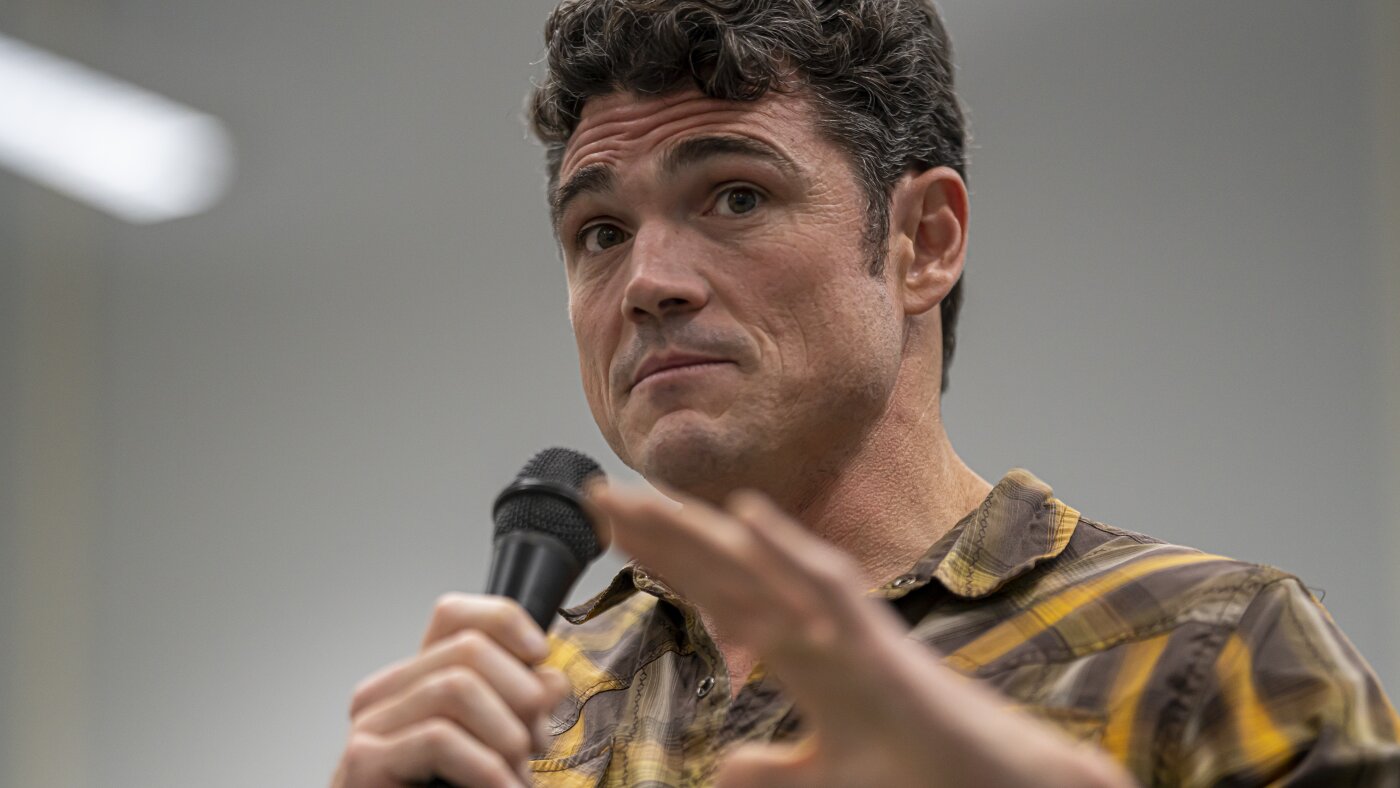
Joe Kent, a top counterterrorism official, resigns citing Iran war

Minnesota bill would ban warrants allowing police to collect data from devices near a crime scene

Kallas says ‘no appetite’ to shift mandate of EU Hormuz naval mission
-

 Oklahoma1 week ago
OSSAA unveils Class 6A-2A basketball state tournament brackets, schedule
-

 Oklahoma3 days ago
Family rallies around Oklahoma father after head-on crash
-

 Michigan1 week ago
Operation BBQ Relief helping with Southwest Michigan tornado recovery
-

 Nebraska4 days ago
Wildfire forces immediate evacuation order for Farnam residents
-

 Southeast1 week ago
‘90 Day Fiancé’ alum’s boyfriend on trial for attempted murder over wild ‘Boca Bash’ accusations
-

 Health1 week ago
Ancient herb known as ‘nature’s Valium’ touted for improving sleep and anxiety
-

 Connecticut1 week ago
Exclusive | Ex-CBS anchor Josh Elliott back on Connecticut dating scene after ugly Liz Cho split
-

 Technology1 week ago
Sony appears to be testing dynamic pricing on PlayStation games