
Entertainment
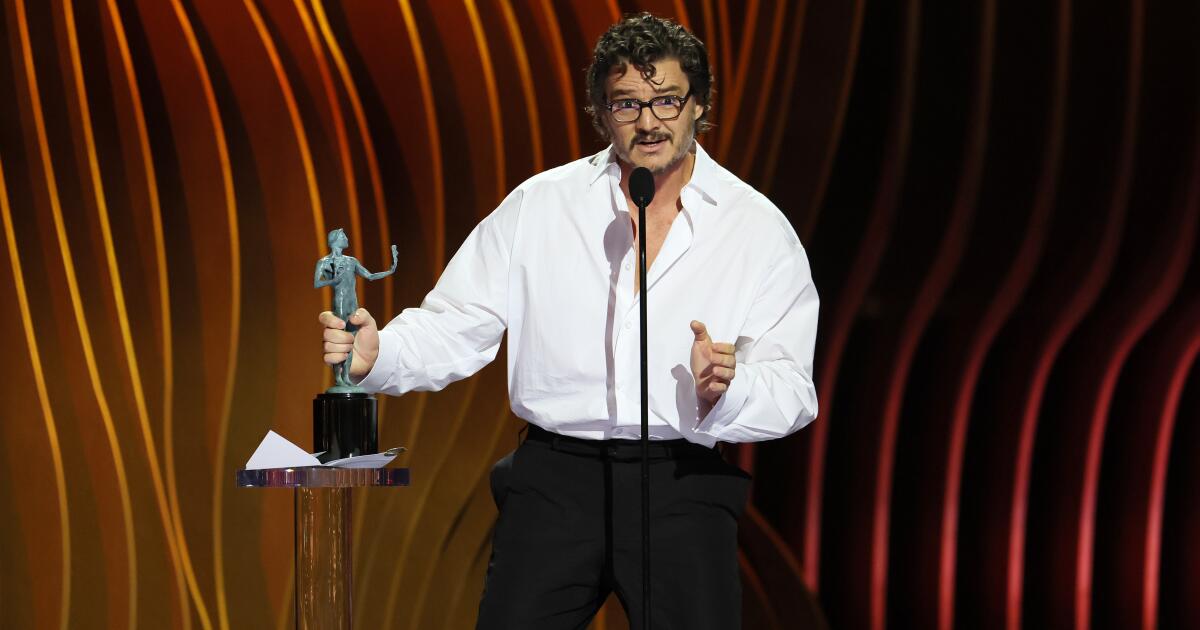
Pedro Pascal breaks 'Succession's' dominance at 2024 SAG Awards: live updates
After months of direct confrontation in a bitter Hollywood strike, the Screen Actors Guild and Netflix are offering each other a two-hour olive branch: The 30th SAG Awards are streaming on the platform tonight for the first time ever.
Many hopes hang from either side of that branch. SAG is betting that Netflix can give its awards show, traditionally viewed as a predictive precursor to the Oscars, a much wider audience than it reached in previous years. Netflix is determined to prove that it can broadcast a live event as successfully as any television network.
Of course, it’s the biggest stars that will be the draw on Saturday, including a rare public appearance by Barbra Streisand, who will receive SAG’s Life Achievement Award. She’s showing up because, as she recently told The Times’ Glenn Whipp, she liked the fact that “so many actors marched and worked very hard to get what they campaigned for,” and also because “they told me in advance that I got the award! No trauma or drama.”
Follow along throughout the night as Mary McNamara, Meredith Blake and Josh Rottenberg report on the proceedings live. Here’s hoping that the “no drama” rule doesn’t extend to the show.
Winners list | All the looks from the red carpet
5:43 p.m. I’m officially missing commercials at this point. But the “Lord of the Rings” reunion of Sean Astin and Elijah Wood presenting female actor in a supporting role (motion picture) makes up for it. As does Da’Vine Joy Randolph’s win for “The Holdovers.” “For every actor waiting in the wings, you life can change in a day,” she says. “It’s not if but when. Keep going.” —MM
5:36 p.m. USC gets a shout out as junior Storm Reid says she basically walked over to the Shrine from her dorm to present, with Phil Dunster, male actor in a drama series. Which, astonishingly, Pedro Pascal wins. The iron rule of “Succession” is broken. —MM
It’s hard to begrudge someone so delightful, even if he appears to be wearing the “Seinfeld” puffy shirt. –MB
Only a quarter of the way through the show and Pedro Pascal just dropped the third or fourth f-bomb of the night. “It’s Netflix,” he says. Seems like if nothing else the streaming era could bring us swear-ier awards shows. —JR
5:27 p.m. Melissa McCarthy and Billie Eilish present best female actor in a comedy series — McCarthy tells Eilish she met her “in utero” (does this count in the “vaginal” list, Meredith?) because Eilish’s mother was McCarthy’s improv teacher. Then she asks Eilish to sign her face, something that proceeds to happen. With a Sharpie. —MM
I appreciated McCarthy’s commitment to the bit but I can’t help feeling sad she ruined a very nice makeup job. That’s what we call acting, I guess! Also, as I learned from the pandemic, hand sanitizer is great for getting Sharpie stains out. The more you know! —MB
Ayo Edebiri wins for “The Bear.” “Oh, she won another one,” my daughter says as she wanders into the room. —MM
Ayo Edebiri wins the SAG Award for female actor in a comedy series.
(Robert Gauthier/Los Angeles Times)
5:23 p.m. While Tan France interviews White backstage, attendees in the room are treating it like a commercial break and running to the bathrooms and checking their phones. —JR
5:19 p.m. Glen Powell is not wearing his wrist corsage as he and Issa Rae present female actor in a television movie or limited series. I am very disappointed. Be braver, Glen. Ali Wong wins for “Beef” and has divested herself of her fancy cut-outs, which would also be disappointing but Wong can never disappoint. —MM
It honestly seems like a good idea when you’re in a crowded room and are at least theoretically supposed to be eating food. I need the behind-the-scenes story of how this happened and which bathroom she ducked into with her stylist to make this happen. —MB
“The Devil Wears Prada” costars Emily Blunt, Meryl Streep and Anne Hathaway at the 30th Screen Actors Guild Awards.
(Robert Gauthier/Los Angeles Times)
5:12 p.m. There’s a “Devil Wears Prada” moment as Meryl Streep is joined by Emily Blunt and Anne Hathaway to give the best actor in comedy series award. (Honestly, every awards show should have a “The Devil Wears Prada” moment.)
Unsurprisingly, Jeremy Allen White of “The Bear” wins for male actor in a comedy series. —MM
Weird that they let people curse on stage but then bleeped out the curse words in the clips from “Ted Lasso.” White’s win for continues his total domination of the awards circuit and underwear ads everywhere. —MB
“Wow, they give you a lot of time at this one,” White says, wrapping up his acceptance speech. Indeed winners won’t need to worry about getting played off the stage tonight because … streaming! —JR
5:03 p.m. Show is starting, Hannah Waddington is telling a great story about having a mouse in her dress when she was starring in “Spamalot” and all I can think about is the salmon. Thanks, Josh.
Idris Elba the mounted the stage, saying he can’t wait until he can go home and watch the show being recommended to him by Netflix based on all the other things he has watched that he has starred in — before pivoting to a brief shout-out to the SAG-AFTRA strike. Sorry, it is still weird that months after the vitriolic “Netflix strike,” the SAG Awards are on Netflix. I guess that’s Hollywood. —MM
Idris Elba photographed during the 30th Screen Actors Guild Awards.
(Robert Gauthier/Los Angeles Times)
4:57 p.m. It seems noteworthy that there has not been a single mention (that I noticed) of the actors’ strike so far on the Netflix red carpet. It’s like Mom and Dad have gotten back together after a brief separation and nobody wants to talk about it. —MB
Noteworthy and a bit weird — it is tough to imagine that the irony of Netflix hosting the SAG Awards will go unremarked upon during the show, since so many points of contract contention centered around streaming’s disruption of Hollywood’s business model. Not surprisingly, none of the grey — correction, silver — carpet questions have touched on it. This is a Netflix production, after all. (Random shout out to Welteroth, who is one of the best on-carpet interviewers I have seen in my long career covering these things.) Waiting to see if there are any mentions during acceptance speeches. Will be very disappointed if there are not. —MM
With the show soon to start, SAG-AFTRA’s chief negotiator Duncan Crabtree-Ireland is speaking to attendees about the important gains made during the strike. “This room is a living metaphor of the unity and solidarity that brought us to this point.” They also showed a rousing clip reel of scenes from the strike to big applause. Hard to tell if any of the striking actors shown in the footage were picketing in front of Netflix headquarters. —JR
Hannah Waddingham during the 30th Screen Actors Guild Awards.
(Robert Gauthier/Los Angeles Times)
4:51 p.m. Hannah Waddingham wins best-dressed, in my esteemed opinion, for carrying a homemade cardboard clutch made by her daughter. It’s honestly the chicest thing I’ve seen all night. —MB
And Idris Elba is in the building. All is well. —MM
Elba is set to open and close the show, according to the producers, but they’re not going so far as calling him the “host.” —JR
4:48 p.m. Kieran Culkin went Full Hugh Grant”on Welteroth, giving her grief for leaning on him and taking off her painful shoes on the red carpet. I am always here for a red carpet grump. —MB
Meanwhile, Billie Eilish just confessed to teleprompter-phobia. Well, we all have to be afraid of something. —MM
4:44 p.m. Wait, are they giving awards on the carpet? Apparently so. For stunt ensemble in a TV series, it’s “The Last of Us”; for film, “Mission Impossible: Dead Reckoning Part I.” It feels a bit cavalier and anticlimactic considering, you know, all those freaking stunts involved. I mean they could have had Tom Cruise jump all the main tables on a motorcycle or something. —MM
Tan France shows off his unorthodox bow tie at the Screen Actors Guild Awards.
(Brian van der Brug/Los Angeles Times)
4:39 p.m. If anyone watching at home is curious what attendees will be eating, the “light dinner” will be chive-crusted salmon. It’s served cold, which is good because it’s been sitting out on the tables for a while now and very few people have taken their seats yet. —JR
Josh, that item about the cold salmon should have come with a trigger warning. Maybe it’s a good thing everyone in Hollywood is on Ozempic these days. —MB
And they are mid-awards season. My favorite memory from the post-Oscar’s Governors Ball is seeing all the stars make a beeline for the bread baskets. Finally, they can eat! Honestly, you could lose a finger trying to claim a pretzel roll. —MM
4:34 p.m. Sorry, did Tan say he wanted Jessica Chastain’s babies? This night is really taking an unexpected turn. —MB
I don’t know, France and Debicki and Welteroth and Chastain were all talking at each other from separate parts of the carpet via screens. Which was kind of weird. Then Chastain chatted with Bradley Cooper, who she apparently knows from PTA? Meanwhile, Jon Hamm was standing in the background looking like he can’t understand why no one is interviewing him. Also, I always forget that Alan Ruck is married to Mireille Enos, who looks amazing. —MM
4:29 p.m. For reasons of his own, Tan France just gave Glen Powell a wrist corsage, which Powell misidentified as a boutonniere. Having not seen a wrist corsage since my junior prom, never mind at a Hollywood awards show, I am barely able to obsess about Cillian Murphy’s accent. —MM
I can’t help but notice the prevalence of Netflix stars on the red carpet so far, including Wong (“Beef”), Colman Domingo (“Rustin”) and Elizabeth Debicki (“The Crown”). I’m glad they let Murphy speak for a minute or two because I could listen to that accent all day. —MB
Elizabeth Debicki (“The Crown”) arriving at the 30th Screen Actors Guild Awards.
(Brian van der Brug/Los Angeles Times)
4:22 p.m. The pre-show is underway, and we’re looking at the grey carpet with Tan France — in an insane… bow tie? Boba straw? Inflatable chopstick? — and Elaine Welteroth, who gave us a look at hot fashion of SAG Awards past before kicking things off with Ali Wong wearing a black and white number decorated by what looked like a bunch of artisanal paper snowflakes. Also, my first tiny telecast glitch. —MM
Ali Wong was the first — but let’s hope not the last — person to mention “vaginal birth” tonight on the carpet. So cheers to that. —MB
4:15 p.m. Super excited to be watching the Screen Actors Guild Awards as Netflix continues its attempt to prove it can do everything broadcast/cable can except breaking news. (When Netflix announces it is entering the journalism space, you heard it here first.) I was tiny bit concerned as I struggled to find the pre-show coverage listed anywhere, though: I had to search to find the listing for the actual show, which says it starts at 5 p.m. Pacific. Instead I was being urged to re-watch “Everything Everywhere All At Once,” which swept the awards last year. And frankly, it is tempting. —MM
Same thing over here, Mary, except the algorithm suggested I continue watching “The Crown” and “Love Is Blind,” because it knows I love shows about emotionally stunted people in doomed relationships. Netflix is known for eschewing traditional marketing in favor of using “the algorithm” to suggest certain shows based on “taste clusters” — which are not, in fact, a brand of granola. But the thing about live TV is you kind of need to know when it’s on in order to, ya know, watch it. And if the algorithm can’t figure out that I — a person who writes about entertainment for a living and grew up watching every awards show known to man — might be interested in watching celebrities win trophies and make tearful speeches, then it needs to do better. —MB
Yes, it was kind of weird to be sitting here staring at a screen that said only “It’s almost time; the live event will start soon” instead of, I don’t know, the final minutes of a re-run of “The Closer.” —MM
I am primarily concerned that the whole “No ads” thing will mean no snack breaks, which are truly essential to home viewing of awards shows. Mary, how do you plan to make it through two whole hours without going to the kitchen to refill the popcorn? —MB
Criminy. I hadn’t thought about that. And with the SAG Awards there are no “boring” categories. (Sorry sound editing/sound mixing!) —MM
Movie Reviews
“Resurrection” Movie Review: To Burn, Anyway
“What can one person do but two people can’t?”
“Dream.”
I knew the 2025 film “Resurrection” (狂野时代) would be elusive the second I walked out of Amherst Cinema and into the cold air, boots gliding over tanghulu-textured ice. The snow had stopped falling, but I wished it hadn’t so that I could bury myself in my thoughts a little longer. But the wind hit my uncovered face, the oxygen slipped from my lungs, and I realized that I had stopped dreaming.
“Resurrection” is a love letter to the evolution of cinematography, the ephemerality of storytelling, and the raw incoherence of life. Structured like an anthology film and set in a futuristic dreamscape, humanity achieves immortality on one condition: They can’t dream. We follow the last moments before the death of one rebel dreamer, called the “Deliriant” or “迷魂者,” as he travels through four different dream worlds, spanning a century in his mind.
Being Bi Gan’s third film after the 2015 “Kaili Blues” (路边野餐) and the 2018 “Long Day’s Journey Into Night” (地球最后的夜晚), “Resurrection” follows Gan’s directorial style of creating fantastical, atmospheric worlds. Jackson Yee, known for being a member of the boy group TFBoys, stars as the Deliriant and takes on a different identity in each dream, ranging from a conflicted father-figure conman to an untethered young man looking for love to a hunted vessel with a beautiful voice. His acting morphs unhesitatingly into each role, tailored to the genre of each dream. Of which, “Resurrection” leans into, with practice and precision.
Opening with a silent film that mimics those of German expressionist cinema, “Resurrection” takes the opportunity to explore the genres of film noir, Buddhist fable, neorealism, and underworld romance. The Deliriant’s dreams are situated in the years 1900 to 2000, as we follow the evolution of a century of competing cinematic visions. The characters don’t utter a single word of dialogue in the first twenty minutes, as all exposition occurs through paper-like text cards that yellow at the edges. I was worried it would be like this for the whole film, but I stayed in the theater that Tuesday night, the week before midterms, waiting for the first line of spoken dialogue to hit like the first sip of water after a day of fasting.
Through a massive runtime that spans two hours and 39 minutes, this movie makes you earn everything you get. Gan trains the audience’s patience with a firm hold on precision over the dials of the five senses and the mind.
The dreams may move forward in time through the cultures of the twentieth century, but on a smaller temporal scale, the main setting of each dream functions to tell the story of a day in reverse. The first dream, being a film noir, is told on a rainy night. Without giving any more spoilers, the three subsequent dreams take place at twilight, during multiple sunny afternoons, and then at sunrise. “Resurrection” does not grant sunlight so easily; we are given momentary solace after being deprived of direct sunlight for a solid 70 minutes, until it is stripped from us again and we are dropped into the darkness of pre-dawn – not that I am complaining. I love a movie that knows what it wants the audience to feel. I felt a deep-seated ache as I watched the film, scooting closer to the edge of my seat.
“Resurrection” is a movie that is best watched in theaters, but a home speaker system or padded headphones in a dark room can also suffice. Some of its most gripping moments are controlled by sound. Loud, cluttered echoes of the world, whether from people chatting in a parlor or anxiety in a character’s head, are abruptly cut off with ringing silence and a suspended close-up shot. We are forced to reckon with what the character has just done. I knew I was a world away, but I was convinced and terrified at my own culpability and agency. If I were him, would I have done the same? I could only hear my thoughts fade away as we moved onto the next dream.
Beyond sight and sound, the plot also deals intimately with the senses of taste, smell, and touch, but you will have to watch the movie yourself to find that out.
My high school acting teacher once told us that whenever a character tells a story in a play, they are actually referencing the play’s overall narrative. This exact technique of using framed narratives as vessels of information foreshadowing drives coherence in a seemingly ambiguous, metaphorical anthology film. Instead of easy-to-follow tales that mimic the hero’s journey, we are taken through unadulterated, expansive explorations of characters and their aspirations. We never find out all the details of what or why something happens, as the Deliriant moves quickly through ephemeral lifetimes in each dream, literally dying to move onto the next, but we find closure nonetheless through the parallels between elements and the poetry of it all.
That is why I like to think of “Resurrection” as pure art. It is not bound by structure; it osmoses beyond borders. It is creation in the highest form; it is a movie that I will never be able to watch again.
Perhaps because the dream worlds are so intimate and gorgeous, the exposition for the actual futuristic society feels weak in comparison. We learn that there is a woman whose job is to hunt down Deliriants, but we don’t see the rest of the dystopian infrastructure that runs this system. However, I can understand this as a thematic choice to prioritize dreams over reality. Form follows function, and these omissions of detail compel us to forget the outside world.
What it means to “dream” is up for interpretation, and we never learn the specifics of why or how immortality is achieved. Instead, “Resurrection” compares dreaming to fire. We humans are like candles, the movie claims, with wax that could stand forever if never used. But what is the point in being candles if we are never lit?
The greatest reminder of “Resurrection” is our own mortality. Whether we run from the snow-dipped mountaintops to the back alleyways of rain-streaked Chongqing, we can never escape our own consequences. “Resurrection” gives me a great fear of death, but so does it reignite my conviction to live a life of mistakes and keep dreaming anyway.
Dreaming is nothing without death. Immortality is nothing without love. So, I stumbled back to my dorm that Tuesday night, the week before midterms, thinking about what I loved and feared losing. So few films can channel life and let it go with a gentle hand. I only watch movies to fall in love. I am in love, I am in love. I am so afraid.
Entertainment
Spotify once had a reputation for underpaying music artists. It hopes to change that perception
Back in the early 2010s, the music industry was at a low point.
Piracy was rampant. Compact disc sales were on a steady decline. And the then-new audio streaming services, like Spotify, were taking hits from creators for paying low royalty rates.
Today, Spotify has grown into the world’s most popular audio streaming subscription service and the highest-paying retailer globally — paying the music industry over $11 billion last year. The Swedish company said in a recent post that the payouts aren’t strictly going to ultra-popular artists, but that “roughly half of royalties were generated by independent artists and labels.”
“A decade ago, a lot of the questions were really fair. Spotify had to be able to prove out if it could scale as an economic engine. People didn’t know if streaming would scale as a model,” said Sam Duboff, Spotify’s global head of marketing and policy of music business.
Duboff said Spotify’s payouts aren’t “plateauing — we’re still growing that royalty pool on Spotify more than 10% per year.” He credits the streaming platform’s growth to “incentivizing people to be willing to pay for music again” by providing personalized experiences and global accessibility.
The company, founded in 2006, serves more than 751 million users, including 290 million subscribers, in 184 markets.
“The average Spotify premium subscriber listens to 200 artists every month, and nearly half of those artists are discovered for the first time,” Duboff said. “When you build an experience where people can explore and fall in love with music, it inspires them to upgrade to premium and keep paying.”
The platform offers a wide variety of playlists, curated by editors like the up-and-comer-driven Fresh Finds or rap’s latest, RapCaviar. There are also personal playlists generated for users, such as the weekly round-up Discover Weekly and the daily mix of tunes called the “daylist.”
The streamer considers itself the first step toward “an enduring career” for today’s indie artists. Last year, more than a third of artists making $10,000 on the platform in royalties started by self-releasing their music through independent distributors.
“Streaming, fundamentally, is about opportunity and access. It’s artists from all over the world releasing music the way they want to and reaching a global audience from Day One,” Duboff said. He adds that when fans have a choice, they will discover new genres and music cultures that may have otherwise languished in obscurity.
In 2025, nearly 14,000 artists earned $100,000 from Spotify alone. The streamer’s data also show that last year the 100,000th highest-earning artist made $7,300 in Spotify royalties, whereas in 2015, an artist in that same spot earned around $350.
The company, with a large presence in L.A.’s Arts District, emphasizes that the roster of artists on its platform who earn significantly more money — well into the millions — is no longer limited to the few. A decade ago, Spotify’s top artist made around $10 million in royalties. Today, the platform’s top 80 artists generate over $10 million annually. Some of 2025’s top artists globally were Bad Bunny, Taylor Swift and the Weeknd.
Spotify claims those who aren’t household names can earn six figures, with more than 1,500 artists earning $1 million last year.
For some musicians, the outlook is not as clear
Damon Krukowski, a musician and the legislative director for United Musicians & Allied Workers, argues that Spotify’s money isn’t necessarily going to artists — it’s going to their labels.
Those without labels usually upload music through distributors such as DistroKid and CD Baby. These platforms charge a small fee or commission. For example, DistroKid’s lowest-level subscription is $24.99 a year, and the site states users “keep 100% of all your earnings.”
”There are zero payments going directly to recording artists from Spotify,” Krukowski asserts. “Recording artists deserve direct payment from the streaming platforms for use of our work.”
The advocacy group, which has mobilized more than 70,000 musicians and music workers, recently helped draft the Living Wage for Musicians Act to address the streaming industry. The bill, introduced to the U.S. House of Representatives last fall, calls for a new streaming royalty that would directly pay artists a minimum of one penny per stream.
In the Q&A section of Spotify’s Loud and Clear website, the streamer confirms that it “doesn’t pay artists or songwriters directly. We pay rights holders selected by the artist or songwriter, whether that’s a record label, publisher, independent distributor, performance rights organization, or collecting society.”
Instead of following a penny-per-stream model, Spotify pays based on the artist’s share of total streams, called a “streamshare.”
“Streaming doesn’t work like buying songs. Fans pay for unlimited access, not per track they listen to,” wrote the company online. “So a ‘per stream’ rate isn’t actually how anyone gets paid — not on Spotify, or on any major streaming service.”
Movie Reviews
‘Project Hail Mary’ Review: Ryan Gosling and a Rock Make Sci-Fi Magic
In contrast to other sci-fi heroes, like Interstellar’s Cooper, who ventures into the unknown for the sake of humanity and discovery, knowing the sacrifice of giving up his family, Grace is externally a cynical coward. With no family to call his own, you’d think he’d have the will to go into space for the sake of the planet’s future. Nope, he’s got no courage because the man is a cowardly dog. However, Goddard’s script feels strikingly reflective of our moment. Grace has the tools to make a difference; the Earth flashbacks center on him working towards a solution to the antimatter issue, replete with occasionally confusing but never alienating dialogue. He initially lacks the conviction, embodying a cynicism and hopelessness that many people fall into today.
The film threads this idea effectively through flashbacks that reveal his reluctance, giving the story a tragic undercurrent. Yet, it also makes his relationship with Rocky, the first living thing he truly learns to care for, ever more beautiful.
When paired with Rocky, Gosling enters the rare “puppet scene partner” hall of fame alongside Michael Caine in The Muppet Christmas Carol, never letting the fact that he’s acting opposite a puppet disrupt the sincerity of his performance. His commitment to building a gradual, affectionate friendship with this animatronic creation feels completely natural, and the chemistry translates beautifully on screen. It stands as one of the stronger performances of his career.
Project Hail Mary is overly long, and while it can be deeply affecting, the film leans on a few emotional fake-outs that become repetitive in the latter half. By the third time it deploys the same sentimental beat, the effect begins to feel cloying, slightly dulling the powerful emotions it built earlier. The constant intercutting between past and present can also feel thematically uneven at times, occasionally undercutting the narrative momentum. At 2 hours and 36 minutes, the film feels like it’s stretching itself to meet a blockbuster runtime when a tighter cut might have served better.
FINAL STATEMENT
Project Hail Mary is a meticulously crafted, hopeful, and dazzling space epic that proves the most moving friendship in film this year might just be between Ryan Gosling and a rock.
-
Wisconsin1 week agoSetting sail on iceboats across a frozen lake in Wisconsin
-
Massachusetts1 week agoMassachusetts man awaits word from family in Iran after attacks
-
Pennsylvania6 days agoPa. man found guilty of raping teen girl who he took to Mexico
-
Detroit, MI5 days agoU.S. Postal Service could run out of money within a year
-
Miami, FL7 days agoCity of Miami celebrates reopening of Flagler Street as part of beautification project
-
Sports6 days agoKeith Olbermann under fire for calling Lou Holtz a ‘scumbag’ after legendary coach’s death
-
Virginia7 days agoGiants will hold 2026 training camp in West Virginia
-
Culture1 week agoTry This Quiz on the Real Locations in These Magical and Mysterious Novels
