Entertainment
Opinion: Not another revival of Band Aid's 'Do They Know It's Christmas?'

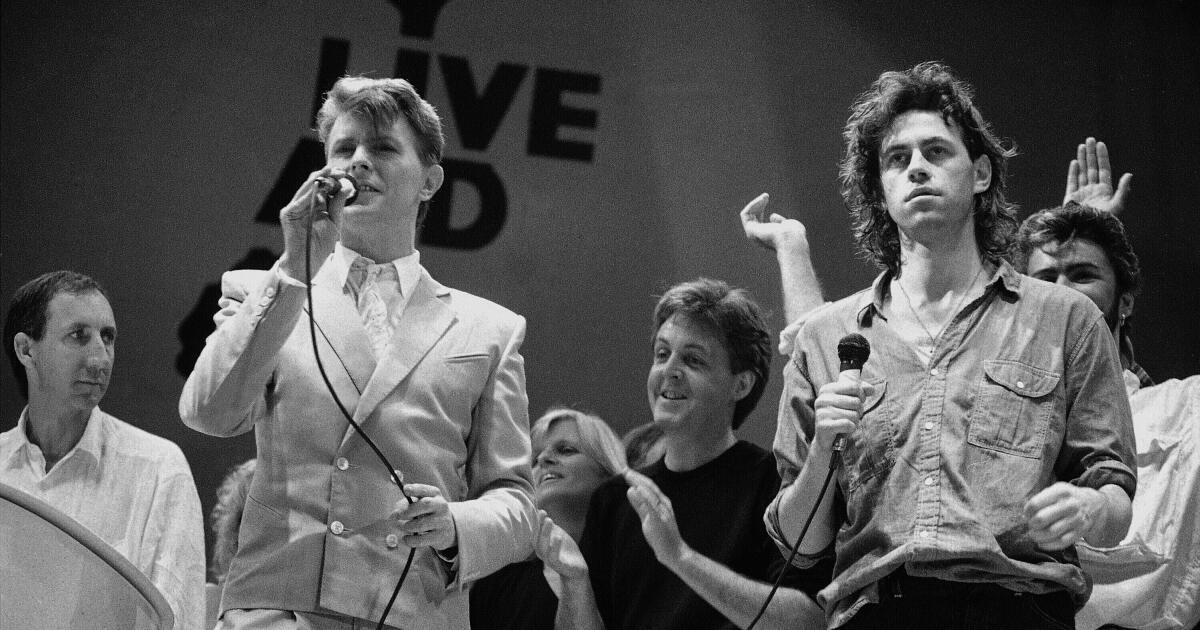
On Nov. 25, Band Aid released the “ultimate remix” of “Do They Know It’s Christmas?,” the rock charity single from 40 years ago that, in addition to whatever good it has done, also broadcasts a narrative that undermines an entire continent’s dignity and agency. The recording has raised millions for humanitarian aid but has also furthered misrepresentations that have long justified treating Africa as a blank slate for Western intervention.
In 1984, Bob Geldof, then the lead singer for the Boomtown Rats, brought together a supergroup of British and Irish rock stars to perform “Do They Know It’s Christmas?,” a song he co-wrote after seeing BBC reports of widespread famine in Ethiopia. The lyrics are a pop-song paean to colonialism, reminiscent of Hegel’s 19th century thinking when he dismissed Africa as “unhistorical, undeveloped” and “devoid of morality, religions and political constitution.”
Lines such as “Where nothing ever grows / No rain nor rivers flow” and “Well tonight, thank God it’s them instead of you” painted Ethiopia as helpless, barren and dependent on Western salvation. In 1984, the song, accompanied by wrenching famine images, simplified a complex crisis, reducing the nation’s historical, cultural and religious identity to a caricature of despair for Western audiences.
The Ethiopian famine of 1984 was far from a straightforward natural disaster. It was exacerbated by the civil war between Ethiopia’s Soviet-aligned Derg regime and insurgent groups such as the Tigrayan People’s Liberation Front supported by Western nations. Cold War geopolitics turned the famine into a proxy battleground, with the U.S. and U.K. providing both famine relief and covert support to insurgents seeking to weaken the Derg.
The original Band Aid release set a record for Christmas sales in the U.K., and eight months later, Geldof organized Live Aid, a televised concert that attracted more than a billion viewers in more than 100 countries, or roughly a third of humanity. Broadcast over 16 hours from Wembley Stadium in London and John F. Kennedy Stadium (since demolished) in Philadelphia, it was a landmark cultural event featuring performances by David Bowie, Madonna, Paul McCartney and dozens more, and was attended by British royalty, including Princess Diana. The spectacle raised an astonishing $50 million in pledges, alongside additional revenue from sold-out merchandise. It was hailed as the pinnacle of humanitarian success.
However, behind the euphoric Live Aid headlines lay dark questions. In a memoir, Fikre Selassie Wogderess, Ethiopia’s prime minister from 1987 to 1989, said only $20 million worth of aid actually reached the country in the mid-’80s. Reports — denied by Geldof and, in one instance, retracted by the BBC — have suggested that some of the funds could have landed in rebel hands. Since 1985, the Band Aid Charitable Trust is estimated to have raised more than $178 million for African relief, but the broader context cannot be ignored.
Beyond the famine, the West’s involvement in Ethiopia turned into overt political meddling. In 1991, during the fall of the Derg, the U.K. and U.S. orchestrated a peace conference in London that enabled the TPLF to rise to power. This minority-led government ruled Ethiopia for 27 years, exacerbating ethnic tensions and sowing the seeds of instability that continue to plague the nation. The parallels with the Berlin Conference of 1884 — 2024 marks its 140th anniversary — where European powers divided Africa for their gain, are striking. Both events reveal a pattern of external forces imposing political structures on Africa to serve their interests, heedless of the continent’s complex histories and diverse peoples.
Band Aid’s long-term impact on Africa’s image is equally troubling. The branding of Ethiopia — and by extension, Africa — as a monolithic land of suffering has been repeated through the years with revivals of “Do They Know It’s Christmas?,” including Band Aid II in 1989, Band Aid 20 in 2004, Band Aid 30 in 2014 and now Band Aid 40, shaping how the world sees and engages with Africa, and no doubt influencing investment, collaboration and policy decisions.
The lyrics have been edited in response to critics calling the song demeaning and rife with colonial tropes, but it remains a self-congratulatory and tone-deaf exercise. A majority of Ethiopians are Christians; the country adopted Christianity as early as the 4th century AD. Ethiopians knew it was Christmas in the winter of 1984, and they know it now — despite the song’s patronizing question.
And Ethiopia continues to be misrepresented in the Western imagination. Far from being a helpless land, it is the cradle of human civilization with a legacy as a leader in Africa’s fight against colonialism. Although the country in 2024 is no utopia — its challenges are real — it has survived a century of external interference and internal struggles. Ethiopian Prime Minister Abiy Ahmed responded succinctly to the 2024 Band Aid remix: “A good cause that has not evolved with the times might end up doing more harm than good.”
The relentless revival of narratives centered on helplessness and dependency distorts the rich and complex realities of Ethiopia and Africa. Rather than perpetuating outdated stereotypes, we must elevate African voices and champion a future where Africa leads and inspires on its own terms.
Elias Wondimu divides his time between Ethiopia and Los Angeles. He is the founding director of Tshehai Publishers, the editorial director of the International Journal of Ethiopian Studies and a senior fellow with the International Strategic Studies Assn.



I am a sucker for all those straight-to-video slasher movies from the 90’s; there was just a certain point where you knew the acting was terrible, however, it made you fall in love. I can definitely remember scanning the video store sections for all the different horror movies I could. All those movies had laughable names and boom mics accidentally getting in the frame. Trucker seems like a child of all those old dreams, because it is.
Let’s get into the review.
Synopsis
When a group of reckless teens cause an accident swroe to never speak of it. The father is reescued by a strange man. from the wreckage and nursed back to health by a mysterious old man. When the group agrees to visit the accident scene, they meet their match from a strange masked trucker and all his toys with revenge on his mind.
Roll on 18 Wheleer
Trucker is what you would imagine: a movie about a psychotic trucker chasing you. We have seen it many, many times. What makes the film so different is its homage to bad movies but good ideas. I don’t mean in a negative way. When you think of a slasher movie, it’s not very complicated; as a matter of fact, it takes five minutes to piece the film together. This is so simple and childlike, and I absolutely love it. Trucker gave us something a little different, not too gory, bad CGI fire, I mean, this is all we old schlock horror fans want. Trucker is the type of film that you expect from a Tubi Original, on speed. However, I would take this over any Tubi Original.
I found some parts that were definitely a shout-out to the slasher humor from all those movies. Another good point that made the film shine was the sets. I guess what I can say is the film is everything Joy Ride should have been. While most modern slashers are trying to recreate the 1980s, the film stands out with its love for those unloved 1990’s horror films. While most see Joyride, you are extremely mistaken, my friend; you will enjoy this film much more.

In The End
In the end, I enjoyed the entire film. At first, I saw it listed as an action thriller; I was pleasantly surprised, and Trucker pulled at my heart strings, enveloping me in its comfort from a long-forgotten time in horror. It’s a nostalgic blast for me, thinking back to that time, my friends, my youth, and finding my new home. Horror fans are split down the middle: from serial-killer clowns (my side) to elevated horror, where an artist paints a forty-thousand-year-old demon that chases them around an upper-class studio apartment. I say that a lot, but it’s the best way to describe some things.
The entire movie had me cheering while all the people I hated suffered dire consequences for their actions. It’s the same old story done in a way that we rabid fans could drool over, and it worked. In all the bad in the world today, and my only hope for the future is the soon-to-end Terrifier franchise. However, the direction was a recipe to succeed with 40+ year old horror fans like me. I see the film as a hope for tomorrow, leading us into a new era.
Trucker is set to release on March 10th, 2026
Entertainment
Review: In ‘American Classic,’ Kevin Kline and Laura Linney deliver a love letter to theater

The lovely, funny “American Classic,” premiering Sunday on MGM+, is a love letter to theater, community and community theater. Kevin Kline plays Richard Bean, a narcissistic stage actor. He’s famous enough to be opening on Broadway in “King Lear,” but he has to be pushed onstage and is forgetting lines. After he drunkenly assails a hostile New York Times critic — caught on video, of course — he’s suspended from the play, and his agent (Tony Shalhoub) advises him to get out of town and lay low until the heat’s off, as they used to say in the gangster movies.
Learning that his mother (Jane Alexander, acting royalty, in film clips) has died, Richard heads back to his small Pennsylvania hometown, where his family — all actors, like the Barrymores, but no longer acting — owns a once-celebrated theater. To Richard’s horror, it has, for want of income, become a dinner theater, hosting touring productions of “Nunsense” and “Forever Plaid” instead of the great stage works on which he cut his teeth.
Brother Jon (Jon Tenney), running the kitchen at the theater, is married to Kristen (Laura Linney), Richard’s onetime acting partner, who dated him before her marriage; now she’s the mayor. Their teenage daughter, Miranda (Nell Verlaque) — a name from Shakespeare — does want to act and move to New York, as her mother had before her, but is afraid to tell her parents. Richard’s father, Linus (Len Cariou), is suffering from dementia, though not to the point he won’t actively contribute to the action; every day he comes out again as gay.
Across the eight-episode series, things move from the ridiculous to the sublime. Richard’s attempt to stage his mother’s funeral, with her coffin being lowered from the ceiling, while “Also sprach Zarathustra” plays and smoke billows toward the audience, fortunately comes to naught; but he announces at the ceremony that he’ll direct a production of Thornton Wilder’s 1938 play “Our Town” at the theater, to “restore the soul of this town.” (His big idea is to ignore Wilder’s stage directions, which ask for no curtain, no set and few props, with a “realistic version,” featuring a working soda fountain, rain effects and a horse.) Fate will have other plans for this, and not to give away what in any case should be obvious, the title of the play will also become its ethos, with a cast of amateurs, including Miranda’s jealous boyfriend, Randall (Ajay Friese), and ordinary people standing in for the ordinary people of Wilder’s Grover’s Corners.
The series has a comfortable, cushiony feeling; it’s the sort of show that could have been made as a film in the 1990s, and in which Kline could have starred as easily in his 40s as in his 70s; it has the same relation to reality as “Dave,” in which he played a good-hearted ordinary Joe who takes the place of a lookalike U.S. president. The town is essentially a sunny place, full of mostly sunny people, to all appearances, a typical comedy hamlet. But we’re told it’s distressed, and Mayor Kristen is in transactional cahoots with developer Connor Boyle (Billy Carter), who wants clearance to build a casino on the site of a landmark hotel. (Much of the plot is driven by money — needing it, trading for it, leaving it, losing it.) He also wants his heavily accented, bombshell Russian girlfriend, Nadia (Elise Kibler), to have a part in “Our Town.”
As in the great Canadian comedy “Slings & Arrows,” set at a Shakespeare Festival outside of Toronto, themes and moments and speeches from the play being performed are echoed in the lives of the performers, while the viewer experiences the double magic of watching a fine actor playing an actor playing a part. Kline, of course, is himself an American classic, with a long stage and screen career that encompasses classical drama, romantic and musical comedy and cartoon voiceovers; the series makes room for Richard to perform soliloquies from “Hamlet” and “Henry V,” parts Klein has played onstage. He brings out the sweetness latent in Richard. Linney, who played against her sweetheart image in “Ozark,” is happily back on less deadly ground (though she’s tense and drinks a little). Tenney, who was sweet and funny on “The Closer,” and who we don’t see enough of these days, is sweeter and funnier here, and gets to sing. (All the Beans will sing, except for Linus.)
As a comedy, it is often predicable — you know that things will work out, and some major plot points are as good as inevitable — but it’s the good sort of predictability, where you get what you came for, where you hear the words you want to hear, ones you could never have written yourself. “American Classic” is not out to challenge your world view in any way but wants only to confirm your feelings and in doing so amplify them. Shock effects are fine in their place — and to be sure there are major twists in the plot — but there is a certain release when the thing you’re ready to have happen, happens, whether it brings laughter or tears. Either is welcome.
Movie Reviews
‘Scream 7’ Review: Ghostface Trades His Metallic Knife for Plastic in Bloody Embarrassing Slasher Sequel

It’s funny how this film is marketed as the first Scream movie in IMAX, yet it’s their sloppiest work to date. Williamson accomplishes two decent kills. My praise goes to the prosthetic team and gore above anything else. The filmmaking is amateurish, lacking any of the tension build and innovation in set pieces like the Radio Silence or Craven entries. Many slasher sequences consist of terribly spliced editing and incomprehensible camera movement. There was a person at my screening asking if one of the Ghostfaces was killed. I responded, “Yeah, they were shot in the head; you just couldn’t see it because the filmmaking is so damn unintelligible.”
Really, Spyglass? This is the best you can do to “damage control” your series that was perfectly fine?
I’m getting comments from morons right now telling me that I’m biased for speaking “politically” about this movie. Fuck you! This poorly made, bland, and franchise-worst entry is a byproduct of political cowardice.
The production company was so adamant about silencing their outspoken star, who simply stated that she’s against the killing of Palestinian people by an evil totalitarian regime, that they deliberately fired her, conflating her comments to “anti-semintism,” when, and if you read what she said exactly, it wasn’t. Only to reconstruct the buildup made in her arc and settle on a nonsensical, manufactured, nostalgia-based slop fest to appeal to fans who lack genuine film taste in big 2026. To add insult to injury, this movie actively takes potshots at those predecessors, perhaps out of pettiness that Williamson didn’t pen them or a mean-spirited middle finger to the star the studio fired. Truly, fuck you. Take the Barrera aspect out of this, which is still impossible, and Scream 7 is a lazy, sloppy, ill-conceived, no-vision, enshittification of Scream and a bloody embarrassment to the franchise. It took a real, morally upright actress to make Ghostface’s knife go from metal to plastic.
FINAL STATEMENT
You either die a Scream or live long enough to see yourself become a Stab.

Rain floods Miami Beach streets, cut short Miami Heat Family Festival

Bruins Believe They ‘Didn’t Do Enough’ In Loss To Flyers | NESN

Police searching for information after fatal assault in Denver

Detectives Investigating Robbery, Shooting Over $20 Necklace – SPD Blotter

Here are the 9 San Diego County communities that set or tied heat records

Florida High School Football Rankings: Top 25 teams – Oct. 21

Cleary's 21 help Le Moyne down Central Connecticut State 69-64 in OT

How old is Bo Nix? What to know about Oregon quarterback ahead of 2024 NFL Draft

99th annual Pony Swim held in Virginia

Indiana Members Credit Union announced as new anchor tenant at Bottleworks District

Video: What the Texas Primary Battle Means for the Midterms

Dems’ potential 2028 hopefuls come out against US strikes on Iran

At least nine killed after Iranian strike on Israel’s Beit Shemesh

Mass shooting at Austin, Texas bar leaves at least 3 dead, 14 wounded, authorities say

Mamdani’s response to Trump’s Iran strike sparks conservative backlash: ‘Rooting for the ayatollah’
-

 World4 days ago
Exclusive: DeepSeek withholds latest AI model from US chipmakers including Nvidia, sources say
-

 Massachusetts4 days ago
Mother and daughter injured in Taunton house explosion
-

 Montana1 week ago
2026 MHSA Montana Wrestling State Championship Brackets And Results – FloWrestling
-

 Denver, CO4 days ago
10 acres charred, 5 injured in Thornton grass fire, evacuation orders lifted
-

 Louisiana7 days ago
Wildfire near Gum Swamp Road in Livingston Parish now under control; more than 200 acres burned
-

 Technology1 week ago
YouTube TV billing scam emails are hitting inboxes
-

 Technology1 week ago
Stellantis is in a crisis of its own making
-

 Politics1 week ago
OpenAI didn’t contact police despite employees flagging mass shooter’s concerning chatbot interactions: REPORT