Entertainment
Nigel Lythgoe accused of sexual assault by two additional women after Paula Abdul's lawsuit


Two additional women have come forward accusing Nigel Lythgoe of sexual assault, days after Paula Abdul sued the “So You Think You Can Dance” producer.
The latest allegations are part of a lawsuit filed Tuesday in Los Angeles County Superior Court by two women — identified as former contestants Jane Doe K.G. and Jane Doe K.N. of the short-lived series “AAG,” which is believed to be a reference to Lythgoe’s “All American Girl.”
The complaint, obtained Wednesday by The Times, was filed against John Roe N.L., a pseudonym for Lythgoe, The Times has confirmed. Other parties in the lawsuit include Lythgoe’s production company, an unnamed New York corporation and 100 other unnamed individuals, and it alleges negligence, sexual assault/battery, sexual harassment, gender violence and intentional infliction of emotional distress.
The women accuse Lythgoe of making unwanted sexual advances and forcibly kissing them inside his Los Angeles home during filming of the competition game show in 2003. The plaintiffs also allege that Lythgoe visited the all-female contestants’ dressing room and “openly swatted and groped” K.G., K.N. and other contestants’ buttocks and that employees, contractors and representatives of the show’s production saw Lythgoe’s alleged behavior and failed to intervene or prevent further possible abuse. The complaint said the behavior “was openly accepted.”
Representatives for Lythgoe did not immediately respond Wednesday to The Times’ requests for comment.
Lythgoe is facing a separate lawsuit filed by Abdul, who alleges that the producer sexually assaulted her twice while working together on his shows “American Idol” and “So You Think You Can Dance.” The singer and dancer joined a growing list of accusers who have filed lawsuits under California’s Sexual Abuse and Cover Up Accountability Act, which allows survivors of sexual assault to sue beyond the usual statute of limitations.
The producer denied Abdul’s allegations, calling them “false” and “deeply offensive to me and to everything I stand for.” He called his relationship with Abdul “entirely platonic,” saying she was a friend and colleague, and he vowed to “fight this appalling smear with everything I have.”
Other recent high-profile lawsuits filed under the state law have levied sexual assault allegations against Jermaine Jackson and former Recording Academy chief Mike Greene. Sean “Diddy” Combs, Antonio “L.A.” Reid and Aerosmith’s Steven Tyler have been sued under a similar New York law.
Some questions have risen around whether the latest lawsuit filed by the “AAG” contestants will hold up in court. Their suit was filed Jan. 2, several days after the Dec. 31 deadline for one of the filing windows under the act, which was enacted in 2023 and runs through 2026, with filing windows depending on when incidents are alleged to have taken place. . Also, the law requires a survivor to be 18 years or older at the time of the alleged incident.
The new complaint lists Jane Doe K.G.’s birth year as 1997. A person close to the matter who was not authorized to discuss it publicly confirmed to The Times that her correct birth year is 1979, which would make her around 24 at the time of the alleged incident. The person also said that since the filing deadline fell on a holiday weekend, the complaint was filed the next day that courts were open.
According to the complaint, when filming on “AAG” ended in May 2003, contestants and the show’s crew and executives attended a wrap party. K.G., a resident of Comal County, Texas, and her fellow contestant, K.N., a resident of Travis County, Texas, were at the party, along with N.L..
After the party, as the cast and crew began to head to the show’s studio, Lythgoe allegedly insisted that K.N. ride back with him after “taking an unusual interest” in her, and K.G. joined them in the car “to ensure her colleague was not left alone.” Other cast and crew saw the pair joining Lythgoe in his personal car, the suit said.
Rather than driving back to the studio, according to the complaint, N.L. drove the two women to his L.A. home, where he repeatedly made unwanted sexual advances. During one instance, he allegedly lifted his sweater over K.G.’s head, wrapped her in his sweater and attempted to kiss her and pushed her body against his. She rejected the advance and tried to free herself. That same night, he allegedly pinned K.N. against a grand piano and pressed his body against hers, forcing his mouth and tongue onto her “despite her numerous statements telling him not to and attempts to pull her face away from his.”
“When Plaintiff K.G. saw this and protested, Defendant N.L. finally surrendered,” the lawsuit said. The complaint seeks damages to be determined at a trial.
Meanwhile, pressure is beginning to mount for companies doing business with Lythgoe, specifically Fox, which airs his show “So You Think You Can Dance.” The long-running dance competition was renewed for its 18th season in December, with Lythgoe returning as an executive producer and judge. At least one petition — started by antisexism advocacy group UltraViolet — has sprung up amid news of the second lawsuit, calling on Fox to drop Lythgoe. The petition, launched Wednesday, is addressed to Allison Wallach, Fox Entertainment’s president of unscripted programming.
“We cannot stay silent while Fox profits from and promotes a known abuser,” the petition said.
Representatives for Fox Entertainment did not immediately respond to The Times’ requests for comment.

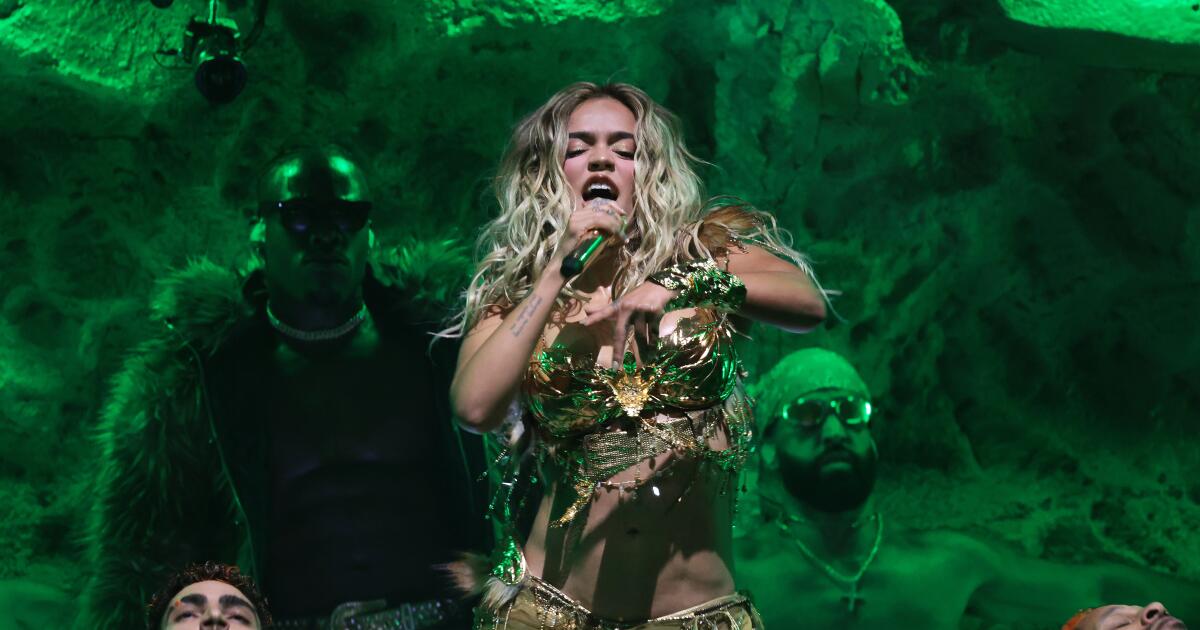
On the first Sunday night of Coachella, headliner Karol G told her American fans, and her global audience, to keep fighting.
“This is for my Latinos that have been struggling in this country lately,” the Colombian superstar told the tens of thousands watching her in person, and many more on the fest’s livestream. She’d recently criticized ICE in a Playboy interview, but this set was about her fans’ resolve. “We want everyone to feel welcome to our culture, so I want everyone to feel proud of where you come from. Don’t feel fear — feel pride!” she said.
Any artist would be proud to play that caliber of headline slot. But right now, many foreign acts also feel fear — or at least wariness — about booking substantial tours in the United States. A year of brutal ICE raids, tensions at border crossings and policed political speech, coupled with sky-high prices for expedited visas, fuel and other touring logistics, could push international acts away from the U.S.
“The fears that ICE would raid shows didn’t really materialize, but there is a chilling effect,” said Andy Gensler, editor of the touring-biz trade bible Pollstar. “Trump’s only been back in office a year, so we haven’t fully seen the effects, but it does send a message that if you’re a political artist you won’t get a visa. With the economic shock of gas prices and tourism way down, the signifiers are out there.”
The music economy is still thriving in SoCal. Coachella sold out with record spending from fans, and fears that ICE might show up for a prominent Latin headliner proved unfounded. (The agency did not respond to a request for comment on Coachella, and Lt. Deirdre Vickers of the Riverside County Sheriff’s office said that their office “does not participate in immigration enforcement operations.”)
But in smaller venues featuring emerging and mid-tier global acts, some see trouble ahead.
Pollstar’s Gensler estimates that the total number of concerts in the U.S. they tracked for the first quarter of 2026 was down about 17% from last year. That could be due to many economic factors — but slower international touring could be contributing.
“The U.S. is still incredibly lucrative market, the arena and stadium level buildings are vast and you can make more money here than any market in the world,” Gensler said. “But I’ve heard anecdotally that fewer people are going to South by Southwest, and tourism from Canada is way down, and that includes music tourism to California. As barriers go up, and the economic shock of gas prices impacts touring, it’s hard to know how that will all shake out.”
Talent firms who specialize in bringing young acts to the U.S. began noticing pullback before this year’s festival season. Adam Lewis is the head of Planetary Group, a marketing agency that produces and promoting musician showcases in the U.S., with a significant roster of artists from abroad. He said that performers who ordinarily would leap at the chance to play U.S. festivals are taking hard looks at the payoffs and risks.
“Artists are thinking twice, based on what the government is doing right now,” Lewis said. “You can look at the economics — the fees are cost prohibitive to get a visa. People are scared, at the bottom line. Artists and industry people are afraid to come to the U.S. for any music event. The money is going elsewhere.”
South by Southwest, the March Texas confab for music, film and tech, was among the first festivals to feel a pinch this year. Several sources said they saw fewer foreign showcases and acts amid a broader culling of music. In 2025, Canada canceled its popular annual showcase, after deciding that hostile policies made the risks not worth the rewards. Many still pulled off successful events, but acknowledged the mood has shifted.
“The perception of how hard it’s gotten has taken root, and that has meant that not as many acts will take the chance on the threat of being turned away or risking future entry,” said Angela Dorgan, the director of Music From Ireland, the Irish Music Export office (which is funded by Culture Ireland). That organization has helped break acts like CMAT (a hit at Coachella this year) and Fontaines DC in the U.S.
“Artists want to continue to come here in spite of the trouble and not stay away because of it. There’s a unique pull to America for all Irish people, so we don’t want to see you hurting,” Dorgan said. ”Irish artists feel that their U.S. fans need music more than ever now and want to continue to connect with and support their fans.”
Takafumi Sugahara, the organizer of “Tokyo Calling X Inspired By Tokyo,” a Japanese showcase at South by Southwest, agreed: “Bringing artists to the United States has always been challenging when it comes to obtaining visas, but it feels like the process has become even more difficult than before — perhaps due to the current political climate under the current administration.”
Fans watch Karol G perform at the Coachella stage last weekend. “We want everyone to feel welcome to our culture, so I want everyone to feel proud of where you come from. Don’t feel fear — feel pride!” the Colombian superstar said.
(Christina House / Los Angeles Times)
After high-profile incidents of tourist detainments and fear of reprisals for political speech, those worries and long-dreaded expenses may shift their priorities. “From my point of view, the impact of global conflicts or wars does not seem to be affecting artists’ decisions very strongly for now,” they said. “However, if the current situation were to worsen, it’s possible that we could begin to see that change.”
Coachella usually hits a few visa snafus every year (this year, the English electronic artist Tourist had to cancel. Last year, it was FKA Twigs). Yet the Grammy-winning Malian Algerian group Tinariwen had to cancel a major tour this year, after the Trump administration placed severe new travel restrictions on 19 countries, including Mali. Folk legend Cat Stevens scotched a book tour after visa problems. Outspoken acts like the U.K.’s Bob Vylan have been denied U.S. visas for criticizing Israel, and the Irish rap group Kneecap faced hurdles after their visa sponsor, Independent Artist Group, dropped them for similar reasons last year.
The Times spoke to one European band (who asked not to be named, for fear of reprisals from the U.S. government) who had a substantial tour of U.S. theaters booked last year, before their visas were denied just days before the tour was due to begin. They were forced to cancel those dates and reschedule for spring 2026, losing tens of thousands of dollars in up-front costs and non-refundable fees. (A performance visa routinely costs $6,000 with now-necessary expedited processing.)
“Our manager said, ‘This has never happened before, but even though you paid lot of money and the check cleared, you won’t have visas,’” the band said. They wondered if their pro-Palestinian advocacy might have played a role, but now believe it was due to changes in their application forms.
That small discrepancy “meant we lost tens of thousands of [dollars], which for a mid-tier band with a loyal cult following, was quite ruinous,” they said. “We had to put on fundraising shows to get to zero, then re-apply for visas, and paid four grand extra to expedite them. We took out a loan to pay it. We felt relentlessly fleeced,” they said. “We love the U.S., but now there is a reality in which we have to cut our losses and stop coming. A lot of bands are giving up on the U.S., for sure.”
“It’s a different feeling now where the U.S. government can do anything to us, and we just have to take it,” they added. “They’re moving the goalposts the whole time. It’s scary.”
That fate can befall even major acts, particularly those from Latin America.
Last year, superstar Mexican singer Julión Álvarez canceled his concert for a planned 50,000 fans in Arlington, Texas, when his touring visa was revoked. Grupo Firme faced a similar fate at the La Onda festival in Napa Valley. Los Alegres del Barranco saw their visas canceled after they projected an image of drug kingpin “El Mencho” during a concert.
“That was a moment where people realize how serious or scary it can get for promoters with this administration when comes to the visa situation, how quickly things can change and you can lose millions,” said Oscar Aréliz, a Latin music expert at Pollstar.
An act the caliber of Karol G might not face quite the same risks, though she told Playboy that “If you say the thing, maybe the next day you’ll get a call: ‘Hey, we are taking your visa away.’ You become bait, because some people want to show their power.”
If it can happen to a stadium-filler like Álvarez, it can happen to anyone. That might make some Latin acts prioritize other regions.
Bad Bunny demurred on touring the continental U.S. for fear of ICE raids at his shows, opting for a lengthy residence in his home territory of Puerto Rico instead.
Local Latin music hubs like Santa Fe Springs and Pico Rivera have suffered greatly under recent ICE raids and have seen fans retreat in fear. Las Vegas is a major touring destination for acts during Mexican independence celebrations in September, but now “it feels different,” Aréliz said. He expects the city — typically boisterous with Latin acts then — to lose a big chunk of music tourism from the north and south.
“Vegas’ top tourist countries are Canada and Mexico, so we’re going to see other countries benefit from this. If acts struggle to tour here because of the visa situation, they’re going to tour Mexico and Latin America instead,” he added.
Tours typically book a year in advance, so the full effects of the visa issues and ICE fears may not be felt until later in 2026 or 2027. The results of the midterm elections may change global perception of America’s safety. The country is still an incredibly valuable touring market for acts that can make it work.
But the world’s music community now looks at the U.S. like an old friend going through a rough patch: They’ll be happy to see us once we pull it together.
“Certainly over the last number of years in the U.S., we have been thinking of where we could find these new audiences for Irish music,” Dorgan said. “The unofficial theme of our at home showcase Ireland Music Week was, ‘America. We are not breaking up with you, but we are seeing other people.’”

NEW YORK (OSV News) – Many potential brides and grooms-to-be have experienced cold feet in the lead-up to their nuptials. But few can have had their trotters quite so thoroughly chilled as the previously devoted fiance at the center of writer-director Kristoffer Borgli’s provocative psychological study “The Drama” (A24).
Played by Robert Pattinson, British-born, Boston-based museum curator Charlie Thompson begins the film delighted at the prospect of tying the knot with his live-in girlfriend Emma Harwood (Zendaya). But then comes a visit to their caterers where, after much wine has been sampled, the couple wanders down a dangerous conversational path with disastrous results.
Together with their husband-and-wife matron of honor, Rachel (Alana Haim), and best man, Mike (Mamoudou Athie), Charlie and Emma take turns recounting the worst thing they’ve ever done. For Emma, this involves a potential act of profound evil that she planned in her mind but was ultimately dissuaded from carrying out, instead undergoing a kind of conversion.
Emma’s revelation disturbs all three of her companions but leaves Charlie reeling. With only days to go before the wedding, he finds himself forced to reassess his entire relationship with Emma.
As Charlie wavers between loyalty to the person he thought he knew and fear of hitching himself to someone he may never really have understood at all, he’s cast into emotional turmoil. For their part, Rachel and Mike also wrestle with how to react to the situation.
Among other ramifications, Borgli’s screenplay examines the effect of the bombshell on Emma and Charlie’s sexual interaction. So only grown viewers with a high tolerance for such material should accompany the duo through this dark passage in their lives. They’ll likely find the experience insightful but unsettling.
The film contains strong sexual content, including aberrant acts and glimpses of graphic premarital activity, cohabitation, a sequence involving gory physical violence, a narcotics theme, about a half-dozen uses of profanity, a couple of milder oaths, pervasive rough language, numerous crude expressions and obscene gestures. The OSV News classification is L — limited adult audience, films whose problematic content many adults would find troubling. The Motion Picture Association rating is R — restricted. Under 17 requires accompanying parent or adult guardian.
Read More Movie & Television Reviews
Copyright © 2026 OSV News

Tens of thousands of readers of all ages, from toddlers clutching picture books to longtime fans carrying armfuls of paperbacks, fanned out across the USC campus Saturday for the opening day of the 31st Los Angeles Times Festival of Books, packing panels and lining up to see favorite authors and celebrity guests.
It was too early to know how many people attended the first day of the event, billed as the country’s largest literary festival, though organizers said they expect between 150,000 and 155,000 attendees over the weekend. By late morning, the campus was already bustling, with strong turnout expected for appearances by author T.C. Boyle and actors Sarah Jessica Parker and David Duchovny, among others.
Founded in 1996 and spread across eight outdoor stages and 12 indoor venues, the festival has become a fixture on Los Angeles’ cultural calendar, bringing together more than 550 storytellers for panels, author interviews, book signings, performances and screenings spanning a wide range of genres, from children’s story times to cooking demonstrations.
This year’s lineup features a broad mix of writers, performers and public figures, including comedian Larry David, musician Lionel Richie, multihyphenate businesswoman (and Beyoncé’s mother) Tina Knowles, author and social critic Roxane Gay and scholar Reza Aslan.
Under sunny skies, actor and reality TV personality Lisa Rinna brought humor and a bit of bite to a 10:30 a.m. conversation on the festival’s main stage. The “Real Housewives of Beverly Hills” alum released her second memoir, “You Better Believe I’m Gonna Talk About It,” in February, chronicling her time on the show and her recent turn on Season 4 of Peacock’s reality competition series “The Traitors.”
Reflecting on her approach to “Traitors,” Rinna said she wanted to strip away the conflict-driven persona she had cultivated on “Real Housewives” and present a more unfiltered version of herself. “I was like, ‘Self, listen. You’re gonna go in there and just be you. No housewife s—, none of that reactionary stuff.’ ”
In conversation with Times senior television writer Yvonne Villarreal, Rinna also spoke candidly about the loss of her mother, Lois Rinna, in 2021 and how her grief manifested in a feeling of rage while she was filming Season 12 of “Real Housewives.”
“It really took me by surprise,” she said. “And you have to give space for it because you can’t make it go away. … They always say time heals, but time makes everything just a little less intense.”
At a noon panel titled “Fire Escape: Wildfires and the Changing Geography of Southern California,” moderated by Times climate and energy reporter Blanca Begert, author and former wildland firefighter Jordan Thomas said the scale and frequency of California wildfires have shifted dramatically in recent decades.
“The vast majority of the largest wildfires in California’s recorded history have happened just in the past 20 years,” said Thomas, author of last year’s National Book Award finalist “When It All Burns: Fighting Fire in a Transformed World.” “While I was a hotshot, there were three of those fires burning simultaneously, including a million-acre fire — more than used to burn across the entire American West over the course of a decade.”
In the early afternoon, former Georgia Rep. Stacey Abrams spoke with moderator Leigh Haber about artificial intelligence and voter suppression in front of an enthusiastic, packed crowd at USC’s Bovard Auditorium.
Abrams’ latest Avery Keene novel, “Coded Justice,” came out last year and explores the role of artificial intelligence in the healthcare industry. AI has already become enmeshed in everyday life, she said, asking audience members to raise their hands if they had used TSA PreCheck or a streaming service.
“AI is a tool … but it is created by someone, it is programmed by someone, it is controlled by someone,” she said. “Regulation is not about slowing down progress. It is about asking questions and saying that in the absence of answers, we’re going to put on reasonable restraints that we can revisit.”
Abrams also revealed that her next book, the fourth in her Avery Keene thriller series, will focus on prediction markets.
“I write Avery Keene novels to tell stories about social justice, but I put it in a form that’s accessible to people who don’t think that they are social justice people,” Abrams said. “I want to meet people where they are, not where I want them to be.”
She also encouraged audience members to push back against voter suppression and defend democracy by volunteering at polling places — even in reliably blue districts — warning that she believes masked paramilitary groups will be allowed to patrol voting locations and target people of color in the upcoming midterm elections.
The festival kicked off Friday evening with the 46th Los Angeles Times Book Prizes ceremony at Bovard Auditorium, emceed by Times columnist LZ Granderson, recognizing both emerging voices and established writers.
Winners were announced in 13 categories for works published last year. Find a full list of winners here.
Oakland-born novelist Amy Tan, whose work often explores identity and the Chinese American immigrant experience, received the Robert Kirsch Award for lifetime achievement, and the literary nonprofit We Need Diverse Books received the Innovator’s Award for its work promoting diversity in publishing.
Accepting her award, Tan, author of the 1989 bestseller “The Joy Luck Club,” said that as a birthright citizen, she had never questioned her place in the country until recent debates over citizenship and belonging led her to reconsider whether she is, in fact, a “political writer.”
“My birthright and that of millions of others is now being argued before the Supreme Court, and no matter what the outcome is, it’s been a kick in the gut to know that those in the highest echelons of government and those who support them believe that we don’t belong.”
Tan said that as an author, “I imagine the lives of the people I write about,” and that act of compassion “reflects our politics and our beliefs. And so yes, I am a political writer.”
Addressing the attendees, Times Executive Editor Terry Tang pointed to the breadth of the weekend’s programming as an opportunity for connection and discovery. “If you take in just a fraction of these events, it will expand your mind,” she said. “This weekend gives all of us a chance to celebrate a sense of unity, purpose and support.”
The festival runs through Sunday. More information, including a schedule of events, can be found on the festival’s website.
-
Entertainment2 minutes ago
Karol G at Coachella was a global hit. Yet other foreign acts fear touring the U.S.
-
 Lifestyle8 minutes ago
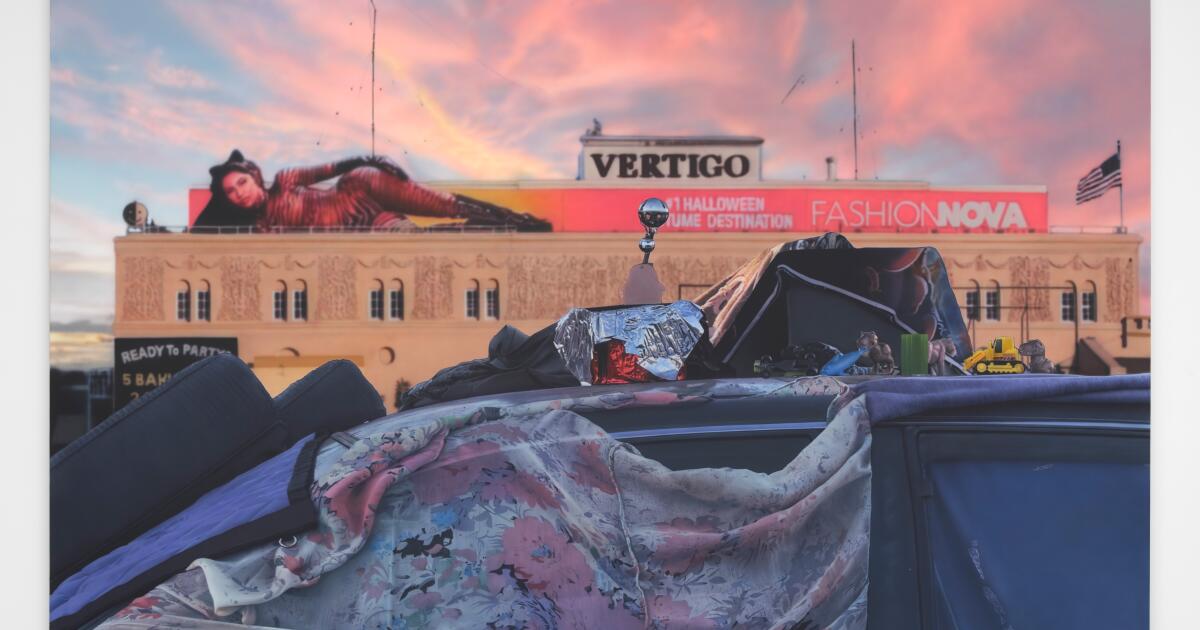
L.A.’s unofficial Statue of Liberty is a Fashion Nova billboard off the 10 Freeway
-
 Politics14 minutes ago
Ordered free, still locked up: Judges fume as Trump administration holds ICE detainees
-
 Science21 minutes ago
A renewed threat to JPL as the Trump administration tries again to cut NASA
-
 Sports27 minutes ago
After 55 years as a broadcaster in L.A., Randy Rosenbloom is leaving town
-

 World38 minutes ago
Bulgaria votes in eighth election in five years
-
 News1 hour ago
Real estate investors are buying up long-term care facilities. Residents can suffer
-

 Detroit, MI3 hours ago
Former Piston shows Detroit what they’re missing as he dominates next to LeBron