Movie Reviews
‘The Last Critic’ Review: A Captivating Portrait of Robert Christgau, the Brilliant Mad Professor of Rock Critics, and How He Made the Grade


As a critic, I should probably take offense at the title of “The Last Critic.” The movie is a captivating portrait of Robert Christgau, the legendary music writer who was one of the founding fathers of what was once known as “rock criticism.” (These were the days before poptimism, not to mention the Taylor Swift fan base.) To be fair, the film never asserts the claim of its title — that Christgau was or is “the last critic.” He was, in fact, one of the first writers to establish rock criticism as a vibrant and essential form, the others being Greil Marcus and the late Ellen Willis (both of whom he was close to; Marcus is featured in the documentary) as well as Lester Bangs, the brilliant bad boy who died in 1982.
The singular thing about Christgau is that he invented, and owned, his very own form of criticism. Born in 1942, he started out as a gifted writer and reporter, with the makings of a star journalist (in 1966, he published an award-winning piece about a girl who died from being on a macrobiotic diet). Attracting the attention of Esquire magazine, which was then at the epicenter of a hip new media world, he began to write a youth-culture column there, and in 1969 he came up with Christgau’s Consumer Guide, a monthly series of capsule reviews that would evaluate — and grade! — the latest slate of rock albums.
That doesn’t sound too remarkable, but Christgau’s prose had a quirky electricity, and in a world where rock writers were nerdish monks (Marcus was a rich-kid academic who smoked a pipe), he had a sixth sense for how to brand himself. An acerbic wise guy, brimming with egomaniacal snark, he once jokingly introduced himself as “the dean of American rock critics,” and the label stuck. From that point on, that’s how he was referred to and thought of.
In the Village Voice, where the Consumer Guide became one of the fabled alt-weekly’s go-to features from the ’70s through the ’90s, Christgau wrote like a possessed fan who breathed insight, making every capsule sound like a psychedelic sonnet. And the notion of affixing each densely compact review with a letter grade (from A+ to E-) was so counterintuitive — at least in the post-counterculture world — that it became Christgau’s signature.
He was playful in his judgments (on Prince’s “Dirty Mind”: “He takes care of the songwriting, transmutes the persona, revs up the guitar, muscles into the vocals, leans down hard on a rock-steady, funk-tinged four-four, and conceptualizes — about sex, mostly.” On Bryan Adams’ “Reckless”: “Maybe I’ll let Bruce Springsteen teach me how to hear John Cougar Mellencamp, but damned if I’m going to let John Cougar Mellencamp teach me how to hear Bryan Adams”). He was famous enough to inspire disgruntled album-track shoutouts from Lou Reed and Sonic Youth, and I guess that you could also call Christgau the unintentional godfather of Entertainment Weekly. At one point in the documentary, Christgau talks about a certain grade category he thinks of as “a high B+,” adding that “no one knows what that means” except him. As a critic who handed out grades at EW for decades, I may be just about the only other person on the planet who knows exactly what that means.
In “The Last Critic,” we meet Christgau as an elder stateman of rock-crit (he’s now 83), a downtown stalwart knocking around the streets of the East Village. He’s a bit more bent than he was, with white hair and a touch of arthritis, but he’s still a wry specimen, lean and mean, with a machine-gun mind, ageless in his vigor (and in his hunger for new music). And God bless him, he still pumps out the Consumer Guide each month (it’s now on Substack). The way he goes about it is the real subject of the documentary, because writing the Consumer Guide is the very spine of Robert Christgau’s life; every aspect of it reflects his obsessiveness. The film opens with him tapping out the following quote on an old word processor: “To the eternal ‘Opinions are like assholes — everyone’s got one,’ I just say, but not everybody’s got ten thousand of them.” Christgau has 14,000 reviews and counting, and that’s his glory and his compulsion.
He and his wife, the writer Caroline Dibbell, have lived in the same 2nd Ave. apartment for 50 years. And though it has seven rooms, Christgau has it organized like the encyclopedic pack rat he is. The place is lined with hundreds of feet of books, and he built special industrial shelves to house his 36,000 vinyl albums and CDs (and even cassette tapes), which cover every square inch of wall space in his cramped office. It’s his cave of knowledge, and he sits each day at the center of it, fumbling with CD players that kind of work, listening to music all day long, tapping out his thoughts on an old computer, feeling at every moment that this is his bliss. It’s criticism as a calling, a mission, a drive to find all the new music that’s good, and to capture each album’s worth in one heightened poetic paragraph. That’s what makes Christgau get up in the morning, and what keeps his spirit young. (Recovering from surgery, he won’t take three days off and not write.)
He has mellowed with age (actually, not much), but he’s still a wit and a scholar and a bit of a pedant. He’s bluntly contentious — in his heyday, he was not only a critic but a Village Voice editor who became fabled for his literary-dictator ways. He would make writers sweat (but only in the quest to make them the best version of themselves), and he would sometimes bike over to their apartments to stalk them for copy that was late. But what cemented the Christgau legend was the weirdly rational mania that informed the Consumer Guide. When it came to music, Christgau genuinely believed in the existence of a hidden grand order. He wanted to turn the act of consuming records into a system — a celestial hierarchy of judgment, of which he was the all-seeing lord.
That’s a way of thinking that some critics have (exhibit A: myself). Yet Christgau, through the Consumer Guide, was the only music critic to wear his system-making brains on the outside. The title of the column was a provocation, because here was this writer on the cutting edge of a rock world that still imagined itself as a “revolution,” yet he had the audacity to say that the revolution was a form of consumerism. He meant it as a joke (“I was thumbing my nose at my colleagues,” he says), the joke being that he was actually serious about it. He was going to grade the counterculture like the ultimate professor of cool.
And that’s what Christgau became. The documentary features plenty of footage of him back in the day, when a bohemian New York critic could still be a celebrity, and when he was just about the only person you could name who turned having long hair and oversize glasses and an ironic smirk into a punk look. He was like a sexy underground version of Poindexter. By the late ’70s, it felt like he was the last guy left with stringy hair that reached his shoulders, but the attitude was as far from hippie as you could get. Christgau was from Queens, the son of a fireman, and he had that working-class outer-borough lack of respect for the elites, even as he himself became one.
“The Last Critic,” directed with lively reverence by Matty Wishnow, is full of pithy testimonials to Christgau’s special qualities as a critic. We hear from writers like Kit Rachlis and Ann Powers and Amanda Petrusich and Chuck Eddy and Rob Sheffield. Nelson George and Greg Tate make the vital point that Christgau, in orchestrating a music review section in the ’70s that showcased diverse voices, walked the walk of what the Village Voice was supposed to be about. As someone who grew up in the early rock-crit days, I especially enjoyed the film’s portrait of Christgau’s friendship with Greil Marcus, an equally legendary critic based on the West Coast (we see the two of them seated today in Christgau’s living room, looking like the Statler and Waldorf of rock criticism). They wrote letters to each that were like intellectual mash notes, and they spoke several times a month on the phone but had serious disagreements. “I don’t think he feels hip-hop,” says Christgau of Marcus. “And I think that’s a function of whether you feel James Brown. And that’s a real gap.”
Christgau felt James Brown, all right (he was a major advocate of funk), but I would argue that his Achilles’ heel as a critic is that he didn’t feel pop. We see him in a TV interview from the ’80s where he catalogues his eclectic tastes, saying, “I love African music, I really love some country music, I like the best of what’s called world music, I love rap, I’ve got nothing against pop, I like funk and dance music quite a lot…” Consider that statement: I’ve got nothing against pop. It reflects something that nearly all the formative rock critics (with the exception of Stephen Holden) felt about pop music, which is that they actually did have something against it. They thought it was glossy, superficial, sentimental, fake, confectionary, corrupt, “commercial,” or some other descended-from-the-left-wing-ether bullshit. At one point in the documentary, we see a roster of albums in different Christgau grade categories, and forgive me, but I don’t live in a world where Sleater-Kinney’s “Dig Me Out” is an A and Madonna’s “Like a Virgin” is a B. (I live in a world where Supertramp’s “Breakfast in America” is an A+, and where Hall and Oates are greater than the Replacements.) The anti-pop animus of classic rock criticism reflected nothing so much as a neurotic puritanism, or maybe just a snobbish inability to hear the deep beauty of pop.
My grousing aside, the early rock critics actually forged their own brand of beauty. The reason they were able to plant this form of criticism on the map is that they were extraordinary writers. What you feel, in every Robert Christgau capsule, is that he’s channeling whatever he’s writing about, and that’s what always made the Consumer Guide such a compulsive read — the drama of listening to Christgau let each of those albums flow through him. “The Last Critic” is a portrait of a venerable voice, but mostly it’s a testament to everything a great critic is: a priest, a fan, an assassin, an aesthete, a merciless truth-teller, and a vessel of love.



By and large, the zombie subgenre has bitten off more than it can chew in modern times. Between George Romero survival films and camp comedies, the well has become pretty infected. But once in a while, along comes a movie like This Is Not A Test.
Let’s sink our teeth into this new release and see how it stacks up against the classics.
The tone and tenor of this film represent the classic survival movies like Night Of The Living Dead. But the thing that grabs the audience about This Is Not A Test is the trauma of the characters. Holt shines as a withdrawn survivor of an abusive home, trying to cut through the wreckage to reunite with her sister. Each of the main characters have standout traits, and they bathe in strongly acted moments as the stress of the situation changes who they are.
The gore in This Is Not A Test is pretty strong. The attacks spring quickly and when they do, the special effects team does a good job showcasing the battle scars. The camera work is also frenetic in a good way, because the chaos of the chase scenes puts the viewers in a first-person perspective. This film lets you feel like a part of the survivors, so their journeys are interactive.

Longtime fans may say that there’s nothing new in This Is Not A Test, and maybe they’re right. There’s no fresh take on the monsters here, no crazy origin, nothing that we haven’t seen in the past fifty-eight years. But the pacing nails a great balance between getting to know the characters and getting the zombie splatter fest. The mental meltdowns of the characters feel well earned, and the arc of Sloane and her sister brings a lot of heart and investment to the story. Even the most jaded zombie horror fans will find something to appreciate here, even as a background movie.
Adam MacDonald has made another intense hit here, and This Is Not A Test is currently available to stream on Shudder.

- THE ODYSSEY
- Starring: Matt Damon, Tom Holland and Anne Hathaway
- Directed by: Christopher Nolan
- Rated: R
- Running time: 2 hrs 45 mins
- Universal
Our score: 4.5 out of 5
EPIC. If I was asked to describe Christopher Nolan’s latest film, that is the word I would use. He has mounted a film that rivals the greatest achievements of filmmakers like Cecil B. DeMille or David Lean. And, like the films of those mentioned, it’s runs a tad too long.
I was shocked, but pleased, to see that my 12-year-old granddaughter recently did a school paper on King Agamemnon. Thank goodness they’re still teaching History in our schools. Based on Homer’s “The Odyssey,” the film tells the story of King Odysseus (Damon) and his adventures which, if you’ve read “The Odyssey,” include the Trojan Horse, the Cyclops and assorted angry Greek gods. The film covers each of these adventures in great detail, sparing nothing in the production design department. While Odysseus is away – and he’s gone for a l-o-n-g time, his wife Penelope (Hathaway) has to endure a never ending string of “suitors,” men lining up in the hopes of replacing the King should he not return. The men are nothing more then scavengers, taking advantage of the law of Zeus, which decrees no one should be turned away. This angers the Queen’s son, Telemachus (Holland), who must control his temper when the men try to bait him into a fight, the idea being if Telemachus is killed, the new husband would become the King. It’s all very interesting and complicated. And long.
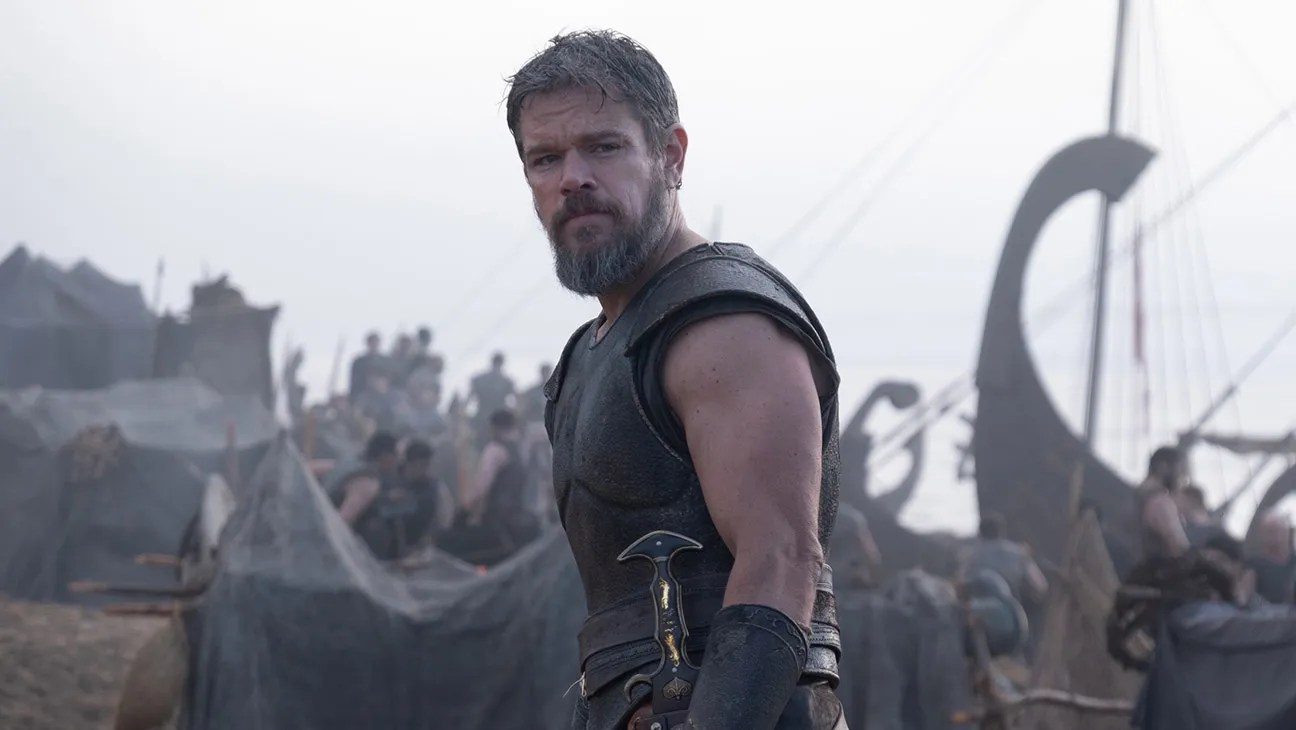
Director Nolan is one of the rare filmmakers who, in my opinion, has never made a bad film. From “Memento” to the “Dark Knight” trilogy to the Oscar-winning “Oppenheimer,” he has proven himself a true master of cinema. “The Odyssey” only adds to that distinguished resume’
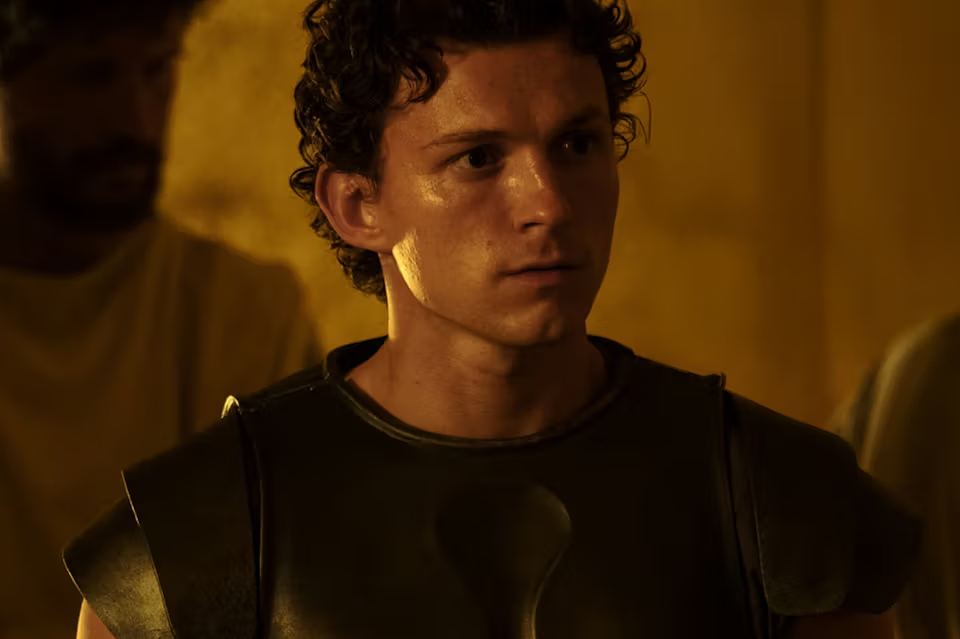
The cast is a tribute to Nolan himself who, like Woody Allen, can pretty much get anyone he wants for his films because, as an actor, why wouldn’t you want a credit in one of his films. Besides the three stars named above, the cast includes Robert Pattinson, John Leguizamo, Zendaya, James Remar, Jon Bernthal, Oscar nominees Samantha Morton and Elliot Page as well as Oscar winners Charlize Theron and Lupita Nyongo. As MGM used to advertise, “more stars than there are in heaven.”
The script and story are pretty faithful to the source material, though for some reason it bothered me whenever Telemacus referred to Odysseus as “dad.” Never father. The weird things you notice. Visual.y the film is stunning and the Trojan Horse and battle of Troy are worth the price of admission alone. I will add that I did see the film in 70 mm and, if that format is playing in your town, I urge you to see it in that format.
On a scale of zero to five, “The Odyssey” receives ★★★★ ½
Movie Reviews
Saari Review: Memory, Betrayal and Identity Converge at River Valley Film Festival – Hollywood Times


Premiering at the 2026 River Valley Film Festival, Saari uses fragmented memories, Finnish landscapes and restrained performances to explore betrayal, identity and reconciliation.
By Valerie Milano
Palm Springs, CA (The Hollywood Times) 7/14/26 – In the visually striking short film Saari—Finnish for “island”, a peaceful family retreat becomes the setting for the slow collapse of a relationship.
Co-written by Justin Seegmueller, Corey L’Esperance and Suvi Härkönen, the film follows Daniel, played by Seegmueller, as he reflects on the choices that damaged his relationship with Liina, portrayed by Ilona Karppanen. Told through fragments of the past, present and future, Saari gradually reveals how secrecy and betrayal can transform a place of safety into one of emotional confinement.
The nonlinear structure was not simply a stylistic choice. The project was developed and filmed over more than a decade, with footage captured in Finland, Boston and the desert. L’Esperance explained that the filmmakers divided the story into “past, present and future,” allowing audiences to experience the relationship from both characters’ perspectives.
Click below for our exclusive interview:
He described Daniel and Liina as two people who are “stuck in these moments in time,” making the fragmented narrative especially appropriate.
Seegmueller said Daniel’s internal struggle is rooted in the questions, “Am I that person? Am I still that person?” His restrained performance captures a man attempting to reconcile his current identity with the damage caused by earlier decisions.
For Seegmueller, the film is fundamentally about choice.
“It’s all about decision-making,” he said. “Are you an accumulation of all your decisions?”
Finland’s lush island scenery contrasts sharply with Daniel’s later isolation in the barren desert. Seegmueller described the progression as “lush and then dead,” a simple but effective visual representation of a relationship moving from intimacy and possibility to emotional aftermath.
For Liina, the island represents family history, comfort and security. By inviting Daniel there, she welcomes him into her sanctuary. His secrets, however, begin to contaminate that protected space.
“You let me into your life,” Seegmueller explained, “and now I’m here almost ruining your sense of security.”

 Because the couple reaches the island by rowboat, the setting also creates a sense of entrapment as suspicion and resentment begin to surface. L’Esperance noted that once they are there, “there’s not really anywhere you can go.”
The film’s cross-cultural perspective was strengthened by the collaboration between American co-director L’Esperance and Finnish co-director Härkönen. Their responsibilities shifted according to which character dominated a scene. L’Esperance generally led sequences centered on Daniel, while Härkönen took a stronger role when Liina’s experience was at the emotional forefront.
That approach helps prevent Liina from existing only as a reaction to Daniel’s behavior. Her journey eventually becomes more compelling than his guilt.
Karppanen traveled to the United States for the first time to film the Boston scenes, which were completed approximately three years after the original Finland footage. Seegmueller said the friendship they developed during production can be seen in the warmth between their characters during the relationship’s happier moments.
The filmmakers deliberately avoid explaining every detail of Daniel’s betrayal. Earlier edits revealed even less, but test audiences needed additional narrative guidance.
“We do need to have some breadcrumbs,” L’Esperance said, explaining that without them, the story became “a little too lost on the audience.”

 The challenge was to provide enough information while maintaining the film’s quiet, interpretive tone. L’Esperance said they wanted to leave room for viewers to “fill in some of the blanks.”
The lengthy production process also changed how the filmmakers viewed Daniel. L’Esperance acknowledged that they initially saw him as “this hero,” but over time recognized that “he is kind of a bad guy in some of these aspects.”
That evolving perspective gives the film greater moral complexity. Daniel is not granted an easy redemption, and his introspection does not erase the harm he caused.
Karppanen brings strength and emotional restraint to Liina, who emerges from the experience as what L’Esperance called “a completely different person.” A final city scene suggests that she is beginning to reclaim her identity and imagine a future beyond Daniel and the relationship that betrayed her.
Subtle, atmospheric and open to interpretation, Saari asks whether people are defined by their worst decisions, and what reconciliation means when the damage cannot simply be undone.
After more than 10 years of work, the film’s world premiere at the River Valley Film Festival is especially meaningful. Both L’Esperance and Seegmueller attended film school in Philadelphia, making the Pennsylvania premiere a return to the state where their filmmaking journeys began.

 Seegmueller hopes the film encourages audiences to examine their own choices and personal histories.
“What does that say about you?” he asked. “What does that say about your story and your own narrative?”
Saari will have its world premiere at the 2026 River Valley Film Festival. Seegmueller will attend the premiere in person, while members of L’Esperance’s family are expected to represent him at the festival.
-
South Dakota2 minutes ago
SD Lottery Powerball, Lotto America winning numbers for July 15, 2026
-

 Tennessee8 minutes ago
Heavy police presence reported near Highway 31W in White House
-

 Texas14 minutes ago
NTSB Confirms Texas Tesla Had 100% Floored Accelerator Pedal During Fatal Crash
-

 Utah20 minutes ago
Muslim man stabbed at Utah mall over his religion, authorities say
-

 Vermont26 minutes ago
Ben & Jerry’s Foundation says it will shut down amid legal dispute with parent company – VTDigger
-

 Virginia32 minutes ago
Drought emergency declared for parts of Virginia; governor warns of water restrictions
-

 Washington38 minutes ago
Trump fires WA US Attorney within an hour
-

 Wisconsin44 minutes ago
Wisconsin Lottery Powerball, Pick 3 results for July 15, 2026

