Movie Reviews
Sinners Is Bold, Ambitious, and Just Misses Greatness


It’s a film that will haunt me just as much as it will keep me wondering who Ryan Coogler wants to be on the other side of Creed and Black Panther.
Photo: Warner Bros./Everett Collection
I have always felt that the South gives America back to itself, ripping illusions from truth. When I see Looney Tunes images of Bugs Bunny sawing off Florida, as if relinquishing land below the Mason-Dixon Line will save our fractured society, my heart breaks. When I read op-eds that suggest Manhattan should be fortified in the face of climate disaster but New Orleans should be consigned to oblivion, I see cowardice in the face of reckoning. The stories we tell about the region, specifically the ones that paint the South as solely a backward territory not worth saving, underscore a basic reality: This is a country built on forgetting. The majority of this country’s Black population is in the South. All this humor and resignation might as well ensure the Black, the brown, the queer, the working class toil under oppressive politicians to death. It certainly complicates the fact that, as poet Eugenia Collier wrote, “It is here that the agony of chattel slavery created the history that has yet to be written. It is the South that has dispersed its culture into the cities of the North. The South is, in a sense, the mythic landscape of Black America.”
With a curiosity that is capacious, Sinners — the 1932-set, southern-bound horror epic from writer-director Ryan Coogler — demonstrates something powerful: a deep reverence for the Black South. Its most beautiful and bracing imagery is that of cotton fields plumbed by sharecroppers, endless skies and dusty roads, the verdant expanse of a land that has witnessed so much sorrow. It opens with an animated segment that bounces through cultures to highlight the esteemed ancestral figures whose artistry pierced the veil between time and space, pausing on West African griots before it lands in 1932 Clarksdale, Mississippi. It’s the waning days of Prohibition when the infamous twin brothers Smoke and Stack (played with gusto by Michael B. Jordan) return to their hometown after cutting it up with Al Capone up North, packing illegal liquor and a firmly held dream to open a juke joint by us, for us. The film takes place primarily over the course of a single day and night, barely touching an encroaching dawn. “I heard they don’t have Jim Crow up there,” Sammie Moore (a sweet-natured Miles Caton), their young cousin with a spiritual talent for the blues, mentions to the twins. But Smoke and Stack respond with expeditious intensity. Chicago is just as racist as the rest of the country, even if its skyscrapers and largess give it a different casing: “We came back home to deal with the devil we know.”
The way the film swims through the contradictions, considerations, and cultural reverie of the rural South is genuinely enlivening. Sinners, festooned with intriguing ideas and even more beguiling characters, grabs the hem of greatness even if it never takes hold, hobbled as it is by a desire to hold more than it can properly contain in its over-two-hour run time, leading to a story that feels misshapen after the setup. Coogler does not rush these proceedings. Instead, he marinates in the happenings and taste of his characters and the world around them after the twins buy a disabused sawmill to operate as a juke joint from a man who is quick to call them “boy” and later proves to be a crucial member of the Ku Klux Klan. Blessedly, a didactic rendition of anti-Black racism does not follow. Coogler trusts his audience, letting the emotional stakes of his movie unfurl slowly. The twins are differentiated by color theory. Smoke in blue, Stack in red. But their differences would be apparent even without that visual cue. Stack is lascivious and abrasive. Jordan carries himself with braggadocio as a man who takes up space unapologetically and never moves quietly in a room, even if he says nary a word. He’s quick to a smile and even quicker to violence. But so is Smoke, though Jordan gives him a taciturn tenderness. He’s bound to Annie (Wunmi Mosaku), a hoodoo practitioner with whom he shares a dead child and all the grief therein.
The twins are crucial leads for the film, but Sammie is arguably the true protagonist. It’s his coming of age that provides Sinners its structure — in which he is forced to choose between his gifts as a supernaturally skilled blues musician and the reserved church-bound life his preacher father, Jedidiah (Saul Williams), desires for him. If the fortunes of Sammie, Stack, and Smoke were the only important threads, Sinners would still be an epic, but Coogler isn’t content to rest there. The film plays like it was made by someone who understands they may never be able to commit to such grand cinematic ambitions — or, at least, the resources necessary to make them a reality — again. (The rights to this film revert to Coogler in 25 years, a rarity in the history of Hollywood dealmaking.) There is also Sammie’s love interest, the married singer Pearline (Jayme Lawson). And Delroy Lindo as piano and harmonica blues musician Delta Slim. A drunkard with a golden spirit. Stack’s own ragged love story involves Mary (Hailee Steinfeld, feasting on the opportunity this film provides her), a woman with a half-Black grandfather who lives on the white side of town but prefers to spend time with the Black people she considers kin. One of my favorites of the important supporting cast is the charismatic Chinese couple who runs two shops in town and provides material support to the twins’ efforts to start their juke joint — Grace (Li Jun Li) and Bow Chow (Yao), who have an adolescent daughter, Lisa (Helena Hu). The actors are quickly able to sketch a deep bond between their characters, and their presence is a reminder that the soul of the South may be Black, but it is a region defined by a more complex diversity it rarely gets credit for.
Coogler luxuriates in the lives of these people, and the ecstatic performances they provoke, for about an hour before Jack O’Connell’s vicious Irish vampire, Remmick, cuts a bloodied path through their stories. Sinners is a horror film, stitched together with menacing imagery of sunlight as clear as crystal and blood darker than death. Smoke trails off Remmick’s body as he stumbles to the home of a family affiliated with the Ku Klux Klan, just as dawn spills upon the land. He weasels his way into being invited inside, escaping the Native American vampire hunters on his tail. They eventually arrive at the doorstep of the couple, who refuse to trust the words of a group of Indigenous men and therefore guarantee an unsuccessful rescue. (It’s a pity we don’t see more of these characters. It’s such a delicious idea.) Vampires are the best of cinema’s major monsters, and Coogler mostly adheres to legible legends. There’s garlic, silver, stakes to the heart, invitations necessary to darken doorsteps. But he adds a few less common touches that have potential — eyes that glow, an elevated monstrousness that arises as they feed, drooling over the mere thought of blood. (In Sinners, draining a human doesn’t just sate an appetite. A vampire absorbs the memories and skills of their victim, too.) But Remmick’s motivations — explained in a stray line of dialogue — are too thinly drawn and haphazardly framed. (Remmick desires to connect to the ancestors vampirism has barred him from knowing; devouring Sammie’s talent for conjuring spirits of the past through music is the means to doing so. All this is only gestured at.) So is the horror he wreaks. It’s as if the camera flinches. Moments of tragedy and violence are never dwelled upon properly, like Coogler has too much to drink in otherwise to give these moments the time they need. There is no sonic tension; spaces like the juke joint feels visually scattershot and confused once Remmick’s fiery violence crowds the room. Then the emotional beats that mark the conclusions of these characters’ stories arrive without the heft necessary for the losses to bruise. Somehow, I was left wanting more. Certain connective tissue is lost in favor of excess elsewhere.
As much as Sinners succeeds as a celebration of the Black South, it ultimately fails as visceral horror. Yet Coogler’s film is distinct in a way I am curious to see audiences take in. While he fails to make his genre terror visually or narratively gut-wrenching, he avoids blunt messaging about racism and history and sidesteps the most laborious, rote choices of the modern Black horror boom, filled with films that prioritized making racial strife clear to non-Black audiences. Instead, Sinners communicates quite magnificently to Black folks at a register many recent, mainstream Black horror directors before him failed to reach. Coogler’s script is trying to shake the table. He brings up questions about Black people’s misguided adherence to Christianity, who counts as Black and a part of the community, the ancestral reverberations of Black music, finding love against the odds, and the beauty that is born when two distinct bodies become one. These themes make the vampire saga feel rapturous, bold, ambitious, and brimming with curiosity and care. Even with its sloppy flaws, in particular the script’s inability to cohere once the true action is under way, it is a film that got under my skin and continues to haunt my imagination.
And what Coogler accomplishes in the realm of sensuality is genuinely exciting. The characters, save for the young Sammie, feel grown. These are adults with the seasoning that time, heartbreak, and wisdom provide — and which the actors communicate with clear-eyed commitment. There are three sex scenes in the film, including a tender reconnection between Smoke and Annie. But it’s Stack having Mary spit in his mouth during their sex scene in a storage room of the juke joint that stands out for sheer delight. A surprising recurrence in the film is its appreciation of the real eaters out there; at one point, Stack straight-up explains cunnilingus by comparing it to the soft licks of eating ice cream. The film reaches its apex in a vivaciously ambrosial scene in which Sammie flexes dulcet tones and guitar skills, inspiring everyone toward sweat-laced dancing. A West African drummer and dancer appears, an echo from the ancestors of the introduction. A funk guitarist strides next to Sammie. When the hip-hop figures appear, the scene teeters toward being a touch too earnest. But for a moment, this blend of past, present, and future touches transcendence. A cinematic rapture capturing the best staging, framing, and composition of the film. It is a phantasm of Black Southern delights. As Delta Slim tells Sammie, “Blues wasn’t forced on us like that religion.”
See All



Movie Reviews
Movie Review: ‘Leviticus’ makes a demon out of desire in an auspicious debut for Adrian Chiarella – Sentinel Colorado

What if the object of your desire was also the thing that’s trying to kill you? Not slowly irritating you to death for leaving the toilet seat up again. We mean actively trying to strangle you.
That’s the intriguing premise behind the horror-satire “Leviticus,” an auspicious feature film debut for writer-director Adrian Chiarella that’s both deeply scary and a queer revolt.
Named for the book of the Old Testament often used to justify homophobia, the movie explores the burgeoning relationship between two young men that is shattered when so-called “conversion therapy” — a scientifically discredited practice — unleashes a demon that stalks them. Some have called the movie “It Follows” meets “Heated Rivalry,” but that’s a disservice to Chiarella’s ambition.
The film centers on Naim (Joe Bird, the breakout star of A24’s “Talk to Me” )and Ryan (newcomer Stacy Clausen), who we watch fitfully, awkwardly fall for each other, slowly exploring their sexuality and stutter-stepping into their true selves. Wrestling turns to flirtation, which becomes longing and tenderness.
That doesn’t go over well in the small Australian town where the movie is set, a blue-collar community with belching smoke stacks, low-slung houses, barking dogs and a Christian pastor — with a “deliverance healer” — who prefers his flock much more heterosexual.
Chiarella is leaning not only into the notion that sexual desire makes you vulnerable, but also the harm that repressing who you are can do. In this case, the demon takes the form of your crush. It has weaponized lust.
“You shouldn’t be near me. I shouldn’t be near you, either,” one of the would-be lovers says to the other.
Chiarella starts his movie with a nod to Alfred Hitchcock — a shower scene worthy of “Psycho” — and nods to others in the genre, like “A Nightmare on Elm Street.” He can be a bit clunky with his images — a frog being eaten by a snake — but his pacing is flawless and his ramping up of terror is sure. “Leviticus” might be an indie film, but it’s got the blessing of Frank Ocean, who gave the filmmakers the right to use his song “Self Control.”
The monsters — in addition to the nasty one only the boys can see, of course — are the adults: the parents and caregivers and friends who turn on vulnerable, scared young men and make them scared of each other. Mom might kindly take some disliked olives off her son’s pizza, but she won’t accept him kissing another boy.
Chiarella’s pro-queer filmmaking extends to his ability to perfectly capture the fumbling ecstasy of new love, the fierce longing of stolen kisses and how scary it is to submit to a new partner. Kudos to Bird and Clausen for capturing that universal feeling.
With his film, Chiarella forms a triumvirate of young filmmakers making horror brilliant in summer 2026, alongside Curry Barker with “Obsession” and Kane Parsons’ “Backrooms.” The future of movies is in good hands.
“Leviticus,” a Neon release that’s in theaters Friday, is rated R by the Motion Picture Association for “bloody violent content, language, some sexual content and teen drug use.” Running time: 88 minutes. Three and a half stars out of four.
Related
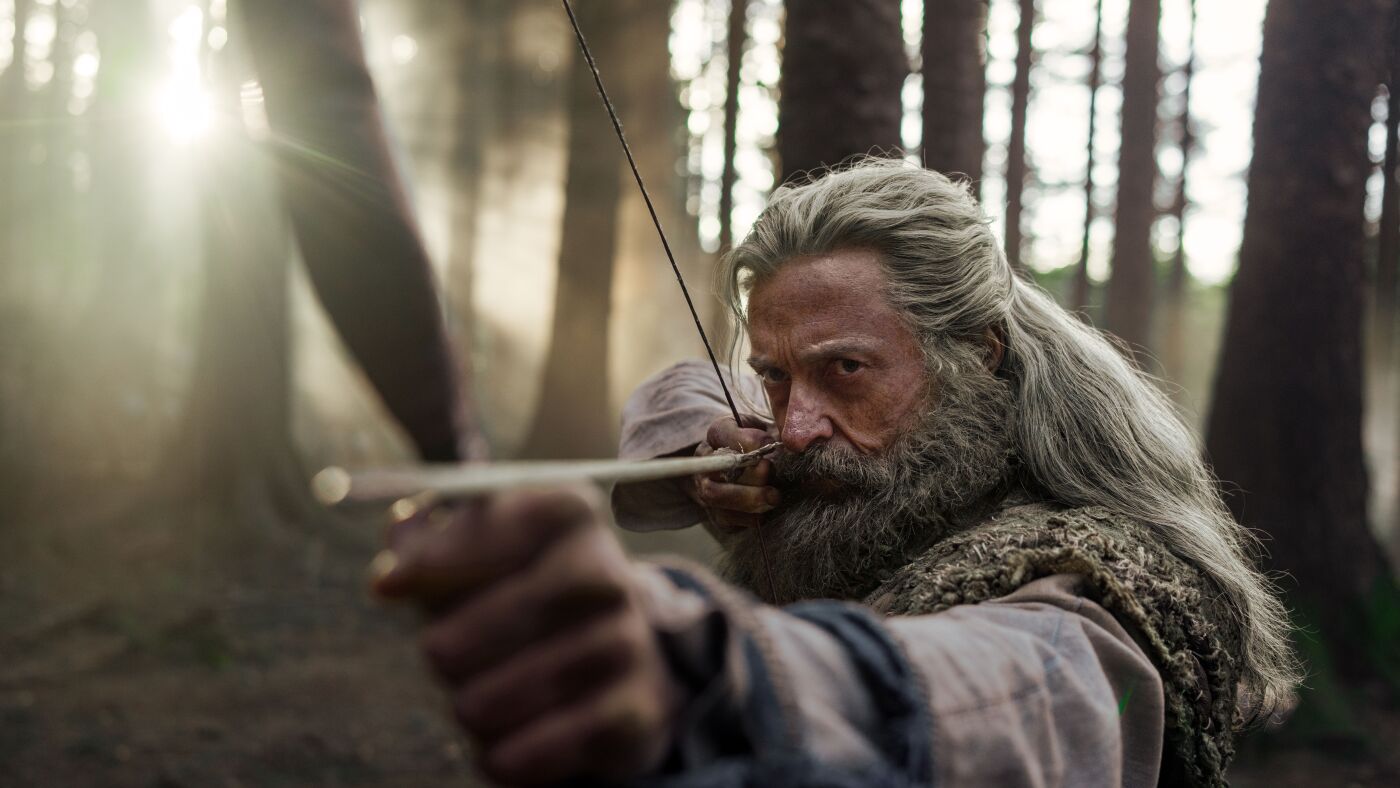
Hugh Jackman as Robin Hood.
A24
hide caption
toggle caption
A24
Gunmetal gray sky, barren muddy terrain, a half-starved child begging a wizened title character for a scrap of food moments before he slashes her throat. It’s hardly the opening you imagine for a film about a folk hero — especially one who robs the rich and gives to the poor. But then, The Death of Robin Hood is the brainchild of Michael Sarnoski (Pig, A Quiet Place: Day One), so maybe leave expectations in the lobby.
Sarnoski gives us Hugh Jackman’s battle-scarred, gray-bearded Robin as a tormented wretch, not the brash strapping outlaw of legend — alone, wracked by regret over the countless lives he’s ended or ruined. When we meet Robin in 1247 A.D., he seems pursued as much by his own guilt as by avenging relatives of the innocents he murdered in younger days (say, that half-starved but surreptitiously knife-clutching little girl).
So he tries to beg off when Little John (Bill Skarsgård, unrecognizable) approaches him with the promise of one more “adventure” — to rescue the wife John’s claimed after killing her husband, from the neighbors who then rescued her from John. Robin notes correctly that she’s not really John’s wife, yet he reluctantly brings his quiver, and an arm that can still shoot an arrow through a skull and out an eye socket at 50 paces.

He proves formidable, but not immortal. This “adventure” leaves him gravely wounded, dragged across forbidding terrain to a remote, cliff-top convent, where a prioress (Jodie Comer) with a curative touch and a marginally gentler way with a knife will attempt to bleed him back to health.
Sarnoski’s indie-realist approach to blood-letting — whether Pitt-ishly clinical, or Game of Thrones-esque in its brutality — is never less than arresting, and Jackman’s certainly up for the gore, extinguishing his torch in one opponent’s mouth and burying a hatchet in another’s back.
But it’s in the film’s later stages, where the character grapples with what his youthful righting of wrongs has cost both him and bystanders, that the actor and this medieval thriller find their emotional footing. Sarnoski is exploring the way we edit and augment the tales we tell about ourselves as we pass through the world, noting that hedges and embellishments will ultimately be laid bare.
If we live long enough, we’ll face a reckoning, a lesson Jackman’s delivered before as Logan, another troubled figure of legend. This film’s latter moments have a similarly eulogistic quality, augmented by Comer’s affecting turn as an accepting if anguished guardian at the hour when life ends, and myth takes flight.
Movie Reviews
‘Dreams of Violets’ Review: What Does a Film Made Entirely with AI Look Like? Ash Koosha’s Iranian Protest Drama Is Dramatically Numbing, but It’s Still a Startling Portent of the Future

“Dreams of Violets,” which premiered last week at the Tribeca Festival, is the first movie generated entirely by AI to be programmed at a major film festival — and it’s also the first movie generated entirely by AI that I’ve seen. As such, those of us at the premiere were really watching — and evaluating — two films at once. The first is a drama, set in Tehran, written and directed by the expatriate Iranian Ash Koosha (who is now a London-based tech entrepreneur), that depicts the days of protest and crackdown and state-sanctioned killing that took place five months ago, in January, as waves of Iranian citizens poured into the streets to register their anger at the country’s theocratic regime. I didn’t find that movie to be particularly effective. In fact, after a while I thought it was stultifying.
But the other movie, which is far more interesting and significant, is the one that demonstrates, simply by virtue of its existence, what some of the possibilities might be for the use of AI within the world of feature filmmaking. This is a delicate and dicey subject to even bring up, since the industry right now is in the grip of multiple perceptions and anxieties about what AI portends for the future of entertainment. And all of this is changing by the week. Just look at how quickly we went from Steven Soderbergh, in April, ruffling feathers for admitting that he used AI to craft fantasy sequences for his documentary “John Lennon: The Last Interview” to Martin Scorsese — as moral and respected a voice as there is in the industry — signing on, at the beginning of June, to partner with the German generative-AI firm Black Forest Labs in order to speed up the storyboarding process. Darren Aronofsky has now crossed the AI barrier as well, using it to make a series of web videos about the Revolutionary War.
These, of course, are all baby steps. But the baby is going to grow up. And what will it look like when it does? “Dreams of Violets” offers indications of at least a few of the places that AI, as its symbiosis with the industry grows and gathers force (which it surely will), might go.
But first, an aesthetic question: Is “Dreams of Violets” a weirdly distant and unsatisfying movie because it was made with AI? The strange answer to that is yes, but not really. It’s actually the form of the movie that’s odd and off-putting: a barely scripted series of anecdotes, or mere moments, with little in the way of dramatic development. Ash Koosha based the film on journalistic reports, photographs, and eyewitness accounts, and it’s clear that he wanted it to feel like we were watching scenes from a documentary, which sounds like a valid impulse. (Plenty of movies, including last year’s combat docudrama “Warfare,” have been staged that way.) But though the characters in “Dreams of Violets” look and talk like real people, and the rubble-strewn urban streets look and feel like real rubble-strewn urban streets, we’re barely given a context for what we’re seeing: soldiers killing civilians with random cruelty, which is the heart of the movie — at least, for the first half, after which it becomes less severe and even less interesting.
If you see a soldier killing a civilian in a documentary, it’s horrifying, but the effect is 100 times less powerful in a film that simply looks like a documentary, since we know, in our gut, that we’re not watching reality. That’s why the quality that draws us into a movie, even if it is a documentary, is the connection we feel to the people we’re watching. But Ash Koosha hasn’t scripted “Dreams of Violets” that way. He has made a movie with an uncanny-valley problem, an “existential” drama that’s all “authentic” but abstract moments: the vérité political-war-movie equivalent of calendar art. It’s like synthetic prize-winning photojournalism that moves.
At the time of the January protests, some observers thought the Iranian regime would topple (the Iran War has now made it clear what a naïve belief that was). But “Dreams of Violets” is not a days-of-rage tale of inspiration. It’s set after the protests have already been contained (the country’s police are doing a clean-up operation), and what it offers, mostly, is raw snapshots of state-sanctioned murder and political oppression. Yes, we “get to know” half a dozen characters — a boy in a wheelchair, his physician older brother, a reminiscing old woman, a music student, and several others. But Koosha doesn’t create fully realized scenes.
When “Dreams of Violets” played at Tribeca, the justification for the film — the reason given by Koosha to make it entirely with AI — is that it couldn’t have existed otherwise, and that the figures we’re seeing onscreen are all based on real people. Maybe that’s true, but effective art needs no justification. If you wanted to be cynical about it, you could say that Ash Koosha is exploiting the tragedy of his homeland to have the best possible excuse to craft an AI showreel. His company builds AI-based characters and has also played with using AI to generate pop music. In “Dreams of Violets,” he’s like the creator of Tilly Norwood pretending to be the director of a movie like “No Other Land.”
But if “Dreams of Violets,” as a movie, is mostly a bust, as an AI showreel it’s something more. Several critics have nitpicked visual flaws in the film’s design, but from moment to moment what I saw in “Dreams of Violence” looked plenty textured and realistic. Does this mean that AI can “make a movie”? No. But it does mean that AI can give you scenes of roiling tumultuous Civil War set in the hurly-burly of Tehran at sunset, with soldiers roaming the streets and forcing citizens into vans as others scurry out of the way, and it can make you believe your eyes. And here’s the buried lead: The film’s entire budget was $2,000. I don’t want to be the bearer of bad news, but the most powerful message to emerge from
“Dreams of Violets” isn’t that the Iranian regime is a ruthless pack of totalitarian oppressors. It’s that $2,000 can now buy a hell of a lot of motion picture.
-
 Sports7 minutes ago
Goalkeeper Raúl Rangel’s elite play and South Korea’s mistake help Mexico advance
-

 World15 minutes ago
US-Iran talks postponed as Israel attacks Lebanon
-
 News40 minutes ago
Luigi Mangione’s lawyers withdraw plans for psychiatric defense
-

 New York2 hours ago
Video: Knicks Fans Celebrate With Ticker-Tape Parade
-

 Los Angeles, Ca2 hours ago
Armed, dangerous CHP pursuit suspect tied to double homicide in Pomona
-

 Detroit, MI2 hours ago
First responders honored after rescuing 12 people from capsized sailboats near Belle Isle
-

 San Francisco, CA3 hours ago
Oakland man faces hate crime charges for Castro District attack
-

 Dallas, TX3 hours ago
At least 4 injured after vehicle drives into Dallas crowd, driver arrested

