Movie Reviews
Maranamass movie review: This Basil Joseph dark comedy is a fun ride filled with mayhem


Maranamass movie review
Cast: Basil Joseph, Rajesh Madhavan, Babu Antony, Suresh Krishna, Siju Sunny, Anishma Anilkumar
Director: Sivaprasad
Star rating: ★★★
The fact that actor-writer-director Basil Joseph and actor-producer Tovino Thomas are thick as thieves is well-known among cinephiles. The two work together professionally quite often and if Basil gave Tovino a superhero in Minnal Murali, it’s now the turn of Tovino to give Basil a comical sigma male in Marannamass.
The premise
A serial killer who’s killing elderly men and then stuffing the state’s famed Poovan banana in their mouth is causing havoc in Kerala. Dubbed the ‘Banana Killer’, he has created fear among people, and the villagers of Vallikkunnu are no exception. The movie reveals early on who the killer is and why he is hell-bent on murdering old men (childhood trauma), and how he finds his victims. Now, while the police are searching for the Banana Killer, another man is creating a major nuisance in the village itself – Luke PP (Basil Joseph), the hero of this film. The police arrest him believing he is the serial killer, but unfortunately for them, he’s not.
Proudly branding himself a sigma male, Luke is a new-age YouTuber cum influencer who goes out of his way to expose people’s dirty secrets with not a malicious intention but to clean up society. If he pulled out the porn search details of the panchayat head and plastered it in the village, he also placed the local police station up for sale on OLX as he didn’t find the cops doing their work. Fed up with his antics, the entire village pools in a sum of ₹16 lakhs to send him packing to Czechoslovakia to get rid of him. The last straw for Luke is when Luke’s girlfriend Jessie (Anishma Anilkumar) breaks up with him because of his inability to take life seriously. Luke is all set to win her back somehow when a bus journey Jessie is on adds a major twist to the story. One night, Jessie heads back and finds herself on the bus with Luke, Jikku (driver), Aruvi (bus conductor), an elderly man, and a stranger. And it is this bus ride they are on that the entire story unfolds.
What works for Maranamass
In recent times, Basil Joseph has been striving to push himself out of his comfort zone (think Ponman, Praavinkoodu Shappu, Nunnakuzhi) and get into the skin of really offbeat characters. Luke PP is one of those roles that uses Basil Joseph’s ability to pull off comedy and adds the Gen Z Sigma male who struggles to pull it off despite his flashy clothes, blonde hair, and faded haircut.
Basil has pulled off Luke in style, but it has been ably aided by the other actors, namely Rajesh Madhavan, Suresh Krishna, Siju Sunny, Babu Antony, and Anishma Anilkumar. Each of them has delivered a truly note-worthy performance and the on-screen chemistry between the scenes lights up even when the dialogues don’t.
In Maranamass, debutant Sivaprasad, who has co-written the film with Siju Sunny, gives us a dark comedy centred around Luke. Most of the comedy in the film, though, is of a slapstick nature and often situational, with heavy pop culture references to elicit laughs. In one instance, the trend of pre-wedding photoshoots is spoofed with a ‘save the date’ photoshoot at a graveyard, and in another, a cop is called Tiger sir because he carries around a Tiger balm in his hand. You get the drift by now. Not all these scenes want to make you laugh and this is due to the inconsistencies in the screenplay that the second half lags.
Each of the key characters has been given interesting quirks to keep alive the narrative, which hits speed breaks ever so often, like the bus journey that Luke and Jessie are on. Produced by Tovino Thomas, Maranamass is, for the most part, an enjoyable, fun ride that’s filled with mayhem.



- THE ODYSSEY
- Starring: Matt Damon, Tom Holland and Anne Hathaway
- Directed by: Christopher Nolan
- Rated: R
- Running time: 2 hrs 45 mins
- Universal
Our score: 4.5 out of 5
EPIC. If I was asked to describe Christopher Nolan’s latest film, that is the word I would use. He has mounted a film that rivals the greatest achievements of filmmakers like Cecil B. DeMille or David Lean. And, like the films of those mentioned, it’s runs a tad too long.
I was shocked, but pleased, to see that my 12-year-old granddaughter recently did a school paper on King Agamemnon. Thank goodness they’re still teaching History in our schools. Based on Homer’s “The Odyssey,” the film tells the story of King Odysseus (Damon) and his adventures which, if you’ve read “The Odyssey,” include the Trojan Horse, the Cyclops and assorted angry Greek gods. The film covers each of these adventures in great detail, sparing nothing in the production design department. While Odysseus is away – and he’s gone for a l-o-n-g time, his wife Penelope (Hathaway) has to endure a never ending string of “suitors,” men lining up in the hopes of replacing the King should he not return. The men are nothing more then scavengers, taking advantage of the law of Zeus, which decrees no one should be turned away. This angers the Queen’s son, Telemachus (Holland), who must control his temper when the men try to bait him into a fight, the idea being if Telemachus is killed, the new husband would become the King. It’s all very interesting and complicated. And long.
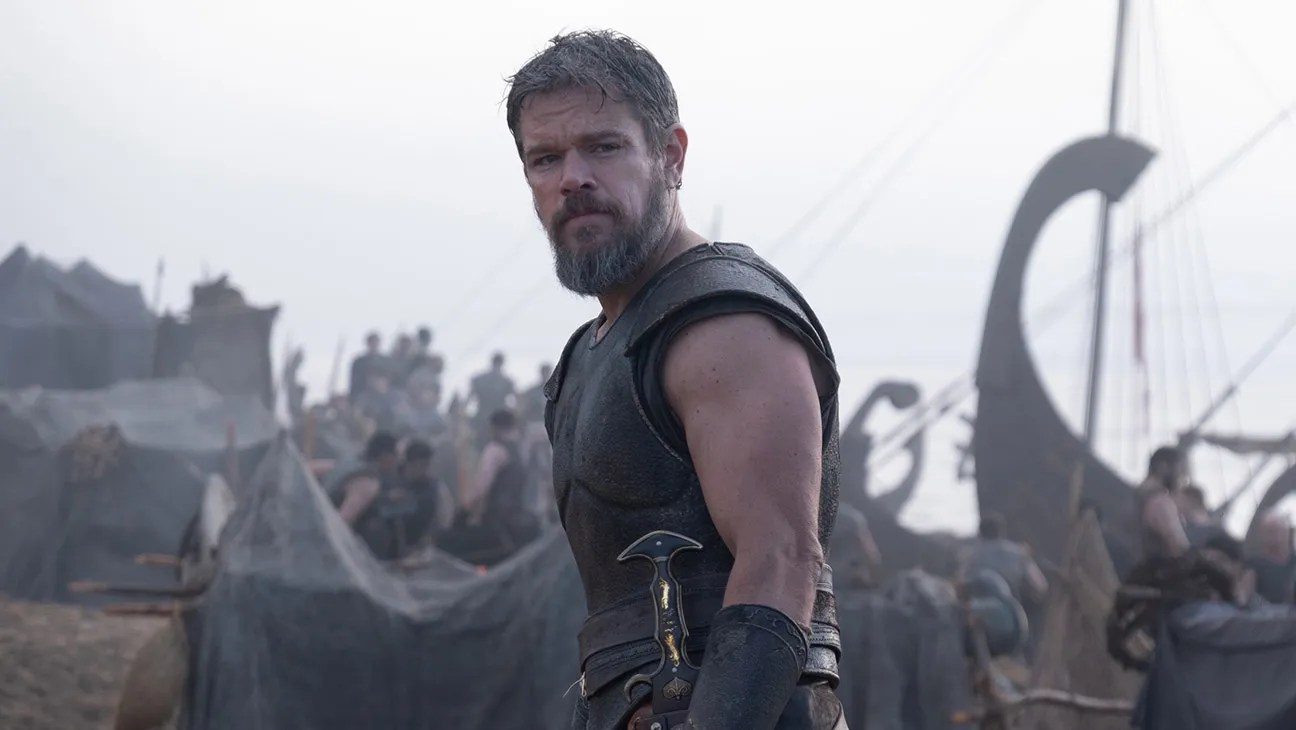
Director Nolan is one of the rare filmmakers who, in my opinion, has never made a bad film. From “Memento” to the “Dark Knight” trilogy to the Oscar-winning “Oppenheimer,” he has proven himself a true master of cinema. “The Odyssey” only adds to that distinguished resume’

The cast is a tribute to Nolan himself who, like Woody Allen, can pretty much get anyone he wants for his films because, as an actor, why wouldn’t you want a credit in one of his films. Besides the three stars named above, the cast includes Robert Pattinson, John Leguizamo, Zendaya, James Remar, Jon Bernthal, Oscar nominees Samantha Morton and Elliot Page as well as Oscar winners Charlize Theron and Lupita Nyongo. As MGM used to advertise, “more stars than there are in heaven.”
The script and story are pretty faithful to the source material, though for some reason it bothered me whenever Telemacus referred to Odysseus as “dad.” Never father. The weird things you notice. Visual.y the film is stunning and the Trojan Horse and battle of Troy are worth the price of admission alone. I will add that I did see the film in 70 mm and, if that format is playing in your town, I urge you to see it in that format.
On a scale of zero to five, “The Odyssey” receives ★★★★ ½
Movie Reviews
Saari Review: Memory, Betrayal and Identity Converge at River Valley Film Festival – Hollywood Times


Premiering at the 2026 River Valley Film Festival, Saari uses fragmented memories, Finnish landscapes and restrained performances to explore betrayal, identity and reconciliation.
By Valerie Milano
Palm Springs, CA (The Hollywood Times) 7/14/26 – In the visually striking short film Saari—Finnish for “island”, a peaceful family retreat becomes the setting for the slow collapse of a relationship.
Co-written by Justin Seegmueller, Corey L’Esperance and Suvi Härkönen, the film follows Daniel, played by Seegmueller, as he reflects on the choices that damaged his relationship with Liina, portrayed by Ilona Karppanen. Told through fragments of the past, present and future, Saari gradually reveals how secrecy and betrayal can transform a place of safety into one of emotional confinement.
The nonlinear structure was not simply a stylistic choice. The project was developed and filmed over more than a decade, with footage captured in Finland, Boston and the desert. L’Esperance explained that the filmmakers divided the story into “past, present and future,” allowing audiences to experience the relationship from both characters’ perspectives.
Click below for our exclusive interview:
He described Daniel and Liina as two people who are “stuck in these moments in time,” making the fragmented narrative especially appropriate.
Seegmueller said Daniel’s internal struggle is rooted in the questions, “Am I that person? Am I still that person?” His restrained performance captures a man attempting to reconcile his current identity with the damage caused by earlier decisions.
For Seegmueller, the film is fundamentally about choice.
“It’s all about decision-making,” he said. “Are you an accumulation of all your decisions?”
Finland’s lush island scenery contrasts sharply with Daniel’s later isolation in the barren desert. Seegmueller described the progression as “lush and then dead,” a simple but effective visual representation of a relationship moving from intimacy and possibility to emotional aftermath.
For Liina, the island represents family history, comfort and security. By inviting Daniel there, she welcomes him into her sanctuary. His secrets, however, begin to contaminate that protected space.
“You let me into your life,” Seegmueller explained, “and now I’m here almost ruining your sense of security.”

 Because the couple reaches the island by rowboat, the setting also creates a sense of entrapment as suspicion and resentment begin to surface. L’Esperance noted that once they are there, “there’s not really anywhere you can go.”
The film’s cross-cultural perspective was strengthened by the collaboration between American co-director L’Esperance and Finnish co-director Härkönen. Their responsibilities shifted according to which character dominated a scene. L’Esperance generally led sequences centered on Daniel, while Härkönen took a stronger role when Liina’s experience was at the emotional forefront.
That approach helps prevent Liina from existing only as a reaction to Daniel’s behavior. Her journey eventually becomes more compelling than his guilt.
Karppanen traveled to the United States for the first time to film the Boston scenes, which were completed approximately three years after the original Finland footage. Seegmueller said the friendship they developed during production can be seen in the warmth between their characters during the relationship’s happier moments.
The filmmakers deliberately avoid explaining every detail of Daniel’s betrayal. Earlier edits revealed even less, but test audiences needed additional narrative guidance.
“We do need to have some breadcrumbs,” L’Esperance said, explaining that without them, the story became “a little too lost on the audience.”

 The challenge was to provide enough information while maintaining the film’s quiet, interpretive tone. L’Esperance said they wanted to leave room for viewers to “fill in some of the blanks.”
The lengthy production process also changed how the filmmakers viewed Daniel. L’Esperance acknowledged that they initially saw him as “this hero,” but over time recognized that “he is kind of a bad guy in some of these aspects.”
That evolving perspective gives the film greater moral complexity. Daniel is not granted an easy redemption, and his introspection does not erase the harm he caused.
Karppanen brings strength and emotional restraint to Liina, who emerges from the experience as what L’Esperance called “a completely different person.” A final city scene suggests that she is beginning to reclaim her identity and imagine a future beyond Daniel and the relationship that betrayed her.
Subtle, atmospheric and open to interpretation, Saari asks whether people are defined by their worst decisions, and what reconciliation means when the damage cannot simply be undone.
After more than 10 years of work, the film’s world premiere at the River Valley Film Festival is especially meaningful. Both L’Esperance and Seegmueller attended film school in Philadelphia, making the Pennsylvania premiere a return to the state where their filmmaking journeys began.

 Seegmueller hopes the film encourages audiences to examine their own choices and personal histories.
“What does that say about you?” he asked. “What does that say about your story and your own narrative?”
Saari will have its world premiere at the 2026 River Valley Film Festival. Seegmueller will attend the premiere in person, while members of L’Esperance’s family are expected to represent him at the festival.

New Year’s Absolution, 2024
Directed by Nick Leisure.
Starring Michael Copon, Joel Brady, Josh Gilmer, Rafael Siegel, Shala White, Victoria Brandart, Siddalee Diaz and Lamondo Hill II.
SYNOPSIS:
Four longtime friends reunite for their traditional New Year’s Eve party. But things start to go awry with the arrival of a mysterious resolution: Kill Someone.

The amateur production values of New Year’s Absolution leak off the screen from the opening frame, as a cheap-looking title card appears over stock drone footage, followed by the actors’ names in a bold yellow font, dancing on and off the screen with only the flashiest of iMovie transitions. It’s effective, in letting you know exactly what kind of ride you’re in for.
We get the first sense of this film’s ‘humour’ as we meet Stuart and Travis, a couple played by Rafael Siegel and Lamondo Hill II. As Travis drives toward the home of Damon (Joel Brady), who’s hosting this year’s annual New Years’ Eve party, director Nick Leisure attempts to shock us with a rude joke, as Stuart bends down towards Travis’ crotch, a visual that would almost work if Travis didn’t have a small dog sitting on his lap. Turns out Stuart was just reaching down to pick up his phone. Hilarious.

Stuart and Damon are both members of ‘the five of ’99’, a friend group who met in 1999, of which only four remain (watch for the shocking revelation to this mystery). Damon is more concerned with arranging the coasters, and bickering with his wife Clare (Shala White) over the canapés, than making sure his friends have a good time. Don’t worry, Damon, we’re not having any fun either.
As everyone starts trickling in, the lack of chemistry between the cast members becomes increasingly apparent. ‘Lifelong friends’ Stuart and Damon interact like coworkers at an after-hours event, while ‘best friends’ Travis and Clare stand around rehearsing dialogue. This involves a lot of bitching about the others, especially the next arrivals Jacob (Josh Gilmer), an off-duty cop, and his wife Misty (Victoria Brandart). They are both vain and image-obsessed, showing off their bodies while the others snigger behind their backs about how fat they used to be.

The last to arrive are narcissistic surgeon Roy (Michael Copon), and his new girlfriend Kira (Siddalee Diaz), a shallow parody of Gen Z shallowness, whose entire character is constructed around her social media presence, and who physically cannot stand being separated from her phone. That’s the caliber of subtle social satire you can expect here.
What with the vanity, body shaming, and some casual racism and homophobia, it becomes clear that these are not nice people. There’s an obscenity to their wealth; Stuart blew 50k on a vintage car that can’t drive in the rain, and Damon forked out for a pool that he’s never swam in. Yet Leisure fails to make any kind of satirical point about the superficiality on display, because his approach to filmmaking lacks any depth of its own.

Damon’s hesitancy to get into his own pool is a key point, as his friends jokingly threaten to throw him in, and Stuart later threatens to drown him if he harms his dog Cookie, whom Damon fears will crap on his precious floors. It’s not much, but it’s nice to get some foreshadowing in a plot that’s mostly lacking in structure or craft.
Said plot eventually coughs and sputters to life when Jacob picks his new year’s resolution out of a ceremonial hat, and reads – kill someone. You might expect the group to laugh this off, but Jacob flips out, and deeper, sinister connotations are revealed. Jacob, who has been doing coke with Roy all night, then draws a loaded firearm in his drug-fueled haze, which he accidentally fires, injuring a member of the party.

This leads to some impromptu bathtub surgery from the coked-up doctor, that further highlights the film’s disconnection from reality. None of the characters react in a normal way to this development, continuing the party as if there isn’t a dude with a gunshot wound in the tub.This could’ve been an interesting satirical point about the hollowness of the upper class, except so little has been established about these characters and their relationships, that it just comes across as lazy writing.
However, it’s after this point that the film finally begins to find some (admittedly ironic) entertainment value, as the plot descends into a chain reaction of over-the-top carnage, with each character blaming another for the night’s misfortunes, and perpetuating them in grisly fashion. It’s in this last half hour that Nick Leisure’s vision of a bloody dark comedy begins to come through, and the kills are as exaggerated as they are unexpected, sparing no amount of fake blood. That said, it’s too little too late, as we’ve already wasted an hour watching these unbearable characters exchange dialogue that’s in turn laughable and dull.

New Year’s Absolution is a tonally confused, poorly put-together piece of work that is unclear in its goals, and fails to achieve them. Director Nick Leisure seems to be going for a broad black comedy, but the only laughs I found were from the piss-poor acting, ridiculous deaths, dumb editing gimmicks, and the autogenerated subtitles while rewatching the surgery scene – “It’s bleeding!” “Boobs tend to do that.”
It’s supposedly a horror/thriller, but it’s not scary or thrilling, because there’s no singular antagonistic force, and the deaths are too random, while the characters are so flat and unlikable that we neither feel nor fear for them. Though it’s possible Leisure is going for some kind of ‘eat the rich’ social satire, his approach is too bland for this to come through, and we don’t get any grounded perspective outside of these awful characters.
One question remains, however – who wrote the resolution? Don’t know. Don’t care.
Flickering Myth Rating – Film: ★ / Movie: ★
Dan Carville
https://www.youtube.com/watch?v=embed/playlist
-

 Nevada3 minutes ago
Nevada’s modern boomtowns are these fast-growing cities, study said
-

 New Hampshire9 minutes ago
NH Forests: A Story of Revival and the Challenges Ahead: Business NH Magazine
-

 New Jersey15 minutes ago
NJ Spine Doctor, Daughter, Granddaughter Killed In Plane Crash, Police Say
-

 New Mexico21 minutes ago
McCauley Springs Fire Reaches 100% Containment
-

 North Carolina27 minutes ago
Massive great white shark spotted off NC coast. See where its headed
-

 North Dakota33 minutes ago
Neighbors, not competitors
-

 Ohio39 minutes ago
Former Powell residents indicted in $9.3M Ohio Medicaid fraud scheme
-

 Oklahoma45 minutes ago
J.D. PicKell: ‘Oklahoma is going to be a wagon once again’

