Movie Reviews
Film Reviews: At the Toronto International Film Festival — Nazi Puppet in Norway and Abortion Saga in Georgia – The Arts Fuse


By David D’Arcy
Two closely watched films in Toronto were dark dramas that couldn’t have been more different.
Gard B. Eidsvold in Quisling – The Final Days. Photo: Agnete Brun
Who outside of Norway remembers Vidkun Quisling today? Maybe historians and students of the Second World War. Quisling (1887-1945) was prime minister of Norway during the German occupation, a gruff enforcer for the Nazis whose name became synonymous with collaborator.
Quisling’s rule was harsh, just what the Nazis wanted. Norway deported a thousand Jews to camps in Poland. Not so many, compared to the horrific broader picture, but only 12 of them returned. Quisling – The Final Days, picks up the narrative when the Germans surrender in May 1945 and the puppet prime minister, who expected to be treated with the respect befitting his office, is arrested. A young Lutheran pastor, Peder Olsen (Andres Danielsen Lie), is assigned to minister to Quisling (Gard B. Eidsvold) in prison after the church’s primate refuses the task. Erik Poppe’s gripping film, adapted from diaries kept by Olsen and his wife, takes us from the traitor’s loud assertions of patriotism, to a court’s judgment, to his execution by a firing squad. It’s a grim study of denial and defeat.
“Surely there must be some civilized people left in this country,” a baffled Quisling pleads before turning himself in, “you’re calling me a criminal ….. I’ve worked so hard for this country.” So much for remorse.
Eidsvold plays the man who led occupied Norway under Hitler as smug and certain in his politics. Even when the Germans surrender, the leader who met with Hitler as late as January 1945 is shocked when he’s put in handcuffs. Locked in a prison cell before his trial, he finds his spiritual future placed in the hands of the pious young Olsen, who is sworn to secrecy about counseling the collaborator. Like any tyrant, Quisling is angry and impatient. Struggling to sleep on his cot, he asks the young guard attending to him to switch the bright light off. The guard turns it off and back on again, an everyman’s expression of the country’s loathing for the thug claiming to be a misunderstood patriot, now brought down to size.
At every step, caged and scorned, Eidsvold brings rage, but also an unexpected subtlety, to the role of his country’s official bully. Not to give too much away, but the final third of the film takes place almost entirely in the condemned man’s cell, where pride battles with a stark begrudging recognition of mortality. We watch this struggle in relentless closeups. Poppe doesn’t flinch from showing the final moments of those final days.
Norway tends to focus on the underground heroism of some brave citizens rather than the many who collaborated during the wartime Quisling years. There’s still nothing revisionist here about Quisling’s crimes. But questions arise as we watch the man try to come to terms with himself with the help of Olsen the clergyman. Attempting to get the former strong man to open up, Olsen admits that there were moments during the just-ended war when he himself was less than admirable, a confession that the self-satisfied Quisling is willing to accept. But that’s about as far as kinship goes between a minister who endured the occupation and the traitor who presided over it.
Then there is the parallel to European politics today, where reactionary extremists are applauded, not punished, and court their counterparts on the American Right.
Those autocrats are not the simple stooges of foreign enemies, except in Putin-dependent Belarus (and in Ukraine before 2014). Yet in Quisling’s claims of being persecuted and misunderstood, and in his constant lies about serving Norway while following orders from Berlin, we find the same pattern of lying in the palaver of those would-be strong men close to home today. In our case, a leader who has already threatened to punish those who stood in his way after the last election – including Jews who vote against him this time – may not need an occupying army to install him back into power.
It’s a sobering prospect to consider, after watching scenes in which a country exults in the downfall of a tyrant.
A scene from April. Photo: TIFF
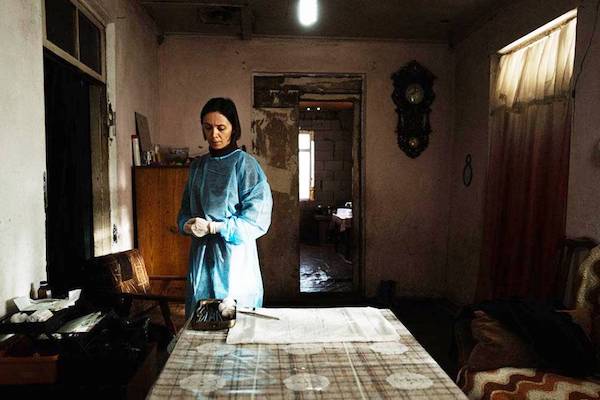
The politics in Georgian director Dea Kulumbegashvili’s April lurch backward and forward through a bleak and cryptically symbolic drama that explores the risks and the stigma of abortion in rural Georgia (the former Soviet republic). And there’s a lot more than politics in this sometimes inscrutable film.
The deadpan Nina (Ia Sukhitashvili) is an obstetrician who supplements her income performing abortions in the countryside, a foreboding expanse which we encounter mostly in the dark. Think of the shadowy emptiness of a place haunted by visions worthy of Bela Tarr, and then place a pregnant patient there whose medical history is unknown and who forbids any emergency surgery. It is a recipe for things to go wrong. A baby is still-born under those conditions to a woman who refuses to have a cesarean section. Nina is forced to defend herself against accusations by the mother’s angry husband and by superiors at her daytime hospital job. Abortion may be legal in Georgia, but it is culturally taboo in much of the country.
This parable about the sufferings of women in a male-dominated culture and the plight of women who try to help them is unnerving in its fatalism. The action — if that’s the right word — moves at a creeping pace, another Tarr trademark. April can feel like a horror film without a monster. Yet Kulumbegashvili gives us a figure – a character? – thats monstrous enough. That presence is a humanoid shape with reptilian textures that slinks around – an observer of injustices, a witness of rural horrors, a victim, a conscience?
If this odd figure in cutaway shots defies explanation, other elements in this film of chilling visuals come off as clear as an anthropologist’s journal. Women stuck in village life are doomed to be pregnant most of the time, and the culture is so closed that medicine isn’t given the opportunity to help them. April will be praised for the staggering power of its images which appear like bumps in the road on which Nina drives her car in the dark. That said, the jostling arrhythmia of the director’s picaresque storytelling (plus the spectral creature) suggest that what we have here are parts of a whole that’s still in pursuit of a style. The film feels like a work in progress – imaginative and improvised — akin to the medical procedures that the film depicts with so much uneasiness. Like the patients in April, audiences who can bear the experience will be grateful to receive what help Kulumbegashvili provides.
David D’Arcy lives in New York. For years, he was a programmer for the Haifa International Film Festival in Israel. He writes about art for many publications, including the Art Newspaper. He produced and co-wrote the documentary Portrait of Wally (2012), about the fight over a Nazi-looted painting found at the Museum of Modern Art in Manhattan.

Movie Reviews
Bandar Movie Review: Bobby Deol roars in Anurag Kashyap’s unsettling legal thriller that refuses to spoon-feed

Name: Bandar
Director: Anurag Kashyap
Cast: Bobby Deol, Sanya Malhotra, Sapna Pabbi, Saba Azad, Jitendra Joshi, Raj B Shetty
Writer: Sudip Sharma, Abhishek Banerjee
Rating: 3.5/5
Plot:
Bandar follows Sameer Mehra’s character, essayed by Bobby Deol, a fading star who is desperately clinging to his past glory. Just as he attempts to rebuild his life and finds solace in a new relationship, his world comes crashing down. A former girlfriend files a heinous allegation against him, dragging him into a vicious, high-profile legal battle. Written by Sudip Sharma and Abhishek Banerjee, the film moves away from standard Bollywood courtroom setups. Instead, it dives straight into the murky waters of social media trials, public perception, and a sluggish judicial system where the truth gets buried under layers of gray.
What works:
Known for his chaotic energy, Anurag Kashyap takes a remarkably mature and controlled approach here. He avoids sensationalizing a highly sensitive topic, choosing instead to focus on the psychological claustrophobia of the protagonist. The prison sequences are exceptionally well-shot. They create a suffocating, raw atmosphere that makes you feel the weight of the character’s confinement. The script successfully avoids preachy, black-and-white monologues. It bravely forces the audience to confront their own biases regarding modern-day public trials and the digital judge-and-jury culture.
What doesn’t:
Clocking in at nearly two hours and twenty minutes, Bandar feels heavily weighed down in the second half. The narrative stretches thin, and a few subplots demand too much patience, making you wish for a tighter edit. The film stubbornly refuses to take a definitive moral stance or offer a neat resolution. While film enthusiasts might appreciate the complexity, mainstream viewers looking for a clear-cut ending or emotional payoff might walk away feeling detached and frustrated.
Performances:
- Bobby Deol is the beating heart of this film. Stripping away the massive macho swagger and menacing villainy of his recent hits, he delivers a deeply vulnerable, understated performance. He plays Samar with a mix of arrogance, confusion, and raw helplessness, proving his immense range.
- Sanya Malhotra anchors her screen time with her trademark reliability, turning in a grounded and impactful performance.
- Saba Azad and Sapna Pabbi excel in their respective roles, bringing genuine nuance to characters that could have easily been sidelined.
- Jitendra Joshi is an absolute scene-stealer, commanding your attention every single time he steps into the frame.
- Indrajith Sukumaran and Raj B Shetty are absolute show stealers with their raw acting.
Final Verdict:
Bandar is an unsettling, morally complex thriller that refuses to spoon-feed its audience. It isn’t a comfortable watch, nor does it try to be. While the sluggish pacing in the second half prevents it from being an absolute masterpiece, it is worth a watch for Bobby Deol’s spectacular acting reinvention and Anurag Kashyap’s gritty, thought-provoking storytelling.
Disclaimer: The views and opinions expressed in this article are solely those of the author and do not reflect the official policy or position of Pinkvilla. No statement in this article is intended to defame, harm, or malign any individual or entity.
ALSO READ: Maa Behen Movie Review: Madhuri Dixit, Triptii Dimri, and Dharna Durga save a slow-burning mystery
Movie Reviews
Movie Review: Travolta’s “Propeller: One-Way Night Coach” is One for the Ages — All Ages

Back in the good ol’days — the ’90s — John Travolta would love to get off the topic of “Michael,” “Pulp Fiction” or “Get Shorty” in interviews with film journalists like me and regale us with how utterly besotted he had been with his first flying experience, how that drove his passion for piloting and buying planes and airfield-adjacent luxury houses.
He didn’t even seem to mind having to move house when this or that development balked at him flying his Boeing 707 out of there on the way to locations.
Travolta would tell any journalist who asked that he was writing a kid-friendly book, “Propeller: One Way Night Coach,” based on his first flights as a child in old propeller driven airliners — cheap red-eye overnight treks with too many connections for your average jet age traveller to tolerate.
I remember picking up the book when it came out later in the ’90s — at an airport gift shop — and thinking “Well, that’s as cute as I figured.”
And now, decades later and trapped in the B-movie hell of his post “Gotti” career, Travolta’s turned that cute book into the most delightful, fanciful and colorful bon bon of a movie.
“One Way Night Coach” is a child’s fantasy of flight and flying the way it used to be — with pristine, uncrowded, futuristic airports, an early ’60s era of jets and prop planes with over-uniformed stewardesses in white gloves, the days “Back before every Joe Sweatsock could wedge himself behind a lunch tray and jet off to Raleigh-Durham,” as Sideshow Bob memorably sneered on “The Simpsons’.”
It’s a fictionalized account of Travolta’s childhood about an only child (at least two Travolta siblings have bit parts in this movie) of a never-made-it/never-will actress/single-mom (Kelly Eviston-Quinnett) who indulges her aviation-obsessed eight-year-old with a cheap cross-country overnight flight.
Little Jeff (Clark Shotwell) will revel in almost every Idlewild to Pittsburgh to Dayton to Chicago to Kansas City to Denver and Los Angeles minute. He strolls into the cockpit to meet pilots, charms the stewardesses and checks out the sleeping bunks on the TWA Lockheed Super Constellation, loving even the delays if not the Chicken Cordon Bleu he’s offered on legs of the journey that offer a meal.
And as he’s an observant child, he comments (Travolta narrates) on his 50ish mother’s vamping and posing, her choice of cigarettes (Newports) and drinks, the solo traveling men whose attention she pursues and earns.
“I was her best audience,” adult Jeff remembers of the mother who’d read him plays as bedtime stories and delusionally hopes that this trip to Los Angeles might be her “big break” even though she’s pushing 50.
“Hollywood called,” she’d explain about their overnight cheap flight arrangements to ticket agents and crew. “They told me to take the next flight!”
At every turn, Jeff meets or sees kindness — stewardesses who indulge his many questions and bump them up to first class on the mostly-empty planes, a captain who fixes his toy model of a Constellation, a mentally ill flyer who flips out but is calmed by a flight attendant who isn’t overworked and frazzled in jet-powered tin-can jammed with Joe and Jane Sweatsocks who think nothing of traveling in their pajamas.
Normally, I cringe at pictures this reliant on voice-over narration. I recoil from stars who populate their picture with Sandler etc. offspring. But “Propeller” is unfailingly sweet and never cloying.
Sure, it’s fictionalized. But if you’ve followed Travolta’s life and career, a lot of him is in this — his raptoruous engagement with flying, an indulged child who developed a taste for fine food and creature comforts, a mother who was his guiding star as an actor.
I get why there are less adoring reviews than mine floating around “Propeller.” It’s unfailingly sweet. Mom’s man-hunting is seriously dated. This TWA tale is decorated with Gershwin’s majestic “Rhapsody in Blue” — United Airlines’ signature tune. And Travolta’s been around long enough for recent generations to come up and not feel a connection to the “Saturday Night Fever/Get Shorty” star whose career has fallen off and life has been visited by too much tragedy.
But I’d hate to be seated next to anybody who doesn’t appreciate this adorable, pristine and nearly perfect aviation fantasy on any flight, much less an overnight one.
Rating: TV-PG
Cast: Clark Shotwell, Kelly Eviston-Quinnett, Ellen Travolta, Ella Beau Travolta, Olga Hoffmann and John Travolta.
Credits: Scripted and directed by John Travolta, based on his book. An Apple TV+ release.
Running time: 1:01


Let’s just say that the wedding band has never occupied the most exalted rung of the ladder in music.
Playing “September” and “Celebration” is often what’s most required. As one member of the Bride and the Groove, the band at the center of John Carney’s new film, puts it: They’re not rock stars. They’re human jukeboxes.
But in “Power Ballad,” a wedding band singer and pop star cross paths. For one night, all of the stratification of the music world falls away. “Power Ballad” starts like a fairy tale.
Since 2007’s “Once,” the Irish writer-director has focused his films on the redemptive capacity of music. Carney, who was once a bassist for the Frames, knows from experience. From “Sing Street” to “Flora and Son,” he has made unabashedly earnest tales where a song, or just picking up an instrument, changes lives.
This can, undoubtedly, lead Carney into sentimental territory. Lucky for him, his chosen subject — music — is more worthy of sentiment than almost anything else. Yet the song doesn’t quite remain the same in “Power Ballad,” a movie that begins with the gentle sweetness Carney is known for, but detours into something more discordant.
Rick (Paul Rudd) is an American musician who gave up on his once-promising rock band’s future to instead live with his wife (Marcella Plunkett) and teenage daughter (a spunky, underused Beth Fallon) in Dublin. His former group was called Octagon, a perfect former band name if there ever were one.
But for years, Rick has fronted the Bride and the Groove. It’s an unromantic day job (or rather a night one) that hasn’t entirely sapped his belief in his own songwriting. During an encore at one wedding, he plays an original tune and is mentally transported to an arena full of swaying fans. When he snaps out of it, he’s staring at an empty dance floor and faces that say: That wasn’t Kool & the Gang.
At another wedding at at a castle, the band is asked to let a friend of the newlyweds sit in. They reluctantly agree, and are surprised to see the very popular boy band veteran, Danny (Nick Jonas), step on stage. He sings Stevie Wonder’s “I Wish,” and it’s great. Though Rick had just dismissed Danny’s music as “manufactured content for young, excitable teens,” he discovers Danny is a genuine musician.
But, later that night, something even more remarkable transpires. Rick bumps into Danny, and the two quickly hit it off. They begin jamming together and sharing songs that need work. They are both so jazzed by their unlikely collaboration that they play into the next morning.
The actual moment of artistic creation, and the craft it requires, is something the movies almost always skip over. But capturing collaborative juices flowing is exactly what Carney excels at. You can feel his joy in it. So it’s fitting that one of the unfinished songs Rick plays for Danny, “How to Write a Song (Without You),” is about creative invention.
It’s here when you wonder where “Power Ballad” is headed. Is this, for Rick, the beginning of a beautiful friendship? Will they turn into the next great songwriting duo, lifting Rick out of weddings and proving to the world that Danny is more than a boy-band pretty face?
That is very possibly the movie Carney might have made a decade ago. But “Power Ballad,” which he co-wrote with Peter McDonald (who also co-stars as a band member), shifts six months ahead in time. Rick is standing in a shopping mall when the familiar lyrics of “How to Write a Song” softly float through the stores. He stands dumbfounded in the gleaming halls of commerce, a befuddlement that slowly turns into outrage the bigger and bigger Danny’s smash hit grows.
“Power Ballad” loses some of its steam in its second half, which follows Rick’s struggle for justice. Making things considerably harder is that he can find no recorded demo of the song. His family and his band don’t even really believe him.
But even as the movie struggles to sustain its opening refrain, Carney’s film is always riffing on ideas of authenticity and aspiration in music. That Jonas is, himself, a former boy band star who has at times gone it alone, lends the movie a direct connection to contemporary music, where tussles over authorship are increasingly common.
Jonas has been good in other films (notably the “Jumanji” movies), but this is his most ambitious and convincing performance to date. It’s a testament to the movie that Danny’s theft isn’t a purely villainous act. He gives the song a bridge and the vocal power to take it to another level. He’s under mounting pressure from his label to deliver a hit. An executive (Jack Reynor) wants “Danny 2.0” but has little faith he can supply it.
But it’s an even more well-tailored role for Rudd. He memorably and very goofily played a bassist in the 2009 comedy “I Love You, Man.” But while he sings well, it’s not his musical chops that lift the performance. It’s more that Rick, a contented family man with unrealized rock-star dreams, gives the exceptionally genial Rudd more notes to play as an actor. Rudd makes for a very likeable everyman out to convince the world he is capable of a beautiful song.
And that’s the abiding belief of Carney’s. No matter all the struggles, the artistic injustices, the corporate hegemony, he still believes that if you make something truly soulful, it will break through. It will claw its way to the surface, and move people. It’s undoubtedly gotten harder since “Once,” this movie seems to admit. The world is against you. But what one person can offer, a ballad or otherwise, still has power. Fairy tale or not, that’s worth believing in.
“Power Ballad,” a Lionsgate release in theaters Friday, is rated R by the Motion Picture Association for “language throughout and some drug use.” Running time: 108 minutes. Three stars out of four.
-

 Dallas, TX2 minutes ago
Crews cover up AT&T branding as stadium becomes
-

 Miami, FL5 minutes ago
Miami leaders gather for FIFA World Cup Host Committee Gala
-

 Boston, MA10 minutes ago
Package fire outside Boston’s Museum of African American History under investigation
-

 Denver, CO17 minutes ago
Rockies beat reporter Patrick Saunders to leave Denver Post
-

 Seattle, WA20 minutes ago
Seattle granted NFL Franchise on this day 52 years ago
-

 San Diego, CA25 minutes ago
Mater Dei Catholic rallies, beats Point Loma in rematch of last week’s final
-
 Milwaukee, WI32 minutes ago
Milwaukee health department monitors 3 people for low-risk Ebola after travel; ‘No public health concern’
-

 Atlanta, GA35 minutes ago
Caitlin Clark’s stats Thursday in Indiana Fever vs Atlanta game

