
Connect with us

Movie Reviews

Film Review: TRON: Ares – SLUG Magazine

Published

on

Film Review: TRON: Ares – SLUG Magazine

Arts

TRON: Ares
Director: Joachim Rønning
Sea Bailey Productions
In Theaters: 10.10.25

I’m a member of GenX, which means I may not be from the greatest generation, but I’m still old enough to long for the ‘80s, and to smugly and stubbornly cling to the delusion that every significant piece of pop culture from that era is superior to what gets made now. Memories of my TRON popup book still move me to tears, and the only thing that keeps me from revering the original as a groundbreaking classic is that every ten years or so, I make the mistake of actually watching it. While TRON: Legacy worked well enough as a glossy nostalgia fix, it was overlong and so much in the shadow of The Matrix that it got bogged down in trying to be smart and existential that it was something of a mess. The point I’m trying to make is for me, loving TRON and thinking that it’s great are too different things.   

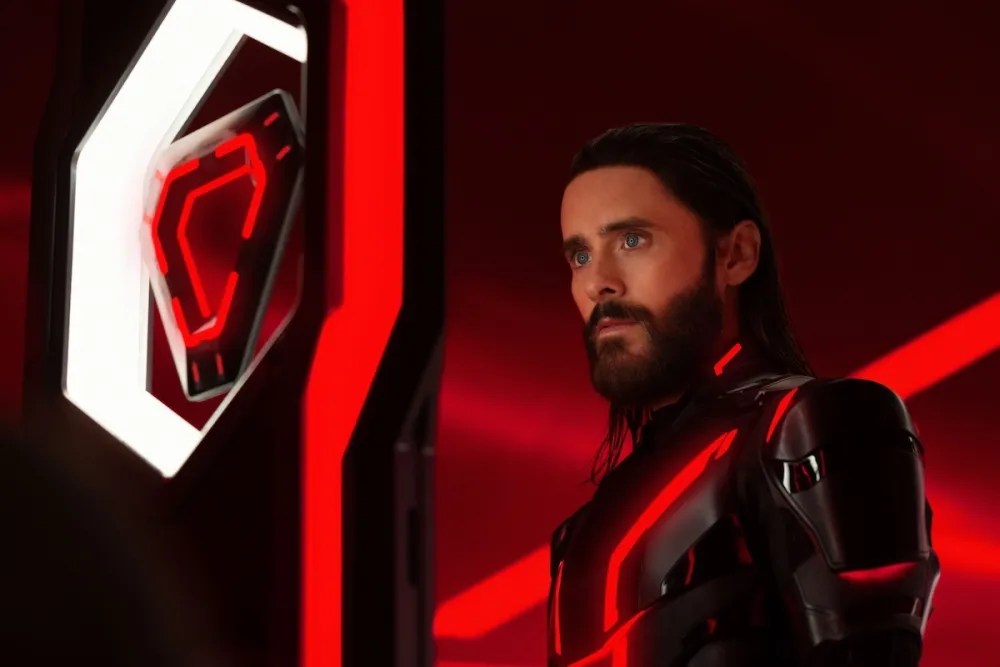
TRON: Ares follows an advanced program called Ares (Jared Leto, Dallas Buyer’s Club) created by tech mogul Julian Dillinger (Evan Peters, X-Men: Days of Future Past, Mare of Easttown), who sends him from the digital world into reality. The only problem? He can only remain in the real world without breaking down. Determined to weaponize A.I., Julian seeks a mysterious “permanence code” that allows digital beings to exist indefinitely in the real world — a discovery secretly made by ENCOM’s CEO, Eve Kim (Greta Lee, Past Lives), continuing her late sister’s work. When Ares and fellow program Athena (Jodie Turner-Smith) are dispatched to retrieve the code, Ares begins to question his purpose after encountering Eve’s compassion. As Julian’s obsession spirals into violence, Eve and her allies fight to free Ares and stop him from weaponizing the code. Torn between his creator’s orders and his growing self-awareness, Ares must decide whether to obey or rebel as the line between human and program dissolves.

Advertisement

I was initially unhappy with the choice of Joachim Rønning to direct, having been less than entertained by the dreadful Pirates of the Caribbean: Dead Men Tell No Tales, but last year’s Young Woman and the Sea really turned me around and made me hopeful. Rønning has a strong handle on the eye-popping visual style of the TRON films, and proves himself to be a highly capable action director. The emphasis on action, embracing the silliness and giving us a streamlined plot with an easy-to-compute McGuffin makes TRON: Ares far more enjoyable as an eye candy blockbuster than I was expecting it to be. That’s not to say that it’s a great film, or a great story, but this time around, there’s an unmistakable Terminator influence that I found to  be quite energizing, and the pacing is much more swift than we’ve come to expect from the franchise. Visually, the movie really delivers, but there’s an audible reason for concern: the whole thing is way too damn loud. While it may be a critically incorrect hot take, I don’t love the way Trent Reznor and Atticus Ross have become the go-to composers for everything, as I find their music to be repetitive and gimmicky much of the time. But while I’m more fond of Daft Punk‘s score for Legacy, the Nine Inch Nails soundtrack is cool and fun, and it gets the job done, but there are far too many times when the whole theater is shaking from the base, and the dialogue is drowned out (not that the dialogue is ever that important). Between the noise level and the constant flashing lights, this is going to one mighty migraine maker of a movie for many.

As a general rule, Leto’s presence in a movie tends to be a big incentive for me to stay away, but despite looking like Turning Point USA’s version of Jesus Christ doing a commercial for Gorilla Snot hair gel, he’s actually quite well suited for the role. The “what is the thinking about?” feeling of detachment and slightly glazed look in his eyes is perfect for a computer program, and he really nails the lighter moments. It’s great to see Lee starring in a major blockbuster, though this movie certainly doesn’t give any hint of the kind of raw brilliance she’s capable of as an actress. Peters is a charismatic actor who is so skilled that he can get hammy without being insufferable even in a Ryan Murphy series, and his take on Julian Dillinger is young corporate corporate baddie who is basically a Lex Luthor who’s not nearly as fun as Nicholas Hoult’s but miles above Jesse Eisenberg’s nauseating version.

It would be overstating to call TRON: Ares a good film, but it’s a helluva fun TRON movie!  If you’re not already attached to the franchise, you truly have no reason to be seeing this one at all. It’s nothing more and nothing less than a hyperactive, hyperstylized and self aware treat for those who grew up on the original. While it’s not going to make best of the year list by a longshot, I’ll most certainly end up owning a digital copy. —Patrick Gibbs

Read more film reviews by Patrick Gibbs:
Film Review: Roofman
Film Review: A House of Dynamite

Advertisement
Continue Reading
Click to comment

Leave a Reply

Your email address will not be published. Required fields are marked *

This site uses Akismet to reduce spam. Learn how your comment data is processed.

Movie Reviews

‘Balaramana Dinagalu’ review: A restrained look at the gangster mind

Published

on

‘Balaramana Dinagalu’ review: A restrained look at the gangster mind

In K M Chaitanya’s Aa Dinagalu (2007), actor Atul Kulkarni, playing gangster Agni Sreedhar, says man is the biggest weapon in the underworld. “The rest are just properties,” he adds. The yesteryear Kannada crime drama, based on the real incidents from a big chapter of the Bengaluru underworld, stood out for its understated storytelling.

In Balaramana Dinagalu, which has the skeleton of a sequel to Aa Dinagalu, weapons are seen in the first scene. As the film progresses, we encounter an arsenal of knives, razors, machetes, and guns — each an extension of the gangsters’ identities and an indispensable tool in their quest to remain feared and lethal. Chaitanya attempts to make the movie a mix of reality and entertaining tropes.

Balaramana Dinagalu (Kannada)

Director: K M Chaitanya

Cast: Vinod Prabhakar, Priya Anand, Atul Kulkarni, Ashish Vidyarthi, Ramesh Indira

Runtime: 151 minutes

Advertisement

Storyline: Balarama, an ordinary young man from a remote village in Karnataka, becomes a dreaded gangster who rules Bengaluru

The director has roped in the same cast, who played the dreaded gangster trio of Kotwal Ramachandra (essayed by Sharath Lohitashwa), Jayaraj (Ashish Vidyarthi), and Agni Sreedhar (Atul) in Aa Dinagalu. That’s what makes one instantly curious about Balaramana Dinagalu. The only difference in the latest movie from the previous one is the fictionalised names of the real dons. Jayaraj becomes Jayaram, Sreedhar is Shashidhar, and Muthappa Rai is called Monnappa Rai (played by Ramesh Indira).

Even if these characters are the big draw in the movie, the plot revolves around the journey of Balarama, a character with a small yet significant presence in Aa Dinagalu. Vinod Prabhakar’s portrayal of the titular role is the film’s biggest takeaway. He makes us feel for the character, and is quite impressive in the final portions of the movie, where Balarama struggles to break free from the underworld’s trap.

Balaramana Dinagalu is impressive when it reflects the psychology of a gangster. Jayaram is shown helping the needy while Balarama urges young boys to focus on education. It’s as if these men who commit heinous acts, have a heart as well. Shashidhar is often called “intellectual gangster”, as the film reflects how the underworld fears well-read men in the field. Politicians and policemen, the supposedly the protectors of people being part of the crime nexus, strengthen the movie’s world-building.

The film falters in its inability to rise above the plot’s predictability. Balarama’s journey is no different from the often-seen life of an innocent man from a small town who becomes a gangster owing to uncontrollable circumstances. I wish the film had delved a bit more into Balaram’s personality. Why does he not resist becoming a gangster? What dreams did he have when he moved to Bengaluru from a small town?

Advertisement

“My hands speak louder than my words,” says Balarama. This signals that he is someone who settles conflicts with fists rather than conversations. Despite this detail, Balaram’s entry into the underworld feels too sudden. The predictability strips the sheen away from the well-shot action sequences, as the result of every fight is known beforehand.

Chaitanya is careful not to glorify the act of violence. He wants to portray the negative effects of violence on the children in a family, as the movie ends with a hard-hitting frame. It’s impressive that the actor-director duo has delivered a non-hero-worshipping gangster saga.

That said, the movie could have benefited from a couple of gripping episodes. While it’s important not to romanticise the life of a gangster, there is no harm in delivering moments of peak tension, the biggest plus of the genre. 

The assassination of Jayaram, the impact of Kotwal’s elimination on the underworld, or the Sakleshpura incident involving Monnappa Rai, had the potential to offer edge-of-the-seat, high-stakes portions, but they are rushed. The love story is simple, but it lacks emotional intensity between the lead couple. Santhosh Narayanan’s dance numbers are forgettable (despite it being his forte) while his montage melodies are beautiful.

Balaramana Dinagalu adopts a restrained, almost clinical approach to the gangster genre. While that keeps it from glorifying violence, it also leaves the narrative feeling a touch too neat and emotionally muted.

Advertisement

Balaramana Dinagalu is currently running in theatres

Published – June 28, 2026 07:58 pm IST

Continue Reading

Movie Reviews

A New Dawn Anime Film Review

Published

on

A New Dawn Anime Film Review

Perhaps there’s a certain irony in a story about a fireworks factory mostly keeping away from explosive drama. Yoshitoshi Shinomiya‘s lowkey feature directorial debut A New Dawn is at the very least visually captivating, comprised of lush and rather hypnotic production design. The story is small scale focusing on a trio of friends who try to save a fireworks factory in their hometown, but the imagery feels expansive and lush. A New Dawn begins with a beautiful and vaguely familiar display of this beauty: the flowing, painterly imagery of its opening sequence recalls Shinomiya’s work on the flashback sequence in Makoto Shinkai‘s your name., immediately showing that the film’s visuals might transcend its small town drama.

A background artist himself on films by Makoto Shinkai as well as the similarly resplendent Pompo: The Cinéphile, it makes sense that this history would be felt in the background works of A New Dawn. They’re dense with detail, rich with almost luminous color and illustrative texture. Shinomiya, who also wrote and storyboarded the film, veers away from the photorealism associated with someone like Shinkai through some impressionist touches – like the splotches of green paint which represent treelines – which sometimes turns into outright abstraction like when a character begins to run through the space. Sometimes there are swaying, morphing textures in the background as splotches of paint subtly shift around. On a more intimate level, the cluttered and characterful interior spaces tell a story too. This is a long-winded way of saying A New Dawn looks really, really good.

It’s not just in the tableaux of its countryside habitats and ramshackle living spaces carved out of abandoned warehouses, but there’s a sense of invention permeating through A New Dawn‘s various experiments with visual languages of animation. The most prominent is an incredibly charming stop motion animated sequence using a cardboard diorama and real human hands invading the shot in a creative reflection of a drunken character’s perspective. Even though it broadly still looks “anime” through its character design, there are also smaller details which work to set A New Dawn apart from its contemporaries, touches like its occasional lineless artwork or the way rain is defined through smudged black brushstrokes.

It’s in the screenwriting where A New Dawn begins to feel more run of the mill. Its story about the constant chasing of the majesty of a fabled firework “Shuhari” feels both familiar in its premise but also a little bit alienating in its structure. The importance of the firework itself never feels clear – the moment its mystery is unravelled hardly feels like a revelation as a result, something amplified by how the writing often obfuscates what anyone is talking about. The whole story feels a little distancing, and despite the allure of the background art and design of the spaces the characters inhabit, the people themselves feel constantly at arms length.

It almost pulls things back with its climax – the detonation of the “Shuhari” goes a long way in justifying the circular conversations about its nature and origins – a painted streak of light launches into the sky before turning into something otherworldly, suddenly tripling down on the film’s captivating exaggerations.

Advertisement
Continue Reading

Movie Reviews

Hollywood Pariah Kevin Spacey Opens in a Straight to Video Movie with 25 Producers, 1 Review, No Theaters, No Press – Showbiz411

Published

on

Hollywood Pariah Kevin Spacey Opens in a Straight to Video Movie with 25 Producers, 1 Review, No Theaters, No Press – Showbiz411
★ Make Showbiz411 your Preferred Source on Google

As we know, Kevin Spacey is a pariah in Hollywood.

He’s in a rare club with Mel Gibson, Armie Hammer, Nate Parker, Jonathan Majors, and James Franco.

Spacey has managed to avoid jail time by reaching settlements with various accusers of sexual malfeasance, all men.

His film career — which included two Oscars and a Tony Award — has been destroyed.

Advertisement

Spacey has been reduced to appearing in straight to video films, made for whatever reason the various producers involved know only to themselves.

On Friday, a new Spacey movie surfaced against its will, but not in theaters. It also went straight to video. “1780” is a period piece set during the Revolutionary War. Spacey plays a toothless Pennsylvania country trapper.

There is no rating on Rotten Tomatoes, largely because there is only one review. The review by Alan Ng of Film Threat is positive. Ng recently reviewed “World War Bigfoot,” which he also liked. He seems to specialize in reviewing films no one has heard of.

“1780” does boast 25 producers who will probably not see a return on their investment. But they can say they made a movie with Kevin Spacey.

Advertisement

Donate to Showbiz411.com

Showbiz411 is now in its 13th year of providing breaking and exclusive entertainment news. This is an independent site, unlike the many Hollywood trades that are owned by one company. To continue providing news that takes a fresh look at what’s going on in movies, music, theater, etc, advertising is our basis. Reader donations would be greatly appreciated, too. They are just another facet of keeping fact based journalism alive.
Thank you

Continue Reading
Advertisement

Trending
