Connect with us

Movie Reviews

Film Review: “Leviticus”

Published

on

Film Review: “Leviticus”

Hello, dear reader! Do you like what you read here at Omnivorous? Do you like reading fun but insightful takes on all things pop culture? Do you like supporting indie writers? If so, then please consider becoming a subscriber and get the newsletter delivered straight to your inbox. There are a number of paid options, but you can also sign up for free! Every little bit helps. Thanks for reading and now, on with the show!

Warning: Full spoilers for the film follow.

I think it’s safe to say that horror is having a bit of a moment. Of course, horror is one of those genres that can always be counted on to be financially profitable, both because it often requires less money and because it’s so effective at tapping into the anxieties, fears, and desires of a particular cultural moment. I’ve loved almost every horror movie I’ve seen this year but, even in a year known for its strong offerings, Adrian Chiarella’s Leviticus is something special. I knew going in that it was going to be one of those films that got into my mind and under my skin. I’ve been on a long and winding journey back to Christianity over the past year or so, and so the issue of faith and queerness has been much on my mind. This film crawled into my mind and my soul, latched its hooks in me, and hasn’t let me go since.

The film begins with an amorous encounter between teens Naim (Joe Bird) and Ryan (Stacy Clausen), and at first it seems the two of them have found a connection they both clearly need. However, when Naim discovers Ryan kissing their pastor’s son, Hunter (Jeremy Blewitt) and tells the pastor what’s happened, things take a sinister turn. Ryan and Hunter undergo a terrifying encounter with a healer, who curses them to be haunted, tormented and, in Hunter’s case, killed by the thing they desire most. Unfortunately for Naim, his mother Arlena (Mia Wasikowska), soon hands him over to the healer, and it’s not long before he’s set on a terrifying course with his beloved Ryan.

Both Joe Bird and Stacy Clausen are phenomenal in this film, with each bringing something unique to the table. Bird perfectly captures Naim’s adolescent angst, as well as his sense of alienation and yearning for something more, some human connection that neither his mother nor their devout religious community can provide. He finds it unexpectedly in Clausen’s Ryan, and the two actors have palpable chemistry. And yet, all the while, Naim is also haunted by his resentment of Ryan and the fact that his own actions were what brought about their harrowing.

Advertisement

For his part, Clausen captures the nuances of a very complicated figure. Ryan is a rougher type than Naim, or at least it seems at first, but as the film goes on he shows a deep well of sensitivity and kindness. Like Naim, he yearns for queer connection. Clausen also superbly captures the menace and danger of Ryan’s doppelganger, even his silent movements conveying a sense of murderous menace. It’s not every actor who could play both characters with equal depth, but Clausen is more than up to the task, his wounded angelic beauty lending even his more terrifying moments an erotic charge.

Though there are moments of gore–including a disturbing moment in which we see Hunter’s head in a field–for the most part Leviticus relies on slowly spreading dread and suspense as the spectral Ryan torments and pursues Naim relentlessly any time he’s alone. Jed Kurzel’s score is also haunting and potent, with an ever-present thrumming that settles into your bones. Combined with the frequent shots of the heavily industrialized area in which these boys live–as well as the eerily intense church scenes–this score keeps us on the edge of our seats, waiting to see what new horror is going to unfold.

Indeed, there’s something particularly deeply unsettling about the premise of being tormented and, in Hunter’s case, literally killed by a demon that takes the form of your innermost desire. From a certain perverse Christian point of view this is exactly what queer desire itself is, so it makes sense that a “healer” like the one we see in this film–or, for that matter, Hunter’s family–would resort to such a desperate attempt to “save” these boys from themselves. The whole ordeal is made all the more upsetting because the being isn’t content to just torment you: as both Hunter’s death and that of the young woman who dies at the beginning of the film reveal, it wants you to suffer. Naim’s own encounter with the demon late in the film is especially disturbing, particularly once the creature tries to literally tear his throat out from the inside.

While the portions with the demon are obviously harrowing and heartbreaking, for me the most traumatic and insidious moment is the one in which Arlene admits she knew from the get-go that the “exorcism” would have terrible and lasting consequences, that Naim would have to live the rest of his life in fear. It’s a moment that’s stunning–devastating, really–for both Naim and those of us in the audience–because it reveals the extent to which Arlene’s own terror of the unknown has poisoned her relationship with her son. It’s also one of those moments that cuts to the bone precisely because it matches so neatly with so many lived experience; there are a distressing number of “Christian” parents who would rather see their children destroyed, both emotionally and physically, rather than have them be their true, God-given selves.

And yet, despite the terror and the horror and the betrayals, there are moments of genuine beauty and affection and erotic connection. The scene in which Ryan admits he wouldn’t want to be haunted by anyone other than Naim is genuinely affecting, and their shared erotic encounter on a bus is also beautifully staged. Somehow, these two young men manage to find an island of calm and love amid all the fear and dread and violence. To be sure, though, these moments are always tinged with terror. While I was watching the scene on the bus I still felt nervous, terrified lest they be discovered and unsettled by the fact that it was precisely this desire that was poised to seal both of their dooms. The film thus powerfully evokes the sinister effects of internalized homophobia, the way that a noxious religious ideology can crawl into your brain and make you fear yourself, your desires, your love, and the person who you feel the greatest connection to. In some terrible ways, the film suggests that the most damaging aspect of this haunting isn’t the violence itself; it’s the sundering of the self.

Advertisement

It would’ve been easy–and, for some no doubt, very satisfying–for the film to conclude with Naim and Ryan defeating their demonic tormentor and riding off into the sunset to have a happy gay life in the big city. However, Leviticus is a far cannier and subtler film than that, and it is smart enough to realize that such an ending would feel cheap and unearned and, more to the point, that it would rob the film of its essential power. By leaving the ending tinged with melancholy and ambiguity, the film suggests that our heroes will be haunted by their ordeal and that there is no easy happy ending in a world in which such homophobia is still very real and very present. (As a brief side note, it’s very satisfying to see Arlene frantically searching for Naim after he abandons her. One can but hope that the rest of her life is spent in misery as she reckons with her loneliness and her complicity in her son’s torment).

However, there is still hope in the conclusion, and it’s fitting that the last we see of Naim and Ryan is the two of them with their heads together, sharing a set of headphones. Queer life is difficult, sometimes, and there is always another hill to climb, another battle to be won. We’re led to hope, though, that these two troubled young men will manage to find their own form of peace and love and happiness, both with one another and with the queer community they’ll one day find.

Continue Reading
Click to comment

Leave a Reply

Your email address will not be published. Required fields are marked *

This site uses Akismet to reduce spam. Learn how your comment data is processed.

Movie Reviews

Stephen King shares his two-line review of 2026’s breakout horror movie

Published

on

Stephen King shares his two-line review of 2026’s breakout horror movie

The King of Horror has given his stamp of approval to Obsession, this year’s breakout hit horror movie.

Stephen King, the prolific author of best-selling horror novels including It, Carrie and The Shining, applauded the May release Tuesday in a two-line review on Threads.

“I gave OBSESSION a B+ in my movie book, but I keep thinking about it,” King, 78, wrote of YouTuber Curry Barker’s directorial feature film debut. “That weird mixture of humor and horror.”

Obsession — which follows the dangerous consequences of a hopeless romantic’s (Michael Johnston) naive wish for his crush (Inde Navarrette) to love him back — has been a massive box-office success, grossing over $297 milion worldwide off a micro-budget of approximately $750,000 to $1 million.

It has earned major plaudits from critics and a 94 percent score on the popular review aggregator Rotten Tomatoes.

Advertisement
'Obsession,' from 26-year-old YouTuber Curry Barker, has quickly become an unexpected critical and box office success
‘Obsession,’ from 26-year-old YouTuber Curry Barker, has quickly become an unexpected critical and box office success (Focus Features)

In her four-star review, The Independent’s Clarrisse Loughrey labeled Obsession “one of the creepiest horror movies of 2026.”

The new sensation marks 26-year-old Barker’s first feature film. He previously directed the 2024 found-footage, prank-themed horror Milk & Serial, which he shot for $800 and uploaded directly to YouTube.

Obsession’s theatrical release coincided with that of fellow YouTuber Cane Parson’s directorial debut, Backrooms, a horror film adapted from his popular YouTube series about liminal spaces. The movie has similarly taken the box office by storm.

The success of both projects signals a fresh direction for the genre, leading Loughrey to declare that “the future of horror is on YouTube.”

Stephen King hailed the film's 'weird mixture of humor and horror'
Stephen King hailed the film’s ‘weird mixture of humor and horror’ (Getty)

“Gone is any feeling of Gothic tenderness, of the misunderstood going bump in the night. Here, the generation exposed to what feels like only the very worst of the world has responded in kind, with horror in which punishment is swift, nasty, and arguably well deserved,” she added. “Obsession is delicately handled work, unafraid to find pockets of humor.”

Meanwhile, King, who often shares his opinion about TV and film online, recently directed his followers’ attention to Apple TV+’s new dark comedy, Maximum Pleasure Guaranteed.

Starring Tatiana Maslany as Paula, a newly divorced mom who becomes convinced she witnessed a crime, the show centers on her spiral into a rabbit hole of blackmail, murder and youth soccer.

Advertisement

Comparing it to the streamer’s Matthew Rhys-led comedy horror series Widow’s Bay, King argued that it was “even better.”

“It’s like Hitchcock came back to do it one more time,” The Long Walk author said on X. “And Tatiana Maslany is so good. The play of emotions on her face is pretty incredible. She goes from comic to terror in an instant.”

Last September, he also revealed his list of 10 favorite films of all time, which consisted of Sorcerer (1977), Godfather 2 (1974), The Getaway (1972), Groundhog Day (1993), Casablanca (1942), The Treasure of the Sierra Madre (1948), Jaws (1975), Mean Streets (1973), Close Encounters of the Third Kind (1977) and Double Indemnity (1944).

Continue Reading

Movie Reviews

Film reviews: ‘Toy Story 5’ and ‘The Death of Robin Hood’

Published

on

Film reviews: ‘Toy Story 5’ and ‘The Death of Robin Hood’

‘Toy Story 5’

Continue Reading

Movie Reviews

‘Bob and David Climb Machu Picchu’ Tribeca 2026 Review: A Travelogue of Old Friends, Older Knees, and Same Absurd Timing

Published

on

‘Bob and David Climb Machu Picchu’ Tribeca 2026 Review: A Travelogue of Old Friends, Older Knees, and Same Absurd Timing

The first thing we see in “Bob and David Climb Machu Picchu” is Bob Odenkirk and David Cross facing each other inside a tent, freezing, exhausted, and quiet in the way only old friends can be quiet. They don’t need to say the obvious. Even without a single word spoken, we can see their faces already asking it: what on earth did we get ourselves into?

That’s a good way into this tender documentary, because Michael LaHaie‘s film isn’t just about two famous comedians going on a difficult hike. The hike actually is the excuse, and a pretty good one at that. What we’re really watching is the kind of friendship that survives time, distance, professional detours, old irritations, and the body’s increasingly rude reminders that “getting older” isn’t just a phrase people say on birthdays.

David Cross reads a letter in a scene from “Bob and David Climb Machu Picchu” (Photo: Tribeca Festival, 2026).

Focus on the Journey, Not the Punchline

The premise is simple. Cross wants to climb Machu Picchu. Odenkirk says yes, partly because he’s game and partly because a recent heart attack has made the bucket list feel less hypothetical. So off they go to Peru, where the Andean scenery is gorgeous, the trail is punishing, and the two men remain funny enough to make shortness of breath sound like a sketch premise.

There’s a long tradition of famous people traveling somewhere beautiful, physically exerting themselves, and landing on gentle reflections about life. Some versions have done it better, slicker, or with more formal ambition. Michael Winterbottom‘s “Trip” films (starring Rob Brydon and Steve Coogan) turned meals and impressions into a running autopsy of male ego and middle age. Meanwhile, the Ewan McGregorCharley Boorman series “Long Way Round” found camaraderie and self-discovery on the road. Even the lesser celebrity travelogues tend to lean on the same basic appeal: put recognizable people somewhere unfamiliar, wait for the guards to drop, and hope that scenery plus discomfort produces something honest.

“Bob and David Climb Machu Picchu” doesn’t pretend to reinvent that setup. It’s too ragged for that, and sometimes too casual. But that looseness is also part of its charm. LaHaie doesn’t over-direct the trip into importance. He lets Odenkirk and Cross walk, complain, riff, reminisce, eat, sweat, and occasionally look around long enough to remember they’re doing something ridiculous and beautiful at the same time.

Advertisement

The comedy isn’t always polished, which is probably for the best. Some bits land because they’re sharply timed; others work because they’re stupid in the way a joke between friends is allowed to be stupid. A scene in which they sit at a small table in a Peruvian town square and wait to be recognized is funny not only because of the awkwardness, but because it gently punctures their celebrity. When recognition comes, it mostly belongs to Odenkirk’s “Breaking Bad” and “Better Call Saul” fame, which Cross absorbs with the wounded dignity of a man who’s spent decades being very funny and still has to watch his friend get all the Saul Goodman heat.

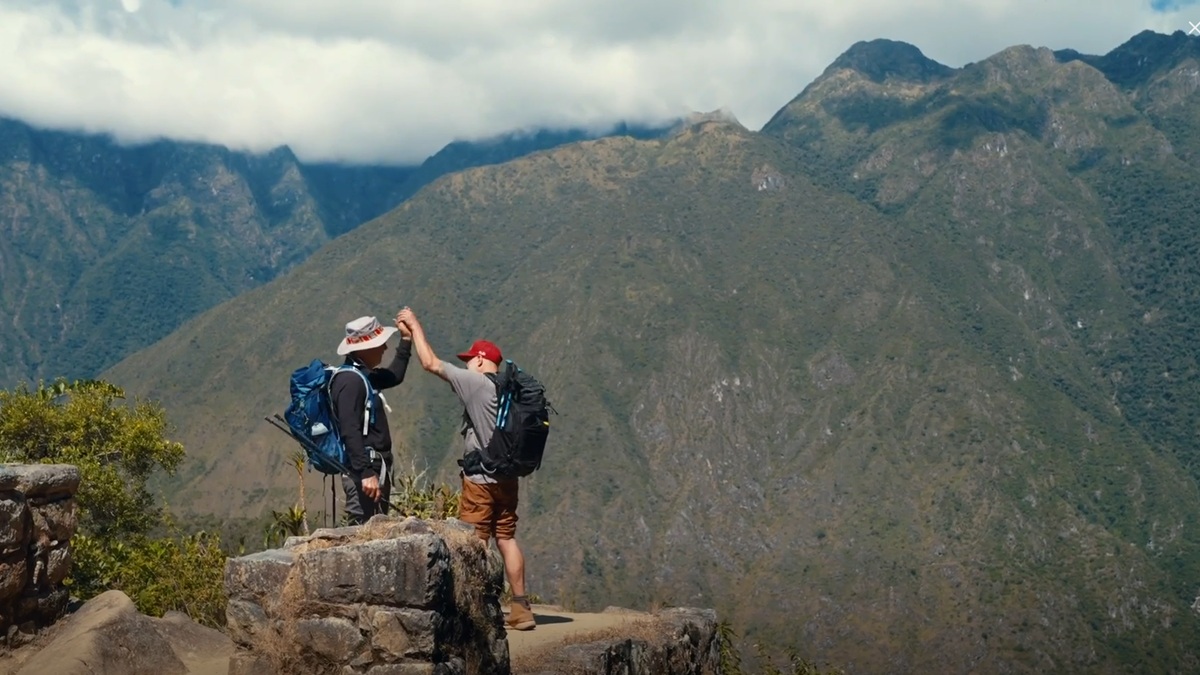
Bob and David successfully complete their hike.
Bob and David complete the hike, in a scene from “Bob and David Climb Machu Picchu” (Photo: Tribeca Festival, 2026).

Old Friends and Older Knees

I have a tightly knit group of male friends who, for reasons both sentimental and mildly embarrassing, call ourselves The Roadtrippers. Every so often, we get together for dinner, a short drive, or—just recently—a trip over a thousand miles away from home to feel like a small act of devotion. Nobody says it that way, of course. Men rarely do. We just show up every time, eat too much, talk nonsense, geek about random things, and pretend the friendship maintains itself. Watching Bob and David wheeze their way through a bucket-list hike, I kept thinking about that unspoken vow.

Keep going. Keep checking in. And keep making memories before the body starts filing formal complaints.

That’s why the film becomes more affecting than its goofy surface suggests. Odenkirk and Cross aren’t selling us a grand thesis about male friendship; they’re simply showing one. Their bond has the friction of people who know each other too well and the ease of people who don’t have to explain the rhythm anymore. They can insult each other, admire each other, poke at old career disappointments, then pivot into absurdity before anything gets too damp with feeling.

That tenderness hit home with me because I know, in my own way, what it means to keep choosing the same friends across time.

More Tribeca Coverage: ‘That Friend’ is a Chaotic Buddy Comedy About the Friend You Can’t Quite Outgrow

Advertisement
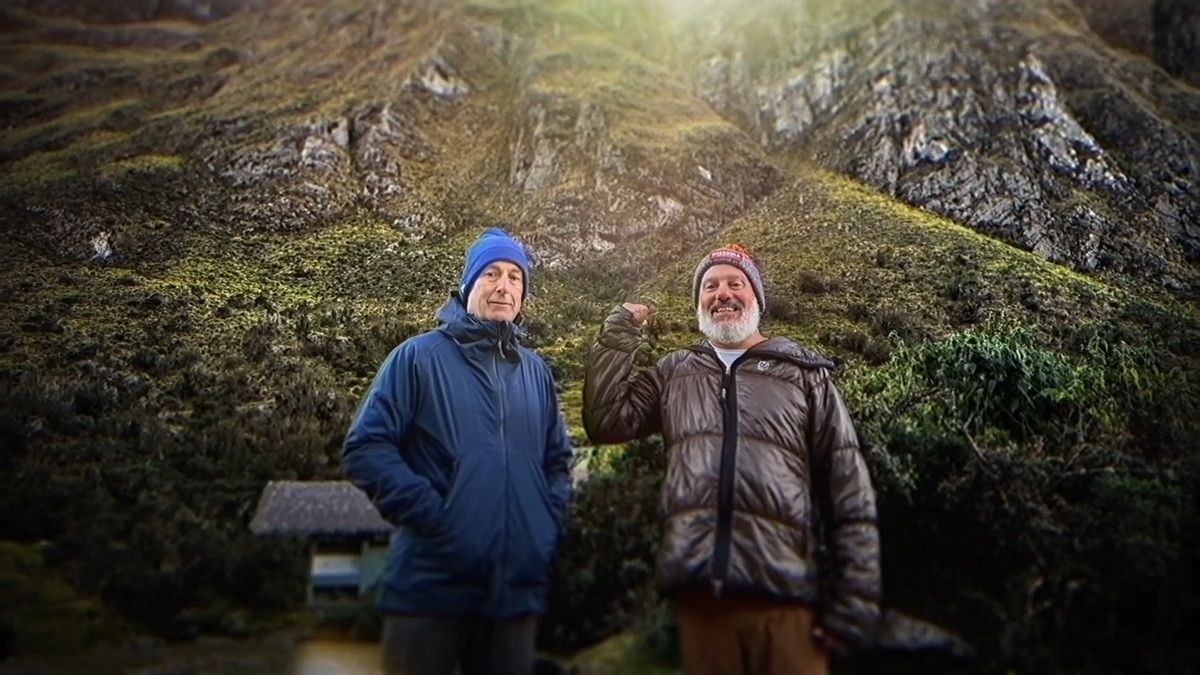
Photo of Bob and David upon completing the hike to the Machu Picchu.
Photo of Bob and David upon completing the hike, in a scene from “Bob and David Climb Machu Picchu” (Photo: Tribeca Festival, 2026).

‘Bob and David Climb Machu Picchu’, and the Joke Between the Breaths

The film works best when comedy opens into reflection without announcing the shift. Odenkirk’s heart attack isn’t treated as the dramatic centerpiece, but it’s always somewhere nearby, especially when the climb starts to feel less like a lark and more like a dare issued to mortality. Cross comes across as both instigator and witness: the friend who proposed the insane thing and now has to keep walking beside the man who agreed to it.

LaHaie keeps the film moving at an amiable pace, and the editing understands that the best travel moments aren’t always the scenic payoffs. They’re the half-formed jokes, the bad meals, the language gaps, the tired silences, and the private laughter that would sound idiotic if explained to anyone else. Yo La Tengo’s music adds to that easygoing mood without trying to turn the hike into a spiritual awakening with better footwear. That both Odenkirk and Cross starred in the band’s music video for the 1997 song “Sugarcube” is extra nostalgic. 

Michael LaHaie’s funny, ragged, unexpectedly tender documentary follows Bob Odenkirk and David Cross up a mountain and into a reflection on friendship, mortality, and staying in sync.

The documentary, of course, has limits. It’s slim, and some of the career material plays more like an affectionate scrapbook than a deeper reckoning. Fans of “Mr. Show” may want more, while newcomers may only get a partial sense of why this partnership mattered so much to a particular corner of American comedy. A few stretches also have the relaxed shapelessness of a vacation video, though admittedly one starring two extremely funny men with better cameras and worse altitude tolerance.

But I didn’t mind the looseness much, because the pleasure is in the company. Odenkirk and Cross are still magnificently in sync, even when they’re wheezing, bickering, or making the kind of joke that exists mainly because the other person is there to receive it. “Bob and David Climb Machu Picchu” is simple, funny, occasionally moving, and blessedly unpretentious. It understands that some friendships don’t need a dramatic breakthrough. Sometimes they just need a trail, a tent, a stupid bit that runs too long, and enough breath left to laugh before the next climb.

'Bob and David Climb Machu Picchu' has a rating of B+ from The Movie Buff staff

Michael LaHaie’s “Bob and David Climb Machu Picchu” had its world premiere at this year’s Tribeca Festival in the Spotlight Documentary category. The festival took place on June 3-14, 2026. Follow us for more coverage.

Continue Reading
Advertisement

Trending