Entertainment
Like his character Isaac in 'Ghosts,' Brandon Scott Jones is multidimensional

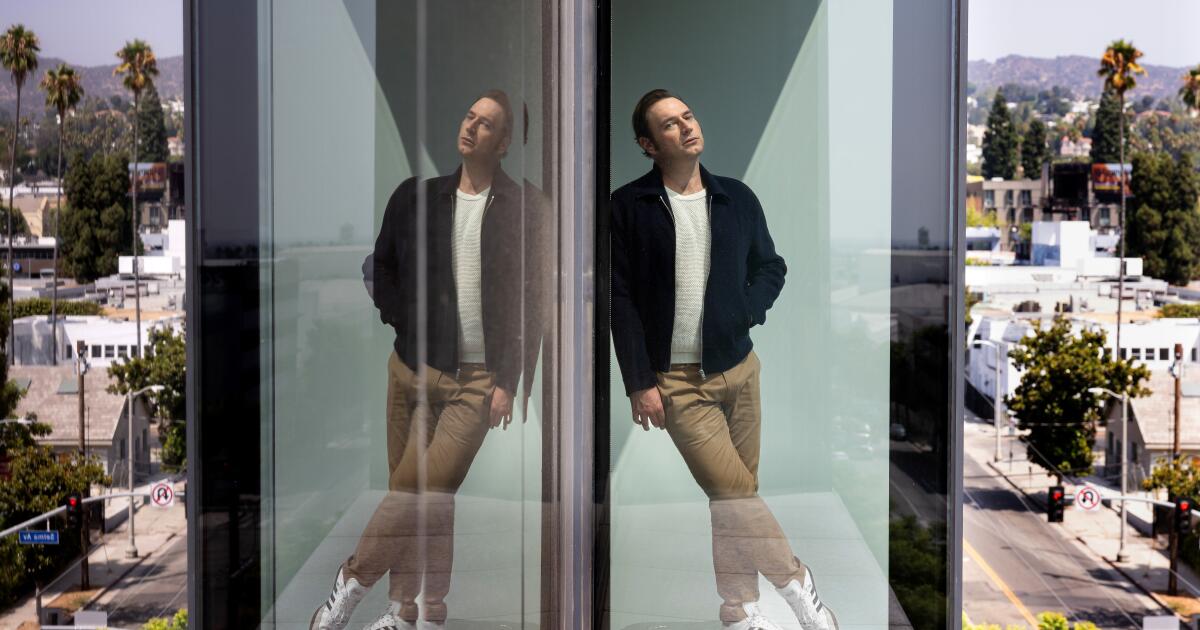
When Brandon Scott Jones was in seventh grade, his mother bought him a copy of “The Elements of Screenwriting.”
Spurred by his interest in actors Matt Damon and Ben Affleck, whose turn to writing resulted in the Oscar-winning screenplay “Good Will Hunting,” Jones says he had “one goal, which was to write a part for myself in something, whatever it was.”
Unfortunately, Jones’ first attempt at screenwriting didn’t include the same kind of realism and lived experiences as Damon and Affleck’s story of a South Boston janitor who also happens to be a math prodigy.
“It was about a pornography director and it was called ‘Whatever Happened to Darren Potter?’” Jones says, laughing during an interview this summer over smoothies at the Silver Lake Erewhon.
His interest in writing came about because he’d broken away from the rest of the family during an outing to the multiplex for a repeat viewing of “Titanic” and snuck into a screening of “Good Will Hunting” instead. Then, when they went back to see “Titanic” again, he left and caught a snippet of Paul Thomas Anderson’s porn-industry drama “Boogie Nights.”
“This was an impressionable time where you were [at an age when you were] taking things in, so I wrote this screenplay about this prodigy actor — like ‘Good Will Hunting’ — and this pornography director,” Jones says. “There was no sex or anything like that. It was just that they were both trying to claw their way back to the top of the game.”
Jones had an early interest in writing and performing, but comedy versus drama turned out to be his strong suit.
(Christina House / Los Angeles Times)
This script, and other early material, were written on the typewriter Jones was given for Christmas when he was in fourth grade. He carried them in a briefcase. In eighth grade, the kid who sat next to him in math class would give him notes.
“Darren Potter” was, sadly, never produced (although Jones thinks he still has a copy of it somewhere in case anyone reading this is interested in setting up a meeting). Instead, his attempt at writing dramas has been parlayed into a career that utilizes something Jones has more familiarity with: self-deprecating humor.
Jones, a graduate of New York Conservatory for Dramatic Arts, got his start at Upright Citizens Brigade, where he was in the main cast of “Asssscat,” one of the improv house’s signature shows. He was then cast in Michael Schur’s NBC philosophical comedy “The Good Place,” winning critical praise for playing a Perez Hilton-like gossip blogger named John Wheaton. And in his film roles, he’s made meals out of small parts in “Renfield,” “Isn’t It Romantic?” and “Senior Year,” co-writing the latter, about a high school cheerleader who wakes up from a coma after two decades and becomes obsessed with returning to finish her senior year and reclaiming her popularity.
He achieved Notable Character Actor status when he was cast as Curtis, a struggling actor and best friend to Cary (Drew Tarver), in the Comedy Central and Max comedy “The Other Two.” It was a part he got literally at 6:30 a.m. one weekday while playing tennis. His friends, series creators Chris Kelly and Sarah Schneider, called him in a panic because another actor had dropped out of the series and they were about to begin shooting. An hour and a half later, he was on his way to the set. He’d eventually join that show’s writing staff as well.
Then came “Ghosts.” Created by Joe Port and Joe Wiseman and based on the British series of the same name, the CBS comedy falls somewhere between “The Good Place” and Jean-Paul Sartre’s dark existentialist play “No Exit.” As the show’s name suggests, it’s about spirits from different periods of American history who are, for reasons unknown to them, forced to spend eternity on the grounds of what is now a Hudson Valley estate.

In “Ghosts,” Brandon Scott Jones plays Isaac Higgintoot, who died of dysentery during the Revolutionary War.
(Bertrand Calmeau / CBS)
Jones plays Isaac Higgintoot, a member of the American Continental Congress who — appropriately, given his last name — died of dysentery while serving as a captain in the Revolutionary War. Isaac, who always felt like an outsider in life, is now furious that his contemporary Alexander Hamilton has everything from money to a book to a musical commemorating him. Meanwhile, Isaac wants to set the record straight that “I was never at the Boston Tea Party. I was in Boston at a tea party, but it was at my Aunt Geraldine’s house.”
“I think about him being constantly one step to the left of history,” says Jones, theorizing that Isaac could have been at the signing of the Declaration of Independence but probably got there late because he’d spilled something on his shirt. Or that he and his wife, Beatrice (played in flashbacks by Hillary Anne Matthews), were “unsuccessful Machiavellians,” who took it personally when snubbed for a dinner party invitation.
Thus far in the show, Isaac has convinced Sam (Rose McIver), a clairvoyant writer who took over the estate with her husband, Jay (Utkarsh Ambudkar), to write his biography because his Wikipedia page is severely lacking. Jones says that Isaac isn’t any different from one of TV’s more memorable (modern-day) political figures, such as Selina Meyer, the singularly focused politico played by Julia Louis-Dreyfus on HBO’s “Veep.”
“To retroactively want your life to have meant something, or to have been part of something, I think is really so fun and desperate,” Jones says.
Not that the afterlife has been too boring for Isaac. At least not in the last few years.
Each season of “Ghosts” has ended with major developments for Isaac. In the first, he realized that times have changed and it’s OK for him to come out as gay, some 250-odd years after his death. In the second, he gets engaged to Nigel (John Hartman), the ghost of a British soldier Isaac accidentally killed on the battlefield. In the third, he leaves Nigel at the altar and then is sucked into the ground by someone else he’d wronged: the ghost of a Puritan woman named Patience, who is played by Jones’ friend and “Senior Year” co-star Mary Holland.

In the Season 4 premiere of “Ghosts,” Brandon Scott Jones’ Issac faces a Puritan ghost named Patience, played by his friend and “Senior Year” co-star Mary Holland.
(CBS)
And now in Season 4 of “Ghosts,” premiering Thursday, audiences find out what exactly Patience has been plotting and whether any of the other estate’s living or dead inhabitants will even notice that Isaac is missing.
“I think the friendship [between us] helped it in a fun way because she’s such a great character actor and a great actor in general,” Jones says of Holland. “It was fun to be surprised by all the choices that she was making. At one point in the script, her character is described as, ‘unhinged and insane.’ So a lot of what you’re seeing, if I’m acting and I’m being terrified of her, it’s also an underlying level of delight watching my friend, which is really, really nice.”
Port and Wiseman stress that they mean no offense to other members of their extensive cast and that it’s merely a coincidence that each season has ended with a big Isaac storyline. They also say that there has been a conscious effort to not make Isaac’s queerness the defining thing about him or to push him into a flamboyant stereotype.
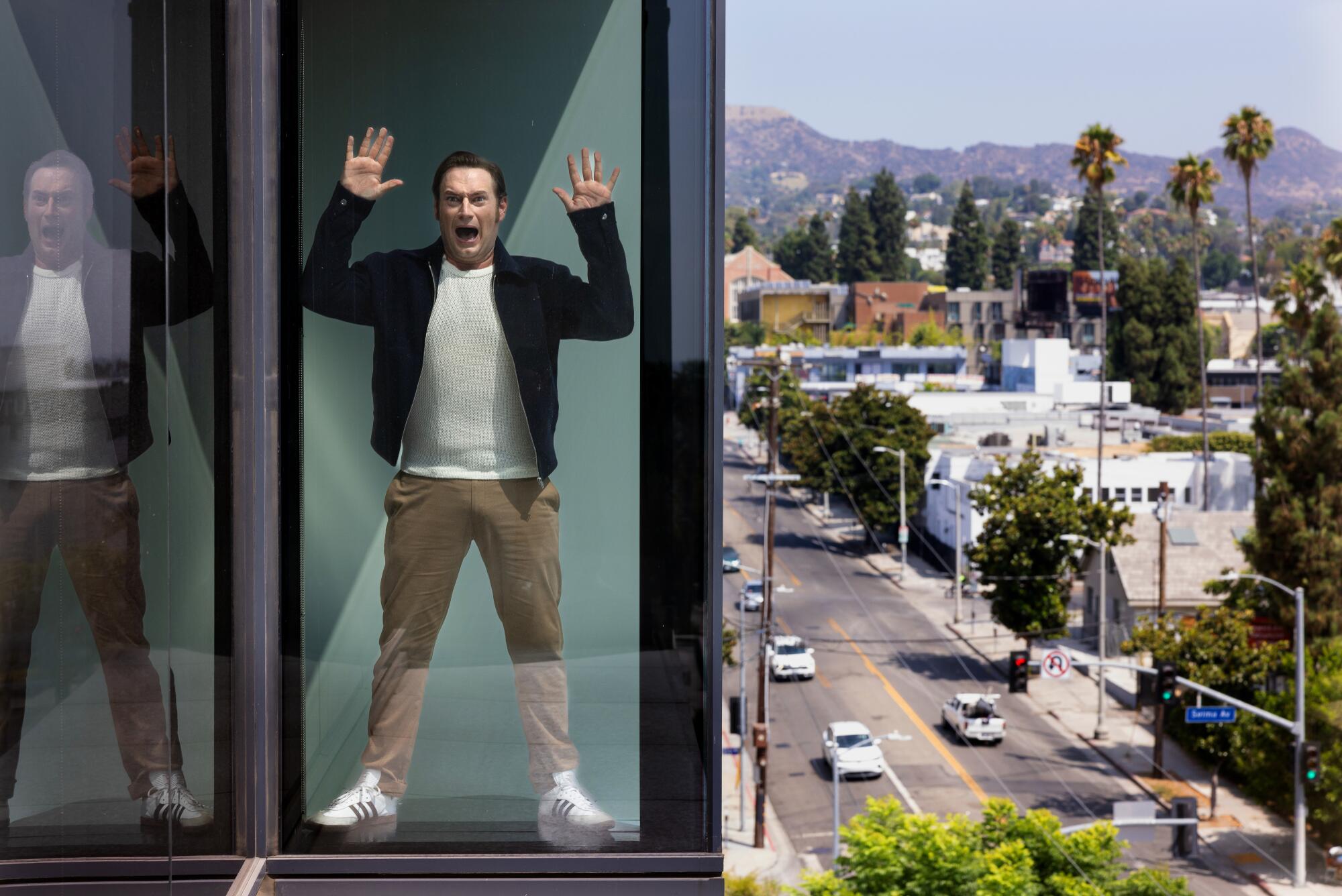
Brandon Scott Jones on playing Isaac Higgintoot in CBS’ “Ghosts”: “I think about him being constantly one step to the left of history.”
(Christina House / Los Angeles Times)
“He’s much more than just that one trait,” says Port. “He’s a military man. He’s a guy from the colonial days. He’s got a bunch of different factors to his character and personality.”
Jones, who is gay, ponders the question when asked if he thinks queer characters should be played only by queer actors.
“My genuine, honest opinion is that the process of playing a character is the process of finding empathy for somebody that you don’t know,” Jones says, noting that he felt a connection to Eric McCormack, a straight actor, and his portrayal of Will, a gay man, on NBC’s “Will & Grace.” “If we’re denying people the chance to kind of step into those shoes, then that’s problematic to me. If a straight person wants to play gay or a gay person wants to play straight, and we feel like we can’t do those things, then, to me, it starts to feel like it’s a snake eating its own tail.”
Modern-day fandom can be intense, so much so that the minuscule details of an actor’s personal life are dissected — a topic that was skewered in “The Other Two.” Jones says he doesn’t like that actors, writers or casting producers could feel “a massive desire to appease a crowd of people instead of just [play] the character.” But he also doesn’t want casting directors to claim that there are no gay actors for these types of roles simply because they’re not looking.
“I just hope that the stories that are being told are being told authentically, whether that means from behind the camera or the writer or anything like that,” says Jones, adding that “there’s also a part of me where I’m like, if somebody wanted me to play a straight character, I would like to think that I could do it.”
This season will see Isaac plunge further into his post-life crisis as he (sometimes literally) loosens his colonial-era ponytail and lets his hair down.
“After a breakup, he’s trying to reinvent himself,” Wiseman says. “He takes his hair down to see if that changes his attitude.” (He says this fits within the rules of “Ghosts,” which doesn’t permit the deceased to change what they’re wearing but does allow them modifications).
And fans will learn more about that biography.
“There’s a part of you that wonders does he just want a book about himself, regardless of how factually correct?” Jones teases.
Maybe Isaac, like the person who plays him, just wants to create a part for himself.






Movie Reviews
‘See You When I See You’ Review: Cooper Raiff Gives a Deeply Felt Lead Turn in a Tragicomedy That’s Sad for the Wrong Reasons

After a 14-year hiatus during which he focused on directing television and acting, Jay Duplass made a welcome return to features in 2025 with The Baltimorons, a gentle May-December romance with an After Hours vibe and an unassuming charm that sneaks up on you like a surprise hug. I wish See You When I See You had a similar effect, but despite its sincerity and the raw pain of shattering real-life experience that infuses it, this feels like a knockoff struck from the template of a thousand bittersweet, funny-sad indie grief dramas branded with the old-school Sundance stamp.
Dysfunctional family whose members seem to have forgotten how to communicate? Check. Belabored metaphor that never adds up to much (in this case a sage grouse at risk of extinction)? Check. Surreally stylized flourishes that are both awkwardly realized and inorganic to the prevailing mood and style? Check. Random nostalgic nods to ‘90s bands? Check. Treasured childhood memory tarnished by soul-crushing trauma? Check. Tinkly piano score poised to underline every emotional beat? Check. The list could go on.
See You When I See You
The Bottom Line Not if I see you first.
Venue: Sundance Film Festival (Premieres)
Cast: Cooper Raiff, Hope Davis, Lucy Boynton, Ariela Barer, Kumail Nanjiani, Poorna Jagannathan, David Duchovny, Kaitlyn Dever
Director: Jay Duplass
Screenwriter: Adam Cayton-Holland, based on his book, Tragedy Plus Time: A Tragi-Comic Memoir
1 hour 42 minutes
All this is a shame since first-time screenwriter Adam Cayton-Holland, adapting his 2018 memoir Tragedy Plus Time, is clearly drawing from a very personal well in depicting with candor the spiraling chaos of a young comedy writer as he struggles to move forward after his beloved younger sister’s suicide. The authenticity of the writer-protagonist’s feelings is undermined by the banal familiarity of a specific indie-film model.
It’s doubly regrettable because Cooper Raiff pours a ton of heart and humor, along with PTSD, into the author’s stand-in, Aaron Whistler. He’s likable and funny, and even when the character is pushing people away like a flailing mess, he never forfeits the audience’s compassion.
Duplass could not have wished for better preparation for material of this nature than his work as producer and director of six episodes — including the pilot — of HBO’s sublime Bridget Everett series Somebody Somewhere. That series started from a similar place, with a central character trying to regain her footing after the shattering loss of a sibling and tending to deflect her sorrow with humor. Every single member of the ensemble felt fully lived-in and relatable, something that can be said for only some of the principal roles here.
It’s been two months since Leah (Kaitlyn Dever) took her own life and her devastated family has still not been able to agree on funeral arrangements — if they are to have one at all. The urn containing her ashes sits conspicuously on the mantlepiece in her parents’ loveless bedroom.
Leah’s mother Page (Hope Davis) has become closed-off and sour, doing her best to ignore her own grave health situation; her husband Robert (David Duchovny) pours himself into his work as a civil rights attorney, avoiding the subject of Leah; their other daughter Emily (Lucy Boynton), who has her own young son to care for, urges Aaron to see a therapist and goes from impatience to anger at the extent to which his grief has hijacked everyone else’s loss. Aaron and Leah were always members of a private club from which Emily felt excluded.
A big part of Aaron’s trauma is that he was the one who found his little sister’s body; when he is forced, after a DUI charge, to sign up for a mental health diversion program, he’s uncooperative and hostile with the therapist, who tells him nothing he didn’t already know. Later, when he finds an empathetic therapist with whom he connects (Poorna Jagannathan), Aaron initially remains blocked, only able to revisit the night he found Leah dead up to a point.
Raiff is very good in these scenes, which makes it frustrating that the memory flashes throughout of time spent with Leah are so clunky and obvious. Dever is always a compelling presence, but Leah seems more like a bundle of exposed nerve endings than a real person — the dangerous, out-of-control highs, the precipitous lows, the psych ward stints. The worst part, though, is a thuddingly literal device so poorly handled it yanks you out of the movie every time — a hole opens up in the ceiling or sky at a certain point in Aaron’s recollections, and Leah is sucked up into the atmosphere.
There are sweet interludes when Aaron reconnects with his girlfriend Camila (Ariela Barer), who is furious about him ghosting her for months until she learns the reason. Still, it’s clear to her that Aaron is not OK, causing her to pull away again.
The scenes that work less well and seem virtually superfluous are those with Kumail Nanjiani as Adeel, an environmental activist who drags Aaron along with him to break into a fracking site that is disturbing the breeding ground of…the sage grouse.
Duplass can’t be accused of lacking sensitivity as a director, and in the moments when See You When I See You works best, the movie has an infectious warmth. Until it turns into treacly cliché. The performances mostly are better than the material deserves — Raiff in particular, but also Davis and Boynton. No one enjoys beating up on a film in which the writer has invested so much of himself and his pain. But Cayton-Holland and Duplass have somehow made an authentic tragedy feel phony and unaffecting.
Entertainment
Writers Guild Awards nominations include ‘Sinners,’ ‘One Battle After Another’ and more

The awards momentum for “Sinners” and “One Battle After Another” continues to build.
Ryan Coogler’s historical vampire horror and Paul Thomas Anderson’s comedic political thriller were among the nominees for the 78th Writers Guild Awards announced Tuesday. Both films were also nominated in their respective writing categories for the 2026 Oscars.
Along with “Sinners,” the original screenplay nominees include the spy thriller “Black Bag” (David Koepp), the parental psychological dramedy “If I Had Legs I’d Kick You” (Mary Bronstein), the ping-pong picture “Marty Supreme” (Ronald Bronstein & Josh Safdie) and the multi-perspective mystery horror “Weapons” (Zach Cregger).
Joining “One Battle After Another” in the adapted screenplay category are the alien comedy “Bugonia” (Will Tracy), the gothic monster movie “Frankenstein” (Guillermo del Toro), the Shakespeare tragedy “Hamnet” (Chloe Zhao & Maggie O’Farrell) and the period piece “Train Dreams” (Clint Bentley & Greg Kwedar).
The television series nominations included past nominees such as “Andor,” “Severance” and “The White Lotus” on the drama side, as well as comedies “Abbot Elementary” and “Hacks.” New series being recognized include “The Pitt,” “The Studio,” “The Chair Company” “Pluribus” and “Task.”
The winners will be announced at at concurrent ceremonies in Los Angeles and New York on March 8. The Los Angeles-based show will be hosted by Atsuko Okatsuka and streamed live on the WGA West’s YouTube channel.
Screenplay nominees
Original screenplay
“Black Bag,” David Koepp
“If I Had Legs I’d Kick You,” Mary Bronstein
“Marty Supreme,” Ronald Bronstein & Josh Safdie
“Sinners,” Ryan Coogler
“Weapons,” Zach Cregger
Adapted screenplay
“Bugonia,” Will Tracy (based on the film “Save the Green Planet,” written and directed by Jang Joon Hwan)
“Frankenstein,” Guillermo del Toro (based on “Frankenstein; or The Modern Prometheus” by Mary Shelley)
“Hamnet,” Chloe Zhao & Maggie O’Farrell (based on the novel by Maggie O’Farrell)
“One Battle After Another,” Paul Thomas Anderson (inspired by the novel “Vineland” by Thomas Pynchon)
“Train Dreams,” Clint Bentley & Greg Kwedar (based on the novella by Denis Johnson)
Documentary screenplay
“2,000 Meters to Andriivka,” Mstyslav Chernov
“Becoming Led Zeppelin,” Bernard MacMahon & Allison McGourty
“White with Fear,” Andrew Goldberg
Television, streaming and news nominees
Drama series
“Andor” — Tom Bissell, Dan Gilroy, Tony Gilroy, Beau Willimon
“The Pitt” — Cynthia Adarkwa, Simran Baidwan, Valerie Chu, R. Scott Gemmill, Elyssa Gershman, Joe Sachs, Noah Wyle
“Pluribus” — Vera Blasi, Jenn Carroll, Vince Gilligan, Jonny Gomez, Peter Gould, Ariel Levine, Gordon Smith, Alison Tatlock
“Severance” — Adam Countee, Mohamad El Masri, Dan Erickson, Mark Friedman, Anna Ouyang Moench, K.C. Perry, Megan Ritchie, Erin Wagoner, Beau Willimon, Wei-Ning Yu
“The White Lotus” — Mike White
Comedy series
“Abbott Elementary” — Quinta Brunson, Ava Coleman, Lizzy Darrell, Riley Dufurrena, Justin Halpern, Joya McCrory, Chad Morton, Morgan Murphy, Brittani Nichols, Rebekka Pesqueira, Kate Peterman, Brian Rubenstein, Patrick Schumacker, Justin Tan, Jordan Temple, Garrett Werner
“The Chair Company” — Zach Kanin, Gary Richardson, Tim Robinson, Marika Sawyer, Sarah Schneider, John Solomon
“Hacks” — Genevieve Aniello, Lucia Aniello, Paul W. Downs, Jess Dweck, Ariel Karlin, Andrew Law, Carolyn Lipka, Joe Mande, Aisha Muharrar, Pat Regan, Samantha Riley, Jen Statsky
“The Rehearsal” — Nathan Fielder, Carrie Kemper, Adam Locke-Norton, Eric Notarnicola
“The Studio” — Evan Goldberg, Alex Gregory, Peter Huyck, Frida Perez, Seth Rogen
New series
“The Chair Company” — Zach Kanin, Gary Richardson, Tim Robinson, Marika Sawyer, Sarah Schneider, John Solomon
“The Pitt” — Cynthia Adarkwa, Simran Baidwan, Valerie Chu, R. Scott Gemmill, Elyssa Gershman, Joe Sachs, Noah Wyle
“Pluribus” — Vera Blasi, Jenn Carroll, Vince Gilligan, Jonny Gomez, Peter Gould, Ariel Levine, Gordon Smith, Alison Tatlock
“The Studio” — Evan Goldberg, Alex Gregory, Peter Huyck, Frida Perez, Seth Rogen
“Task” — Brad Ingelsby & David Obzud
Limited series
“The Beast in Me” — Howard Gordon, C.A. Johnson, Ali Liebegott, Daniel Pearle, Gabe Rotter, Erika Sheffer, Mike Skerrett
“Black Rabbit” — Zach Baylin, Sarah Gubbins, Kate Susman, Andrew Hinderaker, Stacy Osei-Kuffour, Carlos Rios
“Death by Lightning” — Mike Makowsky
“Dying for Sex” — Sheila Callaghan, Harris Danow, Madeleine George, Elizabeth Meriwether, Kim Rosenstock, Sasha Stewart, Sabrina Wu, Keisha Zollar
“Sirens” — Bekah Brunstetter, Dan LeFranc, Colin McKenna, Molly Smith Metzler
TV & streaming motion pictures
“The Best You Can,” Michael J. Weithorn
“Deep Cover,”Derek Connolly & Colin Trevorrow
“The Life List,” Adam Brooks (based on the novel by Lori Nelson Spielman)
“Swiped,” Bill Parker & Rachel Lee Goldenberg and Kim Caramele
Animation
“Abe League of Their Moe,” Joel H. Cohen (“The Simpsons”)
“Don’t Worry, Be Hoopy,” Lindsey Stoddart (“Bob’s Burgers”)
“It’s a Beef-derful Life,” Lizzie Molyneux-Logelin & Wendy Molyneux (“The Great North”)
“Parahormonal Activity,” Loni Steele Sosthand (“The Simpsons”)
“Scared Screenless,” Bill Odenkirk (“Futurama”)
“Shira Can’t Cook,” Mehar Sethi (“Long Story Short”)
Episodic drama
“7:00 A.M.,” R. Scott Gemmill (“The Pitt”),
“A Still Small Voice,” Brad Ingelsby (“Task”)
“Charm Offensive,” (“Pluribus”)
“Execution,” Eric Tuchman (“The Handmaid’s Tale”)
“Got Milk,” Ariel Levine (“Pluribus”)
“Reunion,” Mara Brock Akil (“Forever”)
Episodic comedy
“A Call from God,” Mohammed Amer & Harris Danow (“Mo”)
“Pilot’s Code,” Nathan Fielder, Carrie Kemper, Adam Locke-Norton, Eric Notarnicola (“The Rehearsal”)
“Prelude,” John Carcieri, Jeff Fradley, Danny R. McBride (“The Righteous Gemstones”)
“The Promotion,” Seth Rogen & Evan Goldberg & Peter Huyck & Alex Gregory & Frida Perez (“The Studio”)
“The Sleazy Georgian,” Megan Amram (“Poker Face”)
“Worms,” Ayo Edebiri & Lionel Boyce (“The Bear”)
Comedy/variety series – talk or sketch
“The Daily Show,” Head Writer: Dan Amira; Senior Writers: Lauren Sarver Means, Daniel Radosh; Writers: David Angelo, Nicole Conlan, Devin Delliquanti, Zach DiLanzo, Jennifer Flanz, Jason Gilbert, Dina Hashem, Scott Hercman, Josh Johnson, David Kibuuka, Matt Koff, Matt O’Brien, Joe Opio, Randall Otis, Zhubin Parang, Kat Radley, Lanee’ Sanders, Scott Sherman, Jon Stewart, Ashton Womack, Sophie Zucker
“Have I Got News for You,” Head Writer: Mason Steinberg; Writers: Jim Biederman, Daniel Chamberlain, Jodi Lennon, Michael Pielocik, Jill Twiss
“Last Week Tonight with John Oliver,” Senior Writers: Daniel O’Brien, Owen Parsons, Charlie Redd, Joanna Rothkopf, Seena Vali; Writers: Johnathan Appel, Ali Barthwell, Tim Carvell, Liz Hynes, Ryan Ken, Sofía Manfredi, John Oliver, Taylor Kay Phillips, Chrissy Shackelford
“Late Night with Seth Meyers,” Head Writer: Alex Baze; Supervising Writers: Seth Reiss, Mike Scollins; Closer Look Supervising Writer: Sal Gentile; Writers: Jermaine Affonso, Bryan Donaldson, Matt Goldich, Jenny Hagel, John Lutz, Seth Meyers, Amber Ruffin, Mike Shoemaker, Ben Warheit, Jeff Wright
“Saturday Night Live,” Head Writers: Alison Gates, Erik Kenward, Streeter Seidell, Kent Sublette; Senior Writer: Bryan Tucker; Supervising Writers: Dan Bulla, Will Stephen, Auguste White, Celeste Yim; Writers: Steven Castillo, Michael Che, Mike DiCenzo, Jimmy Fowlie, Sudi Green, Martin Herlihy, John Higgins, Steve Higgins, Colin Jost, Allie Levitan, Ben Marshall, Lorne Michaels, Jake Nordwind, Ceara O’Sullivan, Moss Perricone, Carl Tart, Asha Ward; “Weekend Update” Head Writer: Pete Schultz; “Weekend Update” Writers: Rosebud Baker, Megan Callahan-Shah, Dennis McNicholas, Josh Patten, KC Shornima
“They Call It Late Night with Jason Kelce,” Writers: Andy Blitz, Kevin Dorff, Jon Glaser, Tami Sagher
Comedy/variety specials
“82nd Annual Golden Globes,” Written by Barry Adelman, Nefetari Spencer, Mike Gibbons, Brian Frange, Sean O’Connor, Alex Baze, Bob Castrone, Chris Convy, Anna Drezen, Jess Dweck, Noah Garfinkel, Lauren Greenberg, Ben Hoffman, Ian Karmel, Andrew Law, Mike Lawrence, Jon Macks, Bonnie McFarlane, Chris Spencer, Matt Whitaker
“The Daily Show Presents: Jordan Klepper Fingers the Pulse: MAGA: The Next Generation,” Written by Ian Berger, Devin Delliquanti, Jen Flanz, Jordan Klepper, Zhubin Parang, Scott Sherman
“Marc Maron: Panicked,” Written by Marc Maron
“Conan O’Brien: The Kennedy Center Mark Twain Prize for American Humor,” Written by Jon Macks, Chris Convy, Lauren Greenberg, Skyler Higley, Ian Karmel, Sean O’Connor
“SNL50: The Anniversary Special,” Written by James Anderson, Dan Bulla, Megan Callahan Shah, Michael Che, Mikey Day, Mike DiCenzo, James Downey, Tina Fey, Jimmy Fowlie, Alison Gates, Sudi Green, Jack Handey, Steve Higgins, Colin Jost, Erik Kenward, Dennis McNicholas, Seth Meyers, Lorne Michaels, John Mulaney, Jake Nordwind, Ceara O’Sullivan, Josh Patten, Paula Pell, Simon Rich, Pete Schultz, Streeter Seidell, Emily Spivey, Kent Sublette, Bryan Tucker, Auguste White
Quiz and audience participation
“Celebrity Jeopardy!,” Head Writer: Robert Patton; Writers: Kyle Beakley, Michael Davies, Terence Gray, Amy Ozols, Tim Siedell, David Levinson-Wilk
“Jeopardy!,” Writers: Marcus Brown, Buzzy Cohen, Michael Davies, John Duarte, Mark Gaberman, Debbie Griffin, Jim Rhine, Michele Loud, Robert McClenaghan, Amy Ozols, Billy Wisse
Daytime drama
“Beyond the Gates,” Writers: Sara A. Bibel, Jazmen Darnell Brown, Ron Carlivati, Susan Dansby, Cheryl L. Davis, Christopher Dunn, Robert Guza Jr., Gregori J. Martin, Lynn Martin, Danielle Paige, Judy Tate, Michele Val Jean, Teresa Zimmerman
“General Hospital,” Head Writers: Elizabeth Korte, Chris Van Etten; Writers: Cathy LePard, Emily Culliton, Nigel Campbell, Suzanne Flynn, Charlotte Gibson, Kate Hall, Stacey Pulwer, Ryan Quan, Louise Rozett, Scott Sickles, Micah Steinberg
“The Young and the Restless, Associate,” Head Writers: Jeff Beldner, Marla Kanelos, Dave Ryan; Writers: Susan Banks, Amanda L. Beall, Marin Gazzaniga, Rebecca McCarty, Madeleine Phillips
Children’s episodic, long form and specials
“The First Snow of Fraggle Rock,” Matt Fusfeld & Alex Cuthbertson
“Stay Out of the Basement: Part I,” Rob Letterman, Hilary Winston (“Goosebumps”)
“Merry Giftmas,” Halcyon Person
“I Play Dodgeball with Cannibals,” Craig Silverstein, Rick Riordan (“Percy Jackson and the Olympians”)
“When We Lose Someone” Sean Presant (“Tab Time”)
Short form streaming
“The Rabbit Hole with Jimmy Kimmel,” Jimmy Kimmel & Jesse Joyce
“Sesame Street YouTube: Take a Moment with Jonathan Bailey,” Andrew Moriarty
Documentary script – current events
“Syria After Assad,” Martin Smith (“Frontline”)
“The Rise and Fall of Terrorgram,” Thomas Jennings and A.C. Thompson (“Frontline”)
“The Rise of RFK Jr.,” Michael Kirk & Mike Wiser (“Frontline”)
“Trump’s Power & the Rule of Law,” Michael Kirk & Mike Wiser (“Frontline”)
Documentary script – other than current events
“Change, Not Charity: The Americans with Disabilities Act,” Chana Gazit (“American Experience”)
“Clearing the Air: The War on Smog,” Peter Yost & Edna Alburquerque (“American Experience”)
“Forgotten Hero: Walter White and the NAACP,” Rob Rapley (“American Experience”)
“Matter of Mind: My Alzheimer’s,” Jason Sussberg
“Mr. Polaroid,” Gene Tempest (“American Experience”)
News script – regularly scheduled, bulletin, or breaking report
“Devastating Flooding in Texas,” David Muir, Karen Mooney, and Dave Bloch (“World News Tonight with David Muir”)
“The L.A. Wildfires,” David Muir, Dave Bloch, and Karen Mooney (“World News Tonight with David Muir”)
News script – analysis, feature, or commentary
“Eye on America: Coldwater Creek,” Cait Bladt
“Gaza, Hannah Arendt, and The Banality of Evil,” Basel Hamdan
“Mysterious Russian Deaths,” Michael Rey, Cecilia Vega, Oriana Zill de Granados (“60 Minutes”)
“Remembering Palestinian Journalists Killed by Israeli Forces,” Lisa Salinas
“Uphill Battle,” Richard Buddenhagen, Kay Lim, Lesley Stahl (“CBS News Sunday Morning”)
Digital news
“Altadena Residents Know Their Community Is Worth Rebuilding. Can They Protect Its Legacy?,” Taiyler Mitchell
“American Siberia,” Alexander Sammon
“An Isolated Boarding School Promised to Help Troubled Girls. Former Students Say They Were Abused.,” Sebastian Murdock and Taiyler Mitchell
“How Cassie’s Lawsuit Against Diddy Galvanized A Movement of Survivors,” Njera Perkins and Taiyler Mitchell
“Trump Sent Them to Hell. Now He’s Erasing Them Altogether,” Matt Shuham and Jessica Schulberg
Radio/audio nominees
Radio/audio documentary
“Episode 2: A Game of Telephone,” Heather Rogers, Rachel Humphreys, Colin McNulty (“Camp Swamp Road”)
“Jerry Lewis’ Lost Holocaust Clown Movie,” Max Freedman (“Decoder Ring”)
“Why Women Kill,” Mary Harris and Elena Schwartz (“What Next”)
Radio/audio news script – regularly scheduled, bulletin, or breaking report
“ABC News Radio Top of the Hour News,” Robert Hawley
“CBS World News Roundup,” Paul Farry and Steve Kathan
“Hasan Piker Knew Charlie Kirk,” Mary Harris and Madeline Ducharme (“What Next”)
Radio/audio news script – analysis, feature, or commentary
“How Will We Feed Our Neighbors?,” Mary Harris and Anna Phillips
“The Life and Legacy of Jimmy Carter,” Gail Lee
“We Made a Memecoin,” Lizzie O’Leary, Evan Campbell and Patrick Fort
On-air promotion
“Behind the Crown: King & Conqueror EPK,” Molly Neylan
“CBS Comedy,” Dan Greenberger

Movie Name : Sirai
Streaming Date : Jan 23, 2026
Streaming Platform : ZEE5
123telugu.com Rating : 3.25/5
Starring : Vikram Prabhu, LK Akshay Kumar, Anishma Anilkumar, Ananda Thambirajah
Director : Suresh Rajakumari
Producer : SS Lalit Kumar
Music Director : Justin Prabhakaran
Cinematographer : Madhesh Manickam
Editor : Philomin Raj
Related Links : Trailer
Sirai marks the 25th film of actor Vikram Prabhu. The Tamil movie was released on Christmas Eve and went on to score hit status at the box office. It has now arrived on OTT with a Telugu dub, and here is our review of the crime drama.
Story:
Set in 2003 in Guntur, Srinivas (Vikram Prabhu) is a head constable in the Armed Reserve (AR). During an escort duty, a prisoner attempts to escape, forcing Srinivas to shoot him dead, which puts him under scrutiny by higher authorities. While the enquiry is still ongoing, Srinivas is assigned another escort duty to transport Abdul Rauf (L. K. Akshay Kumar), a murder convict, from a central prison to Kurnool. During the journey, Srinivas senses something amiss, and the situation worsens when Abdul goes missing. With the prisoner required to be produced in court the very next day, the tension escalates. What happens next? Does Srinivas and his team manage to trace Abdul? Who is Abdul, and what is his backstory? The rest of the film unfolds the answers.
Plus Points:
The film touches upon a different and rarely explored aspect of police life. Unlike most films that focus on senior officers and portray them heroically, Sirai revolves around a head constable from the Armed Reserve. Srinivas is shown as a grounded human being rather than a larger-than-life policeman, which makes the approach refreshing.
Vikram Prabhu delivers a neat performance, but the actor who truly stands out is L. K. Akshay Kumar. He effectively portrays the dilemma, pain, and hope of a prisoner, and his performance becomes a major driving force of the film.
The flashback narrated from Abdul’s point of view is emotional and engaging. Along with the emotional depth, the suspense maintained in certain scenes, especially during the escape sequence and the pre-climax and climax portions, works well.
The police station episode after the escape, the emotional scenes in the final 30 minutes, including the courtroom portions, and the suspense-filled climax are well executed and keep the viewer engaged.
Anishma Anilkumar, as Kalavathi, delivers a neat performance. The remaining cast members perform adequately.
Minus Points:
There is limited scope to point out major drawbacks. Some viewers may find the initial portions slightly routine, but the narrative picks up as the film progresses.
Though Vikram Prabhu is the lead, his role offers limited scope for performance. While he gets sufficient screen time, the character does not demand much in terms of expressions. His personal life angle is underdeveloped, and the character of his wife adds little value to the story. In the flashback portions, the love story and conflict scenes could have been explored in more detail.
Technical Aspects:
Despite this being his debut, director Suresh Rajakumari impresses with his screenplay and execution, giving the film the feel of an experienced filmmaker’s work.
Justin Prabhakaran’s background score is one of the film’s highlights and plays a key role in maintaining suspense and enhancing emotional moments. Madhesh Manickam’s cinematography is neat and serves the narrative well.
Editing by Philomin Raj is effective, keeping the film crisp within its two-hour runtime. The production values are decent, and the Telugu dubbing is clean and well done.
Verdict:
On the whole, Sirai is an engaging crime drama backed by a solid screenplay and effective execution. Vikram Prabhu is decent, but L. K. Akshay Kumar steals the show. The police station episode, flashback portions, emotional moments, and suspenseful climax make it a film worth watching. Though the narration feels slightly slow in the beginning, it does not last long. On the whole, Sirai is definitely worth a watch for its content, execution, empathy, and humanity.
123telugu.com Rating: 3.25/5
Reviewed by 123telugu Team

Rep. Ilhan Omar rushed by man on stage and sprayed with liquid at town hall event

Unsealed records in Idaho student murders detail victims’ injuries, final movements

GOP campaign touts MAGA bonafides as critics urge Trump not to endorse in key primary: ‘Keep Iowa red’

Houston school district trying to woo parents while losing students amid school choice competition

College soccer star, girlfriend dead as illegal immigrant’s record ignites lawmaker fury statewide

Florida High School Football Rankings: Top 25 teams – Oct. 21

Cleary's 21 help Le Moyne down Central Connecticut State 69-64 in OT

How old is Bo Nix? What to know about Oregon quarterback ahead of 2024 NFL Draft

99th annual Pony Swim held in Virginia

Indiana Members Credit Union announced as new anchor tenant at Bottleworks District
Rep. Ilhan Omar rushed by man on stage and sprayed with liquid at town hall event

Video: F.A.A. Ignored Safety Concerns Prior to Collision Over Potomac, N.T.S.B. Says

Democrats demand Kristi Noem be fired or warn impeachment will follow

EU Commissioner Virkkunen urges US to respect EU digital rules

Families of killed men file first U.S. federal lawsuit over drug boat strikes
-

 Sports1 week ago
Miami’s Carson Beck turns heads with stunning admission about attending classes as college athlete
-

 Illinois6 days ago
Illinois school closings tomorrow: How to check if your school is closed due to extreme cold
-

 Pittsburg, PA1 week ago
Sean McDermott Should Be Steelers Next Head Coach
-

 Lifestyle1 week ago
Nick Fuentes & Andrew Tate Party to Kanye’s Banned ‘Heil Hitler’
-

 Pennsylvania2 days ago
Rare ‘avalanche’ blocks Pennsylvania road during major snowstorm
-

 Sports1 week ago
Miami star throws punch at Indiana player after national championship loss
-

 Cleveland, OH1 week ago
Northeast Ohio cities dealing with rock salt shortage during peak of winter season
-

 Technology5 days ago
Ring claims it’s not giving ICE access to its cameras