Entertainment
Key changes, karaoke and the importance of timing: The 2025 Grammys roundtable


Thoughts on the visual appeal of musical waveforms. Memories of the late Quincy Jones. Debate over the role of peer pressure in the popularity of New Kids on the Block. These were among the points of pre-roundtable chitchat on a recent afternoon in West Hollywood when The Times gathered five musicians nominated for prizes at February’s 67th Grammy Awards.
Our panelists:
• Songwriter Amy Allen, 32, who’s nominated for songwriter of the year for her work with Sabrina Carpenter, Olivia Rodrigo and Koe Wetzel; song of the year for Carpenter’s “Please Please Please”; album of the year for Carpenter’s “Short n’ Sweet”; and song written for visual media for “Better Place,” from “Trolls Band Together.”
• Musician, songwriter and producer Annie Clark, 42, who performs as St. Vincent and who has nods for alternative music album with “All Born Screaming,” alternative rock performance with “Flea” and rock song and rock performance with “Broken Man.”
• Musician and songwriter John Legend, 45, who’s up for children’s music album for “My Favorite Dream” and an arrangement award for a rendition of “Bridge Over Troubled Water” he recorded with Jacob Collier and Tori Kelly.
• Producer and songwriter Daniel Nigro, 42, who’s nominated for producer of the year for his work with Rodrigo and Chappell Roan, album of the year for Roan’s “The Rise and Fall of a Midwest Princess,” record and song of the year for Roan’s “Good Luck, Babe!” and song written for visual media for “Can’t Catch Me Now,” from “The Hunger Games: The Ballad of Songbirds & Snakes.”
• Musician, songwriter and producer Willow, 24, whose last name is Smith and who’s up for an arrangement prize with “Big Feelings,” from her album “Empathogen,” which received a nomination for engineered album, non-classical.
Several of the artists were meeting for the first time; some went way back, including Nigro and Allen, who co-wrote a song on Rodrigo’s 2023 “Guts” LP, and Clark and Legend, who once teamed up to cover Minnie Riperton’s “Lovin’ You” with help — for some reason — from Zach Galifianakis. (The latter two also share a friend and collaborator in Sufjan Stevens, who produced Legend’s “My Favorite Dream.”) Yet all of them agreed that in a music industry fueled by gossip, they’d heard only good things about the others.
“There’s plenty of people I’ve heard bad things about,” Legend noted with a laugh. “Not this crew.”
Willow
(Jason Armond / Los Angeles Times)
1. ‘Obsessive about the sounds’
You all come from different backgrounds and represent different traditions. But one thing that unites the five of you, I think, is a real devotion to craft. Put another way: You all have a touch of music nerd about you. Is that fair?
Legend: I’ve always been a nerd. I was a 16-year-old going to college.
Clark: You went to college at 16?
Legend: And I was homeschooled before that.
Smith: Me too! Shout-out to homeschool kids.
Legend: We made it.
What does it mean to be a music nerd?
Smith: You study.
Legend: You care about the details and about understanding the history and the legacy that you’re carrying forward.
Allen: And figuring out why your favorite things are your favorite things. That’s how I geek out: What’s actually happening in this Dolly song or this Tom Petty song?
Smith: Is it the chord progression? Is it the words they’re using? Like, what exactly?
What’s a detail in a song by each of you that people might not recognize but that you love? For me, an example is the bridge in “Good Luck, Babe!” where you can hear Chappell panting in the background.
Nigro: That’s literally what I was thinking about. I wanted people to notice that it sounds like she’s getting out of breath.
Smith: It adds to the feeling.
Legend: I have this song called “Safe,” and there’s this one moment when I do this run and Sufjan has this arpeggio going the opposite direction. It’s just this simple thing, but it’s my favorite moment on the album.
Smith: Every album I make, I try to come to the songs with something different about my vocal approach. For this album, I was listening to a lot of Indigenous music, and there’s something that a lot of Native American singers do — this kind of ancestral call. I do it on “Big Feelings.”
Annie, you produced your album yourself, which I assume means you were especially attentive to the sounds.
Clark: Very attentive to the sounds — obsessive about the sounds. On the song “Broken Man,” I had my friend and great drummer, Mark Guiliana, come over and play around on that song at my studio, and he played this fill that was so sick. Later, we recorded some drums and bass at Electrical Audio in Chicago —
Steve Albini’s studio.
Clark: Rest in power. And I’d gotten so attached to that fill that I had Mark replay it but with sounds from Electrical Audio.
Allen: I remember when Jack [Antonoff] did the key change in “Please Please Please.” We were all really excited about it in the room. I don’t know if the common listener would know there’s a key change in the second verse. But I’ve had a lot of family and friends be like, “There’s something that happens halfway through that song that just lifts me.” Being able to really lean into the musicality of pop right now is so exciting.
I’d call “Please Please Please” the key change of the year, but that would suggest I can think of a bunch of others.
Allen: Not a lot of competition.
Clark: If Shania was in the room you might have some. Shania loves a key change.
Smith: Just keeps going up and up and up.
Allen: Same with Beyoncé in “Love on Top.”
Legend: “Love on Top” is the key change of the decade.
Anyone foolish enough to try “Love on Top” at karaoke?
Smith: Only the Talking Heads at karaoke. That’s my go-to.
Legend: I used to cover “Burning Down the House” in my early demo days.
Smith: For a singer, I feel like doing karaoke —
Allen: It’s a trap.
Legend: It’s not for professionals.
Allen: It’s lose-lose because if you kill it, everybody’s like, “F— that guy.” And if you underplay it, they’re like, “John, why didn’t you go harder?”
Nigro: I did karaoke for the first time at like 34 because I was so intimidated. Although I do remember at my cousin’s wedding — this is 10, 12 years ago — they had a timbale player along with the DJ, and I was so smashed that I stole the timbales at one point and started playing them. My dad was like, “You know, for a musician, you really suck.”
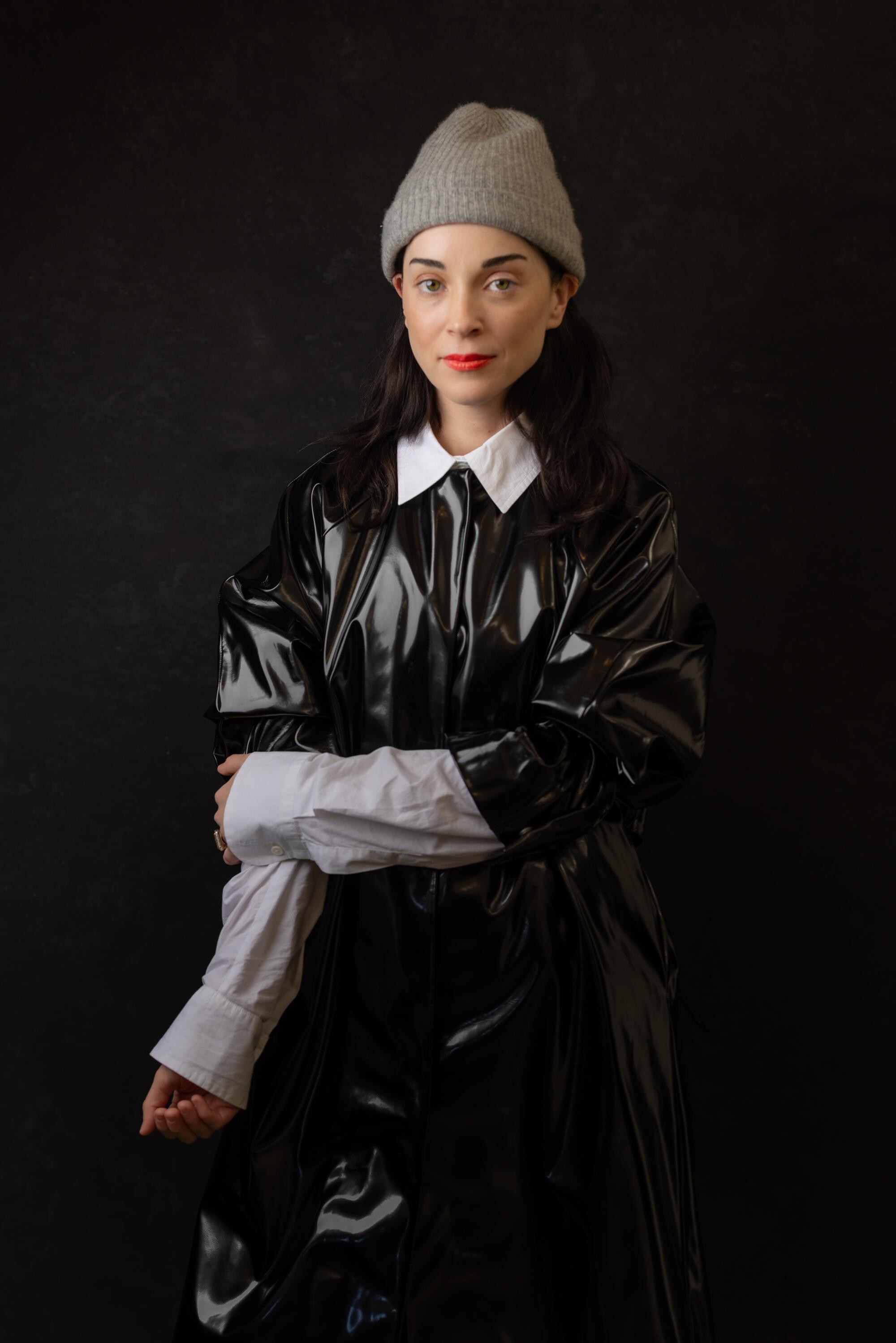
Annie Clark, a.k.a. St. Vincent
(Jason Armond / Los Angeles Times)
2. ‘Unruly in a good way’
What’s a musical era you wish you’d been around for?
Smith: Earth, Wind & Fire, Ohio Players, that whole era.
Legend: The series of Stevie Wonder albums in the mid-’70s when he won three album of the year Grammys — I wish I were alive when those were being made. Those were probably the most inspiring albums for me coming up.
Clark: It shows.
Allen: I think about vocalists back then — how locked in you had to be from the jump. Watching people record harmonies in real time, everyone on one mic, having to match the tonality of everybody else.
Legend: A computer allows you to do so much manipulation. They had to come in and just deliver a take.
Nigro: It’s interesting how our ears have become so adjusted to everything sounding perfect now. In my 20s I was really into Van Morrison’s “Astral Weeks” — listened to it all the time. I hadn’t listened to it in years, and then I put it on the other day and I was like, I can’t believe how out of tune this guitar is. For the first time, it was driving me crazy. And I didn’t want it to drive me crazy.
How’d you deal with that desire for perfection on the Chappell album? It doesn’t sound —
Legend: It feels unruly in a good way.
Nigro: For me, it’s time — sitting with the song, listening to it, what it makes me feel like. I’ll listen, then I’ll walk away and come back: “Oh, that vocal’s rushing — I’m gonna move the vocal.” It’s natural, but there’s definitely editing being done.
Legend: Are you writing on these songs too?
Nigro: Yeah.
Legend: When you’re in your songwriter moment versus your producer moment, what’s the difference?
Nigro: I never care about any production when we’re writing. I’m lucky enough that when I work with Olivia or with Chappell, they don’t care either — they just want to get a song. Sometimes with Chappell, we’ll put a beat on so we know what tempo we’re writing to.
Smith: That’s so cool. So you record the whole song with no production?
Nigro: “Good Luck, Babe!” was just a kick, a snare, a vocal and a synth — not even any chord changes. The chords are the same in the verse and the chorus.
Is that cheating?
Clark: I was just looking at every Madonna hit from the ’80s — just studying chord progressions for fun — and it’s a classic move.
Legend: We’re not nerds at all.
So then what distinguishes the chorus from the verse?
Legend: Sometimes just changing the melody over the same chords can make it feel completely different.
Nigro: Although there’s lots of hit songs where even the melody for the verse is the same as the chorus melody. Calvin Harris and Rihanna, “We Found Love” — same chords, same melody. The whole thing never changes. But the song feels like it’s propelling.
Allen: Tale as old as time, that trick. But it’s really hard to do.

John Legend
(Jason Armond / Los Angeles Times)
3. ‘The best version of herself’
Last year, Taylor Swift’s “Cruel Summer” — which Annie co-wrote — topped the Hot 100 four years after it came out because people on the internet decided it should be a hit. This is a thing that happens now.
Smith: I put out “Wait a Minute!” years ago and then TikTok was like, “Oh, we love this song.” Yo, I’ve put out three albums since then!
Nigro: “Pink Pony Club” did that. It’s going now, and it came out almost five years ago.
When an old song takes off, you ever hear something in it you wish you could change?
Nigro: The crazy thing is that you can. Chappell and I changed “Femininomenon” six months after it came out. I’m not really a dance producer, and the drums [on the original recording] just didn’t hit the way I wanted them to. Every time I heard it, I was like, “The fricking snare’s just not right.” I hated it more and more as time went on. So when we were set to put the record out for real, I called a friend: “Can you please change the kick and snare in this for me? I have like a week before we have to hand in the vinyl.” And we ended up swapping it out.
Annie, you just remade your latest album in a Spanish-language version.
Clark: Sí.
Why?
Clark: I’ve been lucky enough to play a lot in Mexico and in South America and Spain, and I was always blown away by the fact that people will sing along to my songs in what might be their second or third or fourth language. So I thought if they can do that for me, maybe I can meet them halfway in their language.
Legend: How much did you find yourself revising the lyric to make it sing better in Spanish?
Clark: It’s wildly different — kind of a full rewrite.
When you’re writing with an artist, Amy, do you think in terms of absorbing their language?
Allen: When I was really getting into songwriting like six years ago, I would hear what an artist wants to talk about and then try to put myself in their brain and write the song from their perspective. But I had this pivotal moment two or three years ago where I realized I was making it so much harder than it needed to be. Why don’t I just, when they’re venting about something, figure out the closest thing I have within me and then write in a parallel line with them? Sabrina is a special case because I have so much chemistry with her.
Legend: It seems like y’all had fun. My daughter is really into Sabrina right now, so I hear her in the car a lot.
Allen: We can hit the ball back and forth, and it’s unlocked something for her to become the best version of herself. My dream job is not having to sit there and come up with the funniest line. It’s allowing a chemistry to develop where those lines are just second nature.
Smith: It’s coming from the relationship that you guys have created with each other.
Legend: I love that.
Allen: It took me a long time as a songwriter to get there with an artist.

Amy Allen
(Jason Armond / Los Angeles Times)
4. ‘The vision is clear’
Chappell, Sabrina, Charli XCX: Artists who’ve been working for a long time finally made it happen in a big way this year. Is this a story about artist development? Should the music industry be patting itself on the back?
Legend: I don’t feel like that’s what’s happening.
Clark: Can they reach their backs with those wads of cash in their hands? Is that possible?
Legend: What’s happening with labels is they’re not really in charge anymore. They’re not the gatekeepers as much as they used to be. The audience has so much power.
Smith: Social media is a huge part of this. And I feel like it’s a balance: There are situations where the creation of the art is pinnacle, and there are situations where that’s really, really not the case. We all know what it’s like to feel that straitjacket of opinions about what’s gonna make a hit record.
Nigro: Every artist says they don’t care. But there are artists that want to appease everybody and there are artists that really just do whatever the hell they want to do. I think the truth is that the artists have the power, but if they’re not sure about what they want, then they can easily get wrapped up in the major-label —
Smith: Rigmarole.
Nigro: It’s easy to get lost in that. Everyone wants to be successful.
Seems worth pointing out that Sabrina broke through with her sixth studio album.
Clark: That’s her sixth album?!
What does that tell you about a career in pop?
Clark: It’s telling me I got a shot [laughs]. I mean, theoretically, if you do something a lot, you get better. A doctor on their sixth surgery is better than a doctor who’s on their first. For some reason, music is the only place where people are like, “No, that first surgery was the best.”
Legend: But sometimes it’s true — sometimes the first one is the best one.
Clark: And sometimes you pierce somebody’s trachea.
Willow, your debut single came out when you were 10 years old. Do you feel connected now to that earliest instance of your musical life?
Smith: What I’ll say is that the message of my music has always been to love yourself and to love others and to live loud with all of your gusto. So “Whip My Hair” definitely doesn’t go against anything that I stand for now — it actually fits the journey that I’ve had. I look back at my first album and I’m like, I definitely wouldn’t do that now. But like Annie said, the more you do something, the more you refine it.
Legend: And it can take a while to figure out your voice. I’m thinking about the six albums for Sabrina, because now it feels like, OK, she found it. Not saying the other ones weren’t great, but they felt a little more unsettled as far as who she was as an artist. Then I hear these songs and they sound like this is her personality. The vision is clear.
Allen: Also, the world needs to be ready. There’s so many dominoes that need to fall for something like “Good Luck, Babe!” or “Please Please Please” to have the impact we want it to have.
Nigro: We wrote “Good Luck, Babe!” while we were writing Chappell’s album. But if we’d put it out when the album came out, I don’t think it would have done what it did.
Smith: Timing is so important.
Nigro: And I feel like Sabrina needed “Nonsense” to happen for the next iteration to take place.
Allen: It was all stepping stones.

Daniel Nigro
(Jason Armond / Los Angeles Times)
5. ‘I wish I made this song’
Present company excluded, what’s a song or an album that you loved this year?
Legend: Tyler, the Creator’s album. I love his mom talking through every track and the storytelling and the personal journey.
Smith: Esperanza Spalding and Milton Nascimento put an album out, and I just sat in my room with the lights off and was like, I need to ingest this into every cell of my body.
Nigro: The first time I heard “Million Dollar Baby,” I was like, Oh man, I wish I made this song.
Allen: I loved this new Adrianne Lenker album that came out this year. She’s defying every rule that I as a pop writer feel is floating around.
Clark: I’ve been listening to the new MJ Lenderman record, “Manning Fireworks.” It’s so creative and clever, but it doesn’t lose its heart in the cleverness.
’Tis the season for holiday music. You’ve made a Christmas album, John, and you’re on a Christmas tour as we speak.
Legend: Call me Father Christmas.
Have any of the rest of you tried to write a Christmas song?
Nigro: Every year, I call up the artists that I work with and I say, “Hey, let’s write a Christmas song,” and they’re like, “Yeah, sure.” And then we never do.
Legend: I said that every year for 14 years until I finally made one.
Clark: I wrote a Christmas song — sort of. It’s on my last record, and it’s called “… At the Holiday Party.” It’s sad and depressing.
Allen: That definitely counts.
Smith: If I ever made a Christmas song, I feel like it would have to be from the dark side. Or maybe like a pagan perspective.
Clark: You should absolutely write that.
Are Christmas songs hard to write?
Legend: The thing about Christmas songs that endure is that they endure. So there’s a lot of pressure on any new song to make it stand up to all the ones that have lasted for 50 years. And they’ve lasted for 50 years for a reason — people still love them. To try to make your new thing stand up to that canon is quite a challenge.
Clark: Eat s—, Bing Crosby.

Entertainment
‘Children of Blood and Bone’ author won’t see film after feud with star Amandla Stenberg

Tomi Adeyemi, the author of the bestselling fantasy “Children of Blood and Bone,” isn’t planning to see the forthcoming film adaptation — even though she co-wrote it.
Over the weekend, the Nigerian American author posted a video on TikTok addressing fans who have been asking her the same question, “Why don’t you post about the adaptation of your first film adaptation anymore?”
“There is a reason I will not post anything about the adaptation of my work,” the author wrote in what appear to be screenshots of a group chat. “I have not seen the film, and I will not watch it.”
The adaptation of the first installment of Adeyemi’s “Legacy of Orïsha” fantasy trilogy is slated to hit theaters in January 2027. Gina Prince-Bythewood — who wrote and directed “Love & Basketball” and helmed “The Woman King” — is directing. The film stars Amandla Stenberg, Thuso Mbedu, Tosin Cole, Damson Idris, Cynthia Erivo, Lashana Lynch, Regina King, Idris Elba, Chiwetel Ejiofor and Viola Davis.
Alongside the screenshots of her comments in the group chat, she shared a February 2025 exchange with Stenberg that shows the author severing ties with the actor.
Adeyemi shared only her final message to Stenberg, which reads, “Do not ever use my name in an interview or video again. Do not text me. Do not call me.” That exchange is followed by a notification that she blocked Stenberg, who plays Princess Amari in the upcoming fantasy flick.
The message from Stenberg that preceded Adeyemi’s reply is not shown in full.
Stenberg, who played Rue in “Hunger Games,” Starr Carter in “The Hate U Give” and, recently, Verosha “Osha” Aniseya and Mae-ho “Mae” Aniseya in Disney’s “Star Wars” series “The Acolyte,” had been getting flack from readers of the series, who claimed colorism was an issue while casting the movie.
In February 2025, Stenberg posted a since-deleted nine-minute TikTok addressing the controversy and told followers that Adeyemi had given the actor her blessing when cast as the series’ princess.
“I am four months into training for ‘Children of Blood and Bone’ and I am getting my ass whooped,” Stenberg joked in the video, per BET.
“This year was mostly defined for me, honestly, by contending with what it felt like to receive racist death threats just for existing in the ‘Star Wars’ universe, and that was a really difficult thing for me to move through,” she continued. “But honestly, it feels so much more painful for me to feel like I’m at odds with my own community.”
Stenberg said that she considers her skin tone when navigating her career choices and would “never go after a role” she didn’t feel well suited for. “I know that colorism is an insidious system that relentlessly impacts every facet of entertainment.”
The actor continued that it was actually a meeting with the “Children of Blood and Bone” author that gave her the confidence to pursue the role.
“I had the opportunity to meet Tomi, the novelist, for the first time. … And she goes, ‘Amandla, I want you to know that when you were a little girl and you were cast as Rue in “The Hunger Games,” and people said that Rue’s death wouldn’t be as sad because you’re a Black girl — that inspired me to write this series so that Black girls like you and Black girls of all shades could have a story written about them,’” Stenberg said in the video. “We started crying, and I said to myself, ‘God wants me here.’”
Representatives for Stenberg, Adeyemi and Prince-Bythewood did not immediately respond to The Times’ request for comment.
Movie Reviews
‘Night Nurse’ Review: A Caretaker Explores Her Kink for Elder Abuse in the Year’s Strangest Erotic Thriller

There are any number of erotic thrillers in which rich old men are robbed blind and/or left for dead, but Georgia Bernstein’s admirably bizarre “Night Nurse” might be the first movie of its kind where elder abuse is the source — and possible subject— of its erotic thrills. If there are others, I’m not sure I want to know.
But this woozy debut feature doesn’t rely on its audience being turned on by the relationship between a nubile caretaker and her dementia-addled patient. Their psychosexual bond, meanwhile, hinges on cold-calling vulnerable old people under the guise of a grandchild in financial distress. (“I’m in trouble, nana, send me $10,000 or I’ll be left to rot in jail!” That sort of thing). With its slim wisp of a premise stretched into a Strickland-esque dreamscape that substitutes kink for conflict, the film itself hardly seems convinced by its own wrinkled lust — all desperate kisses and non-touching poses of subservience. More important to Bernstein is what that lust reveals about her characters’ deepest needs, specifically how their need to care and be cared for can be as easily perverted as any other form of desire.

As moody and weightless as the noir-accented score that blows through the movie like a curlicue gust of wind in an old cartoon (credit to musicians Sam Clapp and Steven Jackson), “Night Nurse” lacks the pulse required for its stray feelings to come alive. Still, the film ambiently taps into the latent eroticism of teasing out the distance between how you see yourself and who you really are. Bernstein plays with that distance like a telephone cord wrapped around her fingers, and Eleni — played by the excellent newcomer Cemre Paksoy, powerfully helpless — only frays even more as the receiver is brought near the hook. “Everything I did before today wasn’t me,” the nurse tells co-worker Mona (Eleonore Hendricks) after starting a new job at an Illinois retirement home. “It was somebody else.”
What she did before today remains unexplored (specifically, what she did to get herself fired from her last gig), but I’m guessing she’s probably changed less than she thought. There’s a faraway flicker in her eyes the moment she catches the vibe between Mona and Douglas (a ribald and elusive Bruce McKenzie), a white-haired seventysomething who shows early signs of dementia but still commands an undiminished sexual energy. “I’m not an invalid,” he coos as Mona bathes him in the tub, to which she replies, “yes, you are,” in a supplicant tone that hints at a rich history of power games between them.
Later that same night, Douglas will force Eleni to call a stranger, pretend that she’s their granddaughter, and ask for money — he’ll wrap the phone cord around the nurse’s body as she talks and shove her against the wall as they kiss. She’s into it. So into it that he has to clarify the terms of his whole deal: “If you’re looking for a pogo stick, I’m really not your guy.” But Eleni isn’t looking for anything to bounce on. She just wants to be needed, and maybe to need someone in return. Someone who will see her for who she really is and allow her the fantasy of pretending she isn’t being herself when she cons vulnerable strangers out of their money — when she exploits how enthralled those strangers are by the care they have for their loved ones.
“Night Nurse” doesn’t belabor the psychology, as Bernstein prefers to express her story through heavy-lidded suggestion. Somnambulating from the moment it starts, the film moves through a series of beautifully arranged poses that stretch their latent meaning thin across the surface (Lidia Nikonova’s cinematography lacquers every shot with a seductive dreaminess). We see Douglas smoking in a lawn chair with Mona and Eleni curled around his feet. Eleni riding in the backseat of a convertible as the wind blows through her curls. The full staff of nurses — all of them under Douglas’ sway — stumbling around his condo in a state of zonked out bliss as they roll on the prescription drugs they’ve stolen from the residents.
Once you’ve seen one shot of this movie, you’ve practically seen them all, at least until things escalate during a rushed and unsatisfying third act that forces Eleni into an honest confrontation with herself. People will do just about anything to feel needed — they’ll give whatever degree of care allows them to receive it in return. “Night Nurse” understands that desire, but remains far too numb to treat it.
Grade: C+
The Independent Film Company will relase “Night Nurse” in theaters on Friday, July 10.
Entertainment
Lucas Museum to give free annual passes to South L.A. neighbors, host community preview day

The Lucas Museum of Narrative Art, which is moving at light speed toward its Sept. 22 opening, announced Thursday that it will give free annual passes to its South L.A. neighbors living in the 90037 ZIP Code. The 300,000-square-foot, $1-billion museum located in Exposition Park will also host a special community preview day on Sept. 13, more than a week before the general public gets to step inside.
The 90037 ZIP Code has a population of more than 65,000 and is bordered roughly by the 110 Freeway to the west, Slauson Avenue to the south, Central Avenue to the east and Martin Luther King Jr. Boulevard to the north. Residents can register for passes at lucasmuseum.org/lm37 and will be alerted in August when the program launches. Pass holders can reserve tickets for themselves and one guest.
Tickets for non-pass holders go on sale July 21. They cost $25 for adults and $21 for seniors. Kids 17 and under are free.
“Storytelling has the power to bring people together and create a sense of community,” said Lucas Museum Chief Executive Tracey Bates in a news release about the program. “Through LM37, we are inviting our South Los Angeles neighbors to make the museum part of their lives and take their own path of discovery through the art, programs and experiences that will help shape this new cultural hub for Los Angeles.”
The community preview day is designed to give local business owners, community partners, civic leaders and registered LM37 pass holders a sneak peak of the 10,000 square feet of exhibition space, as well as the expansive gardens with 11 acres of park space.
The opening programming, curated by co-founder George Lucas, features 20 inaugural exhibitions across more than 30 galleries, including one titled “Star Wars in Motion,” containing vehicle designs, high-speed racers, flying vessels, props, costumes and illustrations from the first six films in the beloved franchise.
More than 1,200 objects will be on display from Lucas’ personal collection of narrative art. Highlights include work by Norman Rockwell and Dorothea Lange, as well as a variety of manga, children’s book illustrations and comics.
-

 World2 minutes ago
Hoops Players’ Win Tops Big Day in NCAA Eligibility Litigation
-

 Health27 minutes ago
3 Best Peptides for Weight Loss—and the Viral One Doctors Say To Skip
-
 Lifestyle42 minutes ago
Smithsonian chief emphasizes ‘accuracy and integrity’ after White House report
-

 Technology54 minutes ago
Microsoft’s carbon emissions went up 25 percent last year
-

 World57 minutes ago
Jailed Catholic woman’s hunger strike highlights Iran religious persecution — US demands action
-

 Politics1 hour ago
Israel shares intelligence warning Iran plotted new assassination attempt against Trump: report
-

 Health1 hour ago
Parasitic infection causing ‘explosive’ stomach illness exceeds 1,000 cases in northern state
-

 Sports1 hour ago
London descends into disorder as Morocco fans flood streets after World Cup elimination by France

