Entertainment
Keke Palmer isn't worried about Keke Palmer. Why is everyone else?


Once, when Keke Palmer was a little girl, she asked to have Cheerios for dinner.
Her parents told her no: They had already prepared a meal for the family, and besides, cereal was for breakfast. “If you don’t eat the dinner,” her mother advised, “then you’re going to be hungry.”
“That’s OK,” the 4-year-old said, calmly turning and retreating to her room. A few hours later, at 4 a.m., her mother went downstairs to use the bathroom. She found Keke there, asleep in her nightgown with her head resting on the kitchen table.
“Mom,” she said as she looked up sleepily, “can you give me my Cheerios?”

Who are the people shaping our culture? In her column, Amy Kaufman examines the lives of icons, underdogs and rising stars to find out — “For Real.”
Sharon Palmer laughs as she tells this story, which seems, at first, like your standard cute anecdote, tossed off to humanize a famous daughter — an example of how stubborn kids can be in the pursuit of their desires, proof that years before she became a child star, Keke knew how to get what she wanted. But think about it, and it becomes something more. This is a story about a girl who wanted something, was told she couldn’t have it and managed to keep her emotions in check. She didn’t throw a tantrum in protest. She didn’t eat a dinner she didn’t want just because she was supposed to. She absorbed the information, took a beat, weighed her options and then came up with a viable plan to get those damn Cheerios.
It’s a template Keke Palmer has been following ever since.

A few years later, when Keke was 10, she, her parents and three siblings would move to L.A. so that she could pursue acting. She’d just filmed her first professional job — playing Queen Latifah’s niece in “Barbershop 2,” a role she auditioned for at an open call in Chicago — and MGM invited her to the Hollywood premiere. Sharon — who met her husband at a summer theater program — saw this as an opening: They’d get set up in California and use the movie as leverage to get Keke more work. She quit her job as a high school drama teacher to manage her daughter’s career; Keke’s dad, Larry, stopped working at a polyurethane factory to raise the other kids. The couple used donations they’d been offered from their church to pay for the drive to California from Robbins, Ill.
“Keke does not mind sacrificing to get the goal she wants,” Sharon says now. “So if she showed us she’d make a sacrifice for something, we’d go that extra mile to try to encourage it.”
It’s an origin tale that Palmer, 31, has referenced often over her two-decade career — one that began with her breakout role as a precocious spelling bee champion in 2006’s “Akeelah and the Bee” and was revitalized with her critically acclaimed turn in Jordan Peele’s 2022 horror film “Nope.” She talks about how much her family sacrificed to aid her success, not to propagate some rag-to-riches Cinderella story but to illustrate how they all worked together to turn a girl named Lauren into a star named Keke. She has been less vocal about the strategic mind that came up with the Cheerios plot — the girl who has always been determined to get what she wanted without having to scream and shout.

Keke Palmer’s Akeelah Anderson in “Akeelah and the Bee” (2006) has the gift of gab and excels at spelling.
(Saeed Adyani / Lionsgate)

The Jordan Peele-directed “Nope” (2022) revitalized Keke Palmer’s career. She played Emerald Haywood, with Daniel Kaluuya, left, as OJ Haywood and Brandon Perea as Angel Torres.
(Universal Pictures)
Palmer is trying to share more of that story with her new book, a memoir/self-help hybrid, “Master of Me: The Secret to Controlling Your Narrative.” It opens with this epigraph: “I have always been an observer of myself. For years, at the mercy of others. Not anymore.”
She put it there, she says, because she’s long felt that she let other people write her story for her. Over the years, she’s been portrayed as the “poor little Black girl” whose parents used her for money, the teenager who never had a childhood because she was a Nickelodeon child star.
“And that’s not the story,” Palmer says now. “The story is: My family from the south suburbs of Illinois had a dream. We drove four days and three nights, and they watched me become a generational talent. It took our family out of poverty into generational wealth. … I want to tell people, whether they’re a little girl from the Midwest, a queer-identifying person, a first-generation immigrant — you control your story.”
It’s a message that has taken on greater significance this past year, as court documents revealed that Palmer was struggling to escape what she says was an abusive relationship with Darius Jackson, the father of her 20-month-old son. The news threatened to rupture the sunny image Palmer has been cultivating since she played Akeelah at age 12. The girl who went on to star in “True Jackson, VP,” a Nick sitcom about a high schooler who gets a job at a major fashion company. The game show host on NBC’s “Password” reboot who is often so delighted for contestants that it seems as if she has personally just won thousands of dollars.
“I’m not [transgressive artist] Harmony Korine or Lee Daniels. I’m Disney,” Palmer says of her image. “I’m creating an aspirational picture.”
Palmer, who is speaking over video chat, pauses to prop her iPhone up against something so she can squeeze a few drops of black liquid into her water.
“Sorry, I have to do these chlorophyll drops. I’m in my wellness era,” she says. “It’s just supposed to be good for your body — helping with antioxidants, clearing you out. It’s disgusting, though, girl. It’s so nasty.”

Given her schedule, Palmer cannot afford to get sick. During October, we speak three times, and she is in a different place each time. I first meet her at a recording studio on Amazon’s Culver City campus, where she produces her Wondery podcast “Baby, This Is Keke Palmer.” Next time, she was in Atlanta, rehearsing for a new Boots Riley film co-starring Demi Moore, about a group of shoplifters. (This is where she mixes her swamp-like wellness concoction.) On our last call, she’s about to head to Illinois to be a keynote speaker at the Chicago Women’s Expo.
She does a lot of these inspirational talks, and “Master of Me” has a bit of that trademark cheerleader energy — a unique blend of dishy, behind-the-scenes tell-all and conversational wisdom. In one section, she dives into a vitriolic social media debate that arose in the wake of her box office success with “Nope.” Online, audiences began stacking her career up against that of another former child star, Disney veteran Zendaya, whom Palmer doesn’t actually name in the book.
“So here I am, starring in a movie where I’m literally playing a heroine with one of the biggest directors — Black or white — of our generation,” she writes. “But I got people telling me my career isn’t as good as someone else’s because of the complexion of my skin? No, babe, I won’t let you project that onto me.”
Then she pivots, attempting to add a moral to the story: “Any time someone tries to use another person as a comparative marker for where you are or where you’re supposed to be, cut they asses loose!”
The title of her memoir is a play on the idiom “jack of all trades, master of none” — a criticism she says she’s heard levied at performers who, like her, dip their toes into various mediums. Palmer’s bread and butter is still acting. In addition to Riley’s film, she’ll soon appear in an Eddie Murphy comedy, “The Pickup”; Aziz Ansari’s directorial debut, “Good Fortune”; a buddy comedy with SZA that she produced called “One of Them Days”; and a Peacock television adaptation of the 1989 Tom Hanks movie “The ’Burbs.”

In her “Master of Me: The Secret to Controlling Your Narrative,” she offers a unique blend of dishy, behind-the-scenes Hollywood tell-all and conversational wisdom.
(Flatiron)
But she has a lot of offscreen pursuits too. She’s made her own music and overseen the creation of more, including an R&B girl group, DivaGurl, that launched in July. Her digital network, KeyTV, has been platforming diverse creators since 2022. She has partnerships with eight brands, including Estée Lauder, Google and Monopoly. And “Master of Me” is her second book; she published her first, “I Don’t Belong to You: Quiet the Noise and Find Your Voice,” at the ripe ol’ age of 21.
A month before “Master of Me’s” publication on Nov. 19, Palmer is already deep in promotion mode. At Amazon’s studios, she sits in a bouclé armchair on her podcast set, dressed like a demure interviewer: patent leather loafers, cuffed jeans, a sweater set, a string of pearls. She has to knock out three episodes in a day, and she’s just welcomed her final guest, a relationship coach who inquires about her book during their chat before recording.
“It’s a bunch of essays that are built around three Ps — performance, purpose and power — and how all of that has led me to be able to self-master,” Palmer says, as if reciting a press release.
The value of good marketing was instilled in her during her Nickelodeon days. “They were basically paying for people to teach me how to be a 360 entertainer,” she writes in her book. “Who was I not to be taking notes?”
It was after “True Jackson, VP” ended that Palmer needed those lessons most, she says. She had enough money to carry her and her family for about three years, and she did a few television movies and appeared on some episodes of “90210,” but without a consistent paycheck, she fell into “severe debt,” she says. She and her family were forced to move out of L.A.: Her parents returned to Chicago, and Palmer went to Atlanta.
The only way to rebuild, she believed, was to dig into the available data about how audiences perceived her. She started analyzing her social media engagement — how many comments she had, the demographics of her followers — and used the information to help pitch herself on potential jobs. “When people do movies and [get feedback] on this was their favorite character, or they thought you were the funniest, or they thought you were the most likable — that’s proprietary stuff that we now have in one single touch. And so that’s what helped me and my family a lot with knowing, ‘Oh, I was really popular on the East Coast.’”
“I had to be real with myself in order to push through. There was no time for ego or being sad,” she says. “I had to be straight up with myself and be like, ‘OK, girl, what can we get?’ When you’re living in denial about who you are or what people think — you don’t have to believe what they think — but if you’re aware, you can maneuver through it.”
Palmer has been conscious of the importance of money since she was a kid. Her parents never explicitly told her how reliant the family eventually became on her salary; she just knew. Her parents had quit their jobs, and she constantly feared what would happen if her money stopped coming.

Parents Sharon and Larry Palmer dance at Keke’s sweet 16 birthday party Aug. 22, 2009, in Los Angeles.
(Charley Gallay / WireImage via Getty Images)
“The pressure came from me realizing that there was no other outside income,” she says, “so if I failed at any point, we would be in trouble.”
They tried to tell her that even if she stopped getting jobs in Hollywood, they’d find a way to make it work. But she ignored those reassurances. Decades later, she’s still trying to diversify her portfolio.
“I realized that I didn’t want to be Mickey Mouse, I wanted to be Walt Disney,” she says. “I don’t want to keep dancing until the end of time. So I research a lot — I research Walt Disney, Estée Lauder, and all of their families are still a part of their companies. There’s a foundation of: ‘We got to do something that our family and our community can benefit from.’”
She wrote “Master of Me,” she says, partly to share some of these lessons with her audience but also to share her version of stories that have been in the tabloids. And unlike most puffy celebrity books, Palmer actually names names — sharing her unvarnished opinions on such industry figures as Ryan Murphy, Trey Songz and Tyler Perry.
“It was very surprising for me as well, because I thought that I would have to probe her, but she really invited me in,” says Kukuwa Fraser, the editor at Flatiron Books who worked on Palmer’s memoir. “I feel like that’s really rare in some of these celebrity books. Keke wants to bring you to the campfire, sit you down and tell you the story in an intimate way.”

Perhaps the most revealing Hollywood anecdote is about Murphy, who created the 2015 Fox show “Scream Queens,” which Palmer co-starred on for two seasons. She describes how she’d been given her shooting schedule and arranged to fulfill another business obligation on a day off. But when that day rolled around, she writes, production told her that she was actually needed on set. She decided to keep her prior obligation, which she writes resulted in an angry phone call with Murphy in which he “ripped” into her and told her she was unprofessional.
“It was kind of like I was in the dean’s office,” she says now, reflecting on the interaction. “He was like, ‘I’ve never seen you behave like this. I can’t believe that you, out of all people, would do something like this.’ ”
Palmer apologized and thought everything was copacetic between them — until a few days later, in her trailer, a co-star gave her a different read on the situation.

“I said, ‘Ryan talked to me and I guess he’s cool, it’s fine,’ and she was like, ‘It’s bad,’ trying to make me scared or something, which was a little irritating.”
Prior to the incident, Palmer felt she might go on to be one of those people “you keep seeing in Ryan’s world — Sarah Paulson, Emma Roberts.” But in standing up for herself, Palmer says, she believes she ended that possibility.
“I’m still not sure Ryan cared, or got it, and that’s okay because he was just centering his business, which isn’t a problem to me,” she writes in the book. “But what I do know is even if he didn’t care, and even if I never work with him again, he knows that I, too, see myself as a business.”
(Through his publicist, Murphy did not respond to a request for comment.)
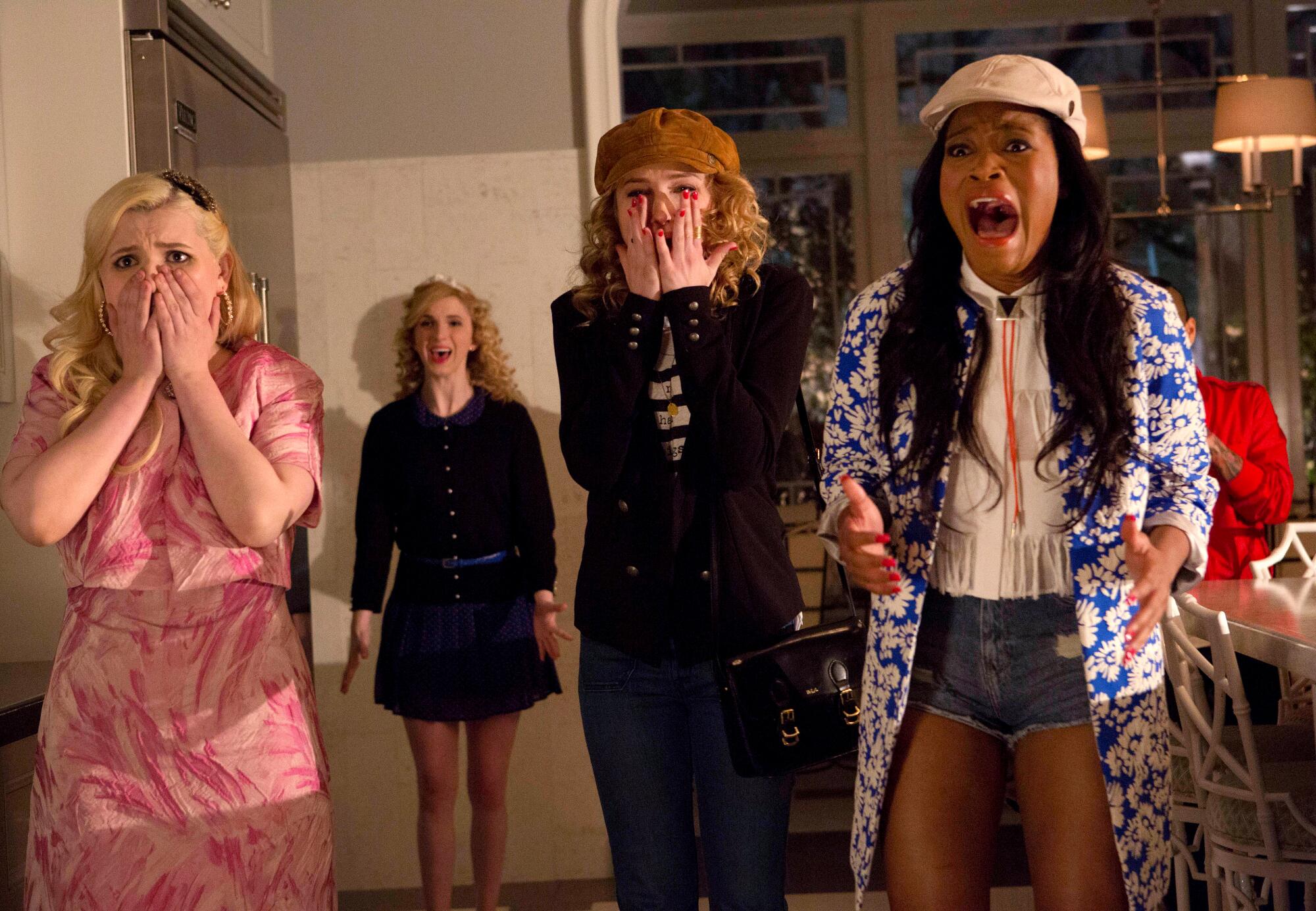
Abigail Breslin, left, Whitney Meyer, Skyler Samuels and Keke Palmer in the series “Scream Queens.”
(Steve Dietl / Fox)
“Scream Queens” — which also starred Roberts, Ariana Grande, Billie Lourd, Abigail Breslin and Lea Michele — does not seem like it was a positive experience for Palmer, per her book. In another part of the book, she describes how a white actor on the show, whom she calls “Brenda,” once made a racist remark to her on set. Palmer writes that Brenda was upset over a clash with a colleague, and she tried to calm her down by suggesting that everyone “have fun and respect each other.”
“Keke, literally, just don’t. Who do you think you are? Martin F— Luther King?”
Palmer says she declined to name the offending party because she wanted to take the power out of her words and not make the moment about Brenda.
“It was such a weighted thing that she said, but I didn’t allow that weight to be projected on me, because I know who I am,” Palmer says. “I’m not no victim. That’s not my storyline, sweetie. I don’t care what her ass said. If I allow what she said to cripple me, then she would.”
It’s an attitude Palmer says she began developing in kindergarten, when she was the only Black kid in a class of 21 at her private Catholic school. She was bullied, she says, and when she came home crying, her parents actually referenced the Rev. Martin Luther King Jr., telling her that microaggressions shouldn’t cause her to lose control. It was a lesson she took to heart.

“Keke is constantly reframing stories and making them work for her, as opposed to her being a victim in them,” says Nora Addison, Palmer’s best friend and a founding partner at KeyTV. “She’s very solutions-oriented. She’s never going to sulk in a situation for so long or let it get the best of her.”
Which is why it has been so difficult for Palmer to grapple with the public’s learning some of the intimate details of her relationship with Jackson. Palmer and Jackson began dating in June 2021 and welcomed a son, Leodis — nicknamed Leo — in February 2023. The first signs of trouble emerged just months after Leo was born, when video of Palmer dancing onstage with Usher during the performer’s Las Vegas residency surfaced online.

Keke Palmer in 2022 with Darius Jackson. Their sometimes-stormy relationship became public knowledge.
(Juan Ocampo / NBAE via Getty Images)
In response to the clip — in which Palmer was wearing a sheer dress over a thong bodysuit — Jackson tweeted: “It’s the outfit tho.. you a mom.” In response to the immediate criticism of his tweet, Jackson doubled down: “We live in a generation where a man of the family doesn’t want the wife & mother to his kids to showcase booty cheeks to please others & he gets told how much of a hater he is. This is my family & my representation. I have standards & morals to what I believe. I rest my case.”
Then, on Nov. 9, Palmer alleged that far graver abuse had been happening behind the scenes. She filed a request for a temporary restraining order, alleging domestic violence, in L.A. County Superior Court, detailing multiple instances in which she said Jackson struck, grabbed or violently put his hands on her over the course of their two-year relationship.
Once, she wrote in the request, he “choked [her] and body slammed [her] onto the stairs in [her] home after becoming violently jealous and irrationally angry over a bikini picture.” On another occasion, she alleged in the request, he lunged at her, struck her, threw her over the couch and stole her phone when she threatened to call the police. There was verbal abuse too, she claimed: “Darius will be holding our eight-month-old son and saying to him, ‘Your mama is a whore/a c—/a liar/no one wants her.’ I know Leo is still too young to understand these words, but the fact that Darius would spew such vile language at a baby is very concerning to me.”
A judge granted the restraining order, and a month later, Jackson filed his own request, alleging that Palmer had been violent toward him and that many of the acts of which he had been accused were in self-defense. In his paperwork, Jackson included a transcript of what he said was a conversation between himself and Palmer’s mother, Sharon, where she berated him with homophobic insults.
“When somebody comes at your child and you know your daughter is a good person, and you know she didn’t do anything to deserve what he said, you go into survival [mode],” Sharon says now. “I wanted my daughter to know that he couldn’t get away with that. I was so happy that people understood that I was a mother that was defending my child. Because I never want to do anything to embarrass Keke ever.”
She starts to cry, describing how she was living in Chicago during the majority of Palmer and Jackson’s relationship and was unaware of the alleged abuse until days before her daughter went to court.

“She called and told me, and I said, ‘Well, you need to protect yourself and call the police,’” Sharon recalls, saying that Keke was reluctant to do so because she was concerned about media attention. “She didn’t even do it. It was her sister who did, her sister who said, ‘I’m gonna call.’ ”
The court filing prompted many messages of concern from her fans, which Palmer says is difficult for her to accept.
“I know I’m a public figure and I’m Keke Palmer and ‘It’s yo’ girl!’” she says, putting on an upbeat voice. “But on the real tip, let me be clear with you guys: This is my personal life. If you care about me or worry about me or want to pray for me, that’s great. But this is not the relationship we actually have. We have a relationship that’s involved with what I would hope to be positive things, encouraging things, laughing moments. I want to put my best foot forward every time for the people that are watching me on my platform. I’m an artist painting the best possible picture that I can, because I care about what you’re looking at.”
Palmer brings up Beyoncé, whom she views as a role model. Fans may assume Beyoncé is the living embodiment of perfection, but Palmer doesn’t see it that way. What Beyoncé is doing, Palmer says, is performance art — “emoting something that is meant to be an aspirational exploration of feminism, gender-nonconformity but still softness, being assertive, having her peace in chaos with ‘Lemonade.’” In other words, if the cracks show, it’s to serve a greater purpose. And the singer, Palmer says, is always in control of when or if they show. That’s what Palmer aspires to.


Things with Jackson are less contentious now, she says. In May, she dropped the restraining order and request for sole custody of Leo, who is with her most of the time now; Jackson entered the military and is busy with basic training. Palmer shares her Encino home with her older sister, Loreal, who is divorced and has three children. Their parents live 10 minutes away. (Sharon also says she’s in a “great place” with Jackson now: “He’s maturing too. I don’t think you should hold people in their sin. He wasn’t even 30 when this stuff happened. You’re telling me a 28-year-old man can’t learn? That’s a lie.”)
For the next few weeks, meanwhile, Palmer plans to balance her book release with her filming schedule in Atlanta. But if she gets tired, she’ll probably never show it.
“You see those clips of people like Tobey Maguire, he’s out and he refuses to clock in. You know, fans try to come up to him, and then there are these funny memes about it,” she says. “Some entertainers are like, ‘No, I’m not on the clock because I’m not on the set,’ which I understand and respect. But whenever a fan comes up to me, even if I say, ‘No, I don’t want to take a picture,’ I’m still going to be as polite as I possibly can. Even if I’m having a s— day. Because in that moment, I’m Keke Palmer. I try my best to uphold that image without losing myself in it.”



Comedy is a matter of taste and preference — it’s a deeply personal thing. Which makes it hard for a critic to give a blanket assessment of a specific kind of comedy, especially if it didn’t work for them, but clearly worked for others (the laughter or lack thereof is the indication). “It’s not funny,” the critic says, “well I had fun,” someone else can reply, and then we’re at an impasse.
Which is the dilemma one finds oneself in with “Gail Daughtry and the Celebrity Sex Pass,” a very strange and shaggy Hollywood satire of sorts from David Wain and The State crew, still riding the goodwill of “Wet Hot American Summer” after all these years. If only this were as funny.
“Gail Daughtry” lives in the same world as that iconic summer camp spoof, as well as Wain’s 2014 rom-com parody, “They Came Together,” in that he’s playing with genre convention and expectation, taking well-known norms to the goofiest extremes. But those films hewed more closely to their respective genres, while “Gail Daughtry” is totally scattered, combining crime and spy movie tropes with a fish-out-of-water comedy and a Hollywood send-up. It has far too many ideas for its own good, and yet no ideas that are good enough to sustain this bizarre curio of a comedy.
What’s ironic is that one of the problems driving this wacky plot forward is the characters have to come up with a movie idea to pitch to star Jon Hamm (playing himself of course), leading them to do some pretty inane and shockingly violent things. It’s almost as if Wain and co-writer and co-star Ken Marino had no idea for a movie, then baked their search for an idea into their script, and then turned it into a madcap adventure about a woman on a quest to have sex with Jon Hamm. What an ouroboros!
OK, about the sex quest. Gail Daughtry (Zoey Deutch) is a chipper hairdresser from Kansas born without the part of the brain that recognizes sarcasm or irony. She’s a cheerful, Pollyanna-ish naïf whose literal-mindedness is almost as extreme as Amelia Bedelia. Her childhood sweetheart and fiancé Tom (Michael Cassidy) is the same. She tells him about the concept of the “celebrity sex pass” as a joke, and he promptly boinks Jennifer Aniston at local book reading.
(Nitpicky aside: why didn’t they use the common nomenclature “hall pass”? Is it copyrighted? “Celebrity sex pass” is clunky and sounds like an off-brand version of the well-known slang.)
That infidelity crisis is how Gail ends up in Los Angeles determined to bang Hamm, collecting a motley crew of similarly clueless helpers along the way. There’s her best friend Otto (Miles Guttierez-Riley), her salon bestie; Caleb (Ben Wang), an overly ambitious intern at Creative Artists Agency; Vince (Marino), a screenwriter turned paparazzo with a heart of gold; and John Slattery, as John Slattery, down on his luck. An accidental briefcase swap has a pair of thugs on their tail, in a forgettable and underdeveloped B-plot.
With a parade of celebrity cameos and collaborators in bit parts, “Gail Daughtry” at times feels like an excuse for Wain and co. to make something at home with all of their friends. Fair enough, it’s great to see all these people employed, but what about what we’re watching? Behold, the Los Angeles of the middle-aged working comedian: the CAA lobby, the Chateau Marmont, Griffith Park, etc. And the plot is as half-baked as the pitch they present to Hamm.
What’s actually interesting about this comedy is the distinct streak of despair and even resentment that reveals itself at the climax, a feeling of helplessness and uselessness. Everyone’s been striving to make it in this crazy town: the intern, the actor, the paparazzo. But not even Jon Hamm can help them get a movie made; even he feels inherently powerless. There’s an unexplored anxiety vibrating there that feels the most thematically fruitful, about what it means, some 25 years after bursting onto the scene with a generation-defining comedy, about maintaining the work, the drive, a sense of purpose, after years of strikes, and in the face of a constricting industry. Do they still have it? Is the dream still alive?
Maybe that’s why Wain and Marino need to invent a dreamer stand-in with Gail, a guileless eternal optimist who knows nothing of the craven Los Angeles and accepts everything at face value (though she is filled with a scary bit of rage too). She might behave like she has a head injury, but she’s going to achieve her goal, dammit. “Gail Daughtry and the Celebrity Sex Pass” might not be as funny as “Wet Hot American Summer” (for this critic), but reframed, it serves as a fascinating status update on life in La La Land for this troupe.
‘Gail Daughtry and the Celebrity Sex Pass’
2 stars (out of 4)
MPA rating: R (for sexual content, violence/bloody images and language)
Running time: 1:33
How to watch: In theaters July 10
Entertainment
Emily Ratajkowski’s viral essay on sex life as a single mom scores her a seven-figure book deal
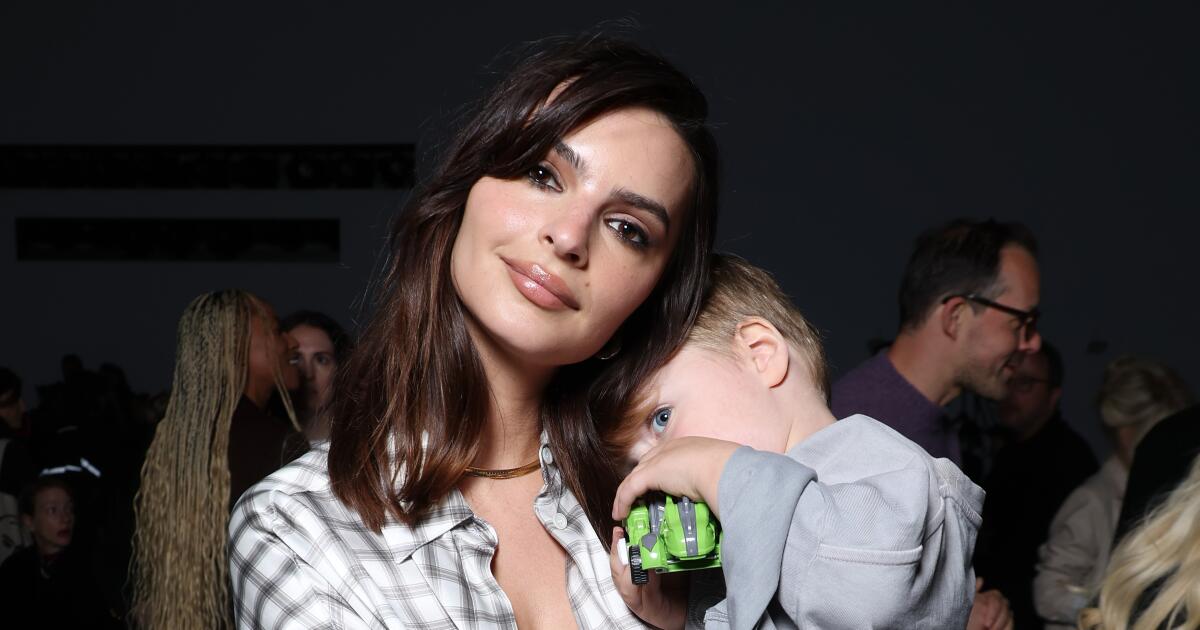
Emily Ratajkowski’s viral essay detailing her sex life as a single mom just landed her a seven-figure book deal.
According to Page Six, the model’s essay in the Cut had publishers champing at the bit in a 12-way bidding war that culminated in the hefty pay day. Editor Helen Rouner at Penguin Press — who also edited Lauren Christensen’s memoir “Firstborn” and Michael W. Clune’s novel “Pan” — reportedly landed the deal.
Penguin Press did not immediately respond to The Times’ request for comment Friday.
Publishers Marketplace announced the forthcoming memoir, describing it as “an examination of modern female identity through the story of the author’s own efforts as a newly single mother in New York City to discover what really constitutes a good life for a woman.”
The essay, which dropped a month ago and quickly broke the internet, drops the veil on EmRata’s sexual adventures (or maybe misadventures) since she and her former husband, Sebastian Bear-McClard, split in 2022.
“It was a violent transition into a new reality of screaming baby on my aching tit and ring on my swollen finger,” Ratajkowski writes of new motherhood. “And then, in a time period that felt both instant and excruciatingly slow, my marriage collapsed. Six months after my son was born, my husband and I stopped having sex. Less than a year later, we separated.”
In the missive, the model interrogates her sexuality — is she a Madonna or a whore? — while untangling bigger questions around gender, power and self-actualization. If Carrie Bradshaw wrote about “Sex and the City,” then Ratajkowski is writing about sex, the city and single motherhood. And naturally, her fleeting paramours have vague monikers: “Vegan Graffiti Artist,” “Spanish Gen-Zer” and “Son of a Billionaire.”
“And then there was the Elder Millennial: obsessed with dental hygiene, psychedelics, and dirty talk,” she writes. “He had approached the subject coyly at first, like it was something he was kind of embarrassed about — the way a kid will test you to see if you’ll talk to them about their dorky obsession of the moment. Do you like Godzilla? What about Star Wars?”
Would-be sleuths with Ratajkowski’s essay and a gossip rag handy will have their work cut out for them.
This will be Ratajkowski’s second book. The first, “My Body,” dropped in 2021 and was a bestselling collection of essays exploring gender, power dynamics, sexuality and the commodification of female beauty in the modeling and entertainment industries.
Ratajkowski’s foray into the spotlight came more than a decade ago when Robin Thicke’s controversial “Blurred Lines” music video made the model an overnight star. She was cast in David Fincher’s adaptation of “Gone Girl,” which hit theaters the following year, and catapulted to top fashion runways — Marc Jacobs, Versace, Victoria’s Secret and Dolce & Gabbana, to name a few. She she’s been romantically linked to Harry Styles, Eric Andre, Shaboozey, Brad Pitt and Pete Davidson, among others.
In 2023, she moonlighted as the host of the “High Low With EmRata” podcast, where she interviewed sex workers, investigated ethical nonmonogamy and pondered the etymology of the word “toxic.” The same year, she told The Times that she was coming into herself post-divorce, “Being able to assert what I want — that feels like it just started: My life as a creator and not as a muse.”

Wainheads will be delighted to see his alums in cameos: Kerri Kenney-Silver, Michael Ian Black, Thomas Lennon, and supporting roles for Zickel and Truglio. A large portion of the cast are his homies. But with Deutch, Gutierrez-Riley, Wang, Slattery, Impacciatore, and yes, Hamm, it’s as if they’re being inducted into a new mad family. Wain and Marino are basically catching Pokémon and hoping they can hold onto the roster (by that logic, yes, Paul Rudd is a legendary Pokémon). The film is anchored by Zoey — everything everywhere all this summer with Voicemails From Isabelle to Minions & Monsters — Deutch in the Dorothy Gale role, exuding a high level of perkiness consistent with the character’s can-do, wide-eyed, midwestern charm and heart.
A major standout, Ben Wang finally gets to show off his comedic abilities, portraying a self-assured, quick-witted agent who makes me laugh every time he reveals his sheltered upbringing in snappy whines at every inconvenience. Sabrina Impacciatore, who has proven to be a comedic juggernaut in The Paper, is having so much fun hamming it up as the mob boss-esque wicked witch counterpart, torturing her henchmen and deliciously chewing up the scenery whenever onscreen. I don’t think they use her to the height of her comedic prowess, but she’s a delight nonetheless. John Slattery is the film’s comedic MVP. The way the writers use his over-the-top character for comedy is downright hilarious every time. They use him as either a punchline or a force of nature, and he’s great. This movie is like Mad Men propaganda, and by God, it works. As someone who’s never seen it, Gail allowed me a better appreciation for Slattery and Hamm.
Man, we don’t deserve Jon Hamm. This is the second time I’ve seen him play a silly, fictionalized version of himself this year (the other being the SXSW crowd-pleasing rom-com Wishful Thinking, which Gail distributor Sony Pictures Classics acquired), and he also voice-acted in his comedic Mayor Jerry role in Hoppers. Maybe working with Wain in 2007’s The Ten was the canon event, but I consider his weird little sex scene with Kristen Wiig in Bridesmaids his awakening. Since then, I’ve only seen him as unserious, and it’s delightful. Oz-like in appearance, he’s funny and befitting the film’s overall light, joyful nature.
LAST STATEMENT
Ultimately, Gail Daughtry and the Celebrity Sex Pass is a campy, delightful romp that succeeds as both a distinctive Hollywood‑centric riff and a Wizard of Oz reimagining, retaining a loving, twisted, demented charm. It’s a weird description, but it’s so high‑spirited and light‑hearted despite being strangely ultraviolent. It might as well be a live‑action episode of Smiling Friends (RIP), yet it’s everything the theatrical market needs today. Ten years ago, this would’ve been a studio production rather than an indie Sundance acquisition, but thank God it exists for the big screen. More absurdist Gail Daughtrys for cinemas (not streaming), please, because this is the most fun to be had in a theater all summer, if not the year thus far.
-

 Washington, D.C1 minute ago
Storm Team4 Forecast: Scattered showers and storms possible Saturday PM
-

 Cleveland, OH8 minutes ago
Cleveland’s First Round woes must end with the 2026 class
-

 Austin, TX11 minutes ago
Texas reports dozens of cyclosporiasis cases tied to contaminated fresh produce
-

 Alabama23 minutes ago
Small Plane Makes Emergency Landing In Peanut Field Near Florida-Alabama Line : NorthEscambia.com
-
Alaska26 minutes ago
An Alaska vacation can remind Israelis the world doesn’t revolve around them | The Jerusalem Post
-
 Arizona31 minutes ago
Arizona AG continues to investigate Glendale apartment complex after Friday deadline to fix A/C
-

 Arkansas38 minutes ago
Office of Keep Arkansas Beautiful Now Part of the ARDOT
-

 California41 minutes ago
Amber Alert issued for 3-year-old out of California City in Kern County

