Entertainment
In ‘Vladimir,’ Rachel Weisz navigates steamy fantasies and an unraveling reality

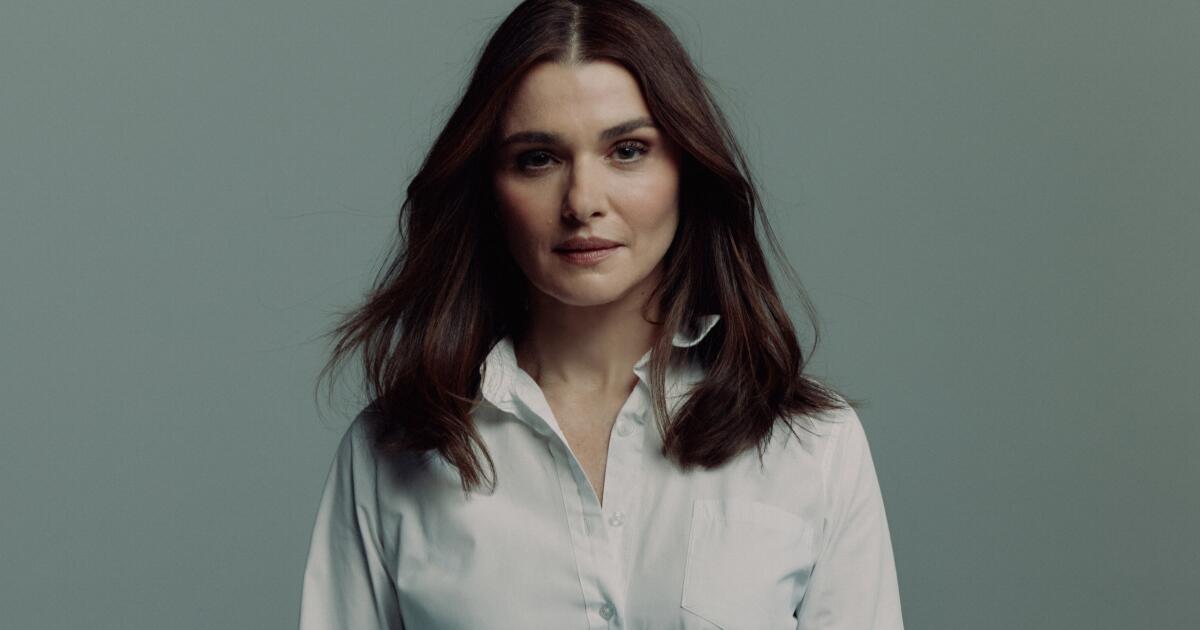
London — It’s been almost six months since Rachel Weisz wrapped filming on “Vladimir,” and she’s still unsure how to discuss her character on the series. The unnamed protagonist, known in the scripts as “M,” was so complexly drawn that Weisz is now struggling to externalize the experience of playing her.
“This is the first time I’ve spoken about it to anybody,” she says, sitting at a table in Goodfare, a restaurant in London’s Camden, on a frigid morning in early January. “I may be a little creaky.”
It’s a few days after the holiday break and Weisz, 55, is preparing to start production on a new film, “Séance on a Wet Afternoon.” Despite that, she hasn’t fully left M behind. As an executive producer on the series, she was involved in the edit, still ongoing at the time of our interview. Today, after a meandering back and forth about the character, she admits, “I suppose I still need to gather my own point of view on her.”
“Vladimir,” an eight-episode limited series premiering March 5, is based on playwright Julia May Jonas’ 2022 novel of the same name. Both the novel and the series center on a literature professor (Weisz) who teaches at a liberal arts college. Her husband (John Slattery) is under investigation for misconduct at the school as she becomes infatuated with a new colleague named Vladimir (Leo Woodall). Jonas wrote the pilot several years ago without a particular actor in mind for the lead character, who narrates the novel as if she were delivering an ongoing monologue. Weisz had read the book — it was recommended to her by a friend — before she was sent the script.
Rachel Weisz as M, a literature professor who becomes infatuated with the titular character, played by Leo Woodall.
(Netflix)
“It was a damn good piece of writing, the novel and the pilot,” she says. It led to a meeting with Jonas. “Ultimately, I think I was really intrigued about getting into the skin of this character,” Weisz adds. “I thought it would be challenging and hopefully fun.”
As M’s life goes farther off the rails, she becomes more obsessed with Vladimir, often indulging in torrid romantic fantasies about him, which the audience sees in juxtaposition to the more mundane reality. She eventually crosses lines at work and at home, all while narrating her unraveling directly to the viewer.
“The novel is very internal,” Jonas says, speaking later over Zoom from New York. “So it was about: How do we take that internal voice and translate it to the screen? One of the ways was her direct address, but we wanted to twist what that device usually does for an audience. In most direct addresses, the actor tells you the truth about what’s really going on.”
But that’s not what always happens here.
“I wanted to flip that to where she’s talking to someone and she’s always trying to massage the truth or sometimes outright lie,’” Jonas says. “She’s a completely unreliable narrator.”
Throughout the series, M confides in the camera, an unusual technique that draws its inspiration from Jonas’ theater background. Weisz remembers doing a Neil LaBute play in the ‘90s in which she broke the fourth wall but had never done so onscreen. The actor says she did have an audience in mind when speaking to the camera, but it would be “reductive” to overexplain it.
“There was somebody I was imagining,” she says. “On set, we called it my special friend. The other actors had to pretend it didn’t happen. It wasn’t so much choreographed as it was breaking out of the scene and chatting to my special friend and then going back into the scene.”
It eventually became second nature for her and the cast, she says.
“It was really interesting watching Rachel and all the creators involved navigate that,” Woodall adds, speaking separately on Zoom from London. “She did a really remarkable job at staying within a scene while also having to pivot and deliver a monologue and then come straight back into the scene. It was a new challenge for me, but I thought it was going to be more difficult than it actually was.”

“There was somebody I was imagining,” says Rachel Weisz about breaking the fourth wall with her character on “Vladimir.” “On set, we called it my special friend.”
(Sophia Spring / For The Times)
The episodes are snappy, at around 30 minutes each, and the tone of “Vladimir” often leans more funny than serious. Weisz tends to gravitate toward drama — her last series was a remake of David Cronenberg’s “Dead Ringers” — but she has flexed her comedic muscles in the past, notably in Yorgos Lanthimos’ satirical film “The Favourite.” She doesn’t see herself as a particular funny actor despite the many laugh-inducing moments in “Vladimir.”
“For me, everything was intensely serious,” she says. “It was about committing to her reality and what she cares about and what matters to her and how she’s trying to convince herself that everything’s just fine.”
She pauses. “I wouldn’t know how to be funny,” she affirms. “It’s not my wheelhouse. I was aware that there was a lot that was ridiculous, but life is often so ridiculous, isn’t it? Things are going very wrong in her life with her husband and everything. It gets harder and harder for her to toe that line as she tries to pretend it’s not going wrong.”
Weisz mostly relied on her “imagination and Julia’s words” to portray the character. She’s known a lot of professors over the years, especially when she lived in New York City, which helped. She understood that despite the character’s misbehavior in the series — like breaking into her boss’ office — she’s decently good at her job. “Times are changing and her husband is in this deep crisis and her reputation is on the line,” Weisz says. “But I think she thinks she’s a beloved teacher and an esteemed professor.”
To play M, Weisz had to be totally on her side. She knows it’s generally important to be able to defend the person you’re playing, but she also says the character felt “psychologically true.”
“It’s very hard to do something if it doesn’t feel like that,” she says. “The writing is the beginning of my job and this was so well written. But I wouldn’t be able to play someone unless I could totally be in their point of view.”
Jonas says what makes M compelling is that it’s hard to put a label on her or know what to expect.

“Vladimir” is an adaptation of Julia May Jonas’ novel. The author says M is difficult to pin down.
(Sophia Spring/For The Times)
“Is she right? Is she wrong? Is she psycho? Is she sane? Is she brilliant? Is she all of those things? Or none of them? You can’t pin her down,” Jonas explains. “And that’s what makes her so exciting to watch. You’re not quite sure what the choice is that she’s going to make next other than being deeply smart and well read.”
“Vladimir” began shooting in July 2025 in Toronto, which stood in for an undefined liberal arts college town. It was deliberately shot while Weisz’s young daughter with husband Daniel Craig was out of school for the summer. Although the actor felt tethered to the character while on set, she could easily dissociate at the end of the day. She’s repeatedly keen to clarify that she’s nothing like M even as she defends her, as if she’s slowly realizing just how unhinged the character comes off in the series.
“I deeply empathize with her and understand her,” Weisz says. “But I left her when I got home. She’s like a projection of what a viewer might want to live out.”
Jonas adds, “It’s allegorical in nature. What if I could just take this man and chain him up? It’s making that literal for us to watch. It’s about that female id deep inside of us.”
Both Woodall and Jonas were struck by Weisz’s intuitive approach to the character. Woodall and Weisz didn’t discuss M’s relationship with Vladimir during filming.
“She loves as much spontaneity as possible, and she loves to not really know ahead of time what the actor’s going to do,” Woodall says. “For someone who’s as well established as she is and so beautiful, it was really fun to see her allow herself to be the butt of a joke and look ridiculous. Some of the scenes that we shot, we would finish, and she would burst out laughing. She leaned into it and had a lot of fun with it.”
“Rachel is completely surprising,” Jonas adds. “The first time I’d see a scene I’d think, ‘Oh, that’s not how I wrote it at all.’ And then I would see it a second time and I would realize what she was doing. That’s what makes her so alluring as an actor. She’s funny and interesting and a little off-key but fully committed, and you never know what she’s going to do next.”
Weisz has always wanted to be an actor, but she didn’t realize it could be a career until college. She’s drawn to writing and to singular voices. “I loved joining hands with Julia’s imagination,” she says. “I love writers. I’m not one because it’s too solitary, but they’re my favorite people to be with.”

“She’s funny and interesting and a little off-key but fully committed, and you never know what she’s going to do next,” says Jonas about Weisz.
(Sophia Spring / For The Times)
She tends to select projects based on the script, but otherwise she isn’t picky. Weisz has done everything from quirky indie films to prestige drama to high-octane action to Marvel. She won the Oscar for supporting actress in 2006 for “The Constant Gardener” and was nominated again for “The Favourite.”
“In the beginning of my career, I just did whatever job I got so I could pay the rent,” she says, shrugging. “I wasn’t picky. Now I’m in this luxurious position where I can choose things. It’s really about the character and writing, if it appeals to me or if it seems it would be interesting to pretend that story.”
Since our interview in January, Universal Pictures confirmed the production of “The Mummy 4,” which will feature Weisz and Brendan Fraser reprising their roles as Evelyn and Rick O’Connell (Weisz didn’t appear in the third installment). Prior to that announcement, though, Weisz is cagey about the film. “They’re seriously talking about it,” she says. “Brendan’s been very involved. It sounds very interesting.”
Being interested in a character or a story is what ultimately drives Weisz. Her performance in “Vladimir” completely eschewed vanity and instead fixates on what makes this woman go off the rails. M wants so badly to control her own narrative and is unable to face the reality of her life, but she’s also a talented writer and professor who wants the best for her family.
“People are contradictory,” Weisz says. “They can be brilliant at their jobs and have a very messy personal life. This is someone who is human. I know it’s very heightened and ridiculous, and it is in the genre of comedy, but it’s very true. Humans can have these massive contradictions.”
Although Weisz instinctively understands M, questions linger. She hasn’t decided whether M is complicit in her husband’s misbehavior (“That’s a hornet’s nest,” she says) and she’s not sure what happens to the character in the end. Even during the editing process she’s struggled to see M from the outside. “I just see her,” she says. “I don’t see me there at all.”
As the interview wraps, Weisz worries I won’t have what I need. Did she say enough about the series? Did she overly defend her character?
“I’m still aligned with her point of view,” she acknowledges again. “I think she’s — I was going to say I think she’s reasonable, but that might not be quite the right word.”
The actor laughs. “I am aware that is not the right word.”



By ABBIE BERNSTEIN / Staff Writer
Posted: March 8th, 2026 / 08:00 PM
THE BRIDE movie poster | ©2026 Warner Bros.
Rating: R
Stars: Jessie Buckley, Christian Bale, Annette Bening, Jake Gyllenhaal, Peter Sarsgaard, Penelope Cruz, Jeannie Berlin, Zlatko Burić
Writer: Maggie Gyllenhaal, based on characters created by Mary Shelley and William Hurlbut and John Balderston
Director: Maggie Gyllenhaal
Distributor: Warner Bros.
Release Date: March 6, 2026
“THE BRIDE!” (as with the recent “WUTHERING HEIGHTS,” the quotation marks are part of the title) is awash in homages, and not just the ones we might reasonably expect in a movie that takes its most obvious inspiration from 1935’s BRIDE OF FRANKENSTEIN.
There’s that, of course, plus its source, Mary Shelley’s 1818 novel FRANKENSTEIN; OR THE MODERN PROMETHEUS, and its sober 1931 film adaptation FRANKENSTEIN. But there are also big nods to wilder takes on the legend, including YOUNG FRANKENSTEIN and THE ROCKY HORROR PICTURE SHOW and even movies that have nothing to do with FRANKENSTEIN, like BONNIE AND CLYDE.
Writer/director Maggie Gyllenhaal casts a wide net in metaphors and ideas and looks. Sometimes “THE BRIDE!” is a comedy, sometimes it’s a crime drama, sometimes it’s a love story, occasionally, it’s even a musical.
Mary Shelley (Jessie Buckley) narrates the tale to us from beyond the grave. She is haughty and naughty, intoxicated by verbiage and her own literary genius. She is going to tell us a story, she says, that she didn’t even dare imagine while alive.
We’re in 1930s Chicago, where a young escort (also Buckley) is having a really awful evening out at a fancy restaurant with some of her peers and a bunch of crass gangsters. Shelley dubs the woman “Ida” and takes possession of her, causing her to speak and act in ways that get her escorted outside. There she stumbles and takes a fatal fall.
The two goons who were with Ida are happy to describe her tumble as the result of their intentional actions to their horrible gangster boss (Zlatko Burić). Ida was suspected of talking to the cops.
Around the same time, Frankenstein’s creation (Christian Bale) – let’s just call him “Frank,” like everybody else does – comes to Chicago to seek out the groundbreaking scientist Dr. Euphronious (Annette Bening), whose published works he has read.
Frank wants the doctor to create a companion for him. His appearance is unusual, but the most alarming injuries are covered by clothing, so he’s not as extreme-looking as, say, Boris Karloff in the role. This isn’t about sex, Frank explains when Euphronious asks why he doesn’t just hire a prostitute. After over a century of loneliness, he seeks a soulmate, and he is sure this can only be achieved by reviving a corpse.
So, Euphronious and Frank dig up the grave that turns out to belong to Ida (we never do learn how they know it belongs to a soulmate candidate as opposed to a shot-and-dumped male gangster). Euphronius revives her. Ida remembers how to walk and talk, but not who she is or what happened, so Frank and the doc tell her she’s been in an accident.
Even without Ida’s beauty, Frank is already devoted to the very notion of her. A more accommodating suitor would be hard to find. Frank has another passion, the musical films of Ronnie Reed (Jake Gyllenhaal, the filmmaker’s brother), a Fred Astaire-like star. Frank imagines himself in the midst of those dance routines, and we get some more within “THE BRIDE!”’s “real” action.
One thing leads to another, Frank and Ida go on the run, leaving a trail of bodies in their wake. They are pursued all over the country. Among those seeking them are sad-eyed police detective Jake Wiles (Peter Sarsgaard) and his secretary Myrna Mallow (Penélope Cruz), who’s better at this whole crime-solving business than he is.
It’s all very kaleidoscopic and energetic, occasionally impressive and sometimes very funny. Bening as the frazzled, worldly Euphronious has some great moments. Buckley, currently and justifiably Oscar-nominated leading performance in HAMNET, juggles the very unalike personas of Mary and Ida with impact.
Oddly, Bale underplays Frank. We get that he is trying his hardest not to spook Ida (or anyone else), but it seems like he should have a bit more spark. Cruz, going for a snappy ‘30s working woman, has her own style that works.
But in addition to being entertaining and eye-catching, Gyllenhaal has a message that gets very muddled. This is less because it’s so familiar by now that it feels a little redundant, and more because a crucial part of the set-up collides head-on with the feminist slant.
Ida seeks to be her own person, but she is literally bodily controlled by Mary Shelley, who puts her creation in danger with her outbursts. This may help get Ida out of the clutches of the mob, but it is possession, the aftereffects of which the character understandably finds confusing and upsetting.
If Gyllenhaal wanted to discuss or dramatize the clash between what Mary, as a woman, is doing to this other woman, that would make sense, but it seems we’re just meant to somehow overlook this while being immersed in how men control women. The resulting cognitive dissonance adds another layer to a movie that already has more than it can comfortably service.
Additionally, when Mary has one of her outbursts while inhabiting Ida, the plot comes to a screeching halt until she’s finished. Many viewers will wish Mary would stop declaiming and just let Ida be herself.
“THE BRIDE!” succeeds in being trippy and some of it is memorable. By the end, though, it is more disjointed than even a movie about experiments and a character made up of multiple people’s body parts ought to be.
Related: Movie Review: NFT: CURSED IMAGESRelated: Movie Review: SCREAM 7
Related: Movie Review: OPERATION TACO GARY’S
Related: Movie Review: ANACORETA
Related: Movie Review: THIS IS NOT A TEST
Related: Movie Review: GHOST TRAIN
Related: Movie Review: COLD STORAGE
Related: Movie Review: THE HAUNTED FOREST
Related: Movie Review: “WUTHERING HEIGHTS”
Related: Movie Review: THE MORTUARY ASSISTANT
Related: Movie Review: THE STRANGERS: CHAPTER 3
Related: Movie Review: PILLION
Related: Movie Review: JIMPA
Related: Movie Review: ISLANDS
Related: Movie Review: WORLDBREAKER
Related: Movie Review: MOTHER OF FLIES
Related: Movie Review: 28 YEARS LATER: THE BONE TEMPLE
Related: Movie Review: NIGHT PATROL
Related: Movie Review: THE CONFESSION (2026)
Related: Movie Review: WE BURY THE DEAD
Related: Movie Review: ANACONDA
Related: Movie Review: AVATAR: FIRE AND ICE
Related: Movie Review: IS THIS THING ON?
Related: Movie Review: MANOR OF DARKNESS
Related: Movie Review: DUST BUNNY
Follow us on Twitter at ASSIGNMENT X
Like us on Facebook at ASSIGNMENT X
Article Source: Assignment X
Article: Movie Review: “THE BRIDE!”
Related
Related Posts:
Entertainment
‘Sinners,’ ‘The Pitt’ win big at Writers Guild Awards after L.A. ceremony cancellation

The already highly decorated “Sinners” was among the top winners at the 78th Writers Guild Awards on Sunday in New York City.
The horror film, directed and written by Ryan Coogler, won the award for original screenplay, and its biggest competitor for the best picture Oscar, Paul Thomas Anderson’s “One Battle After Another,” clinched the win for adapted screenplay. “Sinners” star Miles Caton accepted the award for the former, and “One Battle” cast member Shayna McHayle for the latter.
“Sinners” star Miles Caton and “One Battle After Another” actor Shayna McHale accepted the awards for original and adapted screenplay, respectively.
(Cindy Ord / Getty Images for Writers Guild of America East)
In the TV realm, “The Pitt” made a splash with awards for drama series, new series and episodic drama.
As for lifetime achievement honors, Robert Smigel presented Stephen Colbert with the Walter Bernstein Award for critiquing the power elite on his late-night show, which will air its final episode in May. Terry George received the Ian McLellan Hunter Award for Career Achievement from Don Cheadle, and Diana Son earned the Richard B. Jablow Award for Devoted Service to the Guild from last year’s recipient, Kathy McGee.
Most years, the Writers Guild holds simultaneous ceremonies in New York and Los Angeles. But the East Coast edition became a solo affair after WGA West canceled its ceremony amid an ongoing strike by its own staff union, who claimed guild management had “surveilled workers for union activity, terminated union supporters, and engaged in bad faith surface bargaining.”
The L.A. ceremony was set to honor James Cameron with the Laurel Award for Screenwriting Achievement, Don Reo with the Paddy Chayefsky Laurel Award for Television Writing Achievement and Mstyslav Chernov with the Paul Selvin Award for “2,000 Meters to Andriivka,” which won the award for documentary screenplay Sunday evening.
While WGA West’s board of directors said the ceremony was postponed to give members “an uncomplicated celebration of their achievements,” the Writers Guild Staff Union characterized the cancellation as an attempt to sow division between management and unionized staff, which is ill-timed given upcoming contraction negotiations between the WGA and the Alliance of Motion Picture and Television Producers, which represents Hollywood studios and streamers. In 2023, the WGA went on its longest-ever strike, lasting 148 days.
Comedian and Emmy-nominated producer Roy Wood Jr., who this year hosted the WGA’s East Coast ceremony for the third time, during his opening monologue offered (in jest) his predictions for the negotiations, which begin later this month.
“First, I predict somebody’s gonna lose their s—,” the host said. “Cooler heads are gonna prevail, and then somebody else is gonna lose their s—.”
Here is the full list of Writers Guild Award winners:
Original screenplay: “Sinners,” written by Ryan Coogler; Warner Bro. Pictures
Adapted screenplay: “One Battle After Another,” screenplay by Paul Thomas Anderson, screen story by Paul Thomas Anderson, inspired by the novel “Vineland” by Thomas Pynchon; Warner Bros. Pictures
Documentary screenplay: “2,000 Meters to Andriivka,” written by Mstyslav Chernov; Frontline Features
Drama series: “The Pitt,” written by Cynthia Adarkwa, Simran Baidwan, Valerie Chu, R. Scott Gemmill, Elyssa Gershman, Joe Sachs, Noah Wyle; HBO Max
Comedy series: “The Studio,” written by Evan Goldberg, Alex Gregory, Peter Huyck, Frida Perez, Seth Rogen; Apple TV
New series: “The Pitt,” written by Cynthia Adarkwa, Simran Baidwan, Valerie Chu, R. Scott Gemmill, Elyssa Gershman, Joe Sachs, Noah Wyle; HBO Max
Limited series: “Dying for Sex,” written by Sheila Callaghan, Harris Danow, Madeleine George, Elizabeth Meriwether, Amelia Roper, Kim Rosenstock, Sasha Stewart, Sabrina Wu, Keisha Zollar; FX/Hulu
TV & streaming motion pictures: “Deep Cover,” written by Derek Connolly and Colin Trevorrow; Prime Video
Animation: “Shira Can’t Cook” (“Long Story Short”), written by Mehar Sethi; Netflix
Episodic drama: “7:00 A.M.” (“The Pitt”), written by R. Scott Gemmill; HBO Max
Episodic comedy: “Prelude” (“The Righteous Gemstones”), written by John Carcieri, Jeff Fradley, Danny R. McBride; HBO Max
Comedy/variety series – talk or sketch: “Last Week Tonight with John Oliver,” senior writers: Daniel O’Brien, Owen Parsons, Charlie Redd, Joanna Rothkopf, Seena Vali; writers: Johnathan Appel, Ali Barthwell, Tim Carvell, Liz Hynes, Ryan Ken, Sofía Manfredi, John Oliver, Taylor Kay Phillips, Chrissy Shackelford; HBO Max
Comedy/variety specials: “Marc Maron: Panicked,” written by Marc Maron; HBO Max
Quiz and audience participation: “Celebrity Jeopardy!”, head writer: Bobby Patton; writers: Kyle Beakley, Michael Davies, Terence Gray, Amy Ozols, Tim Siedell, David Levinson-Wilk; ABC
Daytime drama: “The Young and the Restless,” associate head writers: Jeff Beldner, Marla Kanelos, Dave Ryan; writers: Susan Banks, Amanda L. Beall, Marin Gazzaniga, Rebecca McCarty, Madeleine Phillips; CBS/Paramount+
Children’s episodic, long form and specials: “When We Lose Someone” (“Tab Time”), written by Sean Presant; YouTube
Short form streaming: “The Rabbit Hole with Jimmy Kimmel,” writers: Jimmy Kimmel and Jesse Joyce; YouTube
Documentary script — current events: “Trump’s Power & the Rule of Law” (“Frontline”), written by Michael Kirk and Mike Wiser; PBS
Documentary script — other than current events: “Forgotten Hero: Walter White and the NAACP” (“American Experience”), written by Rob Rapley; PBS
News script — regularly scheduled, bulletin or breaking report: “Devastating Flooding in Texas” (“World News Tonight with David Muir”), written by David Muir, Karen Mooney and Dave Bloch; ABC News
News script — analysis, feature or commentary: “Remembering Palestinian Journalists Killed by Israeli Forces” (“Ayman”), written by Lisa Salinas; MSNBC
Digital news: “An Isolated Boarding School Promised to Help Troubled Girls. Former Students Say They Were Abused.,” written by Sebastian Murdock and Taiyler Mitchell; HuffPost
Radio/audio documentary: “Jerry Lewis’ Lost Holocaust Clown Movie” (“Decoder Ring”), written by Max Freedman; Slate
Radio/audio news script — regularly scheduled, bulletin or breaking report: “ABC News Radio Top of the Hour News”, written by Robert Hawley; ABC News Radio
Radio/audio news script — analysis, feature or commentary: “The Life and Legacy of Jimmy Carter,” written by Gail Lee; CBS News Radio
On air promotion: “CBS Comedy,” written by Dan Greenberger; CBS
Times staff writers Stacy Perman and Cerys Davies contributed to this report.
Movie Reviews
‘Heel’ Review: Why Did Stephen Graham and Andrea Riseborough Sign on for This Contrived Debacle?

The original title of “Heel” was “Good Boy.” The new title is probably more accurate, though an even more accurate title might be “Painfully Annoying Punk Idiot.” I jest (a bit), since the title of “Heel” is actually a verb. The film wants to tell the story of a budding hooligan who needs to be brought to heel. That said, does anyone seriously want to see a movie about a 19-year-old British sociopath who gets chained up in a basement so that the weird upper-middle-class couple who’ve kidnapped him can modify his behavior? “Heel” is like “A Clockwork Orange” remade as the year’s worst Sundance movie.
The opening sequence is actually promising. It depicts, in rapidly edited documentary-like montage, a reckless night out on the town by Tommy (Anson Boon) and his friends. They’re hopped-up club kids, and Tommy is their snarling, curly-haired, sexually coercive wastrel ringleader, living in the moment, pouring drinks down his throat, snorting coke and popping pills, dancing and carousing and puking and rutting in the bathroom, pushing himself to a higher and higher high, until he winds up collapsed on the sidewalk — a ritual, we gather, that has happened many times before. Only this time his crumpled body is gathered up by a mysterious stranger.
When Tommy wakes up, he’s in the basement of a stately stone house somewhere in the British countryside. He’s got a metal collar around his neck, and it’s chained to the ceiling. The film has barely gotten started, and already it’s cut to the second half of “A Clockwork Orange”: Can this monster delinquent be rehabilitated? Theoretically, that’s an interesting question, except that the way this happens is so garishly contrived that we can only go with the movie by putting any plea for reality on permanent hold.
Who are the people who have kidnapped Tommy? Chris (Stephen Graham) is a mild chap in a toupee who goes about his mission with a puckish vengeance disguised as gentility. His wife, Kathryn (Andrea Riseborough), is so neurasthenic she’s like a ghost. (She has suffered some trauma that isn’t colored in.) The two have a cherubic preteen son they call Sunshine (Kit Rakusen). And why, exactly, are they doing what they’re doing? We have no idea. Trying to make a bad person into a good person is not, in itself, a terrible notion, but the conceit of “Heel” — that Tommy is locked in a dungeon, being treated like a dog, because that’s what it will take to change him — is like a toxic right-wing fantasy that the film somehow reconfigures into an implausible liberal “family” allegory.
Ah, plausibility! How unhip to gripe about the absence of it. Yet watching “Heel,” I found it impossible to suspend my disbelief for two seconds. The entire movie, directed by the Polish filmmaker Jan Komasa (“Corpus Christie”) from a script by Bartek Bartosik and Naqqash Khalid, is just a grimy monotonous conceit. It’s been thought out thematically but not in terms of recognizable human behavior. It’s like a film-student short stretched out to an agonizing 110 minutes.
Anson Boon, a charismatic actor who did an okay job of playing Johnny Rotten in Danny Boyle’s TV miniseries “Pistol” (though he never conjured Rotten’s homicidal gleam), infuses Tommy with a loutish energy that in the early scenes, at least, makes him a convincing candidate for either prison or the contemporary equivalent of shock therapy. And yet the character is exhaustingly obnoxious. As a filmmaker, Komasa doesn’t dramatize — he uses one-note traits to clobber the audience. Stephen Graham’s Chris is as quiet and circumspect as Tommy is abrasive. He tries to train Tommy by showing him motivational tapes, and by subjecting him to Tommy’s own depraved TikToks. He then rigs up an elaborate system of gutters on the ceiling so that Tommy, in his metal leash, can wander around the house, a sign that he’s been housebroken.
Tommy has to grow and change, since there wouldn’t be a movie otherwise. In the process, he gets less annoying but also less interesting, because “Heel” sentimentalizes his transformation. Komasa seems to have missed the key irony of “A Clockwork Orange”: that the behavior modification of Alex is as brutalizing as his original state of punk anarchy. In “Heel,” Tommy’s evolution is singularly unconvincing — by the end, he’s practically ready to be the suitor in a Jane Austen drama. But that’s all of a piece with a movie so false it puts the audience in the doghouse.

How a Choreographer Lives on $55,000 in Kensington, Brooklyn

Detroit water main break snarls travel on East Jefferson Monday morning

Soak up sunlight in SF with these 18 fun events

Dallas weather: Storms return this week with large hail and tornado threat

Miami Dolphins releasing quarterback Tua Tagovailoa, team says

Florida High School Football Rankings: Top 25 teams – Oct. 21

How old is Bo Nix? What to know about Oregon quarterback ahead of 2024 NFL Draft

Cleary's 21 help Le Moyne down Central Connecticut State 69-64 in OT

99th annual Pony Swim held in Virginia

Indiana Members Credit Union announced as new anchor tenant at Bottleworks District

Video: Airports Struggle to Staff T.S.A. During Partial Government Shutdown

Before-and-after satellite imagery offers a rare look at damage inside Iran
Hungary's opposition leader Péter Magyar calls on Russia to refrain from election interference

Video appears to show U.S. cruise missile striking Iranian school compound

Trump vows block on signing new laws until SAVE America Act passes Senate
-

 Wisconsin1 week ago
Setting sail on iceboats across a frozen lake in Wisconsin
-

 Massachusetts6 days ago
Massachusetts man awaits word from family in Iran after attacks
-

 Maryland1 week ago
AM showers Sunday in Maryland
-

 Florida1 week ago
Florida man rescued after being stuck in shoulder-deep mud for days
-

 Pennsylvania4 days ago
Pa. man found guilty of raping teen girl who he took to Mexico
-

 Oregon1 week ago
2026 OSAA Oregon Wrestling State Championship Results And Brackets – FloWrestling
-

 News1 week ago
2 Survivors Describe the Terror and Tragedy of the Tahoe Avalanche
-

 Sports4 days ago
Keith Olbermann under fire for calling Lou Holtz a ‘scumbag’ after legendary coach’s death