Entertainment
How the Grateful Dead inspired Bill Walton and shaped his life's perspective

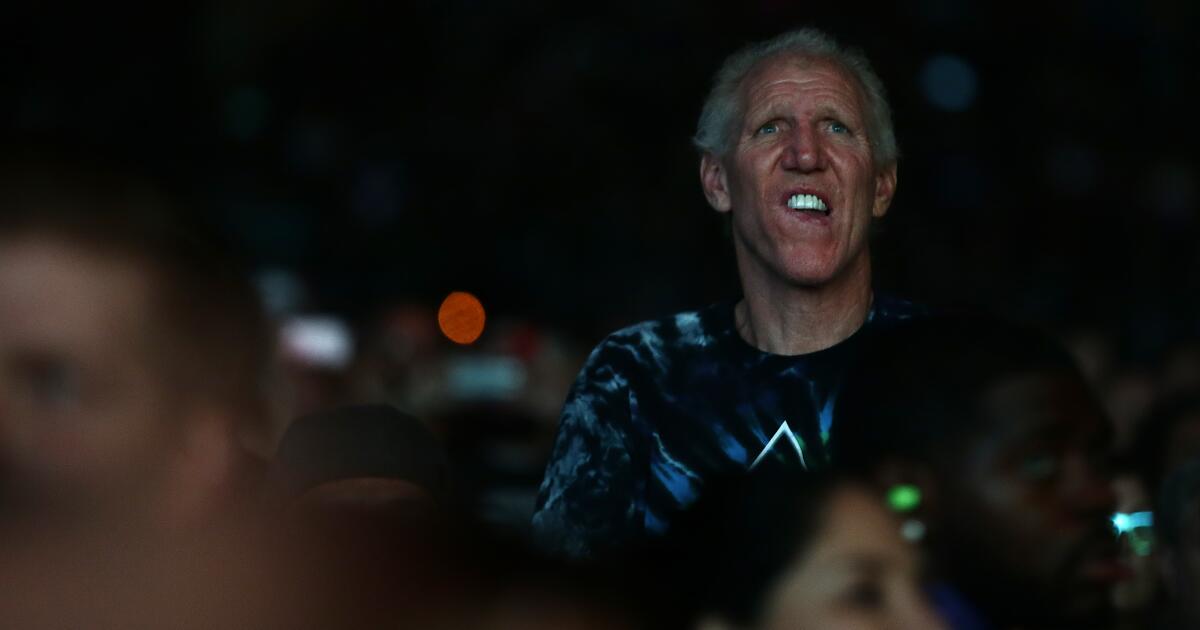
Bill Walton was a proud Deadhead.
The basketball great, who died Monday at age 71 following a prolonged cancer battle, was famously a huge fan of the Grateful Dead (and a tie-dye aficionado). A fixture at the band’s shows — he was hard to miss at nearly 7 feet — Walton reportedly had attended more than 850 shows since 1967, including when the Dead played in front of the Great Pyramids in Egypt in 1978. As a broadcaster for ESPN, Walton often inserted references to the band in his color commentary during games.
“I became the basketball player that I was because of the Grateful Dead,” said Walton in a 2016 interview with Salon. “I am the human being that I am today because of the Grateful Dead. They’re right there at the top of my teachers. Their inspiration moved me brightly.”
More than just a fan, the UCLA basketball legend, who helped lead the team to back-to-back NCAA championships (and undefeated seasons) during coach John Wooden’s tenure in the 1970s, developed a friendship with the Grateful Dead over the years. The band often would stay at Walton’s house when they were in San Diego, and the Hall of Famer attended band member Jerry Garcia’s private funeral. Not only that, his home resembled a Grateful Dead museum, with photos and memorabilia lining the walls. Walton even peppered his 2016 memoir, “Back From the Dead,” with his love of (and lyrics from) the band.
Among the anecdotes that Walton shared is how he got his Boston Celtics teammates into a Grateful Dead concert in 1985. (Walton, who was drafted first overall by the Portland Trail Blazers in 1974, had been traded by the Clippers to the Celtics in 1985.) His teammates had never seen the band perform and gathered at Larry Bird’s house before the show.
“I had to explain to everybody in the Grateful Dead that … the Celtics were just icons and they couldn’t really go out in public because they were so popular,” recounts Walton in a video previously shared on X, formerly Twitter. “They said, ‘We’ll take care of this, Bill.’ So they built this special little enclave right on the side of the stage where, unless you were on the stage, you couldn’t look into this little area. It was all curtained off. It was the perfect little place to watch the concert.”
Following news of his death, fellow Deadheads posted tributes to Walton on social media, remembering him for his kind spirit and big smile.
In a TV interview, Walton discussed how the Grateful Dead helped shape his approach to life.
“I don’t look back,” said Walton. “Over the course of my basketball career I’ve had many many setbacks and many pitfalls that I’ve stumbled into. Something that I’ve learned and I’ve received a lot of encouragement and help from my friends, particularly in the Grateful Dead, [is] don’t look back. Just keep going and something good will happen.”



1 of 5 | Elvis Presley performs in Las Vegas in “EPiC: Elvis Presley in Concert,” in theaters Friday. Photo courtesy of Neon
LOS ANGELES, Feb. 16 (UPI) — EPiC: Elvis Presley in Concert, in theaters Friday, is a movie worthy of The King. Especially in IMAX, the concert documentary captures the magnitude of Presley’s charisma, performance and sense of humor.
Director Baz Luhrmann assembled footage from Presley’s 1969 to 1977 Las Vegas residency, including 16mm footage from the 1972 documentary Elvis on Tour and 8mm footage from Graceland to provide context for the concert.
All of the footage still looks like it was captured in the ’60s and ’70s. It hasn’t been restored to an inauthentic state.
However, the material that fills the entire IMAX screen makes that aesthetic towering. Even with front row seats, Presley never looked that big.
But, much of the concert footage, particularly a performance where he’s wearing the iconic white jumpsuit, is presented in the 2.35:1 widescreen aspect ratio. The sound actually immerses more clearly than many concerts because it is calibrated for a movie theater.
Though the narration is culled from Presley’s own soundbites, there isn’t any earthshattering revelation. He explains how his shaking dance moves developed alongside rhythm and blues music.
He dodges questions about Sun Records and his movie prospects in press conferences. Priscilla and baby Lisa Marie only appear in one brief section, but he appears happy and loving in those moments.
The rehearsals reveal the most about Presley’s character. He interacts with the band, makes performance decisions and cracks jokes.
Presley approached performing with good humor. The show is organized but he’s having fun with it and with his partners.
He uses humor on stage, too, but with his band, he is a lot more familiar than when he’s playing to the nosebleed section in an arena. So EPiC shows Presley adapting his humor to both settings.
The set list includes all-time hits like “That’s All Right,” “Hound Dog,” and “Are You Lonesome Tonight,” some of his gospel and more than one Beatles cover.
Presley performs “Burning Love” when it’s new, and coordinates with the band on how to conclude the live performance, which simply fades out on the record.
He gives a lot of female fans full kisses, so whatever they paid for front row seats they got their money’s worth. He doesn’t engage lustfully, and indeed his attention to young and disabled fans reinforces his good heart.
For a performer as well documented as Presley, EPiC envelops viewers in his energy. Even when there is overlap with other Presley material, EPiC‘s presentation elevates it to new heights.
Fred Topel, who attended film school at Ithaca College, is a UPI entertainment writer based in Los Angeles. He has been a professional film critic since 1999, a Rotten Tomatoes critic since 2001, and a member of the Television Critics Association since 2012 and the Critics Choice Association since 2023. Read more of his work in Entertainment.

What does one do on the morning of the Academy Award nominations? Wake up early? Try to sleep in? Wait for your publicist to call?
Having returned home late from a friend’s dinner the night before, Kate Hudson debated the best course of action ahead of last month’s nominations — before deciding she needed to wake up and hear the news either way.
“It’s been such a ride,” she says. “I wanted to be able to go back to sleep knowing that this part is over. Or I wanted to just wake up and celebrate and be tired. You prepare yourself for everything. But you just feel completely unprepared for when your name is called.”
Hudson’s lead actress Oscar nomination for her turn as Claire Sardina in “Song Sung Blue” is the culmination of an incredible awards season, in which she’s also been nominated for a Golden Globe, an Actor Award and a BAFTA. Based on a true story, the movie follows Claire and her husband, Mike (Hugh Jackman), who headlined the popular Milwaukee-based Neil Diamond cover band Lightning & Thunder in the 1980s and ’90s.
Hudson with Hugh Jackman in “Song Sung Blue.”
(Sarah Shatz / Focus Features)
The honor comes 25 years after Hudson received her first and only previous Oscar nod for playing Penny Lane in her breakthrough role in “Almost Famous.” And although she’s had a slew of successes in the interim — including the now-classic rom-com “How to Lose a Guy in 10 Days” and other hit movies; Netflix’s Lakers-inspired comedy series “Running Point,” currently in postproduction on its second season; and the popular podcast “Sibling Revelry,” which she hosts with brother Oliver Hudson — it can sometimes seem that we’ve underappreciated, and perhaps underestimated, Kate Hudson.
But for her, being recognized for “Song Sung Blue” isn’t some long-awaited vindication. As always, it’s about the work.
“When you’re acting, all you want to do are the things that stretch you, that are exciting,” she says. “You have these opportunities that come, and they don’t come very often, and so you get excited by that process. I don’t think you look from the outside in and say, ‘I always knew I could do this.’ It’s more, my drive is to continue doing this. It’s more, when you look into a horizon and you’re like, ‘Oh, that looks interesting. I wonder what that’s gonna be?’ versus, ‘I’m gonna do that and I’m gonna be good at that.’”

-
Share via
So the most rewarding part of the movie is not the possibility of adding trophies to her decor, but rather how complex and layered Claire is, who during the course of the movie survives a tragic accident. The role provided Hudson with “so many wonderful things to soak in and perform.”
“There was no one note,” she says of her onscreen alter ego. “There were 10. Everything mattered. The process was really extensive, which is something that I long to do all the time. But it doesn’t happen very often that you get to play so many different things in one movie. That’s our drug as an artist. It mattered that I got this right. There was a personal stake attached to it for me, which was not wanting to let Claire down and wanting to honor her life experience.”
While much of the industry has transformed in the 25 years between Hudson’s Oscar nominations, much has also stayed the same. “It hasn’t changed so drastically that it feels like it’s a different world,” she says. “The soul of our industry is very present. I was talking about this with Ethan Hawke [who is nominated for his turn in ‘Blue Moon’]. We’ve been having so much fun with this. We love it. And it’s nice when you’ve been doing it for so long and then you’re in the conversation and you still just love it and enjoy it.”


“I see where I had the opportunity and where that privilege comes from,” Hudson says of her Hollywood pedigree. “But I also don’t discount how much work needs to go into getting to where [I am]. It doesn’t just happen. It’s something you have to create.” (Christina House / Los Angeles Times)
Did she have a hint when filming “Song Sung Blue” that it could become a career-defining moment for her? “I don’t ever get that far outside of myself,” she says. “The goal is really just to make the best version of something that you love, and then walk away from it and hope that you’ve created something that ends up translating.”
“Song Sung Blue” also marked the first time, since becoming a mother, that she was able to leave her children for an extended period to film a movie. “I feel so lucky right now. My kids are a bit older and I can really get into my creative space,” she says, before adding with a laugh, “I don’t have any more strollers in my house. It’s a whole new world.”
As is her nature, Hudson talks openly and honestly about how being a mother has intertwined with her career. “Mothering doesn’t stop,” she says. “I remember being in a meeting with my dad. Within this meeting I had two phone calls, one from the school and one from someone else asking me a question about my kids. And I had to take these calls because I’m the epicenter. And my dad looked at me and he goes, ‘I don’t know what that’s like.’ I loved that he said that. He was so proud. And also like, ‘Wow, I wouldn’t know what that is, as a man.’”

(Christina House / Los Angeles Times)
Being able to celebrate this moment with her family, including her parents Goldie Hawn and Kurt Russell, is the “cherry on top” to the entire awards season for Hudson. There are not that many mother-daughter pairs who can both boast Oscar nods. “I honor that so deeply,” she says. “My mom’s 80 years old. She’s had a phenomenal career. She’s my No. 1 best friend in the world. Even though I’ve had a different type of career and we’re very different actresses, that’s my mommy and I learned from her first. So there’s something about being in the same industry and being able to celebrate each other in these moments that becomes even more meaningful because it’s understood differently.”
Hudson has never shied away from being the daughter of famous parents. “To pretend that’s not a huge part of my life would be dishonest,” she says. “It would be irresponsible to say that there isn’t an opportunity that comes from growing up in this town. The difference is if you take it for granted or if you honor it. I see where I had the opportunity and where that privilege comes from. But I also don’t discount how much work needs to go into getting to where [I am]. It doesn’t just happen. It’s something you have to create.”
She particularly credits her parents with the work ethic they instilled in her from a young age to have respect for the craft and the job. “You don’t just show up and think you’re gonna become an actor. You have to take it seriously. My dad always said put your head down and you just do the work. You just just keep plugging away.”
That perspective also helps her see this experience as having a bigger purpose than just her nomination. “It really feels special to be a part of the community this year that’s talking about the importance of celebrating cinema in the theater and how much we need to be saving this industry and nurturing it,” she says. “We have to protect it or else we lose the art form.”
After the hubbub abates, Hudson says the hardest part will be knowing that it will be time to say goodbye to the character and the movie. “It’s the saddest goodbye because you really love a character, and then that moment marks the real letting go of that experience,” she says. “It’s really like sending your kids to college. You’re like, well, now it just lives. It lives without me having to support it. That makes it really emotional. Win or lose, you know?”

(Christina House / Los Angeles Times)

Thor Moreno’s 2026 semi–found footage thriller Van Life presents a compelling premise that ultimately struggles to sustain its feature-length ambitions. The film follows Zoe (Kelsey Osborne), a law school dropout who abandons her conventional path to pursue solitude and self-discovery in the forests of the Pacific Northwest. When Zoe goes missing and an official search effort turns up empty, her brother (Adam Meirick) begins his own investigation. His discovery of Zoe’s abandoned cell phone offers a fragmented window into her final days — footage that gradually reveals her journey from quiet adventure to psychological and physical peril.
Drawing clear inspiration from the survivalist introspection of Into the Wild and the escalating dread of The Blair Witch Project, Van Life sets out to explore the dangers of isolation in an era where even solitude is mediated through digital self-documentation. Zoe’s travel vlog initially captures the beauty and tranquility of the Northern California wilderness, but as her recordings continue, the tone darkens, suggesting that something far more unsettling may be stalking her beyond the reach of her camera.
Osborne delivers a grounded performance that anchors much of the film’s early momentum, and the found-footage cinematography makes effective use of the region’s stark landscapes to create a persistent sense of unease. Unfortunately, the film’s pacing undermines these strengths. Much of the narrative unfolds at a languid pace, with genuine tension and horror elements not emerging until the final act. By the time the film’s more overt scares arrive, the earlier promise of its premise has largely dissipated. A post-credits scene offers little in the way of narrative or thematic resolution.
The film is also hampered by several distracting inconsistencies. Most notably, despite its title and repeated dialogue references to Zoe purchasing a van to facilitate her travels, she is instead shown driving a Subaru hatchback throughout the film. No van in the film. While this discrepancy does not directly impact the plot, it creates an avoidable disconnect between the film’s premise and its on-screen reality.
Additional logical gaps — including the improbable recovery of Zoe’s phone months after her disappearance in a snow-covered wilderness, and the apparent existence of an active vlog audience unknown to both her family and law enforcement — further strain the film’s credibility.
Van Life contains the foundations of an effective suspense narrative: a likable central character, an evocative setting, and a timely thematic focus on curated independence in the digital age. However, its execution rarely capitalizes on these elements in a way that justifies its runtime. The material might have been better served in a more concise format, where its atmospheric strengths could be emphasized without the burden of narrative sprawl.

Mutiny Tiki Bar in southwest Detroit to close, owners say

Flooding closes portions of highways near Sonoma

Massive Dallas-area warehouse will not be used as an ICE detention center, developer says

Miami Dolphins make roster moves

Where to watch Colgate vs. Boston University today: College basketball free stream

Florida High School Football Rankings: Top 25 teams – Oct. 21

Cleary's 21 help Le Moyne down Central Connecticut State 69-64 in OT

How old is Bo Nix? What to know about Oregon quarterback ahead of 2024 NFL Draft

99th annual Pony Swim held in Virginia

Indiana Members Credit Union announced as new anchor tenant at Bottleworks District

Video: We Tracked All the Lawsuits Against the Second Trump Administration

Nancy Mace proposes bill to make aliens deportable, inadmissible for animal cruelty

Ukraine team heads for Geneva talks as Moscow, Kyiv build military pressure

Europeans push back at US over claim they face ‘civilizational erasure’

Department of War transports next-generation reactor in nuclear energy milestone
-

 Alabama1 week ago
Geneva’s Kiera Howell, 16, auditions for ‘American Idol’ season 24
-

 Illinois1 week ago
2026 IHSA Illinois Wrestling State Finals Schedule And Brackets – FloWrestling
-

 Technology1 week ago
Apple might let you use ChatGPT from CarPlay
-

 Culture7 days ago
Try This Quiz on Passionate Lines From Popular Literature
-
 News1 week ago
Hate them or not, Patriots fans want the glory back in Super Bowl LX
-

 Technology1 week ago
We found 20 Verge-approved gifts on sale ahead of Valentine’s Day
-

 Politics1 week ago
Virginia Dems take tax hikes into overtime, target fantasy football leagues
-

 Politics1 week ago
West Virginia worked with ICE — 650 arrests later, officials say Minnesota-style ‘chaos’ is a choice