Entertainment
‘Hamnet’ seemed ‘completely lost.’ How four days saved the year’s most emotional film


There were only four days left of shooting on “Hamnet” when Chloé Zhao realized she didn’t have an ending. The filmmaker had led the cast through a week filming the pivotal climactic sequence inside the Globe Theatre, where William Shakespeare (Paul Mescal) is staging his opus “Hamlet,” but something was missing. The script had Shakespeare’s wife, Agnes (Jessie Buckley), and her brother Bartholomew (Joe Alwyn) witnessing the demise of Hamlet (Noah Jupe), a denouement that should have evoked a sense of release. But even though the moment was meant to tie Shakespeare’s masterpiece to the still-fresh death of Will and Agnes’ 11-year-old son, Hamnet (Jacobi Jupe), neither Zhao nor Buckley could feel the necessary catharsis.
“Jessie and I avoided each other for the rest of the day because we both knew we had no film,” Zhao says. “We both went home feeling completely lost.”
“We were searching for this ending,” Buckley adds. “It was a daunting idea to try and pull together all the threads of the story we’d woven prior to this moment. I felt incredibly lost and a bit untethered.”
Zhao admits that she rarely preplans the endings of her films because she doesn’t tell stories linearly. She imagines the journey of her characters unfurling in a spiral, with the story extending downward into the darkness before rising back up.
“I’ve had to wait on every single film,” she says. “But this time I was going through the ending of a relationship, so I was terrified of losing love. I was holding on to it with dear life.”
Actors Jessie Buckley and Joe Alwyn with director Chloé Zhao on the set of “Hamnet.”
(Agata Grzybowska)
The morning after they filmed the scripted ending, Buckley sent Zhao Max Richter’s “This Bitter Earth,” a reimagining of his song “On the Nature of Daylight” with lyrics. The filmmaker played it in the car on her way to the set.
“I could feel the tears and the heart opening, and then I started reaching my hand out towards the window,” Zhao remembers. “I was trying to touch the rain outside of the car. I looked at my hand and I realized that I needed to become one with something bigger than me so I would no longer be afraid of losing my love. Because love doesn’t die, it transforms. When we’re one with everything around us, it’s the illusion of separation that makes us so afraid of impermanence.”
The true culmination of “Hamnet” occurred to Zhao as she reached for the rain. If Agnes reached her hand toward the dying Hamlet, he could then rest and she could let go of her grief over losing Hamnet. And if the audience joined her, the sensation of release would be even greater.

-
Share via
“The thing I didn’t expect, the surprise of it, was the absolute communal surrender,” Buckley says. “The way the fourth wall was broken between the play and the audience, the need to reach out and touch the core of the play. Agnes’ compass has always been touch.”
Although the specifics didn’t come to life until those final days, Zhao always planned the production so the Globe scenes would be done last. Production designer Fiona Crombie re-created the historic open-air theater on the backlot at England’s Elstree Studios using real timber brought in from France. The set version, which took 14 weeks to build, is smaller than the original Globe to create a sense of intimacy.

Plans for the building of the Globe Theatre set in “Hamnet.”
(Agata Grzybowska)
“This is my version,” Crombie says. “Our footprint is a bit smaller overall, but the essential architecture of the tiers and the roofline and the shape and everything is accurate. By virtue of having real beams that are scarred and aged, it feels more realistic. We wanted the whole thing to feel completely authentic. You want to smell these sets and feel these textures off the screen.”
“I told Fiona I wanted it to feel like the inside of a tree,” Zhao says. “So, spiritually, it’s correct for this story. And the play is accurate. We didn’t change any lines.”
Historically, there would not have been a backdrop onstage. But for the thematic purposes of “Hamnet,” a backdrop was essential. “There was a whole conversation about not just the aesthetic but the importance of that motif,” Crombie says. “It’s also a wall that separates Will from Agnes.”
“Hamnet’s” Globe was constructed to have a working backstage so Mescal, Jupe and the players could move in and out of the wings. There were real prop tables and makeup stations, as well as a nod to other Shakespeare plays. “We had a horse from ‘A Midsummer Night’s Dream’ that was loaned from the real Globe,” Crombie says. “There were loads of details everywhere that honored theater.”
The actors learned significant portions of “Hamlet.” Mescal led the cast of players in rehearsals before filming. “We would rehearse later in the evenings as an ongoing part of the process,” Mescal says. “Once the camera came in, it was Chloé’s baby, but we rehearsed consistently throughout the production. It was so cool. I have a lot of sympathy for directors. What I loved about it wasn’t necessarily the act of directing. It was more so the part of the process in helping me to act. It felt weird to direct them as Paul, but I could direct them as Will.”

Paul Mescal backstage at the Globe in “Hamnet.”
(Agata Grzybowska / Focus Features)
Mescal and the players acted out 30 to 40 minutes of “Hamlet” while filming. The actor describes the feeling of being on the Globe stage as “sacred,” both because of the physical space and because of the emotional quality of the scenes.
“It felt very charged,” he says. “Up until that point we knew we had made something very special, but we were also acutely aware that this is where you had to land the plane. And that came with its own pressure. There’s something very special about playing Shakespeare and hearing Shakespeare’s words spoken in that place. The film is talking about the collision of art and humanity, and there are no greater words to communicate that feeling than the words in ‘Hamlet.’”
Zhao enlisted 300 extras to be the theater’s crowd. Each day, Zhao and Kim Gillingham, a dream coach who worked on the film, led the cast and extras in a daily meditation or dream exercise. It was unlike anything many of the actors had previously experienced.
“Everyone dropped into this very deep place of connection to themselves and to what was happening in front of them on the stage,” Alwyn says. “It was this amazing collective feeling of catharsis and connection to something bigger than ourselves.”

(Evelyn Freja / For The Times)
“The performances from some of the supporting artists are extraordinary,” Mescal adds. “And that was intentional in terms of how Chloé constructed that feeling and by having Kim there.”
After Will notices Agnes in the audience, he goes backstage and finally breaks down, experiencing a long-awaited release of grief. Mescal prepared for the scene by listening to Bon Iver’s “Speyside.” Fittingly, it was the last thing he filmed.
“The play becomes something different because it’s being witnessed by Agnes,” Mescal says. “It comes alive for the audience because of this weird alchemy. Something feels different in the air. That moment felt like such relief, like he could just let go.”
“Hamnet” ends with Agnes reaching for Hamlet. In doing so, she gives herself permission to let her son go. It was a moment that had to be discovered rather than constructed.
“The scene became a holding of collective grief in a communal space where we were allowed to let it out,” Buckley says. “It was like a tsunami. I’ll never forget it.”
In Mescal’s mind, the film’s ending is really its beginning. He imagines the relationship between Will and Agnes will go on, continuing the spiral.
“I have no idea how a relationship survives the death of a child, but I do think there is a miraculous hope and they can see each other again in that moment,” Mescal says. “They’ve abandoned each other in certain moments, but now she understands where he went. And I think they will return to each other.”
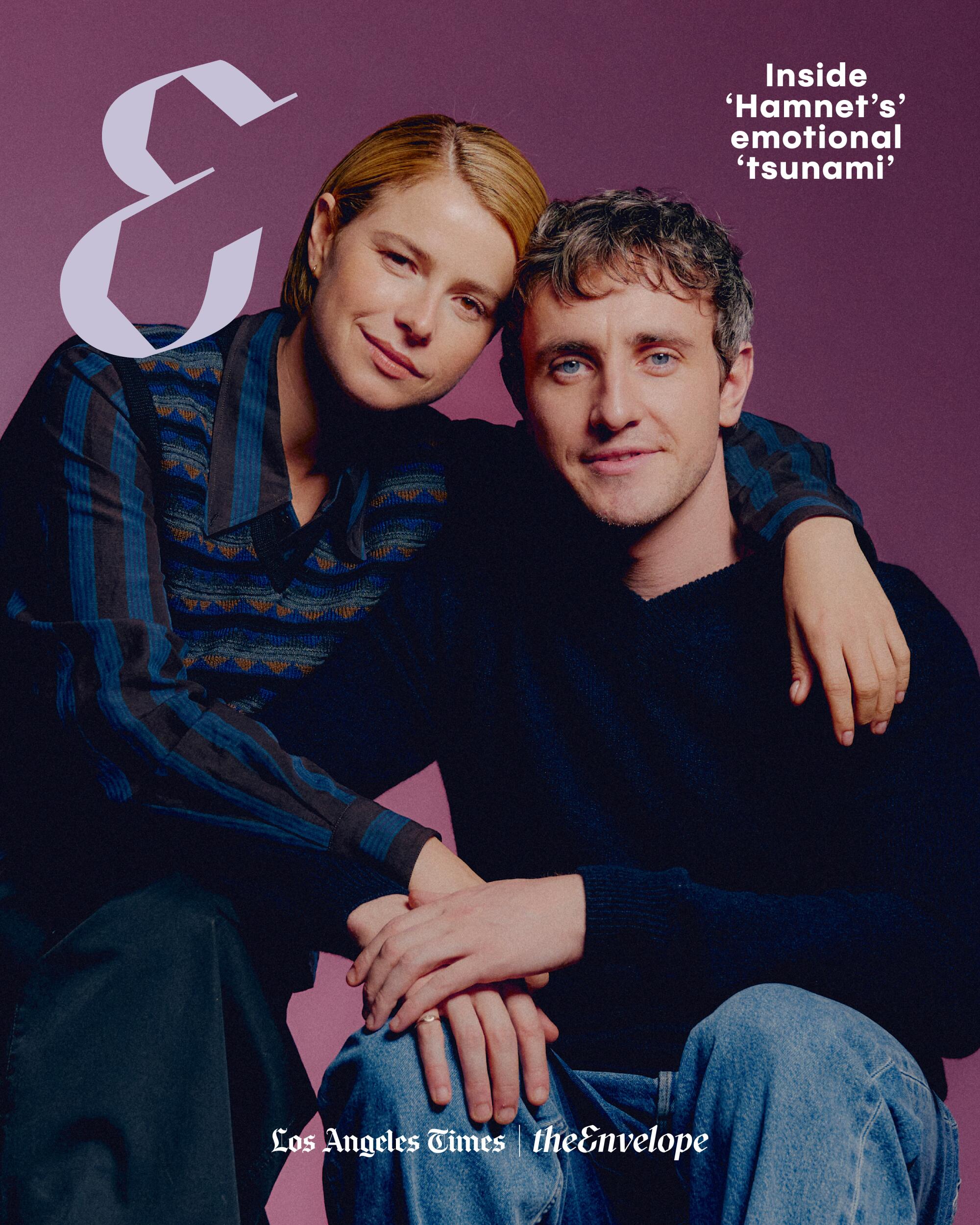
(Evelyn Freja / For The Times)


NEW YORK (OSV News) – As America’s Catholic bishops prepare to mark the semiquincentennial by consecrating the nation to the Sacred Heart of Jesus, a French docudrama that can aid viewers in understanding the full significance of such an action makes its timely appearance.
A Fathom Entertainment presentation, “Sacred Heart: His Reign Has No End” will have a limited theatrical run June 9-11 and June 14. The version screening on June 10 will be dubbed in Spanish.
Following its initial release in France last fall, the film proved to be phenomenally popular, with ticket sales reaching the half-million mark in a country usually regarded as deeply secular. This unusual development clearly indicates that the movie resonated with audiences in a way that even its creators may not have expected.
Filmmakers Sabrina and Steven J. Gunnell examine the origins, meaning and enduring relevance of devotion to the Sacred Heart. They begin their exploration even before the landmark revelations received in the 1670s by St. Margaret Mary Alacoque, a Burgundian Visitation nun, showing that earlier saints had focused on the subject in medieval times.
Using reenactments, interviews and archival images, the Gunnells also highlight the theological connection between the Sacred Heart and the Eucharist. This is done, in part, by recounting a few of the many Eucharistic miracles granted to the Church over the centuries.
By profiling contemporary devotees of the Sacred Heart, including formerly inactive Catholics, the picture demonstrates the impact the insights given to St. Margaret Mary continue to have on the lives of people around the world. Locations visited range from the gang-infested streets of a Parisian suburb to the once war-torn Central American country of El Salvador.
An excellent and enjoyable catechetical resource, the feature is also both moving and uplifting. It can be recommended for all but the youngest kids.
For theater locations and showtimes, go to: sacredheartfilm.us
Dubbed into English.
The film contains gory images of the Crucifixion. The OSV News classification is A-II — adults and adolescents. Not rated by the Motion Picture Association.
Read More Movie & Television Reviews
Copyright © 2026 OSV News

According to data from the Los Angeles City Ethics Commission, Pratt’s supporters include two members of the record industry’s most powerful family who have donated the maximum amount allowed by law.
Los Angeles’ music industry, in recent years, has generally supported progressive causes. But as the primaries for the city’s mayoral race and California‘s governorship wrapped up Tuesday, some music executives and performers have supported and donated large amounts to Spencer Pratt, the right-leaning activist and reality TV star running for mayor.
According to data from the Los Angeles City Ethics Commission, Pratt’s supporters include two members of the record industry’s most powerful family who donated the maximum amount allowed by law.
Pratt is a registered Republican whose heated rhetoric about homeless “zombies” and AI-created advertisements have rankled progressives and delighted conservatives. He has received support from President Trump, who told reporters that “I’d like to see him do well. He’s a character. I don’t know him, I assume he probably supports me… I heard he’s a big MAGA person.”
In response, Pratt told TMZ that “Everybody wants me to succeed because L.A. is the most important city in the country. The only support I need is from moms that wanna feel safe in Los Angeles. I’m laser-focused on that.”
Universal Music Group is home to some of music’s most outspoken progressives, including Olivia Rodrigo and Billie Eilish, whose brother and collaborator Finneas O’Connell donated $250 to the progressive mayoral candidate Nithya Raman on May 6.
Earlier this year, UMG’s chairman and chief executive Lucian Grainge presented Rodrigo with the company’s Universal Music Group x REVERB Amplifier Award, which advocates for “social and environmental nonprofit campaigns through the cultural power of music,” according to a release.
On May 9, Grainge (listed as a resident of Pacific Palisades, where Pratt lost his home in the 2025 fires) maxed out with an $1,800 donation to Pratt’s campaign, as previously reported in The Times. A representative for UMG did not immediately return a request for comment on Grainge’s donation.
He’s not the only Pratt donor in the family.
Grainge’s son Elliot ascended through the record industry with his 10k Projects label, and now heads UMG’s competitor Atlantic Records. Vocal progressives like Cardi B, the Marías and Charli XCX are some of the label’s most high-profile acts.
On May 8, Elliot Grainge also gave $1,800 to Pratt‘s campaign. A representative for Atlantic did not immediately return a request for comment.
Last month, the record producer and composing titan David Foster and his wife, singer Katharine McPhee, performed at a fundraiser for Pratt where they crooned a version of Tina Turner’s hit “The Best” to the mayoral hopeful. “Spencer, you’re simply the best. Better than all the rest. Better than Karen Bass and Nithya Raman,” McPhee sang.
At Warner Music, Gabz Landman, the senior vice president for A&R at Warner Chappell, its powerful music publishing wing, who has worked with Dua Lipa, Laufey and Amy Allen, gave $105.24 to Pratt on Feb. 4. Through a Warner Music representative, Landman said the donation was for merchandise given to a friend, and was not intended as support for Pratt’s campaign.
The superstar EDM producer and DJ Kaskade has left supportive messages on Pratt’s social media, commenting on one of the candidate’s posts that “At this point, who is buying in to Bass’s fairytale narrative?! I am still shocked she hasn’t resigned!” The DJ and producer Diplo also left a supportive comment — a prayer-hands emoji and “please” — on one of Pratt’s social media posts. Records do not show any personal donations to Pratt’s campaign from either artist.
Public records do not show any donations to Pratt’s campaign from live-industry executives atop firms like Live Nation, AEG or Goldenvoice.

There’s a photo of me (below) from the mid-1980s, when I was around age 5, standing on the hood of an old Plymouth in the overgrown field behind my childhood home. I’m holding He-Man’s shield in one hand and his sword, made of yellow plastic, in the other. (Unrelatedly, I’m also wearing an Incredible Hulk shirt in the picture.) And I’m grinning with pride because I have thoroughly conquered the jalopy. The vehicle never ran again, probably because I fucking destroyed it with my sword and shield. Around that time, I also had a He-Man birthday cake and a sizable collection of Mattel’s Masters of the Universe action figures. They were my first foray into toys of this kind, later replaced by G.I. Joe, Teenage Mutant Ninja Turtles, and X-Men. However, my nostalgia for He-Man remains almost nonexistent today, perhaps because, looking back at the material, the mythology remains at once weird and unmemorable, and neither the popular animated series nor the 1987 film, Masters of the Universe, starring Dolph Lundgren and Frank Langella, holds up well.
Over the years, Mattel has tried to revive the toy line and cartoon, but the company’s biggest effort thus far is the new feature from Amazon MGM Studios, which reportedly spent upwards of $200 million on a blockbuster-sized Masters of the Universe. If the 1980s versions of this franchise unabashedly targeted the preadolescent boy demographic, the new iteration has been reconfigured (by a sausage fest of credited screenwriters: Chris Butler, Aaron Nee, Adam Nee, and David Callaham) to adopt a more conventional mold. The movie also incorporates the last three decades of ironic reassessment: the series’ very 1980s obsession with bulging muscles; the loincloth-centric costumes, all of which look like rejected designs from Zardoz (1974); the vague eroticism between He-Man and several characters, including his nemesis, Skeletor; and the eccentricities of the cartoon, from the many heads thrown back in laughter to the bizarre characters—all of which started first as action figures (Stinkor, Mantenna, etc.), around which the writers built a lame storyline.
Despite its origins, Masters of the Universe sets out to become a four-quadrant feature, appealing to everyone, and in that, no one in particular. The story is too bloated for little children, with a 142-minute runtime that challenged the attention spans of the kids in my prescreening, who became restless after an hour. Admittedly, so did I. The material’s self-awareness and humor aren’t memorable enough to distinguish it from other, better examples in this genre, such as Dungeons & Dragons: Honor Among Thieves (2023)—a movie that I enjoy more with each subsequent viewing. And director Travis Knight can’t decide whether the audience should take these characters seriously or laugh at their inherent silliness. He attempts both and does neither very well. The result did not rekindle my nostalgia for this chapter of my childhood; it didn’t create an exciting new take for audiences of all ages, either.
A protracted opening establishes the distant realm called Eternia, where sword-and-sandal heroes stand alongside robots and flying ships with laser guns. Eternia’s resident baddie, Skeletor (voiced by Jared Leto, doing an R-rolling master-thespian thing), wants the Sword of Power, which imbues its wielder with, as you might guess, power. But it’s kept in Castle Grayskull, home of King Randor (James Purefoy), who’s disappointed by his son, Adam (Artie Wilkinson-Hunt), a young boy more interested in goofing around than learning to fight. When Skeletor attacks the castle and proves victorious, the Enchantress (Morena Baccarin), the magically inclined protector of Grayskull, sends Adam away to Earth along with the coveted sword. What happens then? Did a couple of farmers adopt him à la Superman? Or did he grow up in the foster system? The writers ignore such practical questions, picking up the story years later, when the adult Adam (now a hulking Nicholas Galitzine) works in corporate human resources. After Adam finally locates his sword, which was lost when he was transported from Eternia to Earth, he eventually finds his way home with the help of his childhood friend, Teela (Camila Mendes), to retake Grayskull from Skeletor.
Knight’s main source of inspiration, besides the cartoon and earlier movie, seems to be the similarly themed cult classic Flash Gordon (1980). Masters of the Universe’s music features identical-sounding Howard Blake-style guitar riffs and, to echo the original songs Queen wrote for Flash Gordon, the production uses Queen’s “Princes of the Universe” on the soundtrack. In other areas, Knight directs a conventional franchise movie with choppily edited and CGI-heavy battle scenes full of anonymous violence, lifeless chase sequences, digital backdrops resembling video-game environments, and shameless product placements for Coca-Cola and Amazon. The VFX sometimes look impressive; at other times, they look cheap and generic. Fortunately, Knight’s production also offers practical effects and prosthetics for some characters, most memorably the cyborg Trap Jaw. Knight’s secret weapon is costume designer Richard Sale, who visualizes the inherently absurd look of these characters, for better or worse, in tangible garb. The actors inhabiting the excellent costumes don’t have much to do, though. Ask yourself why they hired Kristen Wiig to voice Roboto, a bland robot character whose dialogue could have easily been performed by anyone else, or even just replaced with the beeps and boops of a Star Wars droid. When you have Kristen Wiig, use her.

Elsewhere, Masters of the Universe attempts to be self-aware in its irony and sexually suggestive underpinnings. There’s a running gag about how practically everyone can’t keep their eyes off Adam after he becomes his heroic alter-ego, He-Man, given his oiled-up muscles and blonde locks. But under Adam’s pink shirt, he still looks buff, making his eventual Hulk-like transformation into a muscle-bound barbarian unremarkable. Elsewhere, I liked the detail of Adam growing up on Earth and forgetting everyone’s names on Eternia, so he makes up their names based on their physical characteristics. A man with a big metal hand becomes Fisto (Jóhannes Haukur Jóhannesson), and another with a metal head-butting helmet becomes Ram-Man (Jon Xue Zhang). The writers take advantage of this with veiled dirty jokes about fisting and Ram-Man “giving head” to Skeletor’s goons. That’s about as clever as the movie gets. As for character development, there’s almost none. Skeletor, for instance, wants to be bad for the sake of being bad. His motivations are nonexistent, resulting in an obvious, uninteresting, and one-dimensional villain.
A key series in the conservative, Reagan-era 1980s, the Masters of the Universe cartoon and previous movie valued strength and power, muscles and might. Today, that message has negative, regressive associations with the political right, which often looks at this period from a fond standpoint. To avoid alienating any part of their audience, the filmmakers desperately try to please everyone with a mild progressive commentary to counter the franchise’s original themes. Adam’s character must learn to “be a man” to please his father, King Randor, and his makeshift father figure, Man-at-Arms (Idris Elba, in a chummy reformed drunk role). But there’s also a half-hearted message that Adam, having worked in human resources, knows the value of empathy and emotional intelligence. For a while there, the movie even claims you can’t solve every problem with muscles—that is, until He-Man resolves the conflict by pummeling Skeletor with his fists. The movie’s message is ultimately nonexistent. The committee making this movie has carefully avoided any line-in-the-sand worldview, all in an attempt to manufacture a box-office hit that will please everyone and offend no one.
That’s exactly the problem with Masters of the Universe. It’s so afraid to have a perspective or be about something that nothing onscreen has an impact. This is not to say every movie must have a substantive message. Sometimes, a mindless adventure is enough. However, even on those terms, there’s no tension or danger here because Skeletor is never all that menacing, and Adam alternates between self-parody and earnest heroism. None of the emotional beats land, not the many father-son dynamics nor the hero’s journey. And the production’s competing tones, from its intentional camp to its sword-swinging adventure, lack the balance of wit and scope that Dungeons & Dragons: Honor Among Thieves so delightfully captured. For much of the runtime, I felt bored and, aside from a few chuckles at the childish humor, disengaged from everything happening. Perhaps Roboto describes the movie best when referring to life as “a series of absurdities leading to infinite nothingness.”
Photo: Brian the Barbarian

-

 Boston, MA2 minutes ago
Visiting Boston this summer? Here are 8 navigation tips you need to know.
-

 Denver, CO7 minutes ago
Denver-ish Central Market? RiNo food hall vendors claim they’ve been pushed out
-

 Seattle, WA14 minutes ago
New Ben & Jerry’s location opening at Seattle waterfront’s Pier 54
-

 San Diego, CA17 minutes ago
Padres designate Nick Castellanos for assignment
-

 Milwaukee, WI22 minutes ago
21 Things to Do During Pride Month in Milwaukee
-

 Atlanta, GA29 minutes ago
Miguel Almirón: World Cup profile | Paraguay & Atlanta United midfielder | MLSSoccer.com
-

 Minneapolis, MN32 minutes ago
Cantus vocal ensemble takes on Dolly Parton hits
-

 Indianapolis, IN37 minutes ago
That trail you walk downtown? It’s generated $3 billion for Indianapolis, study finds

