Entertainment
Brenton Wood, 'Oogum Boogum Song' crooner who captivated Latino listeners, dies at 83

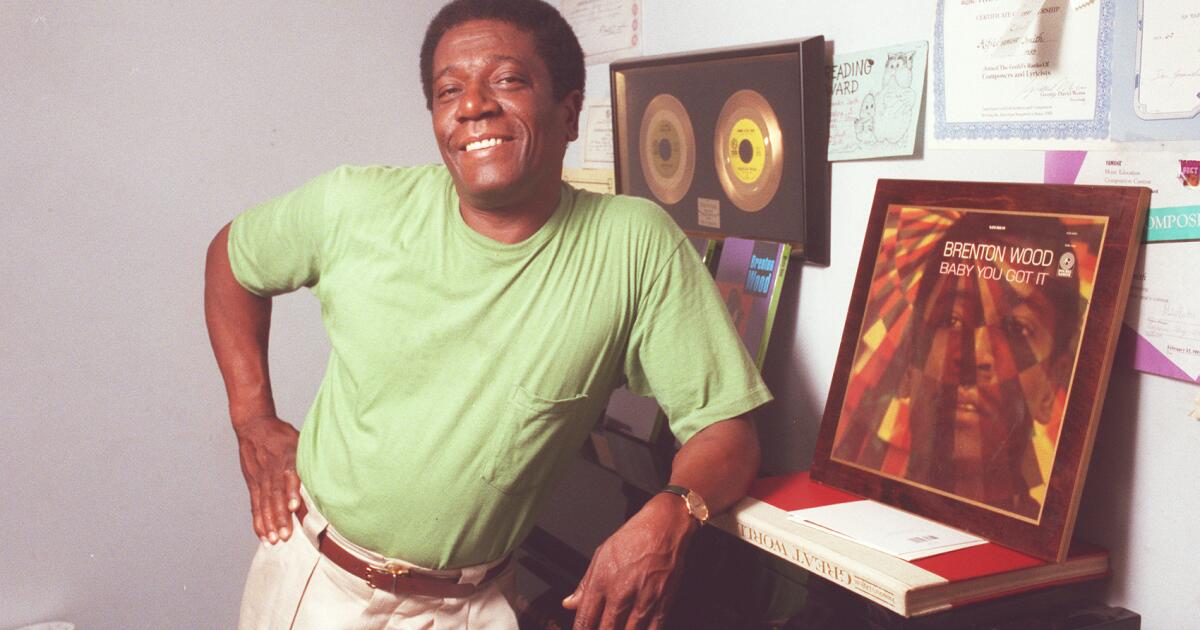
In 1967, Brenton Wood looked as if he was on the cusp of mainstream success.
The Compton crooner’s single “The Oogum Boogum Song” became a hit and ranked 34th and 19th on the Billboard’s Hot 100 and Top Selling R&B Singles charts, respectively. A few months later, Wood debuted his second hit, “Gimme Little Sign,” which peaked at No. 9 on Billboard’s Hot 100.
Wood, who was born Alfred Jesse Smith, died Friday of natural causes at his home in Moreno Valley, his manager and assistant Manny Gallegos confirmed to Variety. He was 83.
Wood’s slinky and upbeat tunes are infectious. His seductive and affable manner of describing the essence of a budding romance in layman’s terms is inviting. Whether solo or with a partner, it’s easy to groove to the beat.
Wood continued releasing tracks but none ever garnered similar success. Frustrated with the music industry, he quit for a couple of years, then inched back onto the club circuit. There, he found an audience that would sustain him for decades: Latinos.
He would play major California cities, then travel through Mexico and into Arizona before returning home. As his audience aged, Wood began to perform on themed cruises and at festivals with Chicano musical luminaries including Los Lobos, Thee Midniters and Ozomatli. Wood’s romantic oldies resonated with a new generation of lovebirds, becoming a soundtrack of Southern California life — literally, as Wood found a third career as a performer at weddings, quinceañeras and anniversary parties.
Bob Merlis, a former executive for Warner Bros. Records and co-author of “Heart & Soul: A Celebration of Black Music Style in America 1930-1975,” described the artist as a “local hero” to L.A. — a “standard bearer for the Southern California pop soul scene.”
“Nothing else sounded like them,” said Merlis, who now runs a public relations and consulting firm. “It was so different and that instrumentation is very unusual.”
“They’ve kind of picked me out of the whole batch, and they keep me going,” Wood told The Times in 1992. “I appreciate it, because if I was waiting for the big boys to call, I’d have died a long time ago.”
Wood’s lyrics captured the cat-and-mouse chase of a first love, the kind of infatuation that makes people act a fool. He encapsulated that all-too-familiar yearning to whisk away a lover to bask in their honeymoon paradise. But he also wrote about heartache — and the triumphant moment when the pain wears off.
“Latinos like to dedicate songs, and his songs are good for that,” radio veteran Art Laboe told The Times in 1992. “It’s not the big hits they like. It’s songs like ‘Take a Chance,’ ‘I Think You’ve Got Your Fools Mixed Up’ — if a girl’s having trouble with her boyfriend, she’ll dedicate that to him.”
The songwriter was born July 26, 1941, in Shreveport, La., and moved west to San Pedro when he was 3. He moved throughout L.A.’s inner cities, selling papers and fish and shining shoes until he created a career in the music industry.
Wood was 7 when a pianist mesmerized him. Without a television set at home, he spent hours at the park, watching and mimicking the performer, using two fingers to tap on imaginary keys until he got his own piano. At 10, Brenton Wood wrote his first song about a man who wanted to be a bird. It was cheerful and rhymed but lacked oomph.
He found his groove when he met his first girlfriend. Then, the words flowed out.
The Compton High School graduate enrolled at East Los Angeles College and sang in local R&B groups such as Little Freddie and the Rockets and the Quotations in the 1950s before he went solo. He took on his stage name, Brenton Wood, from the wealthy L.A. enclave of Brentwood, where a manager lived.
Wood’s “The Oogum Boogum Song” came entirely by accident. He was working the graveyard shift at Harvey Aluminum in Torrance when the melody came to him.
“It took me about six weeks, because I had to switch the verses around about a hundred times,” he told the San Diego Union-Tribune in 2000. “That was a song about fashion changes in the ’60s with bell-bottom hip-huggers and high-heeled boots and all the different styles of clothes the girls were wearing — hot pants and all that stuff.”
The bouncy track was later featured in Cameron Crowe’s “Almost Famous” and Olivia Wilde’s “Don’t Worry Darling.”
“It was one of the best feelings you could have,” Wood told Cal State Fullerton’s Titan TV in 2014.
By 1970, he founded Mr. Wood Records and produced other artists’ singles. Latino listeners were already embracing him as one of their own.
Chicano music historian Gene Aguilera recalls being “glued up” to his little transistor radio as a teen, listening to Wood’s “Gimmie Little Sign” mixed in with the Beatles and the Supremes on KRLA-AM 1110 all within an hour. Walking his neighborhood, he would hear Wood’s voice along with Thee Midniters wafting in the background, emanating from nearby parties or from lowriders cruising down Whittier Boulevard, bumping his tunes.
“Even though he wasn’t born here, he’s just forever going to be etched in our consciousness,” said Aguilera, who last saw the artist perform at a local park in Baldwin Park before the pandemic.
“His music was really accepted by East L.A. because of the slow groove he’s got, very soulful, that people from East L.A. just love.”
Vega is a former Times staff writer.






“What can one person do but two people can’t?”
“Dream.”
I knew the 2025 film “Resurrection” (狂野时代) would be elusive the second I walked out of Amherst Cinema and into the cold air, boots gliding over tanghulu-textured ice. The snow had stopped falling, but I wished it hadn’t so that I could bury myself in my thoughts a little longer. But the wind hit my uncovered face, the oxygen slipped from my lungs, and I realized that I had stopped dreaming.
“Resurrection” is a love letter to the evolution of cinematography, the ephemerality of storytelling, and the raw incoherence of life. Structured like an anthology film and set in a futuristic dreamscape, humanity achieves immortality on one condition: They can’t dream. We follow the last moments before the death of one rebel dreamer, called the “Deliriant” or “迷魂者,” as he travels through four different dream worlds, spanning a century in his mind.
Being Bi Gan’s third film after the 2015 “Kaili Blues” (路边野餐) and the 2018 “Long Day’s Journey Into Night” (地球最后的夜晚), “Resurrection” follows Gan’s directorial style of creating fantastical, atmospheric worlds. Jackson Yee, known for being a member of the boy group TFBoys, stars as the Deliriant and takes on a different identity in each dream, ranging from a conflicted father-figure conman to an untethered young man looking for love to a hunted vessel with a beautiful voice. His acting morphs unhesitatingly into each role, tailored to the genre of each dream. Of which, “Resurrection” leans into, with practice and precision.
Opening with a silent film that mimics those of German expressionist cinema, “Resurrection” takes the opportunity to explore the genres of film noir, Buddhist fable, neorealism, and underworld romance. The Deliriant’s dreams are situated in the years 1900 to 2000, as we follow the evolution of a century of competing cinematic visions. The characters don’t utter a single word of dialogue in the first twenty minutes, as all exposition occurs through paper-like text cards that yellow at the edges. I was worried it would be like this for the whole film, but I stayed in the theater that Tuesday night, the week before midterms, waiting for the first line of spoken dialogue to hit like the first sip of water after a day of fasting.

Through a massive runtime that spans two hours and 39 minutes, this movie makes you earn everything you get. Gan trains the audience’s patience with a firm hold on precision over the dials of the five senses and the mind.
The dreams may move forward in time through the cultures of the twentieth century, but on a smaller temporal scale, the main setting of each dream functions to tell the story of a day in reverse. The first dream, being a film noir, is told on a rainy night. Without giving any more spoilers, the three subsequent dreams take place at twilight, during multiple sunny afternoons, and then at sunrise. “Resurrection” does not grant sunlight so easily; we are given momentary solace after being deprived of direct sunlight for a solid 70 minutes, until it is stripped from us again and we are dropped into the darkness of pre-dawn – not that I am complaining. I love a movie that knows what it wants the audience to feel. I felt a deep-seated ache as I watched the film, scooting closer to the edge of my seat.
“Resurrection” is a movie that is best watched in theaters, but a home speaker system or padded headphones in a dark room can also suffice. Some of its most gripping moments are controlled by sound. Loud, cluttered echoes of the world, whether from people chatting in a parlor or anxiety in a character’s head, are abruptly cut off with ringing silence and a suspended close-up shot. We are forced to reckon with what the character has just done. I knew I was a world away, but I was convinced and terrified at my own culpability and agency. If I were him, would I have done the same? I could only hear my thoughts fade away as we moved onto the next dream.
Beyond sight and sound, the plot also deals intimately with the senses of taste, smell, and touch, but you will have to watch the movie yourself to find that out.
My high school acting teacher once told us that whenever a character tells a story in a play, they are actually referencing the play’s overall narrative. This exact technique of using framed narratives as vessels of information foreshadowing drives coherence in a seemingly ambiguous, metaphorical anthology film. Instead of easy-to-follow tales that mimic the hero’s journey, we are taken through unadulterated, expansive explorations of characters and their aspirations. We never find out all the details of what or why something happens, as the Deliriant moves quickly through ephemeral lifetimes in each dream, literally dying to move onto the next, but we find closure nonetheless through the parallels between elements and the poetry of it all.
That is why I like to think of “Resurrection” as pure art. It is not bound by structure; it osmoses beyond borders. It is creation in the highest form; it is a movie that I will never be able to watch again.
Perhaps because the dream worlds are so intimate and gorgeous, the exposition for the actual futuristic society feels weak in comparison. We learn that there is a woman whose job is to hunt down Deliriants, but we don’t see the rest of the dystopian infrastructure that runs this system. However, I can understand this as a thematic choice to prioritize dreams over reality. Form follows function, and these omissions of detail compel us to forget the outside world.
What it means to “dream” is up for interpretation, and we never learn the specifics of why or how immortality is achieved. Instead, “Resurrection” compares dreaming to fire. We humans are like candles, the movie claims, with wax that could stand forever if never used. But what is the point in being candles if we are never lit?
The greatest reminder of “Resurrection” is our own mortality. Whether we run from the snow-dipped mountaintops to the back alleyways of rain-streaked Chongqing, we can never escape our own consequences. “Resurrection” gives me a great fear of death, but so does it reignite my conviction to live a life of mistakes and keep dreaming anyway.
Dreaming is nothing without death. Immortality is nothing without love. So, I stumbled back to my dorm that Tuesday night, the week before midterms, thinking about what I loved and feared losing. So few films can channel life and let it go with a gentle hand. I only watch movies to fall in love. I am in love, I am in love. I am so afraid.
Entertainment
Spotify once had a reputation for underpaying music artists. It hopes to change that perception

Back in the early 2010s, the music industry was at a low point.
Piracy was rampant. Compact disc sales were on a steady decline. And the then-new audio streaming services, like Spotify, were taking hits from creators for paying low royalty rates.
Today, Spotify has grown into the world’s most popular audio streaming subscription service and the highest-paying retailer globally — paying the music industry over $11 billion last year. The Swedish company said in a recent post that the payouts aren’t strictly going to ultra-popular artists, but that “roughly half of royalties were generated by independent artists and labels.”
“A decade ago, a lot of the questions were really fair. Spotify had to be able to prove out if it could scale as an economic engine. People didn’t know if streaming would scale as a model,” said Sam Duboff, Spotify’s global head of marketing and policy of music business.
Duboff said Spotify’s payouts aren’t “plateauing — we’re still growing that royalty pool on Spotify more than 10% per year.” He credits the streaming platform’s growth to “incentivizing people to be willing to pay for music again” by providing personalized experiences and global accessibility.
The company, founded in 2006, serves more than 751 million users, including 290 million subscribers, in 184 markets.
“The average Spotify premium subscriber listens to 200 artists every month, and nearly half of those artists are discovered for the first time,” Duboff said. “When you build an experience where people can explore and fall in love with music, it inspires them to upgrade to premium and keep paying.”
The platform offers a wide variety of playlists, curated by editors like the up-and-comer-driven Fresh Finds or rap’s latest, RapCaviar. There are also personal playlists generated for users, such as the weekly round-up Discover Weekly and the daily mix of tunes called the “daylist.”
The streamer considers itself the first step toward “an enduring career” for today’s indie artists. Last year, more than a third of artists making $10,000 on the platform in royalties started by self-releasing their music through independent distributors.
“Streaming, fundamentally, is about opportunity and access. It’s artists from all over the world releasing music the way they want to and reaching a global audience from Day One,” Duboff said. He adds that when fans have a choice, they will discover new genres and music cultures that may have otherwise languished in obscurity.
In 2025, nearly 14,000 artists earned $100,000 from Spotify alone. The streamer’s data also show that last year the 100,000th highest-earning artist made $7,300 in Spotify royalties, whereas in 2015, an artist in that same spot earned around $350.
The company, with a large presence in L.A.’s Arts District, emphasizes that the roster of artists on its platform who earn significantly more money — well into the millions — is no longer limited to the few. A decade ago, Spotify’s top artist made around $10 million in royalties. Today, the platform’s top 80 artists generate over $10 million annually. Some of 2025’s top artists globally were Bad Bunny, Taylor Swift and the Weeknd.
Spotify claims those who aren’t household names can earn six figures, with more than 1,500 artists earning $1 million last year.
For some musicians, the outlook is not as clear
Damon Krukowski, a musician and the legislative director for United Musicians & Allied Workers, argues that Spotify’s money isn’t necessarily going to artists — it’s going to their labels.
Those without labels usually upload music through distributors such as DistroKid and CD Baby. These platforms charge a small fee or commission. For example, DistroKid’s lowest-level subscription is $24.99 a year, and the site states users “keep 100% of all your earnings.”
”There are zero payments going directly to recording artists from Spotify,” Krukowski asserts. “Recording artists deserve direct payment from the streaming platforms for use of our work.”
The advocacy group, which has mobilized more than 70,000 musicians and music workers, recently helped draft the Living Wage for Musicians Act to address the streaming industry. The bill, introduced to the U.S. House of Representatives last fall, calls for a new streaming royalty that would directly pay artists a minimum of one penny per stream.
In the Q&A section of Spotify’s Loud and Clear website, the streamer confirms that it “doesn’t pay artists or songwriters directly. We pay rights holders selected by the artist or songwriter, whether that’s a record label, publisher, independent distributor, performance rights organization, or collecting society.”
Instead of following a penny-per-stream model, Spotify pays based on the artist’s share of total streams, called a “streamshare.”
“Streaming doesn’t work like buying songs. Fans pay for unlimited access, not per track they listen to,” wrote the company online. “So a ‘per stream’ rate isn’t actually how anyone gets paid — not on Spotify, or on any major streaming service.”

In contrast to other sci-fi heroes, like Interstellar’s Cooper, who ventures into the unknown for the sake of humanity and discovery, knowing the sacrifice of giving up his family, Grace is externally a cynical coward. With no family to call his own, you’d think he’d have the will to go into space for the sake of the planet’s future. Nope, he’s got no courage because the man is a cowardly dog. However, Goddard’s script feels strikingly reflective of our moment. Grace has the tools to make a difference; the Earth flashbacks center on him working towards a solution to the antimatter issue, replete with occasionally confusing but never alienating dialogue. He initially lacks the conviction, embodying a cynicism and hopelessness that many people fall into today.
The film threads this idea effectively through flashbacks that reveal his reluctance, giving the story a tragic undercurrent. Yet, it also makes his relationship with Rocky, the first living thing he truly learns to care for, ever more beautiful.
When paired with Rocky, Gosling enters the rare “puppet scene partner” hall of fame alongside Michael Caine in The Muppet Christmas Carol, never letting the fact that he’s acting opposite a puppet disrupt the sincerity of his performance. His commitment to building a gradual, affectionate friendship with this animatronic creation feels completely natural, and the chemistry translates beautifully on screen. It stands as one of the stronger performances of his career.
Project Hail Mary is overly long, and while it can be deeply affecting, the film leans on a few emotional fake-outs that become repetitive in the latter half. By the third time it deploys the same sentimental beat, the effect begins to feel cloying, slightly dulling the powerful emotions it built earlier. The constant intercutting between past and present can also feel thematically uneven at times, occasionally undercutting the narrative momentum. At 2 hours and 36 minutes, the film feels like it’s stretching itself to meet a blockbuster runtime when a tighter cut might have served better.
FINAL STATEMENT
Project Hail Mary is a meticulously crafted, hopeful, and dazzling space epic that proves the most moving friendship in film this year might just be between Ryan Gosling and a rock.

400 million barrels of oil to be released from strategic reserves as Iran targets commercial ships

Nearly 40% of California produce contains PFAS pesticides, report finds

Jessica Pegula’s commitment to hard work every day has turned her into a leader

Not ‘a litre of oil’ to pass Strait of Hormuz, expect $200 price tag: Iran

Tornadoes hit Illinois, Indiana and Texas as severe storms sweep US

Florida High School Football Rankings: Top 25 teams – Oct. 21

Cleary's 21 help Le Moyne down Central Connecticut State 69-64 in OT

How old is Bo Nix? What to know about Oregon quarterback ahead of 2024 NFL Draft

99th annual Pony Swim held in Virginia

Indiana Members Credit Union announced as new anchor tenant at Bottleworks District
Not ‘a litre of oil’ to pass Strait of Hormuz, expect $200 price tag: Iran
Tornadoes hit Illinois, Indiana and Texas as severe storms sweep US

EXCLUSIVE: ICE says El Paso detention facility will stay open under new contractor after $1.2B deal scrapped

Von der Leyen ‘acting outside of competence,’ Araud tells Euronews

Wheelchair curler Steve Emt’s path from drunk driver to three-time Paralympian
-

 Wisconsin1 week ago
Setting sail on iceboats across a frozen lake in Wisconsin
-

 Massachusetts1 week ago
Massachusetts man awaits word from family in Iran after attacks
-

 Detroit, MI5 days ago
U.S. Postal Service could run out of money within a year
-

 Pennsylvania6 days ago
Pa. man found guilty of raping teen girl who he took to Mexico
-

 Miami, FL7 days ago
City of Miami celebrates reopening of Flagler Street as part of beautification project
-

 Sports7 days ago
Keith Olbermann under fire for calling Lou Holtz a ‘scumbag’ after legendary coach’s death
-

 Virginia7 days ago
Giants will hold 2026 training camp in West Virginia
-

 Culture1 week ago
Try This Quiz on the Real Locations in These Magical and Mysterious Novels