Entertainment
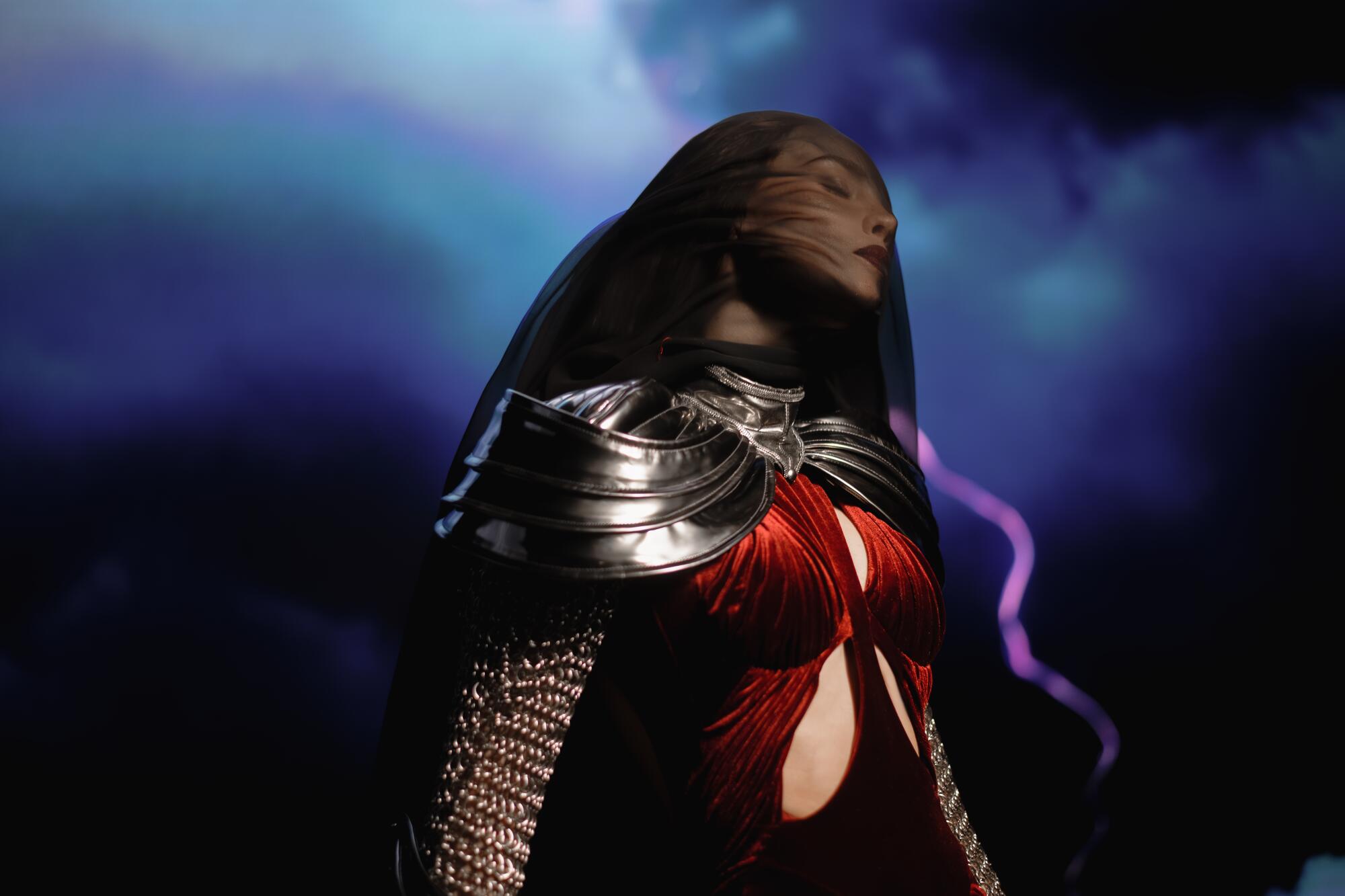
Belinda cannot be tamed. Her latest album, 'Indómita,' proves it


There is no containing a star of Belinda’s caliber.
In the making of her fifth studio album “Indómita,” the Mexican singer and actor began to understand that what made her hard to contain — in life, in love and in her career — was worth writing an album about.
“I was reading a book and all of a sudden the word ‘indómita’ appeared,” says Belinda in an audio call from her home in Mexico City. “For two days, I kept dreaming of that word. ‘Indómita, Indómita,’” says Belinda during a recent audio call from her home in Mexico City.
Out on June 5, “Indómita” is an assortment of corridos tumbados, reggaeton, rock and pop ballads with exciting collaborations — ranging from the American rock band Thirty Seconds to Mars to Latin stars like Tokischa and Tito Double P.
“This album is very special, not just for women but for everyone who feels untameable, who feels strong, who feels like a warrior,” she explains.
The title directly translates to indomitable, or untameable, a term that seems to perfectly suit the 35-year-old artist, whose long and prosperous career made her an international household name.
Born in Madrid, Spain, as Belinda Peregrín Schüll, but known widely by her mononym, Belinda began her legacy in Mexican television, taking on lead roles in early 2000’s childhood telenovelas like “Amigos x siempre,” “Aventuras en el tiempo,” and “Cómplices Al Rescate,” where she played a set of twins who has been separated at birth. She also broke through the Disney sphere, appearing in the popular 2006 sequel of “The Cheetah Girls 2” as Marisol, a Spanish pop star and competitor of the titular girl band.
Belinda’s music career has been equally as fruitful, including a stint as a singing coach on the TV competition “La Voz” and dozens of hit singles, such as the popular “Amor a Primera Vista,” a 2020 collaboration with Los Ángeles Azules and Lalo Ebratt. Her previous studio albums, 2003’s “Belinda,” 2006’s “Utopía,” 2010’s “Carpe Diem” and 2013’s “Catarsis” have all graced Billboard’s Top Latin Albums chart.
Her new LP marks a personal artistic triumph for the artist, given its unique regional Mexican edge. “300 Noches,” her 2024 corrido track with Natanael Cano, made No. 4 on the Mexican Billboard pop chart and appeared on the Billboard Global 200, making it Belinda’s first appearance on the chart. Other corridos tumbados, like the rugged “La Cuadrada” featuring Tito Double P and the blistering “Mírame Feliz” with Xavi, unleash a new alter ego of the famed singer known as “Beli bélica,” the latter of which means “warrior” in Spanish.
“With this album, I’d like to open up the door to more women to sing corridos tumbados of heartache,” says Belinda.
The record is already scorching hot, with songs like “Cactus” making a subtle, prickly nod to her past relationship with Mexican crooner Christian Nodal, who famously tattooed her eyes on his chest. There’s also the reggaeton-corrido fusion called “La Mala,” which coyly addresses the rumors that Belinda is a cold, calculated lover — which heightened in the wake of her high-profile relationship.

Still, her notoriety as a heartbreaker has simultaneously granted her sainthood status from fans, who created fake prayer cards of the enchanting star to bolster their own love life.
“This album was made up of things that we live every day,” says Belinda. “Someone breaks our heart, we feel better, we fall in love, they break our heart again and so forth. Life is like that.”
But “Indómita” is much more than Belinda’s foray into regional Mexican music; there’s also “Jackpot,” a dazzling club alongside Kenia Os, a tribute to lightning-fast cars in “Rayo McQueen” — and even her love of anime in “Death Note.”
“I’m a versatile artist and this record reflects that,” says Belinda.
This interview has been edited and shortened for clarity.
What motivated you to release this album over a decade after your last one, “Catarsis”?
I know it might seem like it’s been a long time, but I never left. I’ve always been involved in music. I’ve done collaborations with Los Ángeles Azules, “Amor a Primera Vista,” that was super popular, with Ana Mena in “Las 12,” Lola Indigo and Tiny in “La Niña de la Escuela,” with Juan Magán and Lapiz Conciente in “Si No Te Quisiera.”
I’ve made a lot of music, but obviously this record means so much to me. It’s not the same to work on collaborations and music for other artists as it is to do it for myself. The album is full of collaborations with Thirty Seconds to Mars, who are one of my favorite bands of all time. It also has Kenia Os, Tito Double P, Neton Vega, who’s a hard-hitting act in the world of reggaeton and corridos tumbados, and Natanael Cano, who I can’t forget either. It’s a complete album, with lots of different styles.
Many of the songs on this album are corridos tumbados. Why did you dive into that style of music?
It’s a really stigmatized genre, and a genre that is specifically for men and for certain kinds of lyrics. I wanted to break that [idea] and say that instruments used — like the trombone, the alto horn, tololoche — aren’t just for men or for specific lyrics or a specific market. There can be more romantic lyrics, a mixing of sounds like pop with urban music. The challenge was also getting my collaborators to believe in this too, since they are used to other topics, but everyone trusted me and believed in the song[s] since the beginning and it was organic.
Tell me more about your collaborations. What did you learn from them and what did you teach them?
They’re so talented and play instruments very well, especially Natanael Cano — you can tell him to play any instrument. He’s very talented. We were in the studio and he started to play a Metallica song and I was like, “Wow!” Although we might pigeonhole them into this genre, they’re very versatile and talented. I admire them.
One of the singles of this album, “Cactus,” talks about your feelings toward an ex. How did it feel to release your emotions? And would you say that it helped you heal, as the song suggests?
I love healing through music. The first phrase of the song goes: “Therapy helps, but music heals more bad-ass.” Perhaps I couldn’t express with words what I can through music. As a composer we express our emotions through our lyrics. But it’s also important that people remember that not everything is based on experiences. It’s music so that people can identify themselves in love or heartache. I never mention anyone by name, but people can make their own conclusions or deductions. At the end of the day, I make music for people who can relate to the lyrics.
You’ve been in the spotlight for so many years. Do you believe there are two Belindas that exist? As in, one that is for the public and one that’s just for close family members?
Of course, I can guarantee it. There’s also a song where I express that idea that many times people have categorized me as a bad character, “La Mala.” At the end of the day, I know who I am and the people around me know the heart that I have — my feelings and intentions, my day-to-day. That’s what counts for me. If I paid attention to every comment [people made of me], my God, I’d be locked up in a room without an exit, which sometimes does happen to me.
How do you tune out those outside critics?
I try not to see these things. Sometimes it’s inevitable but I’m also not going deep into the web to find what people are saying. I do other more productive things that nourish me.
Obviously it hurts, because even if certain comments are not true, they still hurt because they carry negative energy. I don’t want to give into these comments as truth, but that energy of negativity or insult or humiliation or anything that comes from a negative side, obviously has a consequence. So one has to be careful about how they express themselves, because there’s so much negativity that exists, so it would be nice if we could just throw a bit more of love.
I heard you’re a big anime fan, and you show that in your song “Death Note.” Why was it important to include that?
I’m [an] otaku, even if people don’t believe it. I really like anime. I’m a fan of “One Piece,” “Death Note,” everything, “Attack on Titan,” but “Death Note” is my favorite. It’s pretty dark, but Ryuk is one of my favorite characters in life. I’ve always been a fan of terror, because within the darkness, there’s always some light.
You were born in Spain but were raised in Mexico. How have you navigated both identities?
I can’t pick one or the other, but I’ve always considered myself Mexican, because I was raised in Mexico and my accent is Mexican. I’m very, very much Latina.
What advice would you give your younger self?
Don’t take everything so personally and enjoy life. When I was little, I would think too much about what the world thought. I was always like, “do you like it? Oh you don’t, why?” and I would suffer. And now if I like it, OK, and if no one else likes it, then too bad, I like it!

Movie Reviews
‘Night Nurse’ Review: A Caretaker Explores Her Kink for Elder Abuse in the Year’s Strangest Erotic Thriller

There are any number of erotic thrillers in which rich old men are robbed blind and/or left for dead, but Georgia Bernstein’s admirably bizarre “Night Nurse” might be the first movie of its kind where elder abuse is the source — and possible subject— of its erotic thrills. If there are others, I’m not sure I want to know.
But this woozy debut feature doesn’t rely on its audience being turned on by the relationship between a nubile caretaker and her dementia-addled patient. Their psychosexual bond, meanwhile, hinges on cold-calling vulnerable old people under the guise of a grandchild in financial distress. (“I’m in trouble, nana, send me $10,000 or I’ll be left to rot in jail!” That sort of thing). With its slim wisp of a premise stretched into a Strickland-esque dreamscape that substitutes kink for conflict, the film itself hardly seems convinced by its own wrinkled lust — all desperate kisses and non-touching poses of subservience. More important to Bernstein is what that lust reveals about her characters’ deepest needs, specifically how their need to care and be cared for can be as easily perverted as any other form of desire.

As moody and weightless as the noir-accented score that blows through the movie like a curlicue gust of wind in an old cartoon (credit to musicians Sam Clapp and Steven Jackson), “Night Nurse” lacks the pulse required for its stray feelings to come alive. Still, the film ambiently taps into the latent eroticism of teasing out the distance between how you see yourself and who you really are. Bernstein plays with that distance like a telephone cord wrapped around her fingers, and Eleni — played by the excellent newcomer Cemre Paksoy, powerfully helpless — only frays even more as the receiver is brought near the hook. “Everything I did before today wasn’t me,” the nurse tells co-worker Mona (Eleonore Hendricks) after starting a new job at an Illinois retirement home. “It was somebody else.”
What she did before today remains unexplored (specifically, what she did to get herself fired from her last gig), but I’m guessing she’s probably changed less than she thought. There’s a faraway flicker in her eyes the moment she catches the vibe between Mona and Douglas (a ribald and elusive Bruce McKenzie), a white-haired seventysomething who shows early signs of dementia but still commands an undiminished sexual energy. “I’m not an invalid,” he coos as Mona bathes him in the tub, to which she replies, “yes, you are,” in a supplicant tone that hints at a rich history of power games between them.
Later that same night, Douglas will force Eleni to call a stranger, pretend that she’s their granddaughter, and ask for money — he’ll wrap the phone cord around the nurse’s body as she talks and shove her against the wall as they kiss. She’s into it. So into it that he has to clarify the terms of his whole deal: “If you’re looking for a pogo stick, I’m really not your guy.” But Eleni isn’t looking for anything to bounce on. She just wants to be needed, and maybe to need someone in return. Someone who will see her for who she really is and allow her the fantasy of pretending she isn’t being herself when she cons vulnerable strangers out of their money — when she exploits how enthralled those strangers are by the care they have for their loved ones.
“Night Nurse” doesn’t belabor the psychology, as Bernstein prefers to express her story through heavy-lidded suggestion. Somnambulating from the moment it starts, the film moves through a series of beautifully arranged poses that stretch their latent meaning thin across the surface (Lidia Nikonova’s cinematography lacquers every shot with a seductive dreaminess). We see Douglas smoking in a lawn chair with Mona and Eleni curled around his feet. Eleni riding in the backseat of a convertible as the wind blows through her curls. The full staff of nurses — all of them under Douglas’ sway — stumbling around his condo in a state of zonked out bliss as they roll on the prescription drugs they’ve stolen from the residents.
Once you’ve seen one shot of this movie, you’ve practically seen them all, at least until things escalate during a rushed and unsatisfying third act that forces Eleni into an honest confrontation with herself. People will do just about anything to feel needed — they’ll give whatever degree of care allows them to receive it in return. “Night Nurse” understands that desire, but remains far too numb to treat it.
Grade: C+
The Independent Film Company will relase “Night Nurse” in theaters on Friday, July 10.
Entertainment
Lucas Museum to give free annual passes to South L.A. neighbors, host community preview day

The Lucas Museum of Narrative Art, which is moving at light speed toward its Sept. 22 opening, announced Thursday that it will give free annual passes to its South L.A. neighbors living in the 90037 ZIP Code. The 300,000-square-foot, $1-billion museum located in Exposition Park will also host a special community preview day on Sept. 13, more than a week before the general public gets to step inside.
The 90037 ZIP Code has a population of more than 65,000 and is bordered roughly by the 110 Freeway to the west, Slauson Avenue to the south, Central Avenue to the east and Martin Luther King Jr. Boulevard to the north. Residents can register for passes at lucasmuseum.org/lm37 and will be alerted in August when the program launches. Pass holders can reserve tickets for themselves and one guest.
Tickets for non-pass holders go on sale July 21. They cost $25 for adults and $21 for seniors. Kids 17 and under are free.
“Storytelling has the power to bring people together and create a sense of community,” said Lucas Museum Chief Executive Tracey Bates in a news release about the program. “Through LM37, we are inviting our South Los Angeles neighbors to make the museum part of their lives and take their own path of discovery through the art, programs and experiences that will help shape this new cultural hub for Los Angeles.”
The community preview day is designed to give local business owners, community partners, civic leaders and registered LM37 pass holders a sneak peak of the 10,000 square feet of exhibition space, as well as the expansive gardens with 11 acres of park space.
The opening programming, curated by co-founder George Lucas, features 20 inaugural exhibitions across more than 30 galleries, including one titled “Star Wars in Motion,” containing vehicle designs, high-speed racers, flying vessels, props, costumes and illustrations from the first six films in the beloved franchise.
More than 1,200 objects will be on display from Lucas’ personal collection of narrative art. Highlights include work by Norman Rockwell and Dorothea Lange, as well as a variety of manga, children’s book illustrations and comics.

Last year’s “Superman” ended with Iggy Pop singing “Because I’m a punk rocker, yes I am” — an ironic coda for a superlatively square hero. But it rings straightforwardly true for Superman’s cousin.
Milly Alcock’s Kara Zor-El, or Supergirl, sports not a spandex suit but a Blondie T-shirt. When we meet her in Craig Gillespie’s “Supergirl,” she’s been on an interstellar bender for days. She’s more Courtney Love than Clark Kent.
Nonchalant and sarcastic, Kara is also a little Han Solo-ish, you might say, given that she moves capriciously through the galaxy in her junky spaceship while getting in fights in extraterrestrial bars. She’s a welcome, jagged riff on more buttoned-up superheroes, and Alcock is terrific in the role. If only “Supergirl” was as good as she is.
While the latest DC release, and second under James Gunn’s stewardship, has its moments, “Supergirl” struggles to match Kara’s punk-rock energy with an equally spirited supporting cast and story.
Skepticism seems to have gathered for “Supergirl” ahead of its release. Many fans have argued it wasn’t the right next step for DC Universe. But I’m not so sure. Alcock’s breezy cameo in “Superman” was one of that movie’s highlights. Handing the follow-up to her, and her faithful floating dog Krypto, strikes me as an extremely natural next step. When in doubt, follow the dog.
And much of “Supergirl” is winning. It resides almost entirely in space, touching down only momentarily on Earth. In its consistently creative production design, clever needle drops and underdog story arc, “Supergirl” resides a little closer to Gunn’s “Guardians of the Galaxy” movies than other DC entries. Its outer space is filled with cosmic detritus, mean characters and cute critters. Seth Rogen as the voice of a tiny alien co-piloting a space bus is an inspired concoction, as is a shabbier sci-fi realm with rest stops along the intergalactic highway.
-

 Miami, FL6 minutes ago
Miami-Dade Schools names six semifinalists for superintendent
-

 Boston, MA9 minutes ago
Lawsuit: ICE detained East Boston father despite legal status
-

 Denver, CO14 minutes ago
Victor Marx wins GOP primary for Colorado governor, defeating veteran lawmaker after unorthodox campaign
-

 Seattle, WA21 minutes ago
Widower of pregnant woman who was shot to death in Seattle sues homelessness authority
-

 San Diego, CA24 minutes ago
Terrifying moment huge sea lions chase tourists off popular California beach
-

 Milwaukee, WI36 minutes ago
Milwaukee leaders condemn ICE arrests as agency ignores City mask ordinance
-

 Atlanta, GA39 minutes ago
Georgia Secretary of State opens investigation into voter registration mailers sent to deceased residents
-

 Minneapolis, MN44 minutes ago
Minneapolis chief communications officer Adam Fetcher out amid possible criminal charges

