

Connect with us

Entertainment

Appreciation: Catherine O’Hara was an onscreen benediction

Published

on

Appreciation: Catherine O’Hara was an onscreen benediction

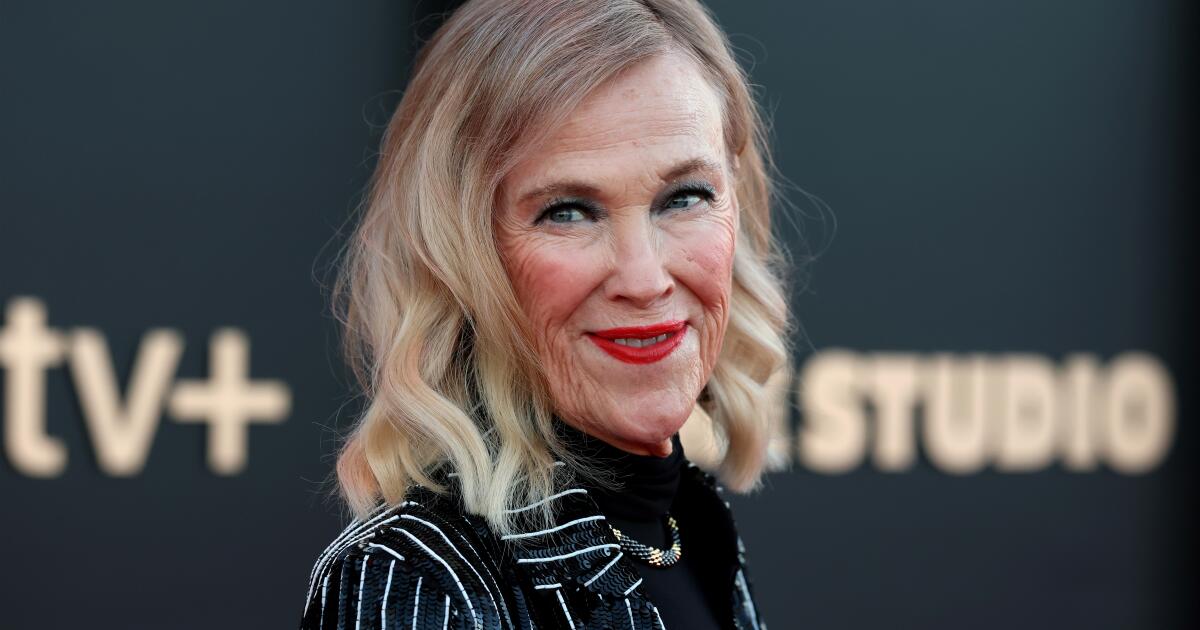
It is painful to have to write about Catherine O’Hara, so alive and lively a presence, in the past tense. O’Hara has lived inside my head — is it too corny to say my heart? — from “SCTV” to “Schitt’s Creek” to “The Studio,” on whose second season she was scheduled to start work, when she died, Friday at 71.

Any appearance constituted a recommendation for — a benediction upon — whatever she was appearing in; you felt she would only say yes to things that used her well, that sounded fun or interesting, and that her casting reflected well on the project and people who cast her. I think of her not as a careerist, but a Canadian. Of joining “Schitt’s Creek,” she said when I interviewed her in 2015, “it took me a few moments to commit, [but] I already trusted [co-creator, co-star] Eugene [Levy] as a writer and an actor, and as a good man who I could stand to spend time with.”

This is how it began for her, in Toronto, where her brother Marcus was dating Gilda Radner, who was in “Godspell” with Levy and Martin Short. “And it was really watching Gilda when I realized, ‘cause I’d always liked acting in school, that it was actually a local possibility. And then she got into Second City theater, and I was a waitress there — it’s like I stalked her — and then she did the show for a while and then took on a job for the National Lampoon. So I got to understudy or take her place — I got to join the cast, and Eugene was in it. It was really just the luck of having a professional actor suddenly in my life.”

As an “SCTV” early adopter, O’Hara was first attractive to me because she was funny, but she was also beautiful — a beauty she could subvert by a subtle or broad rearrangement of her features. Though fundamentally a comic actress, her characters could feel pained or tragic beneath the surface — even Lola Heatherton, one of her signature “SCTV” characters, an over-exuberant spangled entertainer (“I love you! I want to bear your children!” was a catch phrase) is built on desperation. Among many, many other parts, she played a teenaged Brooke Shields singing Devo’s “Whip It!,” Katharine Hepburn, a depressed Ingmar Bergman character, and, most memorably, chirpy teenage quiz show contestant Margaret Meehan, buzzing in with answers before the questions are asked, and growing tearfully undone as the host (Levy) becomes increasingly angry.

Advertisement

Elsewhere, she played a forgetful suburban mom in “Home Alone,” the work for which she’s arguably best known, given its ongoing mainstream popularity; an ice cream truck driver messing with Griffin Dunne in Martin Scorsese’s “After Hours”; and a tasteless art snob and indifferent mother in “Beetlejuice,” where she met her future husband, production designer Bo Welch. She shone in three Christopher Guest movies, paired with Fred Willard in “Waiting for Guffman” as community stars; opposite Levy in “Best in Show,” as a dog handler with a lot of ex-boyfriends; with Levy again in “A Mighty Wind,” as a reuniting ‘60s folk duo; and in “For Your Consideration” as an aging actress dreaming of an Oscar. In the great Netflix miniseries “A Series of Unfortunate Events” (also designed by Welch), she played an evil optometrist, the sometime girlfriend of Neil Patrick Harris’ Count Olaf, dark, cold, sexy. Last year, she picked up a supporting actress Emmy nomination as a dethroned but not knocked down executive in “The Studio”; she’s fierce and funny. And, though she was fundamentally a comic actress, she could play straight, as in the second season of “The Last of Us,” penetrating opposite Pedro Pascal as his therapist, and the widow of a man he killed.

Lived in across six, ever-richer seasons of “Schitt’s Creek,” Moira Rose is certainly her crowning achievement, a completely original, Emmy-winning creation whose quirks and complexities were embraced by a wide audience; going forth, she’ll be a reference to describe other characters — a “Moira Rose type” — with no explanation needed. With her original, breathy way of speaking, stressing odd syllables and stretching random vowels to the breaking point, her mad fashions and family of wigs, Moira is a sketch character with depth. Of all the Roses, she’s the one most resistant to adapting to their motel world, to coming down off the mountain, but she is as needy as she is condescending, and underlying her fantastic, tightly structured carapace is a fear that’s terribly moving when it shows through the cracks.

A man looks over at a woman holding a large restaurant menu.

Eugene Levy and Catherine O’Hara in scene from “Schitt’s Creek.” The actors worked together frequently over the years.

(PopTV)

Advertisement

“I like to think she’s really threatened by this small-town life — because she’s been there, you know?” O’Hara said back when the series began. “That just makes it more threatening in my mind. And I like to think of her as more vulnerable than just snobby or superior. I think it’s way more insecure.”

Her tentative acceptance of her circumstance, as well as the show’s overarching arc, finds expression in the series finale, where, all white and gold, in flowing robes with long blonde locks cascading from beneath a bishop’s hat, she tearfully conducts the marriage of her son, David (co-creator Dan Levy). Speaking of a sort of wind of fate, she says, “All we can wish for our families, for those we love, is that that wind will eventually place us on solid ground. And I believe it’s done just that for my family in this little town, in the middle of nowhere.” You might cry, too.

I had the luck to speak with O’Hara several times over the run of the series. The last was in Canada, a day or two before the last day of filming. We sat on the apron of the Rosebud Motel, looking across the muddy parking lot to where fans were gathered on the road above.

“They’re there as much for each other as for us. It’s almost that we don’t have to be there, but we brought them together somehow.” That’s what actors and the stories they tell, give us — the joy, and sometimes the pain: A world of strangers, united in this awful moment, out of love for Catherine O’Hara.

Advertisement

Movie Reviews

Melania sets record for largest-ever gap between critics’ scores and audience ratings

Published

on

Melania sets record for largest-ever gap between critics’ scores and audience ratings

Melania Trump’s new documentary, Melania, has broken a Rotten Tomatoes record for the biggest discrepancy between critics’ scores and audience ratings in the last 27 years.

Since its release, reviews have been largely negative, with the film sitting at a measly 10 percent on the platform. However, viewers on the reviewing site have given the documentary a 99 percent, in an apparent demonstration of support for Trump.

In a one-star review for The Independent, Nick Hilton wrote: “Perhaps Melania is merely a piece of post-modern post-entertainment. After all, it is transparently not a documentary.”

Hilton continues: “Melania spends most scenes playing a staged version of herself, and shots of the first lady are composed with all the deliberateness Ratner brought to his work on X-Men: The Last Stand. This is somewhere between reality TV and pure fiction.”

However, audience members were generally interested in seeing the work behind the first lady’s lead-up to Inauguration Day, with one Rotten Tomatoes user writing, “A very private look at the work put in before inauguration. Shows her commitment to the children in need.”

Advertisement
Melania Trump’s new documentary, ‘Melania,’ has seen exceedingly positive audience reviews despite largely negative reviews from movie critics on Rotten Tomatoes
Melania Trump’s new documentary, ‘Melania,’ has seen exceedingly positive audience reviews despite largely negative reviews from movie critics on Rotten Tomatoes (Muse Films)

“Nothing to dislike,” another five-star Rotten Tomatoes user wrote. “What an amazing movie from our beloved First Lady. I highly recommend everyone go see this film. It is inspiring whether you are male, female, left or right!!”

Other similar examples of large gaps between critic reviews and audience ratings include Transformers, which scored 57 percent with critics but 85 percent with audiences, and the 1999 film The Chosen, which critics also disliked at 26 percent as audiences raved, giving it a 91 percent.

The gap in reviews comes after the box office numbers of the documentary were revealed last weekend. Melania had exceeded box office predictions on its opening day, grossing $2.9 million from 1,778 theaters.

Speaking to reporters at the film’s premiere at the Kennedy Center last week, President Donald Trump played down reports of weak ticket sales for the film.

“It’s a very tough business in theaters selling movie tickets after Covid,” he said. “I think this will do unbelievable — streaming and everything. Theaters are a different world.”

While analysts predicted the controversial film to make between $1 million and $5 million through its opening weekend, Variety reports it is on course to bank around $8.1 million.

Advertisement

Although the film has performed better than expected, it is still unlikely to recoup the $40 million Amazon MGM paid for it. Amazon reportedly spent an additional $35 million to market the film.

Melania will stream on Prime Video at a later date.

Continue Reading

Entertainment

Kelly Clarkson to end talk show this fall to ‘prioritize’ her kids

Published

on

Kelly Clarkson to end talk show this fall to ‘prioritize’ her kids

I can’t believe it’s happening to us.

“The Kelly Clarkson Show,” the Daytime Emmy Award-winning series hosted by the Grammy-winning musician, is ending after a seven-season run. Kelly Clarkson announced Monday that she had decided to step away from hosting the daily talk show.

In a statement, Clarkson said she made her decision to prioritize spending time with her children. The former singer had two children, in 2014 and 2016, with ex-husband Brandon Blackstock, who died in August at age 48.

“I have been extremely fortunate to work with such an outstanding group of people at ‘The Kelly Clarkson Show,’ both in Los Angeles and New York,” Clarkson said in a statement. “This was not an easy decision, but this season will be my last hosting ‘The Kelly Clarkson Show.’ Stepping away from the daily schedule will allow me to prioritize my kids, which feels necessary and right for this next chapter of our lives.”

The syndicated talk show launched in September 2019 after Clarkson, who won over TV audiences as the first-ever winner of “American Idol,” in 2002, returned to the world of musical reality competitions as a coach on “The Voice” in 2018. “The Kelly Clarkson Show” showcased the “Since U Been Gone” singer’s affable, approachable charm in her sit-down interviews with celebrities and everyday heroes, as well as her talents in popular segments including “Kellyoke,” which saw Clarkson sing covers of other people’s songs.

Advertisement

“I am forever grateful and honored to have worked alongside the greatest band and crew you could hope for, all the talent and inspiring people who have shared their time and lives with us, all the fans who have supported our show and to NBC for always being such a supportive and incredible partner,” Clarkson added in her statement. “This isn’t goodbye. I’ll still be making music, playing shows here and there and you may catch me on ‘The Voice’ from time to time. … You never know where I might show up next. But for now, I want to thank y’all so much for allowing our show to be a part of your lives, and for believing in us and hanging with us for seven incredible years.”

The seventh season of “The Kelly Clarkson Show” kicked off in September and production will continue as planned. Clarkson will continue to host Season 7, with a few yet-to-be-announced guest hosts. The episodes for Season 7 will run through September.

Continue Reading

Movie Reviews

‘The Mysterious Gaze of the Flamingo’ Review: A Tender Chilean Coming-of-Ager Turns the AIDS Epidemic Into a Surreal Trans Western

Published

on

‘The Mysterious Gaze of the Flamingo’ Review: A Tender Chilean Coming-of-Ager Turns the AIDS Epidemic Into a Surreal Trans Western

At the Cannes Film Festival last year, there were not one but two genre-bending, metaphorical movies that revisited the deadly AIDS crisis of the 1980s.

The first was Palme d’Or laureate Julia Ducournau’s explosive and overzealous body horror flick, Alpha, in which the infected became living and breathing human sculptures, their skin hardening into marble that looked real enough to cut into a fabulous kitchen countertop.

The Mysterious Gaze of the Flamingo

The Bottom Line

A touching and inventive look at a tragic disease.

Advertisement

Release Date: Friday, Dec. 12
Cast: Tamara Cortés, Matías Catalán, Paula Dinamarca, Francisco Díaz, Pedro Muñoz 
Director-screenwriter: Diego Céspedes

Rated N/A,
1 hour 44 minutes

The second and less buzzy feature was debuting Chilean director Diego Céspedes’ The Mysterious Gaze of the Flamingo (La misteriosa mirada del flamenco), which walked away with the top prize in the fest’s Un Certain Regard sidebar. In this touchingly surreal story, AIDS is an unknown plague transmitted by looking too lovingly into the eyes of the infected, causing turmoil among the inhabitants of a remote mining town in the desert.

Céspedes captures this strange phenomenon through the viewpoint of a preteen girl, Lidia (Tamara Cortés), who lives with her trans mother, the titular Flamenco (Matías Catalán), in a ramshackle bordello populated by a rowdy gang of sex workers. The place is run by Mama Boa (Paula Dinamarca), a tough-loving madam who doesn’t mind giving a difficult client a good kick in the nuts from time to time.

Advertisement

It’s certainly a unique setting, and some of what happens in Flamingo seems too outlandish to be true. But things suddenly turn tragic in the last act, and what felt frivolous or folkloric becomes deadly serious when Lidia is forced to face what’s happening around her.

Until then, the story follows the pugnacious 11-year-old as she’s harassed by boys at the local swimming hole while witnessing her mom’s declining health at home. Their lives are soon at risk when one of Flamenco’s clients, Yovani (Pedro Muñoz), shows up with symptoms of the disease and blames her for his sickness, threatening to take revenge.

The gunslinging miner belongs to a band of angry men who show up at the bordello and surround it like a posse from the Wild West. But instead of delivering the usual shootout at that point, Céspedes transforms what could have been a nasty brawl into a gentle snuggle-fest between the sex workers and their unlikely lovers.

In the world of Flamingo, macho attitudes and transphobia give way to tenderness, especially during a bittersweet wedding sequence in which Mama Boa marries the bearded old prospector, Clemente (Luis Dubó). Another memorable scene involves an annual talent contest in which Flamenco lip-syncs a Latino ballad in full drag, mesmerizing all the hardened miners who’ve come to watch her perform.

Despite its bleak subject, there’s plenty of joy and warmth on display in Céspedes’ first feature, which is reminiscent of other recent Chilean fare like Sebastián Silva’s Rotting in the Sun and Sebastián Lelio’s A Fantastic Woman, both of which inventively combined genre plots with LGBTQ themes. Flamingo goes overboard on the surrealism at times, but by ultimately focusing on how Lidia comes to terms with the reality of the AIDS epidemic, it delivers a solid emotional blow by the end.

Advertisement

Shot in a pared-down but colorful style by Angello Faccini, Flamingo makes the most out of its limited budget and picturesque locations, which include an arid mountain range straight out of a spaghetti Western. Most of the action takes place in a dusty one-horse town whose residents have chosen to open themselves up both sexually and spiritually, paying the ultimate price for their tolerance.

Continue Reading

Trending
