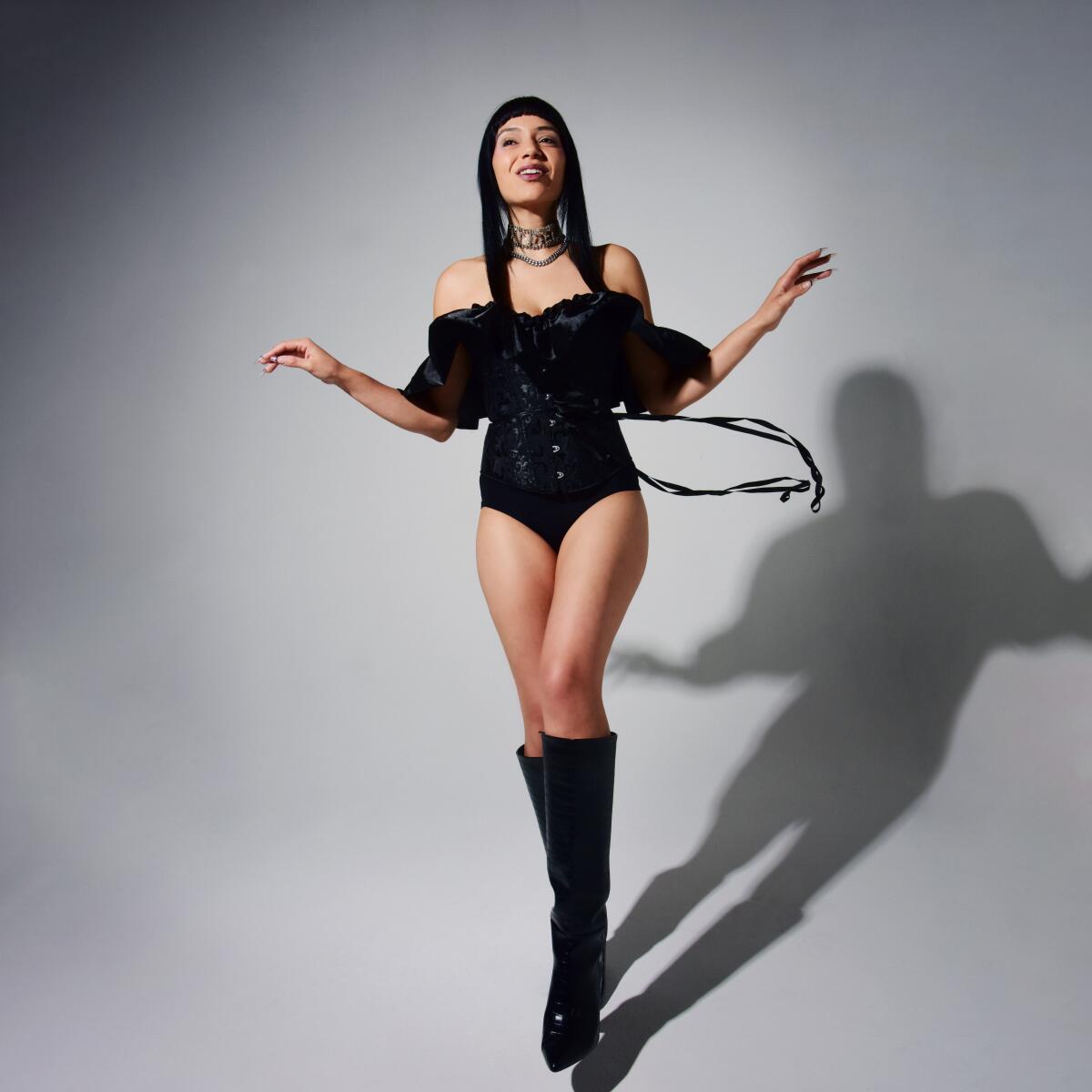
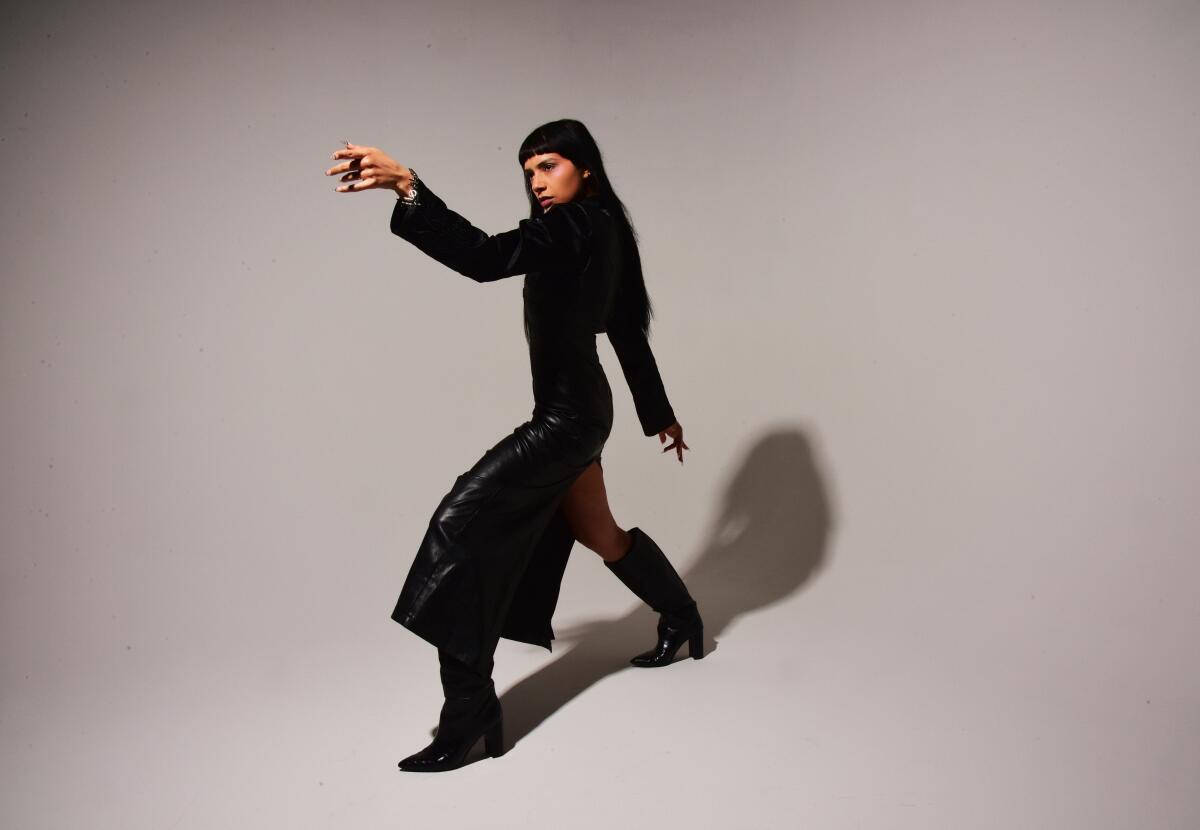
Angélica Garcia has been busy finding herself. Or, rather, her selves. The Los Angeles pop singer’s new record, “Gemelo” — twin in Spanish — is a rhythmic exploration of the spiritual world and our relationship to our inner, intuitive beings.
It also is a study of dualities, whether of culture, gender or language. For the first time, Garcia sings almost entirely in Spanish, something she first experimented with on 2020’s “Cha Cha Palace.” A move back to L.A. from Virginia in the spring of that year led her to reconnect with her Latin heritage, and with it her ancestry.
As a result, “Gemelo” is a fascinating mix of the mystical and the feminine, of self-love and grief, that glides effortlessly from synth-pop to cumbia to trip-hop. Songs like “Color de Dolor” or “Juanita” slink and shimmy infectiously, even as they channel generational trauma or commune with the dead.
“It really means a lot that I’m writing a song about intuition in Spanish and how it’s connected to our ancestry, and there are people in the audience that are like, ‘Yeah!’” Garcia says over a Zoom call, just after stepping offstage at a festival in Germany. “Maybe that’s my weirdo perspective, but that’s kind of what I do.”
On the heels of her album’s Friday release, Garcia discussed the upheaval that spawned the album, her difficulties writing in Spanish, and how creating the new songs helped her to know and assert herself better than ever before.
Advertisement
There are all these dualities on “Gemelo,” and so much self-discovery. What started that journey for you to explore those themes?
It’s kind of just what was coming out at the time, to be honest. There was a lot grief processing, different types of big life changes happening at the same time. The first song to come out was “Color de Dolor.” That kind of represents that, because when you’re asking, “What is the color of pain? What is the color of grief?” — it can have many forms.
What kinds of grief were you processing?
I was reconciling distance from people that I loved, but also realizing that, being close to them, I didn’t necessarily feel particularly good either. Because sometimes the people that raise you, although there’s love there, it doesn’t necessarily mean that you’re seen.
There was also this strange cultural tug of war that I was feeling within myself. I was working really hard at the time to educate myself about ancestors and generations past in the family. The more I started down that rabbit hole, the more I realized, wow, these are things that I’ve always felt in me, that I’m only discovering now. So there’s a weird sadness that comes with that too.
Advertisement
[And] also just being a woman and feeling like I was really tired of having people speak for me and on my behalf.
Was family history or ancestry part of your life growing up?
My family moved to Virginia when I was a teenager … so I went from having Latino, Mexican American, Chicano culture all around me to, suddenly, it was very hard to come by. That separation from my culture, I had to work hard to keep it alive within me.
Advertisement
With “Gemelo,” I really began to realize the severity of the grief I’d been given. There was a lot that I wanted to know that sometimes even my family themselves couldn’t answer, and I had to go deeper to figure out.
What sorts of things do you feel you’ve figured out?
Patterns, like questions of nature and nurture. For example, alcoholism. You look back and go, “Oh, this person had it. This person had it.” Or maybe I realized there are abandonment wounds in my family. And it’s very interesting, when you think back to the time in which people were born. For women, especially — my mom, my grandma couldn’t make choices that I can make now.
“I can just be. And just being is so much,” says Garcia.
(Shervin Lainez)
Advertisement
What did being in L.A., and presumably being around more family, add to that process?
It felt like I had a little more clarity, so when I came back I felt more of the things that I loved and wanted to preserve. And also the things that were like, “It’s time to abolish this. I’m over it.”
What made you decide to sing most of this album in Spanish?
My grandmother’s like a mother to me, and I realized, when I brought home the LP of “Cha Cha Palace,” that she didn’t understand anything. Over time, as I got better with my Spanish, I remember sitting with my grandmother and I was like, “Holy s—, you’re so funny.” And I had no idea, because I was so bad at Spanish.
How was it to trying to actually write in Spanish, then?
Advertisement
It was pretty brutal. Everybody that I showed it to had a problem with how I expressed myself. … I was also being stubborn in the sense I still wanted it to be in my voice, as a human and as a writer. A lot of people I showed it to wanted to rewrite the whole thing. So it was a pretty arduous process that almost took me out a few times.
Did you speak Spanish a lot at home as a kid, or was it mostly English?
The first thing I ever spoke were prayers that my grandmother taught me in Spanish, and we spoke it a lot at home. But then with public schooling and everything, it kind of disappeared. The older I got, the more conversations I had with other first-gen, second-gen kids like me, that was a common thing.
But yeah, I mean, the first music that I learned how to sing, as well, with my mom was mariachi music, because she was a mariachi singer, like ranchera music. As a child, she sang it at rodeos with the whole outfit and everything. So it was a thing we did at parties.
Advertisement
Does it feel risky at all, commercially, to sing mostly in Spanish, or does it feel like now’s a good moment in terms of how receptive general audiences would be?
I kind of don’t care. So many countries speak Spanish, and it’s such a poetic language. It’s beautiful. The more I started to express myself, the more I was like, “Oh, English kind of feels like a sword fight.” It’s very precise and very cunning. Spanish, it’s just very romantic. And Latino music always hits hard at parties.
Are you able to express yourself in certain ways in Spanish that you maybe couldn’t in English?
I got to be more philosophical. Like “El Que,” for example, is an inner monologue, my spirit watching over my flesh body going through something and guiding it, trying to wake up the person below. So I got to play with perspective. I don’t know, maybe it just felt more natural for me to do it in Spanish than it did in English because it was me doing something different than I normally do.
That goes back to that idea of dualities. Is there a particular duality that feels most central here?
Advertisement
The biggest one to me was body and spirit. I think our bodies get so in routine and focused on survival. But I’ve always been a spiritual person. I’ve always felt like when I’m able to step outside myself, there’s a spirit self that guides me. Some people call that intuition.
Some of those dualities could easily turn into a divided self. But you treat it more like a special perspective, like you can see things from different sides.
So many things went into that. In going back home, I’d been thinking, “Oh, if I just go back to L.A., I’ll be seen by my culture, my people.” And then it was like, no, that didn’t happen. These identities that we tie ourselves to, it’s bigger than that. Your people are the people that see you and understand you.
That being said, I am still Latina. I am still queer. I’m still these things. But it’s much bigger than I thought.
“On this record, I tapped into a very specific type of rage that comes from femininity. I also think I showed love and gentleness,” Garcia says of “Gemelo.”
(Shervin Lainez)
Advertisement
You mentioned the idea of being a woman and how other people were always speaking for you. How do you feel you were able to speak for yourself here?
On this record, I tapped into a very specific type of rage that comes from femininity. I also think I showed love and gentleness.
You have a song like “El Que” that talks about how sometimes people don’t understand how intelligent you are. … It happens to women all the time. We’re just used to that rage, the fact that we have to get used to that and have to navigate it.
Then there’s the mysticism and wonder I see in “Juanita.” And on the other end of the spectrum is “Paloma,” where I’m talking about the divine reflected in people, how that is beauty, that is love.
Advertisement
What do you feel making this album has done for you, more broadly, for where you are in life, as Angélica Garcia, right now?
I definitely feel way more like I just have to speak very loudly and clearly in my voice. I realized how much of my life I had felt conditioned to check on other people first. A lot of my Latina friends, we’ve talked about that, how we’re conditioned to take care of our families and the men in our family and the youth, and not feeling guilty about just doing my damn thing.
It’s been very affirming to see people support that. So I need to do that and not feel a pressure to make a certain kind of thing, or be more polite, or be more sexual, or be more anything. I can just be. And just being is so much.
In cinema logic, sharks, especially great whites, make excellent characters in animation. From Bruce in Finding Nemo to Mr Shark, the master of disguise in The Bad Guys, these apex predators turn their great gummy mouths with many pointy teeth into jolly good fellows.
In Hoppers, the 30th animation film from Pixar, there is a great white called Diane (Vanessa Bayer), who, despite being a scary assassin, has such sweet, shining eyes and a warm smile that one cannot help but grinning back.
Hoppers (English)
Director: Daniel Chong
Voice cast: Piper Curda, Bobby Moynihan, Jon Hamm, Kathy Najimy, Dave Franco
Storyline: A fierce animal lover uses a new technology to converse with animals and save their habitat from greedy, self-serving humans
Advertisement
Runtime: 104 minutes
We first meet Mabel (Piper Curda) as a little girl trying to set all the animals in school free and being sent home for her pains (and also because she bites one of the teachers trying to stop her). Her busy mother drops Mabel with her grandmother (Karen Huie) who shows her the peace and quiet that can be hers if she only stops to listen.
The glade where grandmother Tanaka teaches her this valuable life lesson becomes a special place for Mabel. Years later, after her grandmother has passed, 19-year-old Mabel is a college student and still fighting for animal rights.
Matters come to a head when the mayor of Beaverton, Jerry Generazzo (Jon Hamm) plans to blow up the glade to build a freeway. Mabel tries to get signatures from the citizenry to stop the freeway plans, but that comes to naught as people quickly turn away from the zealous Mabel.
Frustrated, with no recourse in sight, Mabel chances upon a beaver making its way to her university’s biology lab. First worried that her biology professor Sam (Kathy Najimy) is doing some unspeakable animal experiments, Mabel is nonplussed to find that Sam, with her colleague Nisha (Aparna Nancherla) and graduate student Conner (Sam Richardson), have developed a revolutionary technology to transfer human consciousness to robot animal.
Advertisement
Mabel uploads her consciousness into a robot beaver and sets off to thwart the mayor. Seeing the world from the animals’ perspective gives Mabel a unique point of view. Hoppers has jokes, chases, largeness of heart and solid science — not consciousness-switching with robot animals or flying shark assassins but the fact that beavers are the environmental engineers of the natural world.
The voice cast is wonderful, from Bobby Moynihan as the beaver king, George to Dave Franco as Titus, the prickly butterfly who becomes the insect king after Mabel accidentally kills his mum — the Insect Queen, played with terrifying grandeur by Meryl Streep.
The animals are delightfully delineated, from the spaced-out beaver, Loaf (Eduardo Franco) to Ellen (Melissa Villaseñor) the grumpy bear. The animation is lovely, with each of the animal and human characteristics clearly outlined. From the mayor’s grasping to Sam’s brilliance, Mabel’s fervour to Loaf’s stillness, and the different animal monarchs’ regality, it is all given marvellous life.
ALSO READ: ‘The Bride!’ movie review: Maggie Gyllenhaal’s glam-goth Frankenstein can’t hold its stitches
The “pond rules” ensure that the animals are not completely anthropomorphised — a sticky point in animation films where carnivores and herbivores hang together without even a sneaky licking of lips!
Advertisement
Smart, funny, exciting, honest, and touching, Hoppers is the kind of film you can watch with the bachcha party and elders alike, with a happy grin. And then there is Diane of the red, red lips and sparkly white rotating teeth — yes, Hoppers boasts that level of detailing.
A moment of silence for all the comedians, late-night-show writers, political satirists, memers, animators and random influencers who just lost a wealth of inspiration.
Kristi Noem, Homeland Security secretary, was fired Thursday by President Trump, ending the 13-month tenure of a political figure whose bravado, cruelty, incompetence and commando cosplay inspired more wickedly funny material than Dick Cheney, Sarah Palin and Sean Spicer combined.
Social media’s so-called ICE Barbie, the first Cabinet secretary to leave the Trump administration during the president’s second term, was a font of material for “South Park,” “SNL,” late night and thousands more sketch artists, impersonators, musicians and everyday trash posters. She never disappointed, unless you were looking to her for feasible, humane immigration policy enforcement.
Former Homeland Security Secretary Kristi Noem.
(Julia Demaree Nikhinson / Associated Press)
Advertisement
Drama and spectacle marked her brief career, from posing in front of a packed holding cell at El Salvador’s maximum security prison CECOT, where the DHS had shipped and detained deportees, to casting herself as an agent of action in multiple ICE raid videos. Donning a big gun and long, flowing locks of hair, she insinuated herself into operations, vamping for the camera in a bulletproof vest while masked agents rounded up fellow humans like cattle.
Grim, to be sure, but at least she contributed a shred of comic relief (unintended, of course) to our new, sad reality of federal agents invading American cities and abducting people off the streets, out of their cars and from their homes.
“South Park” skewered Noem in unprintable ways. “SNL” brought back Tina Fey to play Noem. Dressed in a lavender pantsuit, too much makeup and brandishing a massive firearm, she introduced herself as “the rarest type of person in Washington, D.C.: a brunette that Donald Trump listens to.”
The endless stream of memes across social media date back to 2024, when in her memoir Noem recalled shooting and killing her 14‑month‑old dog, a wirehaired pointer named Cricket, after deciding the dog was “untrainable.” Gov. Gavin Newsom later trolled the DHS and Noem with a meme captioned “Kristi Noem’s Dog Obedience School: She’ll Treat Them As Good As She Treats Brown People.” The mock ad featured a smiling woman holding a gun and kneeling beside a dog.
Advertisement
If it seems cruel, consider that the DHS posted holiday-themed deportation memes around Christmas, proclaiming that federal agents were stepping up removals “for the holidays,” with a “holiday deal” offering a free flight and $1,000 to those who self-deport. One X post featured an AI-generated image of federal agents in Santa hats with the caption, “YOU’RE GOING HO HO HOME.”
Noem’s dismissal comes on the heels of two congressional hearings this week where she was questioned about her response to the ICE killings of U.S. citizens Renee Good and Alex Pretti in Minneapolis (she incorrectly called Good a domestic terrorist and claimed Pretti was involved in an act of domestic terrorism). She was grilled about the department spending $172 million for the purchase of two jets, the nature of her relationship with top DHS adviser Corey Lewandowski, and her $220-million DHS ad campaign starring none other than Kristi Noem. She testified in the hearings that Trump approved the ads. He said he knew nothing about them.
Her firing triggered an immediate rush of snarky content across social media, and a sharp a comment or two from prominent politicians. “Shouldn’t let the door hit her on the way out,” said Illinois Democratic Gov. JB Pritzker.
But all is not lost for those needing a laugh at Noem’s expense, or at the expense of the DHS, for that matter. The president said Thursday that Noem would take on a new, freshly invented role: Envoy for The Shield of the Americas. He described the position as one that will lead “our new Security Initiative in the Western Hemisphere.” The job title and description already sound like the basis for a villainous political satire, without even trying.
And for the new guy taking the post? He’s Sen. Markwayne Mullin (R-Okla.), a former MMA fighter. Let the memes begin …
The satirical romp Josie and the Pussycats (2001) is a fun movie. But is it a great rock ‘n’ roll movie? Eh, not so fast on that second one. Welcome back to Glide’s quest for what makes a good rock ‘n’ roll movie. Last month, we looked at Almost Famous, a great launching pad because it gets so much right. And every first Friday, we’ll take another look at a rock ‘n’ movie and ask what it means in the larger pantheon. This month, the Glide’s screening room brings you Josie and the Pussycahttps://glidemagazine.com/322100/almost-perfect-why-almost-famous-sets-the-gold-standard-for-rock-movies/ts. The film is a live-action take on the classic comic-and-cartoon property of a sugary, all-girl rock trio that exists in the world of Riverdale, a.k.a. fictional home of the iconic Archie Andrews.
But this Josie has next to nothing to do with Riverdale and is instead a satire of consumerism and ’00s boy bands. A worthy target, and a topic that has stayed worthy in the quarter-century since Josie dropped. The film was not a hit, but it has become something of a cult classic (like many movies featured in this series).
The plot is fairly simple. Wyatt Frame, an evil corporate type, is making piles of money off boy band Du Jour. They start to wise up to his evil scheme and have to be… taken care of. Frame needs a new group to front his plot, which revolves around mind control to push consumer culture. Enter Josie and the Pussycats, who are about to have a whirlwind ride to the top. And along the way, foil a plot with tentacles so far-reaching they have ensnared… Carson Daly?
Josie is a fun, clever movie, but it doesn’t have a whole lot to say about real rock ‘n’ roll, unless you want to simply accept a perspective that it’s just another cynical consumer-driven product. Even that is an argument that can be made, as long as you’re willing to ignore underground and indie scenes and passionate artists making amazing music.
And it is true that this is a theme of Josie. The band triumphs at the end via their authentic music. But it somehow doesn’t feel authentic, which makes it something of a hollow victory. Let’s consider the criteria already established for a good rock ‘n’ roll movie, and how Josie delivers on that front. The first is in the characters department. The film dodges the previously established Buckethead Paradox, which states that “The real-life rock stars are so much larger than life that you can’t make up credible fictional versions. There is no way someone like Buckethead would come out of a writer’s room and make it to a screen.”
Advertisement
For better or worse, Josie dodges the Paradox by essentially embracing it. The characters themselves are cartoons, and there’s no effort at realism. Given that intent is a huge part of art, it seems unfair to call these characters “cartoons” as a criticism, and it should probably be a compliment. At the same time, they aren’t particularly memorable, which is not a great quality.
And—as a bonus—Tara Reid is perfectly cast as drummer Melody Valentine. Josie was a few years after her turn in Around the Fire (1998), an unintentionally hilarious classic that plays like a jam band afterschool special from the producers of Reefer Madness (look for this amazing film in an upcoming piece). The acting in general is good, with Rachel Leigh Cook as Josie McCoy and Rosario Dawson as bassist Valerie Brown rounding out the band. And Alan Cumming almost steals the show as sleazy corporate weasel Wyatt Frame.
The character of Wyatt is the film’s funniest riff on a rock ‘n’ roll archetype: the sleazy, corporate manager accompanied by assorted crooked accountants. From Colonel Tom Parker to Albert Grossman to The Great Rock ‘n’ Roll Swindle. It’s all about the benjamins. Which is where the music comes in. If the music is good, that’s what makes it worth it. And Josie’s music has aged particularly well. It’s well-recorded, produced and executed. The songs are particularly catchy. The vocals are by Kay Hanley of Letters to Cleo. Much of the soundtrack sounds like a lost album from The Muffs, and one wonders why Kim Shattuck wasn’t involved.
There’s an argument that power pop was never supposed to be dangerous, and that the Muffs aren’t dangerous either. Fair on the surface, but they played real punk clubs and came from a real scene. There’s not even a hint of that in Josie. So an argument that they play pop punk (which they kinda do) is really lacking the punk part. And it was produced by Babyface, of all people. While that doesn’t seem like it should lead to great rock ‘n’ roll, sometimes preconceptions are wrong.
That said, this is a very commercial product and sound—as catchy as it is—so maybe it’s not a misconception. Maybe the right question to ask is whether it’s all too perfect? And that’s what gives this ostensibly rock ‘n’ film a smoothed-down edge? After all, the basic ingredients are there. But part of what makes good rock good is that it feels actually dangerous. Maybe there are some actual subversive messages, or a genuine counterculture scene. And Josie simply isn’t that film. The soundtrack is fondly remembered enough that Hanley appeared live and performed the songs at a screening in 2017. That appearance also included the film’s stars Cook, Dawson and Reid.
Advertisement
It’s worth noting that while Cook and company obviously lip sync to the songs in the film, their performances are credible. They went through instrument boot camp, so they pull off the parts.
In the end, the film is primarily a satire of consumer culture. And even more strangely, is loaded with actual product placement. Clearly, the joke was intended to “hit harder” with real products, but having Target in the film constantly makes it feel like more of what it is parodying than a parody. Where’s the joke if the viewer actually pushes to shop at Target while watching the film? And if the filmmakers actually took money (which they almost certainly did)?
And perhaps that is the lesson for this month: a great rock ‘n’ roll movie needs to have something to say about the larger meaning or culture of the music. And while Josie may have a lot to say about culture in general, and it may say it in a fun and likeable way, it’s just not very rock ‘n’ roll. There’s no grit. Now, does it have some things to say about being in a band? Yes, though they are arguably true of most collaborations.
If someone in a hundred years wanted to understand early 21st century rock, Josie and the Pussycats is a bad choice. It doesn’t show the sweat of a performance or the smell of beer. But it’s a great choice for anyone looking for a light-hearted, fun watch with a great soundtrack. We could all use some sugar in our lives these days. Join us again next month, when we’ll look at one of the inspirations for Josie, A Hard Day’s Night, the legendary first film from The Beatles