Entertainment
A fool’s journey: Notes from a clowning workshop


We all have an inner clown, a wild self whose yearning for delight is greater than the fear of failure. A little one who wants to play during nap time, convenience to others be damned. Underneath layers and layers of socialization, we each have a clown willing to risk heartbreak for joy. Or at least that’s the idea.
Clowning, an ancient art form that includes but is not limited to the red wigs and big shoes of the circus, is difficult to define. Filed under “physical comedy,” a clown communicates primarily through their body rather than words.

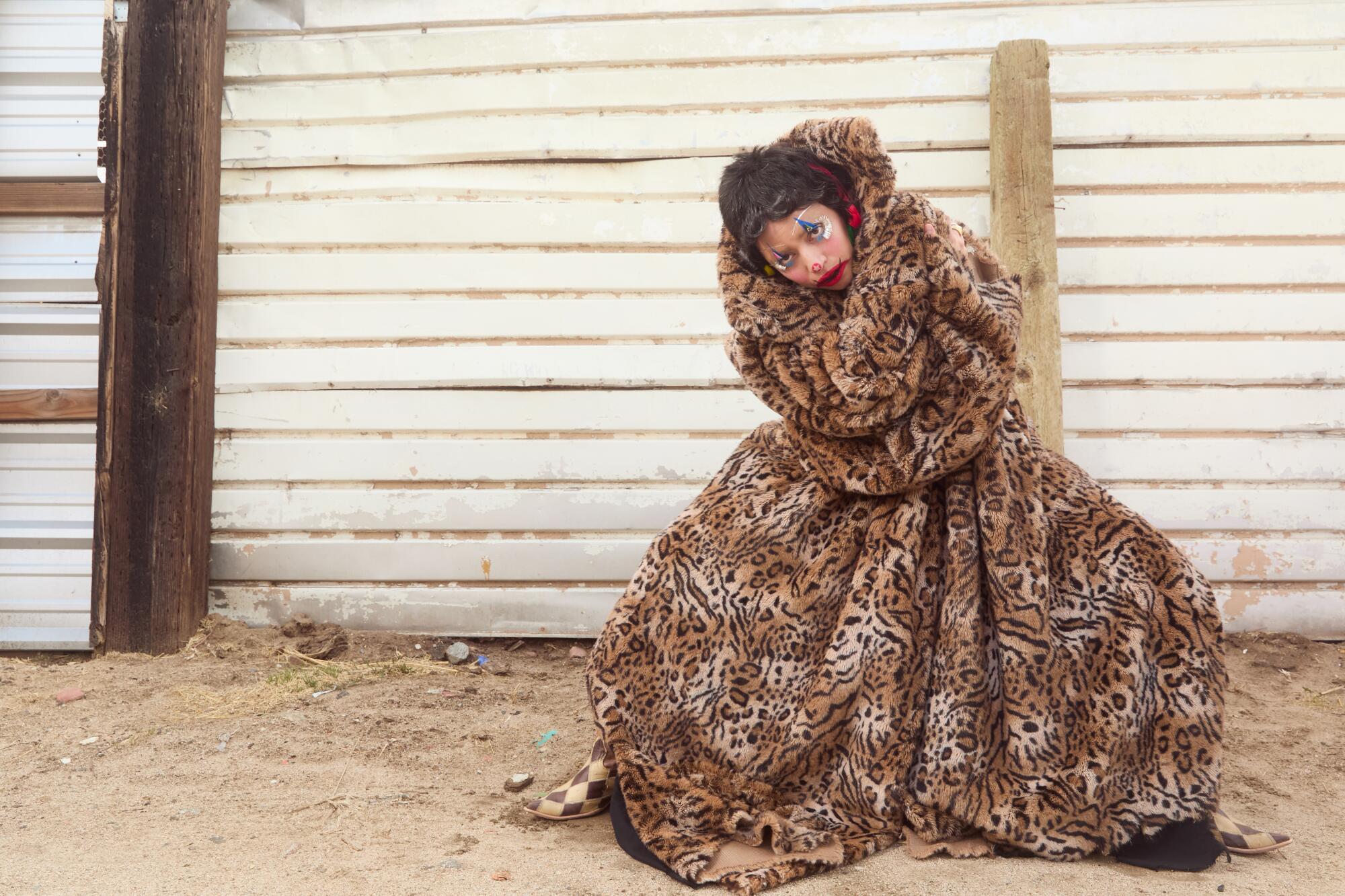
Yulissa wears Balenciaga jacket and skirt, talent’s own shoes.
All I’m sure of is that without an audience — to play with, to laugh or not laugh, and hopefully cry and transform — there is no clown. I’ll admit: When I started, I wanted the benefits of clowning, namely feeling comfortable and even coming to enjoy reading my work in public, without any of the scary bits (and clowns in America have quite a scary reputation). I had asked my first clown teacher for private (read: audience-free) lessons. She chuckled over the phone: “It doesn’t work that way.” Thus began my fool’s journey, if you will, from scared and lost to scared and lost with a dash more openness to being vulnerable.

I was glad I was wearing sneakers because I ended up running from the subway station to the midtown Manhattan building. I arrived at Room 315 on time and out of breath. It was a Saturday, and I was there for a two-day workshop, from noon to 5 p.m., with an hour break for lunch, with Christopher Bayes. His credentials, in a field where it feels funny to have them, include studying under clown masters Philippe Gaulier and Jacques Lecoq and working as the head of physical acting at Yale’s David Geffen School of Drama. While this all sounds technique-heavy, Bayes is known for valuing a heart-forward approach over an intellectual one. This was an honor for which I somehow justified paying $300.

We began with introductions — names, pronouns, why we were there. “I’m a writer,” I said, picking one job, out of the three I had, most suited to the moment. “And I’m writing a piece on clowning.” I scanned the room and my eyes landed on A, whom I recognized from another workshop. Our faces lighted up. We smiled — and clowns must smile only when they’re actually happy since, as I learned in workshop, a smile is a mask — and waved to each other. When it was A’s turn, they explained that whatever they were seeking from psychoanalysis, they were finding in clowning.
In this group of about 25 people, there was also a theater director who flew all the way to New York from San Francisco to take this workshop. There were a lot of people who loved theater and hoped a more honest connection with audiences would bring them back.
Next were the warm-up exercises. We started shaking our bodies, and I made another mental note: Actors and musicians all did warm-up exercises. What was the equivalent for writers? My thought was interrupted when Bayes instructed us to laugh very hard. It had been a confusing week, a mix of macro tragedy and micro wins. I cracked up, and it felt like sobbing. The group entered a frenzied state. I acclimated to the cacophony of primal sounds. We sounded like the animals we tend to forget we are.
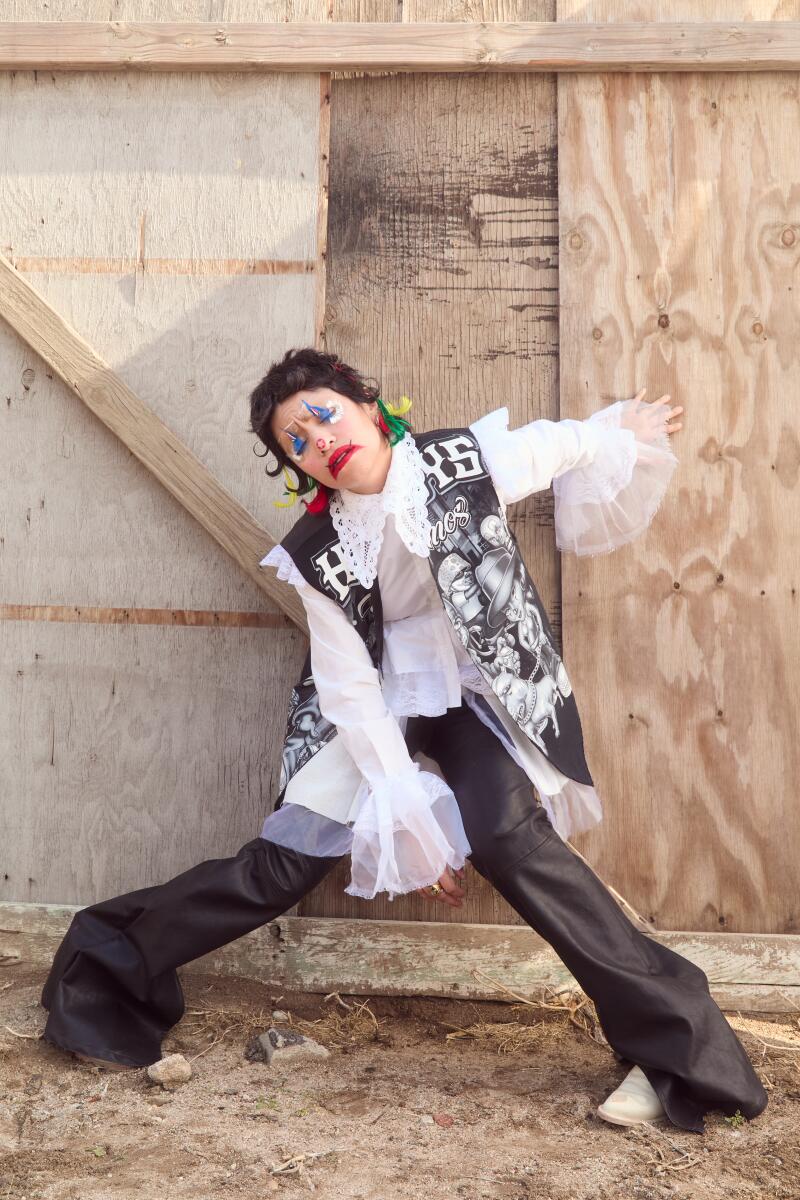

Yulissa wears Rio shirt and vest, Elena Velez pants, Pskaufman… shoes.
“Now cry!” Bayes shouted. I wailed and made my ugliest face. I was screaming so loud my voice cracked and I had to cough to clear it. I said, “Why, oh why?” I slapped my hands down on my quads. I headed toward the floor. I curled into a ball and cried with my face hovering an inch above the wooden floor. I heard a voice from above: “Don’t hide your sadness.” I stood up awkwardly having just been reprimanded for crying the polite way. I needed to cry the clown way, that is, take up space. I balled my hands into fists and stretched my arms out and up. I turned my face toward the ceiling and blamed it for all that was wrong with the world. Sobbing from the belly and feeling like some sort of tragic figure, I doubled over in laughter and now I couldn’t tell the difference between the two.
Afterward, we separated into groups of four. We were given 10 minutes to devise a song, along with a dance. My group chose the chorus “I love it.” We all had solos when we sang about something we genuinely loved. I sang about my apartment, how I loved it. I got the instructions mixed up and tried to rhyme but learned I wasn’t supposed to, so I sang, “Ohhhhhh, that’s easieeeeerrrr.” My solo came to a dark end: I loved my apartment, but I couldn’t afford it on my own, without roommates, and even if I could, it would be selfish to live there alone because of the city’s housing crisis. I sang about how the rental vacancy rate was 1.4% and that 5% was considered an emergency. There was nowhere else to go, so I sang to the audience to think about that. Some of the faces in the audience looked scared. My group sang, all together, “I love it, I love this love, I love love love love, yeah I like it!” We broke for lunch, and someone added me to the “Clown NYC” WhatsApp group. It has 712 members, and there are multiple threads, including “Shows & Mics,” “Meetup & Hangouts,” “Prop/Costume Exchange” — and “Housing.”
When I saw my first clown show, Julia Masli’s “Ha Ha Ha Ha Ha Ha Ha,” my first words might have been, “What the f—?” Masli emerged on a blueish dark stage amid the haze of fog. I recall a Medusa-like nest of wires around her head with a light illuminating her face. A gold mannequin’s leg with an attached microphone substituted as Masli’s left arm. She was bundled in a witchy outfit resembling a duvet cover. Masli looked extraterrestrial, complete with the wide, innocent stare of a being looking upon our society and its problems from a fresh perspective.

As a clown, it’s ideal if you wear something so stupid, people laugh just glancing at you. A performer’s costume signals to the audience that they’re in a space operating outside of societal norms, a place of amplification. While a clown’s “look” can be idiosyncratic and interesting, what starts off as funny and absurd gives way to the profound. In this way, clowning appears light and gets deep. With the support of aesthetics, a clown communicates, “Isn’t being human with all of its striving for status and repression in order to fit in kind of ridiculous?”
In “Nothing Doing,” a work-in-progress, clown Alex Tatarsky announced at the top that they didn’t believe in work or progress. They entered the stage in a top hat, white sequined leotard, rhinestone heels, sporting a long, thick braid attached to their hair. When they turned around for the first time, I was treated to a grotesque mask at the back of Tatarsky’s head and prosthetic cleavage that might have also been the plastic molding of butt cheeks. By the close of their show, after having mimed chasing after the performance’s nonexistent plot, Tatarsky sat at the head of a table, facing the audience, eating Life cereal with milk, with their hands, out of an empty skull, and at one point chewed and swallowed a cigarette. They said something like, “Darling, I just want you to love me, but it’s repulsive when I’m this desperate.” This desperation, rather than repelling me, became a source of connection. I found myself falling in love with this clown and, in turn, with the parts of myself I tend to reject.
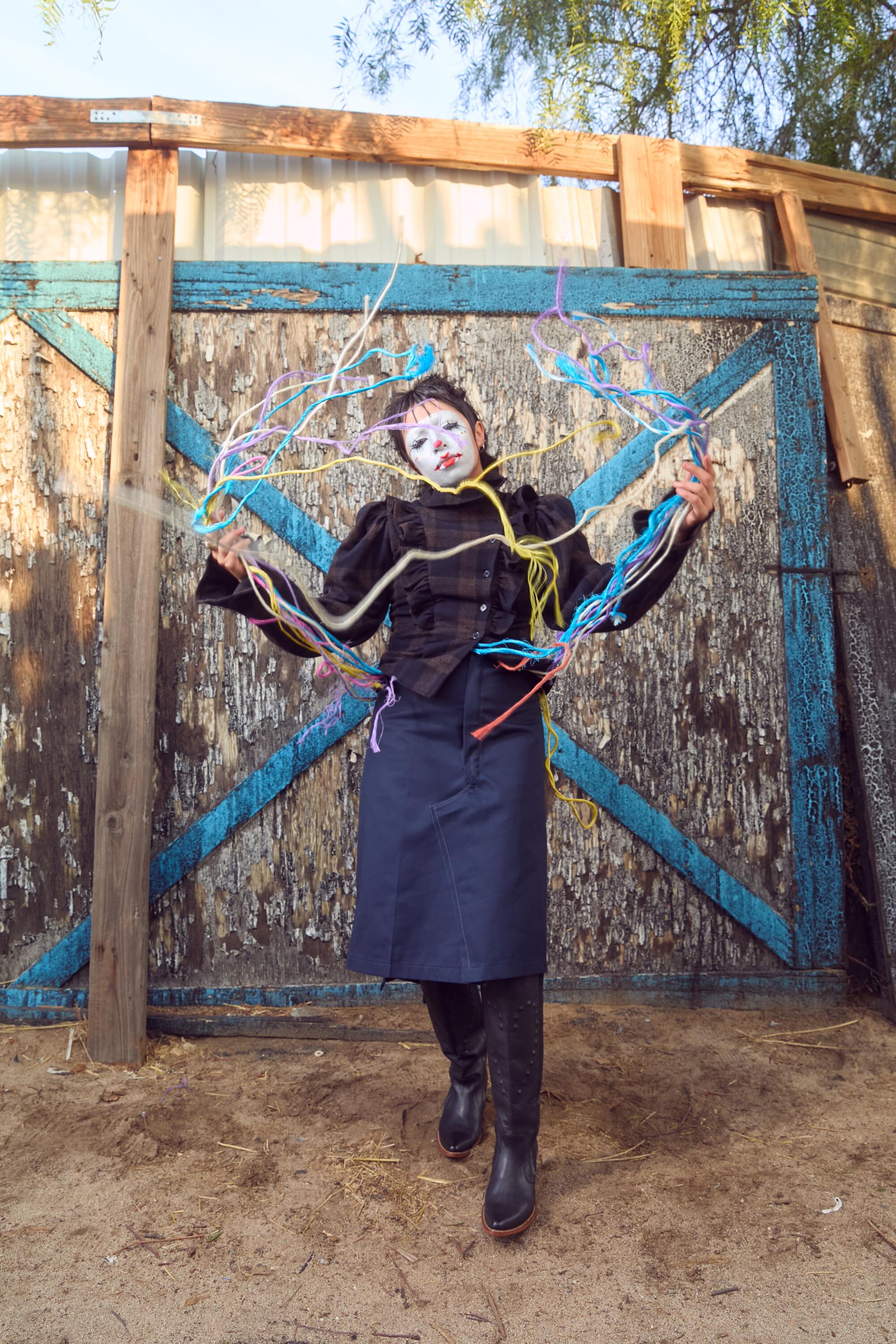
Yulissa wears Willy Chavarria shirt, Rio skirt, Pskaufman… shoes.
In the environment of a clown workshop, practicing loss of control (a clown can’t plan for an audience’s response) and being present with what is (a clown works with whatever they’ve got) can feel good. One eases off expecting specific results and being disappointed when things don’t turn out according to a rigid vision of success and delights in surprises no one could have imagined. If clowning is on the rise, and it certainly feels that way, it might be because it provides relief from having to keep it together.
On the second day of the workshop, we tried a different exercise. Two conventionally attractive men were onstage, and I was prepared to hate them both. Why? Because conventionally attractive men send me hurtling back in time to when I was an awkward preteen, and I’ve since developed an aversion. Bayes instructed them to get to know each other. They looked uncomfortable. One extended a handshake to the other. The crowd booed at the predictably masculine, business-like gesture. Then, Bayes told them to turn away from each other and walk to opposite ends of the room. One faced stage left, the other stage right.

They had to jump around to face each other and land at the exact same time. They kept failing. “Oh, come on,” I jeered. Ten minutes passed. The audience was exasperated. An eternity passed. One would turn around while the other didn’t move. Was I cursing them somehow? One wore a crisp white T-shirt that looked expensive with black wide-leg trousers. He had shoulder-length hair parted down the middle, like a model. The other, a white T-shirt that looked worn-in, black joggers and a delicate hoop earring. Both were barefoot. They kept missing even though they could technically cheat and set a pattern for the other to follow. It was agony. Bayes, who was sitting next to me, drew my attention to the man on the right. He was twitching. His eyebrows, his legs. The impulses were all confused. I laughed. I thanked the heavens that my performance of the same exercise didn’t go this badly.
Bayes told them, “You’re not getting it because you haven’t tucked in your shirts and raised your pants all the way up.” The two clowns followed the instructions. Now, they looked more ridiculous and endearing. We waited. We breathed. Finally. They jumped. They landed at the exact same time. People erupted in applause. A great tension was released. I rose from my seat along with others for a standing ovation. No matter how hopeless it seems, a clown can always win back the audience.

Yulissa wears Elena Velez shirt, pants, and hat, Pskaufman… shoes.
Now, the two men were facing each other. There were more boos. They lost us because they were “trying” again. I joined in, feeling like I was at a wrestling match where I wanted neither party to win. Now they were holding hands and squatting up and down vigorously. “Say, ‘Oh, yeah,’ ” shouted Bayes. They complied in unison. “Now say, ‘Oh, daddy,’ ” Bayes shouted. Again, the two complied, but they missed a beat and now they were saying “Daddy, O” in a guttural way as they continued holding hands and squatting up and down. I was laughing hard and clapping my hands. I was full of glee. In less than 30 minutes, I’d seen myself mirrored and altered. I could be someone who was afraid of being in front of others. Cocooned in the safety of a crowd, I could be cruel. I could be extravagantly generous. The clown wanted my love regardless. The clown was there to hold it all. I learned things that words fail to capture.
You had to be there. And that’s what I love most about clowning — it brings you into the now. Everything else fades away. It’s no longer about the shape something takes but about the attempt. No one is ever done as a clown.
Later that week, I found myself singing a stupid-sweet song from the workshop called “Open Like a Little Flower.” The next line was “Open like a different type of flower.” I remembered Bayes saying that when you go looking for beauty, you find it. I remembered too my pounding heart. Breathing hard from physical exertion. Buzzing with the high of a collective response, with the feeling of wholeness.

Priscilla Posada is a writer living in New York City. Her work can be found in the Los Angeles Review of Books, BOMB and the Brooklyn Rail, among other places.
Photography & Talent Yulissa Mendoza
Styling Erik Ziemba
Hair & Makeup Jaime Diaz
Art Direction Jessica de Jesus
Production Alexis de la Rocha
Photography assistant Lily Soleil Lewites
Styling assistant Nathan Alford
Content assistant Perry Picasshoe
Special thanks Ricardo Mendoza


Sam Raimi‘s Evil Dead films and TV series are a fine example of creativity within constraints, playfulness, self-awareness and outright slapstick comedy. The Evil Dead series after Raimi is very, very different. Starting with 2013’s Evil Dead by Fede Álvarez, followed by Evil Dead Rise by Lee Cronin, the new series takes itself more seriously and emphasises pure horror, violence and gore. Some have considered this praiseworthy as it avoids being a mere retread of the old films, but the reception has been mixed.
In Sébastien Vanicek’s Evil Dead Burn, Alice (Souheila Yacoub) loses her abusive husband (George Pullar) to a motor accident. When she goes home to stay with his family, the consequences of the work of their dead grandfather researching the Necronomicon and the Deadites manifest in terrible ways. One by one, the family are turned into the Evil Dead.
Horror is a genre that depends on you relating to the protagonists so you care what happens to them. In the case of Evil Dead Burn, Yacoub does a decent job with the character she’s given, but the gonzo horror elements manifest so early in the film that she may as well be collateral damage in the onslaught, especially as the film’s early point of view is that of her brother-in-law (Hunter Doohan).
Fans of gory violence will get their money’s worth here, but there’s not a lot going on besides that. The film is a descent into madness and carnage that is so resolutely unpleasant that, after some of the early kills, it becomes numbing. It’s hard to gather what the tone is supposed to be, with lots of callbacks to the early films’ style by setting up inevitable kills with Chekhov’s weed trimmer, Chekhov’s fork and every other potentially dangerous prop the camera lingers on. The family are all deeply unpleasant at some level and so their deaths register as meaningless. Yes, the film has the obligatory something to say about how our tendency to ignore domestic abuse creates demons that destroy families, but then absolutely panders to bloodlust by absolutely revelling in some of the most extreme violence imaginable between family members (and a pet). To say this is not a film for the sensitive is to understate things considerably. This is a film that absolutely earns its content guidance warnings.
Is there any comedy? Some, but it feels out of place given the absolute brutality inflicted on the cast. While most of the other films were self-aware about setting up a ludicrously grisly end for a villain as a payoff, in Evil Dead Burn,the kills have very little flair. It’s also hard to know what the rules for getting rid of a Deadite are, as some of them are still upright and chatty after losing most of the contents of their skull and some are dispatched by the repeated application of a blunt object to the head. Towards the end, a McGuffin is added to make the kills final, but before that, who knows?
Should you watch Evil Dead Burn,? It certainly gets vocal reactions from audiences in a cinema, and if you’re a gorehound you’ll be in for a ride. If you’re a horror fan, it’s certainly a horror film, but violent instead of scary. If you’re just a fan of cinema who likes good films whether or not they’re horror films, then this will be an alienating watch. In Evil Dead Rise the decay of the family was more than background noise and factored into the circumstances of the individual deaths, but not here. It has slight pretences of being a film with Themes and Ideas, but in the end it just feels like an excuse to serve up limbs being mutilated, skulls being crushed and any number of stabbings, slicings and gougings rendered with psychopathic visual fidelity. If that’s what you’re after, that’s what it’s got.
Entertainment
‘Children of Blood and Bone’ author won’t see film after feud with star Amandla Stenberg

Tomi Adeyemi, the author of the bestselling fantasy “Children of Blood and Bone,” isn’t planning to see the forthcoming film adaptation — even though she co-wrote it.
Over the weekend, the Nigerian American author posted a video on TikTok addressing fans who have been asking her the same question, “Why don’t you post about the adaptation of your first film adaptation anymore?”
“There is a reason I will not post anything about the adaptation of my work,” the author wrote in what appear to be screenshots of a group chat. “I have not seen the film, and I will not watch it.”
The adaptation of the first installment of Adeyemi’s “Legacy of Orïsha” fantasy trilogy is slated to hit theaters in January 2027. Gina Prince-Bythewood — who wrote and directed “Love & Basketball” and helmed “The Woman King” — is directing. The film stars Amandla Stenberg, Thuso Mbedu, Tosin Cole, Damson Idris, Cynthia Erivo, Lashana Lynch, Regina King, Idris Elba, Chiwetel Ejiofor and Viola Davis.
Alongside the screenshots of her comments in the group chat, she shared a February 2025 exchange with Stenberg that shows the author severing ties with the actor.
Adeyemi shared only her final message to Stenberg, which reads, “Do not ever use my name in an interview or video again. Do not text me. Do not call me.” That exchange is followed by a notification that she blocked Stenberg, who plays Princess Amari in the upcoming fantasy flick.
The message from Stenberg that preceded Adeyemi’s reply is not shown in full.
Stenberg, who played Rue in “Hunger Games,” Starr Carter in “The Hate U Give” and, recently, Verosha “Osha” Aniseya and Mae-ho “Mae” Aniseya in Disney’s “Star Wars” series “The Acolyte,” had been getting flack from readers of the series, who claimed colorism was an issue while casting the movie.
In February 2025, Stenberg posted a since-deleted nine-minute TikTok addressing the controversy and told followers that Adeyemi had given the actor her blessing when cast as the series’ princess.
“I am four months into training for ‘Children of Blood and Bone’ and I am getting my ass whooped,” Stenberg joked in the video, per BET.
“This year was mostly defined for me, honestly, by contending with what it felt like to receive racist death threats just for existing in the ‘Star Wars’ universe, and that was a really difficult thing for me to move through,” she continued. “But honestly, it feels so much more painful for me to feel like I’m at odds with my own community.”
Stenberg said that she considers her skin tone when navigating her career choices and would “never go after a role” she didn’t feel well suited for. “I know that colorism is an insidious system that relentlessly impacts every facet of entertainment.”
The actor continued that it was actually a meeting with the “Children of Blood and Bone” author that gave her the confidence to pursue the role.
“I had the opportunity to meet Tomi, the novelist, for the first time. … And she goes, ‘Amandla, I want you to know that when you were a little girl and you were cast as Rue in “The Hunger Games,” and people said that Rue’s death wouldn’t be as sad because you’re a Black girl — that inspired me to write this series so that Black girls like you and Black girls of all shades could have a story written about them,’” Stenberg said in the video. “We started crying, and I said to myself, ‘God wants me here.’”
Representatives for Stenberg, Adeyemi and Prince-Bythewood did not immediately respond to The Times’ request for comment.
Movie Reviews
‘Night Nurse’ Review: A Caretaker Explores Her Kink for Elder Abuse in the Year’s Strangest Erotic Thriller

There are any number of erotic thrillers in which rich old men are robbed blind and/or left for dead, but Georgia Bernstein’s admirably bizarre “Night Nurse” might be the first movie of its kind where elder abuse is the source — and possible subject— of its erotic thrills. If there are others, I’m not sure I want to know.
But this woozy debut feature doesn’t rely on its audience being turned on by the relationship between a nubile caretaker and her dementia-addled patient. Their psychosexual bond, meanwhile, hinges on cold-calling vulnerable old people under the guise of a grandchild in financial distress. (“I’m in trouble, nana, send me $10,000 or I’ll be left to rot in jail!” That sort of thing). With its slim wisp of a premise stretched into a Strickland-esque dreamscape that substitutes kink for conflict, the film itself hardly seems convinced by its own wrinkled lust — all desperate kisses and non-touching poses of subservience. More important to Bernstein is what that lust reveals about her characters’ deepest needs, specifically how their need to care and be cared for can be as easily perverted as any other form of desire.

As moody and weightless as the noir-accented score that blows through the movie like a curlicue gust of wind in an old cartoon (credit to musicians Sam Clapp and Steven Jackson), “Night Nurse” lacks the pulse required for its stray feelings to come alive. Still, the film ambiently taps into the latent eroticism of teasing out the distance between how you see yourself and who you really are. Bernstein plays with that distance like a telephone cord wrapped around her fingers, and Eleni — played by the excellent newcomer Cemre Paksoy, powerfully helpless — only frays even more as the receiver is brought near the hook. “Everything I did before today wasn’t me,” the nurse tells co-worker Mona (Eleonore Hendricks) after starting a new job at an Illinois retirement home. “It was somebody else.”
What she did before today remains unexplored (specifically, what she did to get herself fired from her last gig), but I’m guessing she’s probably changed less than she thought. There’s a faraway flicker in her eyes the moment she catches the vibe between Mona and Douglas (a ribald and elusive Bruce McKenzie), a white-haired seventysomething who shows early signs of dementia but still commands an undiminished sexual energy. “I’m not an invalid,” he coos as Mona bathes him in the tub, to which she replies, “yes, you are,” in a supplicant tone that hints at a rich history of power games between them.
Later that same night, Douglas will force Eleni to call a stranger, pretend that she’s their granddaughter, and ask for money — he’ll wrap the phone cord around the nurse’s body as she talks and shove her against the wall as they kiss. She’s into it. So into it that he has to clarify the terms of his whole deal: “If you’re looking for a pogo stick, I’m really not your guy.” But Eleni isn’t looking for anything to bounce on. She just wants to be needed, and maybe to need someone in return. Someone who will see her for who she really is and allow her the fantasy of pretending she isn’t being herself when she cons vulnerable strangers out of their money — when she exploits how enthralled those strangers are by the care they have for their loved ones.
“Night Nurse” doesn’t belabor the psychology, as Bernstein prefers to express her story through heavy-lidded suggestion. Somnambulating from the moment it starts, the film moves through a series of beautifully arranged poses that stretch their latent meaning thin across the surface (Lidia Nikonova’s cinematography lacquers every shot with a seductive dreaminess). We see Douglas smoking in a lawn chair with Mona and Eleni curled around his feet. Eleni riding in the backseat of a convertible as the wind blows through her curls. The full staff of nurses — all of them under Douglas’ sway — stumbling around his condo in a state of zonked out bliss as they roll on the prescription drugs they’ve stolen from the residents.
Once you’ve seen one shot of this movie, you’ve practically seen them all, at least until things escalate during a rushed and unsatisfying third act that forces Eleni into an honest confrontation with herself. People will do just about anything to feel needed — they’ll give whatever degree of care allows them to receive it in return. “Night Nurse” understands that desire, but remains far too numb to treat it.
Grade: C+
The Independent Film Company will relase “Night Nurse” in theaters on Friday, July 10.
-
 Nevada7 minutes ago
Nevada bystanders pull crash victim from burning motorhome on I-15 near Mesquite
-

 New Hampshire9 minutes ago
Townsend man arrested in connection with two armed robberies in New Hampshire and New Jersey, authorities say – The Boston Globe
-

 New Jersey14 minutes ago
Are all Freedom Fuel locations $3.47? Not anymore
-

 New Mexico21 minutes ago
New Mexico’s ban on liquor ‘minis’ yields mixed results five years later
-

 North Carolina24 minutes ago
NC state budget includes $27M for Madison County’s new public service complex
-

 North Dakota30 minutes ago
The Women’s College Fan Guide To 2026 Junior Nationals – FloWrestling
-

 Ohio36 minutes ago
Ohio reports nearly 200 cases of ‘explosive diarrhea’ illness
-

 Oklahoma39 minutes ago
Every Oklahoma State Cowboys’ College Football 27 Preseason Player Rating

