Entertainment
8 movies to look out for at the Sundance Film Festival


How is this for whiplash? Fresh off a hot batch of Oscar nominations, we now turn to the week’s other big news, a new edition of the Sundance Film Festival, where independent cinema will make its stand for yet another year. As always, The Times will be in Park City, Utah, for all the buzz and world premieres — check back daily for reviews, news, video interviews and more. Evenings of single-digit temperatures await us, as do, we hope, a number of discoveries. For now, here are the titles that beguile us going in.
‘By Design’
Samantha Mathis, Juliette Lewis and Robin Tunney in the movie “By Design.”
(Patrick Meade Jones / Sundance Institute)
Juliette Lewis has played murderers, drifters, alcoholics, punk rockers, Reiki healers and roller-derby captains. Now, she plays a chair. (Yes literally, with wood and four legs.) “By Design,” by the playwright-turned-filmmaker Amanda Kramer, has one of this Sundance’s more mysterious hooks: What happens when a woman realizes that society prefers her inanimate? Kramer’s first two films, “Ladyworld” and “Please Baby Please,” introduced her as an arch stylist with bold ideas and an insouciant disregard for telling stories that play by the rules — if she were a chair, she’d wear a slipcover of sharp crystals. Clearly, audiences will have to check their commitment to reality at the door. Even within a cast that includes Melanie Griffith, Samantha Mathis and Udo Kier, I’m most curious to see Mamoudou Athie play a man who comes to possess (and sit) on Lewis’ seat. Athie is a performer of unusual conviction — and this unusual film is going to take everything he’s got. — Amy Nicholson
‘The Dating Game’

A still from the documentary “The Dating Game.”
(Wei Gao / Sundance Institute)
Much ado has been made over the lopsided mating pool of China, where the recent census showed a surplus of 30 million single men. With women scarce, the competition is steep — think “The Bachelorette” on steroids. Enter Hao, a dating guru who believes that being yourself is a myth. He runs a seven-day boot camp that remakes lonely guys both outside and in, including flashy shirts and haircuts to what he calls “strategic deception.” Hao’s own lovely wife, Wen, is a testament to his pickup skills. But the couple is still at odds. Wen not only disagrees with his instructional methods, she has her own coaching business that advises women to love themselves first. This documentary by Violet Du Feng studies the battle between the sexes on a scale that’s both intimate and grandly sociological. She’s pointed her camera at Chongqing, but she’s captured an empathetic universe of insecurity, flirtation and, hopefully, love. — Amy Nicholson
‘It’s Never Over, Jeff Buckley’

Jeff Buckley in the documentary “It’s Never Over, Jeff Buckley.”
(Merri Cyr / Sundance Institute)
Like so many, I discovered the beauty of Jeff Buckley’s music years after he drowned in the Mississippi River in 1997. There was a period when his lone studio album “Grace” was a constant in my three-disc changer, listening nightly as I drifted off to sleep. Even now, I revisit it often, 31 years after its release, because it remains a haunting and near-perfect album, and one that I count among the best of the last 50 years. Naturally, I am eager to see what Oscar-nominated documentarian Amy Berg (“Deliver Us From Evil,” “Janis: Little Girl Blue”) has unearthed for the film, the title of which references the lyrics of Buckley’s “Lover, You Should Have Come Over.” Berg convinced Buckley’s mother, Mary Guibert, to give her access to the artist’s archive. The documentary promises rare performances and “Buckley’s own diaristic narration,” according to the festival’s programming notes. It’s also a chance to introduce a new audience to an incredible artist, one who should be better known beyond his cover of Leonard Cohen’s “Hallelujah.” — Vanessa Franko
‘Lurker’

Archie Madekwe, left, and Théodore Pellerin in the movie “Lurker.”
(Sundance Institute)
I’ve been waiting for the British actor Archie Madekwe (“Midsommar,” “Gran Turismo”) to become a big star. Here, at least, he plays one on the rise — a musician who might need to get a better handle on his entourage. Before the velvet ropes go up, the artist allows a dubious average Joe (Théodore Pellerin) into his inner circle. I’m not sure what happens next in this thriller, but I have a feeling that Madekwe, recently seen in “Saltburn” as a snide, posh snob undone by Barry Keoghan, might put up more of a fight this time. Debuting filmmaker Alex Russell has two major TV credits on his resume — “The Bear” and “Beef” — which he wrote on and produced. Awkward tension is definitely his thing. If Russell’s depiction of burgeoning pop stardom feels as visceral as his depictions of kitchens and road rage, this one’s gonna be a scorcher. — Amy Nicholson
‘The Perfect Neighbor’
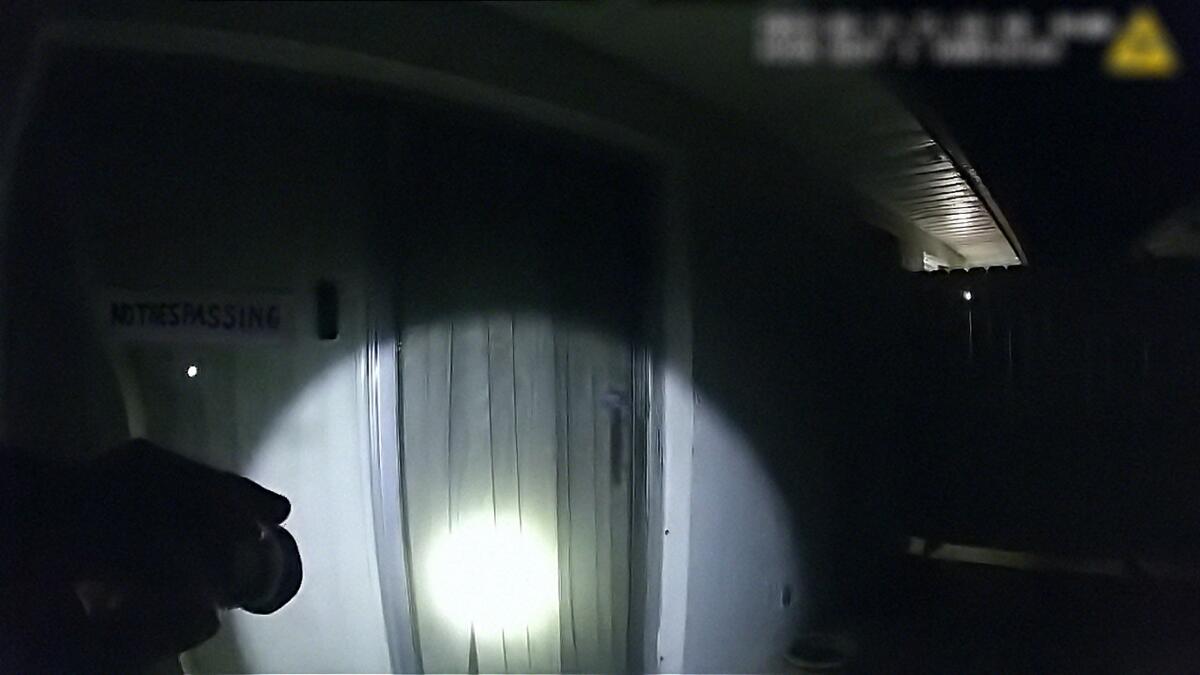
A still from the documentary “The Perfect Neighbor.”
(Sundance Institute)
Many will likely remember aspects of the 2023 news story of how Ajike “AJ” Owens, a mother of four, was shot by her neighbor, Susan Lorincz, through a locked door following an escalating series of minor disputes. Directed by Geeta Gandbhir and premiering in the U.S. documentary competition, “The Perfect Neighbor,” recounts the build-up and aftermath of that startling incident in vivid, up-close detail. Told largely via the perspective of police body-cam video — the authorities were called to the otherwise quiet neighborhood so often that characters, story lines and subplots all clearly emerge — there is a genuine immediacy to the storytelling that reaches a devastating climax as the night of the shooting spirals into chaos and heartbreak. Lorincz was not initially charged with any crime because of Florida’s “stand your ground” self-defense law before later being brought to trial, as the film shifts to examine how a single act of violence can irrevocably change so many lives. — Mark Olsen
‘Serious People’

Miguel Huerta, left, and Pasqual Gutierrez in the movie “Serious People.”
(Pasqual Gutierrez and Ben Mullin / Sundance Institute)
The festival’s NEXT section is home to films that are too offbeat, too unconventional, just too plain weird to fit into other sections of the Sundance program. Directed by Pasqual Gutierrez and Ben Mullinkosson, “Serious People” is an exemplar of that ethos as its oddball charms unfurl. Pasqual, a music video director played by Gutierrez, wants to spend more time with his pregnant partner, so he hires a lookalike to take his place at work. The plan is for his double to unobtrusively play along during Zoom calls and production meetings, but the guy he hires turns out to be an unpredictable live-wire, prone to utterly impractical ideas and deeply inappropriate workplace behavior. Wildly funny, the film also has a tender side as it explores the need for a work-life balance even in creative fields that also require a commitment of passion. — Mark Olsen
‘Sorry, Baby’
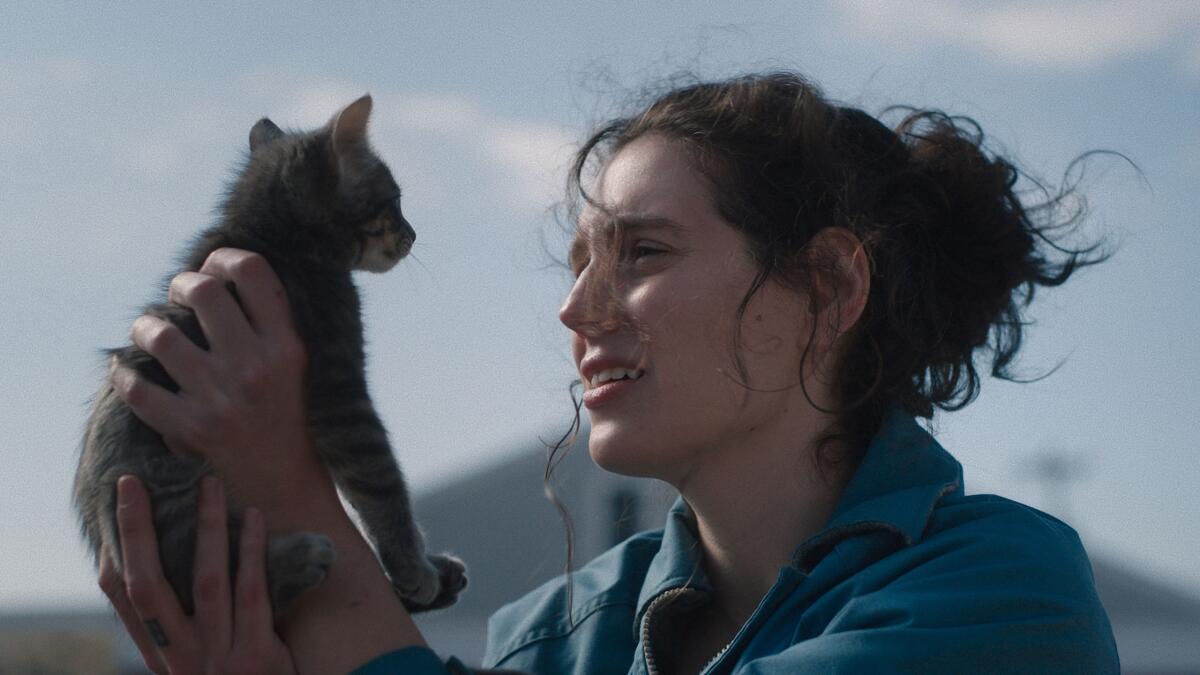
Eva Victor in the movie “Sorry, Baby.”
(Mia Cioffi Henry / Sundance Institute)
The debut feature from director-writer-star Eva Victor, “Sorry, Baby” is also a compact primer on why Sundance still matters. Serving as an introduction to an engaging new artistic voice, the film captures a certain laconic, free-floating malaise and anxiety that are indicative of an emergent generational sensibility. Told in an elliptical style with novelistic chapters, the story follows Agnes, a literature grad student turned junior professor at a small liberal arts college who is struggling to move forward from a traumatic event. Victor’s performance is touched by grace and whimsy while also pulling off dramatic emotional moments, sometimes within the same scene. With key supporting turns from Naomi Ackie, Lucas Hedges and John Carroll Lynch, the film is the sort of bold, inventive storytelling along with a discovery of fresh talent that is exactly what one wants out of the festival. — Mark Olsen
‘Zodiac Killer Project’

A still from the film “Zodiac Killer Project,” directed by Charlie Shackleton.
(Sundance Institute)
Given all the high-profile movies and series TV spun out from this still-unsolved criminal case, you’d think the actual Zodiac killer would have emerged by now, just to get a taste of the royalties. Of course, as any bleary-eyed obsessive knows, the real guy is most likely dead at this point, but don’t call filmmaker Charlie Shackleton late to the game. His humorous, bone-dry documentary gets at more than most, first by being a meta-confessional about how his own efforts to make a conventional movie failed. (He was denied the option rights to a book.) No matter: The film that he has made is revenge on an entire genre, detailing all the clichés that go into seemingly every true-crime project, including atmospheric, faceless re-creations and those gauzy title sequences that manage to both say everything and nothing. Narrated in his own witty British voice, Shackleton’s latest provocation joins prior titles “Beyond Clueless” and “Paint Drying” as an enjoyably self-deprecating study that takes aim at a mode of storytelling that could benefit from a little danger. — Joshua Rothkopf



In contrast to other sci-fi heroes, like Interstellar’s Cooper, who ventures into the unknown for the sake of humanity and discovery, knowing the sacrifice of giving up his family, Grace is externally a cynical coward. With no family to call his own, you’d think he’d have the will to go into space for the sake of the planet’s future. Nope, he’s got no courage because the man is a cowardly dog. However, Goddard’s script feels strikingly reflective of our moment. Grace has the tools to make a difference; the Earth flashbacks center on him working towards a solution to the antimatter issue, replete with occasionally confusing but never alienating dialogue. He initially lacks the conviction, embodying a cynicism and hopelessness that many people fall into today.
The film threads this idea effectively through flashbacks that reveal his reluctance, giving the story a tragic undercurrent. Yet, it also makes his relationship with Rocky, the first living thing he truly learns to care for, ever more beautiful.
When paired with Rocky, Gosling enters the rare “puppet scene partner” hall of fame alongside Michael Caine in The Muppet Christmas Carol, never letting the fact that he’s acting opposite a puppet disrupt the sincerity of his performance. His commitment to building a gradual, affectionate friendship with this animatronic creation feels completely natural, and the chemistry translates beautifully on screen. It stands as one of the stronger performances of his career.
Project Hail Mary is overly long, and while it can be deeply affecting, the film leans on a few emotional fake-outs that become repetitive in the latter half. By the third time it deploys the same sentimental beat, the effect begins to feel cloying, slightly dulling the powerful emotions it built earlier. The constant intercutting between past and present can also feel thematically uneven at times, occasionally undercutting the narrative momentum. At 2 hours and 36 minutes, the film feels like it’s stretching itself to meet a blockbuster runtime when a tighter cut might have served better.
FINAL STATEMENT
Project Hail Mary is a meticulously crafted, hopeful, and dazzling space epic that proves the most moving friendship in film this year might just be between Ryan Gosling and a rock.
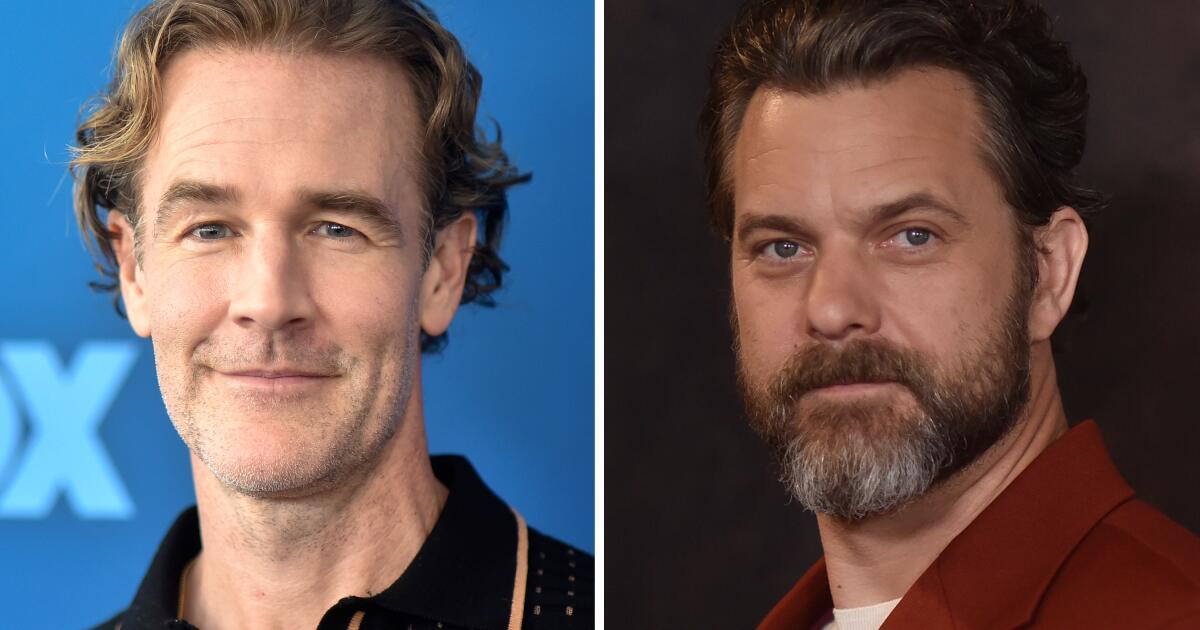
Joshua Jackson says he knows he was “really just a footnote” in James Van Der Beek’s life, despite the “amazing” time they spent together as stars of the series “Dawson’s Creek.”
The star of “The Affair” is reflecting publicly for the first time about his former castmate, who died Feb. 11 at age 48 after a battle with colorectal cancer.
The time they shared on set was “formational” for them, Jackson said on “Today.” When the “Dawson’s Creek” pilot aired in January 1998, he was 19 and Van Der Beek was almost 21, playing characters who were 15.
“I know both of us look back on that time with great fondness, but I will also say that I know that I’m really just a footnote in what he actually accomplished in his life.”
Jackson spoke with great respect for his friend, who he said “became what we used to just call a good man, a man of the kind of belief, the kind of faith that allowed him to face the impossible with grace, an unbelievable partner and husband, just a real man who showed up for his family and a beautiful, kind, curious, interested, dedicated father.”
On the one hand, the 47-year-old said, “that’s beautiful.” On the other, “The tragedy of that loss for his family is enormous.”
Since Jackson and Van Der Beek played Pacey Witter and Dawson Leery three decades ago, both men had kids of their own — a 5-year-old daughter for Jackson, born during the pandemic with ex-wife Jodie Turner-Smith, and six kids for Van Der Beek with second wife Kimberly Brook. The latter couple’s children — two boys and four girls, ranging in age from 4 to 15 — were what Van Der Beek said changed everything for him.
“Your life becomes shared, and your joys become shared joys in a really beautiful way that expands your level of circuitry out to other people instead of just keeping it all for your own gratification,” the actor told “Good Morning America” in May 2023. “And the lessons, they keep on coming. It’s the craziest, craziest thing I’ve ever done, and it’s the thing that’s made me happiest.”
Knowing his colleague’s love for his family, Jackson said on “Today” that “for me as a father now, I think the enormity of that tragedy hits me in a very different way than just as a colleague, so I think the processing [of Van Der Beek’s death] is ongoing.”
The “Little Fires Everywhere” actor was on the morning show Tuesday to bring attention to colorectal cancer screenings.
Van Der Beek’s diagnosis, which went public in November 2024, was among the factors prompting Jackson to get involved with drugmaker AstraZeneca’s “Get Body Checked Against Cancer” campaign, which takes a lighter approach to a serious subject — cancer screening — through a partnership with Jackson, the National Hockey League and the Philadelphia Flyers’ furry orange mascot, Gritty.
“It is … true, the earlier you find something,” said “The Mighty Ducks” actor, “the better your possible outcomes are.”

DAN WEBSTER:
It may now seem like ancient history, especially to younger listeners, but it was only 26 years ago when the streets of Seattle were filled with protesters, police and—ultimately—scenes of what ended up looking like pure chaos.
It is those scenes—put together to form a portrait of what would become known as the “Battle of Seattle” —that documentary filmmaker Ian Bell captures in his powerful documentary feature WTO/99.
We’ve seen any number of documentaries over the decades that report on every kind of social and cultural event from rock concerts to war. And the majority of them follow a typical format: archival footage blended with interviews, both with participants and with experts who provide an informational, often intellectual, perspective.
WTO/99 is something different. Like The Perfect Neighbor, a 2026 Oscar-nominated documentary feature, Bell’s film consists of what could be called found footage. What he has done is amass a series of news reports and personal video recordings into an hour-and-42-minute collection of individual scenes, mostly focused on a several-block area of downtown Seattle.
That is where a meeting of the WTO, the World Trade Organization, was set to be held between Nov. 30 and Dec. 3, 1999. Delegates from around the world planned to negotiate trade agreements (what else?) at the Washington State Convention and Trade Center.
Months before the meeting, however, a loose coalition of groups—including NGOs, labor unions, student organizations and various others—began their own series of meetings. Their objective was to form ways to protest not just the WTO but, to some of them, the whole idea of a world order they saw as a threat to the economic independence of individual countries.
Bell’s film doesn’t provide much context for all this. What we mostly see are individuals arguing their points of view as they prepare to stop the delegates from even entering the convention center. Meanwhile, Seattle authorities such as then-Mayor Paul Schell and then-Police Chief Norm Stamper—with brief appearances by Gov. Gary Locke and King County Executive Ron Sims—discuss counter measures, with Schell eventually imposing a curfew.
That decision comes, though, after what Bell’s film shows is a peaceful protest evolving into a street fight between people parading and chanting, others chained together and splinter groups intent on smashing the storefronts of businesses owned by what they see as corporate criminals. One intense scene involves a young woman begging those breaking windows to stop and asking them why they’re resorting to violence. In response a lone voice yells their reasoning: “Self-defense.”
Even more intense, though, are the actions of the Seattle police. We see officers using pepper spray, tear gas, flash grenades and other “non-lethal” means such as firing rubber pellets into the crowd. In one scene, a uniformed guy—not identified as a police officer but definitely part of the security crowd, which included National Guardsmen—is shown kicking a guy in the crotch.
The media, too, can’t avoid criticism. Though we see broadcast reporters trying to capture what was happening—with some affected like everybody else by the tear gas that filled the streets like a winter fog—the reports they air seem sketchy, as if they’re doctors trying to diagnose a serious illness by focusing on individual cells. And the images they capture tend to highlight the violence over the well-meaning actions of the vast majority of protesters.
Reactions to what Bell has put on the screen are bound to vary, based on each viewer’s personal politics. Bell revels his own stance by choosing selectively from among thousands of hours of video coverage to form the narrative he feels best captures what happened those two decades-and-change ago.
If nothing else, WTO/99 does reveal a more comprehensive picture of what happened than we got at the time. And, too, it should prepare us for the future. The way this country is going, we’re bound to see a lot more of the same.
Call it the “Battle for America.”
For Spokane Public Radio, I’m Dan Webster.
——
Movies 101 host Dan Webster is the senior film critic for Spokane Public Radio.

Source: Lamont Paris returning to South Carolina next season

Trading property tax for sales tax: Legislature moves forward with parts of homeowner relief package

In final address, Gov. Bill Lee credits TN economic, innovation gains

Most applicants for Texas school choice vouchers already attend private schools, state data shows

‘They’re trying to change the rules’: Republicans ramp up fight to stop new maps in Utah

Florida High School Football Rankings: Top 25 teams – Oct. 21

How old is Bo Nix? What to know about Oregon quarterback ahead of 2024 NFL Draft

Cleary's 21 help Le Moyne down Central Connecticut State 69-64 in OT

99th annual Pony Swim held in Virginia

Indiana Members Credit Union announced as new anchor tenant at Bottleworks District

Map: 2.3-Magnitude Earthquake Reported North of New York City

Trump stirs GOP primary drama with visit to Massie’s Kentucky home turf

Israeli air strike targets building in south Lebanon

Ed Martin, outspoken Justice Department lawyer, is formally accused of ethical violations | CNN Politics

Trump reveals top issues GOP should focus on to secure midterms victory: ‘I’ve never been more confident’
-

 Wisconsin1 week ago
Setting sail on iceboats across a frozen lake in Wisconsin
-

 Massachusetts1 week ago
Massachusetts man awaits word from family in Iran after attacks
-

 Maryland1 week ago
AM showers Sunday in Maryland
-

 Pennsylvania5 days ago
Pa. man found guilty of raping teen girl who he took to Mexico
-

 Florida1 week ago
Florida man rescued after being stuck in shoulder-deep mud for days
-

 Sports6 days ago
Keith Olbermann under fire for calling Lou Holtz a ‘scumbag’ after legendary coach’s death
-

 Virginia6 days ago
Giants will hold 2026 training camp in West Virginia
-

 Miami, FL6 days ago
City of Miami celebrates reopening of Flagler Street as part of beautification project