Crypto
New cryptocurrency GBTC hits 5M: What is Green Bitcoin, and why are traders backing it for its upside potential?


With the presale rapidly progressing, the early adopter’s opportunity to get positioned at the lowest price is quickly running thin as the price consistently increases in the unique fundraising design.
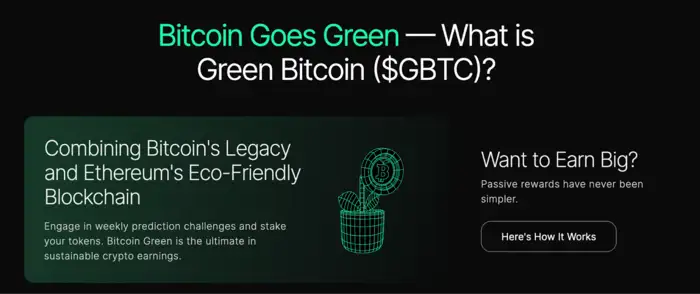
Green Bitcoin officially crossed the $5 million fundraising milestone, as traders back the predict-to-earn protocol for considerable gains in the coming weeks. The project has created a unique staking mechanism that allows users to place forecasts on the future price of Bitcoin to earn massive rewards scaled to their level of investment while earning staking rewards simultaneously.Green Bitcoin is being hailed as a greener alternative to Bitcoin. It combines Bitcoin’s legacy with Ethereum’s co-friendly proof-of-stake mechanism. As a result, Green Bitcoin has birthed an ecosystem tied to Bitcoin’s price through price predictions with no environmental impact.
The project intends for its blockchain to experience a high level of activity. Its users will consistently stake $GBTC to participate in the daily price contests and earn massive rewards. The price contests are rooted in the staking system, and the team will release new daily and weekly challenges based on Bitcoin’s price action to keep the content fresh.
What is Green Bitcoin, and how does it reward users for accurate price forecasts?
 Spotlight Wire
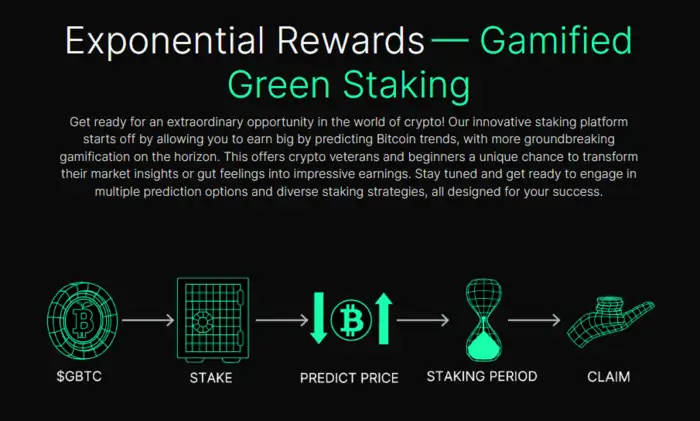
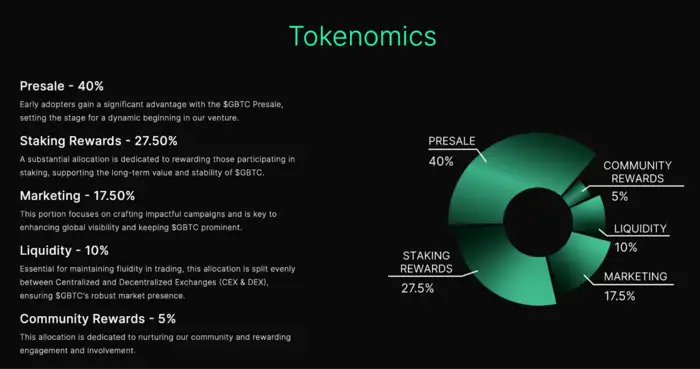
Green Bitcoin introduces a novel staking ecosystem called Gamified Green Staking. This ecosystem allows users to stake $GBTC tokens to be eligible to place daily price predictions on Bitcoin’s value. Those who accurately place correct forecasts are proportionally rewarded from the daily mining rewards pool, scaled to their level of commitment to the ecosystem.Green Bitcoin pays homage to Bitcoin’s legacy. Its rewards are distributed to winners every ten minutes, in line with the original Bitcoin block schedule. Contestants can claim their accumulated rewards from the protocol once every 24 hours to keep transaction costs low. The team has allocated an enormous 27.5% of the entire $GBTC supply to provide the rewards for accurate predictions for the next two years.
 Spotlight Wire
Users must lock their $GBTC into the Gamified Green Staking mechanism and submit their forecast before 11:30 PM EST to participate. At midnight, the smart contract will tally the day’s stakes against the actual price of Bitcoin and reward forecasts that land in the ‘Green Zone.’
As mentioned, the rewards earned depend on the level of investment made and the duration committed to the ecosystem. For example, those who have staked their $GBTC tokens in the Gamified Green Staking mechanism for more than a week are entitled to a 5% bonus on top of their regular daily rewards to recognise their extended commitment.
Those staking their tokens while participating in the daily price contests also earn an APY reward on top of their holdings through daily passive staking. The staking currently provides a 110% APY return, further incentivising users to keep their $GBTC locked into the ecosystem.
Why are traders backing it for huge upside potential?
 Spotlight Wire
Traders are quickly flocking to the presale, expecting upside potential for $GBTC due to its supply constraint dynamics.
Influential YouTubers ClayBro and Matthew Perryare backing the project with bullish views. They believe the unique staking system will cause $GBTC to surge following its exchange listing.
Users are required to stake their $GBTC into the ecosystem to participate in the price contests, so the tokens aren’t available for purchase on the open market. As a result, these experts predict that there might be a supply shock on centralised and decentralized exchanges as most $GBTC will be locked into the ecosystem.
Therefore, newcomers to $GBTC will likely be forced to pay higher prices to acquire the token and participate in the predict-to-earn ecosystem following the presale.
Investors are comparing the supply dynamics for Green Bitcoin as very similar to those of Bitcoin itself, which is currently experiencing a pre-halving rally ahead of its block reward cut. Both cryptocurrencies will likely experience massive supply shocks on the open market, causing prices to surge.
How to buy $GBTC today
$GBTC can be purchased at presale prices through the project’s website. Green Bitcoin is utilising the Web3Payments gateway to ensure the safety and security of everybody investing.
- Go to the official $GBTC presale page.
- Fund your wallet with $ETH or $USDT and connect to the Web3Payments widget.
- Use the presale widget to swap your currency for $GBTC, entering the desired amount you wish to purchase.
- If you prefer plastic, order $GBTC tokens to your wallet using your credit/debit card.
Once purchased, your $GBTC will be automatically staked, allowing you to start earning a return on your investment throughout the presale stage. You can claim your $GBTC through the same portal when the token officially launches.
Overall, it’s unsurprising to see investors rushing to the $GBTC project, which, with its unique staking dynamics, is about to cause a supply shock on the open market, leading to much higher prices following the presale.
Buy $GBTC today.
Disclaimer: The above content is non-editorial, and TIL hereby disclaims any and all warranties, expressed or implied, relating to the same. TIL does not guarantee, vouch for or necessarily endorse any of the above content, nor is it responsible for them in any manner whatsoever. The article does not constitute investment advice. Please take all steps necessary to ascertain that any information and content provided is correct, updated and verified.



Subscribe to Knox News: Local journalists covering local stories
Knox News journalists cover the important moments in Knoxville. Support local journalism by subscribing.
Nonprofits and cryptocurrency donations are increasingly being used to put old-fashioned money in the bank.
Cryptocurrency valuations over time are such that more nonprofits are opening up to accepting crypto and converting it to cash, or holding on to it for hoped-for long-term value increases.
Principal factors that have held back nonprofits’ acceptance of crypto donations are uncertainty about how it works, valuation volatility, tax implications and regulatory considerations. But the strains on traditional fundraising and the potential gain nonprofits can realize from crypto are driving them to explore — or accept — this nontraditional funding source. Other issues are not having a vehicle in place to accept crypto, and many nonprofits as regards crypto haven’t updated their internal investment policies and donation acceptance policies.
Crypto’s name is based on combining cryptography (encrypted codes) with currency. There is no government central bank or other authority creating crypto. An internet artificial intelligence overview explains crypto creation as follows, and don’t be surprised if it seems almost a foreign language: “Cryptocurrency is created through decentralized digital processes, primarily mining or validation, rather than being minted by a central bank. New coins are generated as rewards for securing the blockchain network, verifying transactions, and solving complex mathematical problems, using specialized computer hardware.”
Crypto valuation has something in common with the plush toys called Beanie Babies. Beginning in 1993, Beanie Babies were a craze for a short time. As the idea of a collectible toy spread, demand grew; scarcity and restrained production drove costs higher. Long lines formed at stores so the newest ones could be grabbed as they went on shelves. Today, many Beanie Babies can be bought on eBay for $5.99, though some rare, mint-condition Babies sell for thousands. Why the high and the low? That’s what people are willing to pay.
Basically, crypto has value because it’s believed and accepted to have value. Key valuation factors include supply and demand and crypto’s controlled, decentralized nature outside the traditional fiat currency structure. There are many forms of crypto; Bitcoin, the largest crypto variation, has seen spectacular gains in value as well as encountering substantial valuation declines.
Bitcoin debuted in 2009 with essentially no value. On Oct. 6, 2025, Bitcoin reached its high-water mark of $126,198.07. At 2 p.m. on March 11, Bitcoin was at $70,268.35. Bankrate.com explains Bitcoin’s value driver: “The price of Bitcoin is notoriously driven by sentiment. When the market shifts to its ‘greed’ phase, Bitcoin soars amid the utopian promises and speculators dismiss the risks of an asset that generates no cash flow. In the ‘fear’ phase, Bitcoin’s price seems to find no traction, as sellers push its price lower amid bad news or general market malaise.” In short, Bitcoin, or any crypto, is worth what the buyer will pay.
The IRS treats crypto as a digital asset, along with stablecoin (stable because it’s tied to stable assets like gold or the U.S. dollar) and non-fungible tokens (NFTs, one-of-a-kind cryptographic tokens on a blockchain, that can’t be replicated.) Nonprofits receiving crypto donations must treat them for tax purposes as property donations rather than currency donations. The IRS’s “Frequently asked questions on virtual currency transactions” page lists IRS notices and links to pages dealing with crypto’s tax implications.
A nonprofit with crypto donations can’t go down to the bank and hand them to a teller to cash in the donations. Financial institutions use third-party processors, just as a nonprofit would use an exchange or processor to make the conversion. The National Council of Nonprofits provides a detailed look at crypto donations and conversion in “What Your Nonprofit Needs to Know About Cryptocurrency Donations.”
Nonprofits can seek to convert their crypto donations to cash as soon as the donation is in hand. If Bitcoin, the amount, even if well off the high, will still likely be substantial. Other types, not so much. The question confronting every nonprofit looking at a crypto donation is whether to sell or buy and hold? The decision depends substantially on the organization’s immediate needs — and if they’re willing to bet the value will increase — because that’s what it is, a bet.
Nonprofits are best advised to seek the advice of accounting or finance professionals fluent and experienced in cryptocurrency language and disposition strategies, and who walk nonprofit leaders through the substance of crypto merits and demerits. The outcome will give a stronger basis for decisions on if, when and how much money from a crypto donation will actually go into the bank.
Samuel French is president of the accounting and business consulting firm Rodefer Moss & Co. PLLC, headquartered in Knoxville. The company’s website is rodefermoss.com.

Trust Wallet Agent Kit: AI Can Now Act on Your Crypto — With Your Permission
The kit ships in two configurations. In the first, developers set up a dedicated wallet built specifically for AI agent activity, where users define permissions upfront, and the agent can run automated strategies like dollar-cost averaging, limit orders, and price alerts, without asking for approval on every transaction.
In the second configuration, an AI agent connects to a user’s existing Trust Wallet through Walletconnect, proposes transactions, and waits for the user to approve them before anything moves. The firm notes that the user’s custody stays intact throughout.
The release follows Trust Wallet’s Developer Portal, which opened last week with read-only access to crypto data across more than 100 blockchains, including live prices, token metadata, and onchain risk signals. The Agent Kit extends that foundation by adding the ability to act, not just observe.
At launch, supported networks include Ethereum-compatible chains, Solana, Bitcoin, BNB Chain, Cosmos, TON, Aptos, Tron, NEAR, and Sui. Trust Wallet says that coverage makes it the broadest chain-compatible AI wallet infrastructure currently available.
The kit integrates with Model Context Protocol (MCP), the standard developers use to connect AI systems to external platforms, and is available through a command line interface. According to the company’s announcement, a developer can go from account creation to a working AI agent in under 15 minutes.
Out-of-the-box features include token swaps, limit orders, automated strategies, ENS resolution, ERC-20 approvals, message signing, portfolio tracking, wallet auto-lock, and a REST API for deeper integrations.
Felix Fan, CEO of Trust Wallet, remarked in a statement that AI agents need a trusted layer before they can safely act on a user’s finances. The Agent Kit, he said, gives developers the tools to build agents that execute on real wallets within rules the user sets.
Trust Wallet, which reports more than 220 million downloads, describes its broader goal as becoming the self-custody infrastructure for AI-powered finance, a foundational layer that lets AI participate in crypto workflows without users surrendering ownership of their assets.
The company plans to bring AI features directly to end users inside the Trust Wallet app over the coming months, with in-wallet insights, automated strategies, and personalized alerts. A separate Agent Marketplace is also on the roadmap, where developers can publish reusable agent strategies and trading bots for users to deploy directly from their wallets.
Trust Wallet’s development arrives as a growing number of crypto firms roll out services and features tailored to the emerging agentic economy. Since the debut of Openclaw, interest in AI agents has accelerated profoundly, with companies such as Circle, Binance, Coinbase, and a myriad of others unveiling tools and infrastructure focused squarely on this evolving segment.
FAQ 🔎
- What is the Trust Wallet Agent Kit? It is a developer tool that allows AI agents to execute real crypto transactions on a user’s wallet across more than 25 supported blockchains.
- How does Trust Wallet keep users in control of AI transactions? Users can require per-transaction approval through WalletConnect or configure preset permissions on a dedicated agent wallet before any automation runs.
- What blockchains does the Trust Wallet Agent Kit support? At launch it supports Ethereum-compatible chains, Bitcoin, Solana, BNB Chain, Cosmos, TON, Aptos, Tron, NEAR, and Sui.
- Where can developers access the Trust Wallet Agent Kit? The kit is available now via the Trust Wallet Developer Portal at portal.trustwallet.com.

CEDAR FALLS, Iowa (KCRG) – Cedar Falls city officials postponed a public hearing on zoning and code changes needed for a proposed power plant and cryptocurrency mining operation.
The hearing was pushed back to April 22 amid concerns from residents about environmental impacts and utility costs.
Cedar Falls Utility and Simple Mining, the company behind the cryptocurrency operation, say their projects will not negatively impact the public or the environment. Residents at Tuesday night’s meeting showed skepticism about those claims.
People are concerned about noise levels and water and electricity usage. Simple Mining says its crypto mining will use a closed loop water cooling system, which will allow the operation to use very little water. The company also says it can be shut down quickly when energy rates are higher.
Matt Hein, Simple Mining Director of Energy Infrastructure, said the company’s energy usage is a benefit to Cedar Falls.
“Our large consumption of electricity is an economic benefit to the city of Cedar Falls,” Hein said. “We help pay for schools, we help pay for roads.”
People worry high energy usage will push their utility bills up.
Cedar Falls Utility says the power plant was planned for years before the crypto operation became part of the picture.
Copyright 2026 KCRG. All rights reserved.

How hunters are helping to feed those in need throughout New Jersey

Reckoning over César Chávez’s legacy deepens in New Mexico amid swift erasure plans

ND State Fair completes 2026 grandstand lineup with EDM artist Zedd, ‘Turn Up ND!’

Thousands head to Columbus for 23rd annual Home Improvement Show at Ohio Expo Center

Oklahoma City Comets preliminary 2026 roster

Florida High School Football Rankings: Top 25 teams – Oct. 21

How old is Bo Nix? What to know about Oregon quarterback ahead of 2024 NFL Draft

Cleary's 21 help Le Moyne down Central Connecticut State 69-64 in OT

99th annual Pony Swim held in Virginia

Indiana Members Credit Union announced as new anchor tenant at Bottleworks District

Video: Will ICE Change Under Its New Leader?

DHS shutdown breakthrough comes at cost for Republicans as funding fights nears end

Rubio joins crucial G7 talks as Iran war set to dominate second day

A surprise resignation could open the door for an independent to win a Montana Senate seat

Video: Savannah Guthrie Says She Believes Her Mother Was Taken for Ransom
-

 Detroit, MI1 week ago
Drummer Brian Pastoria, longtime Detroit music advocate, dies at 68
-

 Science1 week ago
How a Melting Glacier in Antarctica Could Affect Tens of Millions Around the Globe
-

 Movie Reviews1 week ago
‘Youth’ Twitter review: Ken Karunaas impresses audiences; Suraj Venjaramoodu adds charm; music wins praise | – The Times of India
-
 Science1 week ago
I had to man up and get a mammogram
-

 Sports6 days ago
IOC addresses execution of 19-year-old Iranian wrestler Saleh Mohammadi
-

 New Mexico5 days ago
Clovis shooting leaves one dead, four injured
-
 Business1 week ago
Disney’s new CEO says his focus is on storytelling and creativity
-

 Texas1 week ago
How to buy Houston vs. Texas A&M 2026 March Madness tickets