Crypto
Cardano Soars 32% Amid Buzz Around Hoskinson As Trump’s Crypto Advisor


After Donald Trump won the US elections, speculations have been circulating that Cardano founder Charles Hoskinson could be appointed to a key government role that will oversee the crafting of policies on digital currency.
Hoskinson confirmed that he might step in as the presidential advisor on legislation concerning crypto.
Collaboration With The Trump Administration
He confirmed that he is interested in working with the government of the newly elected US president to share his expertise in creating crypto legislation.
The crypto founder said that he will push for clearer regulatory frameworks that are appropriate to the cryptocurrency landscape. A positive outlook on the future of the industry which has been confronted by regulatory challenges and uncertainties in the last couple of years.
Hoskinson emphasized that there is an urgency to develop positive policies involving cryptocurrency, which he noted needs the support of Democrats and Republican lawmakers as major digital monies are facing legal challenges from state authorities.
Why President Trump could pick Charles Hoskinson as a crypto policy advisor:
– Experience & knowledge: He is a co-founder of Ethereum and the founder of Cardano.
– Industry representation: He has already represented the cryptocurrency industry before Congress. His ability to…— Aleksandra Huk (@HukAleksandra) November 9, 2024
ADA market cap currently at $20.3 billion. Chart: TradingView.com
A Policy Division Concerning Crypto
In a statement, Hoskinson unveiled his plan to establish a policy division for crypto regulations with the help of his company, Input Output Global (IOG).
The crypto exec explained that the policy division will primarily be tasked to formulate a legislative framework that also encapsulates the terms stipulated in US financial laws, namely: the Financial Innovation and Technology for the 21st Century Act (FIT21) and the Responsible Financial Innovation Act (RFIA).
He promised that he would collaborate with legislators and officials of the Trump administration to pass a bipartisan crypto bill, highlighting the significance of cooperation across the US federal government.
Could Charles Hoskinson become President Trump’s crypto advisor? It would really be a wise decision. #Cardano $ADA https://t.co/xHfoaXjIlz
— Cardano YOD₳ (@JaromirTesar) November 8, 2024
Best Chance For The Industry
Hoskinson believes that the present political climate may offer the cryptocurrency industry the possibility of gaining legal status saying that the odds are in favor of the industry.
“This is the best opportunity we have ever had in the history of the industry to get clarity,” Hoskinson noted.
He argued that the crypto sector is not requesting any special treatment, stressing that digital currency players only want to have rules that will allow them to create new products that do not violate the law.
“The crypto policy should be written by the American people and the American crypto industry,” he added.
Cardano On A Price Surge
Speculations on Cardano’s founder being appointed as a Trump advisor have fueled the growth of the digital currency.
Meanwhile, data shows the digital currency has gained momentum and its price skyrocketed by 32% in the last 24 hours. If investors analyze Cardano’s price movement in the past seven days, the current price represents a nearly 70% growth.
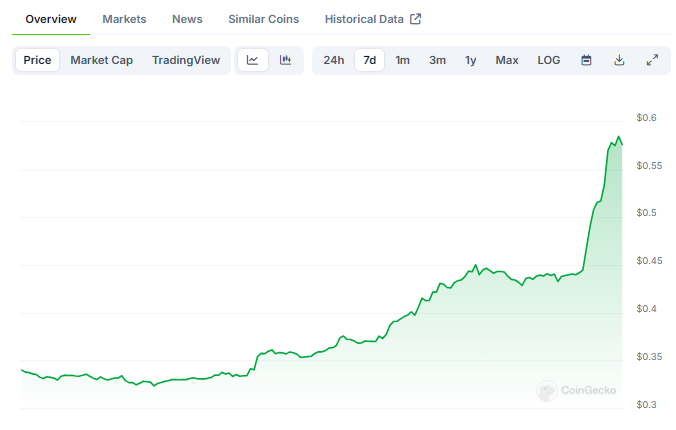
ADA price up nearly 70% in the last week. Source: Coingecko
As a result, Cardano once again ranked as the ninth-largest cryptocurrency and the seventh-largest if stablecoins are excluded from the rankings.
The analysts added that the coin’s current movement is similar to previous market cycles, such as Bitcoin’s halving events.
At the time of writing, ADA is being traded at $0.5804 and the cryptocurrency has a total market capitalization of more than $20 billion.
Featured image from Pumpmoonshot, chart from TradingView


Key Takeaways
- OKX invested in CAEX to meet Vietnam’s $380 million pilot requirement, advancing regulation.
- CAEX, backed by OKX and Hashkey, signals a shift to compliant platforms across Southeast Asia.
- OKX expands 2026 regulatory push after Malta license, as it aims to lead efforts in shaping Vietnam’s crypto market.
Vietnam’s CAEX Gains OKX Support for Regulated Crypto Push
OKX has taken a strategic stake in Vietnam’s CAEX exchange, positioning itself to support the country’s push toward regulated cryptocurrency trading.
The investment, made alongside local partners including VPBank Securities and LynkiD, as well as Hashkey Capital, will help CAEX meet the financial threshold required to participate in a government-backed pilot program. Vietnam has set a minimum capital requirement of $380 million (VND 10 trillion) for firms seeking to operate within the trial framework.
The partnership signals a growing alignment between global crypto firms and local operators as Southeast Asia moves toward clearer regulatory oversight.
Star Xu, Founder and CEO of OKX, wrote in a blog post, saying,
We expect most Southeast Asian markets to establish clear regulatory frameworks and licensing pathways for digital asset companies. This region is already one of the most important sources of global crypto liquidity. We believe the future of crypto will be built on regulated, local platforms that users can trust, and CAEX represents that future in Vietnam.”
CAEX, formally known as Vietnam Prosperity Crypto Asset Exchange Joint Stock Company, is expected to combine domestic market expertise with international infrastructure and compliance standards. OKX said it will contribute not only capital but also technical support across areas such as risk management, security systems, and liquidity provision.
The initiative comes as Vietnam explores a controlled rollout of digital asset trading under government supervision. While details of the pilot program remain limited, authorities have indicated a preference for well-capitalized and compliant platforms.
OKX’s involvement reflects its broader strategy of working within regulatory frameworks rather than operating outside them. The company has spent recent years securing licenses and approvals in multiple jurisdictions, including registration in the United States and regulated operations across Europe.
Earlier this year, OKX obtained a Payment Institution license in Malta, allowing it to expand crypto payment services across the European Union under established regulatory regimes. The exchange has also pursued approvals in markets such as Singapore and Dubai, where it has built localized platforms tailored to regulatory requirements.
Executives at OKX have framed compliance as central to long-term growth. The firm has increased investment in anti-money laundering controls, customer verification processes, and internal risk systems, aiming to meet institutional standards as the industry matures.
That experience is now being applied to emerging markets. In Vietnam, the focus is on building a platform that can operate within a formal regulatory structure while scaling user adoption.
The investment also reflects a broader shift in the crypto industry. As governments introduce clearer rules, trading activity is increasingly moving toward licensed venues. Market participants are placing greater emphasis on transparency, asset protection, and regulatory oversight.
Southeast Asia remains a key region in that transition, accounting for a significant share of global crypto liquidity. For Vietnam, the CAEX initiative represents an early step in that process. For OKX and its partners, it offers an opportunity to shape the development of a regulated market from the ground up.
If successful, the model could serve as a blueprint for other countries in the region, where demand for digital assets continues to grow alongside calls for stronger investor protections.


Key Takeaways:
- Bitcoin ETFs saw $358.17 million inflows on April 9, led by Blackrock IBIT, restoring momentum.
- Ether ETFs added $85.19 million as ETHA gained $90.94 million, showing selective but rising demand.
- XRP lost $661K while Solana saw no flows, suggesting capital is still fluctuating between altcoin ETFs.
Market Turns Decisively Positive for Bitcoin and Ether ETFs
No day is ever the same in the exchange-traded fund (ETF) market, and on Thursday, April 9, the tide turned again. This time, with force.
After a stretch of uneven flows and fading conviction, crypto ETFs snapped back into positive territory, delivering one of the week’s strongest sessions. The recovery was broad, decisive, and led by familiar names.
Bitcoin ETFs recorded a powerful $358.17 million in net inflows, marking a clean reversal from the prior day’s losses. Notably, every major fund contributed, and no outflows were recorded.
Blackrock’s IBIT once again dominated the field, pulling in $269.34 million, roughly three-quarters of total inflows. The scale of that contribution underscored its continued role as the market’s anchor. Fidelity’s FBTC followed with a solid $53.33 million, while Morgan Stanley’s newly launched MSBT added $14.87 million, building on its early momentum.
Further support came from Bitwise’s BITB with $11.73 million, Ark & 21Shares’ ARKB at $4.78 million, Vaneck’s HODL with $2.04 million, and Franklin’s EZBC at $2.08 million. Trading volume reached $1.99 billion, and net assets climbed to $93.29 billion.
Ether ETFs mirrored the rebound, though with a more mixed internal picture. The group posted $85.19 million in net inflows, driven by strong demand for select funds.
Blackrock’s ETHA led with $90.94 million, while its ETHB product added another $13.67 million, continuing its steady rise in investor preference. Grayscale’s Ether Mini Trust contributed $9.67 million.
Yet selling pressure persisted elsewhere. Fidelity’s FETH recorded a $20.98 million outflow, followed by 21Shares’ TETH with $5.53 million. Smaller outflows were seen in Franklin’s EZET at $1.68 million and Grayscale’s ETHE at $900,440. Despite these exits, inflows held firm. Trading volume came in at $831.08 million, with net assets closing at $12.69 billion.
Outside the majors, activity was limited. XRP ETFs posted a modest $661,160 outflow, entirely from 21Shares’ TOXR. Trading volume stood at $11.03 million, with net assets at $955.13 million.
Solana ETFs remained inactive for the session, with no recorded flows. Net assets held steady at $803.03 million.
The broader pattern is becoming clearer. Capital is returning, but it is concentrated. Investors are favoring scale, liquidity, and established names, particularly in bitcoin and select ether products. The market is not fully stable, but confidence is rebuilding in visible pockets.

Scarlet tanagers could earn official status in Pennsylvania
RI Lottery Mega Millions, Numbers Midday winning numbers for April 10, 2026

10 Cheapest Places to Live in South Carolina

Your next can of Coke might have Mount Rushmore on it

New strain of tuberculosis cases in Tennessee is resistant to treatment options

Florida High School Football Rankings: Top 25 teams – Oct. 21

How old is Bo Nix? What to know about Oregon quarterback ahead of 2024 NFL Draft

Cleary's 21 help Le Moyne down Central Connecticut State 69-64 in OT

99th annual Pony Swim held in Virginia

Indiana Members Credit Union announced as new anchor tenant at Bottleworks District

Trump adversary running for Senate borrows his filibuster playbook

Russian propaganda unit targets Hungary’s elections

WATCH: Artemis II astronauts splash down on Earth

Swalwell’s former female staffer drops bombshell allegations of sexual assault, exposing himself: report

NASA’s Artemis II prepares for splashdown on Earth
-

 Atlanta, GA6 days ago
1 teenage girl killed, another injured in shooting at Piedmont Park, police say
-

 Education1 week ago
Video: Toy Testing with a Discerning Bodega Cat
-

 Movie Reviews1 week ago
Vaazha 2 first half review: Hashir anchors a lively, chaos-filled teen tale
-

 Georgia4 days ago
Georgia House Special Runoff Election 2026 Live Results
-

 Pennsylvania5 days ago
Parents charged after toddler injured by wolf at Pennsylvania zoo
-

 Arkansas21 hours ago
Arkansas TV meteorologist Melinda Mayo retires after nearly four decades on air
-
 Milwaukee, WI5 days ago
Potawatomi Casino Hotel evacuated after fire breaks out in rooftop HVAC system
-
 Entertainment1 week ago
Inside Ye’s first comeback show at SoFi Stadium